I don’t think there’s much to say here. I distinctly remember when the music video came out two years later for the song Riding With The King. This one went under my radar. According to mvdbase, B.B. King actually made three music videos back in the mid-80s under the direction of John Landis. This music video is sad, which is appropriate since the song is too. I also like that they paired King with Chapman considering one of her most famous songs is Give Me One Reason, which she would later go on to do as a duet with Eric Clapton for the A Very Special Christmas Live album. Clapton having done Riding With The King with B.B. King. It all connects together.
The last thing I want to mention is that B.B. King didn’t originally do this song. It was written by Roy Hawkins and Rick Darnell in 1951. I have embedded Hawkins’ version below as a way to work him in even though he never did a music video to my knowledge.
The video was directed by Thom Oliphant. He appears to have done around 30 music videos. He went on to produce and direct a lot CMT specials.
Giles Dunning shot the video. He has shot around 35 music videos and directed 2 of them. He went on to do some music and TV work after this video such as for the LCD Soundsystem concert film Shut Up And Play The Hits (2012). But, you’ve probably seen his camerawork that he did prior to this video. He worked on A Nightmare On Elm Street 3: Dream Warriors (1987), Friday the 13th Part VII: The New Blood (1988), A Nightmare On Elm Street 4: The Dream Master (1988), Pet Sematary (1989), A Nightmare On Elm Street 5: The Dream Child (1989), Ghoulies Go To College (1991), Critters 3 (1991), Critters 4 (1992), and for some non-horror ones, he also worked on Pump Up The Volume (1990) and A River Runs Through It (1992). Oh, and he also worked on Rockula (1990) since I apparently am unable to escape that movie since I reviewed it during October of 2015.
It has been 17 years since Tom Hanks was last nominated for Best Actor.
When I discovered this fact, I was shocked because Tom Hanks is one of those actors who has a reputation for always getting nominated. We tend to think of him as almost being a male Meryl Streep, an actor who will be nominated simply for showing up. But, actually, the Academy last nominated Tom Hanks, for his performance in Cast Away, in the year 2000.
Hanks has given plenty of strong performances since then and he’s continued to appear in acclaimed and Oscar-nominated films. And you would think, considering his apparent popularity in Hollywood, Tom Hanks would have been nominated for everything from Charlie Wilson’s War to Bridge of Spies. But no.
Personally, I think Hanks should have been nominated this year for Sully. But you know what Hanks performance truly deserved some Oscar recognition?
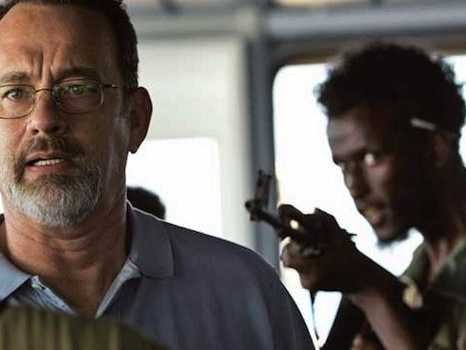
Captain Phillips.
Playing the title role in this 2013 Best Picture nominee, Hanks gave perhaps the best performance of his career. That he was snubbed by the Academy is not only shocking but it’s actually a bit unforgivable. Perhaps Hanks was so good that the Academy took him for granted. Perhaps they thought that since both Hanks and Richard Phillips are decent, down-to-Earth guys, that Hanks was just playing himself. For whatever reason, Tom Hanks deserved, at the very least, a nomination.
Captain Phillips was based on a true story. This is another docudrama from director Paul Greengrass, filmed in his signature (and potentially nausea-inducing) handheld style. (Actually, if any aspiring director wants to understand how to effectively use the handheld style, Greengrass is the filmmaker to study.) In 2009, a four Somali pirates hijacked the Maersk Alabama and took its captain, Richard Phillips, hostage. Captain Phillips was eventually rescued by a group of Navy SEALS. Three of the pirates were killed while their leader, Muse (Barkhad Abdi), was captured and is currently serving a 33 year sentence in a federal penitentiary.
This was a huge news story in 2009 with the rescue being described as being the first major foreign policy victory for the new presidential administration. When Phillips was rescued, people took to the streets and the “USA! USA!” chant was heard. “That’s right,” the media and the government and the chanters seemed to be exclaiming in unison, “America’s back! We were abused and it’s never going to happen again!”
A lot of that jubilation was because, at the time, the term “Somali pirates” conjured up visions of cinematic villains who would be more at home in Mad Max: Fury Road than in the real world. The reality of the situation, of course, was that the “pirates,” whose deaths were celebrated as some sort of political victory for the government, were actually poverty-stricken Somali teenagers, the majority of which worked for warlords who remained (and still remain) safely hidden away.
One of the more interesting things about Captain Phillips is that it devotes almost as much time to the Somali pirates as it does to Phillips and his crew. Rather than presenting them as a nameless and personalityless threat, the film allows Muse and his men to emerge as individuals. Much as Phillips spends the movie trying to keep both himself and his crew safe, Muse spends much of the movie trying to keep an increasingly out-of-control situation stable. Both Phillips and Muse are in over their heads. Barkhad Abdi gives a smart and intimidating performance as Muse. The film never makes the mistake of excusing the actions of Muse or the other pirates but, at the same time, it does provide a more nuanced view of them than one would normally expect.
But really, this film totally belongs to Tom Hanks. Captain Phillips works because of Tom Hanks. It earned its best picture nomination on the strength of Hanks’s performance. As an actor, Hanks could have easily coasted on the good will that the audience would have already had for him but instead, he fully commits himself to playing not Tom Hanks but instead Captain Richard Phillips. The film’s final scene — in which Phillips goes into a state of shock and can’t stop talking — is a masterclass in great acting. How the Academy ignored it, I will never understand.
Captain Phillips was nominated for best picture of 2013. However, it lost to 12 Years a Slave.
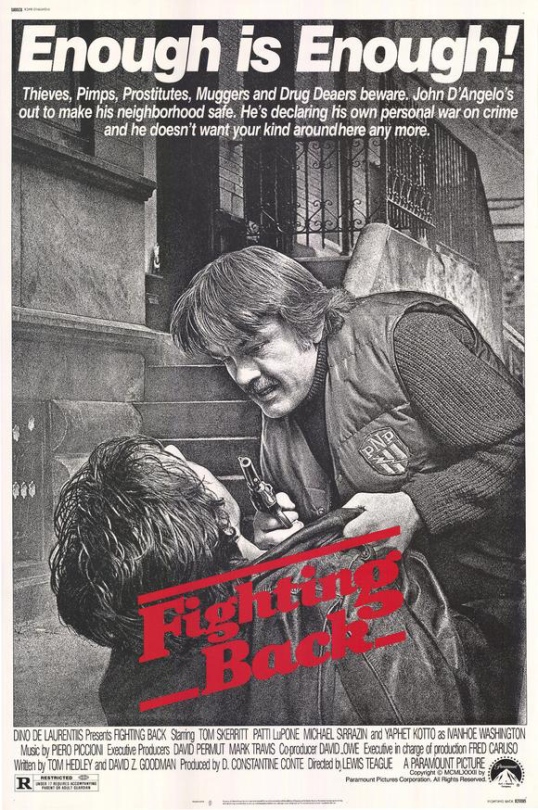
The time is 1982. The place is Hell on Earth, also known as Philadelphia. Crime is out of control and the police are powerless to stop it. When deli owner John D’Angelo (Tom Skerritt) and his wife, Lisa (Patti LuPone), confront a pimp named Eldorado (Pete Richardson), he rams his car into the back of their car, causing the pregnant Lisa to lose her unborn child. At almost the exact same time, John’s mother (Gina DeAngles) is mugged by two thugs who chop off her ring finger.
In the grand tradition of Charles Bronson, John decides to fight back. But he doesn’t go it alone. With his best friend, a police officer named Vince (Michael Sarrazin), John starts the People’s Neighborhood Patrol. The PNP is going to clean up Philadelphia, one street at a time. The media (represented by David Rasche) make John into a celebrity. The black community (represented by Yaphet Kotto) suspect that John and the PNP are guilty of racial discrimination. The Mafia wants to bring John over to their side. John runs for city council but he still has time to drop a grenade in a pimp’s car.
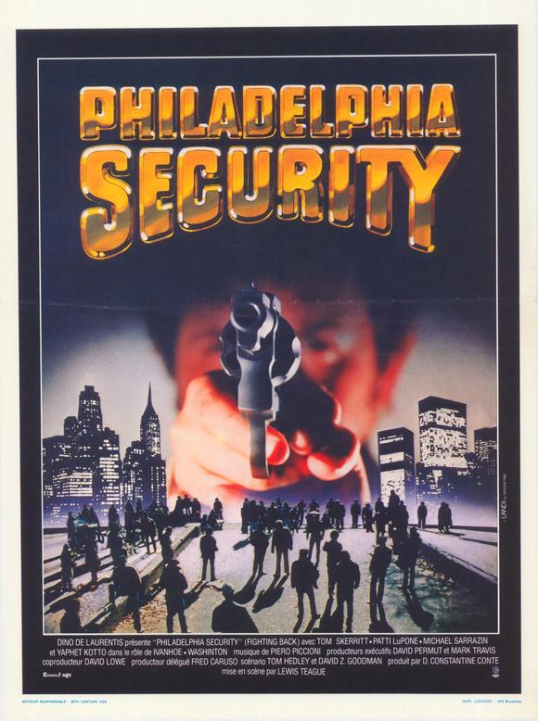
Fighting Back was one of the many urban vigiliante films to come out after the success of Death Wish. Fighting Back‘s producer, Dino De Laurentiis, also produced Death Wish but made the mistake of later selling the rights to Cannon. Fighting Back was not the box office success that either Death Wish or its sequels were, even though Fighting Back is actually the better movie. That’s because Fighting Back was directed by the underrated Lewis Teague. Teague does a good job of making Philadelphia look like a war zone and the scenes of vigilante justice are enjoyable but, overall, Teague takes a far more ambiguous approach to vigilantism than Michael Winner did when he directed Death Wish. As vile as Philadelphia criminals may be, John D’Angelo isn’t always that likable himself. When Kotto accuses John and the all-white PNP of being racially prejudiced, Teague suggests that he has a point. Tom Skerritt gives a good performance, playing John as a proud, blue collar guy who wants to do the right thing but gets seduced by his newfound celebrity.
Better acted than Death Wish and smarter than The Exterminator, Fighting Back is an underrated vigilante gem.
Fighting Back is also known as Philadelphia Security and Death Vengeance.
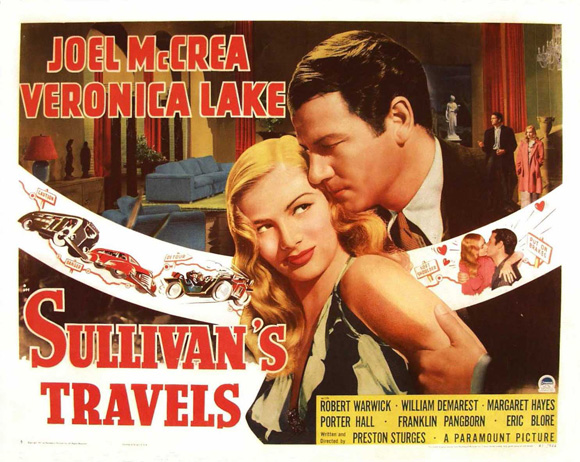
I’m no expert on Preston Sturges, having seen only two of his films, but after viewing SULLIVAN’S TRAVELS I now have a craving to see them all! This swift (and Swiftian) satire on Hollywood stars Joel McCrea as a successful slapstick comedy director yearning to make important, socially conscious films who gets more than he bargained for when he hits the road to discover what human misery and suffering is all about.
John L. “Sully” Sullivan sets his studio bosses on their collective ear when he tells them he wants to film an adaptation of ” O Brother, Where Art Thou?”, a serious novel by ‘Sinclair Beckstein’. The head honcho balks, wanting Sully to do another comedy, but Sully’s not dissuaded, deciding to see what life among the downtrodden is first-hand. He dresses in rags and sets out on his quest, followed by a gaggle of PR flacks in a bus. Somehow he…
Sorry I didn’t get this post up yesterday. I stupidly set the computer I realistically can only do these posts from to perform an all day and all night task that was both CPU and I/O intensive on Sunday. The last time I tried to interrupt it while doing something like that to do just about anything, the computer glitched out to you-need-to-restart-me levels. I was going to let it go. Of course, Lisa noticed, and jumped into action. I think a thank you goes without saying, but thank you nonetheless.
Okay, so it’s Black History Month. I already did Funkadelic last week. I hope to get in a variety of black artists this month. If I can, I am going to try to do one from all sorts of different genres, along with a few legends that I can find made it into some music videos despite their age. Doing nothing but rap would kind of miss the point of the month. Unfortunately, I can’t find a music video from country artist Charley Pride. Maybe I’ll find a way of sneaking him in anyways as a bonus on another post.
Up till now, I have hit Beastie Boys, N.W.A., and Run-D.M.C. That leaves me with just Public Enemy and Salt-N-Pepa in order to really hit the major groups of what I call the second-wave of post Rapper’s Delight rappers. The very first rap song I remember memorizing was Shoop. I learned it while I was in elementary school, and would have the lyrics playing on an endless loop in my head. Which of course is why I am not doing Shoop, but Push It instead.
The first thing I want to get out of the way is that director Ted Demme is the nephew of Jonathan Demme. This video is Demme’s first music video after starting Yo! MTV Raps, according to a quote from editor Glen Lazzaro on mvdbase.
Now lets get to the obvious. Salt-N-Pepa are known for songs about sex. In 1991 they would do a music video for their song Let’s Talk About Sex and would even follow that up a year later with the song called Let’s Talk About AIDS. That makes the GEICO commercial they did using this song especially perfect and extra hilarious. This early song talking about sex would, without changing anything, become a song about pushing one of the possibilities of sex back out of what this song was talking about putting something into. You have to love that. In fact, Let’s Talk About Sex brings up the possibility of pregnancy if you don’t practice safe sex, so it fits that they would be singing this song in a birthing class at one point.
According to mvdbase, this video was recorded live. It’s a pretty standard stage performance all things considered. You can tell that Demme, like his brother, knew the artists he was filming, and catered it to their style. There’s a little Easter Egg in here. At about 3 minutes and 9 seconds, you can see that they tilted the frame upwards toward the right.
Tom Demme would go on to direct a couple other feature films before passing away in 2002 at the age of 38.
James Neihouse was the assistant cameraman on this and at least two other music videos. He has gone on to do a fair amount of work as a cinematographer. It looks like a lot of them are documentaries such as those you would see on the Discovery Channel.
Glenn Lazzaro has done some work outside of music videos, but they seem to have been his primary thing. He has edited somewhere between 75 and 80 music videos. Not small ones either. We’ll see his work again. In fact, I guarantee we’ll see his work again come March Madness.
With that in mind, I recently watched the 1928 film In Old Arizona. In Old Arizona is a bit of an oddity in Oscar history. Even though it is considered to have been a best picture nominee, it was never officially nominated. In fact, in 1929, there were no official nominees. Instead, the Academy simply announced the names of the winners. The winners were selected by a small committee of judges. The committee’s intentions are particularly obvious when you notice that not one film won more than one Oscar in 1929. At a time when the industry was struggling to make the transition from silent film to the talkies, the 1929 Oscars were all about spreading the wealth and reassuring everyone that they were doing worthwhile work. In Old Arizona‘s star, Warner Baxter, was named the year’s best actor while Broadway Melody was declared to have been the best picture.
(At that year’s Oscar ceremony, the second in the Academy’s history, the awards were reportedly handed out in 10 minutes and nobody gave an acceptance speech. If this all seems strange when compared to the annual extravaganza that we all know and love, consider that Louis B. Mayer originally formed the Academy in order to give the studio bosses the upper hand in a labor dispute. The awards were largely an afterthought.)
Years later, Oscar historians came across the notes of the committee’s meeting. The notes listed every other film and performer that the committee considered. Before settling on Broadway Melody, the committee apparently considered In Old Arizona. For that reason, In Old Arizona is considered to have been nominated for best picture of the year.
If it seems like I’ve spent a bit more time than necessary discussing the history behind the 1929 Oscars, that’s because In Old Arizona isn’t that interesting of a film. It was a huge box office success in 1929 and it was an undeniable influence on almost every Western that followed but seen today, it’s an extremely creaky film. Influential or not, there’s not a scene, character, or performance in In Old Arizona that hasn’t been done better by another western.
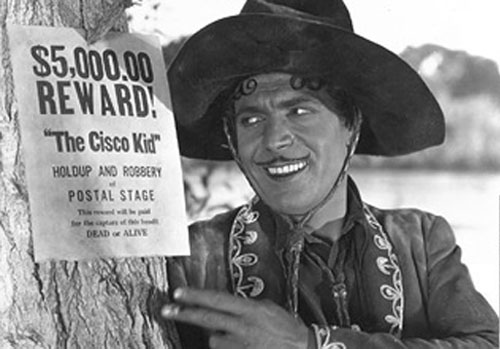
Based on a story by O. Henry, In Old Arizona tells the story of a bandit named The Cisco Kid (Warner Baxter). Cisco may be an outlaw but he’s also a nice guy who enjoys a good laugh and occasionally sings a song while riding his horse across the Arizona landscape. (California and Utah stood in for Arizona.) The Cisco Kid may rob stagecoaches but he always does it with a smile. Besides, he only needs the money so that he can give gifts to his girlfriend, Tonia (Dorothy Burgess). What the Cisco Kid doesn’t know is that Tonia is bored and frustrated by his frequent absences and she has been cheating on him. Then she’s approached by Sgt. Mickey Dunn (Edmund Lowe), the big dumb lug who has been ordered to bring the Kid in (dead or alive, of course). Will Tonia betrayed the Kid?
If you’re watching In Old Arizona and hoping to be entertained, you’ll probably be disappointed. Almost everything about this film has aged terribly. Watching the film, it’s obvious that none of the actors had quite figured out how to adapt to the sound era and, as such, all of the performances were very theatrical and overdone. Probably the easiest to take is Edmund Lowe, who at least managed to deliver his lines without screeching. Sadly, the same cannot be said of Dorothy Burgess. As for Warner Baxter, he may have won an Oscar for playing the Cisco Kid but that doesn’t make his acting any easier to take.
And yet, if you’re a history nerd like me, In Old Arizona is worth watching because it really is a time capsule of the era in which it was made. In Old Arizona was not only the first Western to ever receive an Oscar. This was also the first all-talking, all-sound picture. Watching it today, without that knowledge, you might be tempted to wonder why the film lingers so long over seemingly mundane details, like horses walking down a street, the ticking of a clock, a baby crying, or a church bell ringing. But, if you know the film’s significance, it’s fun to try to put yourself in the shoes of someone watching In Old Arizona in 1929 and, for the first time, realizing that film could not just a visual medium but one of sound as well. For some members of that 1929 audience, In Old Arizona was probably the first time they ever heard the sound of a horse galloping across the landscape.
(I have to admit that, as a student of American history, I couldn’t help but get excited when one of the characters mentioned President McKinley. McKinley may be forgotten today but audiences in 1929 would not only remember McKinley but also his tragic assassination. By mentioning that McKinley was President, In Old Arizona not only reminded audiences that it was taking in the past but that it was also taking place during what would have been considered a more innocent time. Much as how later movies would use John F. Kennedy as a nostalgic symbol of a more idealistic time, In Old Arizona uses William McKinley.)
In Old Arizona is no longer a particularly entertaining film but, as a historical artifact, it is absolutely fascinating.
A U.S. spy satellite has crashed onto an uninhabited island in the Pacific Ocean. Both the United States and an unnamed communist country (described as being “a fifth-rate China,” but obviously meant as a stand-in for not only China but North Korea and North Vietnam as well) have both lay claim to the satellite. To prevent a possible war, the two countries agree to a compromise. One American and one communist will be dropped off on the island and will fight to the death. The survivor gets the satellite. The communists send the disciplined Yuro (Mako). The American select Jacob Galley (Darren McGavin), a grizzled Vietnam veteran-turned-mercenary. Jacob is armed with the latest advancements in weaponry, including a double-barreled sub-machine gun. Yuro is armed mostly with his wits and an endless supply of booby traps. Jacob and Yuro fight to a stand still, growing to respect each other even as each tries to kill the other. However, both countries are willing to cheat to win the challenge.
Originally made for television, this is one of the many films to have been credited to Alan Smithee, the pseudonym that directors used to use whenever they felt that the finished film, usually because of studio interference, did not properly represent their vision. According to the imdb, The Challenge was actually directed by veteran television directed George McGowan, whose other credits includes episodes of shows like Fantasy Island, Starsky and Hutch, and Charlie’s Angels. I am surprised that McGowan chose to take his name off of The Challenge because, for a television movie, it’s not bad. The Vietnam analogy is laid on a little thick but the action is exciting and both McGavin and Mako give excellent performances as the two very different combatants.
The Challenge can be viewed on YouTube. Keep an eye out for a very young Sam Elliott, in the role of America’s insurance policy.
I admit I didn’t pay much attention to the ads during last night’s nail-biting Super Bowl, but this one caught my eye. A rowdy gang of bikers are partying hardy, when one comes in and tells his brothers they’re “Blocked in!”. The gang goes outside ready for action, when they see a shiny new Mercedes AMG GT Roadster. Who’s driving? None other than Mr. Easy Rider himself, Peter Fonda! The ad was directed by the Coen Brothers, and as we say in New England, it’s “wicked funny”! Enjoy!
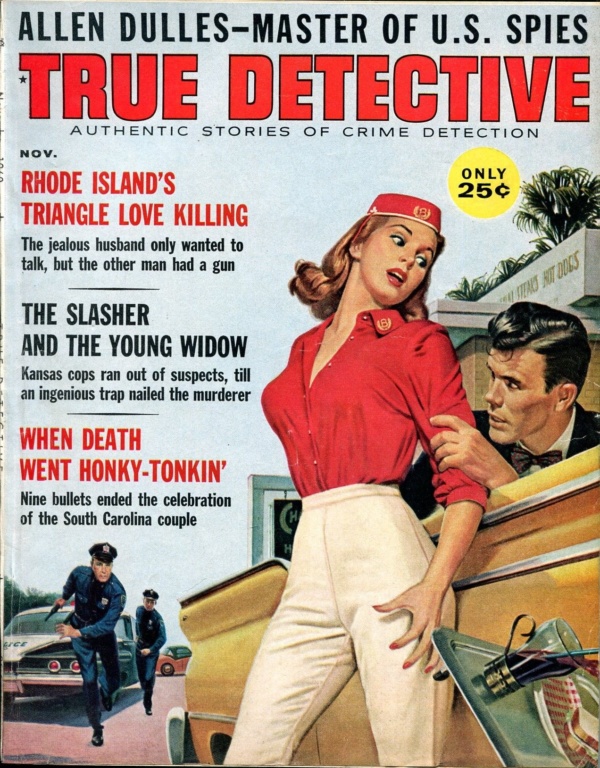
Long before it lent its name to HBO, True Detective was one of the most popular of all the pulp magazines. Founded in 1924, the American version of True Detective was published for 71 years, while the British version is still going! True Detective started out publishing a mix of crime fiction and nonfiction. Eventually, fiction was phased out and True Detective became the first “true crime” magazine.
Over 71 years, there were many covers that were painted by many different artists, some well-known and others forgotten. Below is a small sampling of the True Detective covers:






 Through the Shattered Lens