International Weirdness : “The Pack”


Ryan C. (fourcolorapocalypse)'s avatarTrash Film Guru

The-Pack-Movie-Poster

Late last night my seemingly endless quest to find you, dear reader, the at-least-occasional undiscovered gem among current Netflix horror offerings brought me to a mostly-unassuming, quite-obviously-low-budget Australian indie number from 2015 entitled The Pack (which I’m guessing is probably also available on Blu-ray and DVD if you must go that route), the brainchild of director Nick Robertson and his screenwriter, one Evan Randall Green, that marks yet another entry in the “nature’s fury unleashed, subgenre : wild dogs” category that we see from time to time and that, let’s be brutally honest, probably has nothing especially new, per se, to offer audiences. But hey — that doesn’t mean that it can’t tread its patch of well-worn ground reasonably effectively, does it?

the-pack-fb12

The premise here is about as basic as you’d expect : struggling family farmer Adam Wilson (played with requisite stoicism by Jack Campbell) and his supportive-perhaps-to-a-fault…

View original post 445 more words

Cleaning Out The DVR, Again #26: The Maid (dir by Darin Scott)


(Lisa is currently in the process of trying to clean out her DVR by watching and reviewing all 40 of the movies that she recorded from the start of March to the end of June.  She’s trying to get it all done by July 11th!  Will she make it!?  Keep visiting the site to find out!)

The-Maid-window-620x369

The 26th film on my DVR was The Maid, which I recorded off of Lifetime on May 28th.

According to the imdb, The Maid is also known as A Housekeeper’s Revenge.  Regardless of which one you go with, both titles reveal this to be a Lifetime film.  That’s one thing that I always find interesting about Lifetime films — everyone always has a beautiful house and, naturally, everyone always has either a maid or a housekeeper.  I guess I find it interesting because very few of the people I know can afford to have a full-time maid, though I did once date this guy who was going to SMU where the school’s motto might as well be, “Our maid went to UT.”  When you get down to it, there are very few Lifetime films about poor people, unless the film is about somebody overcoming poverty so that they can go to Harvard or marry a professional athlete.

And I’m not complaining!  Lifetime is all about crowd-pleasing entertainment and, for the most part, we would all love to live in a big house with a great kitchen.  I know that most people would want to have a housekeeper or a maid.  Not me, though.  I like cleaning.

Anyway, in the case of this film, the maid is Colleen (Fay Masterson).  Colleen has just been hired to work for the Blackwell family!  Paul Blackwell (Lance Irwin) has just married a woman who is several years younger than him and, while they’re on their honeymoon, Paul’s angry, college student daughter, Laura (Kathryn Newton), has been left alone in the house with Colleen.  What could go wrong, right?

Well, a lot could go wrong.  If nothing went wrong, it would be a very boring movie.  Laura has had some trouble back at college.  Her boyfriend apparently got really possessive and then Laura started to receive threatening emails.  Even after returning home after her father’s wedding, strange things continue to happen.  Someone hacks into Laura’s Facerange (to use the Degrassi equivalent of Facebook) account and changes her password.  Someone is passing out flyers that announce that Laura’s a slut.  Her dog mysteriously disappears…

Could it be Laura’s ex or it could be … THE MAID!?

It turns out that Colleen has secrets of her own.  Her developmentally disabled son committed suicide, shortly after one of his high school classmates stood him up on a date.  Is it possible that Colleen is trying to destroy Laura?

Of course, it’s possible…

The Maid is pretty much a standard Lifetime film but that’s why I enjoyed it.  This is one of those totally over-the-top films where everyone is either bitter or crazy or both.  You won’t believe the plot for a second but you’ll be having so much fun with all the melodramatic twists and turns that it won’t matter.  Fay Masterson especially deserves a lot of credit for fully committing herself to playing the title character.  When she glares at the rich people that she’s planning on destroying, you never forget it.

And don’t worry,  It’s a made-for-TV movie so you know the dog’s going to be okay.

574c96e639ced_283985n


Music Video of the Day: We Didn’t Start the Fire by Billy Joel (1989, dir. Chris Blum)


Since I did Pearl Jam’s Do the Evolution yesterday, I thought I’d go back about 10 years to when Billy Joel did something similar. His music video didn’t focus on the worst of humanity, but more like a condensed version of The Wonder Years if it spanned many decades. As the decades fly by, it has Billy Joel in the very fake house looking like he couldn’t care less as he plays with drumsticks or a slinky while the people around him are oblivious to him being there. A very “been there, done that” attitude to what is new to the people in the house. Also, a person waiting for what they know is coming. The titular fire that will leave the house burnt.

I’m sure it was no mistake that they had Joel dressed as the man in black throughout this video. That of course being a reference to Johnny Cash’s song Man in Black. It’s probably why when we get the portions that are devoted to Billy alone at a table with a fire behind him, there is often a disturbing picture behind that fire that stands in contrast to the events inside the house.

I love how at the end, it flashes back over the decades, and the studio that was the house is left exposed just as Mom looks over at Billy for the first time now that she has caught up to his time. We are left with a final shot of the couple from the beginning leaving the house as they entered, just before Joel, sitting at the table, suddenly disappears. Yes, I’m sure the couple is a reference to Brenda and Eddie from Billy Joel’s song Scenes from an Italian Restaurant. In a way, you could call this music video a companion piece to that song.

I’m not sure if the music video is a positive or negative look towards the future. It comes across to me as reminder that a destructive force is always at our backs. It’s not necessarily destroying humanity as a whole, but it does destroy the world as we know it with each passing year as it does the house the people inside thought would never change when they were in the moment. It’s also a force that burns down the walls dividing fantasy from the reality of that room Joel sits inside at a table, or does it?

This is one of those music videos where we not only know the director, but some more people who worked on it. I was kind of hoping to avoid him for a little bit since it’s such a cliche to mention him this early. Unfortunately, he was one of the producers on this music video. That person being prolific music video, feature film, and TV director Russell Mulcahy. You could argue that he invented what we know as the fully-formed music video. He was making them back in the 1970s and even directed Video Killed the Radio Star by The Buggles that kicked off MTV back in 1981. I’m sure we’ll see him again.

Cleaning Out The DVR, Again #25: Chang (dir by Merian C. Cooper and Ernest Schoedsack)


(Lisa is currently in the process of trying to clean out her DVR by watching and reviewing all 40 of the movies that she recorded from the start of March to the end of June.  She’s trying to get it all done by July 11th!  Will she make it!?  Keep visiting the site to find out!)

Chang_poster

Before I talk about the 1927 oddity Chang (which also happened to be the 25th film on DVR), here’s a little Oscar history.  If this sounds familiar, it’s probably because I already talked about all this in my review of Sunrise but there’s nothing wrong with repeating a history lesson, right?

At the first Oscar ceremony, two awards were given for Best Picture of the year.  The first award — for Outstanding Production — went to Wingsa big budget action spectacular about World War I.  The other award — for Unique And Artistic Presentation — went to Sunrise.  I’ve read a lot of speculation about which film the Academy meant to name the best of the year but, to me, it’s fairly obvious that the Academy meant for Outstanding Production to honor the year’s big blockbusters while Unique and Artistic Presentation would honor the “art” films.

And, to be honest, I think that, way back in 1928, the Academy had the right idea.  Why should they only give out one award for best picture, as if all films can be judged by only one standard?  Why not give out separate awards for the best comedy or the best thriller or the best film made for a certain amount of money?  Why not bring back the Oscar for Unique and Artistic Presentation?

For whatever reason, the Academy discontinued the Unique and Artistic Presentation Award after the 1st ceremony and, in the future, only one film would be named best of the year.  Since Outstanding Production eventually become known as Best Picture, Wings has been immortalized as the first film to win best picture.

One of the films that Sunrise defeated was Chang.  If, like me, you accept the idea that the Unique and Artistic Presentation Award was meant to be a second award for best picture, then that means that Chang might possibly be the only documentary ever nominated for the top prize.  I say possibly because 1) some people would probably argue that Hollywood Revue should be considered a documentary as well and 2) it’s debatable whether or not Chang actually qualifies as a documentary.

Clocking in at only 67 minutes, Chang is a nearly plotless look at the life of a farmer in what is now Thailand and what was then called Siam.  Kru the farmer plays himself and the film follows him as he takes care of his family, builds a house, and deals with the constant threat of wild animals.  The animals are really the main stars of Chang and, all these years later, some of the footage is still impressive.  (There’s a scene in which a tiger literally bumps his nose against the camera lens, which I imagine was a huge deal for audiences in the pre-YouTube, pre-television days of 1927.)  However, despite the use of real wild animals and all the villagers playing themselves, it’s also obvious that several of the scenes have been staged.   Chang itself never claims to be a documentary and, in fact, one of the title cards even announces that Chang is “a drama of the wilderness.”

Yes, there are title cards.  Chang is a silent film and, to really appreciate it, modern viewers have to be willing to adjust.  That said, I actually enjoyed the fact that it was silent.  The title cards were all either endearingly portentous or surprisingly witty.  I especially enjoyed the “ROAR!” title card that popped up whenever a tiger appeared.

In many ways, Chang serves as a precursor for the original King Kong, which was directed by the same team behind Chang, Merian C. Cooper and Ernest Schoedsack.  If it can be argued that King Kong forever changed the course of American filmmaking, it can also be argued that, without the success of Chang, there would have been no King Kong.

(Another interesting bit of trivia: Chang reportedly only cost $60 to shoot.  Apparently, neither Kru nor any of the other villagers were paid for starring in a movie.)

Chang is something of an oddity but I’d still recommend seeing it.  It is a piece of history after all!

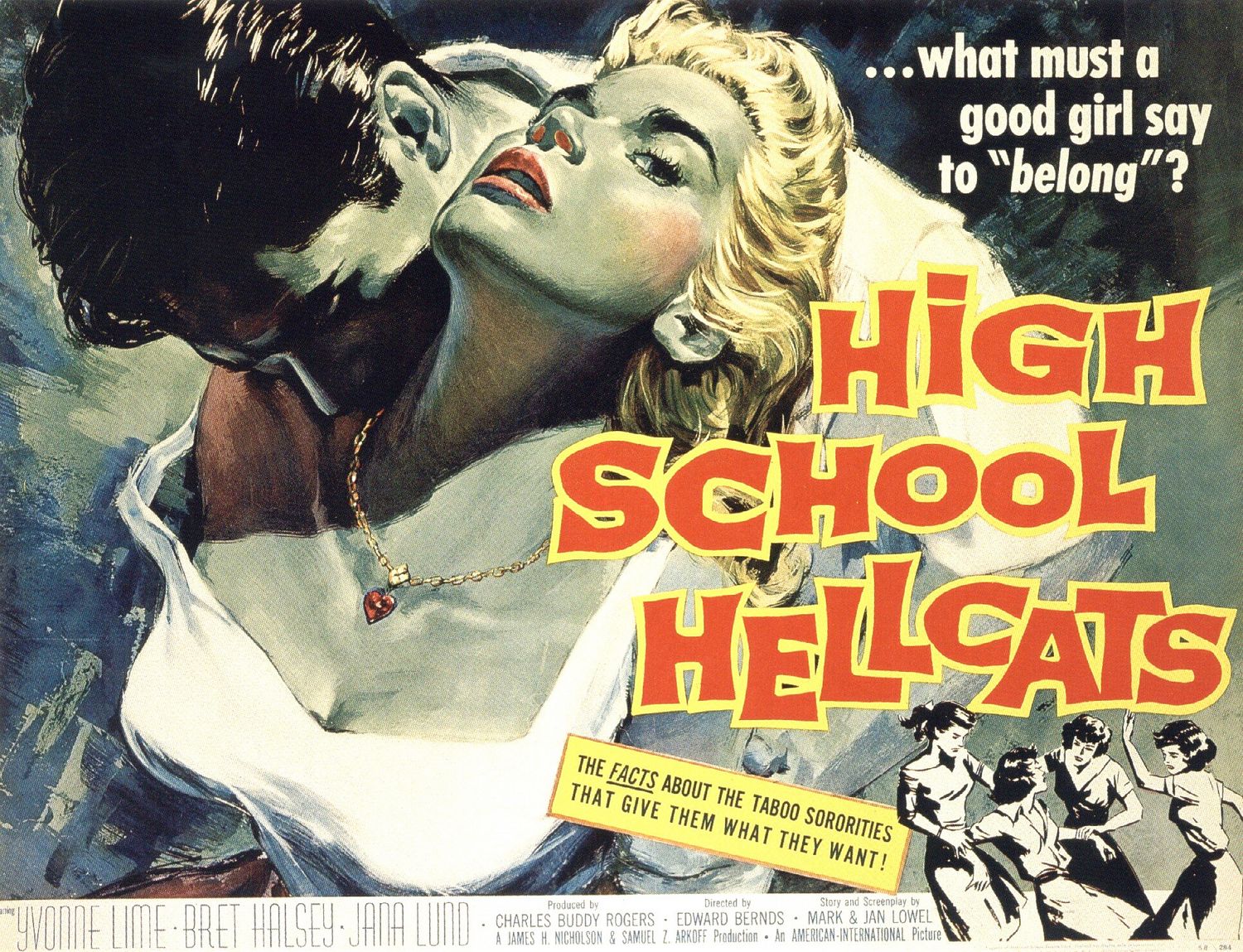
Youth Run Wild!: HIGH SCHOOL HELLCATS (AIP 1958)


gary loggins's avatarcracked rear viewer

hellcats1

One of the most popular 50’s exploitation subgenres was the “Teenage Girl Gang” movie,  with titles like THE VIOLENT YEARS (script by Ed Wood ) and Roger Corman’s TEENAGE DOLL. The plots are pretty much interchangeable: rebellious high school chick, misunderstood by her parents, falls in with the wrong crowd. Soon she’s smoking butts, drinking booze, stealing, staying out late. There’s usually a wild party where something bad happens, and our heroine is placed in peril. If you’re into exploitation flicks, you’ll immediately recognize the storyline, and it’s reused again here to good advantage in HIGH SCHOOL HELLCATS.

hellcats2

Our heroine here is Joyce, the new kid at High School USA. Joyce’s parents just don’t understand her: mom’s always out playing bridge, and dad is just a prick. Joyce longs to be accepted, and is invited to join the Hellcats by anti-social Connie, a rebellious vixen whose attitude seems to be fuck the adult…

View original post 855 more words

Cleaning Out The DVR, Again #24: Bloody Mama (dir by Roger Corman)


(Lisa is currently in the process of trying to clean out her DVR by watching and reviewing all 40 of the movies that she recorded from the start of March to the end of June.  She’s trying to get it all done by July 11th!  Will she make it!?  Keep visiting the site to find out!)

BloodyMama

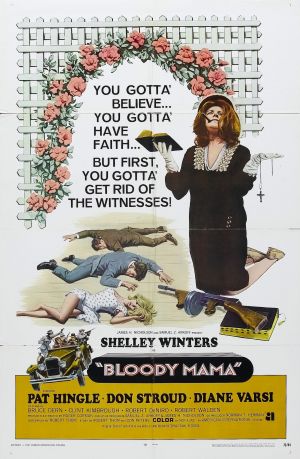
The 24th film on my DVR was the 1970 Roger Corman-directed gangster film, Bloody Mama.  I recorded it off of TCM on May 27th.

Bloody Mama opens with a cheerful song that goes, “Maaaaaama…Bloody maaaaama….” and it’s such an unapolegetically over the top song that it perfectly sets the tone for what’s to follow.  Bloody Mama is violent, occasionally perverse, and totally unashamed.  It doesn’t pretend to be anything that it isn’t.  It’s bloody and it’s about a mother and, in the best Corman tradition, it makes no apologies!

The film tells the heavily fictionalized story of the Barkers, a group of brothers who robbed banks and killed people in the 1920s and 30s.  The majority of them were killed in a gunfight with the FBI.  Also killed in the gunfight was their mother, Kate Barker.  Always aware of the danger of bad publicity, the director of the FBI, J. Edgar Hoover, announced that Ma Barker was actually the mastermind of the Barker gang and that she was even more dangerous than her sons.  Ever since, historians have debated whether Ma Barker was the criminal mastermind described by Hoover or if she was just the innocent woman described by … well, by everyone who actually knew her.

Bloody Mama, of course, leaves no doubt.  From the minute that we discover that Shelley Winters will be playing Ma Barker, we know that she’s the most dangerous woman alive.  As played by Winters, Ma Barker is a ruthless bank robber, one who has no fear of gunning down innocent bystanders and who never lets her love for her sons get in the way of ordering them to kill a witness.  As opposed to a lot of gangster films made in the late 60s and early 70s, the film never attempts to portray its title character as being a heroic or particularly sympathetic character.  Instead, what makes the character compelling is just how thoroughly Winters commits to the role.  It doesn’t matter what Ma Barker is doing or saying, Shelley Winters totally sells it.  When the gang is cornered by the police and one associate makes the mistake of yelling that he’s not a Barker, Ma reacts by gunning him down herself and you can’t help but appreciate the lengths that Ma will go to defend her family’s name.

As for her sons, they are an interesting group of perverts and drug addicts and they’re played some of the best character actors of the 1970s.

Herman Barker (Don Stroud) is a sadist but he’s also one of Ma’s favorites.  He travels with a prostitute (played by Diane Varsi), who quickly tires of the Barkers’s violent way of life.

Arthur Barker (Clint Kimbrough) is the most practical of the Barkers and therefore, he’s also the least interesting.

Fred Barker (Robert Walden) is bisexual, which is a fact that the film handles with all the sensitivity that we’ve come to expect from a film made in 1970 (which is to say, not much at all).  Fortunately, Fred’s lover is Kevin and Kevin is played by Bruce Dern and Bruce Dern is always a lot of fun to watch, especially when he’s appearing in a Corman film.

And then there’s Lloyd who sniffs glue and shoots heroin and who is played by an obscure young actor named Robert De Niro and … wait, Robert De Niro!  That’s right!  One of the pleasures of Bloody Mama is getting to see De Niro at the start of his career.  Unfortunately, he doesn’t really get to do much, though he does occasionally flash the same unhinged smile that would later show up in Taxi Driver.

Roger Corman has repeatedly cited Bloody Mama as being one of his favorites of the many movies that he directed over the course of his long career.  I don’t blame him.  It’s a thoroughly shameless and totally entertaining film!

Keep an eye out for Bloody Mama!

Just remember, the real-life Ma Barker was probably innocent.

Music Video of the Day: Do the Evolution by Pearl Jam (1998, dir. Kevin Altieri & Todd McFarlane)


You may or may not remember that for a while there Pearl Jam stopped making music videos. I don’t recall off the top of my head if they refused to be in them, or had a blanket ban on having them made using their music. I have to imagine that they totally stopped. I say that they probably stopped entirely because of a famous band from the 80s and several of their videos that they made, but refused to be in themselves. Luckily, Eddie Vedder came to his senses by at least 2002 and went back to appearing in music videos. I’m guessing he was as sick of all those Vedder sound-a-likes that were commonplace in the late 1990s and early 2000s as I was. Before Pearl Jam returned, we got this gloriously dark animated music video taking us through the worst of human history with some of that late-90s Internet paranoia. It was put together by famous animators Kevin Altieri and Todd McFarlane.

I’m pretty sure the video speaks for itself, except for one thing that I want to point out. The VR guy at the end sure made me think of the Internet detective from the first episode of the short-lived Ralph Bakshi show Spicy City.

Spicy City (1997)

Spicy City (1997)

Cleaning Out The DVR, Again #23: A Wife’s Suspicion (dir by Jesse James Miller)


(Lisa is currently in the process of trying to clean out her DVR by watching and reviewing all 40 of the movies that she recorded from the start of March to the end of June.  She’s trying to get it all done by July 11th!  Will she make it!?  Keep visiting the site to find out!)

Andrea-620x370

The 23rd film on my DVR was A Wife’s Suspicion.

I recorded this on May 23rd and, just like with Broken Promise, you can probably guess by the title alone that I recorded this off of Lifetime.  In fact, when I first saw that I had recorded this movie, I went back and checked to make sure that I hadn’t already reviewed a Lifetime film called A Wife’s Suspicion.  Seriously, you have to wonder how it could possibly taken until 2016 for Lifetime to use this title.

(In all fairness, before Lifetime picked it up, the movie’s title was Evidence of Truth.  I’m actually glad that they changed the title, just because Evidence of Truth makes it sound like one of those tedious climate change documentaries that you sometimes come across on Netflix.)

Anyway, A Wife’s Suspicion is a mix of CSI procedural and Lifetime melodrama.  Renee Murphy (Andrea Roth) is the type of forensic examiner who talks to corpses while she examines them.  She’s stubborn but she gets results, dammit!  She once dated Detective Kyle Ferguson (Sebastian Spence) but, after they broke up, she ended up married to Jack Murphy (Woody Jeffreys).  Jack seems like he’s a great guy and he’s got impressive hair but women are being murdered and Renee has reason to suspect that Jack might be the murderer.

It doesn’t help, of course, that Jack has been keeping secrets from her.  When she decides to follow him, Renee spots Jack talking to a younger woman.  Could Jack be having an affair or is he telling the truth when he says that he’s simply the woman’s sponsor?  It turns out that Jack has had issues with addiction in the past.  That’s one of those things that he didn’t tell his wife because he wanted “a second chance” at life.

Does Renee give Jack that second chance or does she work with her ex-boyfriend to put him in prison?  Decisions, decision….

When I mentioned that I was watching A Wife’s Suspicion, my Lifetime-watching friend Trevor asked me if the movie had bored me to tears yet.  Well, the movie never quite brought tears to my eyes but I still quickly discovered what he was talking about.  A Wife’s Suspicion moves slowly, largely because there’s barely enough plot for an hour-long cop show, much less a 90 minute movie.  You’ll be able to guess whether Jack is guilty or not fairly early and the fact that you figured it out but Renee didn’t only serves to make Renee an annoying character.

Sadly, A Wife’s Suspicion is a film that I would recommend skipping.