Neon Dream #11: Kinski – Semaphore


I will never summon ethereal fire spirits to rend my foes, and unless the unknown reaches of physics politely comply with Hollywood, I will never receive a post card from the dark side of the Milky Way. I will also never applaud a director’s effective use of taste and smell, or upload a backup of my memory to external storage in between breakfast and a morning shower, but there is a difference here…

Nearly every cyberpunk story I have encountered begins with an apocalypse shortly after its publication. I guarantee you someone is writing one right now in which, in 2020, either Putin or radical Islamists nuke the shit out of everybody. Now it is 2060, and all of a sudden everyone is rocking cybernetic implants, babies grow in artificial wombs, and Lunar Colony Beta just declared independence. It’s not an absurdity. It’s not as if people just go “it’s the future; of course it will be futuristic!” and ignore the context. The assumption is that a cataclysmic act of destruction will somehow propel technology towards radical progress.

This makes sense, if you think about the forces that drive technology forward. In capitalism, there is always an incentive to stagnate. The longer you can milk a product, pumping out new models with superficial “upgrades”, the less you have to invest into research and development. Especially in oligopolies like America, once you establish a monopoly you can dig in your heels for years, even decades, before competition on other fronts undermines your turf. Technology is also hardballed by the western world’s incoherent, slapped-together code of ethics. Since the 1980s, our society has been pretty thoroughly convinced that free will is an endangered species preservable only in captivity. Half of the potential at our fingertips is illegal to research let alone implement, on the grounds that it somehow violates our sanctity.

The post-apocalyptic setting washes us clean of our old ethics and oligarchs. The society that emerges might be a terrible place to live, but it may well be a technocracy. When capitalism undermined the old aristocracy, revolution created bourgeois democracy. The First World War birthed all sorts of hyper-industrial dictatorships, even at the far fringes of the Industrial Revolution’s sphere. A catastrophic event in the information age should, if the trend holds, generate Google empires. How long can conventionally mechanized warlords withstand against soldiers modified to receive live satellite imagery of their terrain and fully regenerate major wounds in a matter of months? Is 45 years too soon for all this? Mother Russia went from de facto feudalism to Sputnik in fewer. And we have to make some allowances for fiction…

There is nothing fundamental preventing massive progress towards biological enhancement–at least nothing we are commonly aware of. The Cyborg Age won’t emerge in our lifetimes, realistically, but only because of entrenched social, political, and economic conditions. The fictional cataclysm is compelling for a lot of bigger reasons, but plausibility still hangs in the air. Our cozy modern lives won’t take us anywhere, but maybe a little pandemonium will usher in the paradigm shift to a society which praises integration of digital technology into our biological systems.

Kinski are a post-rock band from Seattle that formed in 1998. “Semaphore” appears on their 2003 Sub Pop release, Airs Above Your Station. I am pretty sure that the opening two minutes contains a formula to reconcile quantum mechanics with general relativity, but I am too old to do acid. At any rate, I hear it as some sort of major shift in perspective inaugurating an era of progression.
Embracing the Melodrama Part II #86: Zandalee (dir by Sam Pillsbury)


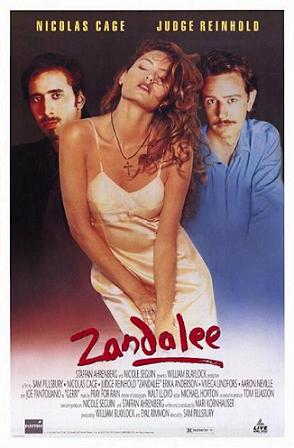
Zandalee

“I want to shake you naked and eat you alive…”

— Johnny (Nicolas Cage) in Zandalee (1991)

As you can probably guess from the quote above, Zandalee is a crazy little movie.

Zandalee takes place in New Orleans, which means that there’s a lot of rain, a lot of jazz, a lot of flamboyant accents, and a lot of sweat.  Zandalee (Erika Anderson) owns a boutique and spends most of her time jogging across the city.  (Zandalee has reddish hair, comes from a Catholic background, and runs a lot so naturally, I related to her.)

During one of her runs, Zandalee happens to pass a thief who is being chased by the police.  The thief flirts with her even while he’s being arrested.  The thief, interestingly enough, is played by a surprisingly hot Steve Buscemi.  Even more interesting is that, though his character makes a dramatic entrance and gets a lot of good lines, Buscemi doesn’t appear again until near the very end of the movie.  There’s really no point to Buscemi being in the film but somehow, it just seems right for him to suddenly be there.

And really, that’s the type of film that Zandalee is.  Odd characters pop up and then disappear.  Plot points are raised and then abandoned.  Events play out almost at random, as if Zandalee’s morning runs are taking her further and further into a dream world.

(It’s all a bit like Lost River, except for the fact that Zandalee is actually memorable in its weirdness, as opposed to just being annoying.)

Zandalee is married to Thierry (Judge Reinhold), a former poet who has abandoned his literary ambitions and taken over the family business.  Now, he’s mostly a figurehead who spends all of his time hanging out with drunk and uninteresting Philistines.  Thierry is so guilt-ridden over giving up poetry that he’s been rendered impotent.  Try as he might, he cannot make love.  As he puts it, while standing naked and staring out into the dark night, he is “a paraplegic of the soul.”

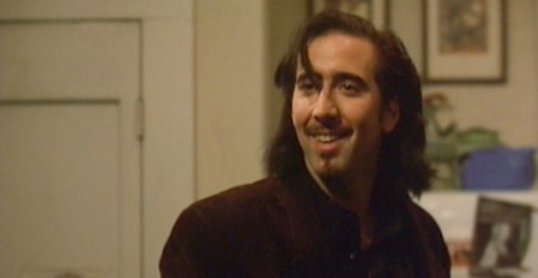
And then Johnny (Nicolas Cage) shows up.  Johnny was Thierry’s childhood friend.  Johnny is a painter and, from the minute he arrives, he’s giving Thierry a hard time for selling out.  Johnny also has long, stringy hair and a mustache and goatee.  He speaks in Nicolas Cage’s trademark muffled monotone, muttering lines of philosophical pretension.  When we first meet Johnny, he’s with Remy (Marisa Tomei, who much like Steve Buscemi, pops up and then vanishes and yet somehow it still seems totally appropriate that she’s in the film) but soon, Johnny has decided that he wants Zandalee.

Or, as he tells her when he approaches her during one of her runs, “I like it when you don’t wear anything underneath….”

Soon, Johnny and Zandalee are having a passionate affair.  Much as Zandalee once inspired Thierry’s poetry, she now inspires Johnny’s art.  Of course, Johnny is also inspired by cocaine.  Along with selling it and snorting it, Johnny also mixes it with olive oil and dips his fingers in it before fingering Zandalee.  And, as effective as some of these Johnny/Zandalee scenes are, it’s still impossible to watch all of this without thinking, “What the Hell, Nicolas Cage!?”

(Even by the standards of Nicolas Cage, Zandalee is a strange film.)

Anyway, eventually, Zandalee breaks it off with Johnny and Johnny’s paintings starts to suffer.  Thierry realizes what has been going on and it all leads to the scene below.

And, believe it or not, that all happens during the first hour!  Even after that epic dance off, there’s still another half hour of melodrama to go!  Zandalee is a seriously odd movie.

Zandalee can be viewed, in its uncensored entirety, on YouTube.  Usually, I’d embed the film at the bottom of this review but Zandalee is so extremely NSFW that it’s probably safer if you just go to YouTube and search for it yourself.

niccagezandaleeSeriously, Nic Cage wants you to do it.

So, I Finally Watched Grace of Monaco…


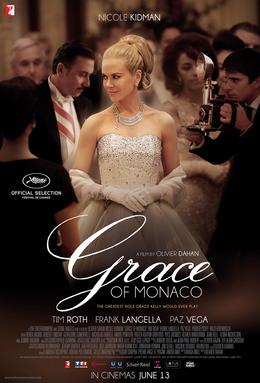
Grace_of_Monaco_PosterWell, I finally saw Grace of Monaco and…

Oh God.

Seriously, I am sitting here right now and I am just thinking to myself, “Oh God, do I really have to try to think up something interesting to say about this movie?”  Grace of Monaco is not a good movie but, at the same time, it’s bad in the worst way possible.  It’s not so bad-that-its-entertaining.  Instead, it’s just a dull misfire.

In fact, probably the only really interesting thing about Grace of Monaco is that it is the first film to go from opening Cannes to premiering on Lifetime.  Though it may seem impossible to believe now, there was a time in 2013 when everyone was expecting Grace of Monaco to be a major Oscar contender.  It seemed like everyone was saying that Nicole Kidman was a lock for a best actress nomination and maybe more!

Then the film’s American release date was moved from November of 2013 to June of 2014.  Rumor had it that the infamous Harvey Weinstein was chopping up the film and destroying the vision of director Olivier Dahan.  “Bad Harvey!” we all said.  (Of course, having now seen the film, I can understand why Harvey may have had some concerns…)

Okay, we told ourselves, Grace of Monaco probably won’t be a best picture contender.  But surely Nicole Kidman can get a nomination.  Surely the costumes and the production design will be honored…

And then the film played opening night at the Cannes Film Festival and it was greeted with less than appreciate reviews.  In fact, the reaction to the film was so negative that it has since become somewhat legendary.

And so, the American premiere was canceled.  The film opened in Europe, where it made little money and received scathing reviews.  But it was destined to never play in an American theater.  Instead, Grace of Monaco was sold to the Lifetime network.

And, after all of the drama and the waiting, I finally got to see Grace of Monaco tonight and … well, bleh.

Don’t get me wrong.  It’s a pretty movie.  I loved looking at what everyone was wearing.  I enjoyed looking at the ornate settings.  Whenever Grace Kelly stopped to look out at the view from the palace, I appreciated it because it was a beautiful view.  If I had hit mute and simply enjoyed the film as a look at beautiful people wearing beautiful clothes and living in beautiful houses, I probably would have enjoyed it a lot more.

But, unfortunately, Grace of Monaco has a plot that gets in the way.  The evil French, led by Charles De Gualle (played by Andre Penvern, who gives a performance that would probably be more appropriate for a James Bond film), want to take over Monaco because the citizens of Monaco don’t pay any income tax.  (I was totally Team Monaco as far as this was concerned.  Everyone should stop paying their taxes.  If we all do it, we’ll be fine.  They can’t prosecute all of us!)  Only Princess Grace Kelly can stop them but first, she has to convince her headstrong husband, Prince Rainier (Tim Roth), to listen to her opinions.  She has to convince her subjects that she’s more than just an opinionated American.

But Grace doesn’t just want to keep the French out of Monaco!  She also wants to return to her film career.  Alfred Hitchcock (Roger Ashton-Griffiths) wants her to star in Marnie.  (Hitchcock is always filmed as being slightly out-of-focus.)  Rainier doesn’t want her to return to acting.  And neither does a priest played by Frank Langella…

What was Frank Langella doing in this movie?  I have no idea.  He was some sort of advisor.  I understand that he’s based on a historical figure but honestly, the film was so boring that I can’t even bring myself to go on Wikipedia to find out who exactly he was.

But really, the main issue with Grace of Monaco is that it tells us absolutely nothing about Grace Kelly.  The film doesn’t seem to know who she was or what it wants to say about her.  And Nicole Kidman is a good actress and I hope that I look as good as she does when I’m 47 and after I’ve given birth to two children but seriously, she seems to be totally lost in this film.  Olivier Dahan fills the film with close-ups of Kidman’s face but for what reason?  Never for a minute do we believe we’re looking at the face of the star of High Noon, Rear Window, or To Catch A Thief.  Instead, we’re always aware that we’re looking at Nicole Kidman and she doesn’t seem to be sure just what exactly she’s supposed to be doing.  We learn nothing about Grace, Monaco, France, royalty, or movies.

And it’s a shame really.  Because the story of Grace Kelly would make a great film.  But Grace of Monaco doesn’t really tell you anything about her life.

It’s just boring and a film about an actress like Grace Kelly has absolutely no right to be boring.

Late To The Party : “Ouija”


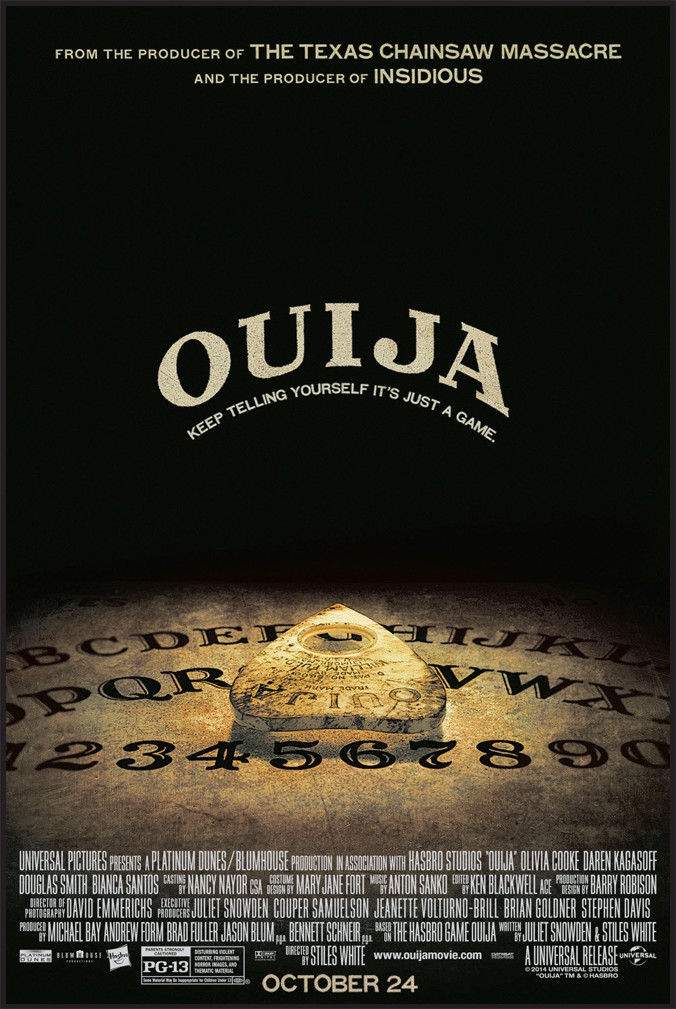
ouija-movie-poster


I was thinking of sub-titling this review “What To Expect When You’re Expecting Nothing,” or something equally less-than-clever, but it just seemed too damn obvious — I mean, how many of us were expecting 2014’s Ouija to actually be any good?

Let’s face it — Hasbro inking a deal with Michael Bay’s Plantinum Dunes to make a series of movies based on their various board games is probably a pretty stupid idea for a number of reasons — not the least of which is that Clue probably just plain can’t be topped in the “best-board-game-movie-of-all-time” category — but what can I say? While there was no way in hell I was going to spring to see Ouija when it was out in theaters, I added it to my Netflix DVD queue when it came out simply because I like to punish myself from time to time by sticking my head into the toilet bowl of PG-13 “horror.” I guess I’m just masochistic like that.

All that being said, director Stiles White (who co-wrote the film’s screenplay along with Juliet Snowden) manages to under-perform here even though the bar was set exeptionally low. We’ve all seen the “malignant spirit haunts teenagers” trope done to death, to be sure, but rarely is everyone so clearly and plainly going through the motions as they are in Ouija. It’s like somebody figured out how to put celluloid on Xanax and then sat back to see what the end result would be.

download (1)

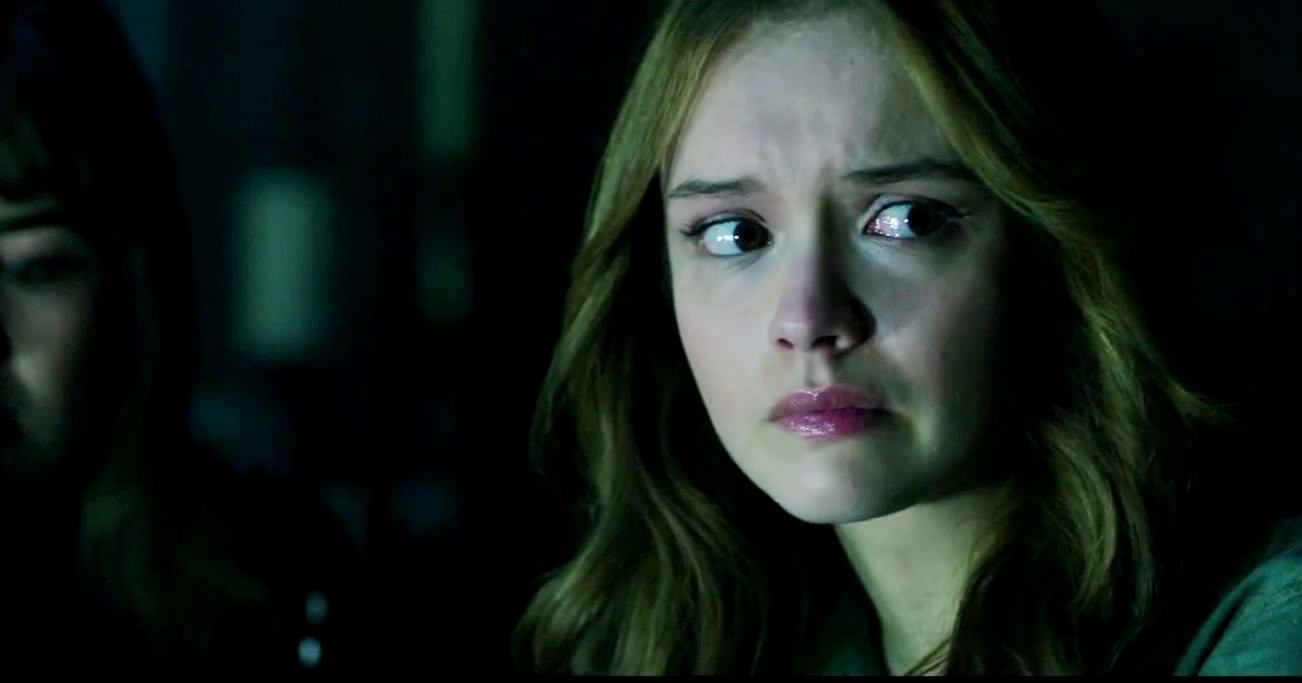
Speaking of Xanax,  Olivia Cooke, of sleazy prime-time soap Bates Motel, certainly looks and acts like she’s on it — she absolutely can’t carry a film, as she ably demonstrates in her starring turn here as nominal heroine Laine Morris. She has precisely one facial expression — the “concerned as shit” look — and can’t even manage to get away from it entirely when she’s supposed to be smiling and looking happy. Not that she’s got a whole lot to be happy about, mind you, given that her best friend, Debbie Galardi (Shelley Hennig) apparently just killed herself after playing around with a Ouija board (hint to Hasbro, by the way — if the primary goal of your newfound motion picture enterprise is to move more of your product, as I’m assuming it is, suggesting that said product actually works in terms of conjuring up evil ghosts maybe isn’t the smartest idea). So, like any intrepid young protagonist, the charisma-free zone that is Laine decides that she’ll get her boyfriend, Trevor (Daren Kagasoff), their friend Isabelle (Bianca A, Santos), and dead Debbie’s (now ex-, I suppose) boyfriend,  Pete (Douglas Smith) together to hold a seance at the scene of the crime. When her perpetual-pain-in-the-ass younger sister, Sam (Ana Coto), proves once again that she can’t be left home alone while their dad is out of town, she gets dragged along to the party, as well.

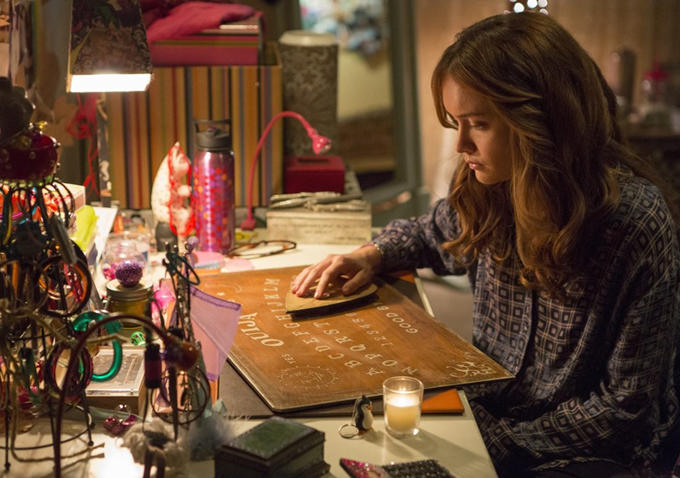
I fucked around with Ouija boards plenty when I was younger, but one thing this flick taught (a term I use very loosely, I assure you) me is that if you look through the plastic-coated hole in the center of the planchette, you’re supposed to be able to see whatever ghost it is you’ve disturbed from their slumber. Laine certainly sees one, and from there on out, our plucky young crew is put through the dullest, most un-involving “living hell” you’re ever likely to see play out before your eyes — suffice to say, the haunted shit they’re all being subjected to ties in to a (yawn!) ghastly crime committed at Debbie’s house many years ago. And in order for the spirits to rest, they’ve gotta (yawn again!) put things right.

ouija-movie-1-720x380

Further details are probably pointless here, but that’s okay — so is the movie itself. I’ve been sitting here scratching my head trying to think of one thing Ouija has to recommend in its favor, but I gotta be honest — I’m drawing a complete blank. The acting’s bad, the story’s stupid and predictable, the “scares” are anything but scary, and the whole thing is a rancid mess.

That may sound harsh, but trust me when I say that, if anything, I’m actually underselling how genuinely lame this thing is. I almost didn’t even bother to review it because it was too easy a target, but I figured that if I could warn off at least one other person from seeing it, then I could chalk it up as my good deed for the day.Sure, the picture and sound quality on the DVD are both fine (I can’t really comment on the extras because the disc I got from Netflix was one of those “bare-bones” rental versions, sorry), but so what? It’s a brand new movie, the technical specs should be flawless.

olivia-cooke-in-ouija-movie-7

So — what do you get when you go into a movie expecting nothing? In the case of Ouija, precisely that.

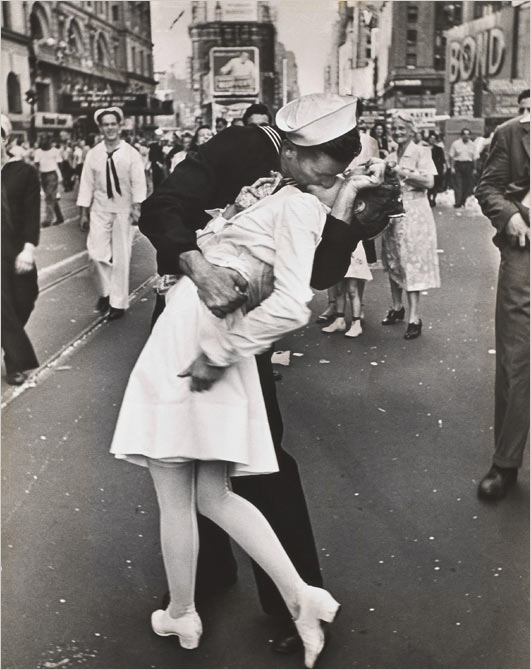
In Remembrance of Memorial Day


Photograph by Alfred Eisenstaedt

Photograph by Alfred Eisenstaedt

“They hover as a cloud of witnesses above this Nation.” — Henry Ward Beecher

We Can Do It

We Can Do It

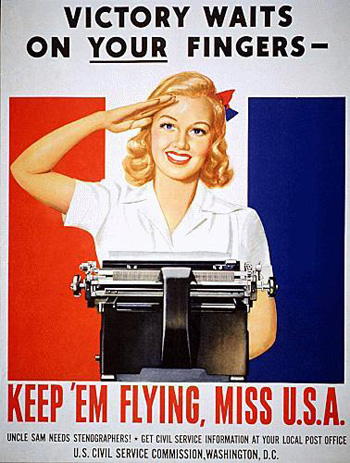
Keep 'Em Flying Miss USA

Keep ‘Em Flying Miss USA

Be A Man

Be A Man

By Adolph Triedler

By Adolph Triedler

By Dean Cornwell

By Dean Cornwell

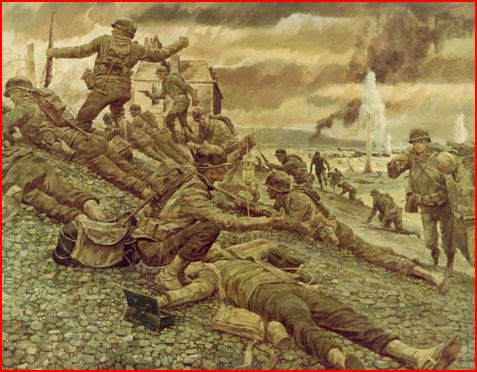
D-Day, Omaha Beach by Ken Riley

D-Day, Omaha Beach by Ken Riley

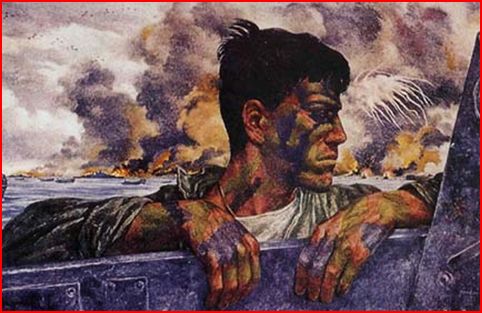
Marine Heading Ashore on D-Day by Tom Lea

Marine Heading Ashore on D-Day by Tom Lea

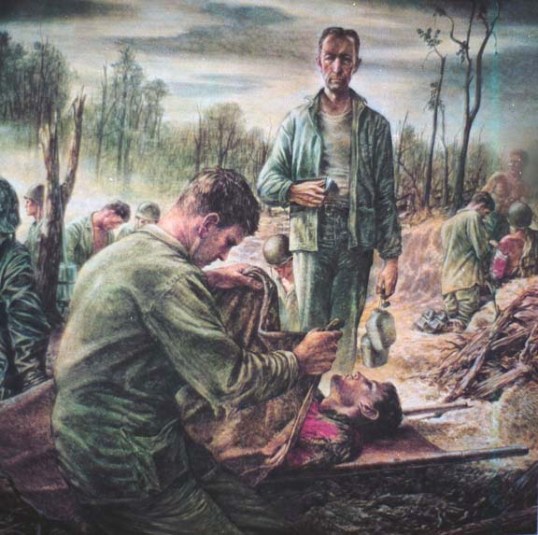
Chaplain by Tom Lea

Chaplain by Tom Lea

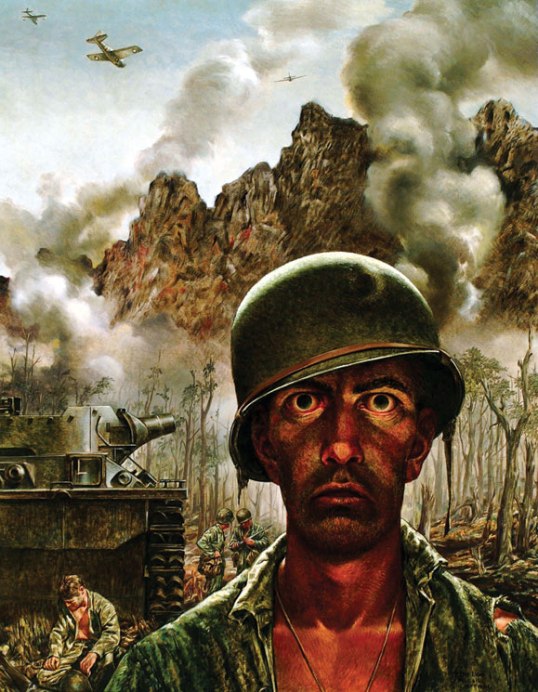
Two Thousand Yard Stare by Tom Lea

Two Thousand Yard Stare by Tom Lea

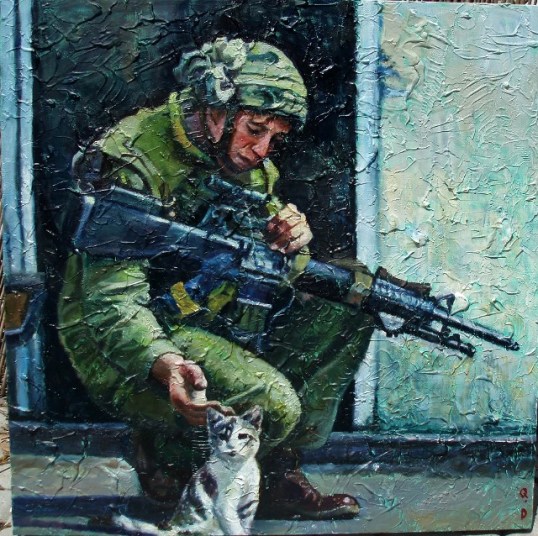
A Break in Combat by Qi Debrah

A Break in Combat by Qi Debrah

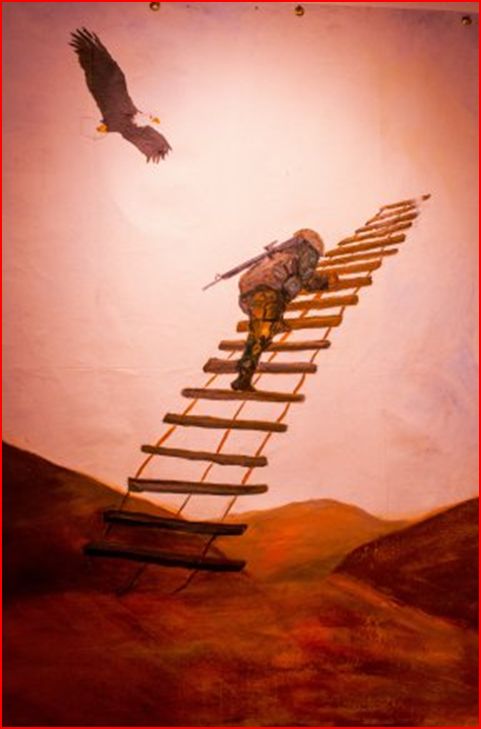
By Qi Debrah

By Qi Debrah

by Qui Debrah

by Qui Debrah

Anonymous

Anonymous

Neon Dream #10: The Album Leaf – The Outer Banks


https://www.youtube.com/watch?v=hQoFb44isHQ

The Album Leaf is an electronic-oriented post-rock band headed by Jimmy LaValle. While the project has been around since 1998, LaValle made it onto most post-rock radars with his third album, In a Safe Place. Released in 2004, is was LaValle’s first album on Sub Pop, and it featured most of Sigur Rós as studio musicians. The album was significant, I think, for affirming that great post-rock did not have to conform to the structure and instrumentation standards that were beginning to overwhelm the genre.

For me though, it filled a very different role. I was pretty obsessed with Lost in Translation at the time, and that soundtrack had a bit of a love affair with Rhodes piano and similar tones. That sound happened to be The Album Leaf’s trademark, and it fit in beautifully, especially with Brian Reitzell’s contributions and “Tommib” by Squarepusher. I ended up inserting my favorite track off In a Safe Place into the middle of my Lost in Translation playlist, and that’s how a song called “The Outer Banks” came to make me think of Japan.

Embracing the Melodrama Part II #85: Ghost (dir by Jerry Zucker)


Ghost_(1990_movie_poster)Along with it being a part of my series of melodramatic film reviews, there are actually two reasons why I recently watched Ghost.

First off, this 1990 film was nominated for best picture and it’s long been my goal to watch and review every single film ever nominated for best picture.

Secondly, my Aunt Kate absolutely loves this movie.  Ever since she first found out that I obsessively love movies, she has recommended that I watch this movie.  And she hasn’t been alone.  A lot of people both in and outside of my family have recommended this film to me.  And, since I tend to be a bit of a contrarian know-it-all, I originally assumed that any film loved by that many people had to be terrible.  However, because I love mi tia, I decided to watch Ghost.

I have to admit that I started to laugh when I saw Demi Moore sitting at her pottery wheel because I’ve seen that scene parodied in so many different TV shows and movies.  As soon as a shirtless Patrick Swayze sat down behind her and joined his hands to hers to help shape a ceramic phallic symbol, I started to giggle.  As Unchained Melody played in the background, I wanted to be snarky.  But then I realized something.  If you can manage watch the scene without comparing it to all the parody versions, it actually works.  Patrick Swayze looked good and he and Demi Moore had the type of amazing chemistry that more than made up for the fact that neither one of them was a very good actor.  (That said, Patrick was very good at projecting decency and Demi was very good at crying and that’s really all that Ghost required.)  And, if the scene has proven easy to parody, that doesn’t change the fact that it’s a very sincere scene.  It’s so sincere that it’s even willing to risk coming across as being silly.

Of course, the entire film isn’t just Demi, Patrick, and a pottery wheel.  There’s also Whoopi Goldberg as a fake medium-turned-real-medium and Tony Goldwyn as the best friend who turns out to be a sleazy villain.  And, of course, there’s the cartoonish demons who pop up every once in a while so that they can literally drag the recently deceased down to Hell.

Sam Wheat (Patrick Swayze) is the world’s most unlikely New York City-based banker.  He owns a beautiful apartment with his girlfriend Molly (Demi Moore) but he has commitment issues.  He can’t bring himself to say that he loves Molly.  Instead, he just says, “Ditto.”  And, from the minute he first utters those words, you know that his habit of saying “Ditto,” is going to be an important plot point.  Anton Chekhov told us that any gun introduced during the first chapter must be fired by the third chapter.  Ghost tells us that any “Ditto” uttered during the first 10 minutes must be repeated by the end of the first hour.

Sam’s best friend and co-worker is Carl (Tony Goldwyn).  At the start of the film, Sam and Carl have a sweet bromance going and some of the best scenes are just the two of them acting like guys.  (There’s a fun little scene where they freak out a group of strangers on an elevator.)  Goldwyn is so likable as Carl that it’s actually genuinely upsetting to discover that he’s arranged for Sam to be murdered.  (Why?  It all involved a lot of financial stuff that basically went right over my head.  Greed is not only the root of all evil but it leads to narrative confusion as well.)  When Sam dies, he comes back as a ghost but nobody can see him but his fellow ghosts.  Vincent Schiavelli has a great cameo as a very angry subway ghost who teaches Sam how “life” works when you’re dead.

(Of course, Schiavelli isn’t on screen for too long because he’s almost too angry for the world of Ghost.)

Eventually Sam discovers that only one living person can communicate with him.  Oda Mae Brown (Whoopi Goldberg) is a fake medium who is just as shocked as anyone to discover that she can speak with the dead.  Whoopi won an Oscar for her performance here and she’s certainly does bring some needed humor and life to Ghost.  With Swayze, Moore, and Goldwyn all giving extremely and sometimes overly dramatic performances, you’re happy to have Whoopi there.

Ghost is designed to appeal to your emotions and it succeeds in doing just that.  If you look at the film logically, you’re missing the point.  In many ways, the film is undeniably silly but I still got some tears in my eyes when I heard that “Ditto.”


The Winners At Cannes And What It Means For This Year’s Oscar Race


poster_tn_sicario

Well, that shows you how much I know.

The 68th Annual Cannes Film Festival came to a close earlier today.  If you’ve been following news from the festival over the past two weeks then you’ve heard that Gus Van Sant’s Sea of Trees is no longer considered to be an Oscar contender.  (That’s putting it gently.)  You’ve heard a lot of acclaim given to Todd Haynes’s Carol.  You have also seen Denis Villeneuve’s Sicario and the Hungarian film Son of Saul emerge as a potential Oscar contenders.  Michael Caine’s performance in Youth was acclaimed, as was the work of Tim Roth in Chronic and Marion Cotillard in MacBeth.

One film that you probably did not hear about was Jacques Audiard’s Dheepan.  As far as coverage of Cannes over here in the states is concerned, Dheepan was ignored.  And yet — once again proving that nobody can predict Cannes — Dheepan is the film that ended up winning the Palme d’Or.  The acting prizes also went to actors who have been under the radar, with the possible exception of Rooney Mara.

(Some day, I will be able to forgive Rooney Mara for playing Lisbeth Salander is David Fincher’s insulting interpretation of Girl With The Dragon Tattoo.  But not today…)

As far as what the past two weeks have meant for the upcoming Oscar race: Well, I think it’s safe to say that we can forget about Sea of Trees.  As for my insistence that Sea of Trees would be nominated … well, we’ll all have a good laugh about it someday.  Carol appears to have emerged as an early front-runner and I think that Sicario could come on strong as well, especially if one of the nominal front runners — like Bridge of Spies, for instance — doesn’t live up to expectations.  It wouldn’t surprise me to see Caine and Cotillard nominated as well.  Everyone loves Michael Caine and, as he gets older, we are more and more aware that a day is going to come that he won’t be around to appear in any more movies.  As for Cotillard, she is everything that Meryl Streep is supposed to be and more.

Anyway, here are the winners!

68th Cannes Film Festival top awards:

Palme D’Or: Dheepan

Grand Prix: Son of Saul

Jury Prize: The Lobster

Best Director: Hou Hsiao-hsien for The Assassin

Best Actor: Vincent Lindon for The Measure of a Man

Best Actress: Rooney Mara for Carol and Emmanuelle Bercot for My King

Best Screenplay: Michel Franco (Chronic)

Camera d’Or (Best first feature): La Tierra Y la Sombra

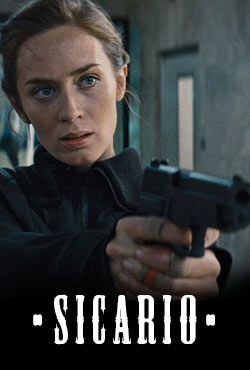
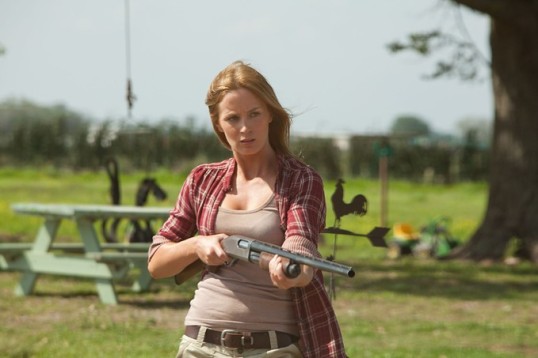
Emily Blunt in Sicario

Emily Blunt in Sicario (No, actually, that is Emily Blunt in Looper.  My mistake…)

Neon Dream #9: Air – Alone in Kyoto


Sofia Coppola’s Lost in Translation left a strange impression on me. In a way I can only really compare to Casablanca, it burrowed into my memory like an actual personal experience. I don’t review movies, and I am ill equipped to explain what made it such a special film for me, but the bond that Bob Harris (Bill Murray) and Charlotte (Scarlett Johansson) forge over a few days in Tokyo is something I’ll always carry with me and look back on fondly. That’s pretty weird, but I’m not complaining.

Music was essential to Lost in Translation, embedded into scenes as a part of what Bob and Charlotte actually experience. The hotel lounge has a live jazz band. “The State We’re In” by The Chemical Brothers plays in the club they visit. Phoenix’s “Too Young” pumps over the stereo when they go to a friend’s apartment. A woman dances to Peaches’ “Fuck the Pain Away” at the strip club. The actors aren’t just seen singing karaoke; they perform it at length. Coppola was pretty clever about extending this integration to the more traditionally situated background music. Happy End’s “Kaze wo Atsumete” enhances the feeling that Bob and Charlotte are winding down from an exhausting night, but it drifts faintly into the hallway, as if playing from the karaoke room. Charlotte is wearing headphones when we first hear Air’s “Alone in Kyoto”. The Jesus and Mary Chain’s “Just Like Honey” kicks off as Bob enters his cab. The encore of “Kaze wo Atsumete” in the credits could easily be playing in Bob’s head. Almost every song in the movie functions within the environment, not just as a peripheral enhancement.

Garden State tried something like this a year later, though I don’t recall the extent of it beyond the awkward Shins sequence. The effect was a sort of garish, in-your-face endorsement of director Zach Braff’s favorite tunes. It didn’t really cut it for me, in spite of the soundtrack’s impressive cast. In Lost in Translation, Coppola was a lot more attentive to creating continuity between songs and bringing musicians on board with the film’s atmosphere. She didn’t stop at using “Sometimes” by My Bloody Valentine; she dug founder Kevin Shields out of relative obscurity to compose four original pieces. A lot of the other artists formed a pre-existing community of sorts, suited to engage the project as art rather than a quick paycheck. Soundtrack supervisor Brian Reitzell performed drums for Air on their 2001 album 10 000 Hz Legend. Both Air and Roger Joseph Manning Jr, a fellow studio musician on that album, contribute original music to Lost in Translation. Phoenix previously performed with Air, and Sofia Coppola ultimately married their singer. While their contribution was recycled (“Too Young” appears in the context of young adults who would have been familiar with obscure but up and coming artists; using Phoenix’s first single made sense), the band was still involved in Coppola’s social sphere of musicians.

“Alone in Kyoto” plays as Charlotte travels through the classic side of Japan, visiting shrines and observing ancient customs. While that could possibly put it at odds with my theme, Air’s approach keeps the feeling modern, casting tradition as a subtle, delicate element of the present rather than as a form of escapism. It also occurs in a sequence without character interaction, permitting a pure sense of exploration. Within Lost in Translation‘s soundtrack, “Alone in Kyoto” reaches closest to that Japanese dream that still permeated a lot of American subcultures in 2003. The movie itself brought many of us the closest we would ever come to actually living that dream.

What Lisa Watched Last Night #124: Kidnapped: The Hannah Anderson Story (dir by Peter Sullivan)


Last night, I watched the latest Lifetime original movie, Kidnapped: The Hannah Anderson Story!

hannah-3_r620x349Why Was I Watching It?

The most obvious answer is because it was on Lifetime.  As y’all know, I love Lifetime movies, especially when they’re based on a “true” crime story.

As well, I am among those who, since 2013, have been fascinated and frustrated with the twists and turns of the Hannah Anderson kidnapping case.  Hannah was a 16 year-old cheerleader who was kidnapped by a family friend, James DiMaggio.  DiMaggio also murdered Hannah’s mother and younger brother.  When Hannah was finally found and rescued by the FBI, many questioned whether Hannah had been DiMaggio’s victim or his accomplice.

I can still remember when questions were first raised over Hannah’s role in DiMaggio’s crimes.  It seemed like everyone had an opinion.  There were some days when I felt like Hannah had to be innocent and then there were other days when I thought the exact opposite. Nearly two years later and I still go back-and-forth.  That’s the main reason I wanted to see Kidnapped.  I wanted to see whether this would be the film that would finally convince me one way or the other.

What Was It About?

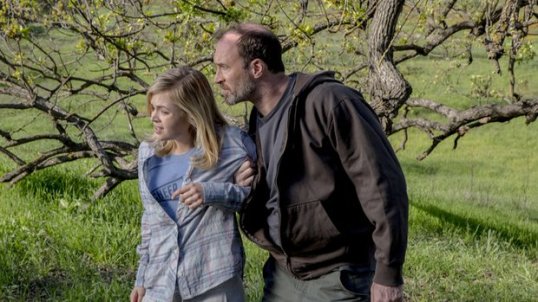
The film begins with the FBI rescuing 16 year-old kidnapping victim Hannah Anderson (Jessica Amlee) and killing her kidnapper, Jim DiMaggio (Scott Patterson).  A traumatized Hannah returns home but soon discovers that some, in the media, are claiming that she collaborated with Jim to murder her mother and younger brother.  Hannah goes on a talk show to tell her side of the story.

What Worked?

Scott Patterson and Jessica Amlee gave good performances as Jim and Hannah.  Amlee was sympathetic throughout.  Patterson was properly creepy.

What Did Not Work?

The main reason that this case captured everyone’s imagination was because of the ambiguity of it all.  Nobody was quite sure how they felt about Hannah Anderson and, especially in the early days of the investigation, Hannah’s behavior gave a lot of people reason to feel uneasy about her story.  And while that’s probably not fair (who knows how any of us would act in a similar situation), it’s still the reason why people continue to debate the specifics of the Hannah Anderson kidnapping to this day.

Unfortunately, none of that ambiguity was present in the film.  The only voice heard is Hannah’s and those who had doubts about Hannah’s story are dismissed as being trolls and bullies.  In the process, a multi-layered mystery is reduced to just being the latest anti-bullying PSA.  Kidnapped: The Hannah Anderson Story had all the elements necessary to be a truly intriguing and potentially unsettling film but, in the end, it’s just a standard Lifetime movie.

“Oh my God!  Just like me!” Moments

Considering the subject matter, I’d just as soon say that there were no “Oh my God!  Just like me!” moments.  However, that’s not quite true.  There were times that I cringed at the flashbacks to Hannah and Jim’s relationship before the kidnapping, because, when I was that age, I did have some similar relationships that, in retrospect, were more than a little bit creepy.  In particular, the scene where 40ish Jim says that he wishes he could “date” the 16 year-old Hannah brought back some less than fond memories.

Lessons Learned

Never underestimate the power of narrative ambiguity.