What Lisa Marie Watched Last Night #80: A Mother’s Rage (dir by Oren Kaplan)


Last night, I turned the TV over to the Lifetime Movie Network and I watched A Mother’s Rage.

Why Was I Watching It?

First off, it was on the Lifetime Movie Network and, as anyone who knows me can tell you, I am an LMN fanatic.  Seriously, there’s nothing I love more than watching a good, silly Lifetime movie.

Secondly, just the title, A Mother’s Rage, is so melodramatic and over-the-top.  Just hearing that title, I knew this movie would be the epitome of everything I usually love about a good Lifetime movie.

What Was It About?

After her daughter is murdered, Rebecca Mayer (Lori Loughlin) sets out to find the man responsible.  Driving across a desolate desert highway and hallucinating that her daughter (Jordan Hinson) is still alive, Rebecca murders every man that she comes across.

Fortunately, all of these men happen to be rather scummy but still, the local police are determined to catch Rebecca and stop her trail of a murder.  Sheriff Emily Tobin (Kristen Dalton) pursues Rebecca with the help of her own teenaged daughter (played by Alix Elizabeth Gitter).

What Worked?

Lori Loughlin and Jordan Hinson were well cast as mother and ghost daughter and, for the first 20 minutes or so, the movie did a pretty good job of keeping you guessing as to whether or not Hinson was real or if she was just a hallucination.

Over the course of the film, Loughlin did murder a few people but, fortunately, everyone she killed was so sleazy that she still managed to remain a sympathetic character.

What Did Not Work?

Even by the melodramatic standards of Lifetime, A Mother’s Rage was not a very believable story.  Plot holes abound and the film’s final scenes were so sloppily edited that the film’s  imdb message board is full of people still trying to figure out what exactly happened at the end of the movie.

One huge issue that I had with this film was that Lori Loughlin essentially murders several people in broad daylight and yet, somehow, there are never any witnesses.  Seriously, Loughlin apparently managed to find the least traveled highway in America.

Then again, it was a Lifetime movie and therefore, it all worked.  Criticizing a Lifetime movie for being melodramatic is like criticizing a kitten for being cute.

“Oh my God!  Just like me!” Moments

Lori Loughlin’s daughter is described as being an aspiring dancer who had a massively overprotective mother and, seriously, how could I not relate to that?  Meanwhile, Kristen Dalton’s daughter spends her time stealing crime scene photographs and trying to solve crimes and again, how could I not relate?  Seriously, there were times when this entire film seemed like one big “Oh my God!  Just like me!” moment.

Lessons Learned

I will apparently watch anything that shows up on Lifetime.

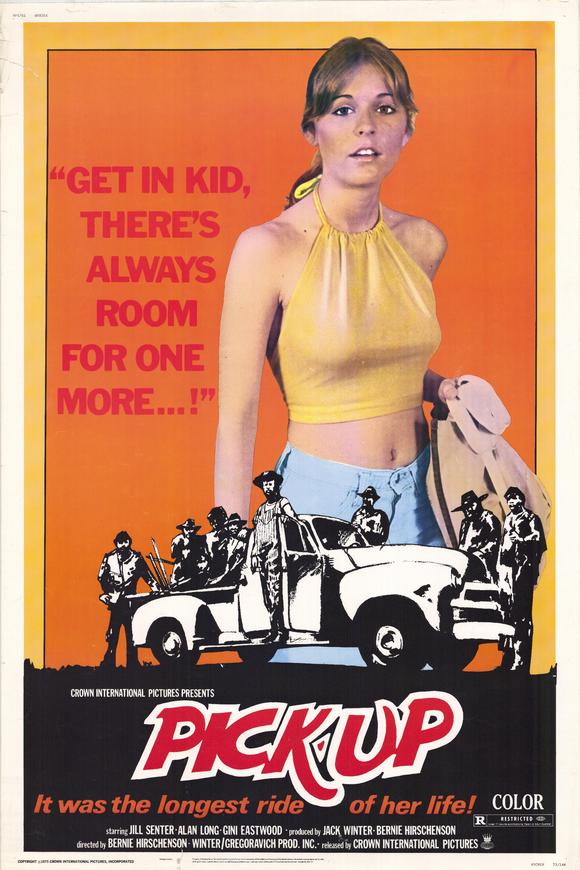
Grindhouse Classics : “Pick-Up”


pick_up_poster_01

One word that doesn’t usually (if ever) come to mind when you’re talking about the drive-in fare churned out by Crown International Pictures in the 1970s is weird.

Yeah, okay, fair enough — I suppose just about any CIP flick looks a little bit “weird” to a contemporary audience, given that they’re all very much  products of their time, but honestly, pretty much everything released under their banner boils down, story-wise,  to a simple morality play with a generous helping of sex (always) and violence (sometimes) thrown in — and more often than not, as with most exploitation fare, the most common themes in the Crown back catalog are “don’t set your sights above your station in life” and “don’t talk to strangers.”

At first glance, 1975’s Pick-Up, directed (and produced, and shot, and edited) by Bernard Hirschenson, would appear to fit comfortably into the “don;t talk to strangers” category, since it’s the story of two footloose-and-fancy-free hippie chicks named Carol (Jill Senter) and Maureen (Gini Eastwood — no relation, at least that I know of, to you-know-who), who hitch a ride across Florida with a far-out guy named Chuck (Alan Long) who is, like them, at loose ends and just “taking in what the world has to offer, one day at a time, man” in his fuck-pad RV.

Come on — he’s gotta be trouble, right? I mean, he’s an Aries, and according to the supposedly-metaphysically-tuned-in Maureen, Aries guys are bad news these days because of some state of flux going on in the universe or something. Still, the girls hop in for a ride anyway —

31361

Trouble eventually does come their way, but Chuck isn’t the cause. After a deluge, the RV gets stuck in the Everglades mud, and that’s when things, as I promised at the outset, get weird. Chuck and Carol get busy screwing their brains out, but Maureen in between reading star charts and tarot cards and having waking (and sleeping) visions of her childhood, is visited by Pythia, a priestess of Apollo, who gives her a sacred dagger for some reason or other. And if you think that sounds strange, wait until the slimy politician and latex-faced clown show up.

Okay, yeah, none of this makes a tremendous amount of narrative sense — or even common sense — but it sure is interesting. It turns out that Maureen was molested by a priest as a child (guess they were into girls in the ’70s) and this is at the root of her psychological disturbances, which culminate in quite possibly the most bizarre  scene (of many contenders) in the film, where she and Chuck finally “make it” on a stone altar with the clown, the politician, and the priestess watching on. And all this right after Chuck kills a wild boar (be warned, this film does feature genuine animal slaughter, although hardly of Cannibal Holocaust proportions) What does it all mean? Who knows. And honestly, who really cares? Pick-Up was clearly made with the stoner crowd in mind and, frankly, was probably made by members of the stoner crowd, as well. It’s all good, man. Just go with the flow.

4517859_l2

There are some notable things to point out in relation to this film while we have a moment — the Florida Everglades locations are authentic, and were probably an absolute bitch to film in (good thing everybody was probably high), and both Senter and Eastwood are not only reasonably talented actresses, but absolutely gorgeous, as well — yet neight ever made another film. Go figure.

Drive-in-cult-classics

Like most of the Crown stuff we’ve covered both here and at my “main” site — http://trashfilmguru.wordpress.com , for those of you who don’t know — Pick-Up is available on Mill Creek’s 12-disc, 32-movie “Drive-In Cult Classics” DVD boxed set collection. There are no extras, but the remastered widescreen transfer looks surprisingly crisp and clean and the mono sound is, at the very least, perfectly adequate. This may not be the best film in the collection by any stretch, nor is it the most fun, but it’s definitely one of the most interesting, and it’s well worth the 80 minutes of your life it takes to watch it.

Is Upstream Color The Best Film of 2013?


(Minor Spoilers Ahead)

Is Upstream Color, the new film from Shane Carruth, the best film of 2013?

Realistically, it’s probably too early to say.  After all, it’s only April and there’s a lot of films waiting to be released.  However, it’s hard for me to imagine how a more thought-provoking, haunting, and occasionally frustrating film could be released this year.

Don’t get me wrong.  A lot of viewers aren’t going to embrace this low budget, independently made film.  Some will dismiss Upstream Color as being pretentious or they’ll incorrectly assume that the film is all about style over substance.  Even in this age of Tree of Life and Beasts of the Southern Wild, Upstream Color is not the type of film that’ll be embraced come Oscar time.

But no matter.  As of right now, Upstream Color is the best film of 2013.

Director Shane Carruth made his directorial debut in 2004 with Primer.  Made on a budget of $7,000 and filmed in my hometown of Dallas, Primer was a low-key but intriguing film about time travel.  It was a science fiction film that succeeded not through CGI but through an intelligent presentation of ideas.  I have to admit that I’ve watched Primer a handful of times and I still don’t quite understand everything that happens in the film.  However, that’s a huge part of the film’s appeal.

The same can be said of Upstream Color.

Playing out like a mash-up of David Cronenberg and Terrence Malick and told through a series of jump cuts, Upstream Color begins with Kris (Amy Seimitz), a successful young woman who is kidnapped by an enigmatic figure known as the Thief (Thiago Martins).  The Thief uses a drug made out of orchid larvae to hijack her mind.  Once she has given him all of her money, the Thief vanishes while the larva continues to grow in Kris’s body.

A mysterious man identified in the credits as The Sampler (played quite brilliantly by Andrew Sensenig) comes to Kris’s aid.  As Kris lies unconscious in a tent, The Sampler cuts the larva out of her body and then puts it into the body of a pig.  The pig is set loose in a pen with hundreds of other pigs who apparently carry larvae in their bodies.  Kris, meanwhile, wakes up the next morning in her car with no memory of why she’s covered in blood, why she’s lost her job, or why her bank account is now empty.

One jump cut later and suddenly, we see Kris riding a train through downtown Dallas.*   We’re not sure how much time has passed but we can see that Kris has changed.  With her hair cut short, Kris sits huddled in the back of the train.  Also on the train is Jeff (Shane Carruth).  Despite Kris’s efforts to be anonymous, Jeff notices her and eventually manages to strike up a conversation with her.

Kris finds herself oddly drawn towards Jeff, especially after he confesses to her that he once stole a lot of money from his employers and he’s not quite sure why he did it.  Not realizing that they’re both victims of the Thief, Jeff and Kris fall in love.  Fortunately, Carruth and Seimetz have a palpable chemistry.  You believe both of them as wounded souls and as lovers.  As a result, even as the film gets more and more surreal, you still care about these two characters and their relationship.

While Kris and Jeff fall in love and struggle to understand what happened to them in the past, the Sampler continues to appear throughout the film as a detached observer.  Sometimes, he’s recording the sounds of nature.  At other times, he’s looking over his pigs.  And then, sometimes, he’s just there.  For his first few appearances, the Sampler seems to be almost a benevolent figure but, halfway through the film, he performs one action that forces you to reconsider everything that you’ve previously seen him do.

Who is the Sampler and how is he connected to the Thief and Kris and Jeff?  This is one of the many questions that the film poses and, quite frankly, the answer is not easy to find.  Don’t get me wrong, the answer is there.  You just have to be willing to look for it.  Carruth, a former engineer, directs with an eye for the reoccurring patterns of nature. (For instance, the curve of the larva in Kris’s bloodstream is later replicated by the sight of Kris and Jeff curled up in each other’s arms.)  As opposed to the very verbal Primer, Upstream Color is a film almost totally told through image and, as a result, one has to be willing to be an observant viewer in order to learn the answers to the film’s questions.  The film’s final 15 minutes features no dialogue, just images scored to Carruth’s propulsive electronic score.  It’s a brave move on Carruth’s part and, even more importantly, it works brilliantly.

As you might guess from reading this review, Upstream Color is not an easy film to understand.  As a filmmaker, Carruth emphasizes the surreal and the obscure but, much like David Lynch, he comes up with images that are so haunting that you can’t look away even if you don’t fully understand what you’re seeing.  Upstream Color may, at times, be an obscure film but it’s compelling in its obscurity.  This is a film that is meant to be seen with four of your smartest friends.  This is a film that is meant to be debated and argued about.

In other words, it may very well be the best film of 2013.

——

*On a personal note, I do have to admit that I loved seeing how much of this movie was filmed at places that I either go to or drive by every single day.

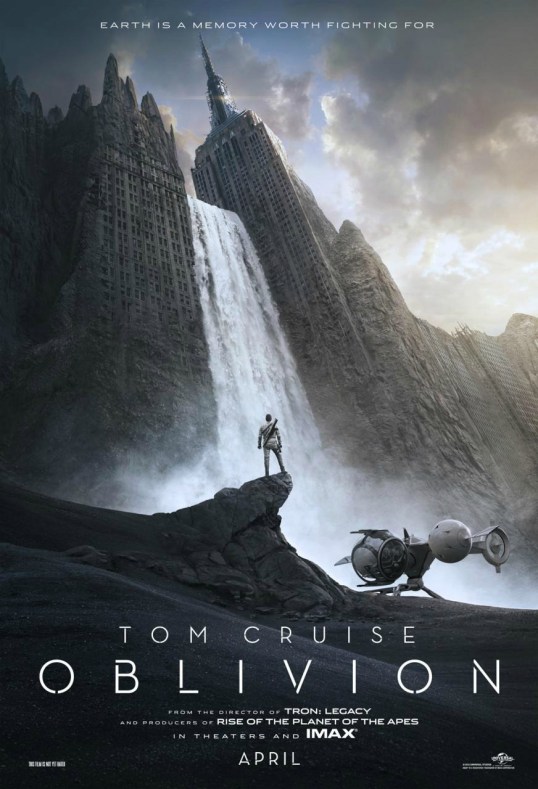
Review: Oblivion (dir. by Joseph Kosinski)


Oblivion-Movie-Poster

Good science-fiction films tend to be far and few between. Most of the time the ideas and ambition to make a good or great science-fiction film are right there on paper, but loses much once people actually have to create it for others to see. This puts the latest sci-fi film from Tron: Legacy filmmaker Joseph Kosinski in a weird position. His follow-up to the underwhelming sequel to the classic sci-fi film Tron is called Oblivion and it manages to be thought-provoking and entertaining, yet also have a sense of a been there and done that to the whole proceeding.

Oblivion quickly gets the introductions to the film’s backstory out of the way. Earth was attacked 60 years ago by aliens who were called “Scavengers” (Scavs for short) who destroyed the moon thus causing massive tectonic upheaval and gigantic tsunamis to ravage the planet. Humanity in its desperation would fight back with the only weapons it had left once the aliens began landing troops and that would be the nuclear kind. The planet is now devastated with the surviving population leaving Earth for a new colony on Saturn’s moon of Titan and in a massive tetrahedron space station orbiting Earth simply called “The Tet”.

It’s the story of the technician pair left behind to provide support for the array of armed drones who patrol Earth for any remaining Scavs and protect the reclamation factories that has been removing the remaining resources that the planet has to be used as an energy source for the Titan colony. This pair of technician are Jack (Tom Cruise) and Victoria (Andrea Riseborough) who live in a towering base above the clouds. Jack does the dirty work by flying patrols in the area that encompasses what used to be the East Coast of the United States while Victoria (who also happens to be Jack’s lover) provides comm and technical support back at their base.

Oblivion01

Victoria can’t wait to finish their five-year stint on Earth and with two weeks left before they can rejoin the rest of humanity on Titan her dream is coming closer. Yet, Jack doesn’t seem to want to leave Earth behind. He has begun to dream about Earth before the war that he should have no memory of. First they’re dreams while he’s asleep but as the film shows it soon begins to invade and distract his waking hours as well.

It’s during one such mission where he comes across the a sudden arrival of a human spacecraft with surviving humans aboard that his dreams become reality. A woman he has dreamed off that he’s never met is one of the survivors (played by Olga Kurylenko) and she becomes the key to unlocking the secret that’s been kept from him about the true nature of the war that devastated Earth sixty years past and why he continues to have flashes of memories that he should never have had.

Oblivion sounds like it’s original at first glance, but as the story moves along we begin to see influences (at times outright plot point lifts) from past innovative sci-fi films such as Moon and The Matrix. While Kosinski (who co-wrote the film as well as directed it) does put his own spin on these ideas it’s not enough to fully distinguish the film from past sci-fi films which did them better. Oblivion is not bad by any means, but it fails to stretch beyond it’s influences that would’ve made it a great film instead of just being a good one. It doesn’t help that the script lags behind Kosinski’s talent for creating some beautiful images and vistas. The world-building he does with art director Kevin Ishioka manages to make a devastated Earth look serenely beautiful which when paired with cinematographer Claudio Miranda’s panoramic sweeps of the Icelandic location shoot make Oblivion one of the best looking film of 2013.

Yet, the script tries too hard to explore some heavy themes such as the nature of memory and identity. The film doesn’t explore them enough to make this film come off as something heavy sci-fi like Solaris. It just teases the audience enough to start a spark that could lead to conversations afterwards. The action that does punctuate the more introspective sections of the film does come off quite well despite coming only few at a time and not for any extended length.

Oblivion02

What seems to hold the film together outside of it’s visuals would be the performance of the cast which sees Tom Cruise doing a very workman-like performance as Jack. We’ve seen him do this sort of performance time and time again that it seems to be second-nature to him by now and something audiences come to expect now. Even Morgan Freeman as an aged resistance fighter lends a bit of serious gravitas to the film whenever he’s on-screen. But it’s the performances of the two female leads that sells the film despite it’s flaws. Olga Kurylenko has less to work with in the role of Jack’s mystery woman Julia. What she does get she does so with a level of empathy that instantly sells the notion that Jack and her were destined to be together despite the vast gulf of time and space.

The stand-out performance comes from Andrea Riseborough as Jack’s lover and partner Victoria. Where Jack comes off as restrained chaotic glee who marvels at the sight he sees every day he’s out on patrol the opposite is Victoria. Her organized and reserved demeanor comes off as sexy in a cold and calculated way, yet just behind that British reserve we see glimpses of her hanging on by a thread at the chaos she sees in Jack. Andrea Riseborough plays Victoria so well that every scene she’s in she steals it from Cruise. Her performance was all about slight changes to her body movement, a quick glance that speaks volumes of what she’s thinking. While this film may not make Riseborough an outright star it will get her noticed by other filmmakers soon enough.

With the summer blockbuster season of 2013 coming closer like a freight train with the approach of Iron Man 3 it’s a good thing that Oblivion was released weeks before this hectic season. For despite it’s flaws in it’s script and the lack of originality in it’s premise the film does succeed in being entertaining and thought-provoking enough that people should see it on the big-screen. Plus, nothing but the massive screen (especially IMAX) does full justice to some of the vistas shot of Iceland that doubles as devastated Earth. So, while Oblivion may not be the slam-dunk hit for Kosinki after failing with Tron: Legacy it is still a film worth checking out.

Enough With The “Bates Motel” Stuff Around Here, How About Some “Mayhem Motel” ?


mayhem-motel

Don’t get me wrong, folks — by and large I kinda like Bates Motel, and I certainly enjoy reading Lisa Marie’s write-ups on each episode here on TSSL, but let’s not kid ourselves —- that show is a soap opera less- than- cleverly-concealed beneath some standard horror genre trappings. You can, of course, say the same for The Walking Dead, another show which I also dig for the most part, but it’s high time we stopped pretending either of these were anything but — well, crap. Enjoyable crap, sure, but crap nonetheless. And I’m certainly not above enjoyin’ me some crap.

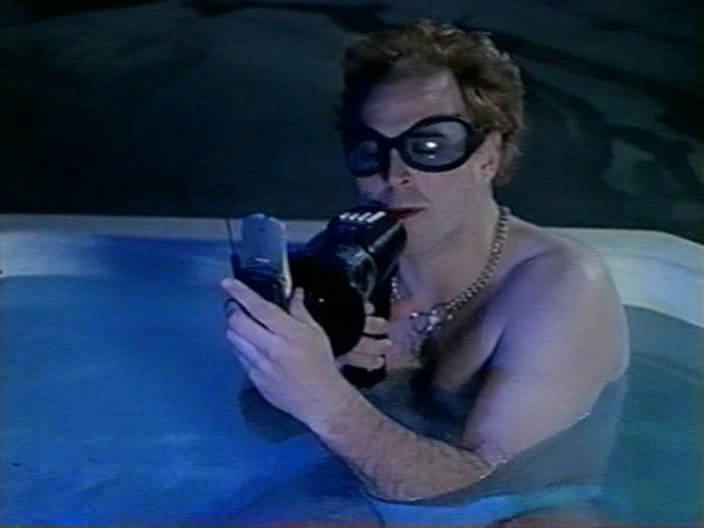
Writer/director Karl Kempter’s 2001 shot-on-video offering Mayhem Motel, for instance. This is most definitely crap — hell, it’s even weird crap, disgusting crap, nauseating crap (less than five minutes into the proceedings a character billed in the credits as “Pukey” throws up in a bathtub — for real — and then proceeds to sit down in his own regurgitated mess), but then, it never pretends to be anything else. There are no affectations  here toward “quality character drama,” Kempter isn’t fooling himself that his film has anything “important” to say, and in fact there’s no real story here to speak of at all, just a series of vignettes centered around a bunch of degenerate fuckwads and various other products of the gene pool’s decidedly shallow end who all happen to be staying (perhaps at the same time, perhaps not — it’s never made clear and frankly doesn’t matter anyway) at the same fleabag motel.

I don’t know about you, but I find that refreshing lack of anything even remotely approaching an agenda to be a strangely noble thing.

mayhemmotel1

It also means that Mayhem Motel  is both a difficult movie to explain, and an easy one to review — plot recaps are completely unnecessary since there literally is no plot, but at the same time simply saying “you’ve really just gotta see it and decided for yourself” sounds like something of a cop-out, even though — well, you really do just gotta see it and decide for yourself. There’s definitely not much of anything resembling a “point” to be taken away from this at-times-self-consciously-weird-for-its-own-sake string of mish-mashed, completely unrelated events — apart from maybe some vague overall suggestion that sex with strangers can get ya killed — and most (okay, all) of the scenes seem more designed to provoke some sort of visceral reaction (even if it’s only “okay, what exactly was that all about?”)  from the audience rather than actually involving you in them, but what the hell — it certainly makes for a one-of-a-kind 70-minute viewing experience.

1234195828_31536

What I can’t say with any certainty, however, is whether or not it’s actually a good one — that’s up to you. The movie’s a mass of contradictions — I mentioned that’s it’s both unpretentious and self-consciously-weird-for-its-own-sake, and trust me, both are true — but the acting (roughly half the parts are played by a guy named Matthew Biancaniello, the other almost-half by a woman named Sara Berkowitz) is of a generally high standard for this type of production (i.e. one shot for a reported $22,000), the lighting is uniformly interesting (if not uniformly effective), and in between the midget, the floating plastic Easter eggs, the guy with a tracheotomy, and the blow-up rubber fuck doll, Kempter really does succeed in creating both a sleazy and genuinely otherworldly atmosphere here. And besides, we ll know that most people will do just about anything for money, but seeing what they’re willing to do for no money is so much more interesting.

So yeah — it’s fair to say that Mayhem Motel does what it sets out to do, I just can’t say whether or not what it sets out to do is really worth doing. That’s a purely subjective call, and while I enjoyed it for what it was, I can certainly see why some folks might turn this off a few minutes after the opening credits. I’m not prepared to say this is one of those things you’re either gonna absolutely love or absolutely hate — like, say, White Castle hamburgers — since I don’t see it as being able to elicit strong reactions along either of the emotional poles like that, but you’re either gonna find it interesting or completely pointless.

Or, perhaps, both interesting and completely pointless.

MV5BMTcwNzE5MzM1M15BMl5BanBnXkFtZTcwMzU5MTk5MQ@@__V1_SY317_CR4,0,214,317_

Mayhem Motel is available on DVD either as a stand-alone release from Brain Damage films (I can’t speak to its technical specs or any extras on that version as I haven’t seen it), or as part of the “Decrepit Crypt Of Nightmares” 50-film, 12-disc box set from Pendulum Pictures, the Mill Creek sub-label that specializes in zero-budget indie and homemade horror. That’s how I caught it and it’s presented full-frame with fairly lousy stereo sound (something of a surprise since Kempter apparently makes his living as a sound mixing guy on various other projects) and no special features or other frills of any sort. Considering the whole package retails for no more than twenty bucks, whaddaya want, anyway? I’d say give it a go if you’re feeling adventurous —  beyond that, you’re on your own.

Review: Bates Motel 1.6 “The Truth”


Bates Motel The Truth

(Warning: Spoilers Ahead)

Ever since Bates Motel began, one of the central questions has been just who was responsible for the death of Norman’s father.  The implication from the start was that Norma (Vera Farmiga) was responsible.  After all, the series began with Norman (Freddie Highmore) finding his father’s body and Norma responding rather calmly to the whole situation.  It was Norma who insisted on leaving town, buying a motel, and starting a new life.  For the past five episodes, it’s Norma who has been the dramatic and manipulative one while Norman has apparently been the one struggling to live a normal life while dealing with his overbearing mother.

In short, it was easy to assume that Norma was responsible.

That said, there has always been a number of viewers who have suspected that Norman would turn out to be the actual murderer.  When the show started, I was one of them.  However, I have to admit that, as Bates Motel progressed, I found myself so caught up in all the other subplots — like the return of Dylan (Max Thieriot) and the creepy Deputy Shelby (Mike Vogel) with his sex slave — that I forgot that there actually was any mystery about the death of Mr. Bates.  I figured it would be one of those plot points that would forever be left open to interpretation.

It turns out I was wrong because last night, the mystery was solved.  As Norma explained to Dylan, Mr. Bates was murdered by Norman.

And, with that explanation, Bates Motel suddenly made a lot more sense.

In the past, Bates Motel has often struggled to define itself.  Last night, however, Bates Motel finally had an identity.  Bates Motel is now a show about a mother trying to protect the world from her son and her son from himself.  With that one revelation, Norma went from villain to sympathetic character and Norman became a lot more creepier.

It’ll be interesting to see how this development will play out over the rest of the series.  Should we be worried about Emma (Olivia Cooke) or the oddly-named Bradley (Nicola Peltz)?

While last night’s episode was dominated by the truth about the death of Mr. Bates, it was also memorable for the fate of Deputy Shelby (Mike Vogel).  After discovering that his sex slave was at the motel, Shelby went on a rampage before finally being shot and killed by Dylan.  Last night’s episode ended with the Bates family staring down at Shelby’s dead body.

How much you want to bet that next week’s episode will feature Shelby being dumped in a nearby swamp?

Random Observations:

  • The Truth is the best episode of Bates Motel so far.  It was certainly the first episode to have a true and definite idea of what the show is trying to be.
  • I loved Norma’s awkward conversation with Emma (Olivia Cooke) at the beginning of the episode.  Emma desperately wants a mom and Norma is frightened of letting anyone get too close to her or Norman.  It created an interesting dynamic.
  • Judging from the previews, next week sees the return of Nestor Carbonell!  YAY!


Disconnected From Disconnect


Disconnect, the feature film directing debut of award-winning documentarian Henry-Alex Rubin, has been getting some fairly positive reviews.  According to Rotten Tomatoes, the film has a critical score of 71 while audiences have been even more impressed.  The last time I checked, it had an audience score of 83%.  If you’ve seen any of the commercials for this film then you’ve undoubtedly heard it referred to as being “the best film of the year.”

That’s high praise for a film that’s essentially Crash with better acting.

Much like Crash (which, incidentally, I consider to be the worst film to have ever won the Oscar for Best Picture), Disconnect is an ensemble film that tells several different stories.  For whatever reason, first-time directors seem to have a weakness for movies with ensemble casts and multiple-story lines.  When done well, an ensemble film can say something profound about the way that people in a society relate to one another.  When done poorly (like in Crash or Disconnect), they just feel trendy.  Watching Disconnect, I felt as if the filmmakers couldn’t come up with a way to tell one compelling story from beginning to end so, instead, they just tossed together fragments of three separate stories and then desperately tried to come up with a theme to connect them all.

That theme, by the way, is that our reliance of modern technology has created a society where people are Disconnected from one another.

Gee, you think?

Disconnect tells three separate, inter-connected stories.  In one story, Paula Patton and Alexander Skarsgard are a married couple who are struggling to deal with the recent death of their child.  Skarsgard deals with his grief by going on long business trips and getting addicted to online gambling.  Meanwhile, Patton joins an online support group and finds herself tempted to have affair another member (Michael Nyqvist).  Patton’s activities leads to identity theft and bankruptcy.  With the help of a sleazy private investigator (Frank Grillo), Patton and Skarsgard try to track down the man who stole their identity.  This story falls apart once Patton and Skarsgard find the man and both characters suddenly start acting in the most inconsistent ways conceivable.  It really should be impossible t0 make charismatic performers like Alexander Skarsgard and Paula Patton seem  bland and boring but somehow, Disconnect manages to do it.

In the film’s best storyline, Grillo’s teenage son (Colin Ford) catfishes and cyber-bullies an alienated classmate (Jonah Bobo).  When Bobo hangs himself as a result, Ford is wracked with both guilt and fear.  Ford’s attempts to cover-up his involvement leads to him meeting and briefly befriending Bobo’s father (Jason Bateman), who has no idea what led to his son attempting suicide.  In this story, Bateman proves that he’s as good with drama as he is with comedy and Ford’s complex and multi-layered performance is more than award-worthy.  This was probably the most powerful part of the film and, if the filmmakers had simply concentrated on this story (as opposed to diluting it by making only one part of a multi-part film), Disconnect would fully deserve the high-praise that it’s currently receiving.

In the film’s third (and most flamboyant) storyline, Andrea Riseborough is a cynical and opportunistic reporter who does a story about a cocky teenager (Max Thieriot) who performs on an adults-only site and who recruits other teenagers for a manipulative pimp (played by none other than Marc Jacobs).  Riseborough finds herself charmed by the teenager (and who can blame her because, after all, he’s played by Max Thieriot) and soon she’s having an affair with him.  However, her news story captures the attention of the F.B.I. and soon both Thieriot and Riseborough find themselves in danger.

At first, I thought I was going to enjoy this storyline because I love Max Thieriot.  He’s ideally cast here and he gives a good, sympathetic performance. For that matter, so does Andrea Riseborough and even Marc Jacobs brings a certain reptilian charm to his role.  However, this story falls apart as it quickly becomes obvious that the filmmakers, having set up a potentially interesting situation, have no idea what to do with it.  Instead, much as with the characters played by Skarsgard and Patton, Riseborough ceases to behave with anything resembling logic or consistency.  Both she and Thieriot go from being interesting, well-rounded characters to being mere plot devices.

That, ultimately, is the main reason why Disconnect fails.  With the exception of the characters played by Bateman and Ford, nobody in this film feels real and, again with the notable exception of Bateman and Ford’s storyline, very little that happens feels genuine.  The film is watchable because of the talented cast but, otherwise, it’s a melodramatic and predictable mess that seems to think that it’s a lot smarter than it actually is.

Perhaps that’s why so many people over on the imdb have been praising this film as “the best of the year.”

Some people will always enjoy feeling like they’re thinking without actually having to do it.

Trailer: Thor: The Dark World (Official)


Thor the Dark World

Iron Man 3 is already premiering in Europe and less than two weeks from premiering in North America. To help tie-over North American filmgoers until Iron Man 3 premieres on this side of the Atlantic Marvel Studios has released the first official trailer for the second film in Phase 2 of their Marvel Cinematic Universe.

Thor: The Dark World sees the Marvel action return to Asgard as Thor must now battle the return of an enemy older than the universe itself. Kenneth Branagh is out as director and in steps Alan Taylor of Game of Thrones as the filmmaker for this sequel. Most everyone returns for this second go-around in Asgard and the Nine Worlds with some new faces such as Chris Eccleston as Malekith the leader of the Dark Elves of Svartalfheim.

Thor: The Dark World is set for a November 8, 2013 release date.

Source: Joblo Movie Network