Enough With The “Bates Motel” Stuff Around Here, How About Some “Mayhem Motel” ?


mayhem-motel

Don’t get me wrong, folks — by and large I kinda like Bates Motel, and I certainly enjoy reading Lisa Marie’s write-ups on each episode here on TSSL, but let’s not kid ourselves —- that show is a soap opera less- than- cleverly-concealed beneath some standard horror genre trappings. You can, of course, say the same for The Walking Dead, another show which I also dig for the most part, but it’s high time we stopped pretending either of these were anything but — well, crap. Enjoyable crap, sure, but crap nonetheless. And I’m certainly not above enjoyin’ me some crap.

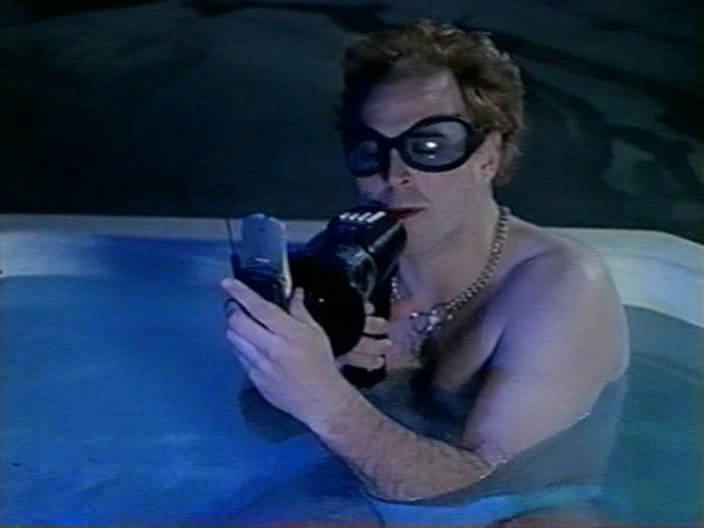
Writer/director Karl Kempter’s 2001 shot-on-video offering Mayhem Motel, for instance. This is most definitely crap — hell, it’s even weird crap, disgusting crap, nauseating crap (less than five minutes into the proceedings a character billed in the credits as “Pukey” throws up in a bathtub — for real — and then proceeds to sit down in his own regurgitated mess), but then, it never pretends to be anything else. There are no affectations  here toward “quality character drama,” Kempter isn’t fooling himself that his film has anything “important” to say, and in fact there’s no real story here to speak of at all, just a series of vignettes centered around a bunch of degenerate fuckwads and various other products of the gene pool’s decidedly shallow end who all happen to be staying (perhaps at the same time, perhaps not — it’s never made clear and frankly doesn’t matter anyway) at the same fleabag motel.

I don’t know about you, but I find that refreshing lack of anything even remotely approaching an agenda to be a strangely noble thing.
mayhemmotel1

It also means that Mayhem Motel  is both a difficult movie to explain, and an easy one to review — plot recaps are completely unnecessary since there literally is no plot, but at the same time simply saying “you’ve really just gotta see it and decided for yourself” sounds like something of a cop-out, even though — well, you really do just gotta see it and decide for yourself. There’s definitely not much of anything resembling a “point” to be taken away from this at-times-self-consciously-weird-for-its-own-sake string of mish-mashed, completely unrelated events — apart from maybe some vague overall suggestion that sex with strangers can get ya killed — and most (okay, all) of the scenes seem more designed to provoke some sort of visceral reaction (even if it’s only “okay, what exactly was that all about?”)  from the audience rather than actually involving you in them, but what the hell — it certainly makes for a one-of-a-kind 70-minute viewing experience.

1234195828_31536

What I can’t say with any certainty, however, is whether or not it’s actually a good one — that’s up to you. The movie’s a mass of contradictions — I mentioned that’s it’s both unpretentious and self-consciously-weird-for-its-own-sake, and trust me, both are true — but the acting (roughly half the parts are played by a guy named Matthew Biancaniello, the other almost-half by a woman named Sara Berkowitz) is of a generally high standard for this type of production (i.e. one shot for a reported $22,000), the lighting is uniformly interesting (if not uniformly effective), and in between the midget, the floating plastic Easter eggs, the guy with a tracheotomy, and the blow-up rubber fuck doll, Kempter really does succeed in creating both a sleazy and genuinely otherworldly atmosphere here. And besides, we ll know that most people will do just about anything for money, but seeing what they’re willing to do for no money is so much more interesting.

So yeah — it’s fair to say that Mayhem Motel does what it sets out to do, I just can’t say whether or not what it sets out to do is really worth doing. That’s a purely subjective call, and while I enjoyed it for what it was, I can certainly see why some folks might turn this off a few minutes after the opening credits. I’m not prepared to say this is one of those things you’re either gonna absolutely love or absolutely hate — like, say, White Castle hamburgers — since I don’t see it as being able to elicit strong reactions along either of the emotional poles like that, but you’re either gonna find it interesting or completely pointless.

Or, perhaps, both interesting and completely pointless.

MV5BMTcwNzE5MzM1M15BMl5BanBnXkFtZTcwMzU5MTk5MQ@@__V1_SY317_CR4,0,214,317_

Mayhem Motel is available on DVD either as a stand-alone release from Brain Damage films (I can’t speak to its technical specs or any extras on that version as I haven’t seen it), or as part of the “Decrepit Crypt Of Nightmares” 50-film, 12-disc box set from Pendulum Pictures, the Mill Creek sub-label that specializes in zero-budget indie and homemade horror. That’s how I caught it and it’s presented full-frame with fairly lousy stereo sound (something of a surprise since Kempter apparently makes his living as a sound mixing guy on various other projects) and no special features or other frills of any sort. Considering the whole package retails for no more than twenty bucks, whaddaya want, anyway? I’d say give it a go if you’re feeling adventurous —  beyond that, you’re on your own.

Review: Bates Motel 1.6 “The Truth”


Bates Motel The Truth

(Warning: Spoilers Ahead)

Ever since Bates Motel began, one of the central questions has been just who was responsible for the death of Norman’s father.  The implication from the start was that Norma (Vera Farmiga) was responsible.  After all, the series began with Norman (Freddie Highmore) finding his father’s body and Norma responding rather calmly to the whole situation.  It was Norma who insisted on leaving town, buying a motel, and starting a new life.  For the past five episodes, it’s Norma who has been the dramatic and manipulative one while Norman has apparently been the one struggling to live a normal life while dealing with his overbearing mother.

In short, it was easy to assume that Norma was responsible.

That said, there has always been a number of viewers who have suspected that Norman would turn out to be the actual murderer.  When the show started, I was one of them.  However, I have to admit that, as Bates Motel progressed, I found myself so caught up in all the other subplots — like the return of Dylan (Max Thieriot) and the creepy Deputy Shelby (Mike Vogel) with his sex slave — that I forgot that there actually was any mystery about the death of Mr. Bates.  I figured it would be one of those plot points that would forever be left open to interpretation.

It turns out I was wrong because last night, the mystery was solved.  As Norma explained to Dylan, Mr. Bates was murdered by Norman.

And, with that explanation, Bates Motel suddenly made a lot more sense.

In the past, Bates Motel has often struggled to define itself.  Last night, however, Bates Motel finally had an identity.  Bates Motel is now a show about a mother trying to protect the world from her son and her son from himself.  With that one revelation, Norma went from villain to sympathetic character and Norman became a lot more creepier.

It’ll be interesting to see how this development will play out over the rest of the series.  Should we be worried about Emma (Olivia Cooke) or the oddly-named Bradley (Nicola Peltz)?

While last night’s episode was dominated by the truth about the death of Mr. Bates, it was also memorable for the fate of Deputy Shelby (Mike Vogel).  After discovering that his sex slave was at the motel, Shelby went on a rampage before finally being shot and killed by Dylan.  Last night’s episode ended with the Bates family staring down at Shelby’s dead body.

How much you want to bet that next week’s episode will feature Shelby being dumped in a nearby swamp?

Random Observations:

  • The Truth is the best episode of Bates Motel so far.  It was certainly the first episode to have a true and definite idea of what the show is trying to be.
  • I loved Norma’s awkward conversation with Emma (Olivia Cooke) at the beginning of the episode.  Emma desperately wants a mom and Norma is frightened of letting anyone get too close to her or Norman.  It created an interesting dynamic.
  • Judging from the previews, next week sees the return of Nestor Carbonell!  YAY!


Disconnected From Disconnect


Disconnect, the feature film directing debut of award-winning documentarian Henry-Alex Rubin, has been getting some fairly positive reviews.  According to Rotten Tomatoes, the film has a critical score of 71 while audiences have been even more impressed.  The last time I checked, it had an audience score of 83%.  If you’ve seen any of the commercials for this film then you’ve undoubtedly heard it referred to as being “the best film of the year.”

That’s high praise for a film that’s essentially Crash with better acting.

Much like Crash (which, incidentally, I consider to be the worst film to have ever won the Oscar for Best Picture), Disconnect is an ensemble film that tells several different stories.  For whatever reason, first-time directors seem to have a weakness for movies with ensemble casts and multiple-story lines.  When done well, an ensemble film can say something profound about the way that people in a society relate to one another.  When done poorly (like in Crash or Disconnect), they just feel trendy.  Watching Disconnect, I felt as if the filmmakers couldn’t come up with a way to tell one compelling story from beginning to end so, instead, they just tossed together fragments of three separate stories and then desperately tried to come up with a theme to connect them all.

That theme, by the way, is that our reliance of modern technology has created a society where people are Disconnected from one another.

Gee, you think?

Disconnect tells three separate, inter-connected stories.  In one story, Paula Patton and Alexander Skarsgard are a married couple who are struggling to deal with the recent death of their child.  Skarsgard deals with his grief by going on long business trips and getting addicted to online gambling.  Meanwhile, Patton joins an online support group and finds herself tempted to have affair another member (Michael Nyqvist).  Patton’s activities leads to identity theft and bankruptcy.  With the help of a sleazy private investigator (Frank Grillo), Patton and Skarsgard try to track down the man who stole their identity.  This story falls apart once Patton and Skarsgard find the man and both characters suddenly start acting in the most inconsistent ways conceivable.  It really should be impossible t0 make charismatic performers like Alexander Skarsgard and Paula Patton seem  bland and boring but somehow, Disconnect manages to do it.

In the film’s best storyline, Grillo’s teenage son (Colin Ford) catfishes and cyber-bullies an alienated classmate (Jonah Bobo).  When Bobo hangs himself as a result, Ford is wracked with both guilt and fear.  Ford’s attempts to cover-up his involvement leads to him meeting and briefly befriending Bobo’s father (Jason Bateman), who has no idea what led to his son attempting suicide.  In this story, Bateman proves that he’s as good with drama as he is with comedy and Ford’s complex and multi-layered performance is more than award-worthy.  This was probably the most powerful part of the film and, if the filmmakers had simply concentrated on this story (as opposed to diluting it by making only one part of a multi-part film), Disconnect would fully deserve the high-praise that it’s currently receiving.

In the film’s third (and most flamboyant) storyline, Andrea Riseborough is a cynical and opportunistic reporter who does a story about a cocky teenager (Max Thieriot) who performs on an adults-only site and who recruits other teenagers for a manipulative pimp (played by none other than Marc Jacobs).  Riseborough finds herself charmed by the teenager (and who can blame her because, after all, he’s played by Max Thieriot) and soon she’s having an affair with him.  However, her news story captures the attention of the F.B.I. and soon both Thieriot and Riseborough find themselves in danger.

At first, I thought I was going to enjoy this storyline because I love Max Thieriot.  He’s ideally cast here and he gives a good, sympathetic performance. For that matter, so does Andrea Riseborough and even Marc Jacobs brings a certain reptilian charm to his role.  However, this story falls apart as it quickly becomes obvious that the filmmakers, having set up a potentially interesting situation, have no idea what to do with it.  Instead, much as with the characters played by Skarsgard and Patton, Riseborough ceases to behave with anything resembling logic or consistency.  Both she and Thieriot go from being interesting, well-rounded characters to being mere plot devices.

That, ultimately, is the main reason why Disconnect fails.  With the exception of the characters played by Bateman and Ford, nobody in this film feels real and, again with the notable exception of Bateman and Ford’s storyline, very little that happens feels genuine.  The film is watchable because of the talented cast but, otherwise, it’s a melodramatic and predictable mess that seems to think that it’s a lot smarter than it actually is.

Perhaps that’s why so many people over on the imdb have been praising this film as “the best of the year.”

Some people will always enjoy feeling like they’re thinking without actually having to do it.

Trailer: Thor: The Dark World (Official)


Thor the Dark World

Iron Man 3 is already premiering in Europe and less than two weeks from premiering in North America. To help tie-over North American filmgoers until Iron Man 3 premieres on this side of the Atlantic Marvel Studios has released the first official trailer for the second film in Phase 2 of their Marvel Cinematic Universe.

Thor: The Dark World sees the Marvel action return to Asgard as Thor must now battle the return of an enemy older than the universe itself. Kenneth Branagh is out as director and in steps Alan Taylor of Game of Thrones as the filmmaker for this sequel. Most everyone returns for this second go-around in Asgard and the Nine Worlds with some new faces such as Chris Eccleston as Malekith the leader of the Dark Elves of Svartalfheim.

Thor: The Dark World is set for a November 8, 2013 release date.

Source: Joblo Movie Network

Scenes I Love: The Final Home Run From The Natural


I love baseball and I love my Texas Rangers.  Josh Hamilton may say that I don’t live in a “baseball town,” but I know that, whether my team is winning or losing, I will always be there cheering them on.

Baseball is known as being “America’s past time” because it’s the oldest sport to have been played in this country.  Football may get more attention but baseball, with its emphasis on teamwork and personal sacrifice, is the sport the epitomizes the American ideal.

There have been some great films made about baseball.  This scene that I love comes from The Natural.  This is a scene that captures the glory and the magic of the game of baseball.

Artist Profile: Joe Chiodo


Chiodo01

Joe Chiodo is a name not unknown to comic book aficionados. The youngest of four boys, Chiodo would grow up to be one of the comic book industry’s most sought after cover illustrators and colorists. His popularity rose during the 1990’s as he contributed cover illustrations for the group of artists who would form the indie publishing, creator-owned company of Image Comics (especially the Wildstorm and Cliffhanger brands).

Chiodo’s pin-up style lends well to the so-called “bad girl” style of comic book characters such as Vampirella, Lady Death, Witchblade and a host of others. His pin-up style was reminiscent of classic pin-up and cheesecake artists such as Dave Stevens and Gil Elvgren. He would add a certain Disney cartoon-style to the mix that would become the unique Chiodo-style fans have come to admire and love.

Joe Chiodo continues to do cover illustrations and coloring for comic book artists and companies. He has also released his own series of artbooks that focuses on his cover works and original art and painting throughout the years.

Chiodo02Chiodo03Chiodo04Chiodo05Chiodo06Chiodo07Chiodo09Chiodo10Chiodo11Chiodo12 Chiodo13

Quick Review – Injustice: Gods Among Us (by NetherRealm Studios)


Injustice-Gods-Among-Us

On my way home recently, I saw a subway poster for Injustice: Gods Among Us, depicting DC Comics characters The Joker really to take a crowbar to the Green Lantern. That seemed interesting, but when I found out that it was a fighting game, I didn’t expect much. Most of the fighting games I’ve played will just toss a number of characters together and have them fight without any real reason to do so. The only game of recent memory to do anything different was Marvel vs. Capcom 3, where you eventually found yourself doing battle with Galactus, but even then, getting to that point was merely a set of random battles from Point A to Point C. After finding out that Ed Boon, creator of Mortal Kombat was involved, I had a feeling the fighting would be good but still empty.

Injustice’s single player game is done in such a way that it gives every character (24 in all, half heroes / half villains) a chance to shine or fall. I haven’t gone all the way through it, but each chapter of the game focuses on a particular hero and the events in that have him or her confronting an enemy to further push the narrative. While I’m not familiar with the story behind it (I’ve always been more of a Marvel than DC fan), it’s compelling enough that I at least want to know what happens next.

The story starts with the full on destruction of Metropolis at the hands of The Joker. As Batman interrogates him, Superman intervenes and we come to find that The Joker somehow manipulated him into killing Lois Lane and his unborn son. The result of this knowledge causes the scene to end in a way that reflects some of the darker tones of the Warner Animated movies like Batman: Under the Red Hood. It shifts to an alternate universe story where – from what I tell – Superman is the ruler of the world with some of the heroes siding with him and becoming your enemies. Can he be defeated? Only crazy button mashing and timing will tell.

As fighting games go, the mechanics to Injustice are very simple. Rooted in the Mortal Kombat style of fighting, you have your basics. Back lets you block anything coming at you high or from the air. Down blocks low sweeps and kicks. Using the diamond formation of console buttons, your light attacks from the 360’s X button / PS3s Square button. Medium Attacks are the 360s Y button / PS3’s Triangle and Heavy comes from the A button / X on the PS3. It’s a good layout that helps the battle flow fast. Combos are also very easy to execute, most of them being of the quick left, right, button press or down, forward button variety. The B button / Circle acts as a special character feature. I thought this was really cool in that every character has either an ability that can be enhanced – Green Lantern charges his ring, Aquaman creates a water shield or Superman uses the Sun to make him stronger. For those were are less than meta, their gadgets / weapons change. Batman brings in a swarm of mini bats, Nightwing’s escrimas fuse together to form a staff and Wonder Woman switches from her lasso to her sword & shield.

InJustice also uses a meter system similar to Street Fighter IV. As you get hurt or string attacks, this meter will fill up in stages. You can use a stage to pull off more advanced moves or if you allow it max out, you can unleash a Signature Move. Some of them are very cool – Both Superman and The Flash have one that I love to do – while others – like Green Lantern’s and The Joker are smile inducing. These are fun, but it would have been nice to maybe incorporate 2 different ones per character. That’s just me.

The backgrounds are used very well in Injustice. If you happen to be near an object that can be used – say a car that’s parked in front of Wayne Manor, a quick bumper button tap lets you smack your opponent with it or throw it at them. Other stages have multiple levels that let you take the battle high or low and damage your enemy in the process. From the street of Gotham City, I sent Solomon Grundy into a chemical truck that exploded, and sent him flying upwards, bouncing off of various apartments until he landed on the roof of a building. That was downright awesome, and strung together with the right combo just adds to the feeling that you’re working with some pretty powerful characters. I haven’t smiled like that since some of my little brother’s Dragonball Z games. Other locations include the Hall of Justice, The Batcave, Atlantis, Themyscira, Arkham Asylum and The Fortress of Solitude. Some of the other locations have multiple levels that be accessed.

And that power can easily be abused, especially when the game goes online. As previously mentioned, the players are divided between those with superpowered abilities (Shazam, Superman, Green Lantern) and the weapons based fighters. I gave the online game a try, which has a number of different modes. While the one on one battles are nice, I liked the Survivor Mode that puts a player as the one everyone needs to dethrone. What’s sweet here is that you can alternate from a theatre mode that lets you watch two people fight or switch over to the current list of people who have waiting to take on the winner. The reigning champ only has so much health to work with from game to game, and I watched one fellow using Black Adam keep everyone at bay with distance shots.  Another used Superman and just kept lasering the opponent. It has room for some cheezy moves, but that’s common with just about any fighter, I think. My Nightwing couldn’t even get close. Then again, I’m not the best fighter in the ring. Every fight you have, whether it’s offline or online gives you some sort of XP, which can be used to unlock and use new Portrait Cards, alternate costumes and backgrounds for your Badge (made popular by Call of Duty).

In terms of problems, the only complaint I have about Injustice is that I hoped there would have been more tailoring to the relationships between the characters. Other than that, the game’s just grand. Marvel vs. Capcom 3 had this system where depending on who you chose and who you were up against, you would get some banter that was character specific. For example, if your tag team of 3 in that game were made up of Thor, Captain America and Iron Man, you’d have an opponent recognize that group as the Avengers. If X-23 faced off against Wolverine, she’d ask him who really was the best at what they do. Injustice does this to a small degree, only happening when you perform a Wager match in a round. Wager matches allow you to bet some of your Meter Power. This results in a scene where the players throw a line at each other before charging at full speed. Whoever wins gains some health. The loser has the opponent’s meter level match his or her damage. Sometimes it works out, other times, it’s just alright. I wanted more of that. My favorite so far is the Nightwing / Joker interaction:

Joker: “I liked you better as Robin.”  / Nightwing: “I liked you better in Arkham.”

Overall, Injustice: Gods Among Us is a great game to play if you’re in either into fighting games or are a fan of the DC Universe. I’m curious as to what the downloadable content is going to contain.

6 Trailers From The Girl At Lake Texoma


Hi there!

Currently, my sister, the Dazzling Erin, and I are relaxing  down at Lake Texoma.  However, if you’ve been reading this site for a while, you know that I would never let a little thing like a vacation keep me from offering up another edition of Lisa Marie’s Favorite Grindhouse and Exploitation Film Trailers!

Before I left for the lake, I sent out the Trailer Kitties and here’s what they brought back!

1) The Terminators (2009)

This film is from our friends at the Asylum so you know it has to be good!

2) Hogzilla (2007)

Believe it or not, this is not an Asylum film.

3) Black Fist (1975)

This film is also known as Bogard.

4) Black Shampoo (1976)

“This stud is no dud…”

5) Cannonball (1976)

“Anything goes in a race across America…”

6) Jackson County Jail (1976)

Tommy Lee Jones is … JACKSON COUNTY JAIL!

What do you think, Trailer Kitty?

trailer k

The Daily Grindhouse: Homebodies (dir by Larry Yust)


Can we just be honest about something?

Most of us are a little bit scared of the elderly.

Oh, we try to deny it.  We talk about how they’re “real characters” or we attempts to convince ourselves that their eccentricities are actually signs of an incurable zest of life.  We tell ourselves that old people remind us of the value of carpe diem but, ultimately, they creep most of us out because, when we look at them, we see our own future.  Regardless of what we do today or tomorrow, we’re all going to eventually become old.  Perhaps that’s why there’s a whole industry devoted to keeping old people out of sight and out of mind.

Today’s entry in the Daily Grindhouse, the obscure 1974 film Homebodies, is effective precisely because it understands that unpleasant truth.

Directed by Larry Yust, Homebodies tells the story of Mattie (Paula Trueman).  Mattie is one of seven elderly retirees who are the sole residents of a condemned apartment building.  All around them, buildings are being torn down and replaced with new apartments.  When an uncaring social worker (Linda Marsh) shows up and informs them that they’re going to be forcefully relocated to an assisted living facility, Mattie take matters into her own hands.  She realizes that every time there’s an accident on a construction site, work stops for a few days.  Hence, if there are enough accidents, work will be stopped indefinitely.  Mattie and her fellow residents (some reluctantly and some not) are soon murdering anyone they view as a threat.  While this is effective initially, things get complicated once Mattie starts to view some of her fellow residents with the same contempt that she previously reserved for construction workers.

Homebodies is one of those odd and dark films that could have only been made in the 70s.  When the film begins, one would be excused for expecting to see a heart-warming comedy about a bunch of plucky seniors outsmarting the forces of progress and real estate.  After all, the elderly residents of the condemned building are all appropriately quirky and, as played by Paula Trueman, Mattie doesn’t seem like she’d be out-of-place as one of the prankers on Betty White’s Off Their Rockers.  Linda Marsh’s social worker and Kenneth Tobey’s construction foreman both seem like the type of authority figures who one would expect to see humiliated in a mawkish 1970s comedy film.

Instead, Homebodies turns out to be an effectively creepy and dark little film.  When the elderly residents of the apartment building fight back, they do so with a surprising brutality that’s all the more effective because of the harmless exteriors of Mattie and her fellow residents.  Paula Trueman makes Mattie into a truly fascinating and frightening monster.  When a few of her fellow residents start to question Mattie’s methods, you truly do fear for them because Mattie has truly proven herself to be capable of just about anything.  While Trueman dominates the film, the entire cast is excellent.  As a classic film lover, I was happy to see that one of the residents was played by Ian Wolfe, a character actor who will be recognizable to anyone who has ever watched TCM.

(Remember the old man who gave the lecture at the observatory in Rebel Without A Cause?  Him.)

I first saw Homebodies on YouTube and I was going to share it below but, apparently, the video has been pulled from the site.  That’s a shame because it’s a film that definitely deserves to be seen, if for no other reason than to appreciate the performances from a cast of underrated character actors who, sadly, are no longer with us.   Unfortunately, the best I can offer is this Spanish-language trailer for the film.

What Lisa Watched Last Night #79: California Dreams 3.14 “Boyz R Us” (dir by Patrick Maloney)


Last night, I watched yet another episode of the mid-90s sitcom, California Dreams.  That episode was entitled Boyz R Us.

And yes, it was a very special episode.

Why Was I Watching It?

As I’ve explained in my previous California Dreams-related posts, I’ve been watching episodes of this 90s sitcom because all of the episodes of Saved By The Bell: The New Class have been yanked off of YouTube.

This was actually the third time I had watched the Boyz R Us episode.  I previously watched it last week with my BFF Evelyn after we saw Tyler Perry’s Temptation.  However, the next day was a busy one and I didn’t get a chance to write about it.  Therefore, in order to maintain the integrity of this feature, I rewatched Boyz R Us yesterday so that I could honestly say that it was what Lisa Marie watched last night.

What Was It About?

In this episode, we discover that Tony (William James Jones) is from “the hood.”  This isn’t surprising since, in the world according to mediocre sitcoms, every single black man on the planet was born in the hood just so he could eventually leave, befriend a bunch of white people, and then be accused of “selling out” in a very special episode.

Tony’s cousin, Darren, drops by for a visit and explains to Tony that “Some changes are going down in the hood.”  When an old friend of Tony’s is crippled by gang members, Tony is forced to choose between being a snitch and going to the police or seeking violent revenge on his own.

Meanwhile, the other members of the California Dreams are all broke and get jobs delivering singing telegrams.  To be honest, compared to what’s happening in the hood, the problems of a bunch of affluent white teenagers seem rather trivial indeed.

Incidentally, I was born in Oak Cliff, Texas which is the Dallas version of the hood.  Just saying…

(Of course, my mom also got us all out of there when I was 14 months old and I wouldn’t know a real gangsta if he came up and stared straight at me but that said, I’m still technically from the hood.)

What Worked?

In some of the other episodes that I’ve seen, William James Jones had a tendency to overact.  However, I thought he did a pretty good job in this episode.  If he went over-the-top, that was largely because the episode itself — with its heavy combination of melodrama and messaging — didn’t leave him much choice.  In this episode, Jones embraced the melodrama and good for him.

Don’t get me wrong.  I appreciate and respect the fact that the show was made with the best of intentions.  (Though you do have to wonder just how many real-life gang members would have been spending their Saturday morning watching California Dreams…)  However, the appeal of this episode really is that it’s so over-the-top and melodramatic.

Seriously.

For 22 minutes, everything with Tony is a drama.  Every phone call he gets is bad news and you get the feeling that the other Dreams are starting to dread the prospect of being anywhere near him.  And then, at the end of the episode, Tony manages to not only convince Darren not to throw his life away but also rallies the entire community to finally stand up to the gang culture.  You can argue that the episode’s resolution isn’t all that realistic (for one thing, nobody seems to have considered that at least one of the two gang members would probably have had a weapon of his own) but that’s part of the appeal.

Also, was it just me or did it seem that the California Dreams were personally arresting the two gangstas at the end of the episode?

What Did Not Work?

Two words: Singing telegram.

The singing telegram subplot would have been weak under normal circumstances but when coupled with all of the melodrama and heavy messaging of the main plot, it looked even weaker.  Seriously, do the California Dreams not have parents to borrow money from?

I’m also found myself wondering if their final client specifically told Sly, “I want a group of teenagers dressed like keystone cops to sing to my girlfriend.”

Finally, the show’s writers missed a golden opportunity to have Jake announce, “Jake Summers doesn’t do silent film buffoonery.”

“Oh my God!  Just like me!” Moments

“I just want to know what its like to poor!”  That sounds like something I’d say while attempting to be cute.

Lessons Learned

“Two years is a long time to be gone from the hood…”