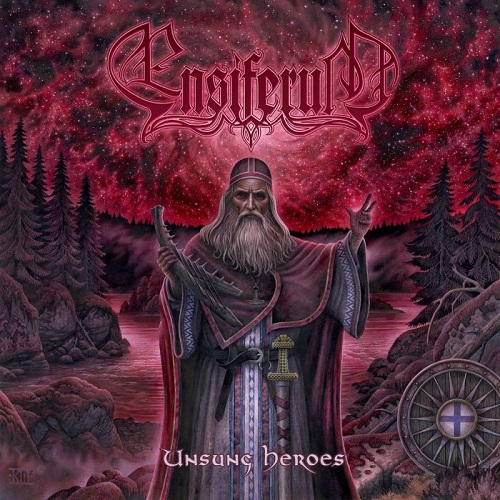
Review: Ensiferum – Unsung Heroes


I read so many negative reviews of Unsung Heroes that I actually avoided listening to it for four months. My acquaintance with Ensiferum goes all the way back to their 2001 full-length debut, and I was in no hurry to hear such an essential and formative band for me fall by the wayside. I finally gave it a spin for the first time last night, and frankly I don’t know what everyone is bitching about.

In My Sword I Trust

I mean, sure, Unsung Heroes isn’t the explosive powerhouse of Victory Songs and From Afar. But was I the only person who got the feeling on From Afar that their standard formula was growing really stale really fast? Ensiferum may have set the standard for folk metal as we know it today, but beneath the fist-pumping and epic folk interludes of even tracks like Twilight Tavern and Stone Cold Metal I got the sneaking suspicion that they were beginning to succumb to the very genre stereotype they established. Victory Songs certainly stands as my favorite Ensiferum album to date, but I kind of felt like From Afar was riding too much on its success. Almost every song followed the formula that made Victory Songs so great, and while this certainly facilitated a fresh batch of great songs, it was less than I’d hoped from a band that had consistently paved their own way over the years.

Is Unsung Heroes a washed out version of Victory Songs and From Afar? Only if you claim that those albums capture exactly what Ensiferum ought forever more to sound like. I for one think it’s a breath of fresh air. It reminds me, if anything, of their 2001 self-titled. It humors the possibility of rocking out without lightspeed double bass. It dares to occasionally divorce overbearing synth and “epic” orchestrated overlays from the folk passages. It drops, I think, the degree of pretentiousness that concerned me on From Afar. I have no interest in listening to the musical equivalent of 300 spin-offs ad nauseam. The total testosterone indulgence of Victory Songs was exciting in its day, but in music and film alike it grows old quickly.

Pohjola

I really feel like Unsung Heroes is Ensiferum’s most mature work to date. That doesn’t make it their best; Victory Songs was just too perfect and the self-titled too nostalgic to be trumped any time soon. But on Unsung Heroes I can again feel like I’m listening to a band who share my nerdy lust for all things fantasy. There’s none of the glam and special effects that dazzled me on Victory Songs but made me begin to feel distanced from the band on From Afar. I’m absolutely thrilled to be able to connect with these guys again in the more personal way I felt on their first album.

And really, what can you possibly complain about on a track like Pohjola save that it doesn’t fall into the formula of their last two albums? I’ve heard people say they’re becoming a Turisas knock-off. That’s absolutely ridiculous. Post-Battle Metal Turisas has served as the ultimate Hollywood blockbuster band–glossy and refined, if Victory Songs was Ensiferum’s 300, Varangian Way was Turisas’s Lord of the Rings. Tracks like Pohjola might have epic operatic vocals and orchestration, but the surrounding atmosphere is completely different from either of those works. The viking metal riffs that really start to pick up at the 3 minute mark ought to be a revealing sign that this song is all about the steady drive. The orchestration ebbs and flows without many hard, dramatic stops. The synth whistle that accompanies the main riff in the earlier stages of the song gives it a light-hearted, positive feel that carries throughout. The acoustic guitar outro is beautiful, but it’s also accessible. It’s something you the listener could pick up your guitar and play.

Unsung Heroes isn’t perfect. Sami Hinkka’s clean vocals leave a bit to be desired, especially on “Last Breath” where they take center stage. That, the ninth track, is really the first moment on the album where I begin to see where any complaints might have a leg to stand on. If the 17 minute-long closer which follows–“Passion Proof Power”–was as good as we’ve come to expect from an Ensiferum grand finale, any petty complaints about “Last Breath” might be easily forgotten. The problem is that “Passion Proof Power” is frankly pretty bad. It starts off a lot slower than the rest of the album’s non-acoustic tracks, more inclined to bore me than build anticipation. When it does pick up there’s no clear direction as to what’s going on. The song gives way into some really, really lame progressive rock, coupled with boring, unconvincing spoken passages and completely misplaced operatic vocals. The song never really builds up into anything. There are moments here and there where you might find yourself drawn back in–at the 13 minute mark for instance–but as the song continues to go nowhere you’ll forget about it again soon enough. I can’t make any excuses here; “Passion Proof Power” is a waste of 17 minutes, and if you skipped ahead to it expecting to hear Ensiferum’s finest effort–a reasonable thing to do considering how they’ve concluded past albums–you may well be left with the impression that Unsung Heroes is terrible. Follow that up with an embarrassing bonus track cover of Gypsy Kings’ Bamboleo and yeah, you definitely have a right to demand the last 20 minutes of your life back.

http://www.youtube.com/watch?v=3xZK_CJ4TJI

Burning Leaves

In conclusion, this is perhaps Ensiferum’s most down to earth album to date. It’s all about moderation and maintaining a steady drive while never over-extending or burning out into a bore. It doesn’t crush or dazzle; it rocks along, and does so with some really compelling orchestration that’s uniquely accessible. I think there’s this common misconception that fantasy-themed music has to sound larger than life, but for me that’s a detriment in all but the most perfect, Victory Songs/Varangian Way-level instances. If it sounds fake it’s not doing a very good job of creating fantasy now, is it? Unsung Heroes paces itself and transitions in ways that feel legitimate. I love it, at least for the first 40 minutes. It doesn’t so much progressively decline from there as stall mid-air and nose dive; they should have put “Last Breath” before “Pohjola” and made the latter the finale. “Passion Proof Power” and “Bamboleo” are garbage B-sides better suited for some bonus disc on a collector’s edition. (I suppose Bamboleo technically is a “bonus” track.) To say Unsung Heroes is a great album while chucking out a full 20 minutes of its content is a bit of a stretch, but because the weak points are condensed on the fringe rather than interspersed throughout the album, and because 40 minutes of outstanding new Ensiferum is certainly sufficient, I am content to delete the last two tracks from my playlist and call it a success.

Finally! DFW Weighs In On The Oscar Race


It’s Oscar season and we’ve finally reached the moment that you all know you’ve been waiting for.  That’s right — my hometown has finally made its voice heard!

The DFW Film Critics Association is made up of film critics who work for media outlets in the Dallas/Ft. Worth metroplex and throughout North Texas.  Every December, they announce their picks for the best in cinema.

Here are their picks for 2012.  There’s a few pleasant surprises (like the fact that  Life of Pi, Skyfall, and the Master all made their top ten) and a few annoying shocks (because seriously, if Texas critics can’t appreciate Bernie, who can?) but, for the most part, the winners are pretty much what you would expect.  I think some of this might be because I’m not a member of the DFW Critics Association.  Fortunately, I’ll be announcing my own picks for the best in 2012 during the first week of January.

Best Picture:

1) Lincoln

2) Argo

3) Zero Dark Thirty

4) Life of Pi

5) Les Miserables

6) Moonrise Kingdom

7) Silver Linings Playbook

8) Skyfall

9) The Master

10) Beasts of the Southern Wild

Best Actor:

1) Daniel Day-Lewis in Lincoln

2) Joaquin Phoenix in The Master

3) John Hawkes in The Sessions

4) Hugh Jackman in Les Miserables

5) Denzel Washington in Flight

Best Actress:

1) Jessica Chastain in Zero Dark Thirty

2) Jennifer Lawrence in Silver Linings Playbook

3) Helen Mirren in Hitchock

4) Emmanuelle Riva in Amour

5) (tie) Quvenzhane Wallis in Beasts of the Southern Wild and Naomi Watts in The Impossible

Best Supporting Actor

1) Tommy Lee Jones in Lincoln

2) Phillip Seymour Hoffman in The Master

3) Christoph Waltz in Django Unchained

4) Alan Arkin in Argo

5) Robert De Niro in Silver Linings Playbook

Best Supporting Actress

1) Sally Field in Lincoln

2) Anne Hathaway in Les Miserables

3) Amy Adams in The Master

4) Helen Hunt in The Sessions

5) Ann Dowd in Compliance

Best Director

1) Kathryn Bigelow for Zero Dark Thirty

2) Steven Spielberg for Lincoln

3) Ben Affleck for Argo

4) Ang Lee for Life of Pi

5) Wes Anderson for Moonrise Kingdom

Best Foreign-Language Film

1) Amour

2) A Royal Affair

3) The Intouchables

4) Holy Motors

5) The Kid With A Bike

Best Documentary

1) Searching For Sugar Man

2) Bully

3) How To Survive A Plague

4) West of Memphis

5) The Invisible War

Best Animates Film

1) Paranorman

2) Frankenweenie

3) Pirates: Band of Misfits

Best Screenplay

1) Zero Dark Thirty

2) Django Unchained

Best Cinematography

1) Life of Pi

2) Skyfall

Best Musical Score:

1) Lincoln

The Russell Smith Award:

Beasts of the Southern Wild


This Holiday Season, Giovanni Lombardo Radice Needs Your Help!


If you’re a fan of Italian horror, then you know who Giovanni Lombardo Radice is.  He danced for you in The House On The Edge of the Park.  He came back from the dead and helped to destroy the town of Dunwich in City of the Living Dead.  He went on an eating binge at a movie theater in Cannibal Apocalypse.  He’s appeared in three films directed by Michele Soavi, he recorded one of the greatest DVD commentaries ever for Cannibal Ferox, and he was a contributor to one of the most important books about Italian horror cinema, Eaten Alive.

However, there’s more to Giovanni Lombardo Radice than just a resume of showy roles in bloody movies.  He’s also a director, a writer, and an animal lover.  As anyone who follows him on Facebook knows, he can discuss the intricacies of William Shakespeare with the best of them.  He has appeared in films directed by people like Martin Scorsese and he is one of Quentin Tarantino’s favorite actors.

Most importantly, while he has always claimed to be somewhat bewildered by the popularity of some of his films, Giovanni Lombardo Radice is an actor who has always been kind and gracious to his fans.   I’ve met several Italian horror fans who have told me about how excited they were to get a reply to a question from Giovanni or how touched they were to get a gracious message from him.  Myself, I can still remember how excited I was when Giovanni responded to a rather odd dream that I had posted in my online dream journal.  (The dream and his response can be read here and here.)

Recently, Giovanni posted the following on his Facebook page:

MY dog Tommy has hernia and most probably must have surgery. Just what I needed….if you read that someone robbed a bank to cure his dog it will be me.

Anybody who is lucky enough to be friends with Giovanni on Facebook knows how much he loves animals and how much he loves Tommy.  Speaking as someone who spends 8 hours a day looking at cute cat pictures, my heart went out to him.

Earlier today, Giovanni announced (again on Facebook) that Tommy’s operation had been a success!  However, Giovanni is also flat broke.  People tend to assume that a cult film star like Giovanni Lombardo Radice must be rich but that’s rarely the case.  It’s been over 30 years since Giovanni made (and was paid for) the films that most people know him from and films like The House On The Edge of the Park and Cannibal Apocalypse didn’t become cult films until several years after they were first released.  When someone buys a DVD or a Blu-ray of a film like The House On The Edge of the Park, the money goes to the film’s distributor, not to the actors who appeared in the film.  Though Giovanni Lombardo Radice is definitely a star to many of us, he’s also just a working actor who struggles to make ends meet just like everyone else.

So, Giovanni Lombardo Radice is currently asking for help.  He has set up a paypal account connected to his e-mail address, info@giovannilombardoradice.com and he is accepting donations of any amount to help pay for Tommy’s surgery.

As an actor, Giovanni has always been there for his fans.  Hopefully, some of them will now be there for him.

Thank you for reading this and for your consideration.  And, to Tommy and Johnny, I wish both of you all the best this holiday season.  Buona fortuna!

Tommy

Tommy

Film Review: Killing Them Softly (dir. by Andrew Dominik)


Killing Them Softly is perhaps the most unpleasant film of 2012.

Taking place in 2008, Killing Them Softly tells the story of how a poker game got robbed in New Orleans and how that robbery led to a lot of people getting killed.  The poker game is run by Markie (Ray Liotta), a likable and well-meaning gangster who made a big mistake in the past.  A few years  previously, Markie arranged for one of his poker games to get robbed.  Though everyone knew that Markie was guilty, nobody could prove it and Markie continued to claim his innocence even while being tortured by a legendary hitman named Dillon (Sam Shepard).  So, years later, three small-time crooks figure that if they rob another one of Markie’s games, the Mafia will automatically blame Markie and hold him responsible.

Unfortunately, one of the crooks (played by Ben Mendelsohn, who was so good in Animal Kingdom) is also a heroin addict and something of an idiot.  He talks to the wrong people and soon the Mafia knows who was actually responsible.  Since Dillon is in the hospital, his protegé Jackie (Brad Pitt) is sent down to New Orleans to take care of the situation.  As Jackie explains to the mob’s representative (played by Richard Jenkins who gives a very Richard Jenkinsy performance here), not only do the three criminals have to die but Markie has to die as well.  It’s all strictly business.

Speaking of business, this entire story plays out against the backdrop of the 2008 elections.  For some reason, all of these sleazy criminals seem to be obsessed with watching CNN.  As a result, nearly every scene features either George W. Bush or Barack Obama speaking in the background.  At one point, Jackie says, “This is America,” just in case you couldn’t figure out that the film’s plot is supposed to be allegorical.

Killing Them Softly is an odd film, a well-made film that never quite convinces us that its story needs to be told.  Brad Pitt is miscast as Jackie and James Gandolfini has a truly annoying cameo as an alcoholic killer but otherwise, the film is perfectly cast.  Mendelsohn and Scoot McNairy are believable as two of the stupidest criminals to ever appear on-screen and Ray Liotta is likable and sympathetic as the tragic Markie.  Director Andrew Dominik makes good use of the New Orleans locations and the film has a few genuinely suspenseful moments.  That said, the film’s graphic and brutal violence quickly goes from being shocking to just being tedious.

If for no other reason, I did appreciate the fact that Killing Them Softly was brave enough to lump Barack Obama in with every other politician whose words are used to punctuate the film’s action.  Here in America, filmmakers tend to be very hypocritical when it comes to criticizing the government, going to almost ridiculous lengths to excuse Obama for following the same policies that they previously spent eight years attacking George W. Bush for instituting.  Instead of attempting to promote any partisan position, Killing Them Softly argues that the business of America will remains the same regardless of who is in charge.  Normally, that would seem to be a pretty obvious point but, in today’s cult-like political climate, it’s practically revolutionary.

Critics have been mixed on Killing Them Softly but, judging on both the film’s anemic box office and a lot of the comments that have been left online, audiences seem to absolutely loathe this film.  This isn’t particularly surprising because Killing Them Softly, with its constant emphasis on everything that’s ugly and dirty about life, seems to be a film that was specifically made to annoy audiences.  Even the film’s strengths ultimately serve to alienate the viewer.  I suspect that was Andrew Dominik’s ultimate goal and, on that count, he definitely succeeded.

Ultimately, I guess that’s why I ended up developing a strange sort of respect for Killing Them Softly, even though I found it impossible to enjoy the film itself and I would rather visit my gynecologist than ever have to sit through it again.  This is a film that stays true to itself, even at the risk of becoming unwatchable as a result.

Trailer: Star Trek Into Darkness (Official Trailer)


StarTrekIntoDarkness

Over ten days ago we saw the release of the teaser trailer for Star Trek Into Darkness. This sequel by J.J. Abrams for the reboot of the storied scifi franchise looks to be one of the most-anticipated films of 2013 (if the world doesn’t end in a couple days of this posting that is). Today we get the release of the official trailer which adds in a couple of new scenes and images not included in the teaser.

Again there’s some debate as to which villain Benedict Cumberbatch is really portraying despite being listed in the cast as the character of John Harrison. The even money bet is that he plays a version of Kirk’s archenemy Khan Noonien Singh which is a strong possibility since the early draft for the Khan character was suppose to be a Nordic superhuman by the name of John Ericssen. Even Abrams himself has never said outright that he would never use the Khan character as the villain in this rebooted franchise. Whether he uses the classic Trek villain in this sequel or the next should get an answer as we get closer to the film’s release date.

Star Trek Into Darkess has a release date of May 17, 2013.

What Lisa Watched Last Night #59: Dead Season (dir by Adam Deyoe)


Okay, I know what you’re going to say.  “Hey, Bowman, Dead Season was just on the SyFy network a few hours ago.  What’s up with this last night crap?”  Well, it’s true that I did watch Dead Season from 8 to 10 on Saturday night.  It’s also true that,  as I sit here starting this review, it is a few minutes passed midnight.  In other words, it is now Sunday and therefore, I can truthfully say that I watched Dead Season last night.

Seriously, people, work with me here.

Why Was I Watching It?

Tonight, as far as watching a movie on television was concerned, I had two options.  I could have either watched Elf on ABC or I could have watched Dead Season on SyFy.  I ended up going with Dead Season because I’ve already seen Elf a few thousand times and I know that I’ll probably end up watching it again on Christmas Eve with my sisters.  Plus, watching a bad movie on SyFy (and writing about it on twitter while doing so) has become something of a Saturday night tradition for me.

What Was It About?

(Minor Spoilers Below)

Your guess is as good as mine.

Seriously, Dead Season generated a near record number of tweets last night and the majority of those tweets were some variation of “WTF!?”  I somehow managed to pay attention to the entire film and I’m still not 100% sure what I saw.  However, here’s my interpretation of the film’s plot:

The zombie apocalypse has hit.  All across the world, the dead are wandering around and eating people.  The few remaining living humans spend their time listening to vinyl records and talking to each other via short wave radio.  If I sound a little bit confused, that’s because the first few minutes of the film is narrated by a guy who is using one of those radios and appears to be exclusively broadcasting on the static channel.

Elvis (Scott Peat) is a doctor who meets a woman named Tweeter (Marissa Merrill).  Tweeter has a kid with her who might be her son but then again, he might not be.  Actually, it’s probably best just to pretend like the kid isn’t in the film.  That’s what we did on twitter.

Eventually, Elvis and Tweeter set sail on a boat and they end up on some jungle island off of South America.  The jungle is full of zombies but luckily, they come across a compound that’s run by Kurt Conrad (James C. Burns).  Kurt has a collection of soldiers, a small harem of concubines, and a daughter (Corsica Williams) who hasn’t left her room in 10 months.

Kurt welcomes Elvis and Tweeter into the compound.  Tweeter starts to bond with Kurt’s daughter while Elvis discovers that his new job is to be both the camp’s doctor and the camp’s cook.  Apparently, Kurt’s a cannibal and eats other survivors.  Elvis is reluctant to take part but Kurt tells him, “I’ve seen you walk in the darkness.”

Meanwhile, Tweeter comes across a bunch of home movies, which she watches while Elvis and Kurt debate the morality of the zombie apocalypse.

And then some other stuff happens.

Again, your opinion of what happened in the film might differ.

What Worked?

While we were talking about the movie on twitter, my friends and I agreed that absolutely nothing worked.  Seriously.  At one point, #deadseason actually became a trending topic and I felt the need to issue an apology to anyone who might end up watching the film as a result.

That said, with the hindsight the comes from three hours of contemplation, I can now say that — despite the fact that their characters were kinda annoying — both Scott Peat and Marissa Merril did about as well as they could with the material that they were given to work with.

What Did Not Work?

Good Lord, where to begin?

Storywise, the film felt like a total rip-off of The Walking Dead.  However, after doing a little research on the imdb, it appears that this film was actually in production before The Walking Dead even premiered.  That said, it was still impossible to watch the film and not unfavorably compare it to The Walking Dead.  The zombies are even called “walkers” at several points.

Technically, the film is a mess.  This is one of those films where various members of the camera crew make cameo appearances.  Most noticeably, the film has one of the most out-of-control, garbled sound tracks that I’ve ever heard.  One conversation between Kurt and Elvis was literally unintelligible because of the overpowering sound of chirping crickets.

Finally, this is one of those zombie films where people are constantly getting blood splashed all over their clothes but yet they never seem to consider changing outfits.  Seriously, I would hate it if I got blood all over the only shirt I had bothered to bring to the zombie apocalypse.  Tweeter spends the first third of the film in a blood drenched shirt and, despite the fact that she’s on a boat and surrounded by water, it never seems to occur to her to try to wash the blood off.  Honestly, after spending a week in a blood-covered shirt, I’m just going to take it off.  I don’t care who sees my boobs.

Admittedly, I am a bit of a clean freak but surely, I’m not alone in this.

“Oh my God!  Just like me!” Moments

If there’s one rule that I learned from zombie films and that I live by, it’s that you should always be sure to pack an extra lacy black bra in case of a zombie apocalypse.  Tweeter, as is revealed several times during the film, agrees with me.

Lessons Learned:

I didn’t learn a damn thing.  So there.

6 Trailers That Have Absolutely Nothing To Do With Christmas


Hi everyone!  Is the Christmas season stressing you out?  I know it is for me.  I’ve got multiple Christmas Parties to attend this week, Dazzling Erin and I have a house that’s only halfway decorated, and I’ve still got a lot of presents to buy. We have something for Sonny, we have the tie for Fredo, and Tom Hagen gets the Reynolds Pen but otherwise, I’m still struggling to get all of my shopping done.

(It would help if I could stop finding so much stuff that I want for myself.)

With all that in mind, here’s the latest edition of Lisa Marie’s Favorite Grindhouse and Exploitation Film Trailers!  Below are 6 trailers that have absolutely nothing to do with Christmas!

Enjoy!

1) Sting of the Dragon Masters (1973)

2) Stacey (1973)

3) The Italian Stallion (1970)

4) Tattoo (1981)

5) Mad Monkey Kung Fu (1979)

6) Americathon (1979)

What do you think, Trailer Kitty?

20121106_19

Song of the Day: Misty Mountains from The Hobbit: An Unexpected Journey


65047_458472170855060_397938394_n

This weekend sees the release of Peter Jackson’s long-awaited first film in The Hobbit trilogy. With news of a new Peter Jackson adaptation of a Tolkien source material there will also be news of the return of film composer Howard Shore back to the musical legacy that is the Middle-Earth film franchise. The latest “Song of the Day” comes from the soundtrack to The Hobbit: An Unexpected Journey and the track I chose has already become the most recognizable theme in this first film of the latest trilogy.

“Misty Mountains” was composed by Plan 9 and David Long and was sung by Richard Armitage as Thorin Oakenshield and his company of Darf Companions as they spend a quiet time in Bilbo Baggins’ home the night before they set out on their quest to destroy Smaug and retake their ancestral kingdom of Erebor in the Lonely Mountain to the far east of the Shire. Every Peter Jackson entry to the Middle-Earth saga has always had the cast sing one or two songs which comes straight out of the many songs created by J.R.R. Tolkien for his novels, short stories and appendices.

This song almost describes the past and future of Thorin Oakenshield as it describes in prose the destruction of his home of Erebor in the hands of Smaug the Dragon, but it could also describe a future event him and his company of Dwarfs (and one hobbit) must defeat as part of the climax of this first part of the new trilogy. The song is just a very well made one and very memorable. So memorable that there’s already reports of people who have returned for repeat viewings of the film joining in the singing of the song when it appears on the screen. While I wouldn’t want my experience interrupted by some in the audience trying their best to sound just as good singing in a deep tenor as Richard Armitage I can’t blame some of these fans for their love and enthusiasm for the song.

Misty Mountains

Far over the Misty Mountains cold,
To dungeons deep and caverns old,
We must away ere break of day,
To find our long-forgotten gold.

The pines were roaring on the heights,
The winds were moaning in the night,
The fire was red, it flaming spread,
The trees like torches blazed with light.

Review: Blut aus Nord – 777 Cosmosophy


Blut aus Nord generated a lot of waves in the metal scene last April when they released Sect(s), the first installment in their 777 trilogy. The album was a gripping ride through a vivid musical nightmare, merging industrial music and a particularly demented take on black metal to paint its demon-ridden post-apocalyptic landscapes. The Desanctification, released in last November, flew much lower under the radar. Lacking all of Sect(s)’s shock value, it was a more contemplative plod which capitalized on the industrial side of their 777 sound and presented the devastation inflicted first-hand on Sect(s) from a less intimate angle. If the listener was the victim on Sect(s), Desanctification offered the role of witness.

Cosmosophy, the final installment in the 777 trilogy, was released this September, and a lot hinged on it. Sect(s) and The Desanctification were drastically different and yet inseparable, the second naturally flowing from the first. How did Blut aus Nord intend to bring it all to an end?

http://www.youtube.com/watch?v=Y3krELtQpSw

In the very last way anyone could have ever expected: They repeated the exact same thing they did on The Desanctification. It’s a brooding, visually stunning bird’s-eye view of a cyberpunk holocaust, and as such it’s just as outstanding as its predecessor. But where is it going?

If Blut aus Nord released two albums like this every year they might well become my favorite band. I’ve been dying for this kind of material, and The Desanctification and Cosmosophy both fill that niche with a degree of excellence that surpasses all other attempts I have heard. But I guess for me the 777 series was telling a story, vague though it need necessarily be, and Cosmosophy just kind of waves that off. It’s an outstanding album in its own right, but it does not feel appropriate in the context of the trilogy.

Epitome XVII and XVIII are somewhat of an exception,and they’re the tracks I’ll be sampling here. XVII has a definite sense of conclusion about it. It’s not an optimistic one, especially given the lyrics–“How many seasons beyond this sacred life? How many treasons beyond this clever lie?” But the feeling is one of profound revelation, as if the listener in this nearly wordless narrative has finally come to see the grand vision we were all hoping Cosmosophy would offer. The transition that spans from about 4:20 to 6:20 is pensive, serving to reintroduce the darkness that resolution has by no means abated. As this fades and we reach the final track in the trilogy, you can definitely see the story coming to an end:

http://www.youtube.com/watch?v=DoUZRsDGlSg

Epitome XVIII is one of the finest of those bird’s-eye perspectives on the greater 777 landscape, and in its context it offers something of a new, esoteric light on the devastation below. The outro that begins to fade in after the 7 minute mark is the perfect conclusion and perhaps the darkest moment in the entire trilogy, epic in its silence. Of Cosmosophy’s two concluding tracks I have no complaints. It’s the first three that get us there that leave a lot to be desired.

If you care to revisit The Desanctification, it ends on a completely twisted industrial groove that offers all of the madness of Sect(s) without any of the fear–a sense that the subject (the listener) is breaking down into utter insanity, becoming a part of the surrounding chaos. I desperately wanted Cosmosophy to pick up on this note. I wanted to hear a merging of Sect(s)’s black metal and Desanctification’s industrial that, if you’ll humor my manner of description, merged the victim and the witness into one. I expected a juxtaposition of the sweeping landscapes and the frantic madness that could, in the context of the trilogy, depict a sort of out of body experience in the subject/listener. Epitome XIV and XVI instead feel like unused (though equal) tracks from Desanctification, while XV offers three minutes of obnoxiously spoken French which quite frankly fails to invoke anything but annoyance before plunging into an outstanding but compromised semi-operatic sweep that could have found a place on the album but lacks appropriate context as presented.

Epitome XV is the only track I dislike in the trilogy, while XIV and XVI seem out of order. In the meantime, I feel like an essential step between Desanctification’s XIII and Cosmosophy’s XVII is missing. In short, Cosmosophy does not live up to my ridiculously high expectations. If Blut aus Nord were to come out with a surprise Part 4, I certainly would not deem it overkill. But if we view Cosmosophy as just another 2012 metal album there is hardly room to complain. It is only in light of the standard set by Sect(s) and The Desanctification, and in expectation that the conclusion ought to be the 777 trilogy’s finest hour, that it slightly disappoints.