Addendum: It was brought to my attention that Maryam and Olivia d’Abo are actually cousins, rather than sisters. This was corrected.
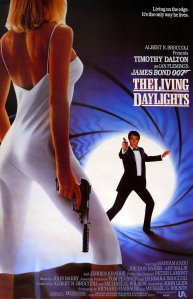
The Shattered Lens continues it’s coverage of all things Bond with 1987’s The Living Daylights. Timothy Dalton was once approached to play 007 after Connery left the franchise the first time, but being only 22 at the time, he considered himself a bit too young for the role. It was only after Roger Moore’s final role in A View to a Kill that he reconsidered and brought on as Britain’s superspy. What I liked about Dalton as Bond was that he was very cold and direct. There was nothing stylish about him, nor did he really try to be (aside for the usual Bond quip). For me, there was sense of darkness to the character. Dalton’s Bond felt like someone just a second away from doing damage to someone, but not exactly caring about how smoothly it was done. This may be partially why I’ve liked Craig so far in his films.
Below is the trailer for The Living Daylights. It makes chuckle how the word “Dangerous” gets thrown on screen every now and then.
The Living Daylights deals with a Russian plot to kill spies. General Gogol in the Roger Moore films was replaced with General Pushkin (John Rhys-Davies, Sallah from the Indy Films and Gimli from Lord of the Rings), and MI6 believes they are behind the recent deaths of agents during a training mission. Bond is asked to help eliminate a sniper for a defecting Soviet named Koskov (Jeroen Krabbe), but upon realizing that the sniper is a woman, he deliberately misses, shooting the frame of the gun and catching the sniper off guard. Bond manages to get Koskov out of Russia via a tube system, but Koskov is later kidnapped again.
We come to find that Koskov’s defection was a fake and that he’s working with an arms dealer (played by Joe Don Baker, who would later return to the Bond Franchise in Goldeneye as a different character), smuggling Opium and arms. Bond locates the sniper, who turns out to be Koskov’s girlfriend Kara (Maryam d’Abo) and poses a friend to Koskov to get closer to him. Granted, this ends up with Kara falling in love with James and we all know where that goes. d’Abo wasn’t bad as a Bond girl, but arguably her cousin, Olivia was more popular at the time.
Q Branch supplies Bond with a few fun gadgets. Back in the 80s, one fad were these keychain finders that would beep when you whistled or made a sound. 007 receives one of these with both an explosive and a smoke gas pellet inside. It’s pretty much the same setup that Connery had in From Russia With Love, placed in a more “modern day” casing (well, as modern as 25 years ago). Bond is also given an Aston Martin V8 Volante, and after all the Lotus editions in the Moore films – perhaps with the exception of the one that doubled as a sub, that one was awesome – it’s really wonderful to see the franchise return to it’s automotive roots. The car is outfitted with missiles, lasers in the hubcabs, on board skis and the all important self destruct system. As with all of Bond’s toys, he doesn’t manage to return this to Q.
From an action point of view, there isn’t a great deal in The Living Daylights. That’s a fantastic snow chase early on, and a fight on an airplane so popular that it was mimicked in the videogame Uncharted 3: Drake’s Deception. Neither of these try to be too over the top and work to great effect, but there are also a number of slow pacing moments that frankly had me wanting to fast forward through the film. I thought the sequence with the desert was drawn out just a little too much, lending to my notion that whenever a James Bond film uses the desert as a filming location, the movie just isn’t as strong in my eyes. Others, of course, may disagree. What the film does do well is establish Dalton as the new Bond. It doesn’t make fun of who he is compared to who came before in the way Her Majesty’s Secret Service did and just gives you an action sequence that says “Take it or leave it, this is who we’re running with”. I like to think it worked well. One could say it becomes the template for all of the “new 007” films
The Living Daylights notes a few changes in the Bond style. It would be the last film ever scored by long time Bond musician John Barry. The Dalton film after this, License to Kill was actually done by the late Michael Kamen (Robin Hood, Die Hard), and everything after that was either done by Eric Serra (The Professional, Goldeneye) or David Arnold (Stargate and Independence Day). A new, younger Moneypenny is introduced after Lois Maxwell’s departure, but I kind of hoped there would have been more time to see the chemistry grow there.
Overall, for a film that had to introduce a new James Bond to audiences, The Living Daylights does so with the 007 style we all know and love. It’s does downshift during the film to concentrate on the love story, but I felt Timothy Dalton’s dark and cold approach to the signature character adds a lot to the story overall.
The theme song to the film is a stand out by the band A-ha (who was popular with their song, Take On Me), and it’s orchestrated version is used heavily in the film. Tomorrow, we’ll visit License to Kill, where Bond goes rogue.
 Through the Shattered Lens
I had forgotten that A-ha had done the film’s song.
I thought Dalton was ok as Bond. It did seem that after the over-the-top levels the film had gotten to with the last few Roger Moore Bond films the producers decided to reset the franchise to something much more dramatic and serious. I thought this was a good plan, but they went so much in the opposite direction that Bond became too dour and detached.
I actually thought after watching The Living Daylights that Dalton would’ve made for a better Bond villain than as Bond himself. This one really had the weakest duo of villains in Koskov and Whitaker. Though I will say that I really liked the latter’s room dedicated to the history of war.
And as a history nerd I disagree with Whitaker that Lee sending Pickett’s up Little Round Top on Day 3 would’ve won the battle or another 35,000 casualties thrown away by Meade on the Union side would’ve ended the war. For an arms dealer he sure has no concept of military tactics.
LikeLike
Thank you for reading and replying. 🙂 I agree with you there on the bad guys. They weren’t terribly memorable. Hmm, Dalton as a villain would have definitely worked, almost on part with Bean and Brosnan in Goldeneye.
LikeLike
Maryam d’abo and Olivia d’abo are not sisters. They are first cousins once removed. Which is extraordinary, given the amazing physical resemblance between the two.
I know that she’s only in the film rather briefly, but I really fell for Julia T. Wallace (Rosika Miklos) in this one. Admit it, men, you all wanted to be that guy who gets the smother treatment from Rosika. I think that by framing her scene in a comic manner, it allows the makers of the film to indulge in a bit of Robert Crumb-style fantasising about zaftig women, under the guise of the scene being “just for laughs”. I notice the same thing in Fellini’s films. But if men were a little more honest, they’d jump at Rosika in a heartbeat. That’s not to say that slinkier women are passe, but I feel that too often, there is a boxed-in view of how a women should look, rather than what’s best for them.
LikeLike
Mark, thanks for the reply,:) My apologies regarding the d’abo’s. I’d always thought they were sisters. I’ll check the facts closer before throwing things like that out there, and will correct that. As for Ms. Wallace, I remember her from The Fifth Element as Brion James’ partner.
LikeLike
Pingback: James Bond Film Review: SPECTRE (dir by Sam Mendes) | Through the Shattered Lens
Pingback: Lisa’s Week In Review — 9/23/19 — 9/29/19 | Through the Shattered Lens