Lisa Marie Does Killer Joe (dir. by William Friedkin)


I nearly didn’t get to see Killer Joe.

Killer Joe, the latest film from William Friedkin (who, 40 years ago, won an Oscar for directing The French Connection), is rated NC-17 for “graphic disturbing content involving violence and sexuality, and a scene of brutality.”  That, more than anything, was why I wanted to see Killer Joe.  I wanted to see just how extreme a film starring Matthew McConaughey could possibly be.  However, I also knew that the NC-17 rating would mean that I would have to show my ID before being allowed to have my mind corrupted.  See, I might be 26 years old but most people seem to assume that I’m 17.  That is, until I speak.  At that point, they usually realize that they’ve guessed incorrectly and decide that I’m actually 15.

Sure enough, when me and my BFF Evelyn bought our tickets to see Killer Joe earlier this week, I was asked to show my ID. Smiling my sweetest smile, I held up my driver’s license.  I was expecting that the ticker seller would just glance at the ID and then say, “Thank you,” but instead, he literally appeared to be studying my picture.  His eyes shifted from the license to me and back to the license.  I was starting to get nervous because, after all, it’s not like I was trying to get through airport security.  I just wanted to see a forbidden movie.

Behind me, I heard Evelyn say, “That looks like a fake to me.”

“Ha ha,” I cleverly replied.

Evelyn responded with, “I don’t trust her.  Maybe you guys should strip search her…”

Finally, the ticket seller looked away from my driver’s license and, as he handed me my ticket, he told us that the theater’s management had instructed him to make sure that we understood that we were about to see an explicitly violent film.  He also told us that there were free donuts available at the concession stand.  That was nice of him.

So, after all that, I finally got to see the forbidden film Killer Joe and you know what?  Killer Joe earns its NC-17 rating, not so much because it’s any more exploitive than any other mainstream film released this year but because it’s actually honest about being an exploitation film.  Killer Joe may be playing in the arthouses but it’s a grindhouse film and proud of it.

Killer Joe takes place in my hometown of Dallas (though it was filmed in New Orleans) and it features perhaps the sleaziest group of losers that you’ll find on a movie screen this year.  Chris (Emile Hirsch) is a drug dealer who lives with his mother and who moves, talks, and thinks with the scrambled energy of a meth addict.  His father Ansel (Thomas Haden Church) is an affably stupid alcoholic who lives in a trailer park with his second wife, Sharla (Gina Gershon, who gives a ferociously good performance here) and his daughter, 16 year-old Dottie (Juno Temple).  Dottie is a spacey girl who is given to sleep walking and who doesn’t appear to be quite all there.  Chris is creepily overprotective of her and, though it’s never implicitly stated, it quickly becomes obvious that there’s a rather disturbing subtext to her relationship with both Chris and her father.

Chris has managed to get into debt with some local criminals but he’s got a plan.  As he explains to Ansel, his mother has got a sizable life insurance policy and if she dies, the money will go to Dottie.  Chris and Ansel hire a hitman to carry out the murder for them.  That hitman is Joe (Matthew McConaughey, giving the performance of his career), a demonic charmer who always dresses in black and who has a day job as a homicide detective.  When Chris and Ansel explain that they don’t have the money to pay him in advance, Joe agrees to take Dottie as a retainer. 

Soon, Joe is living in the trailer park with Dottie, Chris is getting brutally beaten up every time he goes out in the daylight, and the murder doesn’t seem to be any closer to actually happening.  When Joe finally does make his move, it all leads to a lot of very brutal violence, a series of betrayals, and a very disturbing scene involving a drumstick from Kentucky Fried Chicken.  As I said before, Killer Joe earns that NC-17.

William Friedkin, who has had a rather uneven career, dives right into the film’s sordid atmosphere.  The majority of the film takes place in that Hellish trailer park and Friedkin perfectly captures the feeling of a society made up of people who are trapped by their own lack of intelligence, imagination, and status.  There’s been a lot of films made about white trash but Killer Joe gets it right, creating an all too believable Hell where everyone can afford to buy a pit bull but not a decent suit (or, in the case of Dottie, a bra).  When the violence does come, Friedkin doesn’t shy away from showing it nor does he try to pretend that violence doesn’t have consequences.  When people get hurt in Killer Joe, they stay hurt. 

Matthew McConaughey is a wonder as Killer Joe.  Whereas many actors would tend to go overboard with such a psychotic character (and you’d be justified in expecting McConaughey to go overboard as well), McConaughey is actually rather restrained for most of the film. The power of his performance comes from the fact that, while everyone else is going crazy, McConaughey is subdued and steady.  It’s only when he speaks to Dottie that we get a few clues of just what exactly it is that lurks beneath Killer Joe’s coolly professional manner.  It’s only towards the end of the film that McConaughey allows his performance to get a bit more showy but, by that point, the entire film has gone to such an extreme that Joe still seems almost sensible.

Killer Joe, however, is not a perfect film.  Though the film is set in North Texas (and, in fact, the Texas-setting is pretty important to the film’s overall plot), it was filmed in Louisiana.  Speaking as someone who has lived in both of those fine states, trust me when I say that, visually, there’s a huge visual difference between Texas and Louisiana.  (Evelyn and I shared a laugh  when we spotted Palm Trees in the film’s version of Dallas.) 

While the clumsy use of Louisiana as a stand-in for Texas probably won’t be noticeable to anyone outside of the Southwest, a far more noticeable problem with Killer Joe is that the film is based on a stage play and, despite some efforts to open up the action, the film still basically feels rather stagey.  This is the type of movie where people tend to deliver semi-poetic monologues about their childhood at the drop of a (cowboy) hat.  To a certain extent, the staginess made it easier to handle the film’s violence (and perhaps that was Friedkin’s intention) but, at other times, it just caused the action to drag.

Ultimately, Killer Joe is a film that I would recommend with reservations.  It’s definitely not for everyone and I don’t know that it’s a film that I’ll ever want to sit through again (seriously, I’ll be surprised if I ever manage to eat another drumstick) but it is a movie worth seeing.  If nothing else, it’s the closest were going to get to a true grindhouse film this year.
Which Way Forward For The “Batman” Movie Franchise? Take One


Bear with me, folks, ‘cuz this is gonna be a looonnnnng one. Not this post in and of itself, mind you — in fact I’m going to do my very best to keep things brief in this and subsequent installments (whoops! I just gave away what’s going on here, didn’t I?) and try, perhaps even desperately, to confine all postings in this series (and if I didn’t give it away before I sure did now!) to one particular aspect of what we’ll be discussing here each time so as not to throw too much out there at once before receiving input from you, dear readers, as to your own thoughts on what I’m talking about before plowing ahead to the next part. I know, I know — all bloggers say they genuinely want the input of their readership on what they’re posting, but in this case I really do mean it with all sincerity. I want this to be an interactive discussion about what we, as fans/movie geeks, want to see happen next with one of the most successful properties, arguably perhaps even the most successful property,  in cinematic history.

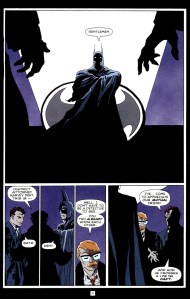
I’m speaking, of course, of the Batman. With Christopher Nolan’s beyond-blockbuster trilogy having just wrapped up, speculation is already rife as to what DC Entertainment and its parent company, Warner Brothers, will do next when it comes to the adventures on the Dark Knight Detective on the silver screen. For an initial hint about were I’d take things, please refer to the famous page above from the Jeph Loeb/Tim Sale comic Batman : The Long Halloween. For reasons that will be made clear over this course of this series of postings, however long it may drag on, that scene — the famous “rooftop meeting” between Batman, Commissioner Gordon, and District Attorney Harvey Dent — is at the very heart of where I think the Bat-franchise would go next.

But let’s not get too far ahead of ourselves just yet. First, let’s take stock of where we are now and the three, as I see them anyway, options DC/Warner has going forward. As of this moment, The Dark Knight Rises has taken in just a hair under $420 million dollars at the domestic box office, and just a hair under $1 billion worldwide. It’s a pretty solid bet that it will end up taking in $500 million domestically and will AvatarTitanicThe Avengers, and The Dark Knight in the over-a-bliion-dollars-in-worldwide-ticket-sales club. That means that of the five highest-grossing films in the world in history, two will be Batman flicks. Clearly, Warner isn’t going to let this property stagnate for too long.

But they need to play their cards exactly right going forward, because this is one golden goose they absolutely need to keep laying eggs. Which brings me back those three options they have going forward, each of which carries some risk, as well as potential rewards. Let’s look at each potential path  forward individually, shall we? Glad you agree.

Option #1 — The direct sequel. Nolan certainly left this possibility wide open with Robin/John Blake’s “inheritance” of the Batcave, and in many ways it’s the easiest and most painless way to go. Blake’s the new Batman (or Robin, or Nightwing, or whoever), some ambitious director would be more than willing to take on carrying things forward from where Nolan left them, and audiences are already primed and ready to accept Joseph Gordon-Levitt as the new man beneath the cowl.

But are they really? Let’s face it — Bruce Wayne is central to the Batman myth. You could argue that DC themselves are working on making him less central to it with the publication of such books as Batman, Incorporated and several storylines in recent years that have seen the likes of Dick Grayson, among others, assuming the Batman role for varying periods of time. Maybe they’re trying to test the waters with this whole someone-else-as-Batman idea on the printed page before going for it on the big screen? It’s possible, but sooner or later they always seem to come back to Bruce Wayne, and it’s easy to see why —

Frankly, it just never really works with anyone else as anything other than a temporary gimmick to boost sales for a few months. Sooner or later, the fans always want to see the “real” Batman back in action. A new guy might be interesting for a movie or two, but the speculation as to if and when Bruce Wayne — and, by extension, Christian Bale and maybe even Chris Nolan — would be back would be a Sword of Damocles hanging over the head of any “direct sequel” flick, no matter how good it was. And that just ain’t gonna happen. Bale’s done. Nolan’s done. These guys have made the studio a fortune. Let them get on with their lives in peace.

Option #2 — The “hard reboot.” This has been done, successfully, with the Bat-franchise before, obviously. Batman Begins is as “hard” a reboot of a character and his origins as you’re going to find. We’re used to seeing Batman reinvented every so often, and it’s never been a dealbreaker before. Every generation flat-out deserves its own iconic take on the character, right? Why go in any other way now? It would free up the next director, producers, and cast from having to do things the “Nolan way,” that’s for sure, and sometimes the best way forward is by taking a few steps back.

And yet — that might necessitate Batman sitting on the shelf longer than Warner wants him to be. The Amazing Spider-Man isn’t that bad a superhero movie by any stretch of the imagination, but even its most fervent partisans would, when pressed, admit that two Spidey origins within a decade is a bit much. And besides, it’s not like Batman Begins is going to appear especially dated within the next five or ten years, nor is it likely to be surpassed in terms of quality as a Batman origin story for the silver screen. Any “hard reboot” story is going to inevitably be compared to it, and any other cinematic origin story is going to come up short, more than likely. Unless, of course, it’s a work of such singular awesomeness that it just comes along and completely blind-sides all of us. But ya know what? Even then, I bet it’s still gonna piss plenty of people off. Plus, there’s the open question of just how necessary a “start-from-scratch”-type story even is. More or less everyone knows at least the basic details of the Batman myth — do we need to see them play out before us yet again to understand and appreciate a new cinematic interpretation of the character?

Which brings us, finally, to Option # 3 — the so-called “soft reboot” option. Admittedly, this hasn’t worked out so well for secondary comic-book-related properties like The Punisher and the Hulk, but they were both coming off first installments that were pretty iffy to begin with, to put things kindly. That”s not the case here by any stretch of the imagination. Even if Nolan’s Batman films weren’t your cup of tea, there’s no denying they’ve been tremendously successful at the box office and generally quite well-regarded by hard-core fans, critics, and more casual audiences alike. Maybe there’s no need to reinvent the wheel here, even if we’re going to go back into Batman’s career chronologically, the cast is going to be entirely different, there will be a new director and screeenwriter(s), etc.

Not that this option isn’t without some risk, too. It would essentially assume at least a rudimentary knowledge of the character on the part of the audience (anyone not know anything about the guy? Bueller? Bueller?), and it would subject the new film,series to more direct comparison with the Nolan flicks than, perhaps, option #2 (although that’s debatable, and flat-out inevitable in any case, anyway), and — well, that’s probably about it.

So — from where I’m sitting right now, that looks like the best bet to me. Let’s have a new take on the Batman franchise with new actors, a new director, a new writer or writers, new everything — but let’s not feel compelled to tell his origin over from the start. Let’s concern ourselves with concentrating on the various elements that have made Batman so appealing and enduring as a cultural icon over the years, tell a story that incorporates and elaborates upon all of those, and maybe throws a few new wrinkles of its own into the mix, and not feel like the wheel needs to be reinvented here. The Nolan films are going to be the standard against which all future films are going to be judged, anyway, so rather than run as far away from them as possible, why not keep what worked about them, and maybe present them in a new way?

If all this sounds just a little bit too abstract for you at this point, I wouldn’t blame you, but stick with me here — at least until you get bored. I hope that as things progress, what I have specifically in mind will become more and more clear. And keep that image from The Long Halloween in mind as we go along, because it’s central to where I’m going — even though I don’t think the comic itself was anything other than a somewhat-above-average Batman story (and yes, I’m hoping that sentence will make a bit more sense to you in the coming days/weeks, as well).

So that’s it for part one of this thinking-it-out as-I-go-along project. I hope to pick things up again tomorrow with some some thoughts on Gotham City — how it’s been presented in the past, how and why it’s central to the Batman mythos, particularly in film, and a really weirdly appealing (in my own twisted mind, at any rate) idea I’ve got as to exactly which major American city would make a great movie Gotham for the future. Until then, please — tear my opinion to shreds! Or agree with it! Or somewhere in between! But let’s see where we agree or disagree and find out where you think I’m right and wrong and why!

VGM Entry 24: Metal Gear and More


VGM Entry 24: Metal Gear and More
(Thanks to Tish at FFShrine for the banner)

Notice: Square Enix have apparently deemed one of my soundtrack reviews a copyright infringement and demanded I remove it. I have complied, and I kindly encourage you to boycott all Square Enix products in the future. Since their games are terrible these days anyway I am probably doing you a favor. (Their complaint involved brief audio samples from only one video game–amusingly out of print today–so I have left my other reviews intact.)

At the same time that RPG/adventure game music was coming into its own on the Nintendo, a lot of solid action soundtracks followed in the wake of Castlevania. Metal Gear (Konami, 1987) kicked off a series that would not really rise to major prominence until 1998, but its history of good scores dates back to the originals.

http://www.youtube.com/watch?v=pyKaAiuwsqM

Metal Gear called for a lot of spy work and sneaking around, and its original soundtrack captured precisely that. Not the music you were expecting to hear? Well, two versions of Metal Gear were released in 1987. The first, released in July, was for the MSX2, and it contained a completely different soundtrack from the NES version that followed it in December. It’s not entirely clear who composed it; Wikipedia lists Iku Mizutani, Shigehiro Takenouchi, and Motoaki Furukawa as the composers for Metal Gear without distinguishing between ports. That’s pretty shady business, as Kazuki Muraoka’s NES score contained a number of original compositions and was much more popular, at least in the western world. Most sites only list Iku Mizutani for the MSX2 and Kazuki Muraoka for the NES, while the only official release of the MSX2 soundtrack simply credits Konami Kukeiha Club.

Well, I watched the actual ending credits of the MSX2 version, and Konami lists it as:

Main Sound Effect:
Iku Mizutani

Sub Sound Effect:
Shigehiro Takenouchi
Motoaki Furukawa

The same bad translation persists on the NES version, where Kazuki Muraoka is responsible for all “Sound Effect”. So that’s enough to sort it out, right? All evidence suggests that Mizutani composed the MSX2 version (with a little help from Takenouchi and Furukawa) and Muraoka composed the NES version.

Of course these indecisive credits always leave room for speculation. Here’s one for you: The PC88 visual novel Snatcher (Konami, 1988) contains an arrangement of the song “Theme of Tara” (1:49). The game offers very thorough credits, and it expressly states that the song was composed by Masanori Adachi and arranged by Masahiro Ikariko and Kazuhiko Uehara. If it’s just an arrangement of the MSX2 original, then… wait a minute…

But Adachi isn’t even credited in Metal Gear. Did Konami perhaps forget who wrote the MSX2 music and credit Adachi by mistake? Here’s the real kicker. Snatcher was ported to the MSX2 shortly after its release, and for the port Iku Mizutani is credited with arranging Masanori Adachi’s composition, which was, if our credits all add up, a copy of Iku Mizutani’s original Metal Gear composition.

http://www.youtube.com/watch?v=-r0lEkwtqQU

Oh well. We are at least pretty sure Kazuki Muraoka wrote the NES one. In the very least he’s the only name appearing in the credits in association with sound. His score was a mix of arrangements from the MSX2 and new songs, and as far as I’m concerned the new material was almost always an improvement. Generally this consisted of replacing the weaker tracks, but Muraoka did take the risk of replacing “Red Alert!” (0:16 in the previous video), perhaps the best song in the MSX2 mix, with a completely new track under the same name (2:03). The decision paid off.

If you would like to hear some comparisons between the original MSX2 compositions and Muraoka’s ports, look for “Mercenary” (4:21 on the MSX2 video, 2:55 on the NES) and “Return of Fox Hounder” (6:52 on the MSX2 and 4:25 on the NES). Unless I overlooked something, the rest of this NES compilation consists of original compositions. The whole Metal Gear sound as established on the MSX2 turned out to be excellently suited for the NES–a system on which speed and catchiness served well to compensate for a lack of much bass or distortion. Even so, my favorite Muraoka addition is a slow one. I have no idea why “Password Entry” (3:37) was put to such petty use. It would have made a fine ending credits theme.

http://www.youtube.com/watch?v=SwiKP7etEnc

Castlevania II: Simon’s Quest (Konami) also made its first appearance in the summer of ’87. By this time Kinuyo Yamashita had moved on to other projects, and Kenichi Matsubara picked up the job. Like Kinuyo Yamashita in the original, it would be his only contribution to the series.

And what a contribution it was. His efforts to maintain stylistic consistency with the first game are commendable, and he did so while writing equally catchy and memorable songs. Obviously his most famous work (and probably the most famous song in the series) is “Bloody Tears”, appearing second in the video. But I was really quite surprised to encounter tracks like “Dwelling of Doom” (2:10), which could just as easily have become series staples had future writers chosen to retain them. Kenichi Matsubara arguably surpassed the original Castlevania with this soundtrack, and it wouldn’t be the last time that the series stood at the forefront of video game music.

In the meantime, Kinuyo Yamashita had by no means fallen by the wayside. Her work on Arumana no Kiseki (Konami, 1987) is really outstanding, taking advantage of the Family Computer Disk System’s enhanced capabilities to produce a very clean, crisp sound. (The FDS was an extension of the Famicom released only in Japan. Its early titles included The Legend of Zelda and Metroid.) I have to imagine the only reason Arumana no Kiseki never got much praise is because fewer people heard it. Konami seem to have gotten around the copywrite challenges of making an Indiana Jones ripoff by simply never releasing the game outside of Japan, although they may have been better off paying up and releasing it. The first licensed series game for the NES, Indiana Jones and the Temple of Doom (Mindscape), released some time in 1987 or 1988, was a gameplay disaster on par with E.T. the Extra-Terrestrial, and its soundtrack is a lame attempt to preserve the original John Williams score.

explod2A03 on youtube provides a nice collection of music from Arumana no Kiseki, available here, along with a number of other forgotten soundtracks from the era.

http://www.youtube.com/watch?v=Ei_YMyN_69Y

Of course we all know what the most important video game music series on the NES was, and Capcom, not Konami, get the credit this time. Known as Rockman in Japan, the original Mega Man was unleashed upon the world in December 1987. Manami Matsumae did not compose for the Mega Man series for long. After scoring Mega Man and contributing to Takashi Tateishi’s work in Mega Man 2, she sort of dropped off the face of the earth, not to resurface in the series again until Mega Man 10‘s massive collaborative effort in 2010. But the legacy she began is one of the finest in gaming history.

Here’s a track list for the compilation, in case you’re interested:
(0:00) Epilogue
(1:40) Stage Select
(1:57) Robot Intro
(2:04) Cutman
(2:52) Fireman
(3:28) Elecman
(4:22) Gutsman
(4:57) Iceman
(6:00) Dr. Wily’s Castle 1
(6:44) Dr. Wily’s Castle 2
(7:20) Robot Battle
(7:49) Dr. Wily Battle
(8:17) Bombman
(9:02) Victory!

Of course the series did not find massive commercial success until Mega Man 2 the following year, but from the beginning it was as intimately tied to its score as the Final Fantasy series. It isn’t nostalgia that leads modern-day rock bands and chiptune artists to cover “Cutman”, “Fireman”, and “Bombman”, just to name a few. It’s because the music is outstanding. I mean, I think the samples speak for themselves. Manami Matsumae established a standard of quality which Capcom would strive to maintain for many years to come. Takashi Tateishi would soon raise the bar higher, but it may well be argued that, without Manami Matsumae’s original concept of what Mega Man music ought to sound like, none of the future improvements would have ever been possible.

Song of the Day: Passin’ Me By (by The Pharcyde)


Something quick and nostalgic for the latest “Song of the Day”.

I rarely put up hip-hop songs as “Song of the Day” since I rarely think back fondly on most of them, but this one I do think back and remember fondly. It’s one of those songs that just brings back memories of simpler days.

The track “Passin’ Me By” by the hip-hop group The Pharcyde came out in in the Spring of 1993 off of their full-length album, Bizarre Ride II The Pharcyde and gradually rose up the charts that season until it reached hit status. The group never had as big a hit as this track though it will continue to consistently make good to very good records since. I think what resonated to me and many fans of this song wasn’t just the beats but the lyrics themselves. It’s a song about young crushes and infatuation ranging from one’s schoolboy days to young adulthood. It’s those very same lyrics which continues to make this song as relevant now as much as they did in 1992-1993 when the song came out.

Passin’ Me By

Now in my younger days I used to sport as shag
When I went to school I carried lunch in a bag
With an apple for my teacher ’cause I knew I’d get a kiss
Always got mad when the class was dismissed
But when it was in session, I always had a question
I would raise my hand to make her stagger to my desk and
help me with my problem, it was never much
Just a trick, to smell her scent and try to sneak a touch
Oh, how I wish I could hold her hand and give her a hug
She was married to the man, he was a thug,
His name was Lee, he drove a Z,
he’d pick her up from school promptly at three o’clock
I was on her jock, yes indeedy I wrote graffiti on the bus
First I’d write her name then carve a plus,
with my name last, on the looking glass,
I seen her yesterday but still I had to let her pass

She keeps on passin me by…

When I dream of fairytales I think of me and Shelly
See she’s my type of hype and I can’t stand when brothers tell me
That I should quit chasin’ and look for something better
But the smile that she shows makes me a go-getter
I haven’t gone as far as asking if I could get with her
I just play it by ear and hope she gets the picture
I’m shootin for her heart, got my finger on the trigger
She could be my broad, and I could be her (nigga)
But, all I can do is stare…
Back as kids we used to kiss when we played truth or dare
Now she’s more sophisticated, highly edu-ma-cated
not at all over-rated, I think I need a prayer
to get in her boots and it looks rather dry
I guess a twinkle in her eye is just a twinkle in her eye
Although she’s crazy steppin, I’ll try to stop her stride
Cause I won’t have no more of this passin me by

And I must voice my opinion of not even pretending she didn’t have me
Strung like a chicken, chase my tail like a doggie
She was kind of like a star, thinking I was like a fan
Dude, she looked good, down side: she had a man
He was a rooty-toot, a nincompoop
She told me soon your little birdie’s gonna fly the coop
She was a flake like corn, and I was born not to understand
By lettin her pass I had proved to be a better man

She keeps on passin me by…

Now there she goes again, the dopest Ethiopian
And now the world around me be gets movin in slow motion
when-ever she happens to walk by – why does the apple of my eye
overlook and disregard my feelings no matter how much I try?
Wait, no, i did not really pursue my little princess with persistance;
And I was so low-key that she was unaware of my existance
From a distance I desired, secretly admired her;
Wired her a letter to get her, and it went:
My dear, my dear, my dear, you do not know me but I know you very well
Now let me tell you about the feelings I have for you
When I try, or make some sort of attempt, I symp
Damn I wish I wasn’t such a wimp!
‘Cause then I would let you know that I love you so
And if I was your man then I would be true
The only lying I would do is in the bed with you
Then I signed sincerely the one who loves you dearly, PS love me tender
The letter came back three days later: Return to Sender
Damn!

She keeps on passin me by…

VGM Entry 23: Wizards & Warriors


VGM Entry 23: Wizards & Warriors
(Thanks to Tish at FFShrine for the banner)

If we are looking for the best soundtracks in the fantasy genre up through 1987, of what I have heard Koichi Sugiyama, Nobuo Uematsu, and the early team efforts of Yuzo Koshiro and Takahito Abe take the cake in pretty much every category, while the works of Kenneth W. Arnold in Ultima III and Ultima IV for the Apple II remain my personal favorites. But there is probably a lot of great stuff out there which I am missing. There are also some absolutely phenomenal songs that simply lack the context of well-rounded albums.

The works of David Wise in Wizards & Warriors (Acclaim, developed by Rare, 1987) make for an excellent example. The game is not in RPG or adventure format; it is a typical side-scrolling hack and slash with a medieval setting. As such, it calls for slightly more action-oriented songs, and that seems to have been a weak point for Wise at this stage of his career. But perhaps more importantly, he seems to sell himself short, leaving a lot of songs unfinished.

The title screen track is a simply gorgeous classical piano piece which could not help but function in any gaming medium past or present. It is a nice little reminder that the excessive emphasis on orchestration today is not always necessary. And it is not the only excellent song in the game.

“Outside the Castle” is arguably much better. In spite of the track looping after only 17 seconds, it feels as though it could go on forever. The periodically fading wave in the background is such a small touch, but it magnificently transforms an already pretty pleasing tune into something entirely enchanting. It has that sort of time dilation effect which came to characterize later forest-theme songs.

But the brevity of Wise’s compositions quickly begins to cause trouble. “Inside the Tree” could be a wonderful song, full of subtle, tasteful variations on a theme which is neither too safe for a little action nor too aggressive for anything else. But it isn’t. In fact, it’s only six seconds long! Wise, what were you thinking?

And on that note, why is this called “Inside the Tree” anyway? It sounds like it should be the sort of tune that plays inside a castle or library or something, whereas the actual song “Inside the Castle” is a boring mess that should have never been included in the game. I don’t think I’m being picky here–“Outside the Castle” functions well enough, but it definitely has a forest vibe to me, and there is a forest stage, you know. “Invincibility Potion” is actually really pretty, and could have functioned effectively as an end credit theme, or at least the start of one. (It’s only 16 seconds.) Instead, the game has no ending credit music at all. Meanwhile,”Invincibility Potion” is so out of character for any action sequence that I think I’d have been inclined to avoid the item during gameplay just to not ruin the vibe. And the boss music, oh the boss music! It simulates the sort of dread you might associate with learning that your mother-in-law is visiting for the weekend.

Here is “Forest”, or “Forest of Elrond”, depending on which track listing you’re looking at. Entirely inappropriate for the theme of the game and absurdly obnoxious when heard for more than half a minute or so, I think it reiterates my point. This whole soundtrack to me feels like Dave Wise either had zero confidence in his song-writing capabilities or else was given about three days to complete the project and had to submit incomplete tracks and some slapped-together last minute fillers. And yet the songs that pull through, most notably the title screen/end credits and “Outside the Castle”, rank among the best songs on the NES.

http://www.youtube.com/watch?v=0KQkBXjk6w4

The music of Gauntlet (Tengen, 1987) for the Nintendo was composed by Hal Canon. (Atari’s 1985 arcade Gauntlet, on which it is based, contained very little music, and Canon’s work is original.) The theme of Stage 1 is entirely appropriate for the ghoul and goblin-graced dungeon on the load screen. Despite the game being quite distanced from your typical adventure game, the music manages to keep pace and still present a wonderful medieval vibe. I do not wish to say that the album falls short after the first level, because it does remain fairly well written and entirely appropriate to the gameplay, but it abandons any serious attempt to sound classical after that first phenomenal success. The music only continues to work because the game itself isn’t nearly as thematic as the title screen leads us to believe. Hal Canon proves here to be a consistently good composer; he doesn’t quit trying the way Wise seems to have. If only he’d remained consistent in style as well, Gauntlet could have numbered among the best.

Scenes I Love: Spy Game (R.I.P. Tony Scott)


[SPOILERS]

The world of cinema lost one of it’s own with the death of British filmmaker Tony Scott (brother of filmmaker Ridley Scott). The circumstances of Tony Scott’s death has now been confirmed and could be found and read easily on most on-line news site.

This post is not to focus on Tony Scott’s death but on the life he lived and how his contribution to the art of filmmaking. Tony Scott has been a major influenc on me and those who grew up during the 80’s and 90’s. His films were huge commercial successes but also unique in that he tried to advance the genre of action filmmaking beyond the bullet point steps on how to make them that other filmmakers could never get beyond.

Tony Scott experimented and innovated with the action genre these last ten or so years to mixed results, but no one could ever say that his visual style was ever boring. Just like his brother Ridley, Tony Scott was a visual director first and foremost, but he also had a way in getting the most out of the cast he was given. It didn’t matter whether they were award-winning veterans like Denzel Washington or up-and-coming stars like Keira Knightley and Chris Pine. His action films weren’t just all about the visual and auditory overload his contemporaries only focused on. Tony Scott used his actors and got from them good to great performances which raised what would’ve been your typical action film to something more.

One of my favorite scenes Tony Scott ever did was also from one of his films I consider one of his best. It’s the last main sequence for his 2001 spy thriller, Spy Game, which starred Robert Redford and Brad Pitt. It was a film that was the passing of the torch from one blue-eyed star of Hollywood’s yesteryear to the current blue-eyed star. This film could’ve been all about action and explosions and techno-spy babble, but it instead became a great exercise in how to create an action-thriller that allowed for dialogue to become the engine that moved the action.

This scene is a favorite because it was the culmination of the machinations and secret plannings of Redford’s aging spymaster, Nathan Muir, to try and save his wayward protege in Brad Pitt’s Tom Bishop. While it would be best for people to watch this scene having watched the rest of the film beforehand, even just watching Redford take control of the room is a clue to how well Tony Scott allowed his actors to work the scene instead of forcing them to do it his way. It’s no wonder that Denzel Washington, considered to be the best actor of his generation, kept working with Tony over and over for the past decade.


Film Review: ParaNorman (dir. by Sam Fell and Chris Butler)


I have to admit that I wasn’t expecting much from the new animated film ParaNorman.  As much as I love animated films, ParaNorman‘s trailer had never really captured my imagination.  (Or, at the very least, it hadn’t captured my imagination in the way that the trailers for Brave and Wreck-It Ralph did.)  For the most part, the only reason that ParaNorman was even on my radar was because it was advertised as being the latest film from the creators of Coraline and the only reason that Jeff and I ended up seeing this film last Friday instead of The Expendables 2 was because I had a slight headache and didn’t want to have to spend two hours listening to men yelling, guns firing, and bombs exploding.

In other words, I saw ParaNorman with low-to-no expectations and sometimes, that’s the perfect way to go to the movies because I absolutely loved ParaNorman.

ParaNorman tells the story of Norman (Kodi Smit-McPhee), a shy boy who has the ability to talk to the dead.  This talent comes in handy because Norman happens to live in the haunted New England town of Blithe Hollow. 

I fell in love with ParaNorman during the opening credits, in which we watch as Norman talks to the spirts of everyone from an unfortunte aviator to a squished dog, all the while simply trying to get to school on time.  In this short, wonderfully animated sequence, we learn everything that we need to know about Norman and the town of Blithe Hollow.  We learn that Norman is shy, he’s lonely, and he’s also one of the few people in the world nice enough to actually be polite to a pushy ghost demanding his attention.  As for the town of Blithe Hollow, it’s a memorably ugly creation, full of ominous buildings that seem to have sprung straight from a nightmare of German Expressionism. 

Blithe Hollow, we soon learn, is a town that’s haunted by a lot more than just a few restless spirits.  The town was founded by Puritans who, as the film begins, are mostly remembered for their witch hunts.  Centuries ago, the town founders burned a witch at the stake and that witch cursed the town.  While it wouldn’t be right for me to give away too many details of the plot, it turns out that the witch’s curse is very much real and, as a result of a several complications and mistakes on the part of both Norman and the citizens of Blithe Hollow, the town is soon overrun by zombies. 

In a twist that would make George Romero proud, the citizens of Blithe Hollow soon prove themselves to be a hundred times more monsterous and dangerous than the film’s actual monsters.  However, as only Norman can actually talk to the dead, he soon discovers that there’s more to the “zombie rampage” then meets the eye.  Soon, it becomes apparent that Norman’s the only one who can give the witch what she wants and save Blithe Hollow from the sins of the past.

Not surprisingly, there were a lot of children at the showing that Jeff and I attended and ParaNorman had enough silly moments to keep them entertained.  They seemed to enjoy the comedic relief provided by Norman’s fat and loyal friend Neil (voiced by Tucker Albrizzi).  That said, ParaNorman isn’t really a film for children.  It starts out slow and wisely devotes a good amount of time  to establishing the oppressive atmosphere of Blithe Hollow.  The film’s resolution comes not with the spectacle that we’ve been conditioned to expect from animated films but instead, the movie ends on a rather subdued, almost mournful note.  ParaNorman‘s humor is combined with a very real sense of melancholy and loss.  This is a film that can be enjoyed by kids but only truly understood by adults.

(If Dellamorte Dellamore is ever remade as an animated film, I expect the end result will look a lot like ParaNorman.)

 Don’t get me wrong, ParaNorman is a funny film that’s full of clever details and smart vocal performances. Along with Smit-McPhee and Albrizzi, the voice cast includes Anna Kendrick, Casey Affleck, John Goodman, Jeff Garlin, and Leslie Mann.  All of them deliver their lines with just the right combination of sincerity and melodrama.  However, the film is really stolen by Jodelle Ferland, who voices the condemned witch and who brought me to very real tears towards the end of the movie.

ParaNorman is hardly a perfect film but’s a nicely ambitious one and it has a good message about tolerance.  I wasn’t expecting much from it and I ended up adoring it.  Perhaps I should lower my expectations more often.

6 Trailers Beyond Imagination


Hi, Lisa Marie here!  I apologize for taking last week off but have no fear and let not your heart be troubled — I have returned and I’ve brought with me another edition of Lisa Marie’s Favorite Grindhouse and Exploitation Film trailers!  (And I’ve also returned with a few trailer kitties, as well…)

1) The Hunger (1983)

Tony Scott, R.I.P.

2) Aenigma (1987)

From director Lucio Fulci comes a film about psychic powers and killer slugs.  Agck!

3) Dolly Dearest (1991)

This is what happens when you build a toy factory next door to Satan’s grave.

4) Godmonster of Indian Flats (1973)

Killer sheep!

5) Rattlers (1976)

If it’s not the sheep, it’s the snakes…

6) The Lollipop Girls In Hard Candy (1976)

In 3-D! 

What do you think, trailer kitties?

VGM Entry 22: Final Fantasy


VGM Entry 22: Final Fantasy
(Thanks to Tish at FFShrine for the banner)

Final Fantasy also lacks much of a kick. Nobuo’s decision to not use any drums might have seemed surprising, had Koichi Sugiyama not done the same thing. Much like Sugiyama, Uematsu was able to craft songs which were memorable and struck a pleasant balance among the available tones. Both artists successfully mastered the positive aspects of the Nintendo’s cleaner tones.

http://www.youtube.com/watch?v=q8_0vY3Nvqk

Final Fantasy doesn’t need much of an introduction. It’s worth noting that it was fairly lengthy for its day, with nineteen full songs. Garudoh did a fine job of capturing all of the best tracks in this collection. The songs which appear here in order are:

(0:00) Prelude
(0:49) Final Fantasy Main Theme
(1:40) Overworld Theme
(2:17) Battle Theme
(3:08) Undersea Shrine
(3:46) Sailing
(4:33) Airship
(5:04) Gurgu Volcano
(5:49) Matoya’s Cave
(6:30) Temple of Chaos
(7:08) Funeral
(7:57) Victory!

I think it would be easy to be a little critical of Nobuo Uematsu’s work, considering how much better his later soundtracks became. One can easily point to later improvements in “Main Theme”, for instance, to say that the original was a little bland. But if you turn to tracks that were not improved upon in future games, “Gurgu Volcano” for example, you can tell that the originals were valuable in their own right. Where Zelda II felt to me like a prototype for a desired sound which the Nintendo was unable to produce, Final Fantasy feels like a finished project.

You will also probably get the distinct impression that Uematsu was inspired by Sugiyama. At least, I did, but this may simply be a consequence of the decision on the part of both musicians to not use a drum track. Uematsu actually had a slightly longer history of writing game music. Koichi Sugiyama started this career late in life, composing his first two game scores, Dragon Quest and Wingman 2, in 1986 at the age of 55. Uematsu’s first soundtrack, a DOS game called Genesis, came out in 1985. The difference is slight, but by the end of ’87 Sugiyama had only one more composition on the books–Dragon Quest II. In that same span of time Uematsu managed to accumulate a staggering repertoire of thirteen.

http://www.youtube.com/watch?v=0VlFoVoqYQ8

I couldn’t find samples from either artist’s first soundtrack, but if you listen to King’s Knight, a Square game composed by Uematsu and released for the MSX in 1986, you can tell that Final Fantasy was no epiphany. It might have been his first recognized and highly acclaimed work, but it was not his first good one.

Uematsu and Sugiyama were acquainted at an early stage though. In an interview on nobuouematsu.com, he states that “Koichi Sugiyama is a big boss of game music. I think he was the first person to really pay attention to my works.” Whether this came before or shortly after the release of Final Fantasy, the two were certainly aware of each other’s work.

My best guess is Sugiyama did influence Final Fantasy, but not in regards to song-writing. That talent came naturally to both of them. Rather, I get the feeling Uematsu may have taken some tips from Dragon Quest on how to effectively arrange these types of songs for the NES medium. I suppose if you got an opportunity to interview Uematsu it would be a petty question to ask, but I’m curious all the same.

http://www.youtube.com/watch?v=USfEmMXFD1k

Perhaps Nobuo Uematsu is still guilty in some capacity of letting the NES sound limitations get the better of him. The sort of stuff he made his career writing worked just fine in King’s Knight, but the NES just didn’t have the capacity to take it all in. Some of the best NES artists dealt with these limitations by allowing the system to dictate the musical style; they approached the NES as an instrument rather than a medium through which to present music existing independently of it. I suppose I’ve said that a lot at this point. Perhaps MSX2 version of Final Fantasy will make it a little more clear. Micro Cabin released the port in 1989, with their sound programmer Tadahiro Nitta handling the new arrangement, not Uematsu himself. Nevertheless, it sounds a lot better than the original in my opinion, and I think it might be a more honest interpritation of the music than Uematsu’s own finished product. If Uematsu had been composing for the MSX in the first place, his music would have made a lot more sense. But the counter argument is fairly obvious; if he hadn’t composed Final Fantasy for the NES the way he did, this MSX version would have never existed.

Review: True Blood S5E11 “Sunset”


For better or worse, the fifth season of True Blood is rapidly drawing to a close.  Tonight’s episode (the last before next week’s season finale) featured a lot blood and it answered at least one big question that True Blood fans have been debating since about halfway through this season.

That question: does Bill actually believe all of this Lilith stuff or is he just pretending in order to manipulate the situation to his own advantage?  A lot of people — myself included — assumed the Bill had to have some sort of secret plan.  Bill, we all assumed, has always been too much of a politician to become a true believer in anything.

Well, it turns out that we were all wrong.  As tonight’s episode proved, Bill is indeed a true believer.  He has drunk from the proverbial kool-aid (or Lilith’s blood, as the case may be).  As Pam explains in one of tonight’s better moments, Bill and the rest of the Authority are nesting.  Essentially, it’s what happens when vampires spend too much time hanging out with each other.

Bill, in fact, has become such a true believer that he’s now having visions of a blood-drenched Lilith telling him that he is the one (and the only one) that she has chosen to lead vampires to their rightful future.  When another chancellor (the bald, black guy whose name I can never remember) confesses to having had the same vision, Bill responds with, “NO, I AM THE CHOSEN ONE!” and then chops off his head. Of course, even before Bill has finished cleaning his hands, Lilith is appearing to Salome and telling her that she’s the chosen one.

In a nice bit of irony, even as former skeptic Bill becomes even more devoted to Lilith, former true believer Nora has lost her faith in Lilith.  After Nora makes up with her “brother” Eric (and thank you, True Blood, for indulging us Alexander Skarsgard fans with that little scene), the two of them start to search for an oppurtunity to escape the bunker.  That opportunity presents itself when a human general shows up, demands to speak to Roman, and then reveals that he has video evidence of Russell and the Rev. Newlin slaughtering a frat house.  Eric responds by killing the general and then volunteering to go (with Nora, of course) to Washington D.C. and take care of the video.  The rightfully suspicious Bill orders a security detail to accompany Eric and Nora but, as soon as they’re out of the bunker, Eric kills both of the guards and he and Nora fly off into the night.  Needless to say, it was nice to see Eric acting like Eric again.

Bill also decided to send a security detail with Jessica after he ordered her to return to Bon Temps and turn Jason into a vampire.  However, Jessica only pretends to turn Jason which gives Jason a chance to kill Jessica’s two guards.  Seriously, the Authority might want to take a look at the training program for the members of their Security Detail because it doesn’t appear to be that effective.

Anyway, Jessica tells Jason what’s going on and then, after Jason runs back to the Faerie nightclub so he can warn Sookie, Jessica ends up hiding out with Pam and Tara.  At first, Pam isn’t all that happy to see Jessica show up because, after all, Pam’s already got her hands full trying to clean up after Tara’s murder of Sheriff Elijah.  Unfortunately, it turns out that Elijah was made by Chancellor Rosalyn and when Rosalyn shows up searching for him, she immediately accuses Tara of killing him.  Pam, who has been incorrectly informed by Jessica that Eric is still at the Authority HQ, confesses and, along with Jessica, is promptly arrested and taken to the bunker.

And you know who else is in the bunker?  Sam and Luna, who are still running around as field mice until they finally manage to track down Emma, who is still in her adorable wolf puppy form.  Unfortunately,  Sam and Luna shift back into human form when they find Emma and are then promptly found by Authority security guards who assume that they’re simply humans who have been imprisoned in order to serve as a food source.  When Sam hears one of the guards mention that it’s time for “Chancellor Compton’s breakfast,” he volunteers to be that meal and, as the episode comes to an end, he is being led out of the jail while Pam’s being led into it.

But that’s not all!

Tara might be falling in love with Pam, or at least that’s the way it seems to Jessica.

Alcide is staying with his dad and apparently spends most of his time chopping wood without a shirt on and that’s perfectly alright with me.  However, when a group of baby vamps show up and start attacking the trailer park, Alcide (and, eventually, his dad) fight them off.

Finally, Sookie is hiding out at the Faerie nightclub and, as part of her efforts to learn why she has been promised to the mysterious Warlow, she talks to the Elder, the oldest faerie in existence.  Unfortunately, the Elder turns out to be a bit of a flake whose mind has been permanently scrambled by the amount of times that she’s jumped through all the various realities.  The Elder assures Sookie that “A dark time is coming,” and it turns out that she’s right as, at the end of tonight’s episode, Russell and the Rev. Newlin manage to track down the fearie night club.  As the terrified faeries watch, Russell drains the Elder dry and then, fangs bared, lunges forward to attack…

This was a bloody episode and, to judge from the previews, next week’s finale is going to be even more bloody.  Will Bill come to his senses?  Will Warlow make an appearance?  And will someone please just go ahead and stake the Rev. Newlin?

Hopefully, we’ll find out next week.

Random Observations:

  1. This episode’s unofficial scene count: 44.
  2. This was an uneven episode but overall, I liked it.  There was a lot about this episode that felt like filler but, at the same time, the idea of the vampires having religious visions as a result of “nesting” is an intriguing one and I hope that it’s one that next week’s finale explores.
  3. Of all the episodes so far this season, this one was probably the most explicit in making the connection between organized religion and the Authority.  It wasn’t subtle but then again, True Blood rarely is.
  4. “Don’t play game with me, you little ginger bitch!”  If I had a nickel for every time I’ve heard those exact same words…
  5. Pam is like the Lauren Bacall of vampires.