I came across this particular AMV (anime music video) while trying to find something else. There really hasn’t been many good AMV’s done with 2010’s hit anime series, Highschool of the Dead, which I find very peculiar. Maybe it’s the extreme ecchi nature paired with zombies which makes some people uncomfortable. I, for one, is not one of those people so I was really surprised when someone made a great AMV from this anime. The latest AMV of the Day is simply titled: “Highschool of the Dead Game”.
The title may be simple, but the video itself ended up looking quite complex in it’s execution. From the mind of AMV creator linnepin007, the video takes the many awesome scenes and sequences from Highschool of the Dead and made it to look like a sizzle reel for an upcoming roleplaying game. The game looks to make each character in the series as a playable one in the game right down to individual stats, character classes and even personal anthems and rally cries.
I know that for some the amount of fan-service in this series ruins it for them and how the series should’ve stuck to just the horror, but this AMV’s creator has realized one thing which has attracted legions of anime fans to this series: it’s fun. This is what this AMV has done to further help sell the series. It highlighted the fun aspect of the anime to ludicrous levels. It helps that the creator used an audio clip from Shaun of the Dead in the very start of the video.
The AMV did well enough that it garnered two awards at this year’s AnimeCon: Editor’s Choice and Audience Choice Awards.
Anime: Highschool of the Dead (Gakuen Mokushiroku)
So, earlier today, I saw Final Destination 5 and guess what isn’t half as bad as you might think?
Now, I’m going to assume that if you’re reading this review, then you probably already know what this film is about. Seriously, once a film has reached its fifth installment, you have absolutely no excuse for not knowing what’s going on. Still, just in case you need to be reminded, here’s how this series works. All of the Final Destination films follow the same basic storyline: a group of attractive but generally anonymous people are gathered together for some everyday event like Nascar or a flight to France. Suddenly, there’s some huge disaster that generally involves a lot of things exploding and people dying. However, it turns out that the disaster we just saw was instead the main character’s vision of what’s going to happen. That character freaks out which leads to him and a handful of other people avoiding the disaster. However, by not dying, they’ve managed to tick off Death and soon, our survivors are dying in a variety of ludicrously convoluted ways, the key being that they’re dying in the order that they died in the original vision. (Fortunately, Tony Todd shows up in each film and explains how it all works.) Anyway, in each film, we learn of a different way to cheat death and each film ends with both the final survivors and the audience learning that actually you can’t cheat death. In many ways, the Final Destination series is the perfect reflection of the 21st Century. The same crap keeps happening and, in the end, we’re all doomed regardless.
Final Destination 5 sticks to established formula. This time, the big disaster is a bridge collapse and the twist is that a survivor can fill death’s quota by killing someone else. That’s kind of a neat idea and the film actually has a little bit of clever fun with that at the end. Still, I wish the film had taken the whole idea to its logical, grindhouse extreme and just had all the survivors running around desperately looking for innocent people to murder.
There’s a lot of very legitimate criticisms that one can make about Final Destination 5. Though the supporting cast is well-chosen (especially Miles Fisher — who could be Tom Cruise’s twin brother, seriously, David Koechner and Courtney B. Vance), the main character is played by Nicholas D’Agosto, who gives a performance that is so free of charisma that you have a hard time believing that he was ever alive to begin with. Emma Bell plays D’Agosto’s girlfriend and it is seriously amazing to see how little chemistry the two of them have together. (Then again, this also helps to make the film’s final twist entertaining as opposed to traumatic…) As much as I love to see Tony Todd doing his Tony Todd thing, it’s hard not get impatient with the fact that these characters need to be told that they’re in a Final Destination film.
But let’s be honest — those criticisms may be valid but who cares? This is a Final Destination film and if you’re not willing to consider it on the basis of what it is, then don’t waste your time watching it and bitching about how it’s not The Help. Judged solely on that basis, Final Destination 5 is actually a return to form for the series. The deaths are all nicely done and memorably grotesque and there’s a real nasty twist at the end of the film that basically serves as a reward for all the horror fans who have stuck with the series since the beginning. I wish I could tell you what that twist was but seriously, it’s way too neat for me to spoil it. I’ll just say that I squealed in delight when I saw it.
Finally, this is a 3-D film that was actually made in real 3-D. The 3-D was not tacked on as an afterthought and, as a result, this is rare film that actually uses the 3-D to make the movie better as opposed to just trendier. This is a film where guts spill freely, eyeballs literally pop out of the screen, and it’s all just the perfect definition of good, stupid fun.
(That said, I do have to admit that this film was apparently made specifically to freak me out because, oh my God, it’s like they exploited every single fear that I have. As Arleigh can tell you, I am terrified of two things — heights and drowning. Which means that if you really want to see me scared, just get me thinking about the prospect of plunging several hundred feet into a large body of water. Seriously, just typing that freaks me out. So, of course, what does this film open with? A freaking bridge collapsing. And don’t even get me started on the laser eye surgery…agck! I’ll just stay blind as a bat, thank you very much.)
For this week’s edition of Lisa Marie’s Favorite Grindhouse and Exploitaiton Trailers, we actually have a loose theme as opposed to just me tossing up random stuff. That theme: Out Of Control Youth. (Cue dramatic DAH-DAH-DAAAAAH music)
Normally, I try to avoid doing “theme” trailer posts because they require way too much concentration on my part. However, this week, as I selected the trailers I wanted to feature, I slowly realized that I was doing just that and I was actually being a pretty good job at it.
Take heart, Out of Control Youths. This post is dedicated to you.
I may be wrong but just judging from the trailer, I think this film might be about “women in chains.” Pam Grier, of course, everyone knows. The white mama was played by Margaret Markov, who later married exploitation film producer Mark Damon.
Eventually, I guess the kids from Over the Edge grew up to be the kids from Suburbia. I’ve got this one on DVD but every time I’ve tried to watch it, I’ve ended up falling asleep. Not necessarily because the film is bad. I just always end up trying to watch it at 4 in the morning for some reason.
I just love that the credits at the end of the trailer announce that this film features a “special appearance” from Peter Fonda.
5) Mission Hill (1982)
“Mission Hill: A Neighborhood where anything can happen…” This is the type of film that I often fantasize about appearing in. Naturally, I would be the girl singing. I can’t really sing but that’s what post-production dubbing is for, right?
This is another one that I have on DVD but I haven’t found the time to watch yet. This appears to be a film in which psycho children kill … well, everything. All I know is that if I’m ever taking a bath and some little child comes wandering in with a bunch of fish, I’m jumping up and running. I don’t care how wet and naked I am.
The scene in Danny Boyle’s “Sunshine” where the crew reaches Mercury is one of my favorites. It may not be as powerful as Kaneda’s Death, but this is one of those moments I can watch and smile at. There are no words, but visually, It’s an awesome moment of reflection in the scheme of things. John Murphy and Underworld’s music add a nice touch to this.
Earlier tonight, I went and saw the new comedy 30 Minutes or Less. The film has, so far, gotten mixed reviews and the theater we saw it in was half-deserted. The audience laughed quite a bit during the 1st half of the movie and a little less so during the second. As soon as the credits started, everyone stood up and left. This is not the type of film that inspires you to sit around and wait to see if there’s any extras at the end. Still, despite that, it’s an enjoyable comedy that has enough laughs in it to justify the 83 minutes it takes to watch the entire film.
Danny McBride plays an aimless loser who, despite being in his mid-3os, still lives at home with his wealthy but hateful father (well-played by Fred Ward). McBride spends his time blowing stuff up with his well-meaning but stupid best friend (Nick Swardson) and fantasizing about the day that his father will die and leave him his inheritance. However, then McBride finds out about a hitman (Michael Pena) who is willing to kill Ward as long as McBride can pay him several thousand dollars. So, McBride and Swardson kidnap a pizza deliveryman (Jesse Eisenberg) and strap a bomb to his chest. They tell him that is he doesn’t rob a bank in the next 10 hours, the bomb will go off. With the help of his best friend (Aziz Ansari), Eisenberg attempts to do just that.
The film’s humor comes not from the plot (which is based very loosely on a true story — more about that in a minute) but instead from the way these very ordinary characters attempt to deal with the situation they find themselves in. All four of the major characters have little grasp on reality beyond what they’ve seen in other movies. When Eisenberg and Aziz plot their bank robbery, it has less to do with logistics and everything to do with Point Break. The film is perfectly cast and all of the actors have a real chemistry with each other. You believe that McBride and Swardson are lifelong friends just as you buy that Aziz would go out of his way to help out Eisenberg.
Much as he did with Zombieland, director Fleischer manages to maintain a nice balance between the comedic and the grotesque. Unfortunately, also much like Zombieland, the film starts to run out of steam during the second half as the storyline becomes more centered on action than on comedy. These characters who were previously only talking about being in an action film are suddenly thrust into an action film and everything starts to seem a little bit too familiar. Still, 30 Minutes or Less is an enjoyable enough movie. I just wish the end result had been a little less uneven.
Now, 30 Minutes or Less is based on a true story and this story wasn’t a comedy. In 2003, a pizza deliveryman named Brian Douglas Wells robbed a bank in Erie, Pennsylvania. He had a bomb around his neck. Unlike the characters in this film, Wells was killed when the bomb went off and blew a softball-sized hole in his chest. The police — who, in the moments before the fatal blast, basically just stood around with their tasers drawn while Wells begged for help — later accused Wells of being a part of the whole plot. Which makes absolutely no sense but who am I to question Big Brother?
Regardless of whether Wells was a victim or participant, that doesn’t change the fact that pizza delivery men are easy targets. Just last year in Dallas, two kids with guns ordered a pizza and gave the address of a deserted warehouse. They had to call many different pizza places before they found someone willing to deliver to that area of town. When the pizza arrived, the kids gunned down the deliveryman. When they were arrested, they said they had simply wanted to kill someone and they knew a pizza deliveryman was the only potential victim they’d be able to lure out to the middle of nowhere. That’s hardly an isolated incident.
Also, as is mentioned in this movie, whenever the pizza person takes 34 minutes to get to your house and then you go, “Duuuuuuude, the pizza’s free!” that means that the cost of your pizza is going to be taken out of the paycheck of a man who puts his life in danger every time he goes to work.
So, what am I saying? I’m saying don’t be an asshole and pay for your damn pizza!
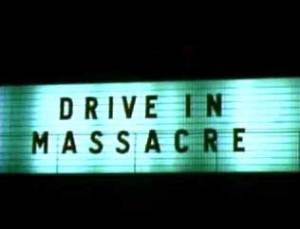
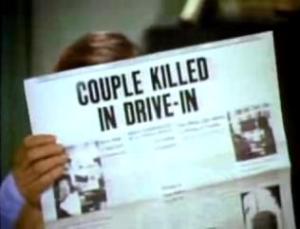
Last night, as part of my quest/mission/curse to watch all of the movies included in Mill Creek’s 50 Classic Chillers Box Set, I watched a film from 1974 called Drive-In Massacre.
So, what’s Drive-In Massacre about? Well, there’s this drive-in and there’s someone wandering around with a sword which he uses to kill various filmgoers. Now, you might think that the fact that people keep getting hacked to pieces at the drive-in would lead to the establishment either getting closed down or perhaps, at the very least, it would lead to an increased police presence. Well, you would be wrong. Even more people start hanging out at the drive-in and the police presence amounts to two overweight detectives who go undercover to catch the killer. (By undercover, I mean that one of the detectives shows up in drag.)
Since this is a pre-1980, giallo-influenced slasher film, the film is structured as a whodunit. Instead of giving us the wisecracking killer that we usually associate with slasher films, this one presents us with a handful of weirdos and dares us to try to guess whose guilty. Is it the bald guy who manages the drive-in and who is referred to as being “a perfect asshole?” Or is it Orville The Pervert who spends all of his time trying to peep on young lovers and who happens to have some bloody clothes in the back of his car? Then again, it could be Germy, the creepy janitor who is a natural suspect because 1) he’s a former sword swallower and 2) his name is Germy. Then again, it could also be the sweaty guy who pops up out of nowhere during the film’s final 20 minutes and spends all of his time saying things like, “I’m going to cut the bad out of you.”
Of course, there’s always the possibility that the film will end with an out-of-nowhere “surprise” twist that will either piss you off or make you squeal with delight depending on how seriously you take these things. Me, I squealed with delight.
I loved this movie and I make no apologies for it. The plot makes absolutely no sense, the acting is really odd, and the whole film has this wonderful feel to it that leads you to suspect that someone just turned on a camera and yelled, “DO SOMETHING!” The first kill scene is actually rather effective and there’s a few scenes of intentional humor that actually work almost well. As well, the film did manage to capture the feel of a sleazy drive-in (perhaps because it was filmed at a sleazy drive-in). I mean, I’ve never been to a drive-in and I probably never will since I don’t think they exist anymore but, after seeing this film, I feel like I’ve had the drive-in experience.
However, my love of this film truly came down to two things:
1) I loved Germy! Seriously, I’ve seen a lot of movies featuring mentally disturbed janitors and Germy belongs in the Mentally Disturbed Janitor Hall Of Fame. Plus, his name was Germy. That just makes me laugh so much.
2) The movie itself only lasts an hour and 13 minutes. Now, on the one hand, that means that there’s not a lot of time for anything along the lines of coherence. However, on the other hand, it also means that the movie never gets a chance to drag and right when you’re starting to get annoyed with it, it’s over!
As a sidenote, Arleigh might be interested to know that this film was apparently co-written by George “Buck” Flower.
I don’t know if I’m just a big fan of the Ukrainian metal scene so I’m inclined to notice or if that country really is popping out more bands than anywhere else in the world, but it seems like a year doesn’t go by that I can’t talk about a new band, probably from Kharkiv, releasing an impressive debut album. Ygg is comprised of three musicians from other bands you may have heard of–Nokturnal Mortum, Khors, and Святогор/Svyatogor to name a few–but I wouldn’t call it a side project. Members of that scene collaborate to such an extent that there’s next to no musician you can associate with only one act. The influences are thus a little more engrained, and it would be kind of silly for me to describe Ygg as sounding like a mix of other bands; they sound like Ukrainian metal. And they sound awfully good.
…Знаю, Висел Я В Ветвях На Ветру…(…I know, I hung in the branches in the wind…)
The album kicks off with one of the more effective intros I’ve heard in a while. Alone it might incline you to expect a pretty elementary album. Simple ambient synths, the overlapping sounds of wind blowing and waves crashing (or are those rustling leaves?), and a jew’s harp that they don’t so much play as randomly wank on amounts to something anyone could create in one take given a keyboard and a sufficiently grim, frostbitten basement.
What I’ve come to find over the course of a couple listens though is that the rest of the album is persistently faithful to the mood it sets. I wouldn’t have even noticed the continued presence of that wind and water effect buried beneath the distortion of the first metal track if the intro hadn’t brought it to my attention, and the jew’s harp bleeds into the next song as well. Over the course of the remaining six tracks these effects fade to be replaced by others, but in a way that maintains consistency from song to song.
YGG
So they’re not really switching gears here. They’re presenting the same scene as the intro from a metal perspective. The trance-like mix of tremolo chords and a moderate steady beat certainly maintains that particular ambient feel, and it’s executed in a way that should make any Drudkh fan happy.
The other elements are perhaps a little less accessible though. The kind of wavy, kind of bubbly keyboard sound would seem a bit out of place for me if Nokturnal Mortum hadn’t used the exact same thing so effectively on Weltanschauung. There is already precedence for associating it with paganism, so the sort of futuristic vibe I originally got from it isn’t an issue here. I imagine if I hadn’t listened to specifically Weltanschauung so many times before it might throw me for a loop.
The most obviously distinguishing feature of the album, the vocals, also require a little consideration. It’s a style very seldom used, and I imagine it would inevitably come off as pretty cheesy on first encounter. Previous bands that have employed it have tended to aim for an effect of pure hatred or insanity, for which it’s probably better suited. I don’t really think that fits Ygg’s picture though. Their sound focuses on nature and paganism, at least as I hear it. The track/album/band name is itself one of the many traditional names for Odin, and the introductory track’s title approximates the opening line of the Rúnatal, a 13th century recording of Odin’s self-sacrifice to acquire the wisdom of the runes. No, the vocals aren’t trying to express insanity or hatred.
So I’m inclined to hear the singing as a sort of vocal reproduction of the howling wind in the introduction. I don’t know, maybe that’s a stretch, but it’s an interpretation that works for me. It’s a sound that’s a bit harder to pull off, because a less chaotic theme requires more precision. When his voice occasionally sounds a bit too human it’s more of a brief letdown for me than a poignant reminder of music’s theme. But at this point perhaps I sound so absurdly full of myself that I’m doing the album more harm than good. I’ll just stop. Suffice to say I really like this, and I think a lot more went into its conception than just three guys jamming black metal and landing on something nice. It’s a rewarding work that’s fairly complex in its simplicity, and I highly recommend it.
We’ve now reached the halfway point of the latest season of Torchwood. While the previous four episodes in this season has been quality work there’s been a small, but growing number of the show’s fans who saw the series as not as good season 3, Torchwood: Children of Earth, and that the addition of more American characters and transplanting the team to the US had lessened the show to some degree. I can’t say if these fans are right or not, but this midway point episode goes a long way to really giving Torchwood: Miracle Day the punch it really needed to put the season from just very good to something on the level of season 3.
The team has now split up into three working groups with Gwen headed back to Wales to try and get her ailing father from becoming just another statistic in the so-called “Outflow Camps” being set up by world governments with the help of the pharma-transnational PhiCorp. Her brief reunion with Rhys and her baby girl makes for some fun moments, but it doesn’t last long as Gwen gets right down to the business of “rescuing” her father from the very people tasked to help him. Their plan seemed like something that would never succeed, but seeing the chaos at the newly created “Outflow Camps” really helped in believing that Gwen and Rhys could actually pull off their rescue of her father. It’s not the danger of being discovered which puts her father in greater danger but the “Miracle Day” situation itself which does it and from that development in this episode’s story thread do we get a clue as to the darker nature of the hidden modules being built in these camps.
It’s during the plot thread involving Rex, Esther and Dr. Vera (who had decided earlier in the episode that she had a better chance to help people if she helped Rex with his plans) in California which was the strongest thread in the episode. We get to see first-hand through the eyes of Vera and Rex just how unprepared the government really was even in setting up these PhiCorp “Outflow Camps”. Camps which have been designed to house those who have been given new categories to describe their “Miracle Day” status. Category 1 being those who were braindead but still alive for some reason (including those who have been horrifically mangled in some fashion). Category 2 being people who have survived a fatal event and still alive and conscious (Rex for example) with Category 3 being everyone else who are healthy and no need for extensive care.
It’s during Vera’s tour with an unctuous, inept camp administrator that the true nature of the camps come to light. It serves less as a place to help ease the overcrowding in hospitals, but more of a concentration camp to segregate those labeled Cat 1 and 2 from the general population who make up Cat 3. It’s also in this plot thread that we see for the first time the horrific nature of the secret camp modules that Rhys had heard being called “burn units”. I wasn’t surprised that the writers decided to go all the way with demonstrating the nature of the modules with one of the season’s lead characters with still half a season to go, but it was a major gut-punch and should change how the Torchwood team goes about exposing not just PhiCorp, but those behind it and the true nature and agenda of “Miracle Day”.
The third plot thread in this episode was the weakest of the three as we see Capt. Jack continue in his attempt to understand Oswald Danes and his role in whats going on, but also use him to try and expose PhiCorp. I’ll be the first to admit that I was wrong in thinking Pullman’s performance as Danes would smooth itself out, but with five episodes in the season already in the can his character (as interesting as this character still remains to be) just looks and behaves like a bad caricature of an unhinged villain. Maybe Pullman will pull back on the scenery-chewing long enough to actually appear as the dangerous, albeit tortured, foil for the team, but I’m losing hope. This thread does show that whatever sympathy Jack may have had for Danes just went out the window as the very person he’s trying to use has just set himself up to be the face of “Miracle Day” and the cult growing around his personality.
“The Categories of Life” was still the best episode to date for this new season of Torchwood despite the weakness that is Oswald Danes. It explored the subject matter that’s dear to many (health care in the country or lack thereof) and themes of how in times of crisis people will flock to whoever is speaking the loudest (even if the message is one that is not for the benefit of people) and give those in power the blank check to do whatever needs to be done to keep the masses a false sense of hope and security.
Torchwood: Miracle Day still hasn’t reached the epic greatness that was season 3’s Torchwood: Children of Earth, but with five more episodes to go it’s making a strong push to try and equal it. Whether it does or spectacularly fail in the attempt should make the second half of the season worth watching.
Like theAlpha Projectand The Demons of Ludlow, Cathy’s Curseis included in Mill Creek’s 50 Chilling Classics Box Set. As opposed to those two previous films (both of which had occasional flashes of quality submerged in all the badness), 1978’s Cathy’s Curse is a film that is just so relentlessly bad and inept that it succeeds in transforming cinematic incompetence into an art form. This is a film that’s so bad, you simply must see it.
Here’s the opening of the film, which will give you a pretty good clue to director Eddy Matalon’s unique cinematic vision. Now, please note, that this is not a case of a bad upload. This is what the film actually looks like as it plays on your television:
Anyway, once the opening credits are over with, here’s just a little of what’s waiting for you:
Years after that fateful car crash, the man’s son moves back into the old house. Accompanying him is his mentally unstable wife (who speaks in an oddly chirpy monotone throughout the entire film, it simply has to be heard to be believed) and his precocious daughter, Cathy. A few minutes after entering the house, Cathy finds her dead aunt’s old rag doll. A few second later, the rag doll’s eyes suddenly start glowing and Cathy’s possessed. Suddenly, she’s speaking in a much lower voice and cursing all the time. Nobody seems to notice.
Nobody, that is, except for the maid. However, the maid is easily taken care of when she happens to casually roll out of the attic window. I had to laugh out loud at this moment because director Matalon didn’t make much of an effort to disguise the fact that the maid had been replaced by a very stiff mannequin for the shot. I mean, its arms don’t even move as it plunges in freefall.
Anyway, the unstable mom happens to see the mannequin fall out of the window and then catches Cathy staring down from the same window. She confronts Cathy and Cathy, via a jump cut so abrupt that it actually makes a “gwapp” noise on the soundtrack, vanishes and then reappears directly behind her. Naturally this leads to mom having a nervous breakdown and going back to the mental hospital.
Cathy’s father has a business meeting out of town and informs Cathy that she might have to go stay with relatives. Cathy cries and her father decides that it would, instead, be a better idea to just leave Cathy alone in the house for a few weeks with the old, alcoholic groundskeeper. Cathy and the groundskeeper get along pretty well until an older woman shows up and claims to be a medium. A mysterious voice replies, “You’re a medium piece of shit!” and the medium runs off. Meanwhile, the groundskeeper starts to have hallucinations where he’s covered with rats, snakes, and spiders and then his noisy dog dies mysteriously.
Eventually, both dad and mom return home. Mom thinks something is wrong with Cathy. Dad says there’s nothing wrong with Cathy. Dad then leaves for work. Mom takes a bath. Suddenly, the bathwater is replaced with blood and mom is covered in leeches. Mom screams in terror.
At this point, (an hour and 7 minutes into the action for those that want to check) there’s an abrupt jump cut to a distinguished looking man getting into a car and driving off. This is the first time we’ve seen this man in the movie and it’s also the last time. Seriously.
Anyway, there’s another jump cut and Dad is relieved that mom is okay despite the fact that just a few seconds ago, she was literally covered in a thousand leeches.
Anyway, at this point, the film goes into its climax and I can’t really go into too much detail but (SPOILER ALERT) let’s just say that those of you who have spent 70 minutes going, “Why don’t they just take the doll away from her?” will end up feeling somewhat vindicated.
If you’re a lover of bad film (as opposed to just someone who watches these things and goes, “That was so dumb…”), Cathy’s Curse is a film that you must see.
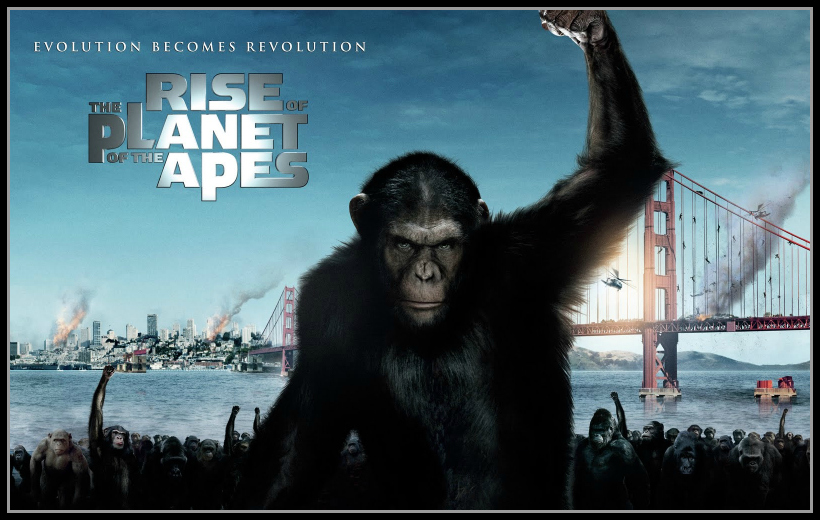
In 2001, Tim Burton released his highly-anticipated remake of the classic 1968 film adaptation of Pierre Boulle’s sci-fi novel which would ultimately be called, Planet of the Apes. Fans of the series were excited to see what idiosyncrasies Burton would add to the series which had petered out decades before. What people were hoping for and what they ended up getting were polar opposites. The film in of itself wasn’t an awful film, but it wasn’t a good one and many saw it as average at best and bad at it’s worst. Any plans to sequelize this remake fell by the wayside. It took almost a decade until a decision was made to continue the series in a different direction.
British filmmaker and writer Rupert Wyatt would be given the task to rejuvenate for a second time the Planet of the Apes franchise. He would be working with a screenplay written by Rick Jaffa and Amanda Silver which would take the 4th film in the series, Conquest of the Planet of the Apes, and rework it for a much more current setting. The film was to be called Rise of the Apes and would star James Franco, John Lithgow and Frieda Pinto. As time went by the film would be renamed Rise of the Planet of the Apes. Despite having such an awkward sounding titles the film would end up to be one of the best films of the summer of 2011, if not one of the best of the year.
The film begins with a harrowing sequence in the jungles of Central Africa as poachers capture several chimpanzees to be sold as medical test subjects. Some of these chimps end up at a genetics research lab outside of San Francisco where one Will Rodman (James Franco) is working to find a cure to Alzheimer. He sees the encouraging result in one chimp he has named “Bright Eyes” (due to the side-effect to the test subject’s eyes taking on green flecks to their irises) and pushes for the next step and that’s human testing. The ensuing pitch to the company’s board of directors doesn’t go as planned as Bright Eyes goes on a violent rampage leading to her being put down and the project shelved. Her reaction they soon find out has less to do with the breakthrough treatment and more of a maternal instinct to protect her baby she secretly gave birth to. Will takes the baby chimp home in secret temporarily, but soon becomes attached to it as does his Alzheimer stricken father (John Lithgow) who names it Caesar.
The first third of the film sees Caesar showing an inherited hyper-intelligence from his genetically-treated mother. Caesar becomes an integral part of the Rodman household even to the point that Will has taught Caesar to call him father. It’s a family dynamic which would help mold Caesar into something more than just a wild animal. He begins to show signs of humanity which would become bedrock of his decision later in the film to turn become the revolutionary that the film has been leading up to the moment Caesar gets sent to a primate sanctuary after a violent encounter with a boorish neighbor to end the first reel of the film.
It’s during the second reel which sees Caesar realize that while he may as smart (maybe even smarter) than the humans he would never be a part of that world. In the sanctuary he learns that his very uniqueness has set him apart from the other primates. He sees the abuse inflicted on his fellow primates and longing to be back to his “home” with Will turns to a focus need to free himself and his people. He does this in the only fashion he knows would succeed. With the help from a couple canisters containing the aerosol-based treatment which increased his mother’s intelligence, Caesar frees everyone from the sanctuary and takes the fight to the humans as they make for the wilds of the Muir Redwood Forest north of San Francisco.
Rise of the Planet of the Apes might look to be an action-packed film from how the trailers and tv spots has been pushing the film, but it actually only has three major action sequences and they’re integral to each third of the film in helping advance the story. These were not action for the sake of having action on the screen. Writers Jaffa and Silver do a great job in figuring out that the real strength of the film would be Caesar’s journey from precocious ape child, rebellious teen and then his final unveiling as the leader of a people who have shaken off the shackles of medical research and their forced sacrifice for the greater good.
The film was never about the humans played by Franco, Pinto and Lithgow. It was always about Caesar and the film hinged on the audience believing Caesar as a character. In that regard, the work by WETA Digital should be commended as should Andy Serkis’ performance as Caesar. Serkis’ motion capture performance goes beyond just mimicking the movement of an ape. His own acting as Caesar comes through in even in the digital form of Caesar. In fact, the film never had a real ape used during filming. From Caesar right up to the scarred ape Koba every ape in the film was the work of WETA Digital’s furthering the motion capture work they had done in Peter Jackson’s Lord of the Rings trilogy and James Cameron’s Avatar. Never once during the two hour running time of the film did I ever not believe I was watching apes on the screen. Every emotion Caesar goes through during the film was able to show through facial expressions and body language.
It’s the strength of Serkis’ mo-cap work and the overall execution of Caesar’s character by WETA which also highlighted the one major weakness of the film through it’s underdeveloped human characters. Whether it was Franco’s benevolent Dr. Frankenstein-like Will Rodman right up to his greedy, amoral boss in the company (played by David Oyelowo), all the human’s in the film were very one-note and mostly served to propel Caesar’s story forward. At times, Franco actually seemed to be just as he was during his hosting gig during the Academy Awards earlier in the year. These were not bad performances by the actors involved. They were just there and part of it was due to how underwritten their characters were.
To help balance out this flaw in the film’s non-ape character would be the beautiful work by the film’s cinematographer in Andrew Lesnie. He has always been well-known for beautiful, majestic panoramic shot of the world as he had demonstrated in Jackson’s Lord of the Rings trilogy. He does the same for this film as we see some beautiful shots of the Muir Redwood forest, of San Francisco’s skyline and in the climactic battle on the Golden Gate Bridge. The city of San Francisco and it’s iconic red-hued bridge and the surrounding area has never been shot as gorgeous as Lesnie has done with his DP work on this film.
Even with some of the characters in the film being underwritten the film succeeds through Rupert Wyatt’s direction which keeps the film moving efficiently, but also bringing out the emotional content of the film’s script in an organic way. Film has always been about manipulating the audience’s emotions. It’s when a director does so and make it seem normal is when such manipulation doesn’t come through for those watching to feel. Then add to this Serkis’ exceptional work as Caesar with some major digital artistry from the folks over at WETA Digital and Rise of the Planet of the Apes does rise above it’s B-movie foundation into something that should live beyond the summer and for years to come.
Rise of the Planet of the Apes does a great job and a long way towards wiping off the bad taste left behind by Tim Burton’s failed attempt to remake the franchise. We didn’t need something exotic and idiosyncratic to give the franchise a fresh breath of life. It seems all it needed was a very good story, some exceptional work from Andy Serkis and WETA Digital and a filmmaker knowing how to tell the story in a natural fashion and not fall into the temptation to go into shock and awe to tell it. Rise of the Planet of the Apes is a film that could stand-alone, but it does something that many trying to create film franchises never seem to do right: it makes people want to see what happens next in the lives of Caesar and his apes.


 Through the Shattered Lens