Another game from one of Microsoft’s internal game studios, Lionhead, is the upcoming third game in Lionhead honcho Peter Molyneaux’s Fable rpg series. This rpg series has been one of the big guns in Microsoft’s exclusive 1st-party titles since the Xbox and now the Xbox 360. It is also the one game franchise which has polarized the gaming community into hardcore supporters and vehement detractors. This major extreme split is due to the fact that Molyneaux has had the tendency to overhype the greatness of each game in the franchise as game-changers for the industry. While each game has been great and fun they all fail to live up to the most extreme boasts by Molyneaux which the franchise’s detractors like to point out with relish.
I’ve been a supporter of the franchise right from the beginning and while I am disappointed that the games never really live up to the rose-colored heights Molyneaux hypes them to be, in the end the games when given a chance to stand on their own merits are some of the best action-rpgs and actually bring new things to the table. IF one was to ignore the hyperbolic rantings of the studio’s head honcho then the games really stand great on their own merits.
This third game (hopefully won’t be the final one in the series) continues the storyline from the two previous games but advances the setting several hundred years into the future. The first game was based in a medieval-type fantasy world while the second game jumped ahead to a Renaissance-type fantasy setting. This third game, if one was to base their observations from the trailer, looks to have the series jump forward to an Imperial Age-type of fantasy setting. Just think of it as 17th to 19th century alternate universe.
The game looks to continue with the series excellent use of morality-based decision making affecting the world around the player, but this time around not just whether a player decides to be hero or villain, but benevolent ruler or despotic tyrant. I like this progression in the series as it should bring new kinds of moral decisions which could affect hundreds of thousands and actually end or cause wars.
While the trailer doesn’t really show pure gameplay scenes it does look to be using the game engine to craft the trailer (something Lionhead has done in the past so no pre-rendered scenes). This is one title for 2010 that I am very excited to purchasing and playing.
E3 2010 is just a day away from starting but that doesn’t stop all the announcements from being made by all the gaming companies. These pre-E3 press conferences are usually the highlight of the Expo for those who cannot attend. Pretty much all the biggest news in gaming are done during these press conferences while the official E3 days are left for people able to attend to try out the games announced. One of these games happens to be Bungie Studios very final Halo game for Microsoft before 343 Studios takes over. The game is Halo: Reach and it looks to be Bungie Studios best offering to date.
The game just recently completed a massive multiplayer beta where millions participated and checked out the beta build of the game’s multiplayer. From how people have reacted to the multiplayer it looks to be mostly positive with Bungie building on the past mulitplayer success of previous Halo titles. This time around Bungie has finally shown what the single-player and co-op campaign looks like. The trailer above shows the game to be squad-based with different types of Spartans outfitted with varying weapon and armor types depending on their roles.
While this squad-based gameplay is not new to the shooter genre what looks to be very new is the fact that space combat looks to be part of the gameplay. SPACE COMBAT!
The space combat scenes showed in the trailer is part of the campaign, but Bungie and Microsoft hasn’t officially said that it won’t be part of the multiplayer. Multiplayer space combat would definitely make this game a fitting send-off for one of the bright stars in the Xbox franchise’s alpha franchise.
The latest song of the day is one of the best example of 1970’s classic rock. It’s “Turn the Page” by Bob Seger and was originally released in 1973 as part of Seger’s rock album, Back in ’72.
The song really didn’t enjoy very early success once it was released. It wasn’t until he performed the song live for his 1976 live album, Live Bullet. His performance of the song for that live recording and future live performances at concerts made it a favorite for classic rock stations which continues to give the song consistent radio airplay. Seger’s performance has been called a mixture of mournful and soul-shattering as he sang about the hard and difficult life of the on-the-road musician. It has been quite the influential song for other musicians down the years.
Metallica even covered the song for their 1998 cover album, Garage Inc. It is this Metallica cover of Seger’s song which introduced me to it. The Metallica cover pretty much stays along the same pacing and keep the lyrics intact, but giving the whole production a decidedly heavy metal tone.
Turn the Page
On a long and lonesome highway
East of Omaha
You can listen to the engine
Moanin’ out his one note song
You can think about the woman
Or the girl you knew the night before
But your thoughts will soon be wandering
The way they always do
When you’re ridin’ sixteen hours
And there’s nothin’ much to do
And you don’t feel much like ridin’,
You just wish the trip was through
Here I am
On the road again
There I am
Up on the stage
Here I go
Playin’ star again
There I go
Turn the page
Well you walk into a restaurant,
Strung out from the road
And you feel the eyes upon you
As you’re shakin’ off the cold
You pretend it doesn’t bother you
But you just want to explode
Most times you can’t hear ’em talk,
Other times you can
All the same old cliches,
“Is that a woman or a man?”
And you always seem outnumbered,
You don’t dare make a stand
Here I am
On the road again
There I am
Up on the stage
Here I go
Playin’ star again
There I go
Turn the page
Out there in the spotlight
You’re a million miles away
Every ounce of energy
You try to give away
As the sweat pours out your body
Like the music that you play
Later in the evening
As you lie awake in bed
With the echoes from the amplifiers
Ringin’ in your head
You smoke the day’s last cigarette,
Rememberin’ what she said
Here I am
On the road again
There I am
Up on the stage
Here I go
Playin’ star again
There I go
Turn the page
Here I am
On the road again
There I am
Up on the stage
Here I go
Playin’ star again
There I go
Turn the page
There I go
There I go
That trailer is the debut of what looks to be another — as the trailer captions even flashed across the screen — “epic masterpiece” from video gaming’s rare “rock star” developer, Tagaki Tomonobu.
Devil’s Third will be the first game from Itagaki’s newly formed development studios Valhalla Game Studio. Itagaki was formerly of Tecmo’s Team Ninja studio where he had been instrumental in developing the very successful Ninja Gaiden and Dead or Alive franchises. Both franchises were fan-favorites (also polarizing just like it’s developer Itagaki.) and sold in the millions with each release. With the falling out between Itagaki and his publisher’s bosses at Tecmo, the mercurial and mad-genius developer left Team Ninja and went on a year sabbatical before finally starting up his own studio in Valhalla. Other top designers and developers from Team Ninja would soon leave Tecmo and join Itagaki at Valhalla. With Valhalla Game Studio now established and publishing agreement made with THQ, it looks like Itagaki is back to doing what he’s best known for: making over-the-top games for the console systems.
Devil’s Third will be Itagaki’s first foray into the shooter-genre. His previous franchises were either in the fighting game (Dead or Alive) and/or the action (Ninja Gaiden) genres. This upcoming title for THQ and Valhalla looks to take the shooter genre into the very same over-the-top aesthetics as Itagaki’s previous titles. From the trailer it looks to be as violent and bloody as his previous titles, but now with guns in addition to the usual melee and bladed action.
Even though the game is still at least two years away from a release date the trailer looks to show Itagaki’s plans at adding some fresh new lifeblood at a genre which has become staid and bereft of anything new and innovative. Devil’s Third looks to be Itagaki’s chance to show that his success while at Team Ninja wasn’t just a fluke and that he could branch out to other genres even one as crowded with very good games as the shooter genre.
Despite the game being still two years away from being completed and released I have a feeling this trailer, once it makes it appearance at this year’s E3, will become one of the most anticipated games for both the Xbox 360 and the PS3.
Last night, with the help of my friend Jeff, I conducted an experiment.
First, I took out my contacts which basically left me blind. Then, just to make sure I was totally without sight, I had Jeff blindfold me. He then took me by the hand and led me over to my DVD collection. Clumsily, I grabbed 10 DVDs at random and handed them back to Jeff. I then proceeded to walk into a wall, at which point I tried to take off the blindfold and ended up losing my balance and falling down flat on my ass.
Why was I risking life and limb to randomly select 10 DVDs?
I did it so you could have the chance to tell me what to do. At the bottom of this article, you will find a poll listing the 10 DVDs I randomly selected. Come next Saturday (June 19th to be exact), I will watch and review whichever movie receives the most votes in the poll. In short, I’m giving you all the power.
Now, to be honest, I’m feeling just a little trepidation about doing this. Whenever you set up a poll, you’re running the risk of absolutely no one voting. Fortunately, I have a plan B in that I recently got the 1st season of Gossip Girlon DVD. If nobody votes in the poll, I’ll just spend next Saturday watching Gossip Girl and writing several long — very long — essays on how different Chuck is in the books as compared to the TV show.
The choice, as they say, is yours.
The 10 movies I blindly selected are listed below in alphabetical order.
1) Anatomy of a Murder (1959) — Jimmy Stewart asks Lee Remick a lot of questions about her panties.
2) Darling (1965) — Julie Christie claws her way to the top of the modeling industry and discovers ennui.
3) Emanuelle in America (1978) — Emanuelle investigates decadence in America. Some people think that this movie contains footage taken from an actual snuff film. We call those people “idiots.”
4) Hatchet For The Honeymoon (1969) — Mario Bava directs this film about a man driven to murder by the sight of an unflattering bridal gown.
5) Lost in Translation (2003) — I will admit that I squealed with joy when I discovered that I had randomly selected one of my favorite movies of all time.
6) Primer (2004) — Engineers play with time and space. Oddly enough, this movie was filmed a few miles away from where I live.
7) The Sidewalks of Bangkok (1986) — Like most of Jean Rollin’s film, this is something of a misunderstood masterpiece.
8 ) Sole Survivor (1982) — An atmospheric little horror film with a sadly generic title.
9) Starcrash (1978) — Strange sci-fi movie in which Christopher Plummer recruits space pirate Caroline Munro to battle a pre-Maniac Joe Spinell. This film also marks the screen debut of David Hasselhoff.
So, those are our ten options. On Saturday, July 19th, I will sit down, watch, and review whichever movie receives the most votes. On that day, for four to six hours, I will give up my independence and submit to the wishes of the majority.
One of my favorite songs from 2009 was the Spaceship Martini’s Running Out Of Empty. The song was written for Lymelife, a flawed but still oddly effective little movie that featured excellent performances from Rory Culkin, Emma Roberts, Alec Baldwin, and especially Timothy Hutton.
Running Out Of Empty is used to score the film’s final scenes and it brings the perfect melancholy touch to the entire movie. I could devote a lot of space to everything that didn’t work in Lymelife but it does have an absolutely perfect ending and this song and its use in the film has a lot to do with that perfection.
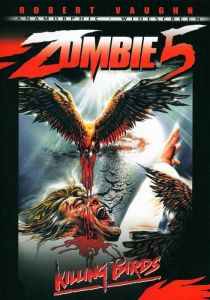
Thanks to the wonderful people at Anchor Bay, I recently watched Zombie 5: Killing Birds, one of the last of the old school Italian horror films.
Admittedly, when I first hit play on the DVD player, I was expecting the worst. Of all the various official and unofficial sequels to Lucio Fulci’s masterpiece Zombi 2 (which, of course, was itself an unofficial prequel to Dawn of the Dead), Zombie 5: Killing Birds has the worst reputation. While most Italian horror fans seem to agree that Zombie 4is enjoyable on its own stupid terms and even Zombi 3has a few brave defenders, its hard to find anyone willing to defend Killing Birds. The general consensus has always seemed to be that Killing Birds is a generic and rather forgettable splatter film that, title aside, had absolutely nothing in common with the Fulci classic.
Having now seen Killing Birds, I can say that the general consensus, in this case, is largely correct. Killing Birds is generic, predictable, and ultimately forgettable. However, taken on its own terms, it’s a perfectly enjoyable way for a lover of zombie cinema to waste 90 minutes. As long as you don’t compare it to Zombi 2, i’ts a perfectly tolerable piece of trash that actually has one or two memorable moments tossed randomly through its running time. At the very least, its a hundred times better than Umberto Lenzi’s similar Black Demons.
The film deals with a bunch of grad students who, while searching for a nearly extinct species of Woodpecker, end up spending the night at a deserted house in Louisiana. Many years ago, a brutal murder was committed at this house and, well, you can guess the rest. The grad students end up falling prey to a bunch of zombies, largely because the students are all remarkably stupid. Meanwhile, B-movie veteran Robert Vaughn shows up as Dr. Fred Brown, a blind man who spends his days studying birds. There’s a lot of birds in this movie and its never quite clear how they link up to the living dead but they certainly do look menacing flying past the camera.
With the exception of Vaughn (who overacts just enough to keep things interesting without going so far over the top as to become ludicrous), the film’s cast is likeable but not memorable. Everyone’s playing a stereotype (i.e., the leader, the computer geek, the slut, the girl with looks and brains) and no one makes much of an effort to be anything more than a stereotype. While this certainly keeps Killing Birds from displaying anything resembling nuance, it’s also strangely comforting. Its lets a neurotic viewer like me know, from the start, that there’s no need to think too much about anything she might see for the next hour and a half. Since this movie was made in the late 80s, most of the men sport a mullet and all of the women wear those terribly unflattering khaki pants that I guess were all the rage back then.
As I stated before, the film does have its occasional strengths. Some of the deaths are memorably nasty (even if the gore effects are decidedly cut-rate, pun not intended). As well, the film does an excellent job at capturing the hot, humid atmosphere of the Louisiana bayous. I’ve spent enough time in that part of the country that I can attest that the movie perfectly captures the stagnant heat and the way dehydration can cause your mind to play tricks on you. While the zombies themselves are hardly as impressive as Fulci’s, the filmmakers wisely keep them in the shadows for most of the film and, if nothing else, this allows the viewer to imagine something scarier than what they’re actually seeing. Finally, this movie does have one of the most effective nightmare sequences that I’ve ever seen. Lasting barely a minute and not really having much to do with the overall plot, this nightmare still features some rather disturbing imagery. One image, in particular, has so stuck with me that I found myself paying homage to it in a my own writing.
Though the movie’s director is credited as being Claudio Lattanzi, it is pretty much an open secret that the movie was actually directed by the infamous Joe D’Amato (who, regardless of what else he may have done during his storied life, also directed one of my favorite movies ever, Beyond The Darkness). I’ve read a few interviews where D’Amato said that he allowed Lattanzi to be credited as director because he wanted to help Lattanzi’s launch his own career. To judge by the movie itself, however, it seems more probable that Lattanzi wasn’t delivering the movie that D’Amato wanted and D’Amato stepped in as a result. Regardless, Killing Birds is hardly the best example of D’Amato’s work but, at the same time, it’s hardly the worst either.
In the end, Killing Birds is a movie that will probably be best appreciated by those who already have a good working knowledge of Italian exploitation films. It’s hardly a masterpiece (and, despite enjoying it, I would hesitate to even call it a “good” movie) but it’s not really deserving of all the criticism that it’s received over the years either. As a bonus, the Anchor Bay DVD come with a lengthy interview with Robert Vaughn in which he discussed his career in B-movies and, while Vaughn says nothing about Killing Birds during the interview, he’s still interesting and enjoyable to listen to. Unlike a lot of “reputable” actors who have made B-movies, Vaughn never condescends to the films that both started and ended his movie career.
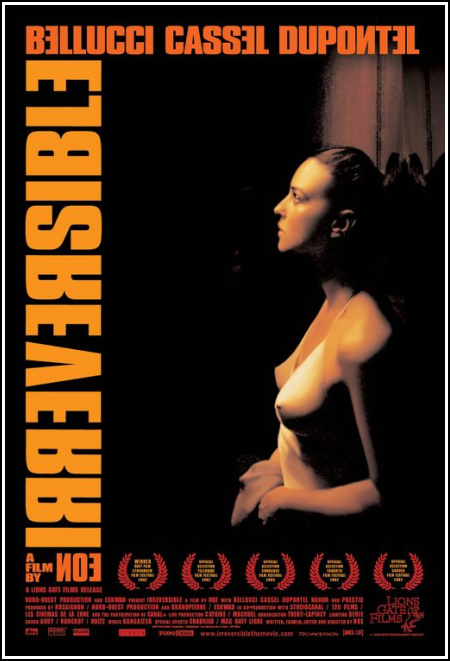
Gaspar Noe’s Irreversible is filmed in the same style as Christopher Nolan’s excellent Memento. With the story unfolding in reverse sequence, the audience’s first impression of the story doesn’t end up being the same once it finishes.
Everyone has made it a point to mention the disturbing and hard-to-watch sodomizing that Monica Bellucci’s character goes through at the hands of a random, strung-out stranger. This 10-minute sequence is as disturbing as any film sequence I have ever had the chance to watch. There is absolutely no feeling of lust or sexiness this scene brings up. A sense of shock, disgust and pain is more appropriate reaction to seeing the lovely Ms. Bellucci’s character go through a very inhumane experience. This scene goes a long way to explaining the film’s beginning where a brutal and equally inhumane murder takes place inside a murky, red-lit, underground gay S&M club.
As the film continues to move backwards in time and shows the viewer the earlier and happier time of Bellucci’s and Vincent Cassel’s characters, the earlier scenes of violence take on a more poignant and sad note. In a space of a day many lives are broken and destroyed, and in the end all because of a random night occurrence in an dingy, lit underpass.
Gaspar Noe’s film is not for everyone and even those daring enough to take a chance to view it will have a hard time sitting through the first half of the film. The film itself takes on a dream-like quality as it begins to unfold. From its nightmarish tone and look to a dreamy last reel. I have heard people call Noe’s film as exploitive and misogynistic in its treatment of its main female character. In the end, Noe’s choice to shoot the rape scene in a realistic fashion and have it linger and linger shows the viewer that evil and ugly things do happen in real life. One either takes it and learn from it or turn away and pretend it never happened.
Irreversible is a film that people will either love or hate. This film doesn’t straddle the center when it comes to viewers reaction to it. Gaspar Noe’s film is not perfect, but overall it provokes the viewer to think on what they’ve seen and felt as the story unfolded.
One of my favorite recent DVD discoveries is an underground film from 1969 called Putney Swope. Directed by Robert Downey, Sr. (who, as we all know, was the father of not only Iron Man and Sherlock Holmes but Sgt. Osiris as well!), Putney Swope is a hilarious satire of advertising, race relations, and everything in between. It’s a must-see for anyone interested in American independent film, American satire, or just plain vulgarity in the service of art and humor.
Since the film takes place at the Truth and Soul Advertising Agency, it features several fake commercials that are so spot-on perfect that they could easily pass for the real thing if not for all the profanity and occasional nudity. Below is my favorite Truth and Soul Commercial:
It is once again time for another offering of The Daily Grindhouse. This time around our latest grindhouse flick comes straight from Spain. I speak of the classic zombie flick, Tombs of the Blind Dead.
The film was shot and filmed wholly in Spain in 1971 by one of Spain’s foremost horror directors, Armando de Ossorio. His film became part of what he became famous for in the horror circles and that is his Blind Dead Tetralogy. This first film in the series I still consider the best of the bunch. While it helped bring about the renaissance of the European zombie cinema craze of the 1970’s this film by Ossorio takes on a different tack from its more gross-out and gore-laden Italian cousins.
Ossorio’s film was all about supernatural and less about zombie apocalypse. His zombies were the ressurected Templars (evil in the way the film portrays them) whose eyes were plucked out by birds during their executions by way of the gallows. The film described them as demon-worshipping knights who performed Satanic rituals to gain power and immortality (propaganda pushed by the French king of the 13th Century and the Catholic Church in Rome to paint the knightly order in a bad light). These zombie knights never did get a full explanation why they rose from their tombs during the film, but for films such as these the scant explanations were always part of their charms. One either bought into the premise in the first 10 minutes or they didn’t. I, for one, bought into it hook, line and sinker the moment the first zombie knight rose.
The film was gory but not in the flesh-eating variety most zombie flicks tended to be. Tombs of the Blind Dead in its international version also showed a lot of sexuality in some of the scenes with nudity part of the norm. The film also was quite good in establishing dread and horror by the use of a creep atmosphere not just from the dark Spanish countryside but from the way the zombies hunted. Being blind they hunted by the sound of the living victims’ breathing and heartbeat. This premise led to some very tense moments as those trying to escape the zombie knights would try to stay silent as the zombies approached their hiding places.
It’s a shame that Ossorio never got the budget to truly pull of what he envisioned with this film and the rest of the tetralogy, but for having as low-budget that he had to make them he definitely created some of the higher-quality grindhouse flicks of the 1970’s.


 Through the Shattered Lens