The latest Song of the Day is from one of the best films of the past decade and, in my opinion, the best film of 2006. I speak of Pan’s Labyrinth by acclaimed Mexican-filmmaker Guillermo Del Toro.
“A Princess” was composed by Spanish composer Javier Navarrete and this particular piece of music from the film continues to use the main lullaby waltz-theme introduced in the beginning of the film. Where the music’s first time being heard by the audience is full of innocence and child-like magic in its tonal structure and melody in “A Princess” Navarrete dials back the innocent quality by adding in some of the hard-won wisdom the main character of Ofelia gains through her trials and tribulations throughout the film’s running time. While the song starts off with a sad and melancholy theme to its melody the song gradually moves back to it’s innocent and magical tone at it’s midway point to signify the main character’s final and complete transition from Ofelia to Princess Moanna.
It’s truly one of the best use of the leitmotif in a film score in quite a while. The fact that Navarrete was able to mine so man different emotional beats from a simple lullaby theme into one final distinct piece of music to end the film shows he was in tune with what director Guillermo Del Toro had in mind. He could easily have gone the usual fantasy music cliche of a huge number of brass and percussion to score the film, but instead went on a more subtle yet complex manner to accentuate a fairly simple fairy tale retelling which also happened to have many complexities in it’s narrative if one was willing to peel back the pages.
If I haven’t already made it clear in my previous reviews on this site, I love exploitation films. Regardless of whether they’re blaxploitation or gialli or whether they’re about zombies or cannibals or just people looking for revenge, I love everything about them. I love them because they’re shameless, they’re frequently incoherent, and occasionally, they’re works of pure (if fractured) genius.
However, I have a special place in my heart for the old school exploitation films of the 1930s and 40s. These are the exploitation movies that came out while the American film industry still operated under the puritanical production code. While the mainstream film industry was still struggling with the idea of Clark Gable saying “damn” onscreen, the underground B-movie makers were making the movies that everyone saw but few people ever talked about. These were low-budget movies, filmed on the cheapest stock available and often times edited with all the skill of a chainsaw-wielding maniac. And while these movies were not necessarily impressive technically, they continue to serve as proof that even our elders occasionally enjoyed a dirty joke.
For the most part, these exploitation films were disguised as being public service announcements. Hence, a film like Ruined Souls wasn’t just a movie about young people skinny dipping and having sex. No, it was a warning about the dangers of venereal disease. Typically, once the film had finished showing off all the bad behavior it could, an authority figure (usually a doctor) would show up and explain why those in the audience shouldn’t do any of the things they had just watched. There’s a shamelessness to these old school exploitation films that reminds me why I admire panhandlers who go through the trouble to come up with an entertaining way to ask me for my money.
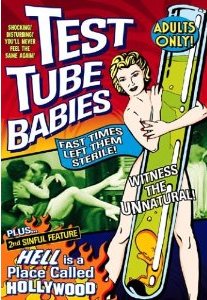
1948’s Test Tube Babies(directed by W. Merle Connell and produced by George Weiss, who would produce most of Ed Wood’s early films) is a typical example of an old school exploitation film. Now the title might lead you to think that this is going to be another horror film about demonic children. However, the exact opposite is true. The message of Test Tube Babies (the film’s PSA) is that any marriage — regardless of how drab and dull — can be saved by forcing the wife to go through hours of excruciatingly painful labor.
The first half of Test Tube Babies plays out roughly like the 1st half of Revolution Road. A boring young man named George meets a frumpy young woman named Cathy. They’re attracted to each other and, since this is the 1940s after all, they get married so that they can have sex. George and Cathy go on a whirlwind honeymoon. They get a house in the suburbs. George gets a job and Cathy settles into the life of being a slave (or “housewife,” as it was apparently known in the 1940s.)
However, is it possible that there is trouble in paradise? Shortly after the honeymoon is concluded, we start to get hints that maybe Cathy isn’t entirely satisfied being an indentured servant. At the breakfast table, Cathy and George talk about how boring their social life is. When George’s womanizing friend Frank comes to visit, Cathy greets him in her nightie and proceeds to dance with him while a simmering George watches. What’s wrong with Cathy? Could it be that she’s suddenly realized that she’s surrendered her own identity just to be someone’s wife? Perhaps it has dawned on her that marriage is really just a societal invention that’s designed to keep anyone from truly challenging the status quo. Or maybe she just needs a child to give her an excuse to remain in a loveless charade of a marriage.
Regardless of the reason why, Cathy is clearly dissatisfied with her new life. Soon, once George is off at work, Cathy invites all of her decadent friends over to the house for a party. This party appears to be the 1940s version of a key party. As Cathy plays hostess, Frank proceeds to make out with another man’s wife and then, from out of nowhere, an elderly lady with bleached blond hair shows up and starts talking about her former life as a burlesque dancer. As Cathy watches in horror (no doubt wondering why she couldn’t have just listened to her husband like a good, dutiful slave), the dancer starts to dance and things quickly escalate until Cathy is finally forced to call George at work and beg him to come home.
One of the reasons I love these old school exploitation films is that they provide a chance to see what our grandparents considered to be risqué. It’s a chance to peer into the repressed sexuality of our elders. So, what can we learn from watching the party scene in Test Tube Babies?
1) To judge from the leering reaction given to the frumpy clothing worn by the female guests, Sears was apparently the Victoria’s Secret of the 1940s.
2) The entire party sequence ends with a bizarre catfight between two women, over the course of which both women somehow end up naked. This serves to prove that, much as I always suspected, men have always been the same.
In a plot development that was later shamelessly ripped off by Revolution Road, all of this suburban decadence leads to Cathy and George realizing how empty their “perfect” sham of a marriage really is. Whereas Kate Winslet decided that this emptiness was linked to her sacrificing her own identity to be a wife, Cathy decides that the marriage is empty because she’s not yet a mother. After all, what could be better than bringing another human being into the world for the sole purpose of justifying a failed marriage? Never mind that neither George nor Cathy comes across like the type of people who could actually raise a happy child. What’s important here is to go through the societal motions.
Cathy, of course, wants to get pregnant immediately because you know us women. We’re just slaves to the old biological clock. However, despite George’s best efforts, Cathy simply cannot get knocked up. She wonders if maybe something’s wrong with her. George is quick to agree that something could be wrong with her so, like any good American couple, they go to a doctor to specifically find out what’s wrong with the wife.
(Interestingly enough, just to judge from the movie’s dialogue and the fact that Cathy is shocked when told to undress before being examined, it would appear that this is not only the first time that she’s ever been to a gynecologist but perhaps the first time she’s even heard the term “gynecologist.” To judge from this movie, apparently women in the 40s were simply locked up in the attic until some idiot came by and paid their dowry.)
It’s here that the movie takes a truly shocking turn as it is revealed that — gasp! — nothing is wrong with the wife. Instead, George is sterile. And this, of course, leads us to the whole concept of test tube babies and how they can even save the most pointless of marriages.
Now, the filmmakers obviously knew that this would a bitter pill for a 1948 audience to swallow so, in order to make sure we understand that this sort of thing actually does happen, we are introduced to Dr. Wright. If for no other reason, see this movie for Dr. Wright. With his oily hair, his ever-present smirk, and an equally ever-present cigarette, Dr. Wright is probably the creepiest gynecologist this side of Jeremy Irons in Dead Ringers. As played by exploitation vet Timothy Farrell, Dr. Wright is the only character in the film to seem to realize that he’s surrounded by idiots.
In the great tradition of old school exploitation, Dr. Wright is used to explain and justify the concept of a test tube baby. By doing so, Dr. Wright justifies and excuses all of the “decadence” that has previously been put up on-screen. Dr. Wright also makes a good argument for the health benefits of cigarettes. Seriously, I have never seen a doctor smoke as much as Dr. Wright. Literally, his every scene is enveloped in a cloud of smoke. He smokes while conducting a consultation, he smokes in between operations, and apparently he even smokes while conducting his examinations. (Which reminds me of a story concerning an ex-boyfriend but the less said about that the better…) Perhaps his best scene comes when, spying a nervous George in a hospital waiting room, Dr. Wright suggests that George “smoke a cigarette and relax.” (“I’ve already gone through two packs!” George replies and everyone shares a cancerous laugh.)
In the end,what can you really say about this odd little time capsule? As far as old school exploitation is concerned, it’s not a classic in the way that a movie like Reefer Madness is. Still, the movie holds a strange fascination for me. Some of it, of course, is the whole “so-good-that-its-bad” factor. This movie has that in spades. However, I think an argument can be made that movies like Test Tube Babies provide a view into the American subconscious that more mainstream films simply can not. Freed up from the confines of the Hollywood production code, the old school exploitation movies could give the people what they wanted to see as opposed to what they felt they should want to see.
Perhaps that’s the real appeal of a movie like Test Tube Babies. Its proof that people were fucked up before any of us were born and that they’ll continue to be fucked up long after we’re gone.
Then again, perhaps I’m just reading too much into an amusingly bad B-movie.
Perhaps it would be best to give the movie the final word…
Now that Guillermo Del Toro has made it official that he’s leaving The Hobbit as director there’s now a scramble to find who will be replacing him on the project. Del Toro was universally hailed as the best choice the first time around when Peter Jackson made it known that he would only produce the two-part film and not get back to directing them. The many delays due to MGM’s financial troubles, script still not completed and casting still not done forced GDT to back away and could shelve the project for good.
The only thing keeping the project afloat is the fact that this project has a major fan-base already clamoring to see it made. With the huge success both critically and commercially of Jackson’s The Lord of the Rings Trilogy this two-part film adaptation of The Hobbit is pretty much a lock to do the same in the hands of the right filmmaker.
Jackson and studio heads holding the rights to the project will not want just any director. While Peter Jackson was still a little-known director and an outsider from the Hollywood scene when he began work on the original trilogy, this time around studio people will want a marketable name or, at the very least, a filmmaker who has the skills to follow Jackson’s work. Guillermo Del Toro was the perfect choice now someone else has to take up the baton.
Some have mentioned Peter Jackson as the only choice if he’d back off comments that he won’t direct but only produce. There’s a camp that say now’s the time to sign Sam Raimi who recently has left another mega-franchise and now available. Raimi is an interesting choice in that knows how to handle huge blockbuster projects and he definitely needs a home-run to follow-up a bad end as helmer of the Spider-Man franchise.
Another name to come up which I would welcome if Jackson doesn’t return as director is Guillermo Del Toro’s fellow countryman and one of his best friends: Alfonso Cuaron. Cuaron has shown himself to be one of his generation’s best. He’s done fantasy as helmer of the third Harry Potter film (universally seen as the best in the franchise) and may see tackling this blockbuster project as a major artistic challenge. I, for one, would hope Cuaron takes the job if offered.
The one dark horse name which has begun making the rumor mill about who may replace GDT is Jackson’s own protege, wunderkind filmmaker Neill Blomkamp. He’s worked with Jackson already and his first feature-length film, District 9, shows he has the storytelling and directing chops. The only drawback to him accepting the job if offered is that this will be a major-budgeted studio film which means it could turn into another Halo-clusterfuck where he commits and the project dies due to problems within the studio.
Other filmmakers have been mentioned like Brad Bird, Jean-Pierre Jeunet, Andrew Adamson, Tim Burton and Peter Weir just to name a few. In the end, my money is on either Jackson just taking the reins on the film if he thinks no one else would give the necessary commitment to the project it deserves, Cuaron takes on the job as a way to challenge himself or Jackson protege Blomkamp tackling something bigger as a way to add more cred to his growing reputation as one of the best young filmmaker of his generation.
Who do you think should take charge of The Hobbit now that Guillermo Del Toro has left?