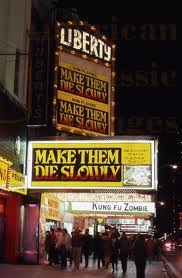
Retro Television Reviews: Miami Vice 2.1 and 2.2 “The Prodigal Son”


Welcome to Retro Television Reviews, a feature where we review some of our favorite and least favorite shows of the past!  On Mondays, I will be reviewing Miami Vice, which ran on NBC from 1984 to 1989.  The entire show is currently streaming on Tubi!

This week, the second season with a two-hour long premiere!  Crockett and Tubbs are going to New York!

Episode 2.1 and 2.2 “The Prodigal Son”

(Dir by Paul Michael Glaser, originally aired on September 27th, 1985)

The second season premiere of Miami Vice opens with a series of set pieces.

In Panama, Crockett and Tubbs visit a secret military base in the jungle and are disgusted to learn how the Panamanian military gets information about drug smugglers.  Tubbs and Crockett find one horribly tortured man in a tent.  Tubbs gives him a drink of water and gets what information he can from the man.  Crockett and Tubbs leave the tent.  A gunshot rings out as the involuntary informant is executed.  When the shot rings out, both Crockett and Tubbs turn back to the tent in slow motion, stunned by the brutality of their allies in the Drug War.  Indeed, it’s hard not to compare the scene to the famous photograph of a South Vietnamese general executing a communist during the Vietnam War.

The Vietnam analogy continues with the next scene.  In the Everglades, Crockett, Tubbs, and the entire Vice Squad work with the DEA to ambush the Revilla cousins as they bring drugs into the U.S.  Sitting in the swamp, Crockett compares the experience to Vietnam, suggesting that the war on the drugs is just as futile and as costly.  And indeed, it’s hard not to notice that every drug dealer that Crockett and Tubbs has taken down over the course of this show has immediately been replaced by another.  The Revillas are just another in a long line of people getting rich off of other people’s addictions.

After the bust goes down, Crockett and Tubbs arrives at a celebratory party, just to discover that almost of all of the undercover DEA agents have been murdered and Gina has been seriously wounded.  There is something very haunting about this scene, with Crockett and Tubbs rushing through a penthouse and seeing a dead body in almost every room.

At a meeting in a stark office, the head DEA agent explains that his agency has been compromised and all of his undercover agents have been unmasked.  Someone has to go to New York and work undercover to take down the Revillas but it can’t be any of his people.  Since the Revillas are smuggling their stuff in through Miami, Miami Vice has jurisdiction.  Paging Crockett and Tubbs!

Working undercover as Burnett and Cooper, Crockett and Tubbs visit a low-level drug dealer (played by Gene Simmons) who lives on a yacht and who gives them the name of a connection in New York City.

From there, Miami Vice moves to New York City, where Crockett and Tubbs meet a low-level criminal named Jimmy Borges (played by an almost impossibly young Penn Jillette) and they try to infiltrate the Revilla organization.  Along the way, Tubbs meets up with Valerie (Pam Grier) and discovers that she has apparently lost herself working undercover.  Meanwhile, Crockett has a brief — and kind of weird — romance with a photographer named Margaret (Susan Hess).

(“I like guns,” she says when Crockett demands to know why she stole his.)

With Crockett and Tubbs leaving Miami for New York in order to get revenge for a colleague who was wounded during an operation, The Prodigal Son almost feels like the pilot in reverse.  Also, much like the pilot, the exact details of The Prodigal Son‘s story are often less important than how the story is told.  This episode is full of moody shots of our heroes walking through New York while songs like You Belong To The City play on the soundtrack.  (There’s also a song from Phil Collins, undoubtedly included to bring back memories of the In The Air Tonight scene from the pilot.)  It’s all very entertaining to watch, even if the story itself doesn’t always make total sense.  Indeed, you really do have to wonder how all of these criminals keep falling for Sonny’s undercover identity as Sonny Burnett.  You would think that someone would eventually notice that anyone who buys from Sonny Burnett seems to get busted the very next day.

Stylish as the storytelling may be, this episode actually does have something on its mind.  Those lines comparing the War on Drugs to the Vietnam Conflict was not just throwaways.  Towards the end of the episode, Crockett and Tubbs follow a lead to the offices of J.J. Johnston (Julian Beck, the ghost preacher from Poltergeist II).  The skeletal Johnston is an investor of some sort.  He has no problem admitting that he’s involved in the drug trade, presumably because he knows that there’s nothing Crockett and Tubbs can do to touch him.  Upon meeting the two cops, he immediately tells them exactly how much money they have in their checking accounts.  He points out that they’re poor and they’re fighting a losing war whereas he’s rich and he’s making money off of a losing war.  Beck gives a wonderfully smug performance as Johnston and it should be noted that, of all of the episode’s villains, he’s the only one who is not brought to any sort of justice.  Val almost loses herself.  Tubbs and Crockett don’t even get a thank you for their hard work.  The somewhat sympathetic Jimmy Borges ends up dead while the Revillas were undoubtedly been replaced by even more viscous dealers.  Meanwhile, J.J. Johnston relaxes in his office and counts his money.  This is the No Country For Old Men of Miami Vice episodes.

This episode is also full of familiar faces.  Charles S. Dutton, Kevin Anderson, Anthony Heald, Miguel Pinero, James Russo, Bill Smtirovich, Zoe Tamerlis, Paul Calderon, and Louis Guzman, they all show up in small roles and add to show’s rather surreal atmosphere.  This is Miami Vice at its most dream-like, full of people you think you might know despite the fact that they’re doing things of which you don’t want to be a part.

As for the title, The Prodigal Son is Tubbs and he is tempted to stay in New York City.  But, in the end, he joins Crockett on that flight back to Miami.  It’s his home.
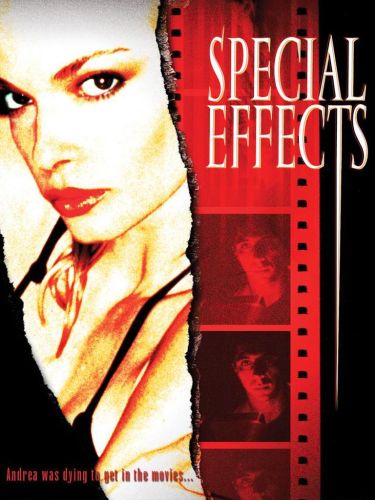
Horror Film Review: Special Effects (dir by Larry Cohen)


https://www.youtube.com/watch?v=vP_uhE5L_cM

In this rather odd horror film from 1984, dumb-as-mud Keefe Wateran (Brad Rijn) travels from Dallas to New York City, hoping to bring his wife back home.  Andrea (Zoe Tamerlis, the star of Abel Ferrara’s Ms. 45) abandoned both Keefe and their son because she wants to be a star.  When the film opens, she’s posing topless in a replica of the Oval Office.  Keefe is not too happy when he discovers that his wife is apparently appearing in politically-themed nude photo shoots.

And the thing is, you feel like you should feel sorry for Keefe, seeing as how his wife abandoned not only him but also their child.  But Keefe is just such a self-righteous know-it-all that you really can’t blame Andrea for leaving him.  As soon he starts going on and on about how she’s abandoned her family just to be a tramp in New York, you’re pretty much automatically on Andrea’s side.

Unfortunately, when Andrea turns up dead at Coney Island, the police automatically suspect that Keefe’s responsible.  When they show up to arrest Keefe for the murder, he’s only wearing his boxer shorts.  One of the detectives comments that, if he was going to commit murder, he would at least wear interesting underwear.  And, again, you may want to sympathize with Keefe but the detective has a point.  You need to dress for the job you want, not the one you have.  I have an entire drawer full of murder thongs, just in case I ever decide to go for a career change.

Keefe is bailed out of jail and provided a high-priced attorney by Christopher Neville (Eric Bogosian).  Neville is a big-time Hollywood director …. or, at least, he was until he directed a huge flop.  (Apparently, the film had over $30,000 worth of special effects, which I guess was a lot back in 1984.)  Neville, whom Andrea was supposed to have a meeting with on the night that she died, says that he’s fascinated by Keefe and Andrea’s story.  In fact, he wants to turn it into a movie and he wants to hire Keefe as a special consultant.

However, what we know (but what Keefe doesn’t know, though he’d be able to figure it out if he wasn’t such a total and complete freaking moron), is that Neville murdered Andrea!  He strangled her when she objected to him filming them while they were having sex.  Now, Neville wants to make a movie about the murder.  He even hires Elaine Bernstein (Zoe Tamerlis, again) to play Andrea in the film, despite the fact that Elaine has no acting experience.  What’s important is that Elaine looks like Andrea.  Neville also manages to manipulate the rather stupid Keefe into playing himself in the film.  Soon, Neville is suggesting that perhaps they need to film a scene of Keefe and Andrea having rough sex and maybe Keefe should choke her during the scene….

And it just gets stranger from there.  Special Effects is Hitchcock-style thriller from director Larry Cohen, one that’s got a bit more on its mind than just murder and a few heavy-handed jokes about the film industry.  Neville may be smooth and manipulative while Keefe may be loud and a bit on the dumb side but, ultimately, they’re both obsessed with turning Elaine into Andrea.  Neville wants to transform Elaine into the Andrea that he victimized while Keefe wants to turn Elaine into his idealized version of Andrea, the version that never wanted anything more than to be his wife and the mother of his children.  In the end, they’re both creeps.  (Admittedly, only one of them is murderer.)

Adding to the film’s strange tone are the three memorably eccentric lead performances.  All three of the actors do unexpected things with their characters.  Bogosian is wonderfully smug and smoothly manipulative as Neville while Brad Rijin goes all out in making Keefe one of the stupidest characters ever to appear in a leading role in a motion picture.  (He’s like Bruce Campbell, without the comedic timing.)  And finally, Zoe Tamerlis does a great job playing four different characters — Andrea, Neville’s version of Andrea, Keefe’s version of Andrea, and finally Esther.

Special Effects is an intriguing mix of thrills, horror, and satire with an undercurrent of anger.  One gets the feeling that Neville is a stand-in for many of the soulless directors who had the type of career that Cohen felt he deserved.  Track it down and check it out.

Artwork of the Day: Ms. 45


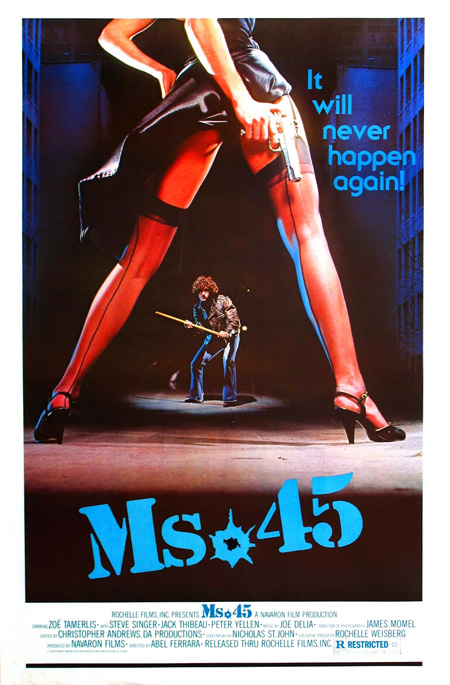
ms45poster

I don’t know who designed the poster for the classic 1981 film, Ms. 45, but it is truly brilliant.

Directed by Abel Ferrara, Ms. 45 tells the story of a mute seamstress named Thana (played by Zoe Tamerlis) who, after being raped twice in one day, uses a 45 caliber pistol to take revenge on almost every man in New York City.  The film’s tagline announces, “She was used and abused — and it will never happen again!” and Ms. 45 is a feminist masterpiece, one that exposed and attacked the same type of men who, undoubtedly expecting to see a typically low-budget, nudity-filled revenge flick, probably flocked down to 42nd Street to see the film when it was originally released.

Like the film itself, the poster is a work of transgressive brilliance, promising sex and violence while, at the same time, announcing that Thana was never again going to be a victim of an exploitive and patriarchal society.  One can only imagine how many men were lured into the theater by the legs on this poster, just to then by left in a state of shock as they literally watched themselves being blown away and punished for their misogyny on screen.  (Reportedly, even the most hardened of grindhouse audiences were left stunned by Ms. 45‘s intense final scene.)

The poster for Ms. 45 is definitely one of the best in grindhouse history and it’s also our latest artwork of the day!

(If you want to read more about my feelings about Ms. 45 and grindhouse cinema in general, please be sure to read my rightfully acclaimed essay on the subject, Too Sordid To Ever Be Corrupted.)


Too Sordid To Ever Be Corrupted


“How could you have possibly enjoyed that movie?”

I hate that question.  I hate the self-righteous tone of it.  I hate the demand that I justify anything that I choose to do with my life.  I hate the implication of the question, the suggestion that somehow there is some sort of moral force at the center of the universe that determines whether or not a movie can be enjoyed.

Unfortunately, no matter how obviously justified I am in loathing that question, it’s still one that I am frequently asked.  How can I not only enjoy watching old school exploitation and grindhouse films (the majority of which were made before I was even born) but also devote a good deal of my time to not only watching these movies but tracking them down and then telling the rest of the world how much I love them?

(Of course, what they’re really asking is what are you doing watching exploitive trash like House On The Edge of the Park or Fight For Your Life when you should be out finding a husband, driving an SUV, and living a life of quiet desperation?)

First off, I should confess.  I have commitment issues, I know it.  I realize that, as a result of some personal experiences in the past, that I tend to beg for affection and attention even while I’m putting up my own invisible wall to keep anyone from getting too close.  It’s not easy for me to trust but, after writing for this site since May, I feel like maybe it’s time to share a little bit more about me.  Hi.  My name is Lisa Marie.  I’m 24.  I have three older sisters that I love.  I’m a proud to be an Irish-German-Spanish-Italian-American.  I lived in five different states before I was 13 and I’m rarely amused when people point out the country twang in my voice.  Up until I was 17, ballet was my life but then I fell down a flight of stairs, broke my ankle in two places, and that was the end of that.  I worked very hard to earn a degree in Art History.  Not surprisingly, my current job has nothing to do with art or history.  I have asthma and heterochromia (my right eye is a darker shade of green than the left).  I’m blind without my contacts.  I like cats, driving fast, and being single.  I dislike dogs, needy men, and those tiny little smart cars.  The only thing that can equal my love for the Grindhouse is my hatred for the Mainstream.

Here’s a few reasons why.

1) Before Independent Film, there was the Grindhouse.

Today, if a young director wants to show what he’s capable of doing, he makes his own little film and enters it into various film festivals and, if he’s made something interesting, he might sign a distribution deal and his film might pop up down here in Dallas at the Angelika theater.  In the 70s, that young director would make an exploitation film, hope that it had enough sleaze appeal to make back its budget by playing in a New York Grindhouse (or a Southern drive-in) and, if he had made something interesting, his cheap, exploitation film might eventually end up being released on DVD by Anchor Bay or Blue Underground.  The best Grindhouse films were made by director who were eager to show what they were capable of doing.  These movies were not made by multimillionaires with houses on both coasts of the country.  Grindhouse movies were made by director who had to work to create something memorable, filmmakers who knew that they might never get another chance to put their vision on-screen.

2) The Mainstream Lies.  The Grindhouse is honest.

Mainstream films are just that.  They are films designed to appeal to the widest possible audience.  A mainstream movie is not made for you.  A Mainstream movie is made to appeal to the brain-dead suburbanites who can be easily recruited at the local mall to be a part of a test screening.  A Mainstream movie is made to be inoffensive.  A Mainstream movie is edited and re-edited to remove anything that could possibly negatively reflect on the bottom line.

Grindhouse movies, however, didn’t have time for that.  Grindhouse movies were made to exploit the moment.  As a result, there was no time to worry about appealing to everyone.  There was no time to constantly edit until not a single rough edge remained.  Grindhouse films are messy.  Grindhouse films are not always pleasant.  They don’t always have the perfect ending.  In short, Grindhouse movies are like life itself.

In the end, safe and inoffensive mainstream movies are made to appeal to the who we wish we were.  Grindhouse movies — sordid, sometimes uncomfortable, and always appealing to the audience’s most primal thoughts, fears , and desires — are made to appeal to who we actually are.

3) The Mainstream is bland.  The Grindhouse is dangerous and unpredictable.

Where else but in a Grindhouse film could you hear a killer who speaks like a duck like in Lucio Fulci’s The New York Ripper?  Because the Grindhouse was free of the need to try to fit in with what the mainstream decreed to be normal, the Grindhouse had the freedom to come up with some of the most brilliantly demented plots in the history of film.  When was the last time that the plot of a Mainstream film really caught you off guard?  I’m not talking about safe, inoffensive surprises like Avatar‘s 3-D effects.  I’m talking about a plot where, halfway through, you look at your fellow viewer and you both say, “What the fuck was that!?”  Anything can happen in the Grindhouse.  As soon as things start to feel safe and a little boring, the Grindhouse has the ability to make things exciting again.  The Mainstream, meanwhile, just asks you to get married.

4) The Mainstream always condescends.  The Grindhouse occasionally empowers.

Here’s a story of two movies.  In the mainstream Brave One, Jodie Foster gets a gun after she’s raped and her dog is stolen.  (In typical mainstream fashion, the movie doesn’t seem to be sure which crime is supposed to be worse.)  In the grindhouse Ms. 45, Zoe Tamerlis gets a gun after she’s raped twice in one day.  In the Brave One, Foster passively sits on the New York subway and waits until she threatened with rape a second time before she kills the potential rapist.  In Ms. 45, Tamerlis shoots every man she sees because she knows that every man she sees is a potential rapist.  In The Brave One, Foster gets her revenge by remaining the victim.  In Ms. 45, Tamerlis becomes the aggressor.  Both Foster and Tamerlis act in self-defense but Foster is wracked with guilt because the mainstream cannot risk losing its audience.  Tamerlis becomes stronger and more confident with each murder as, for the first time, she has found a way to control her own destiny.  At the end of The Brave One, Foster is not only rescued by a man but she gets her dog back too.  At the end of Ms. 45, Tamerlis goes on a shooting rampage at a Halloween party and is finally killed by another woman.  The Brave One‘s tag line was “How many wrongs to make it right?”  Ms. 45’s tagline: “She was used and abused and it will never happen again!”

I know this is probably going to be my most controversial argument.  Don’t get me wrong, I’m not advocating that we should just go out and start randomly shooting men.  But, I will say this — in Ms. 45, Zoe Tamerlis refuses to be a victim and she — and the film — refuses to let society off the hook.  When I think about Ms. 45, it doesn’t inspire me to hate men (because, trust me, I don’t) and it certainly doesn’t inspire me to grab a gun and start shooting.  It does, however, inspire me to not allow myself to fall into that never-ending cycle of victimhood.

I’m not attempting to argue that Grindhouse films are secretly feminist films.  Grindhouse films are infamous for exploiting women.  However, so does the mainstream.  (Of the two films, The Brave One features nudity.  Ms. 45 does not.)  Both the Grindhouse and the mainstream obviously get off on victimizing women.  However, in the Grindhouse, women were occasionally (though certainly not often) allowed to fight back with the same aggression and determination that the mainstream, for the most part, usually reserves just for men.

(If The Girl With The Dragon Tattoo had been released in the 70s, it would have played at the Grindhouse.)

5) Lastly, and most importantly, the Grindhouse is still our little secret.

Let’s just admit it — independent films are trendy.  Contemporary independent films have, to a large extent, become the new mainstream.  The earnest film students who had a Sundance hit are now going to Hollywood to make the next Benjamin Button.  Sundance is just ShoWest with more facial hair.  However, the old school grindhouse will never sell out because it no longer exists.  It was destroyed by the morality police before it could sacrifice its soul.  While an independent filmmaker is just a director who will eventually grow up and break your heart, the great Grindhouse films are frozen in time, too sordid to ever be corrupted.  The Mainstream will never embrace the Grindhouse and for that reason, the Grindhouse will always be the ultimate statement of freedom.