1987’s Cellar Dweller opens with Jeffrey Combs playing an artist.
Sitting in his art studio (located in the cellar of his home), Combs draws a picture of a monster and he adds a few Lovecraftian occult symbols and — uh oh! — the monster comes to life and start to destroy everything that Combs holds dear. Combs discovers that he can stop the monster by setting his drawings on fire but, in the process, Combs also destroys himself.
This ten minute prologue features Jeffrey Combs at his best, bringing his neurotic Re-Animator energy to the role of the artist who discovers just how dangerous an active imagination can be. One reason why Combs is a horror icon is that he can win your sympathy even while playing a character who does some objectively stupid and terrible things. Unfortunately, once the prologue is over, so is Jeffrey Combs’s role in the film. He may be first-billed but he doesn’t appear after the opening credits.
The film jumps forward to 1987. Cartoonist Whitney Taylor (Debrah Farentino) is the latest artist to take residence at Mrs. Briggs’s Institute For The Arts, which just happens to be in the same house that was once home to Jeffrey Combs’s artist. Mrs. Briggs (Yvonne DeCarlo) is a noted critic of modern art. In fact, Whitney and Mrs. Briggs disagree so vehemently about art that you really do wonder why Whitney would apply to the Institute in the first place.
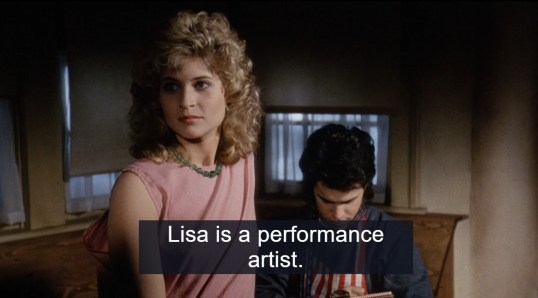
There’s a few artists at the Institute. Norman (Vince Edwards) is a tough guy writer. Philip (Brian Robbins) is a bad boy artist. Amanda (Pamela Bellwood) is a former rival of Whitney’s and the two still hate each other. (Whitney seems to rub a lot of people the wrong way.) Best of all, there’s a performance artist named …. LISA!
Lisa is played by Miranda Wilson.
Frustrated with Amanda, Whitney gives into her worst instincts and draws a cartoon the features a monster killing her rival. Uh-oh. Soon, the monster has reemerged from the cellar and Amanda has disappeared. One-by-one, the other residents are picked off and their deaths appear in Whitney’s cartoons. The monster claims that he dwells wherever there is imagination but Whitney is convinced she’s figure out a way to destroy him and bring everyone back. Has she? You’ll have to watch the film to find out!
Produced by Charles Band’s Empire Pictures, Cellar Dweller is an enjoyably macabre little tale. It’s only 77 minutes long and the fast pace makes the film feel like an extended episode of a horror anthology series. The monster and the plot feel like they could have been lifted from a 50s horror comic and the other artist are all memorably eccentric. The cast appears to be having a ball. It’s a fun treat for horror fans like you and me.
Cellar Dweller was directed by special effects specialist John Carl Buechler and he does a good job with the monster. It’s both intimidating and kind of goofy at the same time. A year after Cellar Dweller, Buechler directed his best known film, Friday the 13th Part VII — The New Blood. That film too was likably goofy.
Welcome to Retro Television Reviews, a feature where we review some of our favorite and least favorite shows of the past! On Tuesdays, I will be reviewing the original Fantasy Island, which ran on ABC from 1977 to 1986. Almost entire show is currently streaming is on Youtube!
Smiles!
Episode 3.11 “The Mermaid/The Victim”
(Dir by Earl Bellamy, originally aired on December 1st, 1979)
This week, Fantasy Island suddenly becomes the most dangerous place on Earth.
Julie Bett (Joan Prather) comes to the island with a simple fantasy. She wants a date — just one date — with a man that she met briefly four years ago. Mr. Roarke asks Julie if perhaps she has overidealized her memories of Michael Duvall (James Darren). Julie says no and that Michael is the ideal man. Roarke reveals that Duvall lives on a nearby island where Roarke has no legal authority. Julie says that fine, since the date will be on Fantasy Island. Roarke reveals that Duvall is usually not allowed to step foot on Fantasy Island because of his shady reputation. Julie replies that there’s nothing shady about Michael Duvall. Roarke finally allows Duvall to come to Fantasy Island for the date.
Of course, within minutes of arriving, Duvall has drugged Julie’s drink and then whisked her back to his own island. It turns out that Michael Duvall is a Jeffrey Epstein-style human trafficker and his estate doubles as a prison for the women that he had abducted. His evil assistant, Madame Jeannot (Yvonne DeCarlo), announces that there is no way that Julie can escape and, to prove her point, she introduces Julie to Annie (Cathryn O’Neil), who tried to escape and was severely beaten as a result.
Julie tries to rally the other prisoners (including Dorothy Stratten, who would be murdered 8 months after this episode aired) to fight back against Duvall, Jeannot, and their servant. If her rebellion fails, Julie knows that she’ll never be seen again….
Meanwhile, oceanographer Harold DeHaven (John Saxon) has come to Fantasy Island with his wife, Amanda (Mary Ann Mobley). Harold and Amanda have a troubled marriage, largely because Harold is too obsessed with his work and his desire to make a major discovery of some sort. No sooner has Harold started walking along the beach then he comes across a mermaid! Princess Nyah (Michelle Phillips) is apparently a well-known figure on Fantasy Island and, at one point, Roarke even confronts Nyah about her history of trying to lure the guests to their deaths. Can Amanda prevent her husband from drowning in his attempt to be with Princess Nyah?
(This episodes leaves us to wonder just what exactly Fantasy Island’s legal liability would be if someone died as a result of their fantasy. Seriously, it seems like Mr. Roarke has really left himself vulnerable to a lawsuit.)
Anyway, Julie and the other kidnapped women manage to escape from Duvall’s estate, just to find Mr. Roarke and a bunch of policemen waiting for them. Roarke explains that he knew what Duvall was doing but he needed proof before he could contact that authorities. Julie provided the proof. Essentially, Roarke is saying that he put Julie’s life at risk to take down Duvall but Julie and the other women seem to be amused by the whole thing. Everyone smiles as Mr. Roarke says that he’ll take them back to Fantasy Island. I guess PTSD doesn’t exist on the islands.
Meanwhile, Amanda’s efforts to keep Harold from swimming off with Nyah nearly leads to Amanda drowning. Seeing his wife risk her life for him, Harold realizes that he really does love Amanda and both he and Amanda return to dry land. Disappointed, Nyah swims off.
Yay! Everyone lived! As they all left the Island, no one seemed to be the least bit traumatized by nearly dying. At the plane flies away, Roarke suggest that Nyah’s new target might be Tattoo. “Be serious, boss,” Tattoo, “I can’t even swim.” The thought of his assistant dying a terrible death from drowning cause Roarke to laugh out loud as the end credits roll.
There was a weird episode and compulsively watchable as a result. Seriously, how do you not love John Saxon following Michelle Phillips into water? That said, Fantasy Island seems like a very dangerous place.
In the late 1970s, the Rev. Jim Jones was a very powerful man.
The leader of the California-based People’s Temple, Rev. Jones had made a name for himself as a civil right activist. As a minister, he made it a point to reach out to the poor and to communities of color. (It was said, largely by Jones, that he had been forced to leave his home state of Indiana by the Ku Klux Klan.) Local politicians eagerly sought not only Jones’s endorsement but also the donations that he could easily raise from the members of the People’s Temple. Though there were rumors that he was more of a cult leader than a traditional preacher, Jones was appointed chairman of the San Francisco Housing Authority. Everyone from Governor Jerry Brown to San Francisco Mayor George Moscone appeared with Jim Jones at campaign events. Among the national figures who regularly corresponded with Jim Jones were First Lady Rosalyn Carter and Vice President Walter Mondale.
Of course, what actually went on behind the closed doors of the People’s Temple was a bit of secret. Jones was a self-proclaimed communist who claimed to have had visions of an upcoming nuclear war between the U.S. and Russia. In his sermons, he often claimed that it would be necessary for both him and the rest of the People’s Temple to eventually leave the United States. Jones spoke of enemies that were trying to destroy him, like the reporters who investigated Jones’s claim of being a faith healer and who followed up on reports that Jones was sexually exploiting both the women and the men who followed him. Jones secretly started to make plans to leave the United States in 1973 but it would be another four years before he and a thousand of his followers arrived in Guyana. The People’s Temple Agricultural Project sat in the jungle, isolated from oversight. It was informally known as Jonestown.
Over the next year, Jonestown did not exactly thrive. Rev. Jones demanded that his people work hard and he also demanded that they spend several hours a day studying socialism and listening to him preach. Jones ran his commune like a dictator, refusing to allow anyone to leave (for their own safety, of course). Anyone who questioned him was accused of being an agent of the CIA. In the U.S, the families of Jonestown’s citizens became concerned and started to petition the government to do something about what was happening in Guyana. A few people who did manage to escape from Jonestown told stories of forced labor, suicide drills, rape, and torture. The People’s Temple claimed that those people were all lying and, because Jones still had his government connections, he was largely left alone.
Finally, in 1978, Congressman Leo Ryan, a Democrat who had a history of opposing the political establishment, flew down to Guyana so that he could see Jonestown for himself and also bring back anyone who wanted to leave. Despite the efforts of Jones to disguise the truth about life in Jonestown, several people did ask to leave the colony with Rep. Ryan. Jones sent his most loyal men to meet and open fire on Rep. Ryan’s entourage at a nearby airstrip. Rep. Ryan and four others were shot and killed, making Ryan the first Congressman to be assassinated since 1868. Nine others, including future Rep. Jackie Speier, were wounded in the attack.
Back at Jonestown, Jim Jones announced that his prophecy was coming true and that the imperialists would soon descend on Jonestown. Though 85 of Jones’s followers managed to escape into the jungle, the other 909 residents of Jonestown subsequently died. Though some showed signs of having been murdered by Jones’s followers, the majority committed suicide by drinking poisoned Flavor-Aid. Jim Jones shot himself in the head.
The world was horrified and the term “drinking the Kool-Aid” entered the discourse. And, of course, many filmmakers were inspired by the horrific events that happened in Jonestown. Ivan Rassimov, for instance, played a Jim Jones-style cult leader in Umberto Lenzi’s Eaten Alive. Meanwhile, Powers Boothe would win an Emmy for playing Jim Jones in a 1980 television miniseries called Guyana Tragedy.
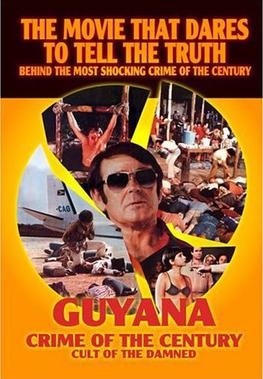
Guyana Tragedy is often described as being the definitive film about Jim Jones. However, a full year before Guyana Tragedy aired, the Mexican director, Rene Cardona Jr., was in theaters with his own version of the Jim Jones story. To anyone who is familiar with Cardona’s style of filmmaking, it’s perhaps not surprising that 1979’s Guyana: Crime of the Century did not win any awards.
Cardona’s film opens with a rather odd title card, explaining that, though the film is based on Jonestown, the names of certain characters “have been changed to protect the innocent.” But if you’re going to start the film by announcing that it’s about the biggest news story of the past year, what’s the point of changing anyone’s name? And for that matter, why is Jim Jones renamed James Johnson and his colony rechristened Johnsontown? Jones was hardly one of the innocents, not to mention that he was dead and in no position to sue when the film came was released. Why is Leo Ryan renamed Lee O’Brien, especially when the film portrays Ryan as being the type of hard-working and honest congressman that anyone would be happy to vote for?
The film opens with Rev. James “Johnson” (played by Stuart Whitman) giving a lengthy sermon about how it’s time for the congregation to move to Guyana, which he describes as being a Socialist paradise. Oddly, in the film, the People’s Temple is portrayed being largely white and upper middle class whereas, in reality, the opposite was true. Indeed, Jones specialized in exploiting communities that were largely marginalized by American society. One reason why Jones’s claim of government persecution was accepted by the members of his church is because the People’s Temple was made up of people who had very legitimate reasons for distrusting the American government.
A few scenes later, Johnson is ruling over “Johnsonville.” Since this is a Cardona film, the viewers are shown several scenes of people being tortured for displeasing Johnson. A child is covered in snakes. Another is shocked with electricity. A teenage boy and girl are forced to kneel naked in front of Johnson as he announce that their punishment for trying to run away is that they will be forced to have sex with someone of Johnson’s choosing. Once the torture and the nudity is out of the way, the film gets around to Congressman O’Brien (Gene Barry) traveling to the Johnsontown. Since the audience already knows what’s going to happen, the film becomes a rather icky game of waiting for O’Brien to announce that he’s ready to go back to the landing strip.
Because the film has been released under several different titles and with several different running times, Guyana: Crime of theCentury has gotten a reputation for being one of those films that was supposedly cut up by the censors. I’ve seen the original, uncut 108-minute version of Guyana and I can tell you that there’s nothing particularly shocking about it. Instead, it’s a painfully slow film that doesn’t really offer much insight into how Jim Jones led over 900 people to their deaths. While Gene Barry make for a convincing congressman, Stuart Whitman gives a stiff performance as the Reverend Johnson. There’s very little of the charisma that one would expect from a successful cult leader. One gets the feeling that Whitman largely made the film for the paycheck.
Of course, Whitman was hardly alone in that regard The film features a host of otherwise respectable actors, including Yvonne DeCarlo, Joseph Cotten, John Ireland, Robert DoQui, and Bradford Dillman. As well, Cardona regular Hugo Stiglitz appears as a photographer. (Stiglitz is perhaps best known for starring in Nightmare Cityand for lending his name to a character in Tarantino’s Inglourious Basterds.) Of the large cast, I appreciated the performances of Cotten and Ireland, who play Johnson’s amoral but well-connected attorneys. (The characters are based on the Temple’s real-life attornes, Charles Garry and Mark Lane. Lane also wrote the first JFK conspiracy book, Rush to Judgment.) I also liked Yvonne DeCarlo’s performance as the most devoted of Johnson’s followers. Even Bradford Dillman’s natural blandness was used to good effect as his character comes to represent the banality of evil when it comes time for him to start administering the Flavor-Aid. But those good performances still can not overcome the film’s slow pace and the fact that the film didn’t bring any new insight to the tragedy.
The film sticks fairly close to what is believed to have actually happened at Jonestown but, in the end, it barely even works as an example of shameless grindhouse filmmaking. It’s not even offensive enough to be enjoyable on a subversive level. Instead, it was just a quick attempt to make some money off of the crime of the century.
Welcome to Retro Television Reviews, a feature where we review some of our favorite and least favorite shows of the past! On Tuesdays, I will be reviewing the original Fantasy Island, which ran on ABC from 1977 to 1986. The entire show is currently streaming on Tubi!
This week, Fantasy Island is invaded by Nazis and Angels!
Episode 2.3 “Charlie’s Cherubs/Stalag 3”
(Dir by Cliff Bole, originally aired on December 9th, 1978)
Today’s episode begins with Mr. Roarke noticing that Tattoo is carrying a calculator with him.
“What is that, Tattoo?” he asks.
“A mini-computer,” Tattoo replies, “My cousin Igor sent it to me. Computers can take away a lot of guess work.”
Mr. Roarke, obviously thinking that these “computer” things are but a mere fad, replies, “So can bikinis. Let us meet our guests.”
This week, all of the guests have dangerous fantasies. For instance, Danny Ryan (Cornel Wilde) is a World War II veteran who has never really been able to make it in the post-War world. So, he invites three fellow vets to return with him to the French town in which they spent 1944. During the War, they were POWS at Stalag 3 but they were famous for continually outsmarting Commandant Horst Von Stern (Nehemiah Persoff). In fact, Von Stern’s career and reputation never really recovered from the time that Danny and his friends escaped. (I imagine that, after the war, Von Stern’s reputation was also damaged by the fact that he was a freaking Nazi commandant.) Not only has Mr. Roarke arranged for the old French village — complete with Fifi of the Resistance (played by Yvonne DeCarlo) — to be moved to Fantasy Island but he also brought over the old POW camp. Unfortunately, Von Stern decides to come over as well and get his revenge by tossing Danny and friends back in the camp.
“You see,” Von Stern announces, “generals have fantasies too.”
What the Hell is going on with this Island? Does Mr. Roarke just give anyone a fantasy, even a Nazi war criminal? Actually, it appears that Mr. Roarke doesn’t know that Von Stern has come to the Island nor does he know that there is a treasure of stolen diamonds hidden in the village. Apparently, Roarke decided to just let this fantasy run on autopilot without actually bothering to check in with what was going on.
Both Mr. Roarke and Tattoo are more concerned with the three secretaries (Melinda Naud, Brenda Benet, and Bond Gideon) who want to be Charlie’s Angels and solve a crime. The crime involves a theft on Fantasy Island and …. well, it’s really not much of a mystery. It’s basically a 20-minutes episode of Charlie’s Angels, with a bit less action but a lot more scenes of people saying stuff like, “He knows about electronics so he’s the thief!” It was really a weak fantasy, which is a shame because, if I ever went to Fantasy Island, I would probably want to be a detective as well!
The show ends with Von Stern being sent to Germany to be put on trial for war crimes and the Angels saying that they’re ready to be secretaries again. Roarke informs them that most angels fantasize about being secretaries. Uhmmm, Mr. Roarke …. the proper term is administrative professional. Everything appears to be wrapped up but, as the show ends, Tattoo announces that someone has stolen his mini-computer and Mr. Roarke laughs at his assistant’s misfortune. Perhaps Tattoo losing his most prized possession was Roarke’s fantasy.
This was a weird episode. Mr. Roarke might need to pay closer attention to what’s happening on his island!
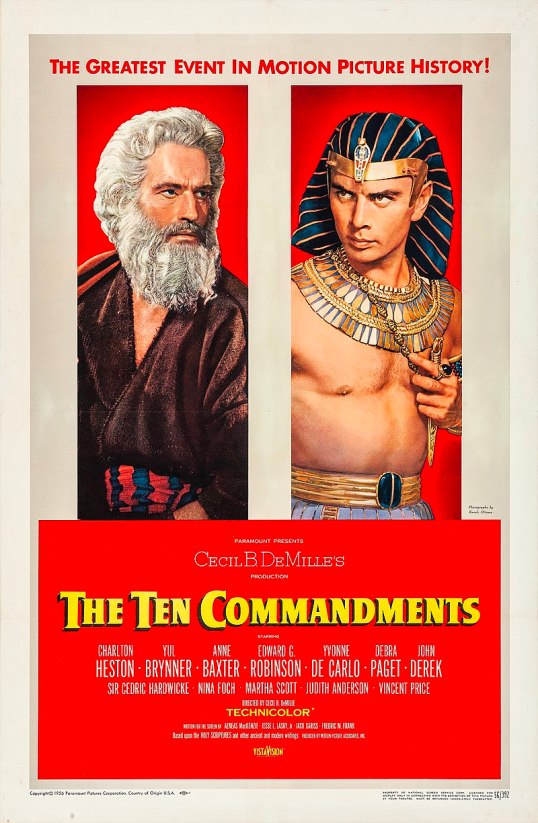
Though you may not know it if you’ve only seen the film during one of its annual showings on television, the 1956 religious epic, The Ten Commandments, originally opened with director Cecil B. DeMille standing on a stage. Speaking directly to the audience, DeMille explains that, though the film they’re about to see me take some dramatic license with the story of Moses, it still based on not just the Bible but also the accounts of Philo, Josephus and Eusebius. He also tells us that The Ten Commandments is more than just an adaptation of the Book of Exodus. Instead, it’s a film about every man’s desire to be free.
Demille concludes with: “The story will take 3 hours and 29 minutes to unfold. There will be an intermission. Thank you for your attention.”
To be honest, it’s kind of a sweet moment. Cecil B. DeMille is a name that is so associated with (occasionally overblown) epic filmmaking that it’s easy to forget that DeMille was one of the most important names in the artistic development of American cinema. He was there from the beginning and, unlike a lot of other filmmakers, he was equally successful in both the silent and the sound era. Say what you will about his films, DeMille was a showman and he handles the introduction like a pro. At the same time, there’s a real sincerity to DeMille’s tone. After you listen to him, you’d almost feel guilty if you didn’t sit through all 3 hours and 29 minutes of his film.
That sincerity extends throughout the entire film. Yes, The Ten Commandments is a big, long epic and some members of its all-star cast are more convincing in their roles than others. And yes, the film can seem a bit campy to modern viewers. (In fact, it wouldn’t surprise me if it seemed a bit campy to viewers in 1956 as well.) Yes, The Ten Commandments does feature Anne Baxter saying, “Oh Moses! You sweet adorable fool!” But it doesn’t matter. Even the most ludicrous of dialogue just seem right. The film is just so sincere that it’s difficult not to enjoy it.
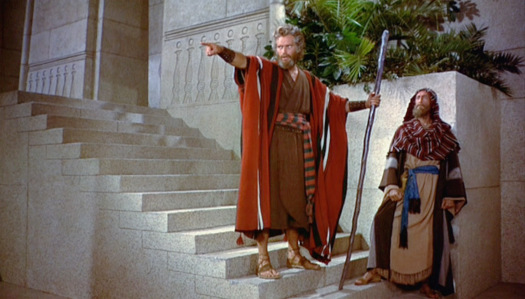
In the Book of Exodus, Moses is described as having a speech impediment and even tries to use it as an excuse to get out of going to Egypt. That’s actually one of the reasons why Moses brought Aaron with him to Egypt, so that Aaron could speak for him. In the movie, Moses is played by Charlton Heston, who comes across as if he’s never felt a moment of insecurity over the course of his entire life. But no matter. Heston may not by the Moses of Exodus but he’s the perfect Moses for the DeMille version. When Heston says that Egypt will be visited by plagues until his adopted brother Ramses (Yul Brynner) agrees to allow the Jews to leave Egypt, you believe every word. (Aaron, incidentally, is played by the legendary John Carradine. He doesn’t get too much other than respectfully stand a few feet behind Charlton Heston but still: John Carradine!)
And really, anyone who dismisses The Ten Commandments out-of-hand should go back and, at the very least, watch the scene where the Angel of Death descends upon Egypt. The scene where Moses and his family shelter in place while the screams of distraught mothers echo throughout the city is chilling. Ramses may spend most of the film as a petulant villain but you almost feel sorry for him when you see him mourning over his dead son. When he sets off after Moses, it’s not just because he’s doing what villains do. He’s seeking vengeance for the loss of his first born. For that brief moment, Ramses goes form being a melodramatic bad guy to being someone with whom the viewer can empathize. Brynner, with his burning intensity, gives a great performance as Ramses.
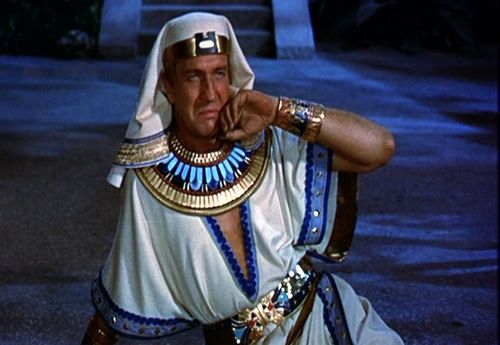
As I said before, this film has what, in 1956, would have been considered an all-star cast. Watching the names as they show up during the opening credits — Cedrick Hardwicke! Yvonne DeCarlo! Woody Strode! Debra Paget! — is like stepping into a TCM fever dream. Some of the performers give better performance than others. And yet, even the worst performer feels as if they just naturally belong in the world that DeMille has created. John Derek may seem rather smarmy as Joshua but his callowness provides a good contrast to the upright sincerity of Heston’s performance as Moses. Edward G. Robinson’s cries of, “Where is your God now!?” may have provided endless fodder for impersonators but just try to imagine the film without him. Even Vincent Price is in this thing! He doesn’t have his famous mustache but, as soon as you hear his voice and see that famous glare, you know that it’s him.
Of course, when you’re growing up and The Ten Commandments is on TV every year, you mostly just want to see the scene where Moses parts the Red Sea. The Ten Commandments was nominated for seven Oscars but it only won one, for its special effects. (The prize for Best Picture went to another epic, Around The World In 80 Days.) Today, the film’s special effects may no longer amaze viewers but there’s still something rather charming about the Red Sea parting and then crashing in on the Egyptian army. The scene where the Earth opens up and swallows those who worshiped the Golden Calf remains impressive, if just because all of the extras really look terrified that they might die. And while the Pillar of Fire may look a bit cartoonish to modern eyes, that’s a huge part of the film’s appeal.
The Ten Commandments is a big, long, sometimes silly, sometimes effective, and always entertaining epic. It’s a grand spectacle and one that I usually watch every year when it shows up on television. I missed this year’s showing but, fortunately, I own it on DVD. It’s a sincere epic and a difficult one not to like.
Last night, as I usually do during the Easter/Passover season, I watched Cecil B. DeMille’s Biblical epic THE TEN COMMANDMENTS. It’s a movie buffs delight, an All-Star spectacle featuring three Oscar winners ( Charlton Heston ,Yul Brynner , Anne Baxter ), one who should’ve been (Edward G. Robinson ), and a literal cast of thousands! Something that’s always stood out to me is the number of horror movie stars that appear in various parts, a plethora of Hollywood practitioners from my favorite genre:
John Carradine as Aaron
Carradine’s credentials in horror films are well documented, and he deserves his spot in the pantheon of Monster Movie Greats. As Moses’s brother Aaron, Carradine has his best “straight” role since THE GRAPES OF WRATH.
Vincent Price as Baka
Our Man Vinnie plays the evil slave master Baka, who gets his just rewards at the hands of John Derek’s Joshua. Price was…
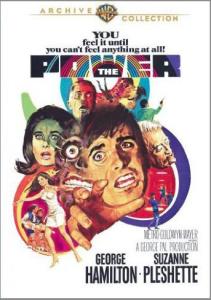
That is the mystery that Professors Jim Tanner (George Hamilton) and Margery Lansing (Suzanne Pleshette) have to solve. Someone is using psychic powers to kill their co-workers in a research laboratory. The police think that Tanner is guilty but Tanner knows that one of his colleagues is actually a super human named Adam Hart. Hart is planning on using his super powers to control the world and, because Tanner is the only person who has proof of his existence, Hart is methodically framing Tanner for every murder that he commits.
The Power is underrated by entertaining movie, a mix of mystery and science fiction with a pop art twist. It was also one of the first attempts to portray telekinesis on film. Similar films, like Scanners, may be better known but all of them are directly descended from The Power. George Hamilton may seem like an unlikely research scientist but he and Suzanne Pleshette are a good team and The Power makes good use of Pleshette’s way with a one liner. Also keep an eye out for familiar faces like Arthur O’Connell, Nehemiah Persoff, Michael Rennie, Gary Merrill, Yvonne DeCarlo, Vaughn Taylor, Aldo Ray, and even Forrest J. Ackerman as a hotel clerk.
Following the death of her husband, Susan Gordon (Karen Black) relocates to Los Angeles with her teenage daughter, Megan (Rainbow Harvest). An angry goth girl who always wears black and bears a superficial resemblance to Winona Ryder in Beetlejuice, Megan struggles to fit in at her new school and quickly attracts the unwanted attention of the school’s main mean girl, Charlene Kane (Charlie Spradling). Fortunately, Megan has an old and haunted mirror in her room that can not only bring her rotting father back to life but which Megan can also use to kill all of her tormentors.
Of the many rip-offs of Carrie, Mirror Mirror is one of the best and I am surprised that it is not better known. The plot, with a teenage girl using paranormal powers to get revenge on all of the bullies at her school, may be familiar but Mirror Mirror is better executed than most of the other films of its ilk. The script is full of snappy dialogue and, despite the low budget, the special effects are effectively grisly. There’s a scene that does for garbage disposals what Jaws did for the water. One thing that sets Mirror Mirror apart from similar films is that Megan is sometimes not a very sympathetic character. Unlike Carrie, who was scared of her powers and only used them once she was pushed over the edge, Megan is initially very enthusiastic about using the mirror to get revenge for every slight, real and perceived.
The cast also does a good job, with Karen Black giving one of her least restrained performances. Keep an eye out for Yvonne DeCarlo playing a realtor and William Sanderson as Susan’s strange new boyfriend. The best performance comes from Rainbow Harvest, a talented actress who appeared in a handful of movies in the 80s and 90s and then appears to have vanished from the face of the Earth. Believe it or not, Rainbow Harvest was her real name.
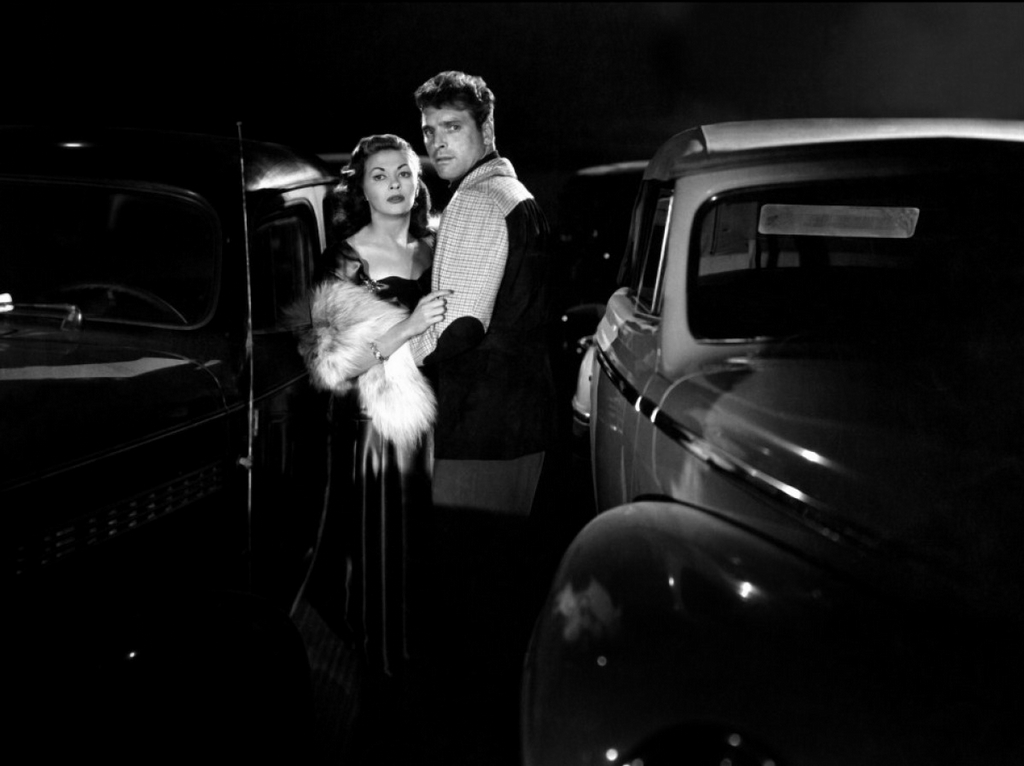
CRISS CROSS hits you like a sucker punch to the gut, delivered hard and swift, followed by a non-stop pummeling that doesn’t let up until the final, fatal shot. Things kick right in as we find clandestine lovers Steve Thompson and Anna Dundee going at it hot’n’heavy in a nightclub parking lot. They go inside, and Steve gets into it with Anna’s husband, the gangster Slim Dundee, who pulls a knife, but the fight’s interrupted by Lt. Pete Rameriz, Steve’s boyhood pal. What Pete doesn’t know is the fight was staged for his benefit: Steve is the inside man on a planned armored car heist Dundee’s gang is pulling off.
Flashbacks tell us how Steve got here: he was once married to Anna, and after the volatile couple divorced left L.A., drifting across country picking up odd jobs along the way. Returning to the City of Angels, he finds himself…



 Who is Adam Hart?
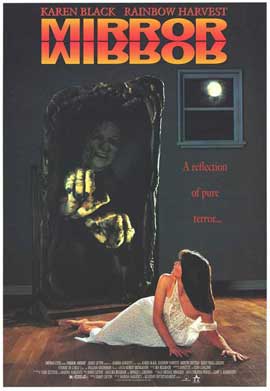 Following the death of her husband, Susan Gordon (Karen Black) relocates to Los Angeles with her teenage daughter, Megan (Rainbow Harvest). An angry goth girl who always wears black and bears a superficial resemblance to Winona Ryder in Beetlejuice, Megan struggles to fit in at her new school and quickly attracts the unwanted attention of the school’s main mean girl, Charlene Kane (Charlie Spradling). Fortunately, Megan has an old and haunted mirror in her room that can not only bring her rotting father back to life but which Megan can also use to kill all of her tormentors.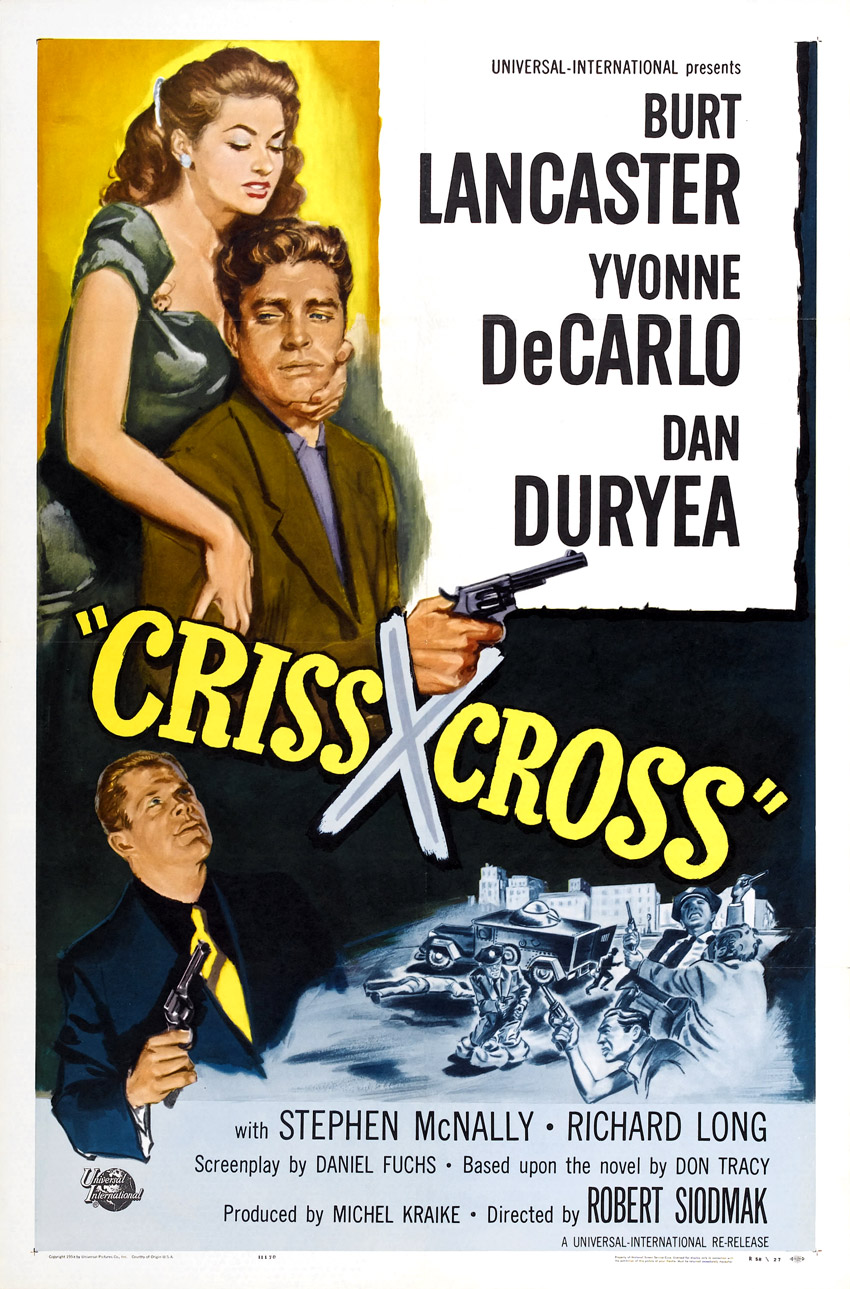
 Through the Shattered Lens