Gene Roddenberry’s space odyssey first sailed onto the small screen on September 8, 1966. I can remember being allowed to stay up late (I was only 8 at the time!) to watch it with my dad, who was a big science-fiction buff. As a career Navy man, I think he related to the idea of a ship’s travels (he was also a fan of VOYAGE TO THE BOTTOM OF THE SEA). Being a young’un at the time, I was more into the weird creatures the Starship Enterprise crew encountered on their “five-year mission”.
Unless you’ve been living in another galaxy the past half century, you know all the characters. There’s William Shatner as the headstrong Capt. James Tiberius Kirk, emoting as only Shatner can. Leonard Nimoy became something of a teen idol as the logical Vulcan Mr. Spock (something about those pointed ears, maybe?). DeForrest Kelly played the ornery Dr. “Bones” McCoy, forever…
Wow. It’s hard to believe that is going to be my final televised horror of the year. (Though I imagine this feature will return in October of 2016 — just in time for election season!) Well, let’s get right to it!
For our final televised horror, I have selected a classic episode of The Twilight Zone. In Nightmare at 20,000 Feet, William Shatner is a man who, though being scared of flying, finds himself on an airplane. And guess what he sees out on the wing?
This episode was written by one of Arleigh’s favorite writers, the great Richard Matheson. It was directed by Richard Donner and originally aired on October 11th, 1963.
Enjoy Nightmare at 20,000 Feet! And here’s hoping that all of our readers have had a wonderful, safe, and happy Halloween!
For today’s Horror on the Lens, we present Incubus, an odd little film from 1966. William Shatner plays a soldier who, along with his sister, visits a mysterious village that has magical, healing water. (Shatner has been wounded in battle and wants to be healed.) However, the village is also home to a succubus who wants to seduce Shatner and lead him to Hell.
Incubus is memorable for three reasons. First off, you’ve got William Shatner giving a very Shatnerish performance. Secondly, legendary cinematographer Conrad Hall gave this film a very dream-like feel. And third, this is one of the four movies to have been filmed in Esperanto, a so-called international language that has never really caught on.
That’s right! This movie has subtitles! But, so what? Who hasn’t wanted to see William Shatner act in Esperanto?
Today is Angie Dickinson’s 84th birthday. One of Angie’s best remembered films is Big Bad Mama, an entertaining and fast-paced gangster film that was produced by Roger Corman.
The year is 1932 and the setting is Texas. Wilma McClatchie (Angie Dickinson) is a poor single mother with two teenage daughters (Susan Sennett and Robbie Lee) to support. When Wilma’s bootlegger lover, Barney (Noble Willingham), is killed by the FBI, Wilma takes over his route. Wilma wants her daughters to be rich like “Rockefeller and Capone” and soon, they graduate from bootlegging to bank robbery. During one robbery, they meet and team up with Fred (Tom Skerritt). Wilma and Fred are lovers until Wilma meets alcoholic con man, Baxter (William Shatner). With Fred and Baxter competing for her affections and her youngest daughter pregnant, Wilma plans one final job, the kidnapping of a spoiled heiress (Joan Prather).
Big Bad Mama is one of the many Bonnie and Clyde rip-offs that Roger Corman produced in the 70s. (Corman also gave us Bloody Mama and Crazy Mama.) Big Bad Mama is a typical Corman gangster film, with fast cars, blazing tommy guns, Dick Miller, and plenty of nudity. Angie was in her 40s at the time and, justifiably proud of her body, her full frontal nude scenes created a lot of publicity for the film. William Shatner also strips down for the film and his sex scene with Angie is just as weird to watch as you would expect it to be.
The whole film changes as soon as William Shatner makes his first appearance. He may be speaking with a Southern accent and he may be playing a sniveling coward but he is still William Shatner, with all that implies. Watching Shatner, it is hard not to imagine that Big Bad Mama is actually a lost Star Trek episode where Kirk goes back in the past and meets special guest star Angie Dickinson. Far more effective is Tom Skerritt, who is thoroughly believable as a Dillinger-style bank robber.
In the style of Bonnie and Clyde, Big Bad Mama presents its outlaws as being counter-culture rebels. Every authority figure that Wilma meets — from a preacher played by Royal Dano to a corrupt sheriff to Dick Miller’s incompetent FBI agent — is presented as being hypocritical and arrogant. Angie plays Wilma as a strong-willed and sexually liberated woman who refuses to allow anyone to tell her how to live her life or raise her daughters. In the gang, both Fred and Baxter are subservient to her. Big Bad Mama’s tag line was “Hot lead! Hot legs! Hot damn!” and that is a perfect description of Angie Dickinson’s performance.
I first found out about the 1976 made-for-tv movie The Tenth Level while I was doing some research on the Milgram experiment. The Milgram experiment was a psychological experiment that was conducted, under the direction of Prof. Stanley Milgram, in 1961. Two test subjects were placed in two separate room. One test subject was known as the “Learner” and he was hooked up to a machine that could deliver electric shocks. The other subject was the “Teacher.” His job was to ask the Lerner questions and, whenever the Learner gave an incorrect answer, the Teacher was supposed to correct the error by pushing a button and delivering the electric shock. With each incorrect answer, the shock would get worse.
Of course, what the Teacher did not know was that the Lerner was an associate of Prof. Milgram’s and that pushing the button did not actually deliver a shock. The Lerner would intentionally give wrong answers and, after the Teacher pushed each subsequent button, the Lerner would groan in pain and eventually beg the Teacher to stop. The test was to see how long the Teacher would continue to push the buttons.
The study found that 65% of the Teachers, even when the Lerner stopped responding, continued to push the buttons until delivering the experiment’s final 450-volt shock. It was a surprising result, one that is often cited as proof that ordinary people will do terrible things if they’re ordered to do so by an authority figure.
The Tenth Level is loosely based on the Milgram experiment. Prof. Stephen Turner (William Shatner) is a psychology professor who conducts a similar experiment. Turner claims that he’s looking for insight into the nature of blind obedience but some of his colleagues are skeptical. His best friend (Ossie Davis) thinks that Turner is mostly trying to deal with the guilt of being a WASP who has never had to deal with discrimination. His ex-wife, Barbara (Lynn Carlin), thinks that the experiment is cruel and could potentially traumatize anyone who takes part in it. Turner, meanwhile, is fascinated by how random people react to being ordered to essentially murder someone.
Eventually, a good-natured carpenter/grad student, Dahlquist (Stephen Macht), volunteers. At first, Turner refuses to allow Dahlquist to take part because he’s previously met Dahlquist and Dahlquist is a friend of one of Tuner’s assistants. However, Dahlquist literally begs to be allowed to take part in the experiment and Turner relents.
Unfortunately, the pressure of administering shocks proves to be too much for Dahlquist and he has a 70s style freak-out, which essentially means that the screen changes colors and everything moves in slow motion as he smashes up the room. As a result of Dalquist’s violent reaction, Turner is called before a disciplinary committee and basically put on trial.
The Tenth Level is an interesting film. On the one hand, the subject matter is fascinating and, if nothing else, the film deserves some credit for trying to seriously explore the ethics of psychological experimentation. On the other hand, this is a film from 1976 that features William Shatner giving numerous monologues about the nature of man. And, let us not forget, this is William Shatner before he apparently developed a sense of humor about himself. That means that, in this film, we get the Shatner that inspired a thousand impersonations. We get the Shatner who speaks precisely and who enunciates every single syllable. And let’s not forget that Shatner is paired up with Ossie Davis, an actor who was never exactly subtle himself.
The end result is a film that is both thought-provoking and undeniably silly. This is a film that will make you think even while it inspires you to be totally snarky.
(Also of note, John Travolta supposedly makes his film debut in the Tenth Level. Apparently, he plays a student. I have yet to spot him.)
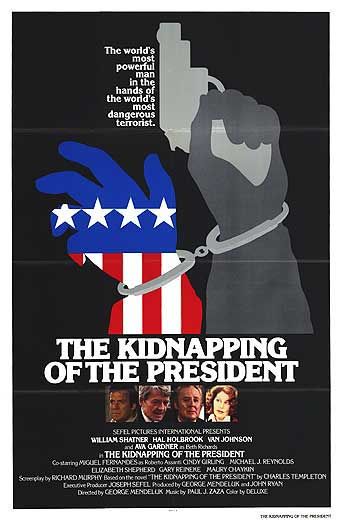
Agency was not the only Canadian film to be made about American politics in 1980. There was also The Kidnapping of the President, a low-budget political thriller that, because it has since slipped into the public domain, can currently be found in a few dozen DVD box sets. In fact, you may very well own a copy of The Kidnapping of the President without even realizing it!
Don’t worry if you do. The Kidnapping of the President is a fairly harmless little film.
U.S. President Adam Scott (Hal Holbrook) is visiting Toronto when he gets handcuffed to a South American revolutionary named Roberto Assanti (Miguel Fernandes). Assanti locks President Scott in an armored car that is wired with explosives and then demands a hundred million in diamonds and two planes. (Though the film never explicitly states it, I imagine that Assanti was primarily motivated by jealousy over the fact that Che is on a million t-shirts while Assanti remains fairly unknown.) It’s up to secret service agent Jerry O’Connor (William Shatner) to negotiate with Assanti and rescue the President! Meanwhile, the ethically compromised Vice President (Van Johnson) is left as acting President in Washington and struggles to keep things calm while his ambitious wife (Ava Gardner) plots for a brighter future.
Overall, the Kidnapping of the President is okay for what it is. It’s neither exceptionally good nor memorably bad. It just sort of is. Hal Holbrook is always well-cast as a President and William Shatner gives a typical Shatner performance, which is either a good or a bad thing depending on how you feel about William Shatner. And, for that matter, Miguel Fernandes is a properly unlikable villain though he never really seems to have the charisma necessary to make him believable as the dynamic leader that he’s supposed to be.
Probably the most interesting thing about The Kidnapping of the President is that it doesn’t try to pass Montreal off for being a location in the United States. Instead, the film was not only filmed in but is actually set in Toronto as well. When Jerry attempts to deal with the local authorities, that means that he ends up talking to a bunch of very polite men in red uniforms.
But what’s strange about this is that the people of Toronto are so excited about the arrival of the President. You half expect to hear one extra say, “I never thought I’d live long enough to see the day that a leader that I can’t vote for and who has next to nothing to do with my everyday life would come to visit Toronto.”
Don’t get me wrong. If you follow me on twitter, then you know that I am unashamed to declare my love for all things Canadian. And obviously, as neighbors, Canada and the United States do have a close relationship. But would people in Toronto really be that excited to see the President?
If so, I think we really owe the people of Canada an apology for not knowing more about their government. At the very least, we should definitely invite Stephen Harper over for lunch.
Along with starting each day of October with a horror film here at the Shattered Lens, we’re going to end each day with a horror-themed television show.
While I had previously caught a few episodes of the Twilight Zone during one of the annual holiday marathons on SyFy, I didn’t truly appreciate the show until I first exchanged e-mails with my friend in Australia, Mark. Among other things, Mark expressed a very eloquent appreciation for The Twilight Zone and that inspired me to watch quite a few episodes that have been uploaded to YouTube and Hulu. Along with being an essential piece of television history, the best episodes of the Twilight Zone remain watchable and entertaining 50 years after they were first broadcast.
Considering the esteemed place that the Twilight Zone continues to occupy in American culture, it seems appropriate to feature it during Horror Month here at the Shattered Lens.
We start things off with an episode that was originally broadcast on November 18th, 1960. The Nick of Time tells the story of what happens when two newlyweds stop off at a small town cafe and the superstitious husband (William Shatner) starts to play with a memorably creepy fortune telling machine. Now, I should warn you that, since this episode is not available on YouTube, I’m having to embed it from Hulu. That means that you’ll have to sit through a few commercials but it’s still a good episode.
Earlier today, I took a look at The People Next Door, a film about a family torn apart by the discovery that their teenage daughter is taking drugs. For all of that film’s melodrama and over-the-top moments, it still worked. It may have felt like it was taking place on a plane of heightened reality but it still felt real nonetheless. Among the many films in the drugs-in-the-suburbs genre, that general feeling of reality made The People Next Door unique. Far more typical of the genre is the 1973 made-for-TV movie, Go Ask Alice.
Go Ask Alice is based on a YA book that’s been in print for 43 years now. (I can still remember spending an afternoon reading it in a Barnes and Noble when I was 14 years old.) The book claims to be the diary of a teenage girl who ended up getting addicted to drugs and sex. She runs away from home for a bit and, even when she does manage to stop using drugs, her friends still insist on secretly slipping her acid. She goes crazy and ends up spending some time in a mental asylum. Eventually, she’s released and moves to a new town with her family. She ends the diary saying that she’s looking forward to the future and then, in the afterward, we’re told that she died three weeks later of an overdose and this diary has been published so that we can all learn from her story.
Now, oddly enough, when Go Ask Alice was originally published, it was apparently sold as being an authentic diary of an anonymous teenage girl who had been a patient of the book’s “editor”, Dr. Beatrice Sparks. However, if you actually read the book, it’s pretty obvious that, while Dr. Sparks may have indeed used some of her patients’ real-life experiences, Go Ask Alice is in no way authentic. Instead, it’s a classic example of the type of cautionary tale in which a character makes one mistake (in this case, the girl drinks a soda that’s been spiked with LSD) and, immediately afterwards, everything bad thing that possibly could happen does happen. The purpose of the book is to shock and titillate, to make us wonder how this girl can go from being the sweet optimist who bought a diary because she feels that she finally has something to say to being so jaded that she casually says stuff like, “Another day, another blowjob.” And, of course, the answer is that she didn’t because the whole thing is totally made up.
But that still didn’t stop anyone from making a movie out of the book and informing us, at the start of the movie, that the story we are about to watch is true and only the names and certain details have been changed to protect everyone’s privacy. Our diarist (who is now definitely named Alice) is played by a young actress named Jamie Smith-Jackson, who is sympathetic and pretty. Alice’s mother (Ruth Roman) is too repressed and uptight to provide any guidance to her rapidly maturing daughter. Meanwhile, Alice’s father is played by William Shatner, so we know he’s not going to be able to do any good either.
Much as in the original book, Alice goes to one party, drinks on LSD-spiked soda, and her life is never the same. Soon, she’s spending all of her time doing drugs and, as she informs us, having a “monthly pregnancy scare.” She’s no longer hanging out with her smart, nerdy friends. Instead, she spends all of her time with a bunch of petty criminals who recruit Alice to help deliver drugs to the students at the junior high. (“I push at the elementary school!” one junior high kid snarls). Eventually, Alice runs away from home and lives on the streets. Fortunately, she runs into a liberal Catholic priest (played by Andy Griffith and yes, you read that right) and starts trying to get her life straight…
Go Ask Alice is no The People Next Door but it’s no Reefer Madnesseither. What it gets wrong about teenage drug use, it gets right about just how confusing and alienating it can be to be 15 years old. At the same time, I’d be lying if I said that this film did not have some camp appeal. How can it not when it features not only Andy Griffith talking tough but also William Shatner with a bushy mustache?
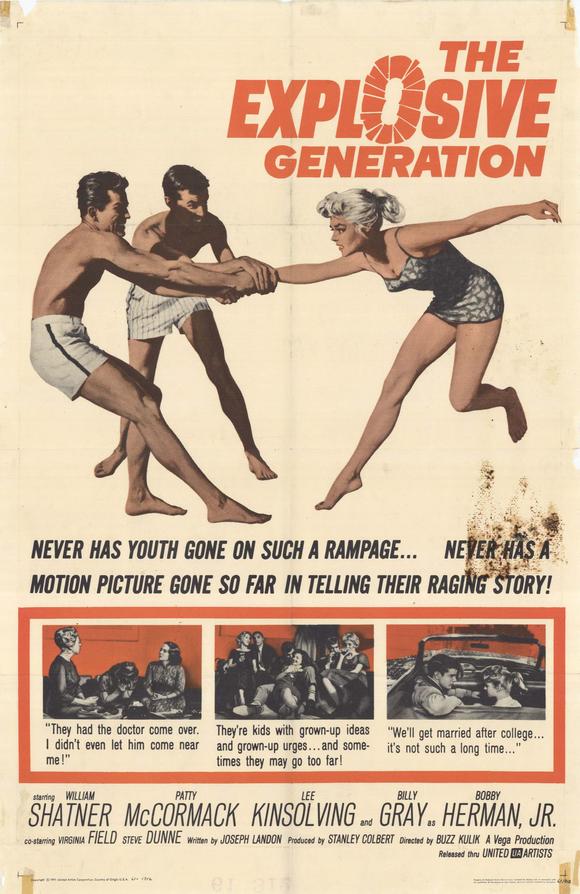
Ever since I first saw it on TCM last year, The Explosive Generation has been a favorite of mine.
This 1961 film deals with sex, peer pressure, censorship, juvenile delinquency, and civil disobedience. The Explosive Generation is one of those films that was made to try to understand the wild and crazy youth of the early 60s, with their crazy rock and roll music, hip way of talking, and their habit of occasionally showing up for high school in a coat and tie. As is typical of low-budget youth films of the period, the film is occasionally clueless and occasionally insightful. In short, it’s a lot of fun and, if you’re a history nerd like I am, it’s a valuable time capsule for the way the world used to be (or, at the very least, the way that people used to think the world was).
Even better, it stars a youngish, intense, and slim William Shatner as an idealistic high school teacher who encourages his students to have a frank and honest discussion about sex. If The Intruder(which was made roughly around the same time) is a film that proves that Shatner was capable of being an intelligent and insightful actor, The Explosive Generation is all about Shatner being Shatner. This performance is everything that you’ve probably come to expect from William Shatner and, as a result, it transcends mundane concepts like good and bad.
Below are two scenes of William Shatner dealing with the Explosive Generation. Be sure to keep an eye out because I’m sure The Explosive Generation will show up on TCM again at some point in the near future!
For today’s entry in the 44 Days of Paranoia, we take a look at one of the most underappreciated films of all time, Roger Corman’s 1962 look at race relations, The Intruder.
Despite the fact that he’s regularly cited as being one of the most important figures in the development of American cinema, Roger Corman remains an underrated director. Many critics tend to focus more on the filmmakers that got their start working for Corman than on Corman himself. When they talk about Roger Corman, they praise him for knowing how to exploit trends. They praise him as a marketer but, at the same time, they tend to dismiss him as a director.
I would suggest that those critics see The Intruder before they presume to say another word about Roger Corman.
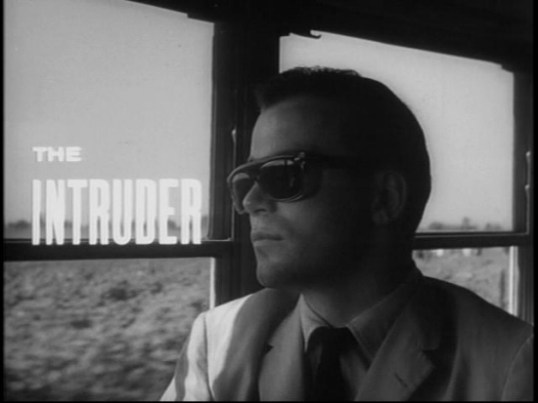
The Intruder opens with a young, handsome man named Adam Cramer sitting on a bus. The first thing that we notice about Cramer is that he’s wearing an immaculate white suit. The second thing we notice is that he’s being played by a very young (and, it must be said, rather fit) William Shatner.
I know that many people will probably be inclined to dismiss The Intruder from the minute they hear that it stars William Shatner. Based simply on Shatner’s presence, they’ll assume that this film must be very campy, very Canadian, or both. Well, they’re wrong. Shatner gives an excellent performance in this film, bringing to life one of the most evil characters ever to appear on-screen.
Adam Cramer, you see, is a representative on a Northern organization known as the Patrick Henry Society and he’s riding the bus because he’s heading to a small Southern town. The high school in that town has just recently been desegregated and Cramer’s goal is to make sure that no black students attend class. As Cramer explains it, he’s a “social worker” and his goal is to help preserve Southern society.
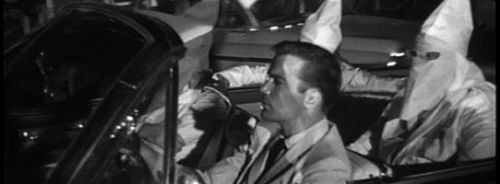
To achieve this goal, Cramer partners up with the richest man in town, Verne Shipman (who is played, rather chillingly, by Robert Emhardt). With Verne’s sponsorship, Cramer gives an inflammatory speech in the town square and then later returns with a group of Klansmen. As opposed to recent films like Django Unchained (which scored easy laughs by casting Jonah Hill as a Klansman and playing up the group’s ignorance), The Intruder presents the Klan as figures that have stepped straight out of a nightmare, making them into literal demons who appear at night and disappear during the day. In a genuinely disturbing scene, the Klansmen set a huge cross on fire. As the flames burn behind him, Cramer seduces the wife of a local salesman.
After Cramer delivers his speech, the local black church is blown up and a clergyman is killed. The editor of the town newspaper — who, before Cramer showed up, was opposed to desegregation — changes his mind and publishes an editorial strongly condemning Cramer. Cramer’s mob reacts by nearly beating the editor to death. Realizing that he’s losing the power to control the mob that he created, Cramer frames a black student for rape which leads the film to its powerful and disturbing conclusion.
Particularly when compared to other films that attempted to deal with race relations in 1962, The Intruder remains a powerful and searing indictment of intolerance and a portrait of how demagogues like Adam Cramer will always use fear, resentment, and ignorance to build their own power. Corman filmed The Intruder on location in Missouri and used a lot of locals in the cast. Judging from the disturbing authenticity of some of the performances that Corman got from some of these nonprofessionals, it’s not unreasonable to assume that quite a few of them agreed with everything that Adam Cramer was saying.
As opposed to most films made about the civil rights era in America, The Intruder doesn’t shy away from showing the ugliness of racism. The Intruder casually tosses around the N word (and yes, it is shocking to not only hear Shatner use it but to see him smile as he does so) but, unlike a lot of contemporary films, it does so not just to shock but to show us just how naturally racism comes to the film’s characters. The scene in which Verne repeatedly strikes a black teenager who failed to call him sir is also shocking, not just for the violence but because of how nobody seems to be particularly surprised by it. As a result, The Intruder is not necessarily an easy film to watch but then again, that’s the point. The hate on display in The Intruder should never be easy to watch.
The Intruder was written by Charles Beaumont, who also wrote several classic episodes of The Twilight Zone. I think it can be argued that The Intruder represents the best work of Beaumont, Corman, and Shatner. Unfortunately, but not surprisingly, The Intruder was the only film directed by Roger Corman to not be a box office success.
However, in a world where people are patting themselves on the back for sitting through The Butler, The Intruder is an important film that deserves to be seen now more than ever.





 Through the Shattered Lens