That Richard Burton is today best-remembered for his tumultuous marriages to Elizabeth Taylor and for his performances in several less-than-worthy films is unfortunate as Burton was also one of the most highly regarded staged actors of his generation. In fact, late in his life, Burton often expressed regret that he had ever left the stage for films to begin with.
In 1964, Burton played Hamlet on Broadway, in a production that was directed by John Gielgud. (Gielgud also provided the voice of the Ghost.) This is a video-recording of both that production and Burton’s acclaimed performance. Burton brings an intense and almost divine madness to the role. Watching, one can see why Burton would have preferred to have been remembered for this instead of for playing Mark Antony.
In 1978, Trevor Nunn staged what would become a legendary production of William Shakespeare’s Macbeth. The play was produced in a small studio theatre, with the actors working in the round were minimum sets and costuming. Shifts in location or mood were indicated are by lighting changes. It was a production that captured both the intensity of the play but also the horror of Shakespeare’s play about ambition, guilt, fate, and multiple murders. Macbeth and Lady Macbeth were played by Ian McKellen and Judi Dench.
This production was filmed and, in 1979, broadcast on Thames Television in the UK. Here, for today’s staged horror, is the Trevor Nunn production of MacBeth, starring Ian McKellen and Judi Dench.
I really don’t have much to say about this teaser, beyond the fact that it looks really good. With Ethan Coen reportedly taking a break from cinema to focus on theater, this will be Joel Coen’s first film as a solo director. Shakespeare, though, seems like a good collaborator. Both Denzel Washington and Frances McDormand are already being spoken of as very likely Oscar nominees as a result of their work in this film.
The Tragedy of MacBeth will be released in theaters in Christmas and will be available on AppleTV+ in January. For the record, this film is the one reason why I currently subscribe to AppleTV+.
Romeo & Juliet, which as you can probably guess is a cinematic adaptation of Shakespeare’s classic play about the doomed lovers and the warring families, is one of the best films that I’ve seen this year. Under normal circumstances, I would probably have it listed as the 2nd best film of the year so far, right underneath TheFather. Unfortunately, Romeo & Juliet did not receive a theatrical release. Instead, in the United States, it was aired on PBS. Though it was submitted for Emmy consideration, it was unforgivably snubbed when the nominations were announced earlier today.
And that’s a shame because this film adaptation of Romeo & Juliet is one of the best that I’ve seen, one that celebrates the story’s theatrical origins while also working as a wonderful display of cinematic artistry.
The production was filmed over 17 days at London’s Royal National Theater. Because it was filmed at the height of the Coronavirus pandemic, there’s no audience. Instead, the film opens with a small company of actors, all dressed in modern clothing, walking through the theater. Director Simon Godwin emphasizes the emptiness of the theater and the almost eerie silence as the actors take their seats around a table and start to recite their lines. We immediately recognize some members of the cast. Jessie Buckley plays Juliet while Josh O’Connor plays the role of Romeo. Adrian Lester is cast as the Prince while Tasmin Grieg plays Lady Capulet. As the actors recite their lines, they stand up and start to move around the theater and, before our eyes, they transform from being actors to being the characters from Shakespeare’s play. Suddenly, we’re no longer watching Jessie Buckley and Josh O’Connor. Instead, we’re watching Romeo Montague and Juliet Capulet.
As the action moves to the stage, Simon Godwin continues to emphasize the eerie emptiness of the theater and the desolate look of the play’s ornate but still rather simple sets. Even with the presence of the actors, the streets of Verona still seem as deserted as the streets of London and every other major city were during the worst days of the pandemic. Watching the story unfold, it’s hard not to feel that Romeo and Juliet aren’t just rebelling against their warring families but they’re also rebelling against the sense of hopelessness that afflicted so many people in 2020. Romeo and Juliet’s refusal to surrender their love takes on an extra poignancy when filmed against the backdrop of the pandemic. At a time when many people were saying that civilization was collapsing and the world was on the verge of ending, Romeo and Juliet refuse to surrender their love. If their world is going to end, it’s going to end on their terms.
As opposed to other cinematic adaptations of Shakespeare’s plays, this version of RomeoandJuliet does not attempt to hide its theatrical origins. Instead, it embraces them, right down to the obviously fake moon that is lowered from the rafters whenever a scene takes place at night. And yet, the actors give such good performances and Simon Godwin directs with such confidence and skill that the viewer still gets wrapped up in the story. Like all good works of theater, Romeo&Juliet succeeded in convincing the viewer of two contradictory things, that they’re both watching a production in a London theater and that they’re watching the Capulets and the Montagues as they walk through the deserted streets of Verona. This production of Romeo&Juliet is one that celebrate both the power of the stage and the power of cinema. Perhaps most importantly, it celebrates the power of Shakespeare’s classic tale, with the mix of the actor’s modern costuming and Shakespeare’s Elizabethan language reminding us that great art is universal and timeless.
Jessie Buckley and Josh O’Connor both give compelling performances as the film’s doomed lovers, with Buckley bringing a good deal of inner strength to the role of Juliet while O’Connor wisely underplays the scenes that would tempt a lesser Romeo to go overboard. As opposed to what we often see in lesser productions of this play, Buckley’s Juliet is never foolishly naïve and O’Connor’s Romeo never surrenders to shrill self-pity. Instead, they’re two lovers who know what they’re getting into but who are still willing to take the risk, even at the most bleak of times. When Buckley and O’Connor first show up in the film, walking through that empty theater, they look like themselves, two talented performers in their early 30s. But, as they perform their roles, they transform before our eyes into Romeo and Juliet and it’s thrilling to watch.
One has to applaud the National Theatre for filming this production. One also has to applaud PBS for airing it in the States. But still, how I wish Romeo&Juliet had been given a theatrical release or, at the very least, a Netflix or Prime release! This is a production that I wish more people had seen, a great work of theater, film, and art.
Now that the Oscars and the Sundance Film Festival are over with, it’s time to start a new series of reviews here on the Shattered Lens. For the rest of February, I will be looking at some films that deal with the universal topic of love. Some of these films will be romantic. Some of them will be sad. Some of them might be happy. Some of them might be scary. Some of them might be good. And some of them might be bad. In fact, to be honest, I haven’t really sat down and made out a definite list of which films I’ll be reviewing for Love On The Shattered Lens. Instead, I figure I’ll just pick whatever appeals to me at the moment and we’ll see what happens!
Let’s start things off with the 1968 film version of William Shakespeare’s Romeo and Juliet.
“Oh my God! Romeo and Juliet are hippies!”
Well, that’s not quite true. I mean, it is true that Romeo (played by Leonard Whitting) and Juliet (Olivia Hussey) are played by actual teenagers in this version of the classic play. It’s also true that, even though the film is set in a painstakingly recreated version of 15th century Verona, almost all of the actors have what would have then been contemporary haircuts. Romeo, Benvolio (Bruce Robinson), and Mercutio (John McEnery) all have longish hair, dress colorfully, and look like they could all be in the same band, covering the Beatles and writing songs about dodging the draft. Even Tybalt (Michael York) seems a bit counter-cultural in this version.
As played by Olivia Hussey, Juliet comes across as being far more rebellious in this version of Romeo and Juliet than in some of the others. It’s hard to imagine that Olivia Hussey’s Juliet would have much patience with Juliets played by Norma Shearer, Claire Danes, Hailee Steinfeld, or even the version of the character that Natalie Wood played in West Side Story. Olivia Hussey’s Juliet is always one step away from running away from home and hitch-hiking to the free Rolling Stones concert at the Altamont Speedway. Like the audience that the film was intended for, Romeo and Juliet both know that their parents are out-of-touch and that their friends are only temporary. Embracing love and pursuing all that life has to offer is what matters.
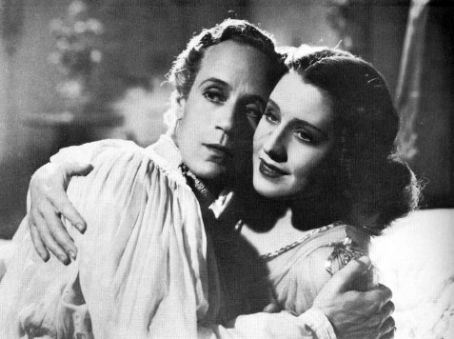
Was this the first film version of Romeo and Juliet to make explicit that the two characters had consummated their marriage? I imagine it was since it was apparently also the first version of Romeo and Juliet to feature on-screen nudity. That’s quite a contrast to the largely chaste 1936 version, in which Norma Shearer and Leslie Howard both seemed determined to keep a respectable distance from each other. Leonard Whiting and Olivia Hussey have an amazing chemistry together. They’re the two prettiest people in Verona and they just look like they belong together. From the minute they meet, you believe not only that they would be attracted to each other but that they’re also meant to be lovers.
Of course, we all know the story. The Capulets and the Montagues are rival families. Juliet is a Capulet. Romeo is a Montague. Juliet’s cousin, Tybalt, kills Romeo’s friend Mercutio. Romeo kills Tybalt. Juliet fakes her death. Romeo commits suicide. Juliet wakes up and does the same. The Prince shows up and yells at everyone. This film version moves around some of the events and it leaves out a few scenes but it actually improves on the play. For instance, poor Paris (Roberto Bissaco) doesn’t die in this version. Seriously, I always feel bad for Paris.
Throughout it all, director Franco Zeffirelli emphasizes the youth of the characters. It’s not just Romeo and Juliet who are presented as young. The entire Montague and Capulet feud is largely portrayed as being just a silly turf war between two competing high school cliques. When Tybalt and Mercutio have their fateful duel, it starts out largely as a joke and, when Tybalt kills Mercutio, it comes across as if it was an accident on Tybalt’s part. Tybalt appears to be just as shocked as anyone, like a scared kid holding a smoking gun and trying to explain that he didn’t know it was loaded when he pulled the trigger. When Mercutio curses both the Capulets and the Montagues, it’s all the more powerful because Mercutio is undoubtedly wondering how the duel could have so quickly gone from playful taunting to a fatal stabbing. The entire conflict between the Montague and the Capulets is a war that makes no sense, one in which the young are sacrificed while the old retreat to the safety of their homes.
Romeo and Juliet was a hit in 1968 and it’s still an achingly romantic film. Whiting and Hussey generate more chemistry in just the balcony scene than Leonardo Di Caprio and Claire Danes did in the entirety of Baz Luhrmann’s version of the tragic tale. Along with being a box office hit, it was also a critical hit. The Academy nominated it for best picture, though it lost to Oliver!
You know the story that’s told in this 1936 film already, don’t you?
In the city of Verona, Romeo Montague (Leslie Howard) has fallen in love with Juliet Capulet (Norma Shearer). Normally, this would be cause for celebration because, as we all know, love is a wonderful thing. However, the House of Capulet and the House of Montague have long been rivals. When we first meet them all, they’re in the process of having a brawl in the middle of the street. There’s no way that Lord Capulet (C. Aubrey Smith) will ever accept the idea of Juliet marrying a Montague, especially when he’s already decided that she is to marry Paris (Ralph Forbes). Things get even more complicated with Juliet’s cousin, Tybalt (Basil Rathbone), kills Romeo’s best friend, Mercutio (John Barrymore). Romeo then kills Tybalt and things only grow more tragic from there.
It’s hard to keep track of the number of films that have been made out of William Shakespeare’s tale of star-crossed lovers and tragedy. The plot is so universally known that “Romeo and Juliet” has become shorthand for any story of lovers who come from different social sects. Personally, I’ve always felt that Romeo and Juliet was less about love and more about how the rivalry between the Montagues and the Capulets forces the young lovers into making hasty decisions. If not for Lord Capulet throwing a fit over his daughter’s new boyfriend, she and Romeo probably would have split up after a month or two. Seriously, I’ve lost track of how many losers I went out with in high school just because my family told me that I shouldn’t.
Producer Irving Thalberg spent five years trying to get MGM’s Louis B. Mayer to agree to greenlight a film version of Romeo and Juliet. Mayer thought that most audiences felt that Shakespeare was above them and that they wouldn’t spend money to see an adaptation of one of his plays. Thalberg, on the other hand, thought that the story would be a perfect opportunity to highlight the talents of his wife, Norma Shearer. It was only after Warner Bros. produced a financially successful version of A Midsummer Night’s Dream that Mayer gave Romeo and Juliet the go ahead.
Of course, by the time the film went into production, Norma Shearer was 34 years old and a little bit too mature to be playing one of the most famous teenagers in literary history. Perhaps seeking to make Shearer seem younger, Thalberg cast 43 year-old Leslie Howard as Romeo, 44 year-old Basil Rathbone as Tybalt, and 54 year-old John Barrymore as Mercutio, (In Barrymore’s defense, to me, Mercutio always has come across as being Verona’s equivalent of the guy who goes to college for ten years and then keeps hanging out on the campus even after dropping out.)
In short, this is the middle-aged Romeo and Juliet and, despite all of the good actors in the cast, it’s impossible not to notice. There were few Golden Age actors who fell in love with the authenticity of Leslie Howard and Basil Rathbone is a wonderfully arrogant and sinister Tybalt. Norma Shearer occasionally struggles with some of the Shakespearean dialogue but, for the most part, she does a good job of making Juliet’s emotions feel credible. As for Barrymore — well, he’s John Barrymore. He’s flamboyant, theatrical, and a lot of fun to watch if not always totally convincing as anything other than a veteran stage actor hamming it up. The film is gorgeous to look at and George Cukor embraces the melodrama without going overboard. But, everyone in the movie is just too old and it does prove to be a bit distracting. A heart-broken teenager screaming out, “I am fortune’s fool!” is emotionally powerful. A 43 year-old man doing the same thing is just not as effective.
Despite being a box office failure (it turned out that Mayer was right about Depression-era audiences considering Shakespeare to be too “arty”), Romeo and Juliet was nominated for Best Picture of the year, the second Shakespearean adaptation to be so honored. However, the award that year went to another big production, The Great Ziegfeld.
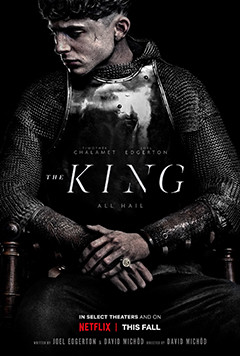
Imagine a version of Shakespeare’s Henry V where Prince Hal is a lot less regal but a lot more whiny. Also imagine a version where Falstaff is never publicly rejected by Henry but instead becomes one of his leading generals. Furthermore, imagine that Robert Pattinson shows ups and does his best imitation of the obnoxious Frenchmen from Monty Python and The Holy Grail. Also, finally, imagine a film that’s based on three of Shakespeare’s most popular plays but which does’t include any lines from those plays. Imagine all of that and you’ve got The King.
Yes, The King is an odd film indeed. It’s also a very long film. You might expect that from a film based on three Shakespearean plays but, then again, since the film actually doesn’t feature any of Shakespeare’s celebrated language, you have to kind of wonder if it can actually claim to be a Shakespearean adaptation. For instance, if I made a film about a sullen prince named Hamlet but totally leave out “To be or not to be” or the part where he sees his father’s ghost, am I truly adapting Shakespeare or am I just making a film about a guy named Hamlet? Interestingly enough, while The King isn’t faithful to Shakespeare, it’s also not faithful to actual historical records. It’s not Shakespeare and, despite using the name of actual kings and nobles from the 15th Century, it’s not really historical. It could just as easily be about King Kevin and his struggle to lead the Land of Homily to victory over Possum Kingdom. It’s hard to really understand what the point of this film is.
Timothee Chalamet plays Prince Hal, who will eventually become King Henry V. Considering just how acclaimed Chalamet’s previous work has been (including receiving an Oscar nomination for Call Me By Your Name and probably coming close to getting a second one for Beautiful Boy as well), it’s a bit strange just how dull Chalamet is in this film. As played by Chalamet, the future King of England is alternatively petulant and whiny. He’s not happy about becoming king. He’s even less happy about having to behead those who have been accused of conspiring against him. He hopes to avoid war, even after the King of France taunts him by giving him a ball as an coronation present. Chalamet wanders through the film with an eternally glum expression on his face. When he has to rally the troops, he is unpleasantly shrill in a way that will remind viewers of one of Leonardo DiCaprio’s lesser performances.
Joel Edgerton, who also co-wrote the script, is a bit more convincing in the role of Falstaff. Instead of the cowardly (but wise) buffoon who appeared in Shakespeare’s plays, The King portrays Falstaff as being a great warrior who merely likes to drink too much. This, of course, means that Hal doesn’t have to publicly rebuke Falstaff or any of his friends but it also makes Falstaff a bit of a pointless character. In Shakespeare’s plays, both the rebuke of Falstaff and the subsequent hanging of Bardolph were meant to show that the once irresponsible Hal was now placing his role of king above all else. By removing that aspect of the tale, The King also removes the entire heart of the narrative. That said, Edgerton is at least convincing as a warrior.
As usually happens when it comes to British historical epics, the film leads up to an eventual battle between the British and the French. Robert Pattinson plays The Dauphin and gives one of the most brilliantly strange performances of 2019. Wearing a blonde wig and speaking in an exaggerated French accent, Pattison gets all of the dirtiest lines and he has fun with them. (“You have zee big balls,” The Dauphin says at one point, “and zee little cock!”) In fact, Robert Pattinson seems to be the only person in the film having any fun whatsoever. Chalamet looks miserable. Edgerton comes across like a professional. But Pattinson appears to be having the time of his life and you’re happy to see him if just because he provides a (too brief) respite from the film’s otherwise dour atmosphere.
As I said, The King is a strange film. I’m not really sure what the point of it was. The battle scenes are effectively bloody and the sets are all convincingly 15th century. But otherwise, this movie is too pointless and too long. Just because it’s about the 100 Years War doesn’t mean that film has to feel like a 100 hours.


 Through the Shattered Lens