Late Night Retro Television Reviews: Gun 1.2 “Ricochet”


Welcome to Late Night Retro Television Reviews, a feature where we review some of our favorite and least favorite shows of the past!  On Tuesdays, I will be reviewing Gun, an anthology series that ran on ABC for six week in 1997.  The entire show is currently streaming on Tubi!

This week, on Gun, Martin Sheen plays a cop who might be investigating the final murder of his career!

Episode 1.2 “Ricochet”

(Dir by Peter Horton, originally aired on April 19th, 1997)

The second episode of Gun opens with the death of a Japanese businessman.  He’s found shot on a cliffside that overlooks the ocean.  The gun that shot him is discovered and taken by a homeless man named Lazy Eye Pete (Bud Cort).  Pete is a cheerfully eccentric type, one who sings for money and who is dedicated to taking care of his pet dog, Chester.  But, as soon as Pete gets that gun, his personality starts to change and he even ends up pulling the gun on a group of teenagers who were attempting to mug him.  In the end, Pete sells the gun to a friend of his.

Also searching for that gun is Detective Van Guinness (Martin Sheen).  Guinness, who suffers from ulcers and who takes his job very personally, has promised his girlfriend (Tess Harper) that he will retire from the force.  However, he doesn’t want to go out on a simple or an unsolved case.  Fortunately, for Guinness, he’s assigned the complicated case of the dead businessman.  Unfortunately, for him, his girlfriend is not at all amused by his refusal to retire.

Van’s partner (Kirk Baltz) thinks that the businessman was killed during a robbery but Guinness disagrees.  Guinness thinks that the businessman was murdered by either his wife (Nancy Travis) or his amoral attorney (Christopher McDonald).  The wife and the attorney are sleeping together and they’ve also come up with a plan to somehow fix the California state lottery.  (I couldn’t really follow what their plan was but then again, I’ve also never played the lottery.)  The attorney thinks that the wife is the murderer.  The wife thinks that the attorney is the murderer.  The truth is a bit more complicated but, in order to full understand what happened, Van Guinness is going to have to find that gun.

Though the plot was a bit too complicated for its own good (Seriously, what was going on with the whole lottery subplot?), the second episode was a definite improvement over the first episode, with director Peter Horton keeping the action moving at a steady pace and establishing the consistent tone that the previous episode lacked.  Ricochet played out like a true ensemble piece, splitting its attention between Martin Sheen, Bud Cort, Nancy Travis, and Christopher McDonald.  All four of the actors did a good job bringing their characters to life.  I especially liked Christopher McDonald’s amoral attorney.  Nobody plays a crooked attorney with quite the style and wit of Christopher McDonald!

Next week: Rosanna Arquette and James Gandolfini appear in an episode directed by the show’s co-creator, James Steven Sadwith.


The Brawler (2019, directed by Ken Kushner)


The Brawler is a biopic of boxer Chuck Wepner (adequately played by Zach McGowan).  A resident of Bayonne, New Jersey and nicknamed “The Bleeder” because of how much he usually bled in the ring, Wepner was the first boxer to face Muhammad Ali (played by Jerrod Page, who looks and sounds like Ali but who has none of his fabled charisma) after Ali’s famous defeat of George Foreman.  No one gave Wepner much of a chance.  Ali barely bothered to train for the match and falsely accused Wepner of using racial slurs while talking to him.  To everyone’s shock, Wepner not only went 15 rounds with the champ but he even knocked Ali off of his feet.  Wepner ultimately lost the fight but he won the hearts of many of the people watching.  He also inspired Sylvester Stallone to write and star in a movie called Rocky.

Though he was famous being “the Real Rocky,” Wepner initially didn’t make a dime off of Rocky or any of the sequels that followed.  While Stallone became a superstar, Wepner got addicted to cocaine, fought exhibition matches against Andre the Giant and a bear, and finally ended up in prison.  After getting out of prison, Wepner returned to his old job of selling liquor and made money signing memorabilia.  After he nearly got arrested as a part of a fraudulent autograph scam, Wepner finally took Stallone to court and sued for the money that he felt Stallone owed him.  Stallone settled, making Chuck Wepner the only man to go the distance with both Muhammad Ali and Sylvester Stallone.

If the plot of The Brawler sounds familiar, maybe you’ve seen one of the many documentaries that have been made about Chuck Wepner.  Or maybe you saw Chuck, a 2016 film about Chuck Wepner that starred Liev Schrieber.  The Brawler hits all of the same points as Chuck, so much so that it almost feels like an unofficial remake.  (Both films even features a voice-over narration from the actor playing Chuck.)  The main difference between the two films is that The Brawler spends a lot more time on Wepner’s time as a drug addict and it also portrays Stallone (played unconvincingly by Anthony Mangano) in a much more negative light.  Even though Wepner screws up every opportunity that he’s offered (including a chance to appear in Rocky II), it’s Stallone who is portrayed as being a villain because he didn’t always return Wepner’s calls and Stallone’s assistants were sometimes rude.  While Chuck spends all of time whining about how unfair his life is, Stallone comes across as being often clueless but hardly malicious in the way he treated Chuck.  It’s not easy to make a Hollywood superstar into a more sympathetic character than the poor underdog who is suing for the money that he’s owed for inspiring one of the most successful franchises of all time but The Brawler manages to pull it off.  In Chuck, Wepner is an inspiring underdog who never lets life keep him down.  In The Brawler, Wepner is a self-destructive child who lets down everyone who tries to help him.  When it comes to Chuck vs The Brawler, it’s Chuck by a clear knock-out.

The most interesting thing about The Brawler is that Burt Young has a cameo as a man watching the Wepner/Ali fight in a bar.  You have to wonder how Stallone felt about that.  Et tu, Paulie?

Film Review: The Butterfly Effect (dir by Eric Bress and J. Mackye Gruber)


How many different ways can Ashton Kutcher fuck up time and space?

That’s the question asked in the gloriously silly The Butterfly Effect, a film that was a minor hit back in 2004.  Ashton plays Evan Treborn, a disheveled college student who is studying how memory works.  All through his life, Evan has suffered from seizures that are triggered by stress.  Evan has a lot of stress because apparently, there’s not a single bad thing that didn’t happen to him when he was a child.

Crazy father who tried to strangle Evan before being gunned down in front of his son’s terrified eyes?  Yep.

Sexual molestation at the hands of a suburban drunk?  Yep.

A best friend who blew up not only a mailbox but also a mother and a baby?  Yep.

A dog that was set on fire by a neighborhood bully?  Yep.

Another friend who was driven into a catatonic state by all the madness around him?  Yep.

A girlfriend who, due to family tragedy, had to move away?  Yep.

However, things seem to be getting better for Evan.  Now, he’s a psychology major with a bright future.  His professors love him.  He’s even got a roommate named Thumper (played, somewhat inevitably, by Ethan Suplee).   And, as he’s soon to discover, he possesses a special power.  All he has to do is read his old journals and, for a limited time, he can go into the past and change his history.

Of course, it turns out that changing history is a lot more complicated than it looks.  Evan goes back into the past and confronts the pervy suburban drunk.  He then goes back to the present and discovers that he’s now a shallow frat boy who is hated by both his professors and Thumper!  Even worse, he eventually ends up in prison for killing a man.  Going back into the past and saving his dog leads to his friend Lenny (Elden Hansen) spending the rest of his life imprisoned.  Another trip to the past results in Evan waking up as a double amputee.  Depending on what Evan does, his friend Kayleigh (Amy Smart) either becomes a shallow sorority princess or a drug-addicted prostitute.  Meanwhile, Kayleigh’s brother (William Lee Scott) goes from being a psychotic murderer to a clean-cut religious guy.

Thumper never changers, though.  Thumper endures.

This, of course, is a lot of pressure to put on any character played by Ashton Kutcher and soon, Evan is having nosebleeds and migraines.  Every time he changes the past, his brain is flooded with 20 years worth of new memories.  His brain might explode before he can fix all the damage that he’s done….

Watching The Butterfly Effect is an odd experience because, on the one hand, the premise is genuinely intriguing but, on the other hand, the film stars the reliably goofy Ashton Kutcher.  Ashton grows a beard and doesn’t wash his hair for the first half of the movie, which is the film’s way of letting us know that we’re meant to take him seriously but it doesn’t change the fact that he’s still Ashton Kutcher.  Even when playing the most dramatic of scenes, Ashton tends to deliver every line as if it’s the set up for a punch line.  It’s not surprising that the best part of The Butterfly Effect is when Ashton wakes up and discovers that he’s now a frat boy.  Those scenes are intentionally funny and they take advantage of what Ashton Kutcher is actually good at.

At the same time, it’s hard not to get into The Butterfly Effect.  It’s a mess but it’s a likable mess and it’s undeniably enjoyable to see how everyone’s life changes as a result of Ashton’s constant meddling.  (William Lee Scott especially has fun, switching between being full-blown psycho and full-blown religious.)  The Butterfly Effect may be dumb but it’s fun.  It’s a film that’s best watched with your snarkiest friends.

Cleaning Out The DVR Yet Again #31: Black and White (dir by James Toback)


(Lisa recently discovered that she only has about 8 hours of space left on her DVR!  It turns out that she’s been recording movies from July and she just hasn’t gotten around to watching and reviewing them yet.  So, once again, Lisa is cleaning out her DVR!  She is going to try to watch and review 52 movies by the end of Wednesday, December 7th!  Will she make it?  Keep checking the site to find out!)

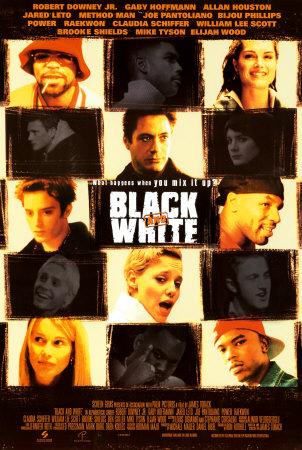
black_and_white_black_white-681253575-large

On November 15th, I recorded the 1999 melodrama, Black and White, off of Encore.

Black and White is a film that I’ve seen several times and I’ve always meant to review it.  It’s an attempt to explore the state of race, rap, crime, and sex in the late 20th century.  It’s also a James Toback film, which means that it contains all of the stuff that appears in every James Toback film: a threesome in the park, improvised dialogue, cameos from famous people playing themselves, an obsession with college basketball games, casual sexism, and a lot of talk about why you should never send “a little boy to do a man’s job.”  By his own admission, the white Toback is obsessed with the black experience but, when you watch a James Toback film, you get the feeling that his entire knowledge of African-American culture comes from watching other movies.

In short, Black and White is probably one of the silliest and most misjudged films that I’ve ever seen.  In fact, it’s so misjudged that it’s compulsively watchable.  Though I’m always hesitant to casually toss around the term “guilty pleasure,” that’s exactly what Black and White is.

Black and White tells several different stories, some of which are connected and some of which are not.  Sam Donager (Brooke Shields) is an independent filmmaker who is attempting to make a documentary about white people who try to act black.  Her husband, Terry (Robert Downey, Jr.), is gay and hits on every man (and boy) that he sees.  Sam and Terry start following around a group of privileged white kids who are obsessed with rap music.  Sam asks them if they want to be black.  They say that they’re going through a phase.

One of the kids is named Wren and he’s played by Elijah Wood.  He doesn’t really do much but every time he shows up in the film, you go, “It’s Elijah Wood!”  And then there’s Marty King (Eddie Kaye Thomas) who is the son of the Manhattan District Attorney (Joe Pantoliano).  Marty’s older brother is Will (William Lee Scott) ,who is some sort of low-level criminal.  And finally, the unofficial leader of the kids is Charlie (Bijou Phillips) and she gets to give a long monologue explaining the various uses of the n-word.

(Their teacher, incidentally, is played by Jared Leto.  If you’ve ever wanted to listen to Jared Leto lecture about the relationship between Othello and Iago, this is the film to see.  That said, the whole Othello and Iago lecture is just kinda randomly tossed in and doesn’t really pay off.)

Charlie is one of the many girlfriends of Rich Bower (Power), who is not only an up-and-coming rap producer but he’s also the head of a criminal organization.  (There’s a lengthy and kinda pointless scene where he and his associates demand money from a club manager played by Scott Caan.)  Rich is also friends with Mike Tyson.  Tyson plays himself and he gets to deliver an entire monologue about how Rich should never send a boy to do a man’s job.

But we’re not done!  Rich’s cousin is Dean Carter (Allan Houston), a college basketball player.  Dean is dating an anthropology graduate student (Claudia Schiffer, giving a hilariously terrible performance) who is obsessed with fertility symbols.  Dean is also being blackmailed by a corrupt cop named Mark Clear.  Guess who plays Mark Clear?

BEN FREAKING STILLER!

Needless to say, Ben Stiller is massively miscast.  He delivers he lines in his trademark comedic fashion, which makes it next to impossible to take him seriously as any sort of threat.  He also has a backstory that is needlessly complex but at least it allows him to say, “I’m Saul of Fucking Tarsus!”

Anyway, almost the entire film was improvised, which is one of those things that probably seemed like a good idea at the time.  A few of the actors do well with the improvisation.  Stiller may be miscast but at least he can come up with stuff to say.  Robert Downey, Jr.’s character may seem out-of-place but again, Downey knows how to keep things interesting.  But the rest of the cast seems to be a bit stranded so we end up with a lot of lengthy scenes of characters struggling to make some sort of sense of Toback’s storyline.

It’s obvious that James Toback felt that this film had something important to say but, instead of any insight, it can only offer up the occasionally strange-as-Hell scene.

Like this scene, for instance, in which Mike Tyson literally attempts to kill Robert Downey, Jr:

Or this weird little scene between Ben Stiller and Joe Pantoliano, which is dominated by Stiller’s odd delivery of his lines:

Or the closing montage, which is actually rather well-put together and makes great use of Michael Fredo’s Free:

Sadly, the video above ends before it gets to the part where we see Claudia Schiffer on a date with Mike Tyson, telling him about fertility symbols.

Anyway, Black and White is one of those films that wants to say something despite not being sure what.  Again, it may ultimately be rather silly but it’s still compulsively watchable.

(For the record, Marla Maples — who also appeared in Maximum Overdrive and was married to future President Donald Trump when this movie was made — has a cameo as a character named Muffy.  We live in a strange fucking world, don’t we?)

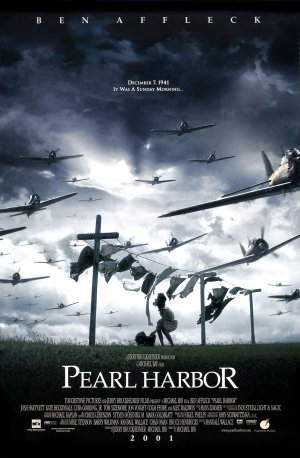
Embracing the Melodrama Part II #100: Pearl Harbor (dir by Michael Bay)


Pearl_harbor_movie_poster

“And then all this happened…”

Nurse Evelyn Johnson (Kate Beckinsale) in Pearl Harbor (2001)

The “this” that Evelyn Johnson is referring to is the Japanese attack on Pearl Harbor.  You know, the date will live in infamy.  The attack that caused the United States to enter World War II and, as a result, eventually led to collapse of the Axis Powers.  The attack that left over 2,000 men died and 1,178 wounded.  That attack.

In the 2001 film Pearl Harbor, that attack is just one of the many complications in the romance between Danny (Ben Affleck), his best friend Rafe (Josh Hartnett), and Evelyn (Kate Beckinsale).  The other complications include Danny briefly being listed as dead, Danny being dyslexic before anyone knew what dyslexia was (and yet, later, he’s still seen reading and writing letters with absolutely no trouble, almost as if the filmmakers forgot they had made such a big deal about him not being able to do so), and the fact that Rafe really, really likes Evelyn.  Of course, the main complication to their romance is that this is a Michael Bay film and he won’t stop moving the camera long enough for anyone to have a genuine emotion.

I imagine that Pearl Harbor was an attempt to duplicate the success of Titanic, by setting an extremely predictable love story against the backdrop of a real-life historical tragedy.  Say what you will about Titanic (and there are certain lines in that film that, when I rehear them today, make me cringe), Leonardo DiCaprio and Kate Winslet had genuine chemistry.  None of that chemistry is present in Pearl Harbor.  You don’t believe, for a second, that Ben Affleck and Josh Hartnett are lifelong friends.  You don’t believe that Kate Beckinsale is torn between the two of them.  Instead, you just feel like you’re watching three actors who are struggling to give a performance when they’re being directed by a director who is more interested in blowing people up than in getting to know them.

Continuing the Titanic comparison, Pearl Harbor‘s script absolutely sucks.  Along with that line about “all this” happening, there’s also a scene where Franklin D. Roosevelt (Jon Voight) reacts to his cabinet’s skepticism by rising to his feet and announcing that if he, a man famously crippled by polio and confined to a wheelchair, can stand up, then America can win a war.

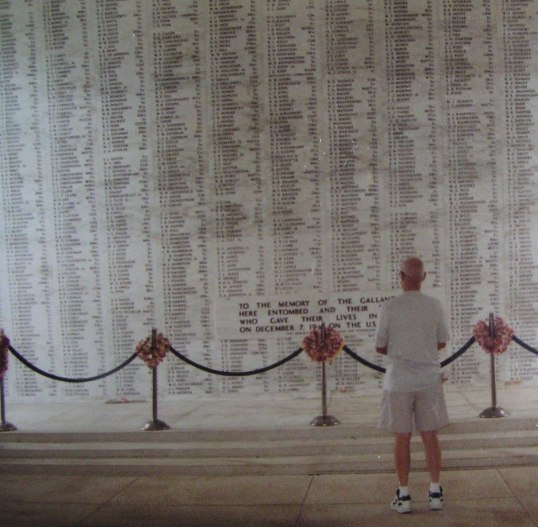
I’ve actually been to Pearl Harbor in Hawaii.  I have gone to the USS Arizona Memorial.  I have stood and stared down at the remains of the ship resting below the surface of the ocean.  It’s an awe-inspiring and humbling site, one that leaves you very aware that over a thousand men lost their lives when the Arizona sank.

I have also seen the wall which lists the name of everyone who was killed during the attack on Pearl Harbor and until you’ve actually been there and you’ve seen it with your own eyes, you really can’t understand just how overwhelming it all is.  The picture below was taken by my sister, Erin.

Pearl Harbor 2003If you want to pay tribute to those who lost their lives at Pearl Harbor, going to the Arizona Memorial is a good start.  But avoid Michael Bay’s Pearl Harbor at all costs.