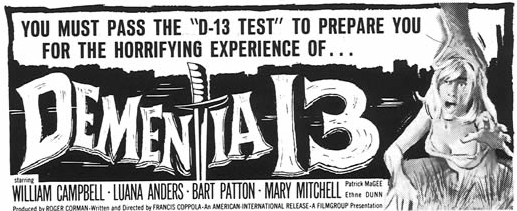
1963’s Dementia13 is a significant film for another reasons.
For one, it’s the mainstream feature film debut of Francis Ford Coppola. (Coppola has said that he directed two softcore films before Dementia13 but they’ve been lost to history.) Both Coppola’s screenplay and his direction were heavily influenced by the early giallo films that were coming out of Italy. One could argue that this is the first American film to pay homage to Mario Bava.
Dementia13 is also the first film on which Coppola ever went overbudget. This film is literally the start of an era.
Coppola himself has been critical of Dementia13. Producer Roger Corman was not happy with the first cut of the film and added a few scenes that took away from Coppola’s pacing. That said, it’s still an atmospheric and creepy forerunner to the American slasher film. The scene in which Launa Anders goes for a swim has been duplicated in numerous other films and it’s still effective in the way that it chops away at the audience’s sense of security. It certainly freaks me out. Of course, I’m not much of a swimmer. I’m a good drowner, though.
(I originally shared this film back in 2011, 2019, 2022, and 2023 — can you believe we’ve been doing this for that long? — but the YouTube upload keeps getting taken down! So, I’m resharing it today!)
For today’s excursion into the world of public domain horror, I offer up the film debut of Francis Ford Coppola. Before Coppola directed the Godfather and Apocalypse Now, he directed a low-budget, black-and-white thriller that was called Dementia 13. In a possible sign of things to come, producer Roger Corman and Coppola ended up disagreeing on the film’s final cut and Corman reportedly brought in director Jack Hill to film and, in some cases, re-film additional scenes.
Regardless of whether the credit should go to Coppola, Corman, or Hill, Dementia 13 is a brutally effective little film that is full of moody photography and which clearly served as an influence on the slasher films that would follow it in the future. Speaking of influence, Dementia 13 itself is obviously influenced by the Italian giallo films that, in 1963, were just now starting to make their way into the drive-ins and grindhouses of America.
Speaking of giallo films, keep an eye out for Patrick Magee, who gave a memorable performance in Lucio Fulci’s The Black Cat. Luana Anders, who plays the duplicitous wife in this film, showed up in just about every other exploitation film made in the 60s and yes, the scene where she’s swimming freaks me out to no end. Other films featuring Luana Anders include Night Tide and Easy Rider, in which she played one of the hippies who unsuccessfully enticed Peter Fonda and Dennis Hopper to stay at the commune.
As for Francis Ford Coppola, well, he’s gone on to have quite a career, hasn’t he? It’s been quite a journey from Dementia 13 to Megalopolis!
Welcome to Retro Television Reviews, a new feature where we review some of our favorite and least favorite shows of the past! On Fridays, I will be reviewing The Master, which ran on NBC from January to August of 1984. The show can be found on Tubi!
This week, McAllister and Max head to Washington, D.C.!
Episode 1.9 “Kunoichi”
(Dir by Gordon Hessler, originally aired on April 9th, 1984)
The 9th episode of The Master opens by showing us what Okasa (Sho Kosugi) has been doing since coming to America to track down and kill his former teacher, John Peter McAllister (Lee Van Cleef). Okasa has been training an apprentice of his own. The apprentice ninja is always seen while wearing a light gray ninja uniform, the better to keep the apprentice’s identity a secret until halfway through the episode.
Meanwhile, McAllister and Max (Tim Van Patten) are in Washington, D.C. As McAllister explains it, he was good friends with Brian Elkwood (Jack Kelly) when they both served in the Army together. During the Korean War, they were both held in the same POW camp and they escaped together. (This, of course, goes against McAllister’s previous backstory, which was that he left the Army after World War II and spent the next 40 years hidden away in Japan.) Elkwood is now an important advisor to the President. Apparently, Elkwood sent McAllister a letter informing him that a spy known as The Hawk was threatening his life so McAllister has come to Washington to protect him. (How exactly McAllister received a letter when he and Max are constantly driving around the country in search of McAllister’s daughter is not explained.)
At the Elkwood estate, Brian Elkwood tells his assistant, Allison Grant (Kelly Harmon), that he has been receiving letters from John Peter McAllister in which McAllister has threatened to kill him. Allison argues that McAllister has always been Elkwood’s friend but Elkwood says that people can change. Elkwood’s head of security, Ron Gordon (Rick Hill), is concerned not only about McAllister but also about uncovering the identity of The Hawk.
Or at least, that’s what Gordon claims. A few scenes later, we discover that Gordon actually is The Hawk and that he’s hired Okasa to assassinate Elkwood. Okasa is planning on framing McAllister for the assassination. The assassination will be carried about his apprentice, who we learn is close to Elkwood. The episode tries to build up a lot of suspense over who Okasa’s apprentice actually is but it’s actually pretty easy to figure out. Elkwood is not the apprentice because he’s the target. Gordon is the not apprentice because he’s the Hawk. There’s only one other guest star on this episode so obviously, the apprentice is Allison. Myself, I’m just confused as to when Okasa’s mission went from personally killing McAllister to framing him for murder.
Eventually, McAllister is able to convince Elkwood that he didn’t write the threatening letters but a sudden attack of Okasa’s apprentice leaves Elkwood hospitalized and McAllister arrested for attempted murder. Fortunately, Max is able to use his ninja training to help McAllister escape from jail and they manage to not only prevent the second attempt on Elkwood’s life but they also expose both Gordon and Allison as being enemies of the state. Yay!
This is one of those episodes where everyone, with the exception of Sho Kosugi, steps to the side and lets their stunt doubles do most of the work. There’s a lot of fights but they are all awkwardly choreographed and framed, probably in an attempt to keep the audience from noticing that Lee Van Cleef’s stunt person was notably thinner and more athletic than Lee was. As far as episodes of The Master are concerned, this was not a bad one but it still ultimately leaves the viewer feeling that it could have been so much better.
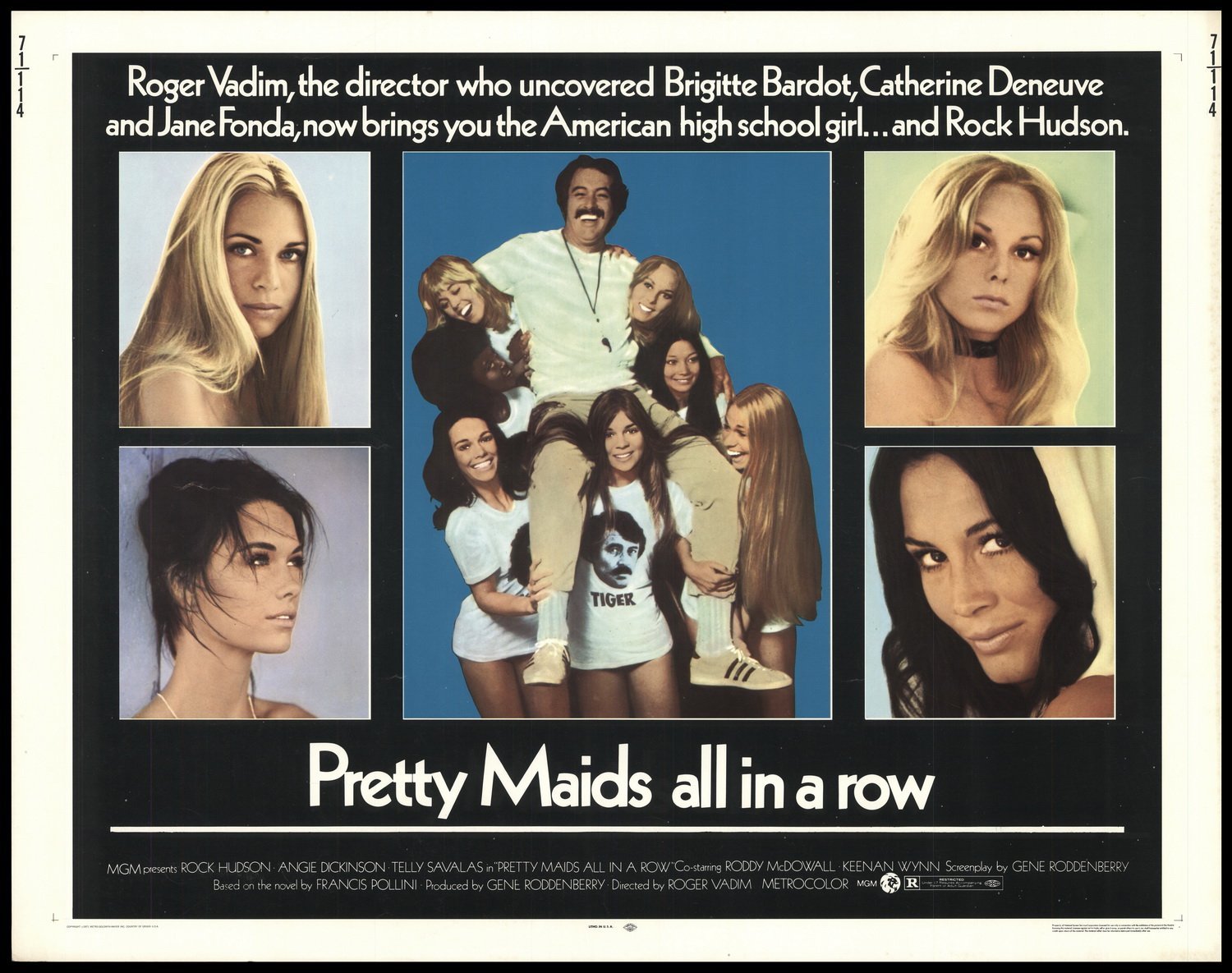
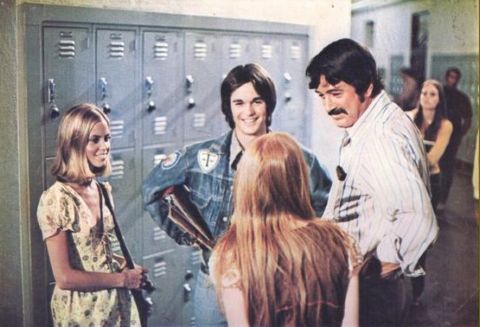
Gene Roddenberry’s post-STAR TREK career had pretty much gone down the tubes. The sci-fi series had been a money loser, and Roddenberry wasn’t getting many offers. Not wanting to be pigeonholed in the science fiction ghetto, he produced and wrote the screenplay for PRETTY MAIDS ALL IN A ROW, a black comedy skewering the sexual revolution, with French New Wave director Roger Vadim making his first American movie. The result was an uneven yet entertaining film that would never get the green light today with its theme of horny teachers having sex with horny high school students!
All-American hunk Rock Hudson was in the middle of a career crisis himself. After spending years as Doris Day’s paramour in a series of fluffy comedies, his box office clout was at an all-time low. Taking the role of Tiger McGrew, the guidance counselor/football coach whose dalliances with the cheerleading squad leads to murder…
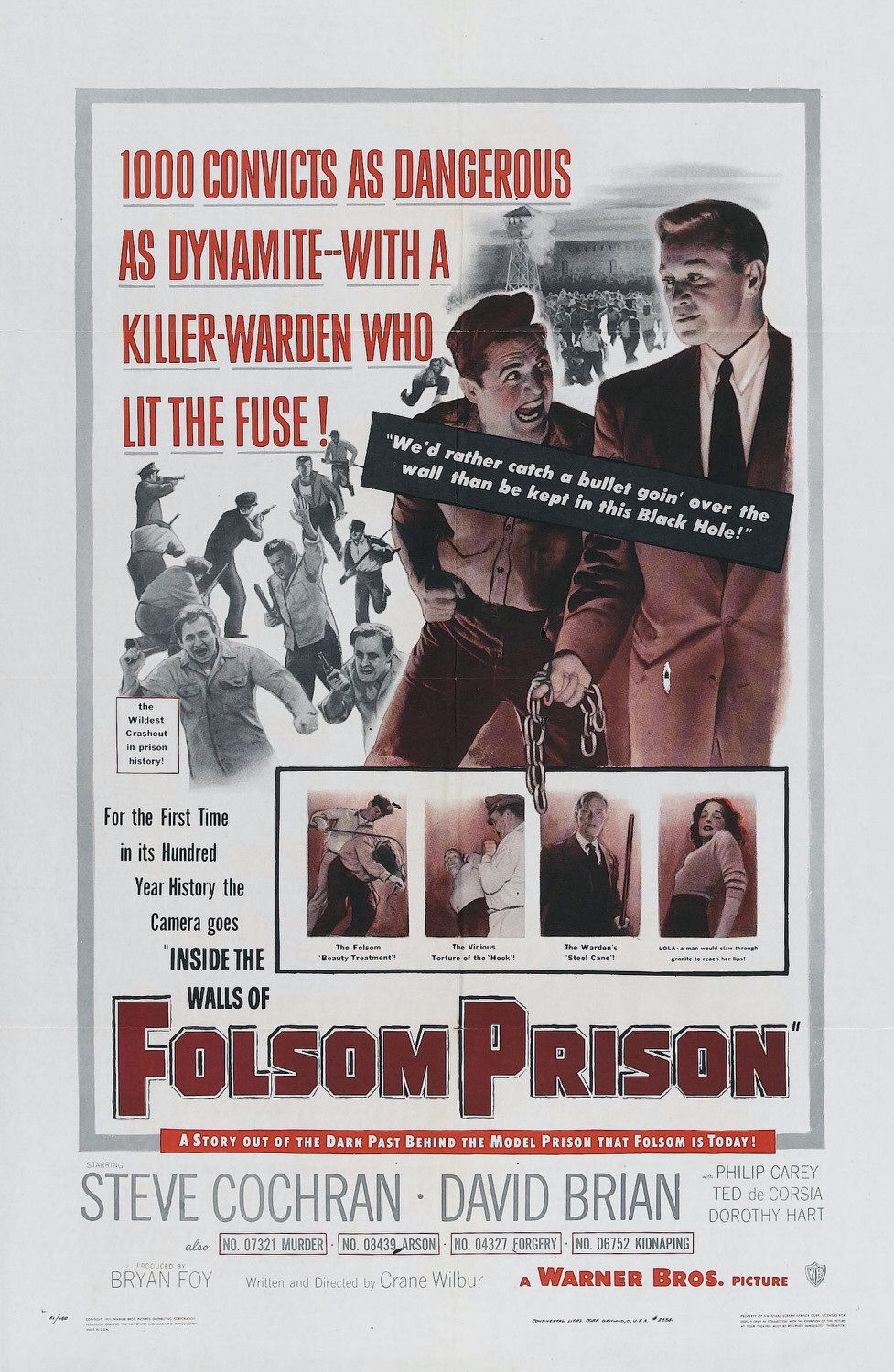
Filmed on location inside the infamous prison, and with a testosterone-loaded cast led by Steve Cochran , David Brian, Ted de Corsia, and Philip Carey , I expected INSIDE THE WALLS OF FOLSOM PRISON to be slam-bang entertainment along the lines of BRUTE FORCE . Well, not so much. The trouble’s not with the cast, nor the atmospheric direction of Crane Wilbur. It’s Wilbur’s script that commits the cardinal sin of any action film: too much talk!
Even the prison itself talks, narrating the opening credits: “I am Folsom Prison. At one time they called me Bloody Folsom. And I earned it…”, intones the prison, voiced by Charles Lung (an appropriate name for someone who talks to much!). The movie begins with an attempted jailbreak, put down by sadistic Warden Rickey (de Corsia) and his thugs. He then ratchets up the punishment, making life even more miserable for the cons, until…
Pretty Maids All In A Row, which — as should be pretty obvious from the trailer above — was originally released in 1971, is a bit of a historic film for me. You see, I love movies. And, as a part of that love, I usually don’t give up. Regardless of how bad a movie may turn out to be, once I start watching, I stick with it. I do not give up. I keep watching because you never know. The film could suddenly get better. It could turn out that what originally seemed like a misfire was actually brilliant satire. If you’re going to talk or write about movies, you have an obligation to watch the entire movie. That was a rule that I had always lived by.
And then, one night, Pretty Maids All In A Row popped up on TCM.
Now, I have to admit that I already knew that Pretty Maids was going to be an extremely 70s film. I knew that it was probably going to be more than a little sexist. I knew all of this because the above trailer was included on one of my 42nd Street Forever DVDs. But I still wanted to see Pretty Maids because the trailer hinted that there might be an interesting hiding underneath all of the cultural baggage. If nothing else, it appeared that it would have some sort of worth as an artifact of its time.
(If you’re a regular reader of this site, you know how much I love my cinematic time capsules.)
So, the film started. I logged onto twitter so that I could live tweet the film, using the hashtag #TCMParty. And from the moment the film started, I knew it wasn’t very good. It wasn’t just that the film’s camerawork and music were all extremely 70s. After all, I like 70s music. I don’t mind the occasional zoom lens. And random psychedelic sequences? WHO DOESN’T LOVE THOSE!? No, my dislike of the film had nothing to do with the film’s style. Instead, it had to do with the fact that there was absolutely nothing going on behind all of that style. It wasn’t even style for the sake of style (which is something that I usually love). Instead, it was style for the sake of being like every other “youth film” that came out in the 70s.
And then there was the film’s plot, which should have been interesting but wasn’t because director Roger Vadim (who specialized in stylish decadence) had no interest in it. The film takes place at Oceanfront High School, where the only rule is that apparently nobody is allowed to wear a bra. We meet one student, Ponce De Leon Harper (played by an amazingly unappealing actor named John David Carson), who is apparently on the verge of having a nervous breakdown because, at the height of the sexual revolution, he’s still a virgin.
(Because, of course, the whole point of the sexual revolution was for losers like Ponce to finally be able to get laid…)
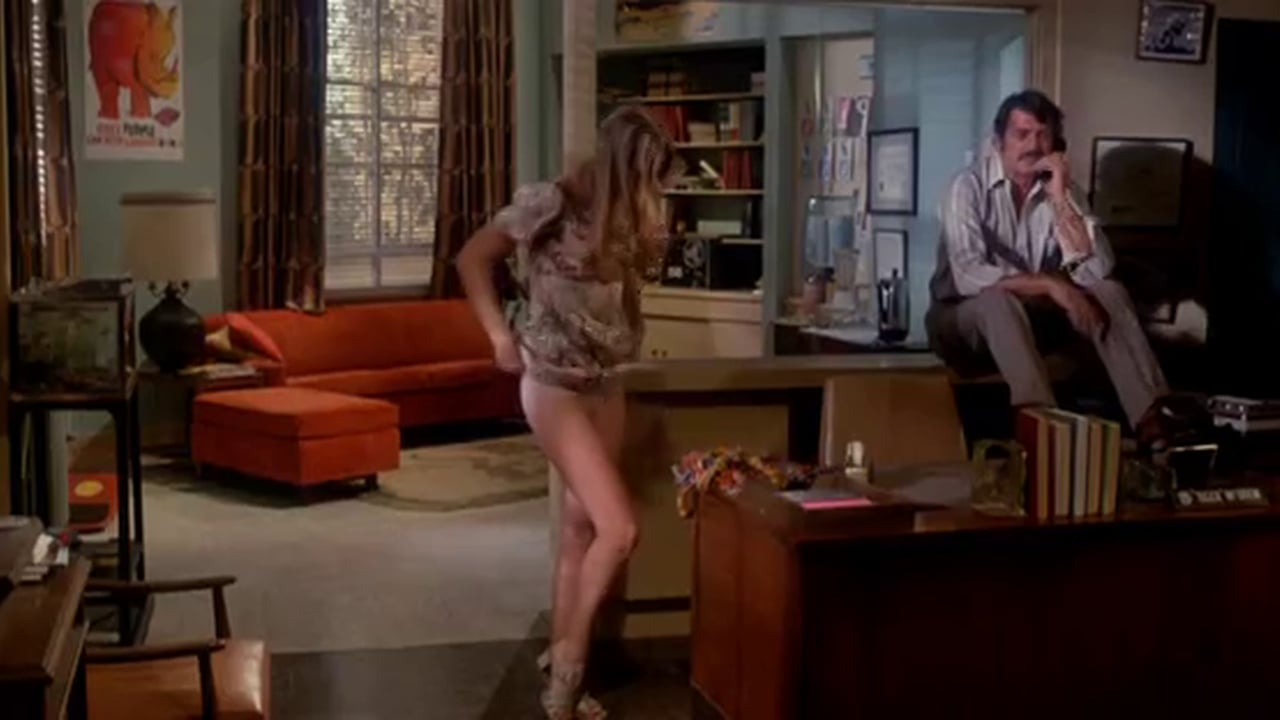
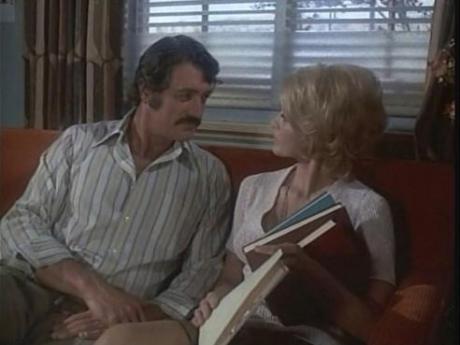
Ponce is taken under the wing of high school guidance counselor Tiger McDrew (Rock Hudson, complete with porn star mustache). Quickly figuring out exactly what Ponce needs, Tiger sets him up with a teacher played by Angie Dickinson. However, Tiger has other concerns than just Ponce. Tiger, it turns out, is a sex addict who is sleeping with nearly every female student at the school. But, American society is so oppressive and puts so much pressure on the American male that Tiger has no choice but to kill every girl that he sleeps with…
This is one of the only film I can think of that not only makes excuses for a serial killer but also presents him as being a heroic character. And, while it’s tempting to think that the film is being satirical in its portrayal of Tiger and his murders, it’s actually not. Don’t get me wrong. The film is a very broad comedy. The high school’s principal (Roddy McDowall) is more concerned with the football team than with all of the girls turning up dead at the school. The local sheriff (Keenan Wynn) is a buffoon. The tough detective (Telly Savalas) who investigates the murders gets a few one liners.
But Tiger, most assuredly, is the film’s hero. He’s the only character that the audience is expected to laugh with, as opposed to at. He is the character who is meant to serve as a mouthpiece for screenwriter Gene Roddenberry’s view on America’s puritanical culture. If only society was less hung up on sex, Tiger wouldn’t have to kill. Of course, the film’s celebration of Tiger’s attitude towards sex is not extended towards the girls who sleep with him. Without an exception, they are all presented as being empty-headed, demanding, shallow, and annoying, worthy only of being leered at by Vadim’s camera until Tiger finally has to do away with them.
(The film’s attitude towards women makes Getting Straight look positively enlightened.)
Rock and Angie
ANYWAY! I spent about 40 minutes watching this movie before I gave up on it. Actually, if you want to be technical about it, I gave up after 5 minutes. But I stuck with it for another 35 minutes, waiting to see if the film was going to get any better. It didn’t and finally, I had to ask myself, “Why am I actually sitting here and wasting my time with this misogynistic bullshit?” So, I stopped watching and I did so with no regrets.
What I had forgotten is that I had set the DVR to record the film while I was watching it, just in case I later decided to review it. So, last week, as I was preparing for this series of Back to School posts, I saw Pretty Maids All In A Row on my DVR. I watched the final 51 minutes of the film, just to see if it ever got better. It didn’t.
However, on the plus side, Rock Hudson does give a good performance in the role of Tiger, bringing a certain seedy desperation to the character. (I’m guessing that this desperation was Hudson’s own contribution and not an element of Roddenberry’s screenplay, which more or less presents Tiger as being a Nietzschean superman.). And beyond that, Pretty Maids serves as evidence as to just how desperate the Hollywood studios were to makes movies that would be weird enough to appeal to young people in the early 70s.
Watching the film, you can practically hear the voices of middle-aged studio executives.
“What the Hell are we trying to do with this movie!?” one of the voices says.
“Who cares!?” the other voice replies, “the kids will love it!”




 Through the Shattered Lens