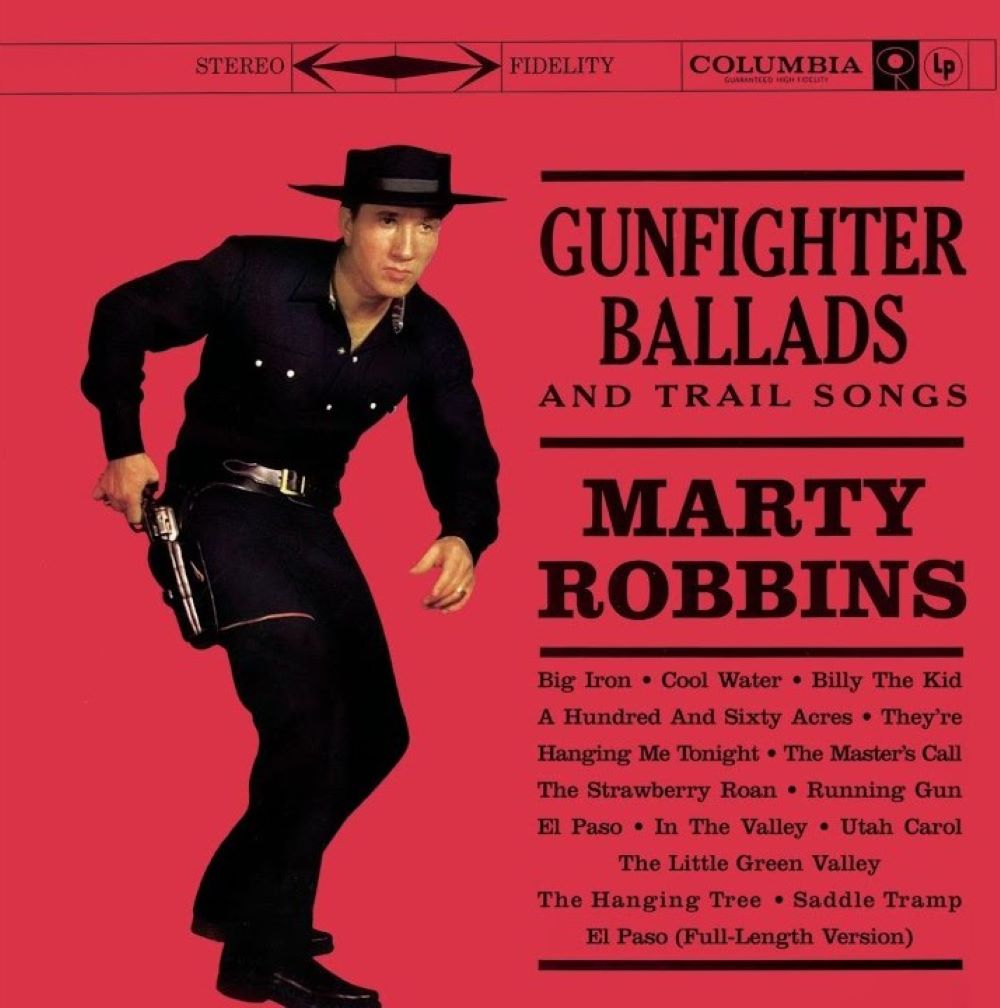
Marty Robbins’ “Big Iron” is one of those songs that instantly takes you back to the Old West. It’s simple but powerful—a ranger rides into town to face down an outlaw, and you just feel that quiet tension building with every verse. Robbins’ steady voice gives the story a calm, almost cinematic vibe, like a slow pan across a dusty street before the final showdown. It’s storytelling stripped to the bone: two men, one promise of justice, and the air thick with purpose.
What’s cool is how “Big Iron” hasn’t just stayed stuck in the past. It’s popped up everywhere—from memes to movies to, of course, Fallout: New Vegas. That game gave the song a second life as a kind of anthem for wanderers—loners crossing desolate landscapes where myths feel more real than history. There’s something timeless about its message: standing your ground, even when the whole world’s gone sideways.
So when “Big Iron” opens the first episode of Fallout Season 2, it feels like a perfect fit. The familiar twang instantly throws you into that classic Fallout energy—part Western, part apocalypse. It’s not just a fun musical nod; it sets the tone for everything that follows. The song reminds us that even in a broken world, we’re still drawn to stories about courage, justice, and lone figures walking into danger with purpose. Robbins’ ballad might be old, but in Fallout’s world, it feels right at home.
Big Iron
To the town of Agua Fria rode a stranger one fine day Hardly spoke to folks around him, didn’t have too much to say No one dared to ask his business, no one dared to make a slip For the stranger there amongst them had a big iron on his hip Big iron on his hip
It was early in the morning when he rode into the town He came riding from the south side slowly lookin’ all around He’s an outlaw loose and running came the whisper from each lip And he’s here to do some business with the big iron on his hip Big iron on his hip
In this town there lived an outlaw by the name of Texas Red Many men had tried to take him and that many men were dead He was vicious and a killer though a youth of twenty-four And the notches on his pistol numbered one and nineteen more One and nineteen more
Now the stranger started talking, made it plain to folks around Was an Arizona Ranger, wouldn’t be too long in town He came here to take an outlaw back alive or maybe dead And he said it didn’t matter, he was after Texas Red After Texas Red
Wasn’t long before the story was relayed to Texas Red But the outlaw didn’t worry men that tried before were dead Twenty men had tried to take him, twenty men had made a slip Twenty-one would be the ranger with the big iron on his hip Big iron on his hip
The morning passed so quickly, it was time for them to meet It was twenty past eleven when they walked out in the street Folks were watching from the windows, everybody held their breath They knew this handsome ranger was about to meet his death About to meet his death
There was forty feet between them when they stopped to make their play And the swiftness of the Ranger is still talked about today Texas Red had not cleared leather for a bullet fairly ripped And the Ranger’s aim was deadly with the big iron on his hip Big iron on his hip
It was over in a moment and the folks had gathered ’round There before them lay the body of the outlaw on the ground Oh, he might have gone on living but he made one fatal slip When he tried to match the Ranger with the big iron on his hip Big iron on his hip
Big iron, big iron When he tried to match the Ranger With the big iron on his hip Big iron on his hip
“You want to shoot me, go ahead. It won’t matter. I’ve seen things you wouldn’t believe.” — The Stranger
The Western Wound: Horror, History, and the Haunting of Frontier Mythology
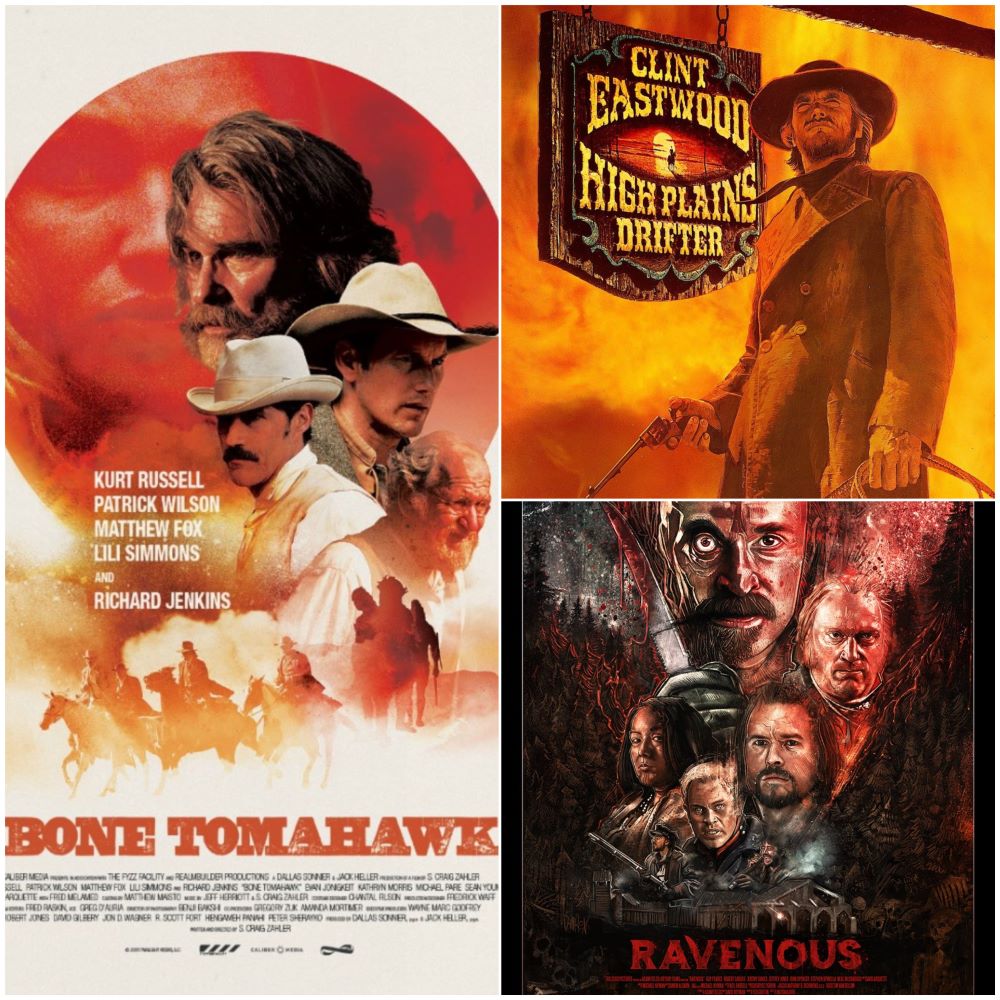
Horror profoundly shapes, distorts, and reframes the American Western, complicating familiar narratives of lawmen and outlaws with the uncanny specter of trauma, dread, and evil. Few films demonstrate this transformation more powerfully than Ravenous (1999), Bone Tomahawk (2015), and High Plains Drifter (1973). These three Westerns push beyond genre conventions, leveraging horror’s capacity to unsettle, destabilize, and haunt—creating experiences that are as philosophically provocative as they are viscerally unsettling. Rather than merely incorporating horror aesthetics into a Western setting, each film employs horror as a core thematic device to interrogate violence, community, morality, and the dark legacies of frontier expansion.
The Haunted Frontier: Atmosphere and the Specter of Evil
High Plains Drifter’s isolation in the arid Nevada desert is more than a physical setting; it externalizes the moral barrenness and guilt festering within the town of Lago. The oscillation between relentless sunlight and dense fog creates a hallucinatory space where natural laws are suspended, and supernatural retribution manifests. Central water imagery—the fog rolling off the lake, the lake itself—serves as a liminal zone, symbolizing the boundary between life and death, past and present, justice and vengeance. The Stranger’s spectral emergence from the desert heat haze hints at his otherworldly nature, turning the town’s landscape into a haunted battleground where redemption is elusive and suffering endemic.
Ravenous’s setting in the snowy Sierra Nevada mountains during the Mexican-American War imbues its horror with claustrophobic dread. Fort Spencer’s remoteness in the face of towering, hostile peaks and unrelenting winter transforms the natural environment into a gothic prison. This wilderness is both physical and psychological, oppressive in its vastness and merciless in its cold. The film uses this setting to amplify the existential terror wrought by cannibalism, suggesting an inescapable cycle of consumption where survival becomes monstrous. Deep shadows, filtered natural lighting, and long quiet scenes evoke dread as much as extreme violence.
In Bone Tomahawk, the stark, sunbaked deserts and towering rock formations of the American Southwest form an ominous landscape embodying ancient and unknowable horror. The frontier town is a fragile outpost at civilization’s edge, surrounded by a wild, menacing wilderness. The deep canyons serve as metaphorical gateways to past atrocities, echoing the silent histories of indigenous trauma and colonial violence. The oppressive silence and vastness underscore humanity’s diminutiveness and vulnerability, while the jagged terrain symbolizes the harshness of both nature and history’s brutal forces.
Monstrous Transformation: The Horror Within
The Stranger in High Plains Drifter manifests the blurring boundaries between justice and vengeance, heroism and monstrosity. His actions—including an unsettling rape scene—force a confrontation with the darkest aspects of human nature, showing how violence corrupts even those who claim righteousness. His ghostly status and ruthless methodology suggest he is a representation of collective guilt made tangible, punishing the town’s sins with otherworldly finality. The film invites viewers to question whether vengeance restores balance or merely perpetuates horror.
In Ravenous, cannibalism literalizes the primal urge to consume not only flesh but identity and sanity, transforming survivors into monsters. The character Ives, charismatic and terrifying, embodies this transformation, seducing others into a vortical descent of brutality. The film’s psychological horror arises from the contagion of hunger and madness, the breakdown of social and moral order amid desolation. It probes existential questions about survival, morality, and the dissolution of self.
Bone Tomahawk depicts transformation through the confrontation with an ancient, savage tribe whose brutality transcends ordinary human evil. The characters’ exposure to this primordial terror strips away civilized facades, forcing characters and viewers to acknowledge the latent barbarity within humanity. The film’s horror is both external—in the violent acts of the tribe—and internal—in the psychological unravelling of the rescue party. This duality highlights the wilderness as both physical terrain and psychic landscape of primal fear.
The Community and the Failures of Civilization
The communal failure in High Plains Drifter reveals how collective cowardice and betrayal corrupt society. Lago’s townsfolk enable the marshal’s murder and face the Stranger’s supernatural justice as a consequence. Their moral bankruptcy transforms the town into a cursed locus of horror, symbolizing how collective sin corrupts the social fabric and invites ruin.
Ravenous portrays community breakdown within the remote outpost, where isolation breeds paranoia, selfishness, and violence. The collapse of trust and order mirrors the broader failure of frontier society to contain human baseness under extreme conditions, suggesting society itself is a fragile construct vulnerable to collapse.
In Bone Tomahawk, the fragile rescue party embodies the precariousness of social cohesion facing profound evil. Their doomed mission stresses how thin the veneer of civilization is, shattering under pressure from ancient horrors. The film critiques assumptions of order and control, emphasizing the ease with which human society can crumble.
Violence, Justice, and the Ethical Horror
Violence in High Plains Drifter is unending, spectral, and morally ambiguous. The Stranger’s vengeance refuses neat closure, illustrating cycles of violence that leave deeper scars rather than justice. The film redefines violent retribution as torment, destabilizing conventional heroic narratives.
Ravenous entwines violence with survival horror and existential dread. The ritualistic cannibalism is a metaphor for moral and spiritual corrosion, forcing characters and audiences to face the horrors wrought by the primal fight for survival at civilization’s edge.
Bone Tomahawk presents violence as slow, ritualistic, and ancient—an elemental force indifferent to human ethics. Its stark, realistic depiction immerses viewers in fear and helplessness, rejecting conventional catharsis and highlighting the terror of primal brutality.
Subtext and Symbolism: Horror as the Depths of Humanity
High Plains Drifter blends ghostly and surreal imagery to explore unresolved sin and cultural guilt. The Stranger is both avenger and specter of collective trauma, with symbolic elements—such as the red-painted town and unmarked graves—that deepen the meditation on punishment and desolation.
Ravenous uses cannibalism and wilderness as symbols of consumption and destruction intrinsic to frontier expansion. Horror here reflects existential struggles with survival, cultural annihilation, and moral ambiguity, set against an environment of engulfing nature and history.
Bone Tomahawk evokes frontier horror as a metaphor for repressed histories and cultural erasure. The savage tribe symbolizes ancestral trauma, while the desolate landscapes underscore the lingering presence of buried horrors that haunt the Western imagination.
The Western Genre as a Wound Haunted by Horror
Ravenous, Bone Tomahawk, and High Plains Drifter deepen the Western genre’s reckoning with violence, morality, and civilization’s fragility. Ravenous allegorizes hunger and expansion’s destructive appetite through cannibalism, revealing survival’s costs to identity and culture. Bone Tomahawk exposes historical violence and trauma encoded in landscape and myth, demonstrating Western justice’s limits. High Plains Drifter dramatizes unresolved guilt and vengeance through spectral retribution, challenging sanitized Western heroism.
The films’ central horrors—the Stranger’s merciless vengeance, the cannibal’s transformative hunger, and the doomed rescue mission into darkness—serve as meditations on violence, communal complicity, and the absence of redemption. They unmask the American West and America itself as terrains haunted by deep, unresolved sins and moral ambiguity. In marrying supernatural and psychological horror, these films offer a complex, layered critique of frontier myth, turning the Western from a tale of conquest into a haunted narrative of trauma, survival, and moral reckoning.
Supernatural vs Psychological Readings
High Plains Drifter uniquely embodies ambiguity between supernatural revenge and psychological torment. The Stranger’s ghostlike qualities and resurrection to avenge his murder firmly anchor a supernatural interpretation. His eerie manifestations—such as the bullwhip’s sound triggering vivid nightmares and his mysterious appearance from the desert heat—signal a spectral force beyond human comprehension. Yet, on a psychological level, the Stranger can be viewed as the materialization of the town’s collective guilt and suppressed trauma. This duality enriches the narrative, allowing viewers to interpret the horror as either literal supernatural vengeance or a psycho-spiritual reckoning of internal moral collapse.
Ravenous blurs supernatural and psychological horror by mixing the tangible terror of cannibalism with metaphysical dread. The figure of Ives carries almost mythic qualities—his charismatic yet monstrous presence suggests an otherworldly evil, a contagion consuming the souls of men. The mountain wilderness functions as a liminal space transcending reality, where madness and primal urges surface. This ambiguity invites readings of the horror as both external supernatural curse and internal psychological disintegration, reflecting survival’s dehumanizing cost amidst isolation and guilt.
Bone Tomahawk grounds itself mostly in realistic terror but invokes mythic supernatural threads through the savage tribe’s almost fantastical menace. Their brutal, ritualized violence carries residues of ancestral curses and primal fears that exceed mere human malevolence. The film explores psychological horror through the characters’ terror and helplessness confronting an unknowable evil, making the wilderness and tribe a metaphor for the abyss of human and historical trauma. Thus, horror emerges as both a tangible threat and a psychological abyss threatening identity and sanity.
This interplay of supernatural and psychological horror amplifies these films’ thematic depth. By refusing to confine horror to one domain, they portray the Western frontier as a space haunted simultaneously by ghosts—whether spiritual, historical, or personal—and inner demons manifesting as guilt, fear, and madness.
Ultimately, horror in these Westerns is not merely a matter of frightening events but a profound engagement with unsettled histories and psyches. This dynamic makes their terror resonate long after the screen fades to black, marking the Western as a genre haunted not only by outlaws and the wilderness but by the specters within us all.
Horror profoundly alters the Western genre’s narrative, revealing it as a cultural wound, a landscape haunted by the ghosts of its own violent history and moral contradictions. By challenging sanitized myths and exposing the fragility beneath civilization’s veneer, Ravenous, Bone Tomahawk, and High Plains Drifter not only frighten but provoke deep reflection on the legacies of violence and the nature of justice itself—capturing the horror at the heart of the American story.
Since this week started with Sergio Leone’s birthday, it only seems appropriate that today’s edition of Lisa Marie’s Favorite Grindhouse Trailers should be dedicated to the Western. Here are 6 classic Spaghetti western trailers!
The Good, the Bad, and the Ugly (1966)
It only makes sense that we should start things off with a trailer from a Leone film and it makes further sense that film should be The Good, The Bad, and the Ugly. It’s all here, from the classic Ennio Morricone score to the unforgettable staring contest between Clint Eastwood, Lee Van Cleef, and Eli Wallach.
2. Sabata (1969)
While Clint Eastwood was able to use his appearances in Leone’s westerns to restart his American film career, Lee Van Cleef remained in Italy. After playing the villainous Angel Eyes, Van Cleef played the hero Sabata. This trailer is very, very 60s.
3. Django (1966)
Franco Nero never appeared in a Sergio Leone film but he was a favorite of the famous “other Sergio,” Sergio Corbucci. In Corbucci’s Django, Nero played the haunted title character, making his way across the west with a deadly coffin.
4. Django Kill (1967)
Django was such a hit that a number of other films were made about other haunted, amoral gunslingers named Django. Whether or not they were all the same Django was left to the audience to decide. In Django Kill, Tomas Milian played the title character and found himself in a surreal hellscape, surrounded by people who were obsessed with gold.
5. The Great Silence (1968)
The Great Silence was one of the greatest of the spaghetti westerns, featuring Klaus Kinski in one of his best and most villainous roles. Unfortunately, like many of the better spaghetti westerns, it initially did not get a proper release in the States. Fortunately, it has since been rediscovered.
6. Once Upon A Time In The West (1968)
And finally, to close things out, here’s one last Sergio Leone trailer. Sadly underappreciated when first released, Once Upon A Time In The West has since come to be recognized as a masterpiece.
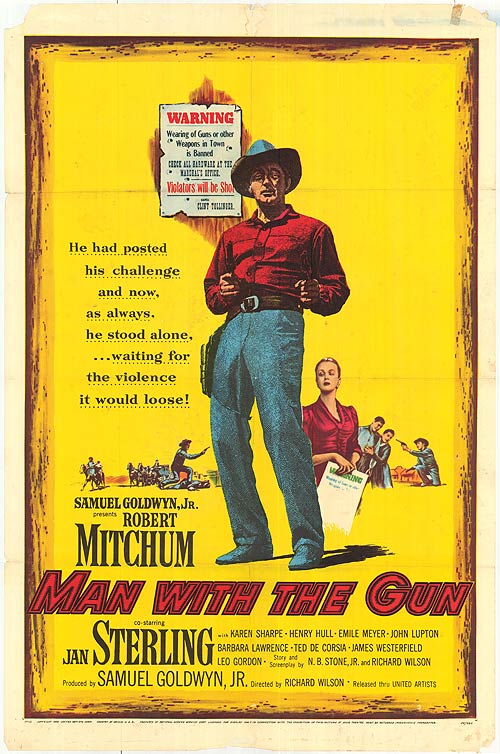
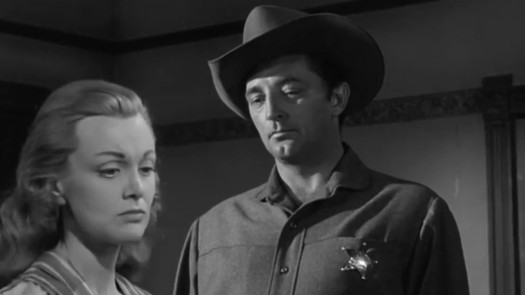
Rugged Robert Mitchum is pretty much the whole show in MAN WITH THE GUN, a film by first time director (and Orson Welles protege) Richard Wilson. It seems a strange choice at this juncture of Mitchum’s career. He was just coming off four big films in a row (RIVER OF NO RETURN, TRACK OF THE CAT, NOT AS A STRANGER, NIGHT OF THE HUNTER ), then makes a low budget Western that harkens back to his days making ‘B’ Zane Grey Westerns at RKO. But that was Mitchum; always the maverick who did things his way.
The film itself isn’t bad: Mitchum plays a notorious gunslinger, a “town tamer” hired by Sheridan City to clean things up from the clutches of boss ‘Dade Holman’ (who isn’t seen til the end, but whose influence is everywhere). There’s a subplot with his ex-wife Jan Sterling, now running the dance hall girls at…
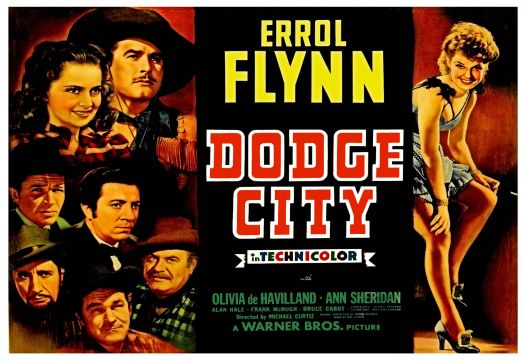
1939 has been proclaimed by many to be Hollywood’s Greatest Year. I could make a case for 1947, but I won’t go there… for the moment. Be that as it may, 1939 saw the release of some true classics that have stood the test of time, including in the Western genre: DESTRY RIDES AGAIN, JESSE JAMES, STAGECOACH , and UNION PACIFIC. One that doesn’t get a lot of attention anymore is DODGE CITY, the 5th screen pairing in four years of one of Hollywood’s greatest romantic duos, heroic Errol Flynn and beautiful Olivia de Havilland.
DODGE CITY was Warner Brothers’ biggest hit of 1939, and the 6th highest grossing picture that year, beating out classics like GOODBYE MR. CHIPS, GUNGA DIN, NINOTCHKA, and THE WIZARD OF OZ. It’s a rousing actioner with plenty of romance and humor thrown in, shot in Glorious Technicolor by Warners’ ace director Michael Curtiz …
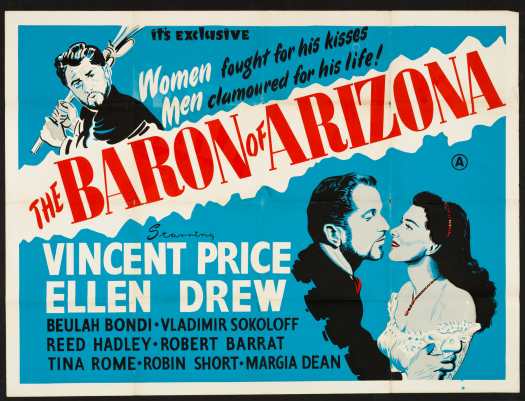
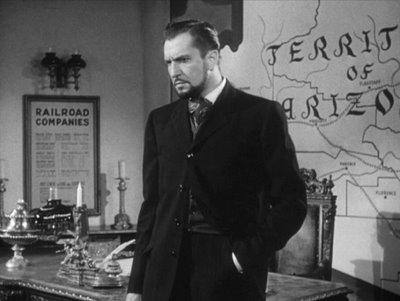
We all know and love Vincent Price for his creepy performances in horror films, from his demented Henry Jarrod in HOUSE OF WAX, to all those AIP/Roger Corman/Edgar Allan Poe shockers, to his turn as The Inventor in EDWARD SCISSORHANDS. But the actor was more than just a screen fiend, playing in many a filmnoir, comedies, costume swashbucklers, and even the Western genre. Our Man Vinnie got top billing in a strange little oater titled THE BARON OF ARIZONA, and as a bonus for film fans the director is a young tyro by the name of Samuel Fuller!
In this bloodless but gripping outing, Price plays James Addison Revis, a swindler, con man, and forger who concocts an elaborate, grandiose scheme to gain control over the Arizona Territory in 1882. He begins his con game ten years earlier by grooming an orphaned waif named Sofia to later be…
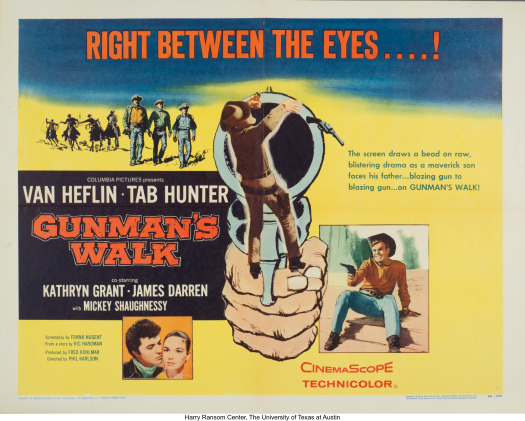
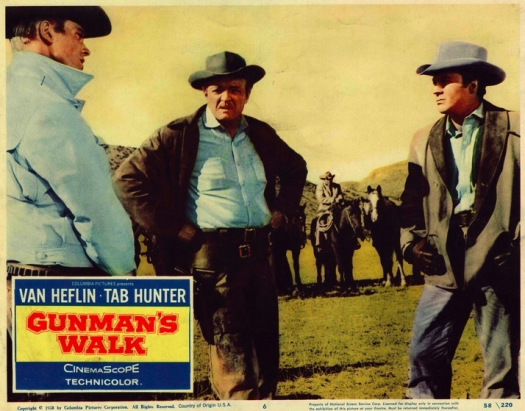
GUNMAN’S WALK may not be a classic Western like THE SEARCHERS or HIGH NOON, but it was entertaining enough to hold my interest. That’s due in large part to a change of pace performance by All-American 50’s Teen Idol Tab Hunter as a sort-of Rebel Without A Cause On The Range, an unlikable sociopath with daddy issues, aided and abetted by Phil Karlson’s taut direction and some gorgeous panoramic Cinemascope shots by DP Charles Lawton Jr.
Boisterous cattle rancher Lee Hackett (Van Heflin) is one of those Men-Who-Tamed-The-West types, a widower with two sons. Eldest Ed (Hunter) is a privileged, racist creep who’s obsessed with guns, while younger Davy (played by another 50’s Teen Idol, James Darren) is more reserved. The Hacketts are about to embark on a wild horse round-up, and enlist two half-breed Sioux, the brothers of pretty young Clee (Kathryn Grant, young wife of crooner Bing Crosby).
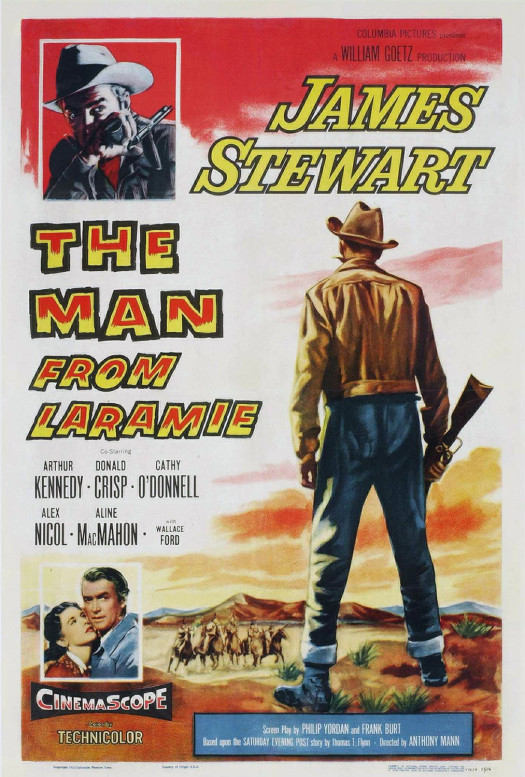
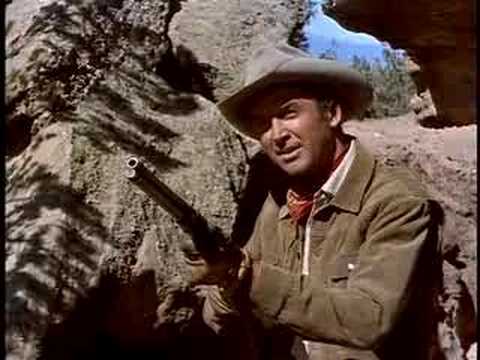
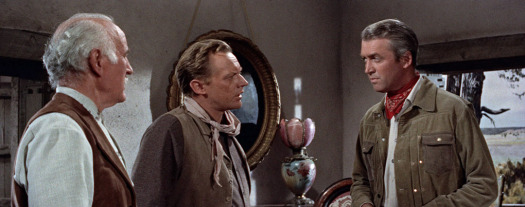
I’ve covered several of the Anthony Mann/James Stewart Western collaborations here. Their final sagebrush outing together THE MAN FROM LARAMIE was shot in Cinemascope and gorgeous Technicolor, features a bunch of solid character actors, has beautiful New Mexico scenery… yet felt like a letdown to me. Maybe it’s because Mann and Stewart set the bar so high in their previous Westerns, but THE MAN FROM LARAMIE is an anti-climactic climax to the director/star duo’s pairings.
Stewart’s good as always, playing bitter Will Lockhart, whose brother was killed by Apaches and whose mission is to find out who’s selling the guns to them. But the film came off flat, feeling like just another routine Western – good, but not in the same category as WINCHESTER ’73 or BEND OF THE RIVER. Those Mann film noir touches are nowhere to be found, replaced by (dare I say it!)… soap opera elements!
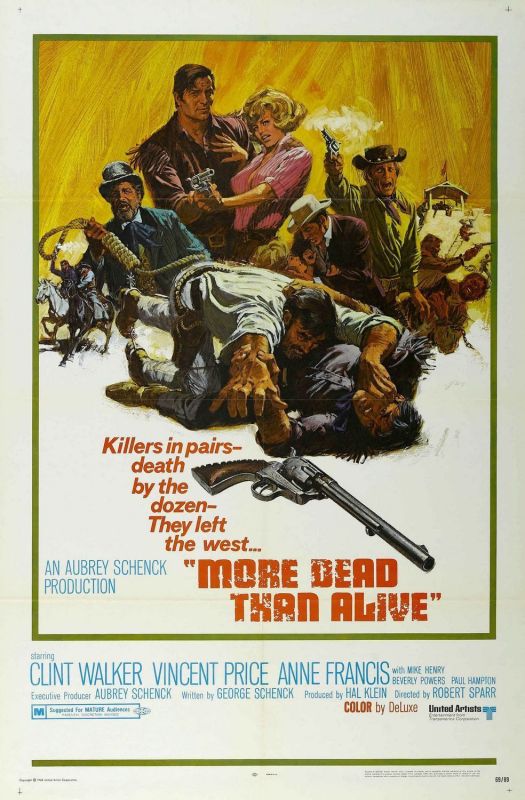
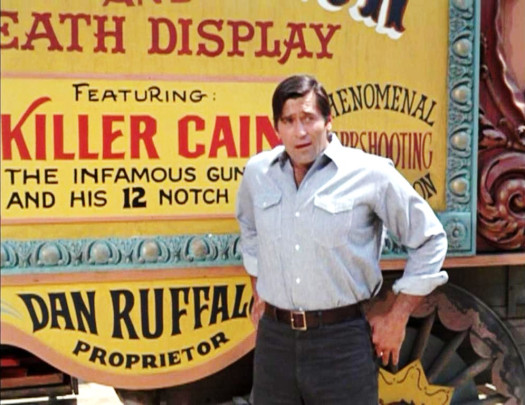
It’s hanging day at a remote Arizona prison outpost, and four men are scheduled to swing from the gallows. After they’re executed, the four pine boxes pop open, and outlaw Luke Santee and his gang commence firing, their six-guns blazing, as they try to free Luke’s baby brother. The escape attempt is an epic fail as ‘Killer’ Cain, a prisoner for 18 years now up for parole, stops the brother from leaving his cell and getting slaughtered, with Luke vowing revenge…
That opening scene, a violent, gory bloodbath, makes one think MORE DEAD THAN ALIVE is going to be a Sergio Leone-inspired American Spaghetti Western. It even stars a former TV Western hero named Clint – big Clint (CHEYENNE) Walker ! But the episodic nature of George Schenck’s script kills that idea, as the film doesn’t quite know what it wants to be. Spaghetti or Traditional Western? Character study, comedy…
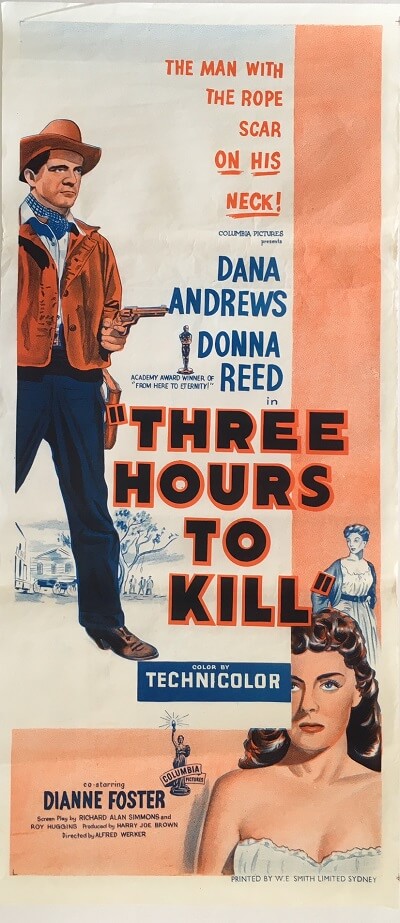
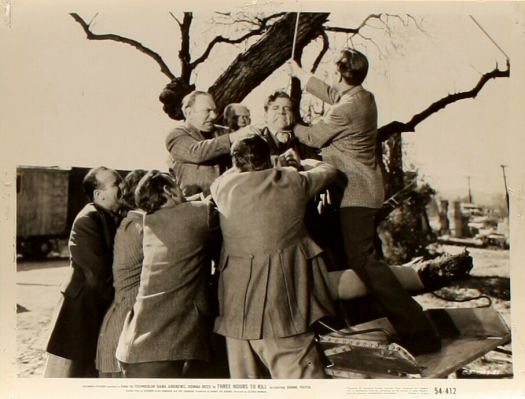
I don’t think you’ll find THREE HOURS TO KILL among anyone’s Top Ten Films list, or Top Ten Westerns, or even Top Ten Dana Andrews Movies. What you will find, if you give this movie a chance, is a solid, adult themed Technicolor Western with just a hint of film noir, made by Hollywood pros in front and behind the cameras. And you can’t ask for much more than that.
Jim Guthrie returns after a three year absence to the town that once tried to hang him. Jim relates the tale via flashback to old friend and current sheriff Ben East: a big night in town had everybody drinking and partying it up. Sexy hotel owner Chris Palmer comes on to Jim, but he only has eyes for pretty Laurie Mastin, bringing out the jealous side of banker Niles Hendricks. Laurie’s brother Carter disapproves of Jim, and a fight…

 Through the Shattered Lens