Do you ever wonder why and how the great artists of the past first decided to become artists in the first place? Have you ever thought about why, since before recorded history, humanity has always had the same desire to record and recreate their existence in the form of art? I know I do and that’s why I was excited to see the new 3-D documentary The Cave of Forgotten Dreams.
The Cave of Forgotten Dreams is probably the only chance that most of us will ever get to see the oldest, preserved art created by our ancestors. The Chauvet Cave in Southern France was first discovered in 1994 and it is believed to contain the oldest known cave paintings in existence. (Some of the paintings are estimated to have first been created 32,000 years ago.) The Chauvet Cave has been very carefully preserved by the French government and the interior of the cave has remained so fresh and undisturbed that ancient footprints can still be seen on the cave’s floor.
For this documentary, German director Werner Herzog was allowed to film in the cave but, as he shows us, he had to work under several restrictions to preserve the cave. He could only work with a three-man film crew, he had to stay on a 2-foot metal walkway the entire time, and, because of the high levels of carbon dioxide in the caves, no one was allowed to stay in the cave for more than a few hours at a time. Once you see the film, you realize that all the restrictions are worth it to preserve the cave.
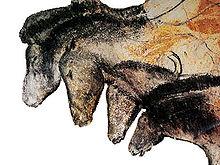
The paintings in the cave are so well-preserved that they seem as if they could have been painted just a year ago. While most prehistoric cave art sites have focused on paintings of animals that could be easily hunted — like horses and reindeer, the Chauvet Cave also features paintings of more dangerous animals, like lions, bears, and especially rhinos. What really struck me was how these paintings were created with a clear aesthetic purpose. Several of the animals are painted in such a way that creates the illusion of movement. The most famous of the Chauvet Cave paintings appears to feature a stampede of horses.
As Herzog makes clear in his narration, the perfectly preserved cave paintings show that “cave men” weren’t the simpletons we always assume they were. Instead, the paintings reveal that they were observant and actually had personality. One of my favorite parts of the movie was when Herzog and a paleontologist look at one wall that is covered with ancient hand prints. The paleontologist points out that we can tell one person made all the handprints because the hand has a crooked little finger. That hand print is also found throughout the entire cave and allows us, 32,000 years later, to follow the man with the crooked finger as he walks through the cave.
Because of the restrictions he had to film under, Herzog had to have his 3-D cameras custom-built and he and his 3-man crew had to put the cameras together inside of the cave. It was all worth the trouble because the 3-D effects truly make you feel as if you’re standing there in the cave with Herzog. Unfortunately, we probably won’t ever be able to see the world’s oldest paintings in person but The Cave of Forgotten Dreams is the next best thing.
Before I talk about this trailer, allow me to share a few facts: my family used to live in Fouke, Arkansas! I’ve been down to Boggy Creek! I never saw the famous Fouke Monster but I went out looking for him a few times! Anyway, this is the trailer for The Legend of Boggy Creek, which is a documentary about an apeman that supposedly lives in the area (though, according to Wikipedia, he hasn’t been spotted since ’98 so maybe he drowned or moved to Missouri). This film is somewhat infamous because it features reenactments of various monster sightings, some of which star people who actually lived in Fouke at the time and who play themselves (and a few of them later sued once the film came out). It was also the first film directed by Charles B. Pierce, who directed a lot of independent films in Arkansas and North Texas, including the classic The Town That Dreaded Sundown. Sadly, Pierce passed away last year at the age of 71.
This is one of those trailers that I discovered while randomly searching Youtube and, I have to be honest, my first thought was that it was a parody trailer. But no, after researching the manner, I can say that Mean Mother is a real movie. It was apparently yet another one of the cinematic offerings of the late Al Adamson.
This Italian film is one of the countless Omen/Exorcist rip-offs that came out in the 70s. Actually, The Night Child is an indirect rip-off of those two films as it’s actually a rip-off of a previous Italian version of the Exorcist, Beyond The Door. What I especially love about this trailer is the “Keeping telling yourself, she’s only a child,” line which is obviously meant to recall the “Keep telling yourself, it’s only a movie…” tagline from Last House On The Left.
“Meet today’s women…beautiful, liberated, and ready for action! They’re the young nurses and they’re growing up fast!” I love the narrator of this trailer. I’ve heard his voice in several exploitation trailers from the early 70s and he just has a way of delivering the sleaziest lines in the most cheerful, harmless way. I’d love to know who he was and if he’s still with us.
Oh. My. God. Okay, I saw this movie a few years ago and I was watching it by myself at 3 in the morning with all the lights off while there was a thunderstorm going on outside and there was this howling wind that kept on making all the windows shake. I got so scared, it’s not even funny. This is a remake of the silent classic. It stars Klaus Kinski, Bruno Ganz, and Isabelle Adjani and was directed by the one and only Werner Herzog.
“Why don’t you come along and see me this week? And bring your girlfriend…” This trailer was specifically designed to promote this film in Australia. Needless to say, that’s not actually Sylvia Kristel providing the voice over.
One of the films to be announced after the success of James Cameron’s Avatar that would also make use of 3D cameras came from an individual who many wouldn’t consider as a proponent of 3D filmmaking. Even during and after the production of this documentary film this filmmaker still is not a total convert to the process. What he did do is use the most advanced filmmaking technique to capture on film exactly what he wanted and 3D filmmaking was the only to give his vision justice.
The filmmaker I’m talking about is the great German director Werner Herzog. The film in question is his documentary about the cave paintings in the Chauvet Cave, Cave of Forgotten Dreams.
In an unprecedented move the French government allowed Herzog to film this documentary in the Chauvet Cave but with some heavy restrictions on what sort of equipment he and his crew could use. They were also limited in where they could stand to film scenes within the cave. Despite these restrictions what scenes people saw during a showing at the 2010 Toronto International Film Festival gave enough people an impression of Herzog’s vision.
The documentary will be released by IFC films this Spring of 2011 with the History Channel getting the rights to show it on TV. This is one of the films of 2011 of which I am very interested in seeing and the fact that it’s Herzog working in 3D is something that needs to be experienced on the big-screen.
Werner Herzog’s Bad Lieutenant: Port of Call New Orleans was one of the best films of 2009. There. I said it. And I know that there’s a lot of people out there who would disagree with me on this. They would say that, at best, this film was memorable because of Nicolas Cage’s manic performance and nothing else. Well, you know what?
Those people are wrong. End of story.
Here’s one of my favorite scenes from Bad Lieutenant, one that features everything that makes this film one of the unacknowledged masterpieces of the 21st Century: Nicolas Cage going crazy, senseless violence, dancing souls, and an iguana.
How do I explain my fascination with Klaus Kinski, an actor who died long before I even saw my first movie? Certainly, it’s not due to his charming screen presence. Kinski never made any secret of the fact that he loathed most of his films and that loathing is usually painfully apparent on-screen. Nor can my fascination be linked to the quality of the films he made. With the exception of a few Italian spaghetti westerns and a set of films he made with Werner Herzog, the majority of Kinski’s films are of little interest beyond his performance in them. Kinski’s film career was largely made up of playing countless murderers, rapists, and psychopaths. By most (but certainly not all) accounts, he committed even worse behavior offscreen.
Yet somehow, Klaus Kinski has captured not only my imagination but the imagination of film buffs around the world. A very good friend of mine has confessed to me that she finds watching Kinski in a bad film to be an almost erotic experience and I have to admit that I do as well. Kinski had one of those faces that was so ugly that it was almost beautiful and, watching him onscreen, it’s hard not to feel as if the you are literally watching cinematic exorcism. It’s as if the fictional characters that Kinski creates are little more than his real-life demons being captured on-screen. A lot of actors specialize in playing insane but Kinski seemed to actually be insane. Even today, watching his performance in Augirre, The Wrath of God on DVD, it’s hard not to feel as if Kinski is going to jump out of the TV at any minute and proceed to destroy your living room while screaming insults in German. Even nearly 20 years after his death, Klaus Kinski remains mad, bad, and dangerous to know.
I have to admit, I’ve always had a weakness for the whole fantasy of the bad boy with the wounded poet’s soul and, even middle-aged and ugly, Klaus Kinski was the ultimate bad boy. Whether or not Kinski had the soul of a poet is another question and a difficult one to answer. However, if you’re going to solve to riddle of who Klaus Kinski really was, that’s the question that must be answered. And probably the best place to start your investigation is with Werner Herzog’s 1999 documentary/tribute, My Best Fiend.
Herzog directed Kinski in five films, beginning with the classic Aguirre, the Wrath of Godin 1972 and ending with the unfortunate Cobra Verdein 1987. The spirit of their collaboration can be seen in the fact that Herzog was rumored to have directed Kinski at gunpoint in Aguirre (though Herzog denies this) and that Kinski eventually physically assaulted Herzog during the filming of Cobra Verde. In both the contemporary press and his own controversial autobiography (entitled Kinski: All I Need Is Love) Kinski regularly declared Herzog to be “an idiot.” Herzog, for his part, regularly declared that he would never make another movie with Kinski just before signing him to another role. Despite all this however, Kinski’s best performances were given in his movies with Herzog and no other actor has ever proven to be as perfectly suited to translate Herzog’s worldview as Klaus Kinski (though Nicolas Cage came close in last year’s Bad Lieutenant). My Best Fiend is Herzog’s attempt to understand his late muse.
The film opens with a classic Kinski image. We see a young, long-haired Kinski, standing on stage. He’s in the middle of one of his infamous one-man shows and has decided that the audience is not paying proper attention to him. He responds to this by literally attacking the audience.
We soon learn that shortly after this footage was filmed, Kinski agreed to star in Aguirre, the Wrath of God. Over archival footage of Kinski scowling and screaming in the Amazon, Herzog talks about both working with Kinski as an actor and about filming Aguirre in general. (Even if you’re not interested in the twisted life of Klaus Kinski, My Best Fiend is fascinating as a behind-the-scenes look at filmmaking.) Herzog talks about how Kinski regularly threatened to leave the production and how he responded by threatening to murder Kinski if he did. Members of the film crew are interviewed. They create a portrait of a monstrous man who, at one point during filming, shot off a cameraman’s thumb for no discernible reason. And yet, as all of this is presented to us, Herzog also shows us clips of Kinski’s amazing performance in the movie. Much like Herzog, we are forced to wonder how such a loathsome human being could also be such a gifted (and, in his admittedly warped way, sensitive) artist.
Though most of the film is devoted to Aguirre, Herzog does offer up anecdotes about his other collaborations with Kinski. He tells how Kinski would regularly threaten to have him killed and he admits to often fantasizing about killing Klaus Kinski himself. He goes as far as to mention that, during several film shoots, members of the crew would frequently (and seriously) offer to kill Kinski for him. He also tells of the hurt of continually reading the latest Kinski interview in which Kinski would, without fail, refer to his director as being an untalented hack.
And yet, the portrait of Klaus Kinski that emerges here is not exactly negative. Even as Herzog tells us that he often wanted to murder Kinski, he finds the time to visit the apartment where an undiscovered, penniless Kinski once lived. He talks to people who knew Kinski when he was younger and they offer up stories of a young man who, while undeniably arrogant, was also refreshingly honest in his refusal to compromise his own unique vision of the world. Herzog interviews two of Kinski’s costars, Eva Mattes and Claudia Cardinale. Both Mattes and Cardinale describe Kinski as being gentle, calm, and supportive while dealing with them. Mattes is especially touching as the amount of affection she felt for this supposed madman is obvious in every word she says. Kinski, himself, is seen assuring Herzog that all the insults and extreme negativity in All I Need Is Love is simply a ruse to convince people to buy the book. In short, Kinski is simply giving the people what they want.
As much as I loved My Best Friend, there were still some things that I wish the movie had spent more time on. Beyond a few tantalizing hints, we learn little of Kinski’s life before he first met Herzog (though we do learn that Kinski had spent time in a mental hospital where he was diagnosed as being schizophrenic) and even less time is spent on the hundreds of films that Kinski made without Herzog. While this makes sense as the film is about Herzog’s relationship with Kinski, it also creates the impression that Kinski was an unknown before Herzog cast him. This simply is not true as Kinski was already had something of a cult following as the result of appearing in several Italian spaghetti westerns. As well, Herzog doesn’t go into near enough detail about the Cobra Verde shoot that eventually led to the end of his collaboration with Kinski. Perhaps its understandable that Herzog would prefer to concentrate on obvious triumphs like Aguirre and Nosferatu but it’s still hard not to feel that he’s allowing his own ego to get in the way of telling the full story of his relationship with Klaus Kinski.
However, any and all flaws are rendered moot by the film’s final scenes. We first see Kinski, during the shooting of Fitzcarraldo, angrily screaming and shouting at a crew member. This is Kinski at his worst (though Herzog insists this is actually a rather mild example of Kinski’s anger), a raving madman who seems to intent of inspiring his audience to rise up and destroy him.
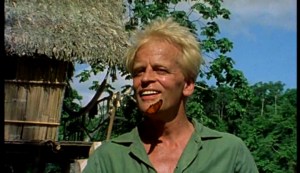
This is followed by a scene in that same Peruvian jungle where Kinski, smiling almost beatifically, gently plays with a butterfly.
After seeing that scene, it leaves me convinced (as it did Herzog) that there truly was the soul of poet lurking underneath the monstrous facade of Klaus Kinski.
While some have called 2009 as not being so great in terms of quality films, there have been others who think the year was a very good year for films from start to finish. Not all the best films of 2009 came out during the so-called “awards season” from October thru December. Some of the worst films, in my opinion, were released very late in the year and clearly done so to try and force its way into award contention. While the year of 2009 saw some very good films come out early in the year and, to my surprise, even during the popcorn and brainless season of the summer blockbusters.
My list consists of the 10 films I saw in 2009 which I believe to be the best of all them. Some people will probably agree with me on and some won’t. Some of my picks may have been little seen outside of independent arthouse theaters or film festivals but it doesn’t diminish just how much I think it deserves inclusion in a “best of” list. In the end, I thought these films doesn’t just celebrate what’s great about films but also celebrating those filmmakers who show that when given room to breathe and do things their way magic can still happen.
10. Bad Lieutenant: Port of Call – New Orleans (dir. Werner Herzog)
 Through the Shattered Lens