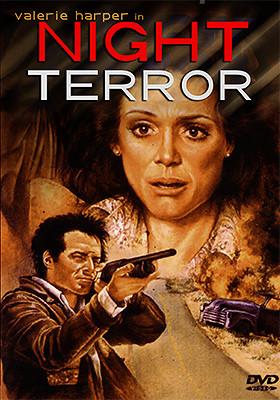
Today’s horror on the lens is a surprisingly violent and grim made-for-TV movie from 1977, Night Terror!
In Night Terror, Valerie Harper plays a woman trying to drive to Denver, overnight. Unfortunately, she catches the attention of The Killer (played by Richard Romanus), a mute psychopath who spends his time driving up and down the highway, killing random people. This is a pretty well-done and suspenseful made-for-television movie, featuring good performances from both Harper and Romanus. I wrote a more in-depth review of the film back in May so give it a read after you watch the movie.
(Or before you watch the movie. I’m not going to tell you how to do things.)
So sang Jim Morrison in the song Riders on the Storm. Now, whatever you may think of Jim Morrison and the Doors (personally, I think the music was good, Jim was pretentious as Hell, and I look cute in my Doors t-shirt), this is a perfect description of the character who is at the center of the 1977 film, Night Terror. He’s played by Richard Romanus and, in the credits, he’s simply called The Killer. The Killer spends his times driving up and down the highway, killing people seemingly at random. We never learn why exactly the Killer does what he does, though the film does offer up a few hints. For one thing, he has no voice. He carries an electrolarynx with him and holds it up to his throat whenever he wants to speak. Of course, he only does this two times in the film and, both times, it’s to basically howl with rage. In another scene, he can clearly be seen to be wearing military-style dog tags. Given when this film was made and the unfortunate popularity of the “deranged Vietnam vet” trope in the 70s and 80s, it’s easy to pick up on what exactly the film is implying.
Night Terror follows one night in the life of both The Killer and Carol Turner (Valerie Harper). Carol is just trying to get to Denver, where her son is in the hospital. When she sees a police officer pulling over a sports car for speeding, Carol decides to ask the cop for directions. Unfortunately, the sports car belong to The Killer and, as soon as the cop turns his back on him, out comes the shotgun. Carol slams down on the accelerator and speeds off, with the Killer pursuing her in own his vehicle. Unfortunately, Carol’s station wagon (which comes with wood paneling because, again, this is a movie from 1977) is nearly out of gas. What follows is a fairly tense game of cat-and-mouse, as Carol tries to hide from the Killer while the Killer stalks the highway, relentlessly searching for her. Along the way, a few familiar character actors pop up. John Quade is a homeless man living in a gas station. The great Nicholas Pryor is another motorist, one who proves to be not much help. Making things all the more dangerous for Carol is that the Killer knows what she looks like but she has no idea what the Killer looks like.
Night Terror owes an obvious debt to Steven Spielberg’s Duel and a host of other 70s car chase films. While Night Terror really can’t compare to the Duel, it does do a good job of creating and maintaining suspense. Fortunately, the film never makes the mistake of tying to turn Carol into some sort of badass action girl. She’s just an average person who has found herself in a terrifying situation and, as played by Valerie Harper, she’s never less than relatable. Richard Romanus, meanwhile, makes for a terrifying killer. The fact that he occasionally flashes a rather child-like smile only serves to make his single-minded pursuit of Carol all the more frightening. We never learn much about what’s led The Killer to becoming what he is but Romanus gives such an intense performance that we don’t need to understand him in order to be scared of him. He’s a nightmare come to life.
Night Terror ends on a somewhat awkward note, as if the filmmakers suddenly remembered that they were making a made-for-TV movie as opposed to a feature film. But, that said, Night Terror is an effectively scary and suspenseful road film. It can currently be viewed on YouTube.
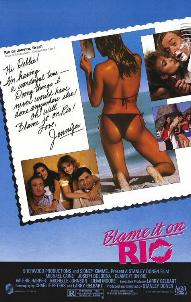
When I was growing up in Baltimore, I used to go down to this independent video story every weekend and check out movies. Every time that I stepped into the store, the first thing I saw was the poster for Blame It On Rio hanging over the front register. The store did not actually have any copies of Blame It On Rio in stock and I don’t think anyone working there had ever seen it but it only takes one look at the poster to guess what they were thinking when they hung it at the front of the store.
Blame It On Rio is one of the films that Michael Caine made during that period when he was willing to accept any paycheck. (The Jaws 4 years.) Caine plays Matthew, who goes on a vacation to Rio with his 17 year-old daughter, Nikki (Demi Moore), his best friend Victor (Joseph Bologna), and Victor’s daughter, Jennifer (Michelle Johnson). Both Matthew and Victor’s marriages are falling apart and Victor encourages Matthew to hit on every topless woman they see. Instead, Matthew ends up fooling around with Jennifer. When Victor discovers that his daughter to having an affair with an older, married man, he recruits Matthew to help him discover the man’s identity. In between the scenes of all the action in Brazil, Matthew and Jennifer appear in interview segments that do no add up to much.
It may be hard to believe but this forgettable movie was co-written by Larry Gelbart and directed by the same director responsible for Singin’ In The Rain, Charade, and Two For The Road, Stanley Donen. For a film about a 43 year-old man having a sexual relationship with a 17 year-old, Blame It On Rio is a hopelessly square movie. Caine and Bologna walking along a topless beach and accidentally leering at their own daughters is about as funny as things get. Michael Caine’s a trooper and does the best that he can but Michelle Johnson is bland as Jennifer. She and Demi Moore should have switched roles.
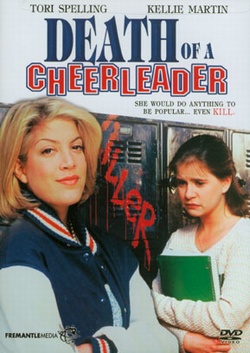
Over the past couple of year, I’ve had so much fun making fun of Tori Spelling’s performance in the original Mother, May I Sleep With Danger? that I almost feel like I have an obligation to review a movie in which she gave a halfway decent performance.
That film would be another 1994 made-for-TV-movie. It was apparently originally broadcast as A Friend To Die For but most of us know it better as Death of a Cheerleader. That’s the title that’s used whenever it shows up on Lifetime. There actually was a time when Death of a Cheerleader used to show up on almost a monthly basis but that was a while ago. Lifetime has since moved on to other movies about dead cheerleaders.
Technically, as my sister immediately pointed out when I made her watch the movie, the title isn’t quite correct. Though Stacy Lockwood (Tori Spelling) does try out for and is named to her school’s cheerleading squad, she never actually gets to cheer. Instead, shortly after the school assembly in which her selection is announced, Stacy is found stabbed to death. But really, Death of A Future Cheerleader doesn’t quite have the same ring to it.
As for who killed Stacy … well, it’s no secret. This is one of those true crime films where the murderer is not only portrayed sympathetically but is the main character as well. Angela Delvecchio (Kellie Martin) was a high school sophomore who was obsessed with trying to become popular. She looked up to Stacey and desperately wanted to be her best friend. (Why she didn’t just offer to bribe Stacey, I don’t know. Maybe she hadn’t seen Can’t Buy Me Love….) When Stacey got a job working in the school office, so did Angela. Of course, the school’s somewhat sleazy principal (Terry O’Quinn, coming across like John Locke’s worst nightmare) only made it a point to talk to Stacey and pretty much ignored Angela. When Stacey applied to work on the yearbook, so did Angela. When Stacey tried out for cheerleading, so did Angela.
In fact, the only time that Angela stood up to Stacey was when Angela was taunting the school’s token goth (played by Kathryn Morris). That turned out to be a mistake because Stacey never forgave her. When Angela invited Stacey to a party, Stacey was reluctant to go. When Stacey did finally accept the invitation, Angela stabbed her to death.
A Friend to Die For/Death of a Cheerleader is based on a true story and the film tries to lay the blame for Angela’s crime on the affluent neighborhood she was raised in. Just in case we missed the message, the film actually features a Priest (played by Eugene Roche) who says that the community put too much pressure on Angela to succeed.
Uhmmm….okay, if you say so.
Seriously, this is a pretty good little true crime film and both Tori Spelling and Kellie Martin give really good performances but this whole “It’s society’s fault” argument is typical, mushy, made-for-TV, bourgeois liberal BS. Angela picked up the knife, Angela committed the crime, end of story. That said, A Friend To Die For is pretty good as far as these movies go. I already mentioned the performances of Spelling and Martin but also keep an eye out for Marley Shelton, who gets a really good scene in which she explains that she never liked Stacey that much while she was alive.
You can watch A Friend To Die For/Death of a Cheerleader below!
For today’s horror on the lens, we present Don’t Go To Sleep!
In this TV movie from 1982, a little girl is killed in a horrific car crash. Her family blames themselves for her death and they really should. The father (Dennis Weaver) was drunk. The mother (Valerie Harper) didn’t keep her drunk husband from driving. Finally, the girl’s brother (Oliver Robins) and sister (Robin Ignico) were playing a prank on her when the car crashed. By tying her shoe laces together, they made it impossible for her to get out of the car.
However, they’re not the only ones who blame themselves. The dead girl blames them as well. When the family moves out to the country and attempts to heal, the girl’s ghost goes with them. And soon, she is encouraging her sister to kill the other members of the family.
And that’s just what happens.
Seriously, this movie took me by surprise. For a movie that made for network television in 1982, it’s a surprisingly dark film that doesn’t shy away from graphically killing off most of the cast. It’s a surprisingly effective little film and you can watch it below!
(Thank you to my wonderful cousin, Toni Posados, for recommending this film!)