Chance Buckman (John Wayne) is the best there is when it comes to fighting oil fires. Along with Greg Parker (Jim Hutton), Joe Horn (Bruce Cabot), and George Harris (Edward Faulkner), Chance travels the world and puts out fires that the regular authorities can’t handle. Chance loves his job but he also loves his ex-wife, Madelyn (Vera Miles). When Madelyn indicates that she wants to remarry Chance but only if he pursues a less dangerous line of work, Chance retires from firefighting and becomes an oil executive. He leaves his firefighting company to his new son-in-law, Greg. When Greg and Chance’s daughter (Katharine Ross) head down to Venezuela to battle a fire and find themselves not only having to deal with the flames but also with a band of revolutionaries, Chance is the only one who can help them.
When I was growing up, Hellfighters was one of those movies that seemed to turn up on the local stations a lot. The commercials always emphasized the idea of John Wayne almost single-handedly fighting fires and made it seem as if the entire movie was just the Duke staring into the flames with that, “Don’t even try it, you SOB” look on his face. As a result, the sight of John Wayne surrounded by a wall of fire is one of the defining images of my childhood, even though I didn’t actually watch all the way through until recently. When I did watch it, I discovered that Hellfighters was actually a domestic drama, with an aging Wayne passing the torch to youngster Jim Hutton but then taking it back.
The fire scenes are the best part of Hellfighters and I wish there had been more of them. The movie gets bogged down with all of Chance’s family dramas but it comes alive again as soon as John Wayne and his crew are in the middle of a raging inferno, putting their lives at risk to try to tame the fire. Wayne was always at his best when he was playing strong, no-nonsense men who were the best at what they did. Hellfighters is slow in spots but the fire scenes hold up well. There’s no one I’d rather follow into an inferno than Chance Buckman.
Though the Academy of Motion Picture Arts and Sciences claim that the Oscars honor the best of the year, we all know that there are always worthy films and performances that end up getting overlooked. Sometimes, it’s because the competition too fierce. Sometimes, it’s because the film itself was too controversial. Often, it’s just a case of a film’s quality not being fully recognized until years after its initial released. This series of reviews takes a look at the films and performances that should have been nominated but were, for whatever reason, overlooked. These are the Unnominated.
I come here to defend Charlton Heston.
1994’s Ed Wood is a great film that has one unfortunate line. Towards the end of the film, director Ed Wood (Johnny Depp) meets his hero, Orson Welles (Vincent D’Onoforio), in a bar. They talk about the difficulties of directing a film. Wood talks about the trouble that he’s having with Plan 9 From Outer Space. Welles says that he can understand what Wood is going through because the studio is forcing him to cast Charlton Heston as a Mexican in his next movie.
And look, I get it. It is true that Charlton Heston does play a Mexican prosecutor named Mike Vargas in Welles’s 1958 film, Touch of Evil. And it is true that Heston is not the most convincing Mexican to ever appear in a film. And I understand that there are people who enjoy taking cheap shots at Charlton Heston because he did have a tendency to come across as being a bit full of himself and he was a conservative in a industry dominated by Leftists. There are people who actually think Michael Moore doesn’t come across like a self-righteous prick when he confronts Heaton in Bowling for Columbine. I get the joke.
But it’s not true and it’s not fair. When Touch of Evil was first put into production by Universal, Welles was not hired to direct. He was hired to play Hank Quinlan, the formerly honest cop with a habit of planting evidence on those who he believed to be guilty. When Charlton Heston was offered the role of Vargas, he asked who had been hired to direct. When he was told that a director hadn’t been selected, Heston was the one who suggested Welles be given the job. When, as often happened with Welles’s film, the studio decided to take the film out of Welles’s hands, Heston argued for Welles’s vision while Welles was off trying to set up his long-dreamed of film of Don Quixote. Say what you will about Charlton Heston’s career, he fought for Orson Welles, just as he later fought for Sam Peckinpah during the making of Major Dundee. Heston may not have agreed with either Welles or Peckinpah politically but he fought for them when few people were willing to do so.
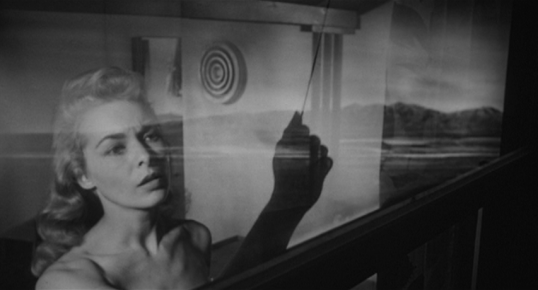
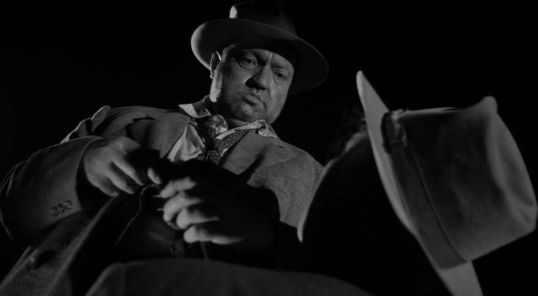
That Touch of Evil is a brilliant film is pretty much entirely due to Welles’s directorial vision. The story is pure pulp. While investigating the murder of an American businessman in Mexico, Vargas comes to believe that Quinlan is attempting to frame a young Mexican for the crime. While Vargas watches Quinlan, his wife Susie (Janet Leigh) is menaced by the crime lord Joe Grandi (Akim Tamiroff), who has his own issues with both Vargas and Quinlan. The plot may be the stuff of a B-programmer but, as directed by Welles, Touch of Evil plays out like a surreal nightmare, a journey into the heart of darkness that is full of eccentric characters, shadowy images, memorably askew camera angles, and lively dialogue. Welles and cinematographer Russell Metty create a world that feels alien despite being familiar. Just as he did with Gregg Toland in CitizenKane, Welles shapes a film that shows us what’s happening in the shadows that most people try to ignore.
There’s really not a boring character to be found in Touch of Evil and the cast is full of old colleagues and friends of Welles. Marlene Dietrich shows up as Quinlan’s former lover. Mercedes McCambridge plays a leather-clad gang leader. Dennis Weaver is the creepy owner of a remote motel. (Two years before Psycho, Touch of Evil featured Janet Leigh being menaced in a motel. Mort Mills, who played Psycho’s frightening highway patrolman, plays a member of law enforcement here as well.) Zsa Zsa Gabor shows up for a few brief seconds and it makes a strange sort of sense. Why shouldn’t she be here? Everyone else is. Joseph Cotten plays a coroner. Ray Collins plays a local official. In the film’s skewered world, Charlton Heston as Mike Vargas works. His upright performance grounds this film and keeps it from getting buried in its own idiosyncrasies. Big personalites are everywhere and yet the film is stolen by Joseph Calleia, playing Quinlan’s quiet but observant partner. Calleia’s performance is the heart of the film.
TouchofEvil was not nominated for a single Oscar and that’s not surprising. It’s not really the type of film that was noticed by the Academy in the 50s. It was too pulpy and surreal and, with its story of a crooked cop framing someone who might very well be guilty anyway, it was probably too subversive for the Academy of the 1950s. It would take a while for TouchofEvil to be recognized for being the noir masterpiece that it is. In a perfect world, Welles would have been nominated for directing and for his larger-than-life performance as Quinlan. Joseph Calleia would have been nominated for Supporting Actor and perhaps both Janet Leigh and Marlene Dietrtich would have been mentioned for Supporting Actress. That didn’t happen but it would have been nice if it had.
Some people love money so much that they make their own.
In 1985’s To Live And Die In L.A., Williem DaFoe is magnetically evil as Rick Masters, a genius at counterfeiting who has gotten rich by selling other people fake money. The film features a lengthy sequence showing how Masters makes his money and the viewer really is left feeling as if they’ve just watched an artist at work. Masters has a talent and he’s a professional. He’s good at what he does. Unfortunately, he’s also a sociopath who is willing to kill just about anyone who he comes across. There have been a lot of movies made about sympathetic counterfeiters. They’re often portrayed as being quirky and rather likable individuals. This is not one of those films. DaFoe’s charisma makes it impossible to look away from Rick but he’s still not someone you would ever want to have to deal with for a prolonged period of time. One gets the feeling that Rick eventually kills everyone that he does business with.
Secret Service agents Richard Chance (William Petersen) and John Vukovich (John Pankow) are investigating Masters. They’re a classic crime movie partnership. Vukovich is youngish and, when we first meet him, goes by-the-book. Chance is a veteran member of the Secret Service, an impulsive loose cannon whose last partner was killed by Masters. Chance is now obsessed with taking Masters down and he’s willing to do whatever it takes. If that means threatening his lover and informant, the recently paroled Ruth (Darlanne Fluegel), so be it. If that means defying the lawyers (represented by Dean Stockwell), so be it. If that means committing crimes himself and nearly getting Vukovich killed in the process, so be it. At first, Vukovich is horrified by Chance’s techniques but, as the film progresses, Vukovich comes to embrace Chance’s philosophy of doing whatever it takes.
What sets To Live and Die in L.A. apart from some other films is that, even as it concludes, it leaves us uncertain as to whether or not Chance and Vukovich’s actions were really worth it. This is not a standard cops-vs-robbers film. This is a William Friedkin film and he brings the same moral ambiguity that distinguished The French Connection to this film’s portrait of the Secret Service. (When Chance isn’t chasing after a counterfeiter, he’s foiling an assassination attempt against the president.)
Like The French Connection, To Live and Die In L.A. features an pulse-pounding car chase, one that occurs as Chance and Vukovich make an escape from robbing a man who they believe to be a criminal. (The man turns out to have been an FBI agent.) This chase involves Chance and Vukovich driving the wrong way down a crowded freeway, desperately tying not to crash into any of the cars that are swerving out of the way. It’s such an exciting scene that it’s easy to forget that Chance and Vukovich are actually escaping from committing a crime. In The French Connection, Gene Hackman was chasing the man who tried to assassinate him. In To Love and Die In L.A., Chance is fleeing the consequences of his own actions.
To Live and Die In L.A. holds up well. DaFoe and Petersen both give charismatic performance but, for me, it really is John Pankow who carries the film. Vukovich’s transformation from being a straight-laced member of law enforcement to being a doppelganger of his partner is both exciting and a little disturbing, To Live and Die In L.A. is a crime film that leaves you wondering how far one can go battling the bad guys before becoming one of them.
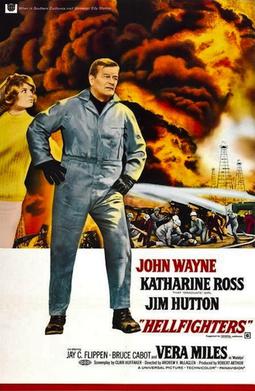 Chance Buckman (John Wayne) is the best there is when it comes to fighting oil fires. Along with Greg Parker (Jim Hutton), Joe Horn (Bruce Cabot), and George Harris (Edward Faulkner), Chance travels the world and puts out fires that the regular authorities can’t handle. Chance loves his job but he also loves his ex-wife, Madelyn (Vera Miles). When Madelyn indicates that she wants to remarry Chance but only if he pursues a less dangerous line of work, Chance retires from firefighting and becomes an oil executive. He leaves his firefighting company to his new son-in-law, Greg. When Greg and Chance’s daughter (Katharine Ross) head down to Venezuela to battle a fire and find themselves not only having to deal with the flames but also with a band of revolutionaries, Chance is the only one who can help them.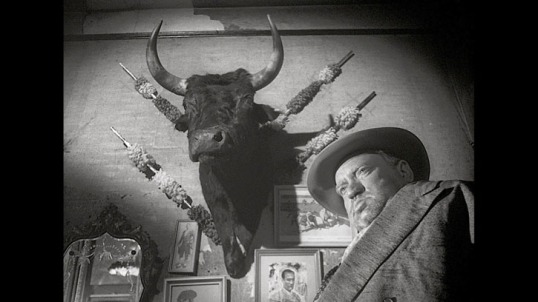
 Through the Shattered Lens