Horror Film Review: The Mummy’s Curse (dir by Leslie Goodwins)


When last we checked in with Kharis the Mummy, he was running into a swamp in Massachusetts, carrying the reincarnation of Princess Ananka with him.  Chasing after him were the standard towns people with torches and guns.  It’s not a Universal horror film without angry villagers, even if the movie itself is taking place in Mapleton, Massachusetts.

Upon entering the swamp, both Kharis and Ananka sunk under the water, traumatizing Ananka’s boyfriend but apparently bringing Kharis’s reign of terror to an end.

Well, not so fast!

The 1944 film, The Mummy’s Curse, opens with the townspeople talking about how Kharis continues to haunt the old swamp, so much so that most of the locals refuse to work in the swamp.  Oddly enough, though, the townspeople are suddenly a mix of Cajuns and gypsies.  (The film even opens with a gypsy woman singing a song in a bar.)  The swamp has now become a bayou.  We are repeatedly told that the film is taking place in the same location as the previous Mummy films but suddenly, that location has changed from Massachusetts to Louisiana.

As for the plot of The Mummy’s Curse, it all centers around the swamp.  The Southern Engineering Company (and that really doesn’t sound like a Massachusetts company) is draining the swamp.  The locals are worried that draining the swamp will bring back the curse of the mummy.  Two representatives from the Scripps Museum show up and announce that they want to search the drained swamp for the remains of the mummies.  Dr. James Halsey (Dennis Moore) is typical of the archeologists who tend to show up in these Mummy films.  Meanwhile, his associate is Dr. Ilzor Zandeeb (Peter Coe) who — surprise! — is that latest Egyptian high priest to come to America to try to recover the bodies of Kharis and Princess Ananka.

Ananka (Virginia Christie) is the first to emerge from the swamp, though she has no memory of who she is.  When she is discovered on the side of the road by Prof. Halsey and his love interest, Betty (Kay Harding), they allow her to stay at their camp on the edge of the swamp.  Everyone is really impressed by the fact that this amnesiac knows so much about ancient Egypt.  Eventually, Kharis (Lon Chaney, Jr., again tightly wrapped in bandages) eventually emerges from the swamp as well, determined to protect Ananka.

The Mummy’s Curse was the final film to feature Lon Chaney, Jr. as Kharis.  Unfortunately, it’s pretty forgettable and certainly not a satisfying conclusion to the story of one of Universal’s original monsters.  A good deal of the film’s 60-minute running time is taking up with flashbacks to previous Mummy films and it seems like it takes forever for Kharis to actually get around to spreading the usual mummy mayhem.  Though it may be too much to ask for too much continuity from these films, the sudden switch from Massachusetts to Lousiana is distracting for those of us who have actually invested the time to watch the previous Mummy films.  One gets the feeling that, by the time this film went into production, no one involved really cared that much about poor Kharis and his never-ending mission to protect his princess.

Previous Universal Horror Reviews:

  1. Dracula (1931)
  2. Dracula (Spanish Language Version) (1931)
  3. Frankenstein (1931)
  4. Island of Lost Souls (1932)
  5. The Mummy (1932)
  6. The Invisible Man (1933)
  7. The Bride of Frankenstein (1935)
  8. Dracula’s Daughter (1936)
  9. Son of Frankenstein (1939)
  10. Black Friday (1940)
  11. The Invisible Man Returns (1940)
  12. The Mummy’s Hand (1940)
  13. The Wolf Man (1941)
  14. Ghost of Frankenstein (1942)
  15. Invisible Agent (1942)
  16. The Mummy’s Tomb (1942)
  17. Frankenstein Meets The Wolf Man (1943)
  18. Son of Dracula (1943)
  19. House of Frankenstein (1944)
  20. The Invisible Man’s Revenge (1944)
  21. The Mummy’s Ghost (1944)
  22. House of Dracula (1945) 
  23. Creature From The Black Lagoon (1954)

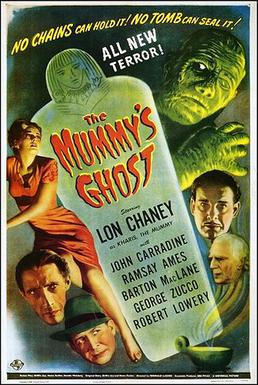
Horror Film Review: The Mummy’s Ghost (dir by Reginald Le Borg)


When we last checked in with Kharis the Mummy, he was trapped in the middle of an inferno in Massachusetts.  Having come to America to kill the members of the expedition that discovered the Tomb of Ananka and who brought Princess Ananka’s body to the United States, Kharis (Lon Chaney, Jr.) was trapped by the citizens of the town of Mapleton who, in the best tradition of Universal horror, cornered Kharis in a house and then set the place on fire.

1944’s The Mummy’s Ghost begins with the revelation that Kharis did not die in that inferno.  Somehow, he managed to escape and, rather improbably, he’s spent the last few years wandering around town without anyone ever noticing him.  The film presents Kharis as being largely a nocturnal creature but, even if he is only coming out at night, it still seems strange that no one would notice a mummy wandering around, especially since the entire town was traumatized by Kharis’s previous reign of terror.  As well, it’s also been established that Kharis owes his eternal life to an ancient Egyptian plant.  One reason why Kharis has always needed a “minder” is because Kharis needed someone who could keep him supplied with the plant.  So, if Kharis has been wandering around Massachusetts for the past few years, from where has he been getting the plant?

The Mummy’s Ghost also established that, in Egypt, High Priest Andoheb (Georg Zucco) is still alive.  This is somewhat surprising, considering that Andoheb died in both The Mummy’s Hand and The Mummy’s Tomb.  But no matter!  Andoheb is apparently still alive.  He’s really old and his hands shake but he’s still alive and he’s still determined to bring both Kharis and Princess Ananka back to Egypt.  This time, he sends Yousef Bey (John Carradine) to Massachusetts.

Yusef Bey takes over managing Kharis and he’s even able to supply Kharis with more of the special plant the keeps him alive.  However, Kharis grows upset when it discovers that Bey has tracked down the reincarnation of Ananka in the person of Amina (Ramsay Ames) and that, rather than return her safely to Egypt, Bey wants to give her eternal life with the help of the plant and then marry her.  This leads to Kharis going on a rampage and carrying Amina into a nearby swamp while Amina’s boyfriend, Tom Hervey (Robert Lowery), chases after them.

Full of plot holes and inconsistencies, The Mummy’s Ghost is about as silly as a mummy film can be.  If the previous films about Kharis managed to create a feeling of tragic inevitability as Kharis tracked down all of the people who had entered Ananka’s tomb, The Mummy’s Ghost presents Kharis as being something more akin to Frankenstein’s Monster, an inarticulate and easily frustrated creature who does things with little rhyme or reason.  That said, the film does make good use of Lon Chaney Jr’s hulking physicality as Kharis.  He’s still an intimidating figure when he goes after someone.  And John Carradine’s pained expression as Yousef Bey is memorable as a reminder of how much Carradine disliked most of the Universal monster films in which he found himself.  Otherwise, The Mummy’s Ghost is fairly forgettable.

Previous Universal Horror Reviews:

  1. Dracula (1931)
  2. Dracula (Spanish Language Version) (1931)
  3. Frankenstein (1931)
  4. Island of Lost Souls (1932)
  5. The Mummy (1932)
  6. The Invisible Man (1933)
  7. The Bride of Frankenstein (1935)
  8. Dracula’s Daughter (1936)
  9. Son of Frankenstein (1939)
  10. Black Friday (1940)
  11. The Invisible Man Returns (1940)
  12. The Mummy’s Hand (1940)
  13. The Wolf Man (1941)
  14. Ghost of Frankenstein (1942)
  15. Invisible Agent (1942)
  16. The Mummy’s Tomb (1942)
  17. Frankenstein Meets The Wolf Man (1943)
  18. Son of Dracula (1943)
  19. House of Frankenstein (1944)
  20. The Invisible Man’s Revenge (1944)
  21. House of Dracula (1945) 
  22. Creature From The Black Lagoon (1954)

Get Ready For Halloween With These Vintage Universal Horror Posters!


It’s October and, just in case you need some help getting into the Halloween spirit, here’s some classic vintage horror movie posters!  All of the posters below are from the 1930s and were commissioned by the Universal Pictures art department.  Universal was Hollywood’s top studio for horror in the 30s and their posters helped to make stars of everyone form Bela Lugosi to Boris Karloff to Lon Chaney, Jr.

Let’s get in the mood for horror with the help of Universal Pictures:

Dracula (1931)

Frankenstein (1931)

The Murders in The Rue Morgue (1932)

The Old Dark House (1932)

The Mummy (1932)

The Invisible Man (1933)

The Black Cat (1934)

The Bride of Frankenstein (1935)

Night Key (1937)

The Game’s Afoot: THE SEVEN-PER-CENT SOLUTION (Universal 1976)


gary loggins's avatarcracked rear viewer

71

Sherlock Holmes has long been a favorite literary character of mine. As a youth, I devoured the Sir Arthur Conan Doyle stories, marveling at the sleuth’s powers of observation and deduction. I reveled in the classic Universal film series starring Basil Rathbone and Nigel Bruce as Holmes and Watson, and still enjoy them today. I read Nicholas Meyer’s 1974 novel “The Seven-Per-Cent Solution” as a teen, where a coked-out Holmes is lured by Watson to Vienna to have the famed Sigmund Freud cure the detective of his addiction, getting enmeshed in mystery along the way. I’d never viewed the film version until recently, and while Meyer’s screenplay isn’t completely faithful to his book, THE SEVEN-PER-CENT SOLUTION is one of those rare instances where the movie is better than the novel.

72

This is due in large part to a pitch-perfect cast, led by Nicol Williamson’s superb performance as Sherlock. We see Holmes at his worst…

View original post 393 more words

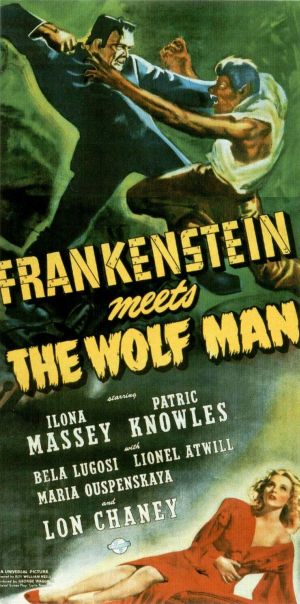
Horror Film Review: Frankenstein Meets The Wolf Man (dir by Roy William Neill)


frankenstein_meets_the_wolf_man_movie_poster

Long before Batman v. Superman, there was Frankenstein Meets The Wolf Man!

Released in 1943, Frankenstein Meets The Wolf Man was the first of the Universal horror movies to feature the monsters meeting.  (Dracula would join both Frankenstein’s Monster and the Wolf Man in later films.)  In our current age of the MCU and Zack Snyder super hero movies, that might not seem like a big deal but I’m sure it was huge in 1943.  Were the Universal Monster Movies the first example of a shared cinematic universe?  To be honest, I have no idea but it sounds good so let’s go with it.

Frankenstein Meets The Wolf Man starts, as so many Frankenstein films have, with a little bit of grave robbing.  Except, this time, the grave robbers aren’t looking for body parts.  Instead, they break into the Talbot family crypt because they’ve heard that Larry Talbot was buried with a lot of jewelry and money.  As the grave robbers wander around the crypt, they recap for us everything that happened in The Wolf Man.  Finally, they open up Larry’s coffin and are confronted with the dead body of Larry Talbot himself!  (Larry is, once again, played by Lon Chaney, Jr.)

Unfortunately for our grave robbing friends, there’s a full moon out.  As soon as the moonlight shines on Larry, he comes back to life and promptly transforms into … THE WOLF MAN!

After killing one of the robbers, the Wolf Man runs out of the tomb.  The next morning, once again human and alive, Larry Talbot wakes up in some bushes.  He’s arrested by the police.  He’s sent to a mental hospital.  He transforms a few more times and kills a few more stock characters.  And during all of this, Larry tells anyone who will listen that he just wants to be cured of his condition so that he can die and stay dead.

It was at this point that it occurred to me that Larry Talbot is perhaps the whiniest werewolf in film history.

Eventually, Larry decides that maybe the famous Dr. Ludwig Frankenstein could help him!  So, he breaks out of the hospital and travels to Germany (though, since the film was made during World War II, we’re never specifically told that he’s in Germany).  Accompanying him is Malena (Maria Ouspenkaya), the gypsy woman from the first Wolf Man.

In Germany a generic Eastern European country, Larry finds out that Dr. Frankenstein is dead and his research is missing.  Larry does, however, discover the frozen body of Frankenstein’s Monster (now played by Bela Lugosi).  After reviving the monster, Larry is upset to discover that the Monster not only doesn’t know where to find Frankenstein’s research but that, after dealing with their crap for four movies, the Monster doesn’t really seem to care about doing anything other than harassing the local villagers.

Fortunately, Larry does get to meet Ludwig’s widow (Illona Massey) and get a chance to tell her about how much he wishes he was dead.  Probably just to get him to shut up about how terrible his existence is, the widow agrees to help Larry.  She gives him Ludwig’s research and Larry believes that he’s finally found a way to end both his life and the Monster’s!

Unfortunately, it doesn’t quite work that way.  For one thing, Larry is working with a scientist (played by Patric Knowles) who doesn’t think that the Monster needs to be destroyed.  Secondly, Larry keeps forgetting to keep track of the lunar cycles.  That full moon is continually taking him by surprise.

It all leads to a final battle between Frankenstein’s Monster and the Wolf Man.  It only lasts for a little less than 10 minutes so it’s hard not to be a bit disappointed but at least no one talks about having a mother named Martha.

(Can you imagine that conversation?

“Growl growl growl growl”

“Why you say Martha?”

“Growl growl.”

“But Monster’s mother named Martha!”

“Growl!”

“Friends!”

“growl…”)

(It’s been seven months since that damn movie came out and, here at the Shattered Lens, we’re still getting mileage out of “But my mother was named Martha!” jokes.)

Frankenstein Meets The Wolf Man isn’t necessarily a good movie but it is a lot of fun to watch.  It helps, of course, if you’ve seen the other Universal horror films.  Part of the fun is spotting members of the Universal stock company, like Lionel Atwill and Dwight Frye, and seeing who they’ll be playing this time around.  One thing that I did legitimately appreciate is that the film made at least some sort of an effort to maintain a continuity with both The Wolf Man and Ghost of Frankenstein.  It appears that some actual thought was put into explaining how both the Wolf Man and the Monster were still around after the events of the last two films.  That shows more respect for the audience that you’ll find in most modern films.

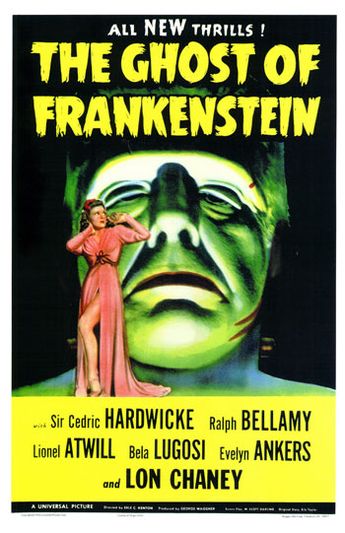
Horror Film Review: The Ghost of Frankenstein (dir by Erle C. Kenton)


the_ghost_of_frankenstein_movie_poster

In 1942, three years after Son of Frankenstein, Universal Pictures continued the story of the Frankenstein family with The Ghost of Frankenstein!

However, The Ghost of Frankenstein was a far different film from the three that came before it.  The budget was lower.  The story was less complicated.  The running time was much shorter.  Whereas the previous films in the franchise clearly took place in Germany, the setting for The Ghost of Frankenstein is less easily defined.  (Considering that the film was made during World War II, this isn’t surprising.)  The biggest change is that, in The Ghost of Frankenstein, the monster is not played by Boris Karloff.  Instead, the role is taken by Lon Chaney, Jr.  Chaney’s hulking frame was perfect for the monster but his face is never as expressive as Karloff’s.  Whereas Karloff turned the monster into as much of a victim as a victimizer, Chaney plays the monster like a … well, a monster.

Returning from Son of Frankenstein, Bela Lugosi is back as Ygor.  At the start of the film, we learn that Ygor actually wasn’t killed at the end of Son of Frankenstein.  Instead, he was just wounded.  He’s spent the last few years hiding out in the old castle, trying to once again revive the monster.  When the villagers attempts to blow up the castle, he and the monster flee.

It turns out that there’s one other Frankenstein son.  His name is Ludwig and he’s played by a very dignified Sir Cedric Hardwicke.  Ludwig, who has been hiding his identity and denying the family legacy, has a successful medical practice in another village.  Working with his assistants, Dr. Kettering (Barton Yarbrough) and the bitterly jealous Dr. Bohmer (Lionel Atwill, who played a far different role in Son of Frankenstein), Ludwig has developed a procedure in which a damaged brain can be removed from the skull, repaired, and then stuck back inside the skull…

Uhmmm … wow, I have no idea what to say about that.  That’s quite a medical breakthrough, though…

When Ygor and the monster show up in the village, searching for Ludwig, the monster ends up getting arrested.  The local prosecutor (played by Ralph Bellamy, Cary Grant’s romantic rival in both The Awful Truth and His Girl Friday) asks Ludwig to examine the prisoner.  Ludwig is shocked to discover that the prisoner is his father’s creation!

Ygor wants Ludwig to perform a brain transplant on the Monster.  At first, Ludwig is hesitant but then he’s visited by Henry Frankenstein’s ghost.  (Since Colin Clive died 5 years before Ghost of Frankenstein went into production, Hardwicke plays both Ludwig and Henry.)  The ghost asks Ludwig to perfect the monster.

Ludwig finally relents and agrees to give the monster a new brain.  Ludwig wants to use the brain of kindly colleague but Ygor has different plans…

The Ghost of Frankenstein is only 67 minutes long but, oddly, it still feels just a little bit draggy.  Director Erle C. Kenton does a workmanlike job but, at no point, does Ghost feature the wit that distinguished James Whale’s films or Rowland V. Lee’s work on Son of Frankenstein.  Chaney is not a particularly interesting monster but Bela Lugosi is a lot of fun as Ygor.  With Chaney showing even less emotion than he usually did and Hardwicke appearing to be occasionally embarrassed by the whole film, it falls to Lugosi to keep the audience awake and he manages to do just that.  Lugosi’s performance may be overly theatrical but that’s exactly what The Ghost of Frankenstein needed.

The Ghost of Frankenstein is occasionally entertaining but ultimately forgettable.  It’ll best be enjoyed by Universal horror completists.

Horror Film Review: The Invisible Man (dir by James Whale)


the-invisible-man

The 1933 Universal horror film, The Invisible Man, never seems to get as much attention as Frankenstein, Dracula, The Wolf Man, or The Mummy.  Perhaps it’s because the invisible man really isn’t a supernatural monster.  He’s just a scientist who has turned himself invisible and is now going mad as a result.  Or maybe it’s because there have been so many crappy films that have used invisibility as a plot point that the reputation of the original Invisible Man suffers by association.

For whatever reason, The Invisible Man never seems to get spoken about in the same breathless, gleeful manner as some of the other Universal monsters.  But I have to admit that, though I usually can’t stand movies about invisibility, I rather like The Invisible Man.

Based on a novel by H.G. Wells, The Invisible Man opens with a mysterious man (played by Claude Rains) arriving in a small English village.  He checks into a small inn and soon, everyone in the village is scared of him.  It’s not just his haughty attitude or his habit of ranting about his own superiority.  There’s also the fact that he is literally covered, from head to toe, in bandages.  He always wears gloves and dark glasses.  He insists that he’s doing important research and demands to be left alone.

The inn keeper (Forrester Harvey) and his histrionic wife (Una O’Connor) put up with the mysterious man until he falls behind on his rent.  However, once confronted, the mysterious man announces that he’s not going anywhere.  When the police and a mob of villagers arrives, the man starts to laugh like a maniac.  He unwraps the bandages around his head and…

THERE’S NOTHING UNDERNEATH!

Well, there is something there.  It’s just that the man is invisible so no one can see what’s underneath.  It turns out that the man is Dr. Jack Griffin, a chemist who has been missing for several days.  He’s created an invisibility serum but he can’t figure out how to reverse the effects.  Even worse, the serum is driving him insane.  Griffin’s fiancée, Flora (Gloria Stuart), and her father, Dr. Cranley (Henry Travers), are searching for Jack but Jack doesn’t particularly want to be found.  Jack is more interested in exploring how he might be able to use invisibility to conquer the world…

The Invisible Man is historically important because it was the film that brought Claude Rains to Hollywood.  Rains has previously made films in the UK but this was his first American film.  Think of how different film history would have turned out if The Invisible Man had, as originally planned, starred Boris Karloff.  Without Claude Rains coming to America, who would have played Louis in Casablanca?  Who would have played Sen. Paine in Mr. Smith Goes To Washington or Alex Sebastian in Notorious?  Of course, we don’t really see Claude Rains’s face until the very end of The Invisible Man.  Instead, we just hear his voice but what a voice Claude had!  He delivers his dialogue with just the right amount of malicious sarcasm.

I like The Invisible Man.  For modern audiences, it’s not particularly scary.  (Though I do find the idea of being unknowingly followed by an invisible person to be a little unnerving…)  However, unlike a lot of other old horror films, you can watch The Invisible Man and see why it would have been scary to an audience seeing it for the very first time.  In 1933, a time when film was still a relatively new medium and audiences had yet to become jaded by special effects, here was a man unwrapping his bandages to reveal that there was nothing underneath!  That had to have freaked people out!

The Invisible Man was directed by James Whale and the film features the same demented sense of humor that distinguished The Bride of Frankenstein.  The villagers are portrayed as being so hysterical that you can’t help but think that maybe Griffin has a point about being surrounded by fools.  By the time the local constable declares, “What’s all this then?,” you can’t help but start to sympathize with Jack Griffin.

There’s been a lot of  bad invisibility movies made but The Invisible Man is not one of them.  It may not be as well remembered as some of the other Universal horrors but it’s definitely one worth seeing.

The Seventh Annual Academy Awards: 1920


Over on Through the Shattered Lens Presents the Oscars, we are reimagining Oscar history, one year at a time. Today, we take a look at 1920. Prohibition goes into effect, women finally get the right to vote, Harding is elected President, D.W. Griffith finally gets some recognition, and Fatty Arbuckle is the most popular man in Hollywood!

Lisa Marie Bowman's avatarThrough the Shattered Lens Presents The Oscars

William S. Hart, the Third President of AMPAS William S. Hart, the Third President of AMPAS

1920 was a year of many changes.

On January 16th, the 18th Amendment went into effect and prohibition became the law of the land.  Suddenly, it was illegal to transport and sell alcohol in the United States.  As social reformers rejoiced, the government grew and ordinary citizens started to hoard whatever liquor they had.  (Selling alcohol was illegal but drinking it was not.)  Perhaps the people happiest about prohibition were the gangsters who now had a totally new market to exploit.

On August 26th, the 19th amendment to the U.S. Constitution passed and, finally, all women were granted the right to vote.  And it came not a minute too late because it was time for the United States to elect a new president.  Weary after the nonstop drama of  8 years of Woodrow Wilson, the American electorate turned to Warren…

View original post 1,342 more words

The Sixth Annual Academy Awards: 1919


At the 1919 Academy Awards, Evelyn Preer makes history, Harry Houdini is rewarded for playing himself, and Bolshevism goes on trial!

Jedadiah Leland's avatarThrough the Shattered Lens Presents The Oscars

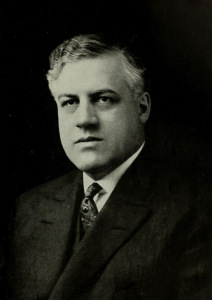
Attorney General A. Mitchell Palmer Attorney General A. Mitchell Palmer

In 1919, as the Spanish Flu continued to infect and kill millions, the world tried to recover from World War I.  After spending six months at the Paris Peace Conference, President Woodrow Wilson returned to the U.S. and launched an ultimately unsuccessful campaign to bring the United States into the newly formed League of Nations.  On September 25th, while barnstorming across the nation in support of the League, a physically exhausted Wilson collapsed and never truly recovered.  On October 2nd, a stroke left him partially paralyzed and blind in one eye.

Even before Wilson’s physical collapse, the U.S. population had reason to feel uncertain about the future.  On January 6th, the wildly popular Theodore Roosevelt died in his sleep.  Before his death, Roosevelt had been widely expected to run for President in 1920 and hopefully return the U.S. to the peace and prosperity…

View original post 1,108 more words

The Fifth Annual Academy Awards: 1918


Over on Through the Shattered Lens Presents the Oscars, we are continuing to reimagine Oscar history, one year at a time! Today, we take a look at the year 1918. World War I ended, the Spanish Flu wiped out 5% of the world’s population, and the Academy embraced Tarzan of the Apes!

Lisa Marie Bowman's avatarThrough the Shattered Lens Presents The Oscars

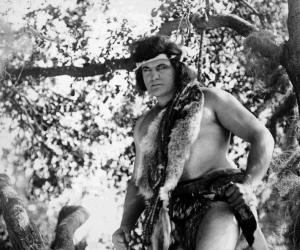
A scene from Tarzan of The Apes A scene from Tarzan of The Apes

1918 was a year of dominated by war and pestilence.  As the world seemed to be intent on destroying itself, both the Academy and American filmgoers embraced escapism.

Overseas, the Great War continued to drag on.  With no end to the fighting in sight, there were fears that the American public would turn against the war and their elected leaders would withdraw American soldiers from the fighting.  The British government, realizing the potential of film as a propaganda tool, contacted director D.W. Griffith and offered to help him make a film.  The end result was Hearts of the World, an epic war film that starred Lillian Gish as a French girl who struggles to survive and find true love as the Germans raid her village.

Though Gish would later say that Griffith was displeased with the pro-war tone of Hearts Of The World

View original post 1,357 more words