4 Shots From 4 Films is just what it says it is, 4 shots from 4 of our favorite films. As opposed to the reviews and recaps that we usually post, 4 Shots From 4 Films lets the visuals do the talking!
Today is Clint Eastwood’s 95th birthday!
Though Clint famously had to go to Italy to really get his film career going, he’s gone on to become an icon of American film. While his early films were often criticized as glorifying violence and of being reactionary, his later films have — more often than not — been meditations on aging, moral ambiguity, and what a lifetime of violence does to a person’s soul. He’s a filmmaker whose legacy will be rediscovered and probably appreciated in the future.
Here are….
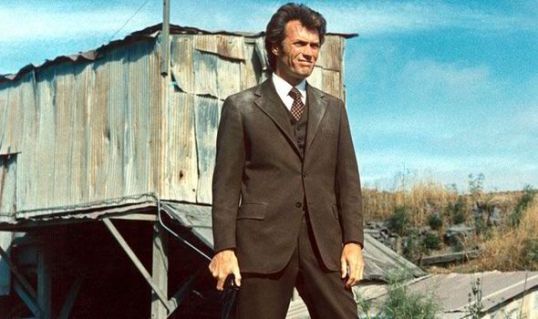
4 Shots From 4 Clint Eastwood Films
For A Few Dollars More (1965, dir by Sergio Leone)
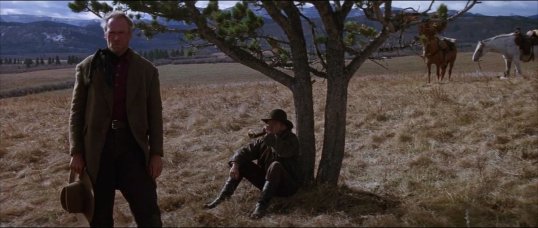
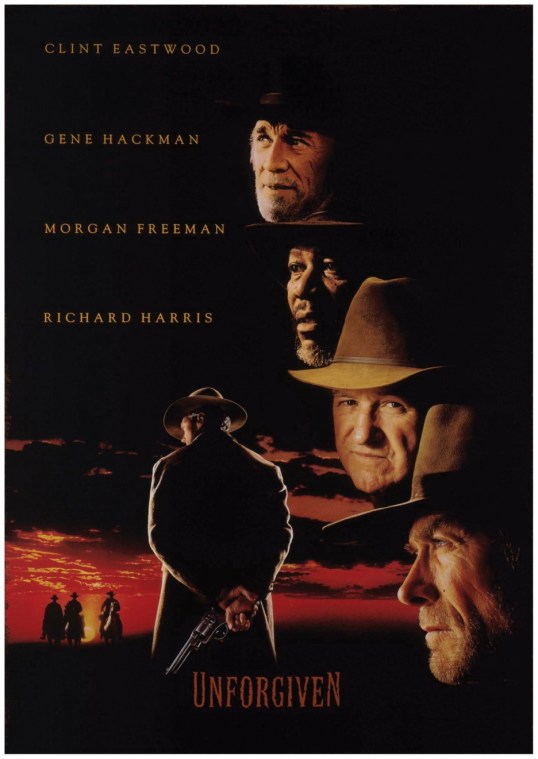
The 1992 Best Picture winner, Unforgiven, begins as a story of frontier justice.
In Kansas, a young and cocky cowboy who calls himself the Schofield Kid (Jaimz Woolvett) rides up to an isolated hog farm. He’s looking for Will Munny (Clint Eastwood), a notorious outlaw with a reputation for being a ruthless killer. Instead, he just finds a broken down, elderly widower who is trying to raise two young children and who can barely even manage to climb on a horse. Will Munny, the murderer, has become Will Munny the farmer. He gave up his former life when he got married.
The Schofield Kid claims to be an experienced gunfighter who has killed a countless number of men. He explains that a group of sex workers in Wyoming have put a $1,000 bounty on two men, Quick Mike (David Mucci) and his friend, Davey Bunting (Rob Campbell). Quick Mike cut up one of the women when she laughed at how unimpressively endowed he was. While Davey didn’t take part in the crime, he was present when it happened and he didn’t do anything to stop it. The local sheriff, a man named Little Bill Daggett (Gene Hackman), had Davey give the woman’s employer several horses as compensation. The Kid wants Munny to help him collect the bounty.
At first, Munny refuses to help the Kid. But, when he realizes that he’s on the verge of losing his farm, Munny changes his mind. He and his former partner, Ned Logan (Morgan Freeman), join with the Kid and the three of them head to Wyoming. Along the way, they discover that the Kid is severely nearsighted and can hardly handle a pistol.
Meanwhile, in the town of Big Whiskey, Wyoming, Little Bill ruthlessly enforces the peace. He’s a charismatic man who is building a house and bringing what many would consider to be civilization to the Old West. When we first meet Little Bill, he seems like a likable guy. The town trusts him. His deputies worship him. He has a quick smile but he’s willing to stand his ground. But it soon becomes apparent that, underneath that smile and friendly manner, Bill is a tyrant and a petty authoritarian who treats the town as his own personal kingdom. Little Bill has a strict rule. No one outside of law enforcement is allowed to carry a gun in his town. When another bounty hunter, English Bob (Richard Harris), comes to town to kill the two cowboys, Little Bill humiliates him and sends him on his way but not before recruiting Bob’s traveling companion, writer W.W. Beauchamp (Saul Rubinek), to write Bill’s life story. Bill’s not that much different from the outlaws that he claims to disdain. Like them, Bill understands that value of publicity.
Unforgiven starts as a traditional western but it soon becomes something else all together. As the Schofield Kid discovers, there’s a big difference between talking about killing a man and actually doing it. Piece-by-piece, Unforgiven deconstructs the legends of the old west. Gunfights are messy. Gunfighters are not noble. Davey Bunting is the only man in town to feel guilty about what happened but, because he’s included in the bounty, he still dies an agonizing death. Quick Mike is killed not in the town square during a duel but while sitting in an outhouse. Ned and Munny struggle with the prospect of going back to their old ways, with Munny having to return to drinking before he can once again become the fearsome killer that he was in the past. And Little Bill, the man who says that he’s all about taming the west and bringing civilization to a lawless land, turns out to be just as ruthless a killer as the rest. A lot of people are dead by the end of Unforgiven. Some of them were truly bad. Some of them were good. Most of them were in the wrong place at the wrong time. Everyone’s got it coming, to paraphrase Will Munny.
With its violent storyline, deliberate pacing, and its shots of the desolate yet beautiful western landscape, Clint Eastwood’s film feels like a natural continuation of the Spaghetti westerns that he made with Sergio Leone. (Unforgiven is dedicated to both Leone and Don Seigel.) Unforgiven was the first of Eastwood’s directorial efforts to be nominated for Best Picture and also the first to win. It’s brutal meditation on violence and the truth behind the legends of the American frontier. Eastwood gives one of his best and ultimately most frightening performances as Will Munny. Gene Hackman won his second Oscar for playing Little Bill Daggett.
Unforgiven holds up well today. Hackman’s Little Bill Dagget feels like the 19th century version of many of today’s politicians and unelected bureaucrats, authoritarians who claims that their only concern is the greater good but whose main interest is really just increasing their own power. Unforgiven remains one Clint Eastwood’s best films and one of the best westerns ever made. Leone would have been proud.
4 Shots From 4 Films is just what it says it is, 4 shots from 4 of our favorite films. As opposed to the reviews and recaps that we usually post, 4 Shots From 4 Films lets the visuals do the talking!
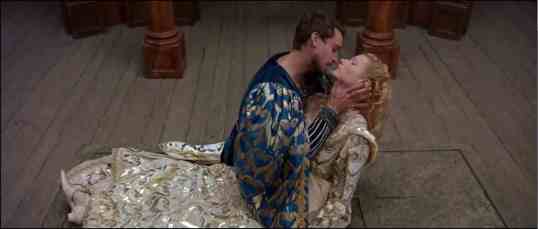
Today, I’m using this feature to take a look at the history of the Academy Award for Best Picture. Decade by decade, I’m going to highlight my picks for best of the winning films. To start with, here are 4 shots from 4 Films that won Best Picture during the 1990s! Here are….
4 Shots From 4 Best Picture Winners: The 1990s
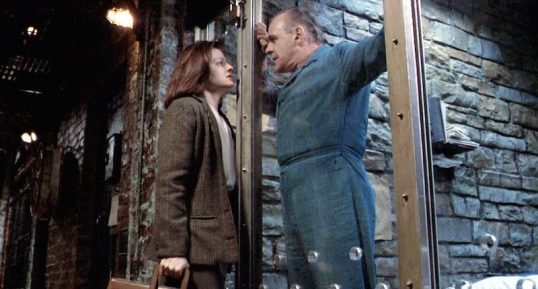
The Silence Of The Lambs (1991, dir by Jonathan Demme, DP: Tak Fujimoto)
Unforgiven (1992, dir by Clint Eastwood, DP: Jack N. Green)
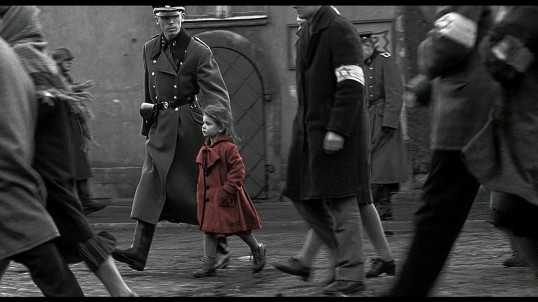
Schindler’s List (1993, dir by Steven Spielberg, DP: Janusz Kamiński)
Shakespeare In Love (1998, dir by John Madden, DP: Richard Greatrex)
4 Shots From 4 Films is just what it says it is, 4 shots from 4 of our favorite films. As opposed to the reviews and recaps that we usually post, 4 Shots From 4 Films lets the visuals do the talking!
Today is Clint Eastwood’s 90th birthday!
Though Clint famously had to go to Italy to really get his film career going, he’s gone on to become an icon of American film. While his early films were often criticized as glorifying violence and of being reactionary, his later films have — more often than not — been meditations on aging, moral ambiguity, and what a lifetime of violence does to a person’s soul. Though Eastwood has fallen out-of-favor with a few critics as a result of the speech he gave at the 2012 Republican Convention (Film Twitter, to the shock of no one, had a particularly over-the-top reaction to it as many of them discovered, I guess for the first time, that not every artist is a Leftist), he’s a filmmaker whose legacy will be rediscovered and probably appreciated in the future.
Here are….
4 Shots From 4 Films
For A Few Dollars More (1965, dir by Sergio Leone)
Anyone who complains that all Hollywood does nowadays are sequels and remakes should think before they start to rant. Sequels and remakes are not exclusive to Hollywood (Bollywood anyone) and it’s been a tried-and-true practice both inside and outside the glitzy confines of Hollywood. Sergio Leone took classic Kurosawa samurai films and remade them into the classic spaghetti Westerns which made Clint Eastwood a household name (pre-RNC chair).
Now Japan is looking to take one of the best Westerns of the past quarter-century in Eastwood’s own critically-acclaimed and award-winning Unforgivenand remake it as a samurai film set in 188’s Japan. The film will star Ken Watanabe in the same role Eastwood had in his film with fellow actors Akira Emoto and Koichi Sato rounding out the cast. The remake will have the title of Yurusarezaru-mono and will closely follow the same story of Eastwood’s film with just changes in location and other cultural changes.
The film will be directed by award-winning Korean filmmaker See Sang-il and should see a release date sometime around 2013.
I, for one, am looking forward to see how this remake will turn out. Jidaigeki (samurai period films) have seen a resurgence in Japanese cinema these past couple years and it’s going to be interesting to see how one of Eastwood’s Western masterpieces will turn out as a samurai drama. Fans of both genres have a mutual understanding that the Western and the samurai films share similar themes and character traits so it shouldn’t have been a surprise that Unforgivenwill be remade into a samurai. What is a surprise is that Japan took twenty years to decide to do it.
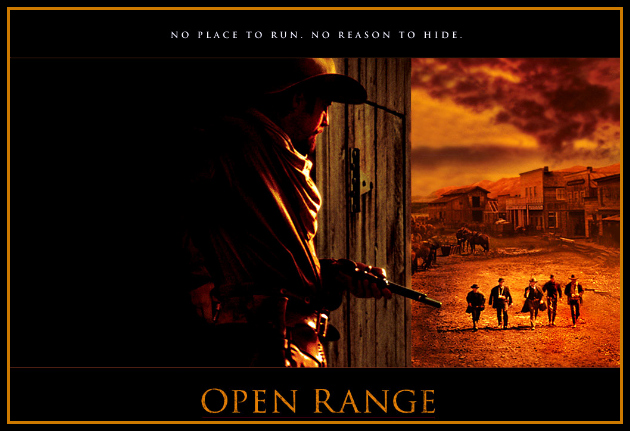
2003 marked a sort of a small comeback for Kevin Costner both as a director and as an actor. The work in question was the very well-done Western, Open Range. Open Range was a moderately budgeted film which has more in common with Costner’s first directorial work, Dances with Wolves than his last big-budget flop, The Postman.
The film was an adaptation of the Lauran Paine novel, The Open Range Men, and it captures much of the themes found in the novel. This was probably due to the fact that screenwriter Craig Storper didn’t deviate from the novel’s basic story. There were no superfluous action sequences and gunfights to ratchet up the action. Everything about Open Range was about the gradual and inevitable final confrontation between the “free-grazers” and the “barbed-wire” men. The free-grazers were played by Kevin Costner and Robert Duvall as Charles Waite and Boss Spearman, respectively. On the other side of the conflict was Michael Gambon playing Denton Baxter, the ruthless land-baron whose attempt to keep the free-grazers from grazing on his land also hides another agenda. Caught in-between these two strong-willed groups were the people in the town Baxter pretty much controls through his “town marshal” (played with fake bravado by James Russo) and the herd helpers under Boss Spearman’s employ.
The theme of freedom to roam the open country versus the rights of a landowner echoes throughout the film. Set in the latter end of the 19th-century, Open Range shows the clash of the more natural ways of the Old West slowly eroding to be replaced by the more industrial, monopolistic practices that became prevalent during the 1880’s, also known in US History as the Gilded Age. Even the personalities of the conflicting characters mirror this theme as the free-grazers only want to use the land as it has been used for years upon years and thats sharing between all men of the West. The land-baron has other ideas in mind and everything boils down to him owning everything around him, even if it means using ruthless tactics to gather even more property.
Open Range also has a bit of modernism in its subplot of Charley Waite’s growing attraction to the sister of the town doctor and the same sister’s well-rounded characterization. It’s not often that a traditional Western shows women in a very positive light instead of the usual submissive and stay-at-home characters of Western’s past. This could also be attributed to the wonderful, underrated performance by Annette Bening who plays Sue Barlow, the doctor’s sister and Charley Waite’s love interest. Bening doesn’t play Sue as the traditional Western female. She also doesn’t go overboard and turn Sue into a 20th-century feminist. She instead plays the character as someone who knows her place in the world, but also one who is strong-willed and willing to stand for what is right.
Open Range was a wonderful throwback to what made such modern Westerns like Unforgiven and Tombstone such a success both for traditionalists and new fans. Kevin Costner’s direction was very low-key. Allowing the story to tell itself at its own pace until the final confrontation. The final gunfight in the end gets a lot of well-earned attention from critics and fans. The entire sequence takes at least 10-15 minutes from start to finish. The fight itself was done in a realistic fashion. There was no sharpshooter dead-eyes in this film, but individuals who had skill but still missed. It was a fight where it wasn’t who was the fastest, but who was the calmest under fire. There’s also a suddenness to the brutality in the final gunfight that demystifies the old-style Western shootouts of past. Some complained that the film was very slow and took too long to get to the “good stuff”, but I actually thought the gradual pacing of most of the film’s length gave the final confrontation even more impact. Costner seem to have learned the lesson all good directors know: less means more.
Open Range won’t go down as a great piece of film making. It surely won’t go down as one of the best in history. What Open Range did accomplish was putting the Western back to its epic and majestic roots, but at the same time keeping the intimacy of a character-driven story. In time, Open Range would probably go down as one of the underrated gems of the last decade and find a place next to its closest comparison, Unforgiven, as one of the best Westerns of the new era.



 Through the Shattered Lens