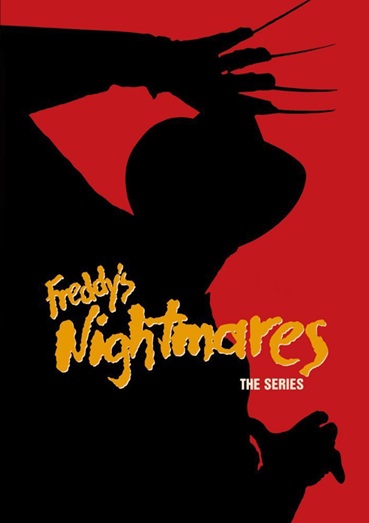
Welcome to Late Night Retro Television Reviews, a feature where we review some of our favorite and least favorite shows of the past! On Fridays, I will be reviewing Freddy’s Nightmares, a horror anthology show which ran in syndication from 1988 to 1990. The entire series can be found on Tubi!
This week, a lottery ticket leads to misery.
Episode 2.6 “Lucky Stiff”
(Dir by William Malone, originally aired on November 12th, 1989)
After the lottery-obsessed Lenny Nordhoff (David L. Lander) has a heart attack and dies, his widow, Greta (Mary Crosby), marries her brutish boyfriend, Hank (Richard Eden). Haunted by nightmares of Lenny holding out his bloody heart and accusing her of having broken it, Greta is not happy with her new marriage. When she and Hank realize that Lenny was buried with a winning lottery ticket, they break into the mausoleum, open his coffin, and retrieve the ticket. Then, Greta pushes Hank into the coffin and seals him up.
Months later, Greta is wealthy but now she’s haunted by visions of Hank and threatening phone calls. Eventually, she is confronted by a gravedigger (Tracey Walter), who blackmails her into marrying him.
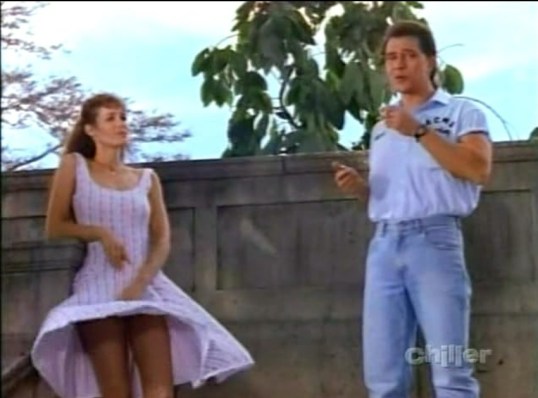
This episode’s only memorable moment was an outdoor scene that was apparently filmed on a windy day, resulting in Mary Crosby having to awkwardly reach down to keep her dress from blowing up. (I supposed it says something about the show’s budget and production schedule that, rather than reshoot this scene, they just went with it.) Crosby didn’t do a bad job in this episode. She had the right neurotic femme fatale look.
Otherwise, this episode was pretty forgettable. The first story featured Greta having nightmares about a dead man and marrying a loser. The second story featured Great having nightmares about a dead man and marrying a loser. Even Freddy, in his reduced host role, looked pretty bored with the whole thing.
In 1977’s The Fifth Floor, Dianne Hull plays Kelly McIntyre.
Kelly is a college student by day and a disco dancer by night! Unfortunately, after someone spikes her drink at the discotheque and she suffers an overdose, she becomes a full-time patient at a mental asylum. Neither the head doctor (Mel Ferrer) nor the head nurse (Julia Adams, who once swam with The Creature From The Black Lagoon) believes her claim that her drink was spiked. Judged to be suicidal and delusional, Kelly is sent to the Fifth Floor!
While her boyfriend (John David Carson) tries to convince the authorities that she’s not insane, Kelly adjusts to life on the Fifth Floor. She befriend Cathy (Patti D’Arbanville). She encourages her fellow patients to dance and enjoy themselves. She tries to escape on multiple occasions. She draws the unwanted attention of a male orderly named Carl (Bo Hopkins, giving a wonderfully sinister performance). A sadist equipped with down-home country charm, Carl has got all of his co-workers convinced that he’s a great guy. The patients, though, know that Carl is a petty authoritarian who enjoys showing off his power. (“I’m just doing my job,” is the excuse whenever he’s challenged.) Carl takes an obsessive interest in Kelly and soon, Kelly is not only trying to get her life back but also trying to escape from Carl’s cruel intentions.
Most film directories list The Fifth Floor as being a horror film and certainly, there are elements of the horror genre to be found in the film. The smooth-talking and nonchalantly cruel Carl is certainly a horrific character and Kelly’s attempts to escape from the asylum capture the very primal fear of not having any control over one’s life. That said, The Fifth Floor owes greater debt to One Flew Over The Cuckoo’s Nest than to the typical slasher film. Kelly is a rebel who brings the patients in the ward together. Much as in Cuckoo’s Nest, the nurses and the orderlies use the threat of electro-shock treatment to keep the patients under control.
It’s not a bad film, though it definitely has its slow spots and I do wish the film had embraced its own sordidness with a bit more style. I’m a history nerd so I appreciated the fact that The Fifth Floor was so obviously a product of its time. Any film that features the heroine showing off her disco moves before being taken to a mental hospital is going to hold my interest. That said, the most interesting thing about the film are some of the familiar faces in the cast. For instance, Earl Boen — who played so many authority figures over the course of his career and appeared as a psychiatrist in the early Terminator films — plays a patient who wears a NASA jacket. The always intimidating Anthony James plays the most violent patient. Michael Berryman and Tracey Walter appear as background patients.
And then you’ve got Robert Englund, cast here as Benny. Benny is the most gentle of the patients, a prankster who befriends Kelly. It’s always so interesting to see the type of roles that Englund played before he was cast as Freddy Krueger in A Nightmare On Elm Street. In this film, Englund is so goofy and friendly that you actually find yourself worrying about something happening to him. Englund’s role is small but his amiable nerdiness definitely makes an impression.
The Fifth Floor opens and ends with a title card telling us that the film is based on a true story. Sure, it was.
In 1989’s Out of the Dark, a man dressed in a clown costume is killing phone sex operators. He lurks in the darkness and jumps out of the shadows to commit his dastardly crimes. Especially during the first hour or so, the film has its share of both suspense and gruesome moments. In the style of Italian giallo and pre-Halloween American slasher pics, the film actually tries to create some mystery about who the killer could be. Lt. Frank Meyers (Tracey Walter) suspects that the killer might photographer Kevin Silvers (Cameron Dye). Kevin and his girlfriend, Kristi (Lynn Danielson-Rosenthal), think that the police should be taking a closer look at David Stringer (Bud Cort), an accountant who has an office in the same building as the phone sex company. Meanwhile, Detective Langella (Divine) thinks that the murders might be linked to a serial killer who is targeting prostitutes.
The main problem with Out of the Dark is that it’s pretty obvious from the start who the killer is and it’s hard not to judge the people who can’t figure it out for themselves. The movie doesn’t really offer up enough viable suspects to keep you guessing and than it spends so much time trying to make it look like one of the suspects is guilty that any experienced film watcher will automatically know that he isn’t. The viewers are supposed to be shocked by the killer’s identity but there’s nothing shocking about it. It’s pretty obvious.
On the plus side, OutoftheDark does have a one-of-a-kind cast. Divine and Tracy Walter play detectives. Bud Cort is intense and nerdy as the bitter accountant. Cameron Dye is vacuously handsome as the photographer. Geoffrey Lewis shows up as an alcoholic. Lainie Kazan plays an aging prostitute. Tab Hunter drives a car. Paul Bartel manages a motel and gets upset when he sees the blood pooling in one of his rooms. And finally, Karen Black plays the owner of the phone sex company and gives a far better performance than the material actually deserves. Black brings some much needed emotional reality to the film.
As I said at the start of this review, OutoftheDark has its moments. The clown costume is truly creepy and the opening murder is all the more disturbing because it happen outside and in a public park. (You do have to wonder how no one noticed a weirdo dressed like a clown wandering around.) A scene in which the clown attacks a phone sex operator who has agreed to serve as bait is also well-done and genuinely frightening. The story moves at a quick and steady pace and it deserves some credit for ending on a definitive note as opposed to trying to copy the ambiguity that was so popular with other slasher films of the era.
If only the identity of the killer had actually been a surprise, Out of the Dark would probably be considered a classic. As it is, it’s just another well-made slasher film.
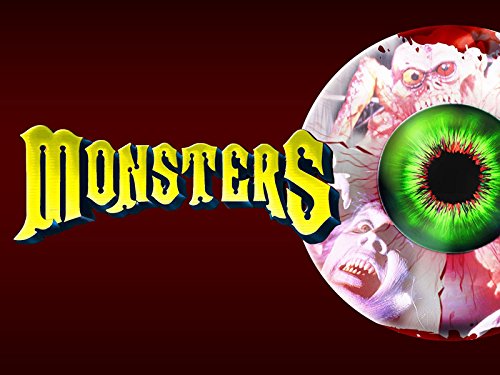
Welcome to Late Night Retro Television Reviews, a feature where we review some of our favorite and least favorite shows of the past! On Wednesdays, I will be reviewing Monsters, which aired in syndication from 1988 to 1991. The entire series is streaming on YouTube.
This week, Monsters takes a look at what is required to get ahead in the cut-throat world of corporate finance.
Episode 3.22 “Hostile Takeover”
(Dir by Randall Moldave, originally aired on February 24th, 1991)
Ruthless but not particularly intelligent corporate executive Laurence Bauer (Dennis Christopher) thinks that he has figured out the perfect way to take over the business from CEO Tom Hart (William Lanteau). He teams up with a voodoo priestess named Matilde (Pam Grier) and, with her help, he manages to force Hart out. However, Matilde explains that all of this comes with a price. The Voodoo Gods want a piece of Bauer’s body. Bauer responds by killing Matilde.
In his office, getting faxes from the Voodoo Gods and dealing with taunting messages on his computer screen, Bauer decides to sacrifice the janitor, Ed (Tracey Walter). However, Ed turns out to be not just any old janitor. He’s a demon who reacts to Bauer’s condescension by plucking out his right eye.
“You’re my boy now!” Ed shouts.
Agck! Scary!
This was a good episode. Christopher, Walter, and Grier all gave memorable performances and the demon effects were genuinely disturbing. The final season of Monsters wasn’t perfect. I’ve reviewed more than a few bad episodes from season 3. That said, it was still a marked improvement over the first two seasons, as demonstrated by episodes like this one. The whole point of the show was to show off the Monsters and this episode featured a truly effective one.
Two more episodes to go and then a new show will be premiering in this time slot!
Though the Academy of Motion Picture Arts and Sciences claim that the Oscars honor the best of the year, we all know that there are always worthy films and performances that end up getting overlooked. Sometimes, it’s because the competition too fierce. Sometimes, it’s because the film itself was too controversial. Often, it’s just a case of a film’s quality not being fully recognized until years after its initial released. This series of reviews takes a look at the films and performances that should have been nominated but were, for whatever reason, overlooked. These are the Unnominated.
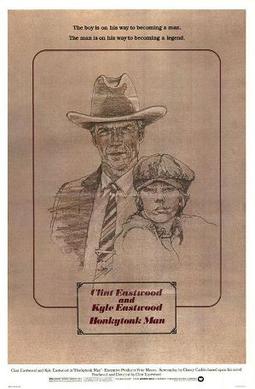
1982’s HonkytonkMan was a Clint Eastwood film that I had never heard of, until I came across it on Prime. I decided to take a chance and I rented it. I’m glad that I did because it turned out to be one of Eastwood’s best films.
Clint stars as Red Stovall, a country singer turned farmer during the Great Depression. Kyle Eastwood stars as Red’s nephew, 14 year-old Whit “Hoss” Wagoneer. When Red gets an opportunity to perform at the Grand Old Opry, he decides to head for Tennessee. Since Red is dying of tuberculosis and barely knows how to drive a car, he is accompanied by Grandpa Wagoneer (John McIntire) and Whit. Whit may be young but he knows how to drive and soon, he’s driving Red and Grandpa across the country. When a highway patrolman (Tim Thomerson) stops them, he says that Whit is too young to drive. After watching a speeding Red struggle to keep the car in the right lane, the patrolman pulls up beside them and says, “Let the kid drive.”
HonkytonkMan features an unexpected performance from Eastwood. Typically, we think of Eastwood’s characters as being the epitome of cool. Red is definitely not that. Red is a screw-up, someone who gets arrested while trying to steal chickens and who frequently gets conned by those that he meets during his journey. When the car breaks down in Arkansas, Red is too busy drinking to remember to catch the bus to Tennessee. He spends the night with a hitchhiker named Marlene (Alexa Kernin). The next morning, Whit wakes Red up and informs him that he only has a few minutes before the next bus leaves. Marlene announces that she’s pregnant. “HOLD THE BUS!” Red yells as he hastily puts on his clothes.
That said, Whit loves his uncle and the two Eastwoods, Clint and Kyle, both give excellent performances in HonkytonkMan. In fact, his performance here is probably the best that Clint Eastwood has ever given. Clint plays with his own image here. Initially, the film almost feels like a satire of Clint’s hypermasculine persona. (There is one scene where Eastwood handles a gun but it doesn’t play out the way that you might expect it to.) But, as the film progresses and Red’s illness grows worse, we start to understand Red and his way of looking at the world. Red is flawed but he loves his nephew and he loves music and, in the end, what’s important is not whether or not his song were recorded but instead that he spent his final days with Whit. The film may start out as a comedy but it ultimately becomes a meditation on aging and how one faces the inevitability of death.
As a director, Eastwood takes his time. He lets the movie play out slowly, with the casual pace of country story. It’s a film full of wonderful performance and beautiful visuals and it more than earns our patience. Wisely, Eastwood the director realizes that this story really isn’t about Red. The story is about Whit (or Hoss, as he asks to be known) and his experiences with his uncle. Whit worships his uncle but he also comes to learn that the most important thing is to be able to respect yourself. In this film, Clint Eastwood knows the story that he’s telling and he knows exactly how to tell it.
HonkytonkMan went unnominated as far as the Oscars are concerned. In the year when the well-intentioned but dramatically inert Gandhi dominated the awards and the nominations, HonkytonkMan was forgotten. That’s a shame.
1986’s Something Wild opens with Charlie Driggs (Jeff Daniels) eating lunch in a New York diner.
Charlie is a stockbroker. He wears a suit. He’s quiet and mild-mannered. He just got a promotion at work. He carries a picture of his kids in his wallet. Everything about Charlie shouts that he’s a nice guy who is extremely conventional in his outlook and behavior. But then, Charlie sneaks out of the diner without paying and is spotted by a woman (Melanie Griffith) who says that her name is Lulu.
Dressed in black and with a brunette bob that makes her look like Louis Brooks (and which is later revealed to be a wig), Lulu chases after Charlie. She offers him a ride back to his job, downtown. However, when Charlie gets in the car, Lulu instead speeds off towards New Jersey. Lulu grabs Charlie beeper and throws it away. (I guess that was the 80s equivalent of stealing someone’s phone.) She stops off at a liquor store and robs the place while Charlie unknowingly waits out in the car. She takes him to a motel and, after handcuffing to the bed, has sex with him and calls his office….
And then the film takes an unexpected turn. What started out as one of those NSFW stories that occasionally cropped up on Internet message boards suddenly turns into a quirky slice of Americana. Lulu and Charlie head to Pennsylvania for Lulu’s high school reunion. Lulu reveals that her real name is Audrey and she’s actually blonde. Audrey introduces Charlie to her family as being her husband and Charlie plays along with her. At the reunion, Charlie turns out to be just as skillful a liar as Audrey. But there’s nothing particularly mean-spirited about their lies. Audrey wanted to be able to brag about having a wonderful husband at her reunion and Charlie, whose wife left him for a dentist, wanted to pretend that he was still married and still a regular part of his children’s lives. The reunion itself is a masterful set piece, one in which director Jonathan Demme balances his trademark quirky humor with a genuine love for small town American. With the old school bands playing in front of an American flag, Demme transforms the reunion into a metaphor for everything good about this country. It’s a place where two lonely people can find each other. The weekend may have started out like a middle-aged man’s fantasy but Charlie finds himself falling in love with the real Audrey. It’s very sweet and humorous and it makes you feel good about life in general….
And then Ray shows up and the film takes another unexpected turn. Played by Ray Liotta, Ray is Audrey’s ex-husband. He’s a charmer, as one might expect from a character played by a young Ray Liotta. Ray is friendly with Charlie, telling him stories about how wild Audrey was in high school. It’s only as the night progresses that it becomes obvious that Ray is a sadistic sociopath and he wants Audrey back.
The violence in the film’s second half is a bit jarring. After the good-natured, screwball comedy of the film’s first 50 minutes, it’s shocking to suddenly see Ray pistol-whipping a clerk and then breaking Charlie’s nose. At the same time, meeting Ray allows us to know what it was that attracted Audrey to Charlie. Charlie is the opposite of Ray, a good man who truly cares about other people. Ray is the type of bad boy who is very attractive when you don’t know any better. Charlie is the guy who seems conventional but, underneath it all, turns out to be something wild as well.
Directed by Jonathan Demme, SomethingWild has a good eye for the quirkiness of America. It portrays the world out of New York with love and none of the condescension that tends to show up in so many other road trip movies. Daniels, Griffith, and the much-missed Ray Liotta all gives performance that take the viewer by surprise. None of them are who we originally assume them to be and Griffith’s deconstruction of the type of character who would later be termed a “manic pixie dream girl” is probably her best and most honest performance. Even Ray, for all his violent tendencies, has moments of humanity. Something Wild is a celebration of life, rebellion, and love. Like Charlie and Audrey, it’s more than worth taking a chance on.
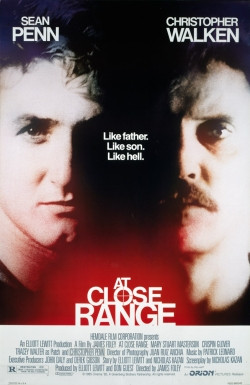
Brad Whitewood, Sr. (Christopher Walken) is known as Big Brad, a rural crime lord who rules the backwoods of Pennsylvania. When his son, Little Brad (Sean Penn, trying too hard to be James Dean), comes to live with him, Big Brad goes out of his way to try to bring the teenager into his criminal lifestyle. At first, Little Brad loves being a part of the family business but witnessing a murder and falling in love with Terry (Mary Stuart Masterson) caused Little Brad to start to move away from his father. With the FBI closing in on the Whitewood family, Brad Sr. starts to eliminate everyone who he considers to be a threat, including the members of his own family.
Based on a true story, this neo-noir features a great cast, including Chris Penn, Millie Perkins, Kiefer Sutherland, Crispin Glover, David Strathairn, Tracey Walter, and Mary Stuart Masterson. Unfortunately, the movie itself moves at a plodding pace. There are some good and disturbing scenes, like the montage where Big Brad starts to eliminate the members of his gang. The film does a good job of showing how seductive Big Brad’s criminal lifestyle can be to a bunch of kids who have basically been written-off by society. But the story itself is so bleak that most people will end up tuning out long before Little Brad finally turns against his father.
Whatever other flaws it may have, At Close Range does feature one of Christopher Walken’s best performances. Walken is chillingly evil as Big Brad. He’s got enough charisma to be believable as someone who could bring a gang together but he’s also frightening as he starts killing anyone who he thinks might talk to the police or the FBI. Big Brad is a remorseless killer and Walken plays him as being a classic sociopath, someone who cannot understand why the members of his gang and family would get upset when he starts killing some of them. To Big Brad, that just goes with the territory. It’s a part of doing business. With his distinct way of speaking and his trademark tics, Walken is someone who has inspired many impersonators and it can be easy to forget that he’s also a damn good actor. Films like At Close Range remind us of just how talented Walken actually is.
Today, it can be easy to forget what an impact Quentin Tarantino had on pop culture in the 90s. The one-two punch of Reservoir Dogs and Pulp Fiction inspired a generation of young and aspiring filmmakers to believe that anyone could make their own film. Suddenly, you didn’t have to be a film school graduate to call yourself a filmmaker. You could just be someone who loved movies and who was willing to keep hustling until you had something you could slip into Sundance. That was the feeling, anyway. The 90s were full of films about eccentric criminals who talked a lot and who loved pop culture, only three of which were directed by Quentin Tarantino. Some of them were good. Most of them were not.
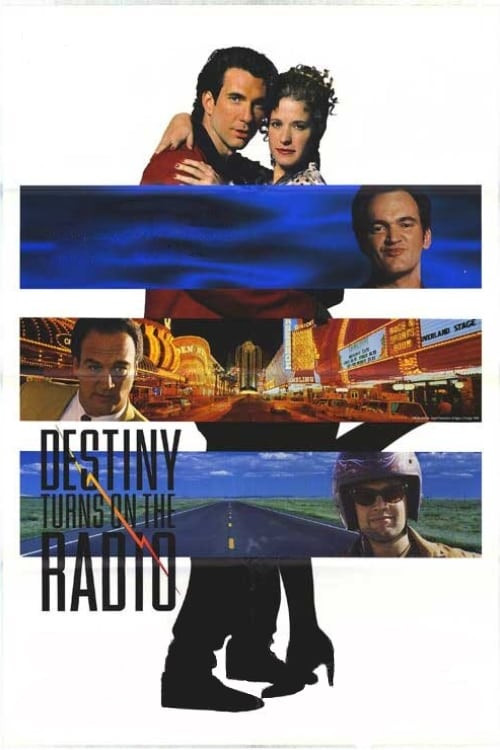
Destiny Turns On The Radio was one of the first films to rip-off Pulp Fiction and it felt more cynical than most because it was directed by Jack Baran, who wasn’t even a video store clerk. He was a producer of films like The Big Easy and Barfly, an industry veteran ripping off two films directed by someone who was, at that time, still an outsider. The film tells a story that had plenty of Tarantino elements, including Quentin Tarantino himself. Tarantino signed to play Johnny Destiny right after Pulp Fiction won the Palme d’Or at Cannes.
Johnny Destiny is a gambler who is apparently also a God. He emerges from a lightning-filled pool and his dialogue is full of pseudo-philosophy. He is driving through the desert when he picks up Julian (Dylan McDermott) and gives Julian a lift to Las Vegas. Johnny Destiny is taking prison escapee Julian on a ride so that Julian can face his destiny. Julian wants to recover some money from a bank job that he pulled off with Thoreau (James Le Gros) but it turns out that, when Johnny Destiny emerged from that pool, he also stole all the money. (There’s no specific reason for Thoreau to be named after the famous philosopher, beyond the film trying to make itself seem deep by drawing in everyone who read Walden in AP English.) Julian wants to get back together with Lucille (Nancy Travis), a singer who performs songs more appropriate for a 20s speakeasy than a Las Vegas lounge. Lucille is involved with a gangster (Jim Belushi). Belushi sings Vivia Las Vegas but otherwise, this is one of his more boring performances.
Like so many of the Pulp Fiction rip-offs of the 90s, Destiny Turns On The Radio is all self-conscious attitude and cool style, full of references to pop culture that fall flat because there’s no real thought behind them. Reservoir Dogs and Pulp Fiction were full of style but they also told compelling stories. Destiny Turns On The Radio is all style and little else and the cast never comes together the way that the actors in Tarantino’s first two movies did. Watching this film, I realized why Dylan McDermott and Nancy Travis both found more success on television than in feature films. The film posits Tarantino (as Johnny Destiny) as the epitome of cool but it then burdens him with the type of dialogue that he would have cut by the time he started a second draft.
Coming hot on the heels of the success of Pulp Fiction, Destiny Turns On The Radio actually led to a few years where many critics assumed Tarantino would be a two-trick wonder. It was thought lightning struck twice but it would never strike a third time and Tarantino would spend the rest of his career as almost a parody of his earlier success. Luckily, Tarantino proved them wrong and Destiny Turned On The Radio turned out to be not his career’s destination but instead just a detour.
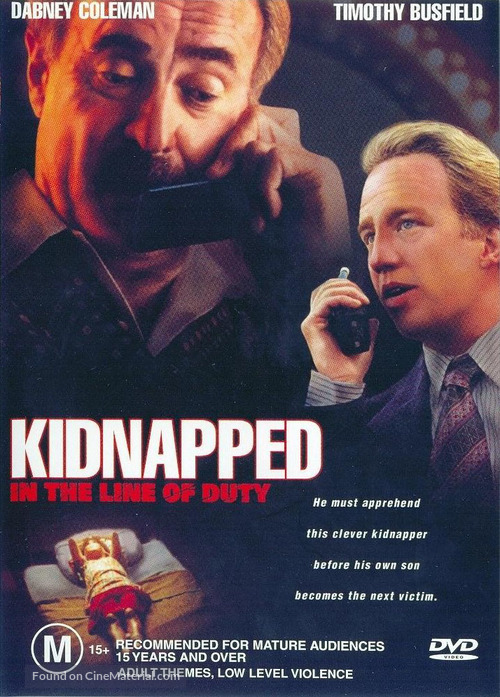
Arthur Milo (Dabney Coleman) is an IRS agent who uses his government position and the powers that with it to commit heinous crimes. (A corrupt IRS agent? What a shock!) Milo kidnaps the children of the wealthy, using legally-filed tax returns to select his target. Most of his accomplices all have the perfect alibi because they’re all in prison! As an agent of law enforcement, Milo is able to check them out of prison for hours at a time. Milo claims that they’re helping him out with an investigation but actually, they’re kidnapping children and digging graves in return for Milo’s help with their tax problems. Once the crime has been committed, Milo returns them to jail. It seems like the perfect plan but Milo may have met his match in hard charging FBI agent Pete Honeycutt (Timothy Busfield).
Loosely based on a true story, Kidnapped was the tenth of NBC’s In The Line of Duty films and it was one of the few not to be directed by Dick Lowry. It’s also the only one of the In The Line of Duty films to not feature a member of law enforcement getting gunned down nor does it end with a title card of statistics about the number of cops who are killed on the job each year. All of this leads me to suspect that Kidnapped was not originally meant to be an In The Line of Duty movie and that it was added to the series at the last minute. NBC was obviously hoping that the rating success of Ambush in Waco would rub off on Kidnapped.
Kidnapped is a pretty typical eccentric criminal vs eccentric investigator movie. Pete is obsessed with taking down Milo and Milo is obsessed with showing up Pete. It’s not a surprise when Milo starts to personally taunt Pete and it’s also not a surprise that Pete’s family is put at risk. There are a few strange moments of humor, most of them supplied by Tracey Walter as Milo’s spacey accomplice. The humor, though, doesn’t always seem to go along with a fact-based story about an IRS agent who abducted children and held them for ransom.
The best thing about the film is Dabney Coleman as Arthur Milo. Coleman has always been an underrated actor. Nobody did as good at a job at playing a curmudgeon as Dabney Coleman. In Kidnapped, Coleman takes his usual persona up a notch by playing Milo as someone who is not just annoyed by people but who is willing to kill them too. While Arthur Milo’s schemes are usually clever, he’s so arrogant and determined to show off how much smarter he is than everyone else that he’s usually his own worst enemy. He’s the type of criminal who wears a white suit and a panama hat, despite the fact that his outfit will make him instantly recognizable to anyone who witnesses his crimes. The character is a strange one but Coleman brings him to life and makes him believable. Kidnapped is a pretty standard police procedural but worth seeing for Coleman’s villainous turn.
As you can probably tell just from looking at everything that’s been posted on the site today, I love the Oscars. That said, I realize that the Oscars aren’t for everyone. Some people find Oscar-nominated movies to be boring. Some people find the ceremony to be unbearably pompous. Every year, there’s the lament of “The truly entertaining films always get snubbed!”
Well, fear not! If you’re not into the Oscars, there are alternatives! For instance, you can go over to Prime right now and rent the 1984 film, Conan the Destroyer!
Conan The Destroyer is the sequel to the original Conan the Barbarian, with Arnold Schwarzenegger returning as Conan and Mako returning as the sorcerer who narrates the events of Conan’s life. This film is a continuation of the adventures of the barbarian who would become king, a trip to a world much different from our own, and a study of savagery vs civilization. Of course, to most viewers, Conan The Destroyer is just the film where a weird lizard monster picks up Arnold Schwarzenegger by his feet and spins him around in circles. Have you seen that meme where it’s made to appear as if Kate Winslet is spinning around a helpless Schwarzenegger? Along with Titanic, this is the film that you have to thank for it.
Conan The Destroyer picks up from where Conan the Barbarian ended. Conan is still wandering around the desert, working as a thief and a mercenary. He’s still praying to Crom and missing Valeria. He’s picked up a companion, a cowardly thief named Malak (Tracey Walter). When Conan and Malk are captured by Queen Taramis (Sarah Douglas), Taramis offers to bring Valeria back to life if Conan will escort the Queen’s niece, Jehna (Olivia D’Abo), to a temple so that she can retrieve a gem that will be used to …. you know what? I’m just going to be honest here. I have absolutely no idea what the quest is about. It’s just one of those things where Conan and his crew have to break into a castle or a temple and steal something so that a god can either be awakened or defeated. The film, to be honest, is a bit vague about how it all works but then again, the mission is less important than the journey.
It turns out that, with the exception of her insanely tall bodyguard Bombaata (Wilt Chamberlain), Jehna has never seen an actual man before and, needless to say, she is quickly fascinated by Conan. (She asks Bombaata if Conan is as handsome as he appears to be, Bombaata reluctantly agrees that he is.) However, Conan only cares for the deceased Valeria. As he leads Jehna, Malak, and Bombaata to the castle where they’ll find the gem, he picks up some other traveling companions. The wizard Akiro (Mako) joins them as does the fierce warrior Zula (Grace Jones). Of course, it turns out that Taramis has an agenda of her own and it all ends in a lot of shouting, swordplay, and muscle flexing.
If Conan the Barbarian was distinguished by the grim and girtty approach that it took to material that others would have played for camp, Conan the Destroyer takes the opposite approach. Of course, a lot of that is because director/screenwriter John Milius did not return to oversee Conan the Destroyer. Instead, Conan the Destroyer was directed by Richard Fleischer, who was one of those veteran directors who made a countless number of films in all sorts of genres but who never really developed a signature style of his own. Fleischer takes a semi-comedic approach to Conan and his quest. As opposed to the brutal warrior and conqueror who appeared in Milius’s film, the Conan in this film is a well-meaning rogue who punches out a camel and who also gets tongue-tied whenever he has too much to drink or when Jehna flirts with him. There’s little of the first film’s violence in this sequel and none of the emotional stakes.
That said, Conan the Destroyer is definitely entertaining. It’s just such a silly movie that you can’t help but enjoy it. Schwarzenegger, apparently understanding that the film is never going to make any sense, cheerfully goes through the motions and he actually does a pretty good job with some of his more comedic lines. The allies and the villains who he collects through the film are all memorably flamboyant. Sarah Douglas is especially entertaining as the over-the-top villainous. If you’re going to be evil in a film like this, you might as well go all out.
Conan The Destroyer was not nominated for an Oscars but it’s still a fun movie.

 Through the Shattered Lens