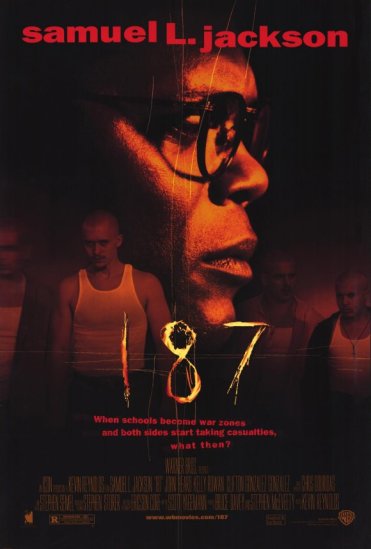
Back to School Part II #35: One Eight Seven (dir by Kevin Reynolds)


one_eight_seven_ver1

I’m writing this review from memory so you’re going to have to bear with me.  187 is one of those films that seems to show up on late night cable constantly, which is how I saw it.  I probably should rewatch it for this review but … no.  I don’t want to have to sit through it again.

See, here’s the thing with 187.  It’s a film where Samuel L. Jackson plays a high school science teacher and, just by definition, that should make it the greatest film ever and yet it isn’t.

Originally, Jackson’s working in New York but then he ends up failing one of his students (played by Method Man).  Method Man ends up giving Jackson a textbook on which he has written 187 on every single page.  Jackson immediately realizes that 187 is the name of the movie that he’s in.  “Always good to meet a fan,” he thinks but then suddenly, it dawns on him that 187 is also police code for homicide!  Jackson asks the school administration for help.  They ignore him (probably because everyone knows that Samuel L. Jackson is too much of a badass to be scared by some numbers in a textbook) and he ends up getting stabbed several times in the back.

Agck!

We jump forward 15 months.  Jackson has recovered from nearly being killed and he’s still determined to teach.  He wants to make a difference!  But he’s decided that New York kids are too homicidal so he transfers to a school in Los Angeles.  Surprise!  It turns out that students in Los Angeles are just as dangerous as the ones in New York.  During his first day as a substitute teacher, Jackson is writing his name on a chalk board.  Someone throws a crumpled ball of paper at him.  Jackson flinches as it hits his back.

FLASHBACK TIME!

Now, here’s the thing: the idea of Samuel L. Jackson teaching in an inner city high school and taking on a bunch of gang members sounds totally kickass.  And you spend this entire two-hour movie waiting for Samuel L. Jackson to have one of those wonderful Samuel L. Jackson moments when he fixes someone with that powerful glare and suddenly speaks in the voice of angry and vengeful God.  You keep waiting but, with the exception of a few moments, it never seems to happen.

I mean, don’t get me wrong.  I wasn’t expecting Jackson to say, “I’m sick of these motherfucking gangstas in this motherfucking classroom!”  It would have been great if he had said that but, after a few minutes of watching the movie, I realized that he probably wouldn’t.  187 is obviously meant to be a serious movie about America’s educational crisis.  Watching it, you get the feeling that 187‘s director, Kevin “I know Kevin Costner” Reynolds, woke up every morning and said, “I am making the most important film ever today!”

But whatever good intentions that the filmmakers may have had, it’s no excuse for totally wasting Samuel L. Jackson.  When you’ve got a powerful actor like Samuel L. Jackson, why do you waste him in such a thinly written role?  When you finally do allow him to do something big and Samuel L. Jackson-like, why do you waste so much dramatic potential by having him do almost all of it off-screen?  Jackson finally does get a great Samuel L. Jackson moment towards the end of the film but that’s just because there’s a big plot twist that doesn’t make any sense.  The end of 187 reminds the viewer that an ironic ending has to be earned.  It just can’t be slapped onto the film.

I mean, I don’t want to toss out any spoilers because, for all I know, 187 is going to be on Cinemax tonight.  If you’re up at 3 in the morning, you might end up watching it and God knows, I don’t want to be accused of giving away the ending.   But let me ask you this — if you’ve finally captured someone who you’ve spent an entire two-hour film trying to kill, would you then suddenly decide to play a game of Russian roulette?

Anyway, 187 should be avoided because it totally wastes Samuel L. Jackson and that’s kind of unforgivable.

44 Days of Paranoia #30: Nixon (dir by Oliver Stone)


For our latest entry in the 44 Days of Paranoia, we take a look at Oliver Stone’s 1995 presidential biopic, Nixon.

Nixon tells the life story of our 37th President, Richard Nixon.  The only President to ever resign in order to avoid being impeached, Nixon remains a controversial figure to this day.  As portrayed in this film, Nixon (played by Anthony Hopkins) was an insecure, friendless child who was dominated by his ultra religious mother (Mary Steenburgen) and who lived in the shadow of his charismatic older brother (Tony Goldwyn).  After he graduated college, Nixon married Pat (Joan Allen), entered politics, made a name for himself as an anti-communist, and eventually ended up winning the U.S. presidency.  The film tells us that, regardless of his success, Nixon remained a paranoid and desperately lonely man who eventually allowed the sycophants on his staff (including James Woods) to break the law in an attempt to destroy enemies both real and imagined.  Along the way, Nixon deals with a shady businessman (Larry Hagman), who expects to be rewarded for supporting Nixon’s political career, and has an odd confrontation with a young anti-war protester who has figured out that Nixon doesn’t have half the power that everyone assumes he does.

Considering that his last few films have been W., Wall Street: Money Never Sleeps, and SavagesI think it’s understandable that I’m often stunned to discover that, at one point in the distant past, Oliver Stone actually was a worthwhile director.  JFK, for instance, is effective propaganda.  Nixon, which feels a lot like an unofficial sequel to JFK, is a much messier film than JFK but — as opposed to something like Savages — it’s still watchable and occasionally even thought-provoking.  Thanks to Hopkins’ performance and, it must be admitted, Stone’s surprisingly even-handed approach to the character, Nixon challenges our assumptions about one of the most infamous and villified figures in American history.  It forces us to decide for ourselves whether Nixon was a monster or a victim of circumstances that spiraled out of his control.  If you need proof of the effectiveness of the film’s approach, just compare Stone’s work on Nixon with his work on his next Presidential biography, the far less effective W.

(I should admit, however, that I’m a political history nerd and therefore, this film was specifically designed to appeal to me.  For me, half the fun of Nixon was being able to go, “Oh, that’s supposed to be Nelson Rockefeller!”)

If I had to compare the experience of watching Nixon to anything, I would compare it to taking 10 capsules of Dexedrine and then staying up for five days straight without eating.  The film zooms from scene-to-scene, switching film stocks almost at random while jumping in and out of time, and not worrying too much about establishing any sort of narrative consistency.  Surprisingly nuanced domestic scenes between Anthony Hopkins and Joan Allen are followed by over-the-top scenes where Bob Hoskins lustily stares at a White House guard or Sam Waterston’s eyes briefly turn completely black as he discusses the existence of evil.  When Nixon gives his acceptance speech to the Republican Convention, the Republican delegates are briefly replaced by images of a world on fire.  Familiar actors wander through the film, most of them only popping up for a scene or two and then vanishing.  The end result is a film that both engages and exhausts the viewer, a hallucinatory journey through Stone’s version of American history.

Nixon is a mess but it’s a fascinating mess.

Other Entries In The 44 Days of Paranoia 

  1. Clonus
  2. Executive Action
  3. Winter Kills
  4. Interview With The Assassin
  5. The Trial of Lee Harvey Oswald
  6. JFK
  7. Beyond The Doors
  8. Three Days of the Condor
  9. They Saved Hitler’s Brain
  10. The Intruder
  11. Police, Adjective
  12. Burn After Reading
  13. Quiz Show
  14. Flying Blind
  15. God Told Me To
  16. Wag the Dog
  17. Cheaters
  18. Scream and Scream Again
  19. Capricorn One
  20. Seven Days In May
  21. Broken City
  22. Suddenly
  23. Pickup on South Street
  24. The Informer
  25. Chinatown
  26. Compliance
  27. The Lives of Others
  28. The Departed
  29. A Face In The Crowd