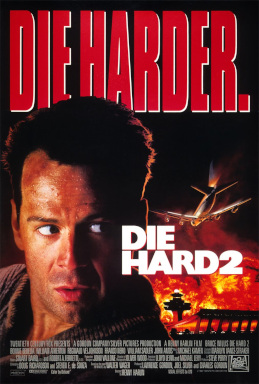
Holiday Film Review: Die Hard 2: Die Harder (dir by Renny Harlin)


During 1990’s Die Hard 2, John McClane (Bruce Willis) asks himself, “How can the same shit happen to the same person twice?” and he does have a point.

I mean, consider the situation.  In 1988, McClane spent his Christmas sneaking around a skyscraper and saving his wife from a group of sadistic mercenaries.  Two years later, John McClane spends his Christmas sneaking around an airport and saving his wife from a group of sadistic mercenaries.

There are a few differences of course.  In 1988, the mercenaries were only interested in stealing as much money as they could and each mercenary had his own properly ghoulish personality.  In 1990, the mercenaries are really more of a cult, led by the fanatical Col. Stuart (William Sadler).  And, along with trying to make some money, they are also trying to free General Ramon Esperanza (Franco Nero), a Central American drug lord and former CIA asset.  Despite the fact that the mercenaries are played by familiar actors (like Robert Patrick, John Leguizamo, Tony Ganois, and Vondie Curtis-Hall), none of them are quite as memorable as the henchmen that Alan Rickman commanded in the first film.  And while Sadler has charisma and makes a big impression during his first scene, his character is nowhere near as interesting or entertaining as Hans Gruber.  Franco Nero, it must be said, is as dashing as ever.  He really seems to be having fun in this movie.

A lot more people die in Die Hard 2 than died in the first Die Hard and the majority of them are innocent bystanders.  This isn’t like the first film, where Harry Ellis died because his coke-addled mind led him to believe that he could outsmart Gruber.  The victims in Die Hard 2 include a friendly church caretaker and over 200 passengers of an airplane that Stuart tricks into crashing on an airport runway.  The scene where the plane crashes remains disturbing no matter how many times that you see it and it truly makes you hate Colonel Stuart.  When the plane crashes, despite McClane’s futile efforts to warn the pilots, McClane sobs and it’s a powerful scene because it’s the first scene in which McClane has not had a quip or a one-liner ready to go.  In this scene, McClane fails to save the day and, for a few minutes, he’s helpless.  I usually end up crying with McClane.  Today, those tears are also a reminder of what a good actor Bruce Willis truly could be whenever he let down his defenses and allowed himself to be vulnerable on screen.

Die Hard 2 is usually dismissed as not being as good as the first movie and …. well, that’s correct.  It’s not as good but then again, few actions films are.  There’s a reason why Die Hard continues to be held in such high regard.  That said, Die Hard 2 is not bad.  The stakes are a bit higher and the action scenes a bit more elaborate, as you would expect from a film directed by Renny Harlin.  Bruce Willis plays McClane with the blue collar swagger that made his such an awesome hero in the first film.  Bonnie Bedelia and William Atherton also return from the first film and Atherton once again gets his comeuppance in a crowd-pleasing moment.  The cast is full of character actors, all of whom get a chance to make an impression.  Dennis Franz is the profane head of security who eventually turns out to be not such a bad guy.  John Amos is the major who eventually turns out to be not such a good guy.  Colm Meaney has a few heart-breaking moments as the pilot of the doomed airplane.  My favorite supporting performance is given by Fred Thompson, bringing his quiet authority to the role of tough but fair-minded Air Traffic Control director.  Watching Die Hard 2, it does feel as if the viewer has been dropped in the middle of these people’s lives.  Everyone seems real.  No one seems like a mere plot device.

Is Die Hard a Christmas movie?  You bet it is!  But so is Die Hard 2 and it’s not a bad one.
Porky’s Revenge (1985, directed by James Komack)


The senior class of Angel Beach High finally graduate in Porky’s Revenge, the last official Porky’s film.  It’s a good thing, too.  Most of the members of the Porky’s cast were already in their late 20s when they were cast in the first Porky’s.  By the time Porky’s Revenge was made, most of them looked more like they should be planning for their retirement than for college.

Director Bob Clark did not return for Porky’s Revenge and it really shows.  The third film doesn’t have any messages about tolerance or fighting bigotry.  Instead, it’s just a typical teen sex comedy with a subplot about Brian Schwartz (Scott Colomby) trying to help Coach Goodenough (Bill Hindman) pay back his gambling debt to Porky (Chuck Mitchell).  Otherwise, the gang plays basketball, tries to arrange an orgy with the cheerleaders, and even helps Ms. Balbircker (Ellen Parsons) find love.  I guess everyone forgot about Ms. Balbricker allying herself with the Klan during the previous film.

Porky’s Revenge doesn’t really have enough ambition to be terrible though.  It’s just bland.  Just as it doesn’t have the social conscience of the first two film, it’s also not as raunchy.  There’s considerably less nudity and the occasionally rough edges of the first two films have been removed.  That makes Porky’s Revenge less problematic but it also makes it less interesting.  The first two films may have been imperfect but they did capture the feel of high school.  This one doesn’t do that because the actors are too old and suddenly their characters are too nice.  If not for the title, you would think this was just another dumb comedy that played for a week at the drive-in as opposed to being the second sequel to the most commercially-successful Canadian film of the 80s.

I did laugh when the gang went to the ruins of Porky’s to make sure that it hadn’t been rebuilt, just to discover that Porky now owned his own steamboat.  I’m also glad that everyone finally graduated and gave the Porky’s saga a fitting close.

There was a direct-to-video sequel to Porky’s Revenge.  It came out in 2009 and was called Porky’s Pimpin’ Pee Wee.  I think I can live without watching it.

Porky’s II: The Next Day (1983, directed by Bob Clark)


The teens of Angel Beach, Florida are back!  They’re still trying to get laid, they’re still playing pranks on each other, and, this time, they’re …. FIGHTING THE KLAN!?

Porky’s II continues with the first Porky’s mix of raunchiness and social commentary.  While Pee Wee (Dan Monahan) tries to get back at his friends for spending the whole previous movie making fun of the size of his dick, the other members of the large ensemble cast thwart an attempt by the Klan to keep them from putting on a Shakespearean showcase.  The Klan is upset that a Seminole has been cast as Romeo so they burn a cross and do everything they can to sabotage the production.  Also trying to keep the show from going on is the hypocritical Rev. Bubba Flavel (Bill Wiley) and Mrs. Balbricker (Nancy Parsons), who both consider Shakespeare’s plays to be obscene.  When Wendy (Kaki Hunter) discovers that one of the county commissioners has been lying about supporting the play, she humiliates him in public by pretending to vomit in a fountain and accusing him of impregnating her.  It’s slightly funnier than it sounds but just slightly.

The first Porky’s took a stand against anti-Semitism while the second Porky’s takes a stand against censorship and the Klan.  That’s actually pretty cool when you consider that both of these films are usually just thought of as being dumb sex comedies.  Just like the first film, Porky’s II may be raunchy but it has a conscience.  That was due to director Bob Clark, who obviously meant for the Porky’s films to be about more than just T&A.

Unfortunately, Porky’s II is never as funny as the first Porky’s.  Too many of the jokes are recycled from the first film and the cast’s habit of laughing at their own “humorous” lines is even more grating the second time around.  Even the film’s most famous scene, where Wendy humiliates the duplicitous commissioner, goes on for too long and doesn’t have as much of a payoff as it should.  The best scenes in the film are the scenes that were lifted from Hamlet, Romero & Juliet, and A Midsummer Night’s Dream.  You wouldn’t expect the ensemble of Porky’s to feature that many Shakespearean actors but apparently it did.  Fans of A Christmas Story, which was also directed by Clark and which came out the same year as Porky’s II, will especially want to pay attention to the MacBeth sword fight scene just because the famous holiday leg lamp makes an appearance.

Porky’s II is nowhere near as good or memorable as the first Porky’s but its heart is in the right place.  While not as big of a success as the first Porky’s, it still did well enough to lead to Porky’s III, which I’ll review tomorrow.

Porky’s (1981, directed by Bob Clark)


Porky’s.

On the one hand, it’s a crude, juvenile, and raunchy sex comedy where a bunch of teenagers in 1960s Florida think that it’s a hoot and not at all problematic to spy on the girls shower and to hire a black man to scare all of their (white) friends.

On the other hand, it’s a heartfelt plea for tolerance where Tim (Cyril O’Reilly) finally stands up to his abusive father (Wayne Maunder) and makes friends with Brian Schwartz (Scott Colomby), who is apparently the only Jewish person living in Angel Beach, Florida.

What’s strange about Porky’s is that everyone knows it for being the template for almost every bad high school film that followed, with tons of nudity, jokes about sex, and characters with names like Pee Wee, Miss Honeywell, Cherry Forever, and Porky.  But, when you sit down and watch the movie, you discover that, for all the raunchiness, it actually devotes even more time to Brian Schwartz dealing with the local bigots than it does to any of the things that it’s known for.  Everyone remembers the shower scene but it’s obvious the film’s heart is with Brian and his attempts to make the world a better place.  Porky’s is a sex comedy with a conscience.

Porky’s is an episodic film about a group of teenage boys trying to get laid and also trying to get revenge on the owner of the local brothel.  There’s a lot of characters but I’d dare anyone to tell me the difference between Billy, Tommy, and Mickey.  I went through the entire movie thinking that Billy was Mickey until I turned on the subtitles and discovered who was who.  Porky’s has a reputation for being a terrible movie but it’s actually a pretty accurate depiction of the way that most men like to imagine how their high school years went.  It captures the atmosphere of good-spirited teenage hijinks if not the reality.

One of the interesting things about Porky’s is that Bob Clark went from directing this to directing A Christmas Story.  The innocence of A Christmas Story might seem like it has nothing in common with raunchiness of Porky’s but, actually, they’re both nostalgic films that are set in an idealized past.  (If you still think A Christmas Story has nothing in common with Porky’s, just remember that Ralphie didn’t actually say “fudge.”)  Of course, A Christmas Story struggled at the box office and only became a hit when it was released on video while Porky’s is still the most successful Canadian film to ever be released in the U.S.  Sex sells.  As cool as it was to see Brian Schwartz stand up for himself, I doubt the people who made Porky’s a monster hit were buying their tickets because they had heard the film struck a blow against anti-Semitism.  They were going because they knew there was a shower scene.

Porky’s deserves its reputation for being a not-so great movie but I would be lying if I said that I didn’t laugh more than once while watching it.  (Of course, I still didn’t laugh as much as the characters in the films laughed.  I’ve never seen a cast that was as apparently amused with themselves as the cast of Porky’s.)  There’s a lot of bad moments but it’s hard not to crack a smile when Miss Honeywell demonstrates why she’s known as Lassie or when one of the coaches suggests that wanted posters can be hung around the school to help catch the shower voyeur.  Plus, everyone learns an important lesson about tolerance and how to destroy a brothel.  As bad as it is, it’s hard to really dislike Porky’s.

A Movie A Day #339: Continental Divide (1981, directed by Michael Apted)


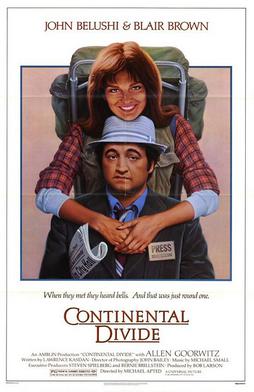
Ernie Souchak (John Belushi) is a reporter in Chicago.  He specializes in stories about municipal corruption and Mafia power plays.  Needless to say, living in Chicago, that keeps him busy.  Literally everyone in the city knows him.  Even the two muggers who try to steal his wallet recognize him and share inside information about which street gang is about to make a big move.  From a modern day vantage point, it seems strange to see everyone so excited about meeting a newspaper columnist but this movie was made in 1981, long before an army of bloggers put journalists like Ernie Souchak out of business.
Souchak’s gotten in trouble with the mob so his editor (Allen Garfield) sends him out of Chicago for his own protection.  Chain-smoking city boy Ernie Souchak finds himself in the Rocky Mountains, assigned to track down and get a story on Dr. Nell Porter (Blair Brown).  Dr. Porter has spent the last few years researching and protecting bald eagles.  She doesn’t like reporters but Souchak wins her over.  Despite being two very different people, Nell and Souchak fall in love.  But can a city boy and a country girl stay together, especially when there are people in Chicago who want Souchak dead?

A strange movie, Continental Divide was meant to be an updated version of the romantic comedies that Spencer Tracy and Katharine Hepburn used to make and Blair Brown was even made up to look like a young Hepburn.  It was one of the first films to be produced by Steven Spielberg, who has always been better at picking material as a director than a producer.  It was directed by Michael Apted, a great documentarian who has never shown himself to have much affinity for comedy.  It was written by Lawrence Kasdan, who specialized in homages to classic film genres and who, after this movie, made it a point to direct the majority of his scripts.  And it starred John Belushi, in his only romantic film lead.

Belushi, of course, is the main reason why anyone would want to see this movie.  It was his second-to-last movie, coming out between the popular success of The Blues Brothers and the infamous failure of NeighborsContinental Divide gives Belushi a chance to play a character, instead of just a version of his own wild persona.  The legend has always been that Continental Divide showed the actor that Belushi could have become if not for his tragic death.  The truth is that Belushi frequently looks uncomfortable and it is often evident that he is having to reign back his natural instincts.  Belushi’s best scenes are the ones where Souchak is walking around Chicago and hustling everyone that he meets.  In those scenes, he’s confident and in control and it’s easy to get swept up in his life.  His scenes with Blair Brown, where he has to be sincere and serious, are far more awkward.  Belushi has enough good scenes in Continental Divide to make you regret the performances that we never got but, at the same time, it’s evident that he still had room to grow as an actor.

If Belushi hadn’t died and had instead gone on to make several more movies (and hopefully beat his drug addiction at the same time), Continental Divide would probably be forgotten.  Instead, it now exists as a hint of what could have been.

A Movie A Day #26: The Taking of Beverly Hills (1991, directed by Sidney J. Furie)


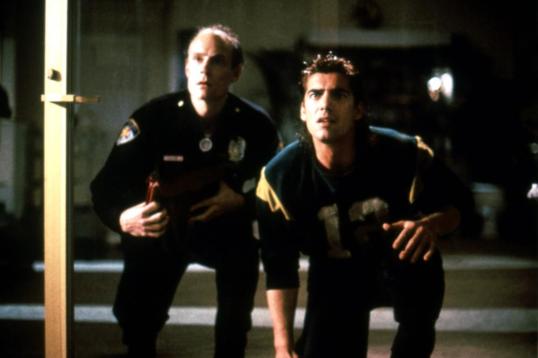
After a toxic chemical spill, Beverly Hills is evacuated.  While its citizens wait in a hotel, their mansions and valuables are guarded by the police and agents of the EPA.  Or so they think.  It turns out that the chemical spill was faked and that both the police and the government agents are in on it.  While the town’s deserted, they’re going to rob everyone blind.  The scheme’s mastermind is Bat Masterson (Robert Davi), the owner of L.A. Rams.  What Masterson doesn’t realize is that one citizen of Beverly Hills stayed behind, his own quarterback, Boomer Hayes (Ken Wahl).  Teaming up with Ed Kelvin (Matt Frewer), the last honest cop in town, Boomer sets out to protect Beverly Hills.

It’s just a dumb as it sounds.  In fact, of the many Die Hard ripoffs that came out in the late 80s and the early 90s, The Taking of Beverly Hills is probably the dumbest, which also makes it one of the most entertaining.  Boomer, who has an impressive mullet, can only speak in football analogies, constantly assuring Ed that it’s only the first down and that they can turn things around after halftime.  When Boomer gets serious, he says, “It’s time to play offense.”  One of the stranger things about The Taking of Beverly Hills is that, unlike working class hero John McClane, Boomer is not an outsider.  He’s in Beverly Hills because he’s rich.  The Taking of Beverly Hills is basically about one rich guy trying to keep another rich guy from robbing a bunch of other rich people.  It’s Die Hard if Hart Bochner had been the hero instead of Bruce Willis.

Keep an eye out for Lee Ving, lead singer of Fear, playing one of the corrupt cops and an uncredited Pamela Anderson cast as a cheerleader.  And keep your ears open for songs like Epic by Faith No More because their presence on the soundtrack (and the associated rights issue) is the reason was this stupidly entertaining movie will probably never get a DVD/Blu-ray release in the United States.

It has been released in Germany, where it was retitled Boomer after the lead character.

It has been released in Germany, where it was retitled Boomer after the lead character.