Late Night Retro Television Review: 1st & 10 1.2 “The Opener”


Welcome to Late Night Retro Television Reviews, a feature where we review some of our favorite and least favorite shows of the past! On Wednesdays, I will be reviewing 1st and Ten, which aired in syndication from 1984 to 1991. The entire series is streaming on Tubi.
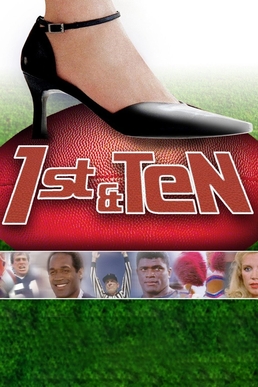
This week, the football season begins!

Episode 1.2 “The Opener”

(Dir by Bruce Seth Green, originally aired on December 2nd, 1984)

The opening game of the season is approaching.  The Bulls have trader their former quarterback (who was played, briefly, by Robert Logan in the pilot) for a new quarterback, Bob D0rsey (Geoffrey Scott).  Bob Dorsey is a notorious womanizer and a veteran player with a strong arm and a bad knee.  So, basically, he’s just like their former quarterback except he’s played by Geoffrey Scott instead of Robert Logan.

Dana has decided that Bob will start on opening day, instead of the quarterback that they drafted out of BYU, the ultra-religious Bryce Smith (Jeff East).  (Opening Day, quarterback, drafted — look at me using all the football terminology!)  Bryce is fine with not starting because he feels that it is God’s will for Bob to start.

However, the Mafia (represented by Michael V. Gazzo and Robert Miranda) is not happy!  It turns out that general manager Roger Barrow has been doing business with the Arcola Brothers.  He’s been giving them tickets and allowing the Arcolas to scalp them in return for a 20% commission.  Dana puts an end to that, saying that all the tickets will now be sold through the box office as opposed to being held for VIPs.  The Mafia wants Roger to make sure that Bob does not start.  Roger convinces one of the other players to injure Bob during practice so that Bryce will be the starter.

Uh-oh!  Bob injures his knee.  Bryce is going to have to play …. except, right before the team hits the field, the team doctor suddenly says that Bob’s knee is at 80% and he can play if he wants to.  Of course, Bob wants to!  Bob takes the field and, after several minutes of stock footage, we’re told that the Bulls have won the game.

This show feels so strange.  On the one hand, I get the feeling that this episode probably was realistic about the physical toll that playing football takes on a player.  Bob is 35 and can barely walk.  I imagine that the episode’s portrayal of the locker room being a mx of stupidity and testosterone was probably accurate as well.  I’ll even give the episode credit for showing that all of the players resent the team’s owner and that Coach Denardo uses that to his advantage when it comes to motivating them.  Everyone — well, almost everyone — resents their boss.  (Not me!  I love everyone I’ve ever worked with!)

On the other hand, the first two episodes have been so low-budget that it appears there’s only five or six players on the team and the mix of comedy and drama feels rather awkward.  Dana’s friend Mona (Ruta Lee) starts drinking in the morning and tossing out pithy one liners.  Meanwhile, the Mafia is threatening to kill Roger.  It really doesn’t fit together.  The whole thing just looks and feels cheap.

But, hey, the Bulls won!  Good for them!
Holiday Film Review: Little Miss Millions (Dir by Jim Wynorski)


A Jim Wynorski Christmas movie!?

Yes, there is such a thing.  First released in 1993, Little Miss Millions tells the story of a cynical but good-hearted private investigator named Nick Frost (Howard Hesseman) who is hired to track down a 9 year-old runway named Heather (Jennifer Love Hewitt, making her feature debut at the age of 12).  Nick is hired by Heather’s stepmother, Sybil (Anita Morris), who only wants Heather back because she’s worth several million dollars.  After Sybil hires Nick, she also decides to frame him for kidnapping Heather so that she can both get back her stepdaughter and get out of having to pay any reward money.  Soon, Nick has two federal agents (played by James Avery and Robert Fieldstell) on his trail.  For her part, Heather just wants to find and live with her birthmother, Susan (Terri Treas).

It’s a pretty simple film, one that borrows heavily from It Happened One Night (minus the romantic element, of course) and every single Christmas film that has ever been made.  This is one of those rather corny family films where you will pretty much be able to guess everything that is going to happen before it happens but that’s not necessarily a bad thing.  It’s a holiday film and no one watches a holiday film to get depressed.  They watch holiday films for the sentimental moments and the heart-warming comedy and the moments that create an idealized portrait of life during the holiday season.  For all of the violence to be found in them, both Die Hard and Die Hard 2 end with John McClane being reunited with his wife for the holidays.  As dark as It’s A Wonderful Life occasionally is, it still ends with that bell ringing and Clarence getting his wings.  Miracle on 34th Street never answers for sure whether or not Kris Kringle is who he says he is but Natalie Wood still gets her house with a tree in back.  A Christmas Story‘s Ralphie does not shoot his eye out.  Lethal Weapon‘s Riggs finds a new family.  And don’t even get me started on Santa Claus Conquers The Martians.  We watch holiday movies for holiday cheer and, in its unpretentious way, Little Miss Millions is full of that cheer.

Of course, it’s still a Jim Wynorski film.  So, while this is definitely a family film without many of the things that are typically associated with the Wynorski brand, Little Miss Millions still finds time for a sudden rainstorm that leaves everyone drenched.  And, of course, Nick and Heather stop off at a biker bar that is inhabited by Rick Dean, Toni Naples, and wrestler Queen Kong.  Peter Spellos, who played the much-abused Orville Ketchum in Sorority House Massacre 2 and Hard To Die, shows up as a bus driver.  It’s still a Wynorski film but it’s also a sweet-natured film, featuring likable performances from Howard Hesseman and Jennifer Love Hewitt.  It’s not a holiday classic but it’s diverting enough for those looking for something with which to pleasantly pass the time.

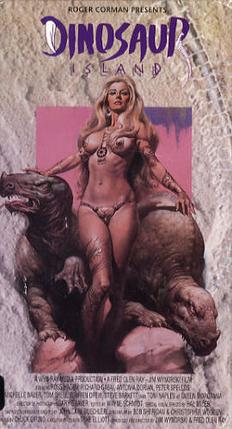
Dinosaur Island (1994, directed by Fred Olen Ray and Jim Wynorski)


What do you get when a producer like Roger Corman notices that Jurassic Park was the most financially successful film of 1993?

Dinosaur Island!

Directed by not just Fred Olen Ray but also Jim Wynorski (and if that combination isn’t enough to spark your interest, I don’t know what is), Dinosaur Island is about what happens when a cargo plane transporting three AWOL soldiers back to the United States crashes near an uncharted island. Led by no-nonsense Capt. Briggs (Ross Hagen), the soldiers make it to the island.

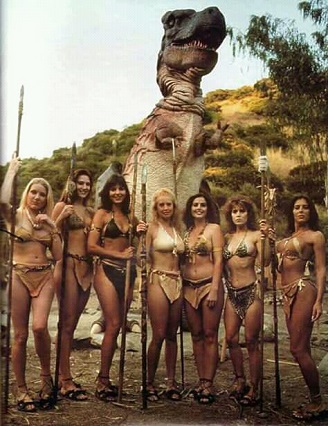
They discover that the island is full of beautiful cavewomen who spend much of their time topless. For the film’s intended audience of teenage boys, that’s good.

They discover that the women are ruled by a queen (Toni Naples) who hates men. That’s bad.

When the women notice that one of the men has a smiley face tattoo, they decide that he is the chosen one who has been prophesized about in the ancient scrolls. That’s good, I guess.

Chosen or not, the men still have to battle the Tyrannosaurs Rex that rules the island. That’s bad. Or is it good? I don’t know anymore.

To save money, Roger and the gang reused the dinosaur who appeared in Corman’s previous Jurassic hit, Carnosaur. They also reused a lot of stock footage from that film. The Carnosaur footage often doesn’t match with the footage that was shot for Dinosaur Island but I don’t know that anyone would expect anything less from Corman-produced rip-off of Jurassic Park. There are some films where the cheapness of it all become a selling point and this is one of them. The special effects are less important than marveling at how the movie got a dinosaur without spending any money.

Dinosaur Island is a bad movie with less than convincing special effects and a lot of overacting but it seems to be aware of its limitations so it’s hard not to like it. It’s obvious that Ray and Wynorski both understood that there was no way that they were gong to be able to make a serious film with the resources that they had available so instead, they shot a flat-out comedy that made fun of its own cheapness. It was the right approach to take, even though the film’s jokes are as often groan-worthy as they are funny. Among the cast, Ross Hagen seemed to have the best understanding of what was needed because he deadpans his way through the entire film, delivering his weird lines with a straight face and giving a performance that wouldn’t be out of place in Airplane! or one of the other ZAZ films.

Not surprisingly, this was a popular film on late night cable back on the day. It’s combination of boobs, jokes, and dinosaurs made it a Cinemax mainstay. Rewatching it, I knew how stupid it was but I couldn’t help but laugh at a few parts. I enjoyed viewing it again. Nostalgia is more powerful than any dinosaur.

The TSL’s Horror Grindhouse: Hard To Die (dir by Jim Wynorski)


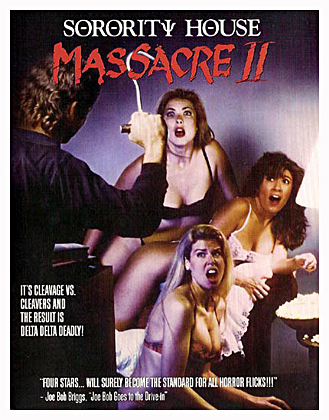
Do you remember how, a few days ago, I reviewed a silly little movie called Sorority House Massacre II?

Well, it turns out that there’s a sequel and it’s on YouTube!  Both films were directed by Jim Wynorski and featured pretty much the same cast, despite the fact that a few of them were playing new characters.  It was released under several different titles.  Hard To Die is the one that I’m going with for this review.  However, the film was also known as Tower of Terror, which makes sense when you consider that the majority of the film takes place in a hi-rise office building.  It was also apparently released in some places as Sorority House Massacre III, despite the fact that there’s no sorority house in the movie.

Actually, it’s debatable whether or not Hard To Die is actually a sequel.  It’s true that Orville Ketchum (Peter Spellos) does make another appearance.  In the first movie, Orville was the creepy neighbor.  In Hard To Die, he’s the janitor at the office building.  Orville tells the exact same story, with the exact same flashbacks, that he told in Sorority House Massacre II.  (Those flashbacks, of course, were lifted from a totally unrelated movie called Slumber Party Massacre.  There were apparently a lot of massacres in the 80s and 90s.)  The evil spirit of Hockstadder returns as well, though this time he comes flying out of a box that was accidentally delivered to the office building as opposed to a Ouija board.  And, of course, there’s an abundance of lingerie, awkward dialogue, and cheap gore effects.  (At one point, a bucket of fake blood is literally splashed on a wall.)  However, Hard To Die also tells almost exactly the same story of Sorority House Massacre II.  There are so few differences that I’m actually more tempted to say that Hard To Die is a remake of Sorority House Massacre II than a sequel.  The only problem with that theory is whether or not a second movie can be considered remake when the first movie literally came out the exact same year.

(One of the reasons that I love my work here at the TSL is that it allows me to obsess over minutia like this.)

Anyway, the main difference between Hard To Die and Sorority House Massacre III is that there’s no sorority house in Hard To Die.  Instead, Hard To Die takes place in a lingerie shop that just happens to be located on the 7th floor of a skyscraper.  The hard-working employees are spending the weekend doing inventory but it’s not going to well.  For one thing, the sprinklers accidentally go off so everyone decides to take off their wet clothes, put on skimpy lingerie, and order pizza.  Personally, I probably would have waited for the pizza to arrive before getting naked but then again, I’ve never worked retail or dated a pizza deliveryman.

The pizza does eventually arrive but no one gets to eat it because the deliveryperson gets set on fire and ends up falling several floors to her death.  That’s a waste of good pizza, which is kind of depressing.  Meanwhile, Orville keeps trying to warn everyone about Hockstadder but, instead, he keeps getting beaten up.  The end credits of Hard To Die promised that the next film would be called Orville In Orbit.  Apparently, it was never made but I do hope that Orville got a vacation after all of this.

Anyway, Hard To Die is an extremely silly movie but it’s just so sincere in its silliness that it feels somewhat churlish to be too critical of it.  If I had to choose whether to be in Sorority House Massacre II or Hard To Die, I would probably pick Hard To Die because, at least in that movie, I’d get to shoot a machine gun.  Hard To Die is so blatantly and unapologetically over the top that you can’t help but be amused by it all.

The TSL’s Horror Grindhouse: Sorority House Massacre II (dir by Jim Wynorski)


Some movies just force the viewer to ask, “What would you do?”

I mean, just consider what it would be like to be in the scenario that’s presented to us in the 1990 film, Sorority House Massacre II.  You’re a college student.  You’ve got your entire future ahead of you.  The president of your sorority has just purchased a new sorority house and she wants you and three others to spend the weekend helping her fix the place up.

You arrive at the house and you discover that it’s literally on the verge of collapsing.  There’s no electricity.  There’s no telephone.  (And remember, this is back when people just used landlines.)  There’s no hot water.  Soon after arriving, you’re informed that there’s two reasons why the house was being sold at such a cheap price.

First off, there’s the neighbor.  He’s a creepy, kinda pervy-looking guy named Orville Ketchum.  When Orville comes over to meet his new neighbors, he announces that he has the keys to the basement.  He reaches into his pants to retrieve them.  Ewwww!

Secondly, it turns out that the house isn’t just any deserted house.  It’s the old Hockstadder Place!  Years ago, Mr. Hockstadder killed his daughters before dying.  Orville witnessed the whole thing.  As he tells the story, you might notice that the flashbacks are lifted from a film called Slumber Party Massacre, despite the fact that you’re starring in Sorority House Massacre II.

Despite all of that, you still enter the house.  A storm is rolling in and, whenever you look out the window, you see the same lightning stock footage that has appeared in a countless number of cheap horror movies.

When you and your friends decide to explore the basement, you find a Ouija board.  You know that Ouija boards can be dangerous but everyone else wants to run upstairs and use it.  Someone suggests that maybe the board can be used to contact the spirit of Hockstadder.  After all, according to Orville, Hockstadder swore that his murderous spirit would never leave the house and would possess anyone who tried to move in.

At this point, you have two options.

Do you say, “Okay, obviously, it’s not a good idea to contact the spirit of a murderer — especially one that said he would possess anyone who tries to contact him — so I’m going to go ahead and leave now?”

or

Do you light some candles, strip down to your underwear in front of a bunch of open windows (despite the fact that weird old Orville is right across the street), sit on a filthy floor, and try to communicate with the spirit of a homicidal maniac?

The smart option would be the first one so, of course, the characters in Sorority House Massacre II do the exact opposite.  Then again, nobody in Sorority House Massacre II appears to be that smart.  For one thing, they’re all in their 30s and they have yet to graduate college.  Trust me, I wish I could have stayed in college forever but, at some point, you really do have to either graduate or drop out.  Tuition’s not cheap.

Anyway, Sorority House Massacre II is one of those movies that just amuses me to death.  There’s absolutely nothing subtle about it.  It’s such a blatant exploitation film that you can’t help but admire it for not pretending to be something that it isn’t.  (At the same time, it’s rather tame when compared to the movies that we’re used to today.  Whenever someone is killed, obviously fake blood is squirted on a wall.)  This may be a stupid movie but it’s very sincere in its stupidity and there’s something to be said for that.

Add to that, Peter Spellos is memorably weird as Orville.  The way he delivers his lines makes Orville into the neighbor that everyone would dread having next door.  In the end, though, it’s a good thing that Orville was there.

Finally, there is one surprisingly effective moment.  The movie starts with the “final girl” huddled in a dark room, begging the unseen killer to remember who they are.  The movie then flashes back to that morning, with the girls standing in front of the house.  The abrupt cut from darkness to the bright and sunny morning is surprisingly effective and feels almost dream-like.  Though one gets the feeling it was probably unintentional, it’s still works far better than you’d expect.

http://www.youtube.com/watch?v=arEhoUT0ang