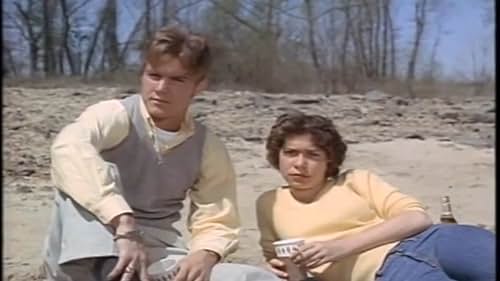
Dennis Quaid in Toad Suck, Arkansas!


Happy 71st Birthday to Dennis Quaid. He’s been in a lot of good movies over the years, but I’m quite partial to a movie he made in 1977 called SEPTEMBER 30, 1955. He stars alongside Richard Thomas, Tom Hulce, Susan Tyrrell, Deborah Benson and Lisa Blount. The movie is about a group of friends at the Arkansas State Teachers College, which is my Alma mater the University of Central Arkansas, who deal with the death of James Dean. It’s a good movie that was filmed all around central Arkansas, including my home community of Toad Suck, Arkansas. In the picture above he’s sitting on a “beach” along the Arkansas River in Toad Suck. I’ve been there many times. The movie was written and directed by the talented Arkansan James Bridges, of THE PAPER CHASE and URBAN COWBOY fame. It’s a film well worth searching out. I’ve included the trailer below.

Retro Television Review: St. Elsewhere 1.13 “Family History”


Welcome to Retro Television Reviews, a feature where we review some of our favorite and least favorite shows of the past! On Fridays, I will be reviewing St. Elsewhere, a medical show which ran on NBC from 1982 to 1988.  The show can be found on Hulu and, for purchase, on Prime!

Usually, I review this show on Friday but, yesterday, my week of visiting Lake Texoma in freezing weather finally caught up with me and I spent most of the day congested and curled up in bed.  As a result, St. Elsewhere got preempted until today.  Now, let’s see what’s happening at St. Eligius….

Episode 1.13 “Family History”

(Dir by Kevin Hooks, originally aired on February 8th, 1983)

After being a background character for the past few episodes, Dr. Wendy Armstrong (Kim Miyori) finally gets her time in the spotlight with this episode.  When Charlie Heller (Keenan Wynn) comes into the ER with a chronic nosebleed, Dr. Armstrong is too quick to assume that it’s nothing serious.  Dr. Westphall, who is in an especially crappy mood this episode, reprimands her for not getting a family history before making her diagnosis.  A chastened Armstrong gets Charlie’s family history and comes to suspect that he has a rare blood condition that only seems to effect Jewish men.  A very expensive test confirms Armstrong’s diagnosis.  Armstrong is excited.  “I was right!” she says.  Westphall again reprimands her, telling her that she now needs to tell Charlie that he has a chronic condition and will have to take medicine for the rest of his life.

Seriously, Westphall was not in a good mood during this episode!  But I don’t blame him.  From her first appearance on the show, Dr. Armstrong has been complaining nonstop.  No matter what happens in the hospital, she seems to take it as a personal affront.  Now, after several episodes of complaining about the other doctors, Armstrong fails to do a simple thing like get a family history.  No wonder Westphall was all like, What are you bragging about?

That said, even if his mood was understandable, I would not want to get on Westphall’s bad side.  Even after Armstrong makes the correct diagnosis, Westphall takes the time to say, “Next time, do what I told you to do.”  Agck!

While Westphall was dealing with whatever was eating away at him, Dr. Chandler was getting annoyed by John Doe’s refusal to try to remember anything about his past.  Even when John Doe’s real father showed up and explained that Doe was his son, Dave Stewart, he refused to try to remember anything.  Eventually, Chandler snapped at Dave for refusing to even try.  Chandler, of course, is played by a young Denzel Washington so, when he gets mad, it’s like having the voice of God call you out.  After Chandler’s reprimand, Dave finally makes an effort to remember his past.  He realizes that, when he was shot, he had a vision of his deceased mother welcoming him to heaven.  Awwww!

Dr. Craig’s friend has his gender affirmation surgery.  Crag met his friend’s lover, a trans man.  Needless to say, this episode featured a lot of scenes of Craig rolling his eyes as he struggled to come to terms with everything he was learning about his old friend.  It was all pretty predictable but William Daniels did a great job playing up Craig’s confusion and single-mindedness.

And finally, Peter was happy because his wife wanted to get back together.  I get the feeling any happiness Peter feels is destined to always be temporary.

This episode was a bit uneven.  Armstrong’s story would have been compelling if Armstrong herself was a more interesting character.  The highlight of the episode were the scenes between Denzel Washington’s doctor and Tom Hulce’s amnesiac.  It’s always enjoyable to watch two good actors perform opposite of each other.

Next week, the great Norman Lloyd takes center stage as Auschlander’s cancer returns.


Retro Television Review: St. Elsewhere 1.12 “Release”


Welcome to Retro Television Reviews, a feature where we review some of our favorite and least favorite shows of the past! On Fridays, I will be reviewing St. Elsewhere, a medical show which ran on NBC from 1982 to 1988.  The show can be found on Hulu and, for purchase, on Prime!

This week, things get dark.

Episode 1.12 “Release”

(Dir by Victor Lobl, originally aired on February 1st, 1983)

The gunshot victim (Tom Hulce) who was saved by Samuels last week has woken up but he has no idea who he is.  He is labeled John Doe #12, meaning there’s at least eleven other people at St. Eligius who are suffering from amnesia!  That’s a scary thought.  There’s a lot of things that I don’t want to suffer from and amnesia is high on the list.  I can’t imagine how frightening that would be, not having any idea who you are or where you belong.

Dr. Chandler tries to help John Doe #12 get his memory back but, in this episode at least, neither has any luck.  Even an attempt at hypnosis reveals that John can’t remember anything before being rolled into the ER.  At one point, an older couple step into the room to discover if John is their son, who has been missing for two years.  He’s not, which leaves the couple in tears.

As serious and as heart-breaking as this all is (and both Washington and Hulce give outstanding performances in this episode), there is one moment where Dr. Westphall makes a reference to a “Lt. Gerard,” who is searching for John’s parents.  It seems like a throw-away reference, unless you’re familiar with either the 1950s television show The Fugitive or the subsequent 1993 film adaptation.  Lt. Gerard was the name of the detective who was hunting for that show’s main character, Dr. Richard Kimble.  Ed Flanders delivers the line solemnly and it occurs at a serious moment.  There’s no winking at the audience.  Instead, it’s simply a reward for the pop culture-literate who might be watching the episode.

For the most part, this was a grim episode.  After losing a patient to cancer, Dr. Peter White was ordered to talk his family into signing a release for an autopsy.  The autopsy was largely to protect the hospital from getting sued.  The family didn’t want an autopsy.  Peter didn’t feel the autopsy was necessary.  But, having been bullied by his superiors, Peter proceeded to bully and manipulate the dead man’s son into signing the release.  In the end, it turned out that Peter was correct.  The man did die of cancer.  The autopsy was not necessary.  Upset over the whole process, Peter said that he felt like he had “raped” a mourning family.  The doctor who ordered Peter to get the release merely smiled and said he would see Peter at rounds the next day.

Meanwhile, Dr. Craig was shocked and angered when he discovered that his old friend (played by Andy Romano) had checked into the hospital for gender-affirming surgery.  This led to the episode final scene, in which Craig talked about not liking the way the world had changed since he was a young man.  The scene was well-acted by William Daniels, who was one of the best when it comes to giving a monologue of frustration.

And finally, Dr. Samuels and Dr. Paxson disagreed on how to treat a patient and this storyline would have been interesting if either Samuels or Paxson had been an interesting character.  But they’re not.  I don’t care about them.  I don’t care about their boring relationship.  And, knowing that neither is going to be around once this season ends, I really didn’t care that much about their storyline.  With all of the interesting stuff that happened in this episode, I groaned whenever I realized I was going to waste a few minutes watching Samuels and Paxson argue.

This episode left me feeling pretty depressed.  Between Peter bullying that family and John Doe searching for his identity, there wasn’t much hope to be found.  Still, I have faith that John Doe will find his identity and maybe Peter will even become a better doctor.  (He certainly can’t get much worse.)  If Lt. Gerard could find Richard Kimble, then anything’s possible!


Retro Television Review: St. Elsewhere 1.11 “Graveyard”


Welcome to Retro Television Reviews, a feature where we review some of our favorite and least favorite shows of the past! On Fridays, I will be reviewing St. Elsewhere, a medical show which ran on NBC from 1982 to 1988.  The show can be found on Hulu and, for purchase, on Prime!

This week, a handful of doctors save two patients and lose one.

Episode 1.11 “Graveyard”

(Dir by Victor Lobl, originally aired on January 18th, 1983)

It’s the graveyard shift at St. Eligius.  The halls and the cafeteria are dark.  The ER is oddly calm.  There are only a few patients to be looked after and most of the doctors are playing poker and talking about the rather boring subject of Dr. Samuels’s love life.

Only a handful of the series regulars make an appearance in this episode but that’s fine.  This episode actually provides a nice break from having to keep track of where everyone is.  Unfortunately, as I already said, a lot of this episode is centered around the character of Dr. Samuels.  Nothing against the late David Birney, who did a perfectly acceptable job in the role, but Dr. Ben Samuels is just not that interesting of a character.  He’s a dedicated surgeon who feels too much, drinks too much, and wants to sleep with his colleagues.  That’s fine but I grew up watching General Hospital.  I’ve seen a hundred doctors just like Samuels on television.

To me, the far more interesting characters are the people like David Morse’s Jack Morrison or Ed Begley, Jr’s Victor Ehrlich or even Terence Knox’s Peter White.  They’re doctors who screw up and aren’t always brilliant and sometimes say the wrong things.  They feel like real people whereas Dr. Samuels just feels like a cliche, a holdover from some other medical show.  Samuels is not a particularly compelling character and, when I did some research, I was not surprised to discover that David Birney only appeared on one season of the show.

G.W. Bailey’s Hugh Beale also only appeared in the first season and that’s a shame because Bailey’s performance as Beale has been one of the first season’s real pleasures.  Bailey plays Beale as a compassionate man who often pretends to be more naive than he is.  As a Southerner, he’s an outsider on this Boston-set show and, being an outsider, he can often relate to the patients in the psych ward.  Of course, that still doesn’t stop Dr. Beale’s main patient, Ralph the Birdman, from throwing himself off the roof of the hospital in this episode.  To be honest, I already suspected things weren’t going to go well for Ralph on this show but his suicidal jump still upset me.  As annoying as the character was, he was also finally making some progress.  He finally admitted he wasn’t a bird.  And then he proved it by showing that he couldn’t fly.

While Ralph plunged to his death, Dr. Samuels saved a gunshot victim (played by Tom Hulce).  And Jack allowed the father (James Hong) of one of his comatose patients to perform a Chinese ritual that led to the patient waking up and eventually walking into the cafeteria, where the doctors were playing poker.  “Who ordered the Chinese?” Fiscus asked and …. ugh.  Not cool, Fiscus.

It was a night of triumph and tragedy.  Ralph died but Dr. Samuels and Dr. Paxton agreed to give their relationship another try which …. eh.  I don’t care about Samuels and Paxton.  For the most part, though, I liked this episode.  The smaller cast made it easier to keep track of things and the poker game banter reminded me that the doctors are all people too.  Still, I have to feel bad for Ralph.  All he wanted to do was fly.

Scenes That I Love: Mozart Meets The Emperor in Amadeus


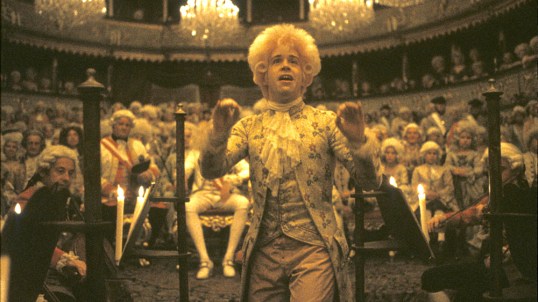
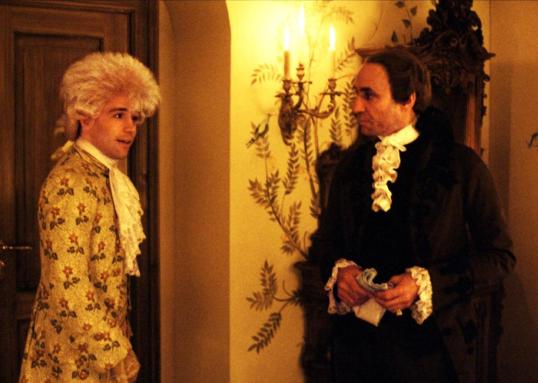
Today is Mozart’s birthday so, of course, today’s scene from the day comes from 1984’s Amadeus.  In this scene, the Emperor (Jeffrey Jones) delivers his critique to Mozart (Tom Hulce) and anyone who has ever had to deal with an idiotic critic will be able to relate.

“There’s too many notes!”

What really makes this scene work, along with Hulce’s reaction, is Jones’s blandly cheerful manner.  The Emperor really thinks he’s being helpful!

Lisa Reviews An Oscar Winner: Amadeus (dir by Milos Forman)


The 1984 film Amadeus is about a man who learns, after it’s a bit too late to really do anything about it, that he is thoroughly mediocre.

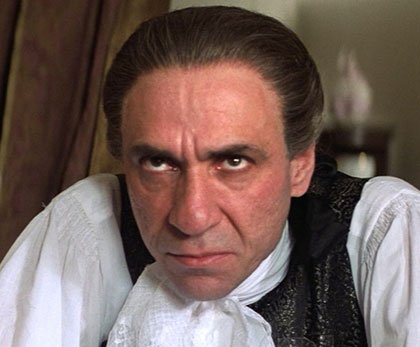
When we first meet Antonio Salieri (played by F. Murray Abraham), he’s an old man who has been confined to a mental asylum because he attempted to slit his own throat.  What should drive Salieri — a respected, if not particularly beloved, composer in 18th Century Vienna — to attempt to take his own life?  As he explains it to Father Vogler (Richard Frank), it’s the guilt of knowing that he’s responsible for death of the greatest composer of all time, Wolfgang Amadeus Mozart.

When Mozart (Tom Hulce) first showed up in Vienna, Salieri was already the court composer to the thoroughly vacuous Emperor Joseph II (Jeffrey Jones).  At the time, Salieri believed himself to be a genius touched by God.  As he recounts to Father Vogler, he prayed to God when he was a boy and he struck what he believed was an ironclad deal.  God would make Salieri a great composer and Salieri would remain a faithful believer.

But then Mozart shows up and, from the minute that he first hears one of Mozart’s compositions, Salieri realizes that Mozart is the one who has been blessed with genius.  Mozart is the one who is writing the music that will be remembered for the rest of time, long after Salieri and all of his other rival composers have been forgotten.  Upon first hearing Mozart, Salieri suddenly realizes that he has been betrayed by God.  He is a mediocre talent and he’s always been a mediocre talent.

The worst part of it is not just that Mozart’s a genius.  It’s also that Mozart knows he’s a genius.  He’s a bit of a brat as well, with a remarkably annoying laugh and vulgar manners that scandalize proper society.  Despite the efforts of his rivals to dismiss his talent, Mozart is beloved by the common people.  He’s an 18th century rock star and it seems as if no amount of scandal and petty jealousy can slow him down.  Even worse, the emperor takes a interest in Mozart and commissions him — and not Salieri — to write an opera.

Rejecting a God that he feels has betrayed him, Salieri plots Mozart’s downfall….

Goddamn, this is a great movie.  Seriously, everything about Amadeus works.

The ornate sets and the costumes not only wonderful to look at but they also actually tell us something about the characters who inhabit them.  One look at the beautiful but cluttered home that Mozart shares with his wife, Constanze (Elisabeth Berridge), tells you almost everything you need to know about not only Mozart’s tastes (which are expensive) but also his talent (which is undisciplined but also limitless).  The empty-headedness of Emperor Joseph is perfectly mirrored by the pretty but uninspired decor of his court while the grubby chaos of the mental asylum seems to have sprung straight from Salieri’s tortured soul.  As visualized in Amadeus, there’s a cold beauty to Vienna, one that is fascinating but, at the same time, menacing.  As for the costumes, Mozart’s powdered wig somehow seems to be brighter than everyone else’s and his colorful wardrobe demands your attention.  Meanwhile, when a costumed and masked Salieri shows up at Mozart’s door, he’s like the Grim Reaper coming to collect a soul.

The witty script is full of sharp lines and director Milos Forman does a wonderful job of balancing comedy and drama.  The scenes involving Joseph II are frequently hilarious and Jeffrey Jones does a great job of portraying Joseph as essentially being a very influential dunce.  The scene where Joseph tells Mozart that he liked his latest composition but that “there are simply too many notes” is a classic and one to which any artist, whether they’re Mozart or not, will be able to relate.  (“Just cut a few and it will be perfect.”)

The film is dominated by the performances of F. Murray Abraham and Tom Hulce.  Hulce is wonderfully flamboyant in the early part of the film and, bravely, he doesn’t shy away from portraying Mozart as occasionally being a bit of a spoiled brat.  It’s not just that Mozart can be annoying.  It’s also that he’s often deliberately annoying.  When we first see Mozart, it’s easy to understand why his very existence so grated on Salieri’s nerves and why Salieri considers him to be an “obscene child.”  But as the film progresses, Hulce lets us in and we come to see that Mozart is actually a very vulnerable young man.  When his disapproving father (Roy Dotrice) comes to visit, we suddenly understand both why Mozart is so driven to succeed but also why he is so instinctively self-destructive.

Meanwhile, F. Murray Abraham — well, what can I say about this performance?  In the role of Salieri, Abraham gives one of the greatest film performances of all time.  In many ways, Abraham has a tougher job than Hulce.  If Hulce has to convince us that Mozart has been touched by genius despite the dumb things that he often does, Abraham has to make petty jealousy compelling.  And somehow, Abraham manages to do just that.  Whereas the role of Mozart allows Hucle to wear his emotions on the surface, Abraham has to play a character who keeps most of his thoughts and impulses hidden and the fact that we end up understanding Salieri (if never actually sympathizing with him) is a testament to F. Murray Abraham’s skill as an actor.  Abraham won the Oscar for Best Actor for his work in Amadeus and it was more than deserved.

At the end of the film, Salieri declares himself to be the patron saint of mediocrities and, to a large extent, that’s what sets Amadeus apart from other biopics.  Most people are mediocre.  Most people are not going to end their life as a Mozart.  They’re going to end their life as a Salieri or worse.  This is one of the few films to be made about a runner-up.  It’s interesting to note that, even though the film is more about Salieri than Mozart, it’s still called Amadeus.  It’s not named Antonio or Salieri.  Even in a film made about Salieri, Mozart is advertised as the main attraction.

(It should also be noted that many historians believe that Salieri and Mozart were actually fairly friendly acquaintances and that, beyond the normal rivalry that any two artists would feel, neither held any significant ill will towards the other.  In other words, enjoy Amadeus as an outstanding piece of cinema but don’t necessarily mistake it for historical fact.)

Along with Abraham’s victory, Amadeus also won Best Picture of the year.  Of the nominees, it certainly deserved it.  (My pick for the best film of 1984 is Once Upon A Time In America with Amadeus as a close second.)  It’s a great film and one that definitely deserves to be watched and rewatched.

Horror Film Review: Mary Shelley’s Frankenstein (dir by Kenneth Branagh)


http://www.youtube.com/watch?v=GFaY7r73BIs

Oh my God, this is an exhausting movie.

Directed by and starring Kenneth Branagh, the 1994 film Mary Shelley’s Frankenstein sticks pretty closely to the plot (if not the tone) of Mary Shelley’s original novel.  What that means is that this movie includes a lot of the good stuff that often seems to get left out of other Frankenstein adaptations.  For instance, we learn more about the life of Victor Frankenstein (Kenneth Branagh) before he created his monster.  We find out about his family and his troubled romance with Elizabeth (Helena Bonham-Carter).  Victor’s good friend Henry Clerval (Tom Hulce) is included and so is Professor Waldman (John Cleese) and Captain Robert Walton (Aidan Quinn).

It also means that we get to watch as the Monster (Robert De Niro) flees into the wilderness and later befriends a kindly blind man (Richard Briers).  The Monster, as always, is happy until mankind interferes and treats him unfairly.  The Monster learns to speak and, after it learns to read, it discovers who created it and it sets out for revenge.  We watch as everyone that Victor Frankenstein cares about dies, all as a result of his desire to play God.

And yet, while you have to respect the fact that Branagh tried to stay (more or less) true to the plot of the original novel, Mary Shelley’s Frankenstein is a bit of a chore to sit through.  A huge part of the problem is that Kenneth Branagh cast himself to play Victor Frankenstein.  In the book, Victor is a rather sickly character and his desire to create life is probably as much inspired by his own poor health and the death of the people close to him.  In the film, Branagh plays Victor as being almost a Byronic figure, with the camera emphasizing his flowing hair and his muscular physique.  Even when Victor does push himself to the point of death in his research, you never really believe it because Branagh the director isn’t willing to let Branagh the actor look weak or malnourished.  However, turning Victor into an alpha male also turns him into a jerk.  Unlike say Colin Clive or Peter Cushing in The Curse of Dracula, you never find yourself sympathizing with Kenneth Branagh’s Victor.

And then you have Robert De Niro as the Monster.  Now, really, I imagine that — in 1994 — the idea of De Niro playing the Monster seemed like an obvious one.  I mean, the Monster is a great role and De Niro’s one of the greatest actors who ever lived so if anyone could find a new and interesting way to play Frankenstein’s Creation, it would have to be De Niro, right?

But no.  First off, De Niro may be a great actor but it’s hard to accept the idea that a monster created in Germany would speak with a New York accent.  Even under tons of makeup, De Niro does an okay job of projecting the Monster’s rage but, unlike Karloff or Christopher Lee, De Niro never seems to really connect with the character.  You never forget that you’re watching a heavily made-up Robert De Niro.  De Niro often seems to be rather detached from what’s happening on screen.

Branagh’s directs in a manner that can only be called operatic, which turns out to be a mistake.  The story is already dramatic enough without Branagh spinning the camera around every few moments.  There’s not a subtle moment to be found in the film but unfortunately, Frankenstein is a story that needs just a little bit of subtlety.  It all gets to be a bit overwhelming and, by the time the Monster is literally ripping a heart out of a body, you’re just like, “Enough already!”

It’s just a really tiring movie.

Back to School Part II #9: National Lampoon’s Animal House (dir by John Landis)


NATIONAL-LAMPOONS-ANIMAL-HOUSE

You know what?  I’m going to start this review with the assumption that you’ve already seen the classic 1978 college comedy, National Lampoon’s Animal House.  At the very least, I’m going to assume that you’ve heard of it and that you know the general details.  Animal House was not only a huge box office success but it’s also one of the most influential films ever made.  Almost every comedy released since 1978 owes a debt to the success of Animal House.  Just as every subsequent high school film was directly descended from American Graffiti, every college film features at least a little Animal House in its DNA.

So, with that in mind, who is your favorite member of Delta House?
toga

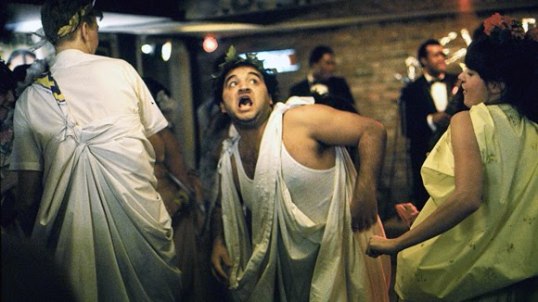
Most people, I think, would automatically say Bluto (played by John Belushi) and certainly, Bluto is the best known and perhaps best-remembered member of the cast.  As played by Belushi, Bluto is the film’s rampaging ID and he’s such a force of nature that, whenever I rewatch Animal House, I’m surprised to be reminded of the fact that he’s not really in the film that much.  He’s present for the parties, of course.  He imitates a zit and starts a food fight.  He gives a rousing speech, in which he reminds the members of the Delta House that America didn’t give up after “the Germans bombed Pearl Harbor!”  He destroys a folk singer’s guitar and I personally love the scene where he tries to cheer up a despondent pledge by smashing a beer bottle over his head.  But really, Bluto is used very sparingly and he’s one of the few members of the ensemble not to get his own subplot.  Bluto’s great but he’s not my favorite member of Delta House.

Hoover

Believe it or not, my favorite member of Delta House is Robert Hoover (James Widdoes).  Hoover is the president of Delta House and, when we first meet him, he seems like he’s way too clean-cut to be in charge of the “worst house” on campus.  But then, as the film progresses, we discover that Hoover may not be as openly crazy as everyone else but he’s definitely a Delta.  Just watch him in the Toga party scene.  Just look at him in the picture that shows up during the closing credits.  It took me a while to realize that Hoover, the future public defender, was giving the camera the finger.  Hoover may look uptight but he’s secretly a wild man!

animal-house 1

One of the things that I love about Animal House is that it truly is an ensemble film.  There’s not a weak performance to be found in the entire movie.  No matter how wild or over-the-top the humor gets, the entire cast commits to their roles and, as a result, they keep this movie grounded.  You actually find yourself caring about whether or not they get kicked off campus.  You truly believe that the members of Delta House have been friends for years but, even more importantly, you believe the same thing about their rivals at Omega House.  For that matter, it may be easy to make fun of Dean Wormer (John Vernon, setting the template for all evil deans to come) but you never doubt that he’s been in charge of Faber College for years and that he’s planning on being in charge for years to come.  As played by the deep-voiced and sinister-looking Vernon, Wormer becomes every unreasonable authority figure.  When he explains the concept of super secret probation, he does so with a smug pleasure that is practically chilling.  When he mentions that the members of Delta House can now be drafted, the smile on his face is terrifying.

Wormer

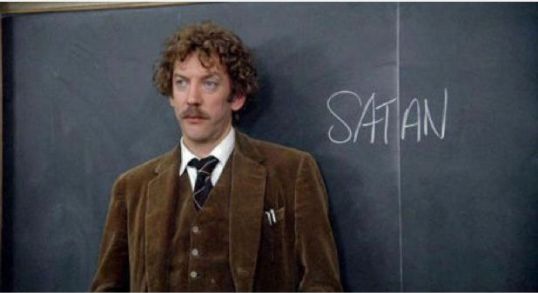
You know who else gives a really good performance in Animal House?  Donald Sutherland.  At the time, Sutherland was the biggest star in the film.  He was offered either a percentage of the grosses or a flat fee.  Sutherland thought the film would flop, took the flat fee, and missed out on millions as a result. Sutherland plays Prof. Jennings, an English teacher who, in the only scene actually set in a classroom, desperately tries to get his bored students to pay attention to him.  There’s something so poignant about the way Jennings begs his students to turn in their papers.  “I’m not joking,” he sputters, “this is my job!”
Jennings

Jennings turns out to be free thinker.  He turns Boone (Peter Riefert), Katie (Karen Allen), and Pinto (Tom Hulce) onto marijuana.  There’s an anachronistic peace sign hanging in his apartment (Animal House takes place in 1963) but no matter.  Far worse is the fact that he temporarily breaks up Boone and Katie!  Everyone knows those two belong together!

Bluto and Flounder

You know who else doesn’t get enough credit for his performance in Animal House?  Stephen Furst.  He plays Flounder, a new pledge.  Flounder is just so enthusiastic about everything and he doesn’t even seem to be upset when Wormer tells him, “Fat, drunk, and stupid is no way to go through life.”  I love the enthusiastic way that Furst delivers simple lines like, “What’s my Delta Chi name?” and “Brother Bluto!  Brother D-Day!  What are you doing here!?” My favorite Flounder moment comes when he accidentally gives a horse a heart attack.  Technically, it shouldn’t be funny but it is because Furst, Belushi, and Bruce McGill (playing the role of D-Day) so thoroughly throw themselves into their roles.  For that matter, the horse did a pretty good job too.
Boone and Otter

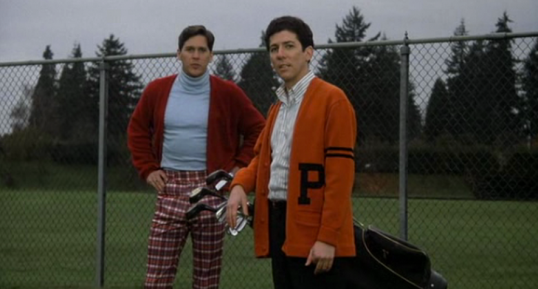
But that’s not all!  How can I praise the ensemble of Animal House without mention Tim Matheson, who plays Otter, the future Beverly Hills gynecologist?  Or what about Kevin Bacon, playing Omega pledge Chip Diller?  This was Bacon’s first role and who can forget him shouting, “Thank you, sir, may I have another!” while being initiated into Omega House?  Or how about James Daughton and Mark Metcalf, as the two leaders of Omega House?  They were villains truly worth hissing!

Omega House

And yes, I know that a lot of the humor in Animal House is not politically correct but who cares?  It’s a hilarious movie, one that is full of good actors at their absolute best.  Yes, they’re all a bunch of privileged sexists blah blah blah, but I’d still party with the Delta House.  They know how to have fun and, even if they did wreck the Homecoming Parade, they had a good reason!

parade

And so is the movie.  Every time I see Animal House, I feel good about the world.  In 1978, The Deer Hunter was named best picture by the Academy.  Well, you know what?  With all due respect to that long epic about the tragedy of America’s involvement in the Vietnam War,  all the Oscars should have gone to Animal House!

Animal-House-e1349570128550

In conclusion … SING IT!

Let me t-t-tell you ’bout some friends I know
They’re kinda crazy but you’ll dig the show
They can party ’till the break of dawn
at Delta Chi you can’t go wrong

Otter, he’s the ladies man
Every girl falls into his hands
Boon and Katy playing “Cat and Mouse”

and Mrs. Wormer, she’s the queen of the
ANIMAL HOUSE

ANIMAL HOUSE

ANIMAL HOUSE

That Pinto he’s a real swell guy
Clorette was jailbait but he gave her a try
Chip, Doug, and Greg, they’re second to none
They studied under Attila the Hun

Mr. Jennings has got his wig on tight
Flouder’s left shoe’s always on his right
Babs and Mandy are having a pillow fight
With D-Day, Hoover, Otis Day and the Knights

DO THE BLUTO

Come on baby, dance with me
Maybe if we do the Bluto
We will get an “A” in lobotomy

DO THE BLUTO
DO THE BLUTO

DO THE BLUTO
DO THE BLUTO

Aw, come on!
Let me tell ya
Dean Wormer tried to shut us down
But he fell and he broke his crown
He didn’t know about the Delta spunk
He came in handy when we were short a skunk

At the

ANIMAL HOUSE

5650948_std