When infielder Bill Riley (Patrick Wayne) makes an error that costs his team the game, sports columnist Rex Short (Carleton Young) claims that he witnessed Bill being paid off by Slim Conway (James Stewart). Slim is a former player who was banned from Major League Baseball after he was accused of taking a bribe from a gambler.
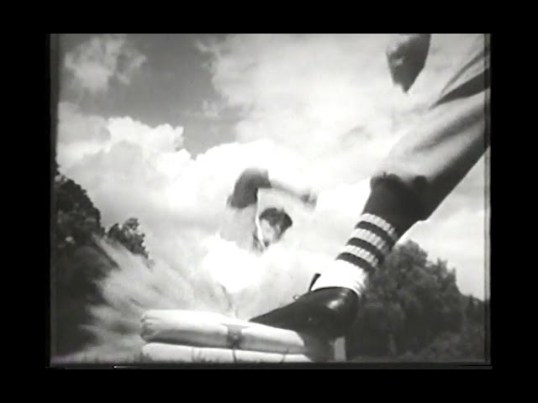
Most the movie is a flashback, showing how Bill first met Slim when Slim was playing for a barnstorming team of former major leaguers. That was my favorite part of the movie. Slim and a collection of old, worn-out men stumble out of their bus and even though they might move a little slower and they might need to stretch a little more before swinging a bat, they still show up a cocky team made up of young local players. Even after the crowd nearly riots when they realize that Slim is one of the players, the old players keep their cool and their eye on the game. After Bill spikes Slim while sliding into home plate, Bill apologizes. Slim remembers the young man’s humility and, working with one of the few friends that he has left in the game, Slim helps Bill get his chance in the Majors.
Usually, when my sister yells at me to come watch something because “it’s got baseball!,” I’m prepared for it turn out to just be a movie with one scene of someone holding a bat. I’m glad that she called me to come watch FlashingSpikes with her because it really is a good and loving celebration of my favorite game. Even after Slim is treated so unfairly by the press, the League, and even some of the fans, he never stops loving the crack of the bats and the cheers of the crowd. FlashingSpikes is unabashedly pro-baseball and Slim stands in for every player who was ever unfairly railroaded out of the game by scandal mongers like Rex Short.
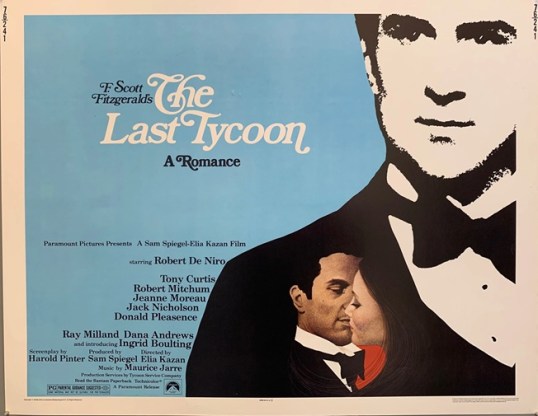
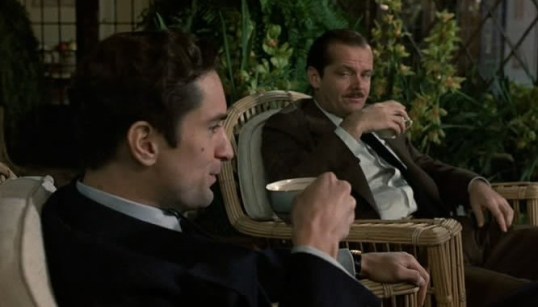
Based on the final (and unfinished) novel by F. Scott Fitzgerald, 1976’s The Last Tycoon tells the story of Monroe Stahr (Robert De Niro).
Monroe Stahr is the head of production at a film studio during the early days of Hollywood. Stahr is an unemotional and seemingly repressed man who only shows enthusiasm when he’s talking about movies. He may not be able to deal with real people but he instinctively knows what they want to see on the big screen. Stahr is a genius but he’s working himself to death, ignoring his health concerns while trying to create the perfect world through film. He’s haunted by a lost love and when he meets Kathleen Moore (Ingrid Boulting, giving a remarkably dull performance), he tries to find love with her but, naturally, he doesn’t succeed. Meanwhile, he has to deal with his boss (Robert Mitchum), his boss’s daughter (Theresa Russell), a neurotic screenwriter (Donald Pleasence), an impotent actor (Tony Curtis), and a lowdown dirty communist labor organizer (Jack Nicholson)! Sadly, for Stahr, McCarthyism is still a few decades away.
There’s a lot of talented people in The Last Tycoon and it’s undeniably interesting to see old school stars — like Mitchum, Curtis, Dana Andrews, Ray Milland — acting opposite a Method-driven, 30-something Robert De Niro. This is one of those films where even the minor roles are filled with name actors. John Carradine plays a tour guide. Jeff Corey plays a doctor. This is a film about Golden Age Hollywood that is full of Golden Age survivors. It’s a shame that most of them don’t get much to do. The Last Tycoon is a very episodic film as Stahr goes from one crisis to another. Characters show up and then just kind of disappear and we’re never quite sure how Stahr feels about any of them or how their existence really shapes Stahr’s worldview. Robert De Niro may be a great actor but, as portrayed in this film, Monroe Stahr is a boring character and De Niro’s trademark tight-lipped intensity just makes Stahr seem like someone who doesn’t have much to offer beyond employment. This is one of De Niro’s least interesting performances, mostly because he’s playing a not-particularly interesting person. Mitchum, Pleasence, and the old guard all make an impression because they’re willing to coast by on their bigger-than-life personalities. De Niro is trapped by the Method and a total lack of chemistry with co-star Ingrid Boulting.
Still, this is the only film to feature both De Niro and Jack Nicholson. (The Departed was originally conceived as a chance to bring De Niro and Nicholson together, with De Niro being the original choice for the role eventually played by Martin Sheen.) Nicholson’s role is small and he doesn’t show up until the film is nearly over. He and De Niro have an intense table tennis match. Nicholson doesn’t really dig deep into Brimmer’s character. Instead, he flashes his grin and let’s the natural sarcasm of his voice carry the scene. It’s nowhere close to being as emotionally satisfying as the De Niro/Pacino meeting in Heat. That said, Jack Nicholson at least appears to be enjoying himself. His natural charisma makes his role seem bigger than it actually is.
Why was The Last Tycoon such a disappointment? Though unfinished, the book still featured some of Fitzgerald’s best work and there’s a huge amount of talent involved in this film. The blame mostly falls on Elia Kazan, who came out of retirement to direct the film after original director Mike Nichols left the project. (Nichols reportedly objected to casting De Niro as Stahr. While it’s tempting to think that Nichols realized that De Niro’s intense style wouldn’t be right for the role, it actually appears that Nichols and De Niro sincerely disliked each other as Nichols also abandoned the next film he was hired to direct when he was told that De Niro wanted the lead role. Nichols choice for Monroe Stahr was Dustin Hoffman, which actually would have worked. If nothing else, it would have provided a Graduatereunion.) Kazan later said that he did the film solely for the money and it’s obvious that he didn’t really care much about the film’s story. The film has some good scenes but, overall, it feels disjointed and uneven. Kazan doesn’t really seem to care about Monroe Stahr and, as a result, the entire film falls flat.
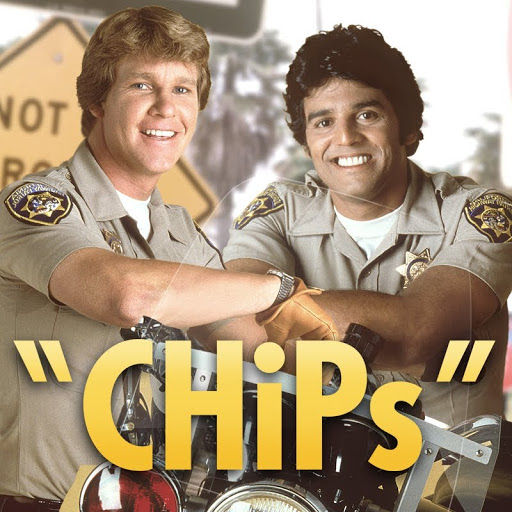
Welcome to Late Night Retro Television Reviews, a feature where we review some of our favorite and least favorite shows of the past! On Mondays, I will be reviewing CHiPs, which ran on NBC from 1977 to 1983. The entire show is currently streaming on Freevee!
This week, it’s all about bio-rhythms!
Episode 2.19 “Bio-Rhythms”
(Dir by Don Weis, originally aired on February 17th, 1979)
The Davis family is back!
Now, if you don’t remember the Davises. they were the family of independent truckers who appeared in an episode called The Volunteers. Patriarch Charley Davis (Tige Andrews) is taciturn and protective. Their friend, Sam (Steve Franken), is taciturn and protective …. actually, to be honest, he and Charley are kind of interchangeable. Daughter Robbie (Katherine Cannon) is in charge of the business and is being pressured by another trucker (Michael Conrad), who is willing to resort to sabotage to keep Robbie from making her deliveries. It’s a good thing that Robbie has got Ponch on her side!
Technically, Robbie also has Baker on her side but this is definitely a Ponch episode. Baker is present but he does very little. Instead, it’s Ponch who flirts with Robbie. It’s Ponch who stops by Robbie’s apartment and uses her shower. It’s Ponch who spends an extended period of time wearing just a towel. Somewhat inevitably, Charley shows up around the same time that Ponch steps out of the shower. Ponch is kicked out of the apartment and his clothes are tossed out the window. Ponch loses his towel while retrieving his clothing. Cue the close-ups of an old woman staring at him with a impressed look in her eyes and Erik Estrada flashing his Estrada smile. It’s not that Erik Estrada wasn’t nice to look at. It’s just that he was so obviously aware that he was nice to look at that the whole scene ends up feeling rather smarmy. One gets the feeling that there was a clause in Estrada’s contract specifying that he, and only he, would be allowed to show off on the show.
While Ponch helps Robbie deal with her rivals, he also learns about biorhythms, the pseudo-science that says that, by calculating how long someone’s been alive, it can be determined which days are going to be good for them and which days are going to be bad. Sindy Cahill is doing a study on biorhythms for her master’s degree. Getraer tells his squad that the department is also very interested in whether or not biorhythms effect an officer’s productivity. Baker is skeptical about biorhythms but Ponch believes in them and even buys a biorhythm calculator.
Believing the Baker’s biorhythms have him at peak physical perfection, Ponch arranges for Baker to play handball against Getraer. Ponch even takes bets. Unfortunately, Ponch spent so much time figuring out Baker’s biorhythms that he never stopped to consider Getraer’s. The episode ends with Getraer on his way to victory and Baker looking embarrassed.
Handball? Biorhythms? Corrupt labor unions? Could this episode be more Californian?
This episode was fairly dull. A huge problem was that the Davis family and their drama are never as interesting as the show seems to think that they are. Much as with The Volunteers, I felt like I was watching a backdoor pilot for a show about the Davises when I really just wanted to watch a show about the Highway Patrol. This episode didn’t do much for me. Maybe everyone’s biorhythms were off when they filmed it.
Welcome to Late Night Retro Television Reviews, a feature where we review some of our favorite and least favorite shows of the past! On Mondays, I will be reviewing CHiPs, which ran on NBC from 1977 to 1983. The entire show is currently streaming on Freevee!
This week, we’ve got ourselves a convoy!
Episode 2.2 “The Volunteers”
(Dir by John Florea, originally aired on September 23rd, 1978)
After a high-speed chase causes a robbery suspect to crash his car into a chemical storage facility (which subsequently explodes), three truckers have to get their trucks full of chlorine gas to the next available facility. Unfortunately, it’s a 170-mile drive over rough terrain and it’s a very hot day. If the gas gets to hot, it’ll explode. If It doesn’t get to the storage facility in time, it’ll explode. In fact, it appears that just about anything can make chlorine gas explode. Californians might love chlorine for their pool but they don’t want it in the air.
Getraer assigns Ponch, Baker, Baricza, and Jane Turner to escort the trucks to the facility. Jane Turner (Rana Ford) is a new member of the highway patrol. She drives a squad car and she’s the first woman and only the second black person who we’ve seen working for the highway patrol on this show. She doesn’t really do much in this episode and, about halfway through, she breaks off from the main group to help deal with a highway pile-up. For that matter, Getraer and Baricza end up vanishing as well. As usual, it’s all on Ponch and Baker.
Despite the danger of a chemical spill killing the population of Los Angeles county, Ponch spends most of this episode trying to get laid. The episode opens with him leering at a jogging stewardess (Anna Upstrom) and then bragging about how he has a date with her later that night.
“She doesn’t smoke, drink, or dance,” Ponch says.
“What are you two going to do?” Baker earnestly asks.
Ponch arches his eyebrow and grins.
But Ponch is soon distracted by one of the truck drivers, a woman named Robbie Davis (Katherine Cannon), who is quick to yell that not only can she drive a truck but she can vote as well. Ponch arches his eyebrow and grins. Baker gets in on the action by saying, “Prettiest little truck driver I’ve ever seen.”
Robbie’s father (Tige Andrews) and the other trucker (Sam Brodie) all totally think Robbie should hook up with Ponch but they’re still amused when, late in the episode, Ponch accepts a ride from a blonde in a convertible. Ponch arches and eyebrow and grins as he gets in the car. WE GET IT, PONCH!
It’s not easy transporting chlorine gas. Along with rough desert terrain, there’s also a group of beer-drinking rednecks who drive by in a pickup truck and threaten to shoot one of the tanks. All of that drunk driving leads to another multi-car pile-up. For some reason, one of the vehicles in the pile-up was transporting a tiger, which promptly gets loose and enters a grocery store. Ponch and Baker grab raw meat from the butcher’s station and use it to trick the tiger into entering an office. After they shut the door, the owner of the store yells at them for wasting meat. There’s also a town puts up a roadblock to keep the trucks from coming through because they don’t want chlorine gas getting into the air. And then there’s an avalanche, which causes chlorine gas to leak out of Robbie’s truck, sending her to the hospital.
Considering everything that happens in this episode, it’s odd that it all feels rather boring. The best episodes of CHiPs focus on fast motorcycles and beautiful scenery. This episode featured slow-moving trucks and the desert. Bleh. I hate the desert. This episode also featured a lot of interaction between Robbie, her father, and their friend. In fact, they were so prominently featured that it wouldn’t surprise me if this episode was meant to be a backdoor pilot for a trucking show. (This episode aired in 1978, which was a big year for trucker movies.) But the Davis family just wasn’t that interesting.
This episode didn’t really capture my attention. Hopefully, next week will see a return of fast bikes and nice scenery.
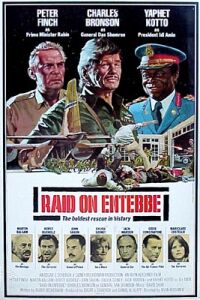
On June 27th, 1976, four terrorists hijacked an Air France flight and diverted it to Entebbe Airport in Uganda. With the blessing of dictator Idi Amin and with the help of a deployment of Ugandan soldiers, the terrorists held all of the Israeli passengers hostage while allowing the non-Jewish passengers to leave. The terrorists issued the usual set of demands. The Israelis responded with Operation Thunderbolt, a daring July 4th raid on the airport that led to death of all the terrorists and the rescue of the hostages. Three hostages were killed in the firefight and a fourth — Dora Bloch — was subsequently murdered in a Ugandan hospital by Idi Amin’s secret police. Only one commando — Yonatan Netanyahu — was lost during the raid. His younger brother, Benjamin, would later become Prime Minister of Israel.
Raid on Entebbe, a docudrama about the operation, was originally produced for NBC though it subsequently received an overseas theatrical release as well. It’s an exciting tribute to the bravery of both the hostages and the commandos who rescued them. Director Irvin Kershner directs in a documentary fashion and gets good performances from a cast full of familiar faces. Charles Bronson, James Woods, Peter Finch, Martin Balsam, Stephen Macht, Horst Buchholz, Sylvia Sidney, Allan Arbus, Jack Warden, John Saxon, and Robert Loggia show up as politicians, commandos, terrorists, and hostages and all of them bring a sense of reality and humanity to their roles.
The film’s best performance comes from Yaphet Kotto, who plays Idi Amin as a strutting buffoon, quick to smile but always watching out for himself. In the film, Amin often pays unannounced visits to the airport, where he lies and tells the hostages that he is doing his best to broker an agreement between the terrorists and Israel. The hostages are forced to applaud Amin’s empty promises and Amin soaks it all up with a huge grin on his face. Forest Whitaker may have won the Oscar for Last King of Scotland but, for me, Yaphet Kotto will always be the definitive Idi Amin.