Review: A Blade In The Dark (dir. by Lamberto Bava)


If you’re lucky, you remember your first time.  I know I do.  I was 17 years old and I was trying very hard to convince myself that I was an adult.  It had been less than a year since I was first diagnosed as being bipolar and I was still struggling to understand what that truly meant about me.  My days were spent wondering if I was crazy or if I was just misunderstood.  In the end, I just desperately wanted to be loved.  As for the event itself, I remember being more than a little anxious and, once things really got going, pleasantly surprised.  However, the main thing I remember is thinking to myself, “Wow, that’s a lot of blood.”

Yes, everyone should remember the experience of seeing their first giallo as clearly as I do.

Over the years, I’ve read a lot of different definitions of what a giallo is and none of them have really managed to capture what makes this genre of film so strangely compelling.  The simplest and quickest definition is that a giallo is an Italian thriller.  Typically (though not always), the film features a protagonist who witnesses and then proceeds to investigate a series of increasingly gory murders.  Often times, solving the murders means uncovering some dark and sordid sin of the past and, just as often, the film’s “hero” turns out to be as damaged a soul as the killer.  However, the plot is rarely the important in a giallo film.  What’s important is how the director chooses to tell the story.  When I watch the classic giallo films of the 60s and 70s, I get a sense of a small group of directors who were all competing to say who could come up with the most startling camera angle, who could pull off the bloodiest death scene, and who could pull off the most audacious tracking shot.  Giallo is a uniquely Italian genre of film, an unapologetic opera of mayhem and murder.  For the most part, the films seems to have a polarizing effect on viewers.  You either get them or you don’t.  (From my own personal experience, I think it helps if you come from a Catholic background but, again, that’s just my opinion.)

My first giallo was Lamberto Bava’s 1983 shocker, A Blade in the Dark.

The protagonist of A Blade in the Dark is Bruno, a popular young composer who has been hired to score a horror movie.  The film’s director has arranged for Bruno to stay in an isolated villa while he works.  Every night, Bruno sits in front of his piano and searches for the perfect note.  Occasionally, his actress girlfriend calls him from the other side of Italy and demands to know if he’s cheating on her.  He’s not despite the fact that he has two attractive neighbors who tend to come by at the most inconvenient of times and who make cryptic comments about the woman who lived at the villa before him.  Bruno would probably be even more frustrated if he knew that, on most night, he’s being watched by someone outside hiding outside the villa.  One night, Bruno listens to the movie’s soundtrack and hears a menacing voice whispering on the recording.  Meanwhile, the mysterious watcher begins to brutally murder anyone who has any contact with Bruno.

(Despite all these distractions, Bruno continues to vainly try to create the perfect score.  Much like Kubrick’s Shining, A Blade in the Dark is as much about the horrors of the artistic process as it is about anything else.)

As it typical of most giallo films, the plot of A Blade in the Dark makes less and less sense the more that you think about it.  However, this is a part of the genre’s charm.  One doesn’t watch a giallo for the story.  One watches to see how the story is told and that is where A Blade in the Dark triumphs.  Wisely, director Lamberto Bava keeps things simple.  Working with a small cast and one main set, Bava fills every scene with a palpable sense of dread and uneasiness.  As Bruno finds himself growing more and more paranoid, so does the audience.  Watching the movie, you feel that anyone on the screen could die at any moment and, for the most part, that turns out to be the case.

A Blade in the Dark is probably best known for the brutality of its violence.  Even after repeat viewings, the murders are still, at times, difficult to watch. In the most infamous of them, one of Bruno’s neighbors is killed while washing her hair over a sink.  The violence here is so sudden and so much blood is spilled (and spurted) that its easy to miss just how well-directed and effectively shocking this scene really is.  In this current age of generic cinematic mayhem, the violence of A Blade In The Dark still packs a powerful punch.

(The scene is so effective that, for quite some time after seeing it, I actually got uneasy whenever I found myself standing in front of a sink.  A Blade in the Dark does for the bathroom sink what Psycho did for showers.)

Bruno is played by Andrea Occhipinti, an actor whose non-threatening, Jonas Brotheresque handsome earnestness was used to great effect by Lucio Fulci in the earlier New York Ripper.  Since I’ve only seen the dubbed version, it’s difficult to judge his performance here.  He’s never quite believable as a great composer though you could easily imagine him writing whatever syrupy ballad that James Cameron chooses to play at the end of his next blockbuster.  However, Occhipinti does have a likable enough presence that you don’t want to see him killed and that’s all that the film really requires anyway.

A far more interesting presence in the cast is that of Michele Soavi.  Soavi plays Bruno’s landlord and, even with limited screen time and even with his dialogue dubbed into English, Soavi is such a charismatic presence that he dominates every scene that he’s in.  Before being cast, Soavi was already serving as Bava’s assistant director on Blade in the Dark and, of course, he later went on to have a significant directorial career of his own.  Soavi is perhaps best known for directing one of the greatest films of the 1990s, Dellamorte Dellamore.

While Soavi would go on to great acclaim, the same cannot be said of this movie’s director.  Among fans of Italian horror, it’s become somewhat fashionable to be dismissive of Lamberto Bava.  It’s often pointed out that the majority of his filmography is actually made up of cheap knock-offs that he made for Italian television (and, admittedly, A Blade in the Dark started life as a proposed miniseries).  Most of the credit for Bava’s most succesful film — Demons — is usually given to producer Dario Argento.  Perhaps the most common complaint made about Lamberto Bava is that he isn’t his father, Mario Bava.  With films like Blood and Black Lace, Lisa and the Devil, Black Sabbath, and Bay of Blood, Mario Bava developed a deserved reputation for being the father of Italian horror and Lamberto is often accused of simply trading in on his father’s reputation.

It’s true that Lamberto Bava is no Mario Bava but then again, who is?  Blade in the Dark was Lamberto’s second film (as a director) and its a tightly constructed, quickly paced thriller.  Bava makes good use of the vila and creates a truly claustrophobic atmosphere that keeps the viewer on edge throughout the entire film.  Even when viewed nearly three decades after they were filmed, the film’s murders are still shocking in both their violence and their intensity.  There’s a passion and attention-to-detail in Bava’s direction here that, sadly, is definitely lacking in his later films.  If most of Bava’s film seem to be the work of a disinterested craftsman, A Blade in the Dark is the  work of an artist.

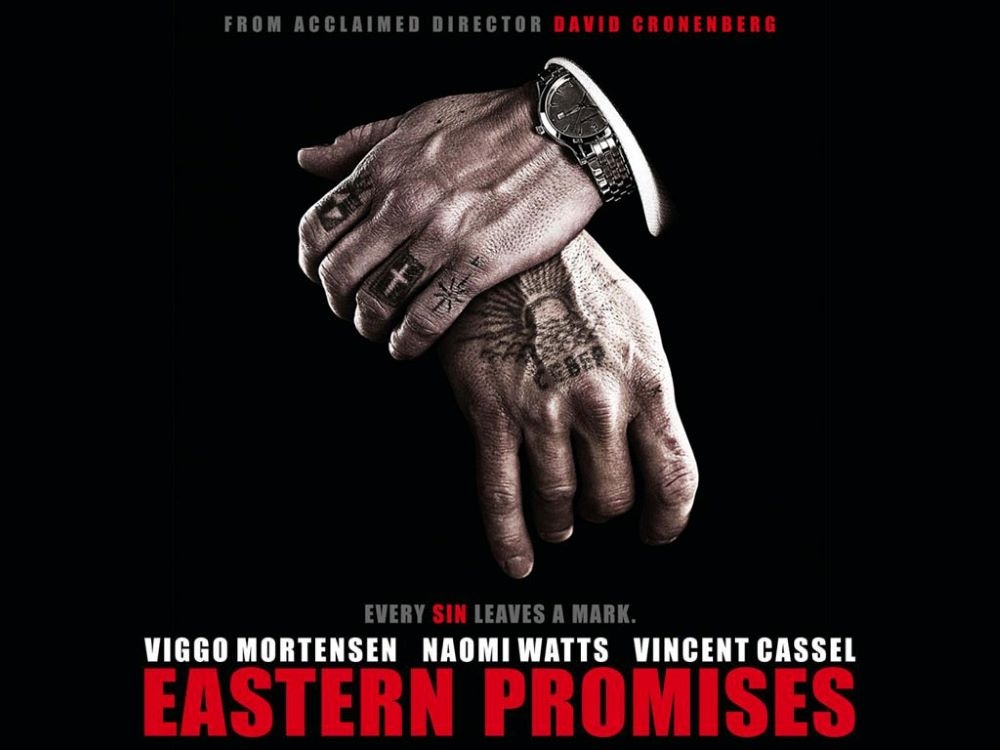
Review: Eastern Promises (dir. by David Cronenberg)


You can’t always be in control.” — Nikolai Luzhin

In 2005 Canadian filmmaker David Cronenberg brought to the silver screen a film that was both a taut, smart crime-thriller and also a well-done film treatise on the nature of violence and how it changes not just witness’ perception of an individual but about themselves as well. The film also introduced what might be the newest creative pairing that could be on par as other pairings like Scorsese-DeNiro and Burton-Depp. The pairing I speak of is that of Cronenberg and his growing repertoire with actor Viggo Mortensen. They scored a critical hit with A History of Violence and in 2007 they collaborate in another crime-drama that more than lives up to their initial collaboration. Eastern Promises is a taut and meticulous drama which brings new eyes and a different approach to the mob film genre made famous by Coppola and Scorsese.

The film begins innocently enough with a very pregnant teenage Russian girl named Tatiana entering a neighborhood store. While Cronenberg chose to open up A History of Violence nary any musical cues and backgrounds to create a sense of naturalism and plant a seed of unease in the audience of what’s to come, he does the opposite with Eastern Promises by allowing long-time collaborator Howard Shore to score this opening scene with a haunting violin solo. Even right from the start Cronenberg’s propensity to use a sudden image of violence to shock the audience works well to set the tone for the film. It is not the usual filmgoing experience to see a young girl, looking lost and afraid of her surroundings, suddenly and bloodily starts to give birth in the middle of a store. It is from the diary entries of this young girl where we get glimpses of the true meaning of the film’s title and sets up the clues and tidbits that Cronenberg gradually fills in as the film progresses and the main characters investigate the girl’s death and the full contents of her diary.

We’re quickly introduced to Anna Khitrova (played with touching compassion and a certain naivete by Naomi Watts), midwife at the London hospital where Tatiana dies from bloodloss due to childbirth. Having had experienced her own personal tragedy regarding a past pregnancy Anna takes it upon herself to find the next of kin or, at the very least, close friends who might know Tatiana and thus claim the child and care for her. It was finding Tatiana’s diary and the business card tucked within amongst the young girl’s meager possessions which gives Anna a starting point for her investigation and search.

It is during this search into Tatiana’s life that Anna encounters Nikolai Luzhin (Viggo Mortensen at his most chameleonic), the personal driver of one Semyon (as played by Armin Mueller-Stahl). Semyon charms Anna with his old world grandfatherly persona yet both the audience and Anna feels something off, even sinister beneath the charm and twinkling eyes. Semyon is not just the owner of the Trans-Siberian, a Russian restaurant, but a boss in the vory v zakone also known as the Russian Mafia. It is through Nikolai that we see the underbelly of Tatiana’s life before her death.

It is during the second half of the film that the film takes a clear turn into Cronenberg territory. With all the players in play Eastern Promises starts to peel the layers on all the characters. Just like in A History of Violence every character in this unofficial follow-up to that film go on through the film living dual-lives. Even Anna’s seeming naivete, in regards to the danger she faces in Semyon and his unstable son Kirill, shows a modicum of world-weariness born out of personal tragedy and those she sees on a daily basis when working as a midwife in the hospital.

Cronenberg doesn’t just try to tell a crime drama about the mob and the subculture they live and die in but he adds his own personal stylistic and metaphorical touches on the mob film conventions. While in the past he has taken on the immutability of the body and the physical nature of man in his later years he has moved on to the amorphous nature of man’s very nature as both a civilized and reasoned animal to the primal being which lurks within each. Eastern Promises delves into this metaphysical topic by showing the natures of both Nikolai and Semyon. Both of whom, at first glance, inhabiting a particular stereotype but soon showing the opposite as the audience gets to know them. Even the twists in the story in the middle section and close to the end doesn’t seem like cheap plot tricks but a logical and almost mathematical conclusion to the very themes Cronenberg has been exploring right from the beginning.

The performances by the cast was top-notch from top to bottom. David Cronenberg’s always has had a reputation for being an actor’s director. His willingness to allow his actors to not just play the part but find ways to become their characters makes his films some of the more well-acted one’s of the last quarter-century. From Watts’ own touching performance as the moral center of the film in Anna to Cassel’s unstable and coward of a bully in Kirill the work put on by the actors adds a level of gravitas to a story that has it’s roots in pulp crime stories and not the high-brow tales prestige films like Eastern Promises has been compared to. But the two stand-out work comes from Viggo Mortensen as the enigmatic Nikolai and Armin Mueller-Stahl as Russian mob boss Semyon. Where Watt’s performance was subtle and Cassel’s literally scene-chewing both Mortensen and Mueller-Stahl bring forth nuanced performances full of life and complexities that makes both characters stand out above a cast already doing great work.

Mortensen’s work as Nikolai actually surpasses his previous Cronenberg-directed role in Tom Stalls of A History of Violence. Viggo has always been quite the Method actor and really loses himself in every role he takes on, but it took him being paired up with Cronenberg for critics and cineastes to finally realize how great an actor he really has become in the last decade. His Nikolai oozes a charisma from the moment he enters the film. He makes Nikolai not just a thug with a brain and a semblance of compassion beneath the rough surface. Mortensen literally becomes Nikolai right down to the very tattoos which tells his character’s criminal past in ink. One could not help but be mesmerized by Mortensen’s work in this film that it was easy to forget that he was playing a part and not actually living that life. To say that Mortensen may have found his creative soulmate in Cronenberg would be quite the understatement and with more projects in the future linking the two together it wouldn’t be a surprise if the two in conjuction finally get the critical awards that has eluded both.

While A History of Violence showed that Cronenberg could work beyond the genre and esoteric genres of his part works, it is with Eastern Promises that we see him move towards a more mainstream type of work. Yet despite a work more accessible than before he still was able to add his own style of storytelling and explore themes usually not seen in crime dramas and mob films. It is this ability to marry the violent pulp with the intellectual high-brow which makes Eastern Promises a delight for both the general filmgoer and the arthouse cineaste. Time will only tell if the successful streak by the duo of Cronenberg-Mortensen continues as the two continue to work together in the years to come.

Michael Caine is Harry Brown (trailer)


This is another film from 2009 that has still to get a release in the United States. A thriller from filmmaker Daniel Barber and starring two-time Academy winner Michael Caine, Harry Brown looks like another in the line of revenge films which all share some similarities with the Charles Bronson 70’s classic Death Wish. The film also stars Emily Mortimer, Liam Cunningham and Iain Glen.

The premise of the film does seem to owe much to Bronson’s Death Wish series with some of the rioting of hoodlums and gang members in the trailer reminiscent of the cult-classic Death Wish 3 where Bronson’s Korean War veteran literally goes to war with the neighborhood gang on the streets. I like Michael Caine as an actor and he always seems to inhabit a role no matter how much, at first glance, it seems like its not a good fit. Caine’s early works has had him play characters with a darkness in them and I think this film will help remind younger viewers to the fact that he was not always Alfred the Butler.

The film makes it’s U.S. debut on April 30, 2010.

Review: A History of Violence (dir. by David Cronenberg)


“In this family, we do not solve our problems by hitting people.” — Tom Stall

David Cronenberg’s A History of Violence opens like a familiar American story but soon transforms into something far darker and more complex—a meditation on how violence reshapes identity and reality itself. The film begins in small-town Indiana where Tom Stall, a mild-mannered diner owner, becomes an overnight hero after killing two violent spree killers who attempt to rob his restaurant. These killers—Billy and Leland—serve as the initial violent intrusion that shatters Tom’s peaceful world and propels the narrative forward. Their actions attract the attention of Carl Fogarty, an East Coast mobster whose relentless pursuit gradually forces Tom and his family to confront a buried, violent history. This confrontation unravels the fragile facade of domesticity and sets the stage for the film’s profound exploration of identity, perception, and the primal tensions beneath civilization.

Cronenberg’s direction is a study in restraint and precision. Far from glamorizing violence, the film presents it as brutally efficient and intimately physical. Cronenberg himself described the action sequences as neither choreographed nor aestheticized but raw, unembellished, and quick—realistic portrayals of violence drawn from street-fighting techniques rather than cinematic spectacle. This choice heightens the emotional impact, making every outbreak of violence feel sudden, close, and devastatingly human. The opening extended shot of the spree killers, for example, follows them in a languid, almost eerie calm before revealing their cold-blooded brutality, establishing an unsettling tone early on. Cronenberg’s camera work—often tight and intimate—immerses viewers in moments where violence erupts not as a fantasy but as a harsh reality, forcing the audience to reckon with its consequences rather than its thrill.

Viggo Mortensen anchors the film with a layered performance that seamlessly navigates the duality of Tom Stall—a man striving for peaceful normalcy—and the darker instincts touched by his mysterious past. Mortensen’s portrayal moves fluidly between the affable family man and the capable, restrained force beneath, embodying the film’s exploration of how violence shapes identity and perception. His physicality and subtle shifts in tone reveal a man perpetually caught between two worlds, never fully belonging to either. Maria Bello as Edie complements Mortensen beautifully, delivering a performance rich in emotional complexity. Her character oscillates between nurturer and survivor, revealing a raw, sometimes unsettling vulnerability beneath her composed exterior. Bello’s nuanced acting gives weight to the evolving dynamics of fear, desire, and trust within their marriage, especially evident in scenes that contrast tender intimacy with underlying tension.

The supporting cast enriches the film’s moral landscape. Ed Harris brings a quiet menace to Carl Fogarty, embodying violence as a cold, business-like inevitability rather than a source of pleasure or spectacle. William Hurt’s portrayal of Richie Cusack is especially memorable—his eight-to-ten-minute screen time is electrifying, providing a darkly charismatic figure who embodies familial loyalty intertwined with brutal pragmatism. Hurt’s performance deftly balances charm and cruelty, offering one of the film’s starkest reminders of violence’s cyclical nature within families. These actors contribute to the film’s thematic depth, portraying violence as a heritage passed down and a force that both defines and corrodes.

Cronenberg’s screenplay, coupled with Howard Shore’s minimalist score, emphasizes mood and psychological tension over action set pieces. The film refuses to indulge in excessive gore or prolonged combat; instead, it presents violence as a disruptive force that shatters normalcy and forces internal reckonings. A notable subplot involving Tom’s teenage son and a school bully underscores the generational transmission of violence and fear, reinforcing the idea that violence’s impact extends beyond immediate events to shape social and familial identities.

One of the film’s most powerful effects is the way it forces viewers to reconsider notions of safety, civility, and identity. Tom’s line, “In this family, we do not solve our problems by hitting people,” starkly contrasts with his son’s chilling rejoinder, “No, in this family, we shoot them.” This exchange encapsulates the film’s core tension—the desire to reject violence while simultaneously being shaped by its inescapable presence. Moments of quiet domesticity are undercut throughout by an ever-present undercurrent of menace, illustrating Cronenberg’s thesis that violence is not merely an event but a contagion of perception and reality.

Ultimately, A History of Violence is a film of dualities—between past and present, civility and savagery, love and fear. Cronenberg’s direction delicately balances these tensions, crafting a film that is at once a taut thriller and a profound psychological study. The performances, especially those of Mortensen and Bello, give the film its emotional resonance, while the supporting cast strengthens its examination of violence’s personal and social ramifications. By the film’s haunting conclusion, viewers are left with a haunting question: can anyone truly escape the shadows cast by violence, or are we forever altered by its imprint?

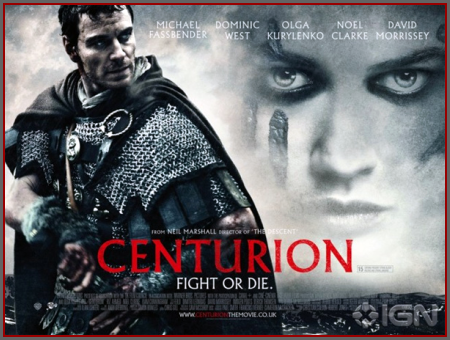
Neil Marshall’s Centurion Official Trailer


I have been a huge fan of Neil Marshall. The British filmmaker burst into the genre scene with his cult-classic werewolf-siege flick, Dog Soldiers. He then follows that up with the excellent all-female cast monster mash, The Descent. His third outing was a bit mixed for some, but I definitely had a great time with Doomsday. Marshall really knows the genre he works in and also enjoys staying in it.

His fourth film is a historical thriller set during the Roman occupation of Britain during the 2nd Century A.D. The film was originally called The Ninth Legion during the production, but has since been officially changed to Centurion. The basic premise of the film is Marshall’s telling of the legend of the 9th Legion and their disappearance north of Hadrian’s Wall. He’s made it known that the film will not be historically accurate and wasn’t meant to be. The film will be his way to re-tell the legend of the legion’s disappearance, it’s cause and wrap an action-thriller around it.

Starring in the film are Dominic West, Michael Fassbender (last seen as the British operative Hickox in Inglourious Basterds) and Olga Kurylenko. The film is tentatively dated to be released in the U.K. on April 23, 2010. No set date has been announced for a NA release, but I’m sure it will get one. It better.

Source: Centurion Official Trailer @IGN

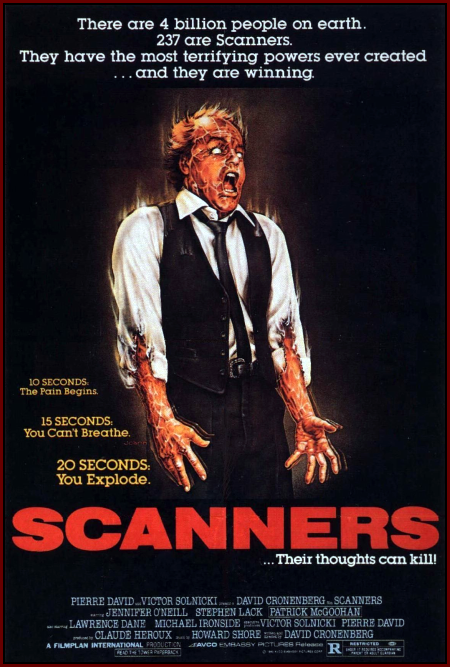
Review: Scanners (dir. by David Cronenberg)


Scanners marks the emergence of David Cronenberg from low-budget horror auteur to one of the most unique voices in filmmaking of the last thirty or so years. He first came onto the scene directing such low-budget horror films such as Shivers, Rabid and The Brood. These three films were later said to have had that Cronenberg propensity to show the horror of the body-politic at its most basic. Cronenberg pretty much points out of how true horror might not be lurking on the outside, but within the the human body. Cronenberg makes the human body as forever changing and mutating against the individual person’s wants and desire of what was suppose to be the ideal. The horror that we as a people do not and will never have control over our own body was where the true horror lie.

In 1981, Cronenberg moves from the purely physical horror to one where the technology man was forever trying to create and achieve perfection would turn on the biological aspect of the human condition. This new form of techno-organic mutation was as terrifying as it was seductive in its potential to those afflicted with it. Cronenberg begins this phase in his filmmaking voice with his excellent, underappreciated and cult-classic Scanners.

The premise for Scanners had alot in common with Stephen King’s novel Firestarter in the fact that in dealt with an omnipresent and powerful organization: the CIA’s shadowy branch that dealt with experimental weapons programs for Firestarter and the ultra-powerful CONSEC multinational corporation in Scanners. These two organizations experiment on random select individuals using experimental drug treatments under the guise of helpful medications. What results from these experiments are more than what was truly expected by their handlers. In Scanners the result comes from mental abilities never seen or documented in the past. CONSEC’s experiments have yielded a unique group of individuals, 237 of them, to manifest powers of the mind that make them living weapons of mass destruction. Instead of becoming a new wonder-weapon for CONSEC to sell to their government contacts, these 237 become unstable in personality, some going as far as to develop a God-complex. Others are driven insane by these new abilities and retreat away from the rest of humanity in order to achieve a semblance of mental peace.

These two different reactions from the 237 are keenly represented by two of the main character’s in Cronenberg’s film. There’s Cameron Vale (played by Stephen Lack who had an eerie resemblance to the same named character of Stephen in Dawn of the Dead) who we first see as a vagrant who seems to be suffering from some sort of mental problem. This is farther from the truth as Dr. Paul Ruth (father of the CONSEC drug effemerol that causes the mutation and played with eccentric flair by Patrick McGoohan) soon discover that Vale’s mental problems is due to him possessing preternatural mental abilities of the highest order. Ruth’s guilt over what his experiments have done and created leads him to use Vale to counter the growing underground of those 237 who have seen their newfound abilities as a stepping stone to supplanting the normal status quo with their own in a plan of global domination that would make fans of X-Men very proud.

Leader of this underground groups of scanners (as the 237 were called) is one Darryl Revok. A scanner whose abilities rival those of Vale’s but whose mental instability for wanting to dominate the normals of the world makes him the most dangerous individual on the face of the planet. Genre veteran Michael Ironside steals the film from everyone else. His grand and classic introduction early in the film has gone down in filmmaking history as one of the most shocking scenes put on film. Ironside’s performance as the scanner with the God-complex was truly megalomaniacal and it was easy to root against him, but hard to take one’s eyes from the screen when he was on. Revok truly made for one of film history’s classic villains.

In the middle of Vale and Revok’s war for control lies Kim Obrist (played by the beautiful Jennifer O’Neill) who tries to lead those who just want to be left alone from being used by both Revok and CONSEC. O’Neill’s performance was the most grounded in reality, as much as a film about people with mental powers could be, and tries to keep the film from getting too fantastic.

This I think was what made Scanners such a great film. As ludicrous a premise as the film had to base its sotry on, there was always a sense of realism to keep everything form becoming too much like a comic book. The story paints a story that could happen in reality since similar things have occurred in the past such as the LSD testing on US military personnel during the 50’s and 60’s. Cronenberg plays on such fears of outside factors introduced by scientists looking to forever improve on what nature took eons to evolve. It’s this hubris about man’s attempt to dominate his own body which interests Cronenberg and what would happen if he did succeed in doing something nature and humanity wasn’t ready for.

Scanners marked Cronenberg’s interest in examining the effect of man’s quest for better and better technology, whether mechanical or biological, on humanity’s physical and mental existence. What he brongs forth, first with Scanners then later on with Videodrome and The Fly, was something both horrific and seductive. Who wouldn’t want to have such abilities as Vale and Revok had at their command. But by the end of Scanners the film posits the question of how much of one’s humanity must be sacrificed for such huge leaps on the evolutionary ladder. Will the resulting amalgamation of nature and technology still leave something human or just something that pretends to look like one.

Some have called Scanners a horror movie and some have called it a sci-fi thriller. It’s both those and more. It’s really hard to pin down just exactly which genre Scanners falls under since Cronenberg never tried to stay within one particular one. The film works as a thriller, as a science-fiction story, a horror flick and a philosophical exercise in examining the human condition. Cronenberg’s skill was clearly evident in keeping all these differing themes and genres from becoming out-of-place and bringing the finished product from becoming too flawed. Cronenberg’s first foray into this new phase of his filmmaking career ushered in what some have called Cronenberg at his most daring and pure. I wouldn’t argue with such an argument. Scanners is a film of great quality that would forever be used as an example of Cronenberg’s genius as a filmmaker.

Soderbergh to Traffic in Contagion


Steven Soderbergh has always been an indepedent-minded filmmaker from the time broke-out with his Sex, Lies and Videotape and up to his dabbling into microbudgeted, HD-shot films like Bubble and The Girlfriend Experience. In-between such arthouse fares he’s also managed to churn out commercial-friendly works like the Ocean’s Trilogy and to a certain extent both Erin Brockovich and Traffic.

While he surely has earned the ability to choose his projects his last major production didn’t pan out as some have thought it would. I’m talking about the passion project and, one I call the ego-project, epic biopic about Che Guevara which ran so long that it had to be released as two films: The Argentine and Guerrilla. His latest studio offering in The informant! also didn’t light up the box-office or even do marginally well.

Hopefully, the announcement broken by The Playlist site about his upcoming major project will change this pattern. Soderbergh has put on the fast-track the production of a film from Scott Z. Burns’ Contagion script. He will direct this action-thriller which some have labeled as Traffic meets The Stand/Outbreak. The premise of the script details the reaction of the cast of characters to a developing viral pandemic which goes global. The film will take place across four continents and already has snagged quite a talented rollcall of actors: Matt Damon, Marion Cotillard, Kate Winslet and Jude Law. We’re sure to get more news about further cast developments the closer to the start of filming.

While I like Soderbergh’s “Sundance” films I also think that he can make commercially-entertaining films and has proven that he could with the Ocean’s series. Here’s to hoping that he could create an action-thriller w/ some horror aspects to it with this latest project. It’s always exciting to see a director try on a new genre and see how well they do in it. I’m betting on Soderbergh hitting a home run instead of fouling out.

Source: The Playlist

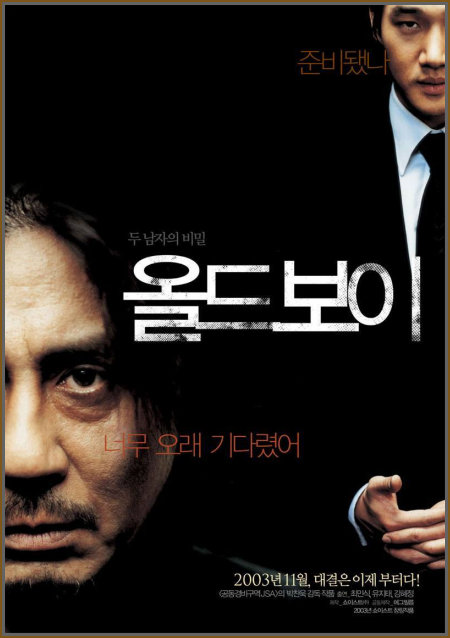
Review: Oldboy (dir. by Park Chan-wook)


2003 would go down as the year a master filmmaker emerged from the ranks of the independent circles to the forefront of elite directors. Park Chan-wook was already well-known amongst the indie circuit as an innovative director coming out of South Korea’s burgeoning film industry. He’d already released such well-received films as Joint Security Area and Sympathy for Mr. Vengeance. In fact, the film in question that’s propelled Mr. Park to the forefront would be the second part of a film trilogy dealing with the existential nature of vengeance and its effect on all involved. Oldboy follow’s Sympathy for Mr. Vengeance like a sonic boom and inproves on the first leg of the trilogy in every way.

Oldboy at its most basic is a revenge film. It is a film about a man wrongly and mysteriously imprisoned for reasons unknown to him and to the audience. We see Oh Dae-su — the man in question — through his 15 years of mysterious imprisonment and we see him change from the Average Joe from before his kidnapping to a taut, volatile and somewhat insane individual whose only goal in life is to find whoever did this to him and make him pay. Oh Dae-su’s imprisonment takes a good part in the telling and makes up the first third of the film’s tale. As the years go by we see him spiral down to the lowest depths a man can get to before sanity leaves him. There’s no evidence that he didn’t go insane during his imprisonment, but Park does show us scenes that Oh Dae-su’s singular focus to find out why he was imprisoned and to exact revenge on those involved might have just unhinged the poor man in the process.

The second part of the tale being told occurs the moment Oh Dae-su was suddenly — as mysteriously as his imprisonment — released. One moment he’s still in his prison where his only contact with the outside world is the TV in his room and then he’s on the rooftop of a building with new clothes on and a suitcase with more clothes and his notebooks where he’s listed all the names he thinks may have caused him this wrong. From here Dae-su goes on a whirlwind search to find clues and information on who may have imprisoned him. Along the way he meets the young sushi chef Mi-do who seem to have taken some interest in Oh Dae-su’s well-being and who slowly falls in love with him. It is their journey through the maze and labyrinth of false leads and trails that dominate the second third of this tale. It is also the part of the film where Oh Dae-su’s monster persona takes precedence as he wreaks havoc on anyone and everyone who may have the information he needs to solving the mystery of his imprisonment.

Many have already mentioned the wince inducing pliers scenes and the single-take corridor fight scene. But it is the lovemaking scene between Oh Dae-su and Mi-do that I consider the most pivotal scene of this part of the tale. With the two characters finally consummating their mutual attraction to each other we see the two as not separate entities but a singular one where both will reap whatever their search will sow in the end. Mi-do becomes less of a sidekick and more of an equal partner in Oh Dae-su’s search. She knows that the only way she and Dae-su would find true happiness together is if she helps him finish his quest even if it means finding the truth that may not be to their liking.

The third and final part of this tale finally puts to light just who exactly is the mastermind of all that has transpired. The clues picked up by Oh Dae-su starts to fall into place and the puzzle that opens up for him and the audience is nothing less than tragic and Shakespearean. This third part really hits the audience between the eyes about the nature of vengeance and how all-consumming it can be if allowed to simmer, grow and take root. We see how it has already driven Oh Dae-su to the brink of madness and how he teeters just beyond the point of no return. Then on the mastermind of the whole thing we see how one slip of the tongue in the distant past of all involved has consumed this individual to exacting a complex and appropriate plan of revenge on Oh Dae-su. As the tragic and heartwrenching final part of the tale weaves and continues to its conclusion no one ends up being the victor. All have become just the victim of the cycle of violence and vengeance thats taken hold of everyone.

Park Chan-wook’s direction was flawless and there’s not a wasted scene from beginning to end. Every scene was shot and edited with a sense of purpose to convey the mood and feel of the situation. It didn’t matter whether it was a a slower-paced scene where the actors conversed in intelligent dialogue or a scene full of frantic energy where burst of violence seemed both randomly shot but choreographed at the same time. The composition of the scenes and his judicious use of wide-angle and static shots with little editing helps convey the single-minded focus of Oh Dae-su and his main antagonist. Some of the scenes even show hints and clues to the audience that — as unlikely as it might seem — the whole film might be a figment of Oh Dae-su’s fractured mind as a consequence of his imprisonment. Park Chan-wook doesn’t answer whether it is a figment of Oh Dae-su’s imagination, but the theory is there for people to ponder over.

The screenplay written by Park from the original Japanese manga was excellent and doesn’t waste unnecessary exposition to distract the audience from the main tale being told. Everything said and acted on the screen ultimately leads to the shocking climax in the end. In fact, I would say that the climax of the film doesn’t happen until the very last second of the film before everything fades to black and the credits roll. That’s how tightly written and focused the screenplay was from beginning to end.

Then there’s the three main characters as played by Choi Min-sik , Yu Ji-tae , and Kang Hye-jeong. These three actors play their parts to perfection. Choi Min-sik as Dae-su Oh was a picture of focused madness. We invest in his quest for vengeance and as the final secret was unveiled we truly feel his shock, horror and anguish. Yu Ji-tae plays the mastermind of the whole thing with icy calculation. This was a man who had spent half his life working on, preparing and letting loose the events that would lead to him finally getting his revenge on Oh Dae-su. The two, though after the same goal of vengeance, are diametrically opposed in terms of look and personality. Then we have Kang Hye-jeong as Mi-do, the young sushi chef caught in the middle of this duelling vengeance tale. She was both endearing, innocent and the pure soul that keeps Oh Dae-su from spiralling into final madness. It truly becomes tragic that the final consequences of the vengeance wrought by both male principals impacts the female in the middle and in the end she remains oblivious to the truth and Kang Hye-jeong conveys this sincere, innocent naivete to sweet perfection.

There’s much more to say about Oldboy, but its really just more accolades to be heaped upon a near-perfect film. A film exploring the darker side of man’s inhumanity towards one another to satiate their self-righteous quest for so-called “justice” and retribution. Like Cronenberg’s A History of Violence, Park’s Oldboy also shows the unending cycle of vengeance heaped upon vengeance in addition to the violence it inherently breeds. Like Cronenberg’s 2005 film, Oldboy doesn’t fully answer this existential question but leaves it up to the viewer to make their own decision. Park Chan-wook’s Oldboy is a film that comes but once in an era and helps redefine an era of its place in film history. Oldboy also continues the vengeance trilogy with Sympathy for Lady Vengeance (shortened to just Lady Vengeance here in North America). Oldboy marks the true arrival of one of the new masters of film and he joins the fine company of such people as Scorcese, Cronenberg, and Kubrick. A near-perfect film all-around.

Review: Hard Candy (directed by David Slade)


The film directed by David Slade and written by Brian Nelson seems disturbing enough for just the subject matter alone, but it’s also eerie in how timely it’s release has been. With reports of teenage girls becoming victims of internet sexual predators appearing in all types of news media, Hard Candy arrives in the theaters through a limited release to highlight this current trend. Slade and Nelson has created an disturbing and, at times, a very uncomfortable film that shows the many twists and turns that happens when the roles of prey and predator become interchangeable.

There’s no denying that Hard Candy aims to put a new twist on the exploitation subgenre of the rape-revenge films that dominated the late 70’s and early 80’s. Brian Nelson’s clearly channeling the influences from such rape-revenge fantasy films like Mastrosimone’s Extremities and the very disturbing and exploitative I Spit On Your Grave (Day of the Woman) by Meir Zarchi. From the beginning the audience is shown the set-up of an adult instant messenging another person with the screen name of Thonggrrl14. Thonggrrl14 is in fact a 14 year-old teenage girl named Hayley and the adult on the other end a 32 year-old photographer named Jeff who goes by the screen name Lensman319. Jeff has an unhealthy and disturbing penchant for pubescent girls as the subject of his camera lens.

From their first meeting meeting at a coffee house where Jeff gradually begins a flirtatious conversation with the young Hayley to the point in the first act when he finally convinces her to go back to his house whcih doubles as his studio. There’s really no denying the sense of unease that permeates the first act as Hard Candy gradually paints Jeff as the sexual predator that he is. There’s no denying the fact that a man of his age should not be flirting and behaving as if the girl across from him is a fully-grown and developed woman of similar age. Hayley also comes across during this first act like a teenage girl dazzled by an older man who treats her older than her real age. It’s really a disturbing look at just how easily an adult can seduce a child into doing things they normally shouldn’t be doing.

Hayley (played by Juno herself, Ellen Page) soons shows just how wrong and mistaken Jeff has been in picking her as his new prey. I don’t use that word loosely for that was what this film truly was when boiled down to its basic component. A one-on-one three-act play (Brian Nelson’s experience as a playwright shows in the stage-like sequences from beginning to end) between a predator and prey. This time around the prey has turned out to be the one who has done the hunting and the consequences on the wanna-be predator that is Jeff leads to a slow and deliberate set-up that looks like something out of Takashi Miike’s Audition. Hayley’s turning the tables on her stalker shows that girls her age are intelligent enough to know that what Jeff’s doing was wrong. Hayley’s answer to that is to be the hunter instead and fix Jeff’s “problem” through what she calls as “preventive maintenance.” What she calls “preventive maintenance” will definitely cause many men watching this film to sit very uncomfortably and wince on more than once occassion.

The acting job done by Ellen Page was dazzling and really showed why she was listed as an up and coming talent years before Juno. She was technically 15 year-old when the film was made and already she showed a keen grasp of the script which deals with disturbing topics. There’s a scene in Jeff’s car as they reach his home where a passing glance of the camera at her face shows not a gullible teenager, but a determined and somewhat oft-kiltered individual who knows what she will be doing in the coming hours will be medieval harsh but in her mind justified. Patrick Wilson as Jeff plays the would-be sexual predator admirably. His range of emotions go from outright denials of Hayley’s accusations to impotent rage and desperation as his fate is described to him in Miike-like detail by his teenage captor.

If there’s a flaw to mar the intense and suffocating atmosphere this stage-like film creates it would be in the script itself. At times the Hayley character becomes a one-note individual whose beyond her years demeanor seemed too cold and rehearsed. I really can’t put the blame for this on Ms. Page, but on the writer himself. It seems like Brian Nelson was trying too hard to add twist and turns on the story being told. He seems to enjoy overmuch his ability to tug back and forth on his audiences’ emotional investment in the film and the two characters. He actually pulls off the trick of making the sexual predator earn the audiences’ sympathy at what is about to be done to him. But instead of continuing on with that tangent and thus putting Hayley on a darker and more sinister light, Nelson backs off and pulls the audience back to wanting physical and emotional destruction to be visited on Jeff. Nelson used too much zig-zagging in making his script look more complicated than it ought to be. A rape-revenge film works best in its most simplest form.

The direction by David Slade (well-known as a music video director) was actually very subdued and deliberate in its pacing. Slade doesn’t fall back onto his music video experience with unnecessary quick-cut editing that’s plagued his music video director brethren. Slade managed to pull off a very Hitchcockian-style of directing by letting the stage and the actors speak for the scene without much bells and whistles to clutter things. There’s a few sequences where he lets the camera film things through one long, continuous take thus adding a sense of realism to the situation developing inside Jeff’s home.

The use of too much twists and turns in the script notwithstanding, Hard Candy is a tour de force piece of suspenseful filmmaking that borders on the great psychological horror films of the 70’s. In fact, the subject matter on the screen lends a sense of real horror to the film with its timely release and story. Any parent or adult who knows teenagers who use social networking sites like Facebook, MySpace and Twitter would think hard about wanting to know more of what their kids are doing on the net. Hard Candy can be brutal at times and almost suffocating at others with little or no levity to break the tension. It’s a difficult film to sit through and probably won’t be the type of film for some, but just watching the performance by Ellen Page is worthy of the price of a viewing. The subject matter is very adult and straddles the line of what constitute a rated R film and one strictly for adults only. Hard Candy definitely falls on the latter.

10 Best Films of 2009


While some have called 2009 as not being so great in terms of quality films, there have been others who think the year was a very good year for films from start to finish. Not all the best films of 2009 came out during the so-called “awards season” from October thru December. Some of the worst films, in my opinion, were released very late in the year and clearly done so to try and force its way into award contention. While the year of 2009 saw some very good films come out early in the year and, to my surprise, even during the popcorn and brainless season of the summer blockbusters.

My list consists of the 10 films I saw in 2009 which I believe to be the best of all them. Some people will probably agree with me on and some won’t. Some of my picks may have been little seen outside of independent arthouse theaters or film festivals but it doesn’t diminish just how much I think it deserves inclusion in a “best of” list. In the end, I thought these films doesn’t just celebrate what’s great about films but also celebrating those filmmakers who show that when given room to breathe and do things their way magic can still happen.

10. Bad Lieutenant: Port of Call – New Orleans (dir. Werner Herzog)

9. The Messenger (dir. Oren Moverman)

8. Collapse (dir. Chris Smith)

7. Moon (dir. Duncan Jones)

6. Der Baader Meinhof Komplex (dir. Uli Edel)

5. Avatar (dir. James Cameron)

4. Up In The Air (dir. Jason Reitman)

3. District 9 (dir. Neill Blomkamp)

2. Inglourious Basterds (dir. Quentin Tarantino

1. The Hurt Locker (dir. Kathryn Bigelow)