Horror On TV: Thriller 1.28 — Yours Truly, Jack The Ripper


Of all of the world’s real-life monsters, Jack the Ripper is one of the most iconic.  Whether it’s because he was never actually caught or because he committed his savage crimes during an era that we associate with emotional and sexual repression or maybe just because he has a memorable name, Jack the RIpper continues to both fascinate artists of all genres and haunt the nightmares of viewers and readers like me.

(Check out my review of Murder By Decree for an example of my fascination.)

Tonight’s episode of televised horror on the Lens deals with Jack the Ripper.  This episode of Thriller was originally broadcast on April 11, 1961 and is based on a short story by Robert Bloch.  It was directed by actor Ray Milland.  

Without further ado, here is Yours Truly, Jack the RIpper…

Horror On TV: Thriller 1.30 “Parasite Mansion”


Down here in Dallas, channel 47 is the local Me-TV affiliate.  Me-TV specializes in showing old TV shows from the 50s, 60s, and 70s.  The network sells itself as a nostalgic refuge for people who are several decades older than me, a place where they can go to escape from Seth McFarlane producing sitcoms and Maury Povich conducting DNA tests.

But you know what?

I like Me-TV and I’m glad that it exists.  It probably has something to do with me being a history nerd at heart.  I love the chance to see what the world was once like.  Add to that, some very good shows were produced in the 50s and 60s.  Just because a lot of us weren’t there to experience them firsthand doesn’t mean that we can’t appreciate them in rerun syndication.

Case in point: Thriller.

Thriller aired for two seasons in the early 60s.  It was an anthology series, in the tradition of The Twilight Zone.  Whereas The Twilight Zone was hosted by Rod Serling, Thriller was hosted by horror icon Boris Karloff, who always introduced the macabre material with a bemused gleam in his eyes.

Parasite Mansion was the 30th episode of Thriller and it originally aired on April 25th, 1961.  In this episode, Marcia (Pippa Scott) crashes her car outside of a dilapidated Southern mansion.  When she awakens, she finds herself in the position of being the unwilling guest of the eccentric family that lives inside the mansion.  I like this episode, largely because I can never resist Southern gothic atmosphere.

Incidentally, the family’s matriarch is played Jeannette Nolan and, if she sounds familiar, that’s probably because she was one of the many actresses to voice Mrs. Bates in Psycho.

Trailer: Aftershock (Official)


Horror is still my first true genre love when things get boiled down to their most basic. 2013 looks to be full of horror films to more than satisfy my appetite for them. One such film that I’d be itching to check out is the Chilean horror-thriller titled Aftershock.

The film was co-produced by horror filmmaker Eli Roth who also had a hand in co-writing the script with Guillermo Amoedo and the film’s director, Nicolás López. The film is a fictional account of the aftermath of the 2010 8.8 earthquake in Chile and how a group of young partygoers try to escape the chaos of the city after the quake. Part of the film’s story uses the real-life prison breakout of prisoners after the quake and the resulting chaos in the damaged areas of the city.

Aftershock looks to be in the same extreme horror that the French have been helpful in making one of the newest trends in horror cinema. The trailer is not the glorious red band variety everyone has been waiting for but there seems to be enough hints throughout to show that Aftershock will not be a bloodless affair.

The film premiered during last year’s Toronto International Film Festival and the buzz surrounding the film has been quite positive. Unfortunately, there’s still no word on a release date in the US or anywhere for that matter, but it definitely joins Franck Khalfoun’s Maniac as one of my must-see horror films for 2013.

Trailer: Skyfall (dir. by Sam Mendes)


We finally get the return of Britain’s deadliest and world-renowend “Double-O” agent with Sam Mendes’ Skyfall.

It’s been quite a long time since Marc Foster’s underwhelming Quantum of Solace with MGM’s subsequent bankruptcy being one of the major causes for the delay of this film being made. With the MGM bit now out of the way James Bond finally returns to the big screen with Daniel Craig once again donning the Walther and the tuxedo to play the debonair and ruthless killer agent that Ian Fleming made famous through his spy novels.

This teaser doesn’t show much other than some bits of action (one of which looks like it might’ve been lifted out of a level of Modern Warfare 3) and Bond being coldly ominous about people coming to get him and “M”. I’ve always been a huge fan of the Bond films and even when they don’t go over so well I still enjoy myself. They also tend to have a different director with each and every film which gives each film a different take on the character of Bond. This time around we have Sam Mendes in the director’s chair and it’ll be interesting to see how well he handles the thriller genre and action.

Skyfall is set for an October 26, 2012 release date.

The Girl With The Dragon Tattoo (dir. David Fincher)


I’ve probably gone back and rewritten this review multiple times over the past few hours. I’ve been struggling to come to a final conclusion to how I felt about the film. On one hand it is a hollow crime thriller, all polish and no substance, and on the other it is an exceptionally crafted dark and mysterious tale of sex, corruption and murder that oozes with atmosphere. One could make the case for either, and many critics have argued in favor of one side or the other. After a lot of contemplation, I’ve come to decide that it actually seems to rely on both being hollow and atmospheric, but what continues to conflict me is whether the former can truly be overlooked even if crucial to the final product.

‘The Girl With The Dragon Tattoo’ stars Daniel Craig as Mikael Blomkvist, a journalist who has recently come under a lot of scrutiny after being accused of making up a story about a wealthy executive and losing the case of libel brought upon him. Facing financial and credibility problems he is hired by Henrik Vanger (Christopher Plummer) a wealthy entrepreneur  who wants Mikael to solve a ‘cold case’ that has haunted him for forty years, that being the disappearance of his grand-niece Harriet who he believes was murdered by a member of his corrupt family filled with Nazis and recluses. As Mikael delves deeper into the mystery of her disappearance he hires the assistance of Lisbeth Salander, a goth-hacker with a dark past who has her own personal issues to deal with, specifically a financial guardian who wants sexual favors in order for her to access her money. When they are finally brought together they discover the dark secrets of the Vanger family and its links to a serial murderer case that begins to threaten their own lives.

David Fincher, who directed ‘Zodiac’ and ‘Se7en’, is no stranger to graphic and dark thrillers so it is no surprise that he handles the creation of ‘The Girl With The Dragon Tattoo’ with a level of competence few other directors could have. Along with the help of cinematographer Jeff Cronenweth and being set in Sweden the film has a very dark and cold (often literally) tone, making an atmosphere just as chilling as the subject matter and beautiful to look at. Sadly under the gorgeous and dark visuals and the bleak and mysterious atmosphere there isn’t much to be had. There is a real lack of emotion and soul.

I can only assume that Fincher’s intentions from the beginning were to avoid any real substance, and to make a film just as hollow and sadistic as the story is was trying to tell. There is just about no emotion and so no reason to be attached to anyone except Lisbeth, but our empathy for her stems more from the vial acts we see acted upon her and less from truly knowing who she is, and why she is so emotionally restrained. It is not until the last twenty minutes that she gets any sort of development, but was it too little too late? Again I cannot decide. One could argue that this insight into the character earlier on would have made us care for her more, which I can understand. But I also question whether or not she could have even opened up the way she does at the end without having first gone through the events of the film, in particular the relationship she has with Mikael. Either way, I’m just glad Fincher went with Rooney Mara to play Lisbeth.

It is hard not to compare both film versions of the Lisbeth character, and even harder to choose which was better. This is mainly because both films, although similar in many ways, have very different tones. The Swedish version is a much more straight forward thriller and Rapace’s Lisbeth fits that film in being just a strong and tough individual, though there doesn’t seem to be too much below her surface and most of the development of her past is shown. Mara’s Lisbeth is a much more complex character, and although the film doesn’t give her much depth in terms of story until the very end, Mara gives off hints of a disturbing past just in the way she talks and moves, especially when men get too close to her. In reality she is a much weaker character than in the Swedish version. I personally liked that soft side because it makes her feel more like a vulnerable woman so when she fights back it feels more powerful.

It is this humanization that really helps propel Fincher’s adaptation over the Swedish version in my eyes. Even Daniel Craig, who put on a very good performance, is given a lot more to do and a much more interesting personality. He gives the character a bit of charisma, and wasn’t just a monotonous individual, like in the original, making it easier for us to care for both him and Lisbeth. It also makes their odd but provocative relationship seem more genuine and intimate.

All of this stuff I loved…but then I fall back to feeling like it was all for nothing. I mean it looks pretty, and the mystery is intriguing and the atmosphere is dark and cool, but once it is all over nothing really sticks other than the technical aspects. This isn’t helped by the fact that it over stays its welcome for the last few minutes, even if it adds to the characters. Luckily the pacing is done well enough to never make it feel boring but it does end up being rather anti-climactic. But I feel a second viewing is necessary.

With that said, as conflicted I am about everything else one thing that I can say for certain was fantastic is the score. It was crucial in the creation of the moody and dark atmosphere. Trent Reznor and Atticus Ross, who did the Oscar winning score for ‘The Social Network’, continue to impress and help give the film a pounding and chilling heartbeat. Also the ‘Bondesque’ opening credits, a brilliant animation of dark tar, leather and gothic imagery set to Karen O’s cover of Led Zeppelin’s ‘Immigrant Song’, was absolutely stunning.

So overall I will say that it is an incredibly well-crafted and dark thriller with fantastic visuals and a wonderful performance by Rooney Mara and because of that it certainly deserves a lot of credit but below the surface it is a rather hollow and anti-climactic story making it hard for me to love it as much as I might have wanted to. It also did not help that going into it my anticipation was at an all-time low due to the hype that was built up around it and by how much I liked the original. So for now I’ll just say I enjoyed it for what it was, it certainly is well crafted enough to deserves the praise it is getting, but a second viewing will determine whether or not I truly thought it was a great film. Still I recommend it for those interested.

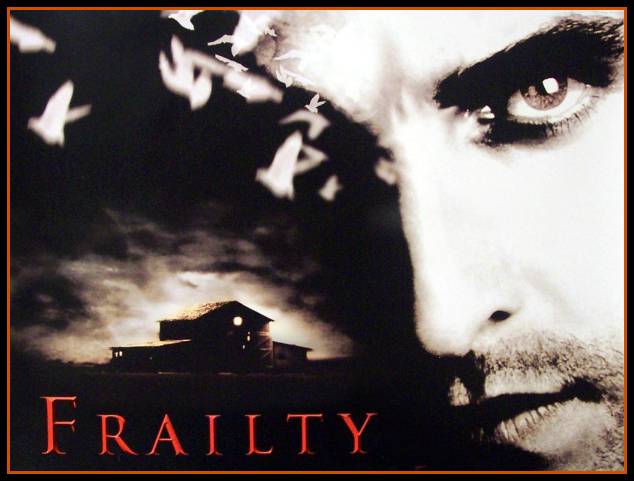
Quickie Horror Review: Frailty (dir. by Bill Paxton)


Every year there are always films of every genre and stripe which fly under the radar of most film-goers. Every film fan knows of several such films and always like to believe they were one of the few who actually saw it in the theaters when it came and went. In 2002, one such film was the psychological thriller/horror film Frailty by veteran actor Bill Paxton. This was to be his directorial debut on a feature-length film and for a first time it was a home run right from the start.

Frailty was done mostly through flashbacks as told to an FBI special agent by a man (Matthew McConaughey) and how this man knows the true identity of a particular serial killer around the Texas region who has dubbed himself the “God’s Hand”. It’s through this man’s retelling of the origins of the “God’s Hand” that we see the lives of a father raising two young boys as best he can until a sudden “vision” of divine nature changes their lives forever. The father begins to believe that he has been given a divine purpose to find and destroy demons who have taken on human form. To do this deed he has an axe he’s dubbed “Otis” to assist him. The reaction of the two young boys differ as their father goes about his new work. The older brother in Fenton Meiks believes what his father is doing to be illegal and makes him a murderer. On the other hand, the younger brother in Adam Meiks has taken on seeing their father as the hero that he sees him and supporting him in his new endeavor.

The film doesn’t inundate the viewer with much gore and violence. This is not say that the film lacked for killings. The father finds and “destroys” the demons given to him on what he calls “God’s list”, but the film doesn’t linger on these scenes of violence. It instead focuses on the reactions of the father’s two sons and the growing rift which gradually begins to grow between the three. It would be this rift which plants the seed of who would ultimately become the “God’s Hand” killer.

The film also manages to turn the theme of a father’s love for his sons and vice versa become a taut and disturbing study on the concept of faith. The film also does a great way of twisting the story in a way that we never know who the “God’s Hand” killer was until very close to the end despite everything being told by the man to the FBI pointing to specific individual. This was one of the few films which used the twist to the narrative properly and not as a crutch to make the film better than the source.

It’s this source, the screenplay in other words, which makes Frailty such an under-appreciated and great film. There’s rarely any instances where the story takes on leaps of logic that would break the audience from the world they’ve become invested in. In fact, I would say that the film was quite traditional in how it handled the story and characters. There’s wasn’t any special character and narrative quirks to make them stand out from the rest of the other roles. It’s from the performances by all involved, especially the very convincing ones from the two young actors playing the young Fenton (Matt O’Leary) and young Adam (Jeremy Sumpter), that sells the film. Matthew McConaughey as the man telling the story of the Meiks does a great job in a role that others might have gone overboard with. His restrained performance in concert with the young actors in the film would be another reason why Frailty became such a great film.

Performances, as great as they were in this film, required for a filmmaker to have a deft handle on his cast and the screenplay. This film was lucky enough to have a first-time filmmaker in Bill Paxton who played to the strength of the screenplay and trust in his actors. He didn’t try to be too cute or direct like someone with something to prove. I know that saying one directed a film with efficiency would be seen as a negative. In this instance I’d say that Paxton’s efficient direction helped the film stay focused on the story and the characters instead of trying to be flashy.

Frailty was, and still is, a film that seems to fly under most people’s radars, but it’s also a film that has gained quite a loyal following since it’s initial 2002 release. It’s a rare film that has continued to live up to it’s growing cult status not because of what people might have heard of it, but because it’s a rare film that stand on it’s quality. A film which, from top to bottom, made for a smart thriller with some horror aspects through in that didn’t try to fool it’s audience (even the twist in the story was a true genuine surprise instead of a story cop-out). If there ever was a film that needed to be seen by more people it’s definitely Frailty.

Quick Review: Contagion (dir. by Steven Soderbergh)


Note that this isn’t the only review for Contagion.

Arleigh has an in-depth review of the film, which is also available to see, whereas this is more of a summary. As it’s for the same film, I’ve used the same tags that were in Arleigh’s post.

Before I start, I have to say that I haven’t had a theatre be so quiet during a film since I went to see Mirrors, and that was because there was no one there. My showing for Contagion was packed, but no one made a sound throughout the film. I coughed twice (because I had to), and you wouldn’t believe how many heads turned in my general direction. If nothing else, it shows that the movie had some impact to the audience, and that’s always (okay, usually) interesting to see. By the time the movie is over, you will probably pay attention to how many times you touch your face or the objects around you.

If there’s one thing I can give director Steven Soderbergh, it’s that he has a great ability to work with ensemble casts. He did a great job in getting everyone to work together on the Oceans Eleven remake and sequels. He also walked away with a Best Director Oscar for Traffic. His films have the ability to avoid having his stars chew up enough screen time that they appear to be an actual center character. Catherine Zeta-Jones’ had a character who’s story was just as strong as Benecio Del Toro’s.

On this, Contagion is no different. In essence, it’s almost like watching cameos in a miniseries.

Although the film is peppered with various actors, no one person can be considered the main character of the film. Soderbergh is able to get them all to play their roles well. He and Scott Z. Burns – one of the writers on The Bourne Ultimatum and a collaborator with Soderbergh – give us a number of perspectives for this story and damn, the whole thing is very tight overall. The movie has very little wasted space.

Like the story itself, the movie moves at a great pace, opening with Elizabeth Emhoff (Gwenyth Paltrow) on her second day after exposure to the virus after returning from a trip to Hong Kong. This eventually escalates to other infections reported in other areas around the world. In an effort to contain and understand what they’re dealing with, the Center for Disease Control starts an investigation. Lead by Dr. Ellis Cheever (Lawrence Fishburne), he sends Dr. Erin Mears (Kate Winslet) to Minnesota to determine the scale of the problem.

In addition to the CDC’s efforts, the World Health Organization also gets involved, sending their own field agent to Hong Kong, played by Marion Cotillard. Both doctors come up with information that appear to be helpful for the overall investigation in various ways.

The other two angles in the film are through a conspiracy theory blogger / investigative reporter played by Jude Law and Mitch Emhoff (Matt Damon), who has to deal with the impact of his wife’s sickness. Enrico Colantoni, Brian Cranston, Sanaa Lathan, Elliot Gould and Jennifer Ehle round out the cast. It should be noted that Ehle is the daughter of Kenneth Branaugh’s Hamlet actress Rosemary Harris, who looks remarkably like her mother. That’s just something that caught my eye.

In terms of the Kid Factor, I would be hesitant to take kids to see this unless they had a pretty clear handle on death or getting sick. Teens and adults could probably handle the film, but anyone under than that may freak out a little. Mind you, there’s very little gore in this film. When I think about it, there’s not even a whole lot of blood. There is some violence though as the story escalates and humanity goes wild, but it’s not that far a cry from many zombie movies. It’s up to the parents discretion on whether their kids should see this.

I should also point out that the music in this film is also very good. Cliff Martinez, who also worked on the score for Drive (also out this month) did an impressive job with an electronic score that sits in the background of the film, but also fits the pacing of the film well. It’s worth giving it a listen if at all possible. This quick review was actually written to the Contagion score.

Contagion is definitely worth seeing, easily recommended, but if you happen to be particular about germs, note that this may not be the most comfortable film to watch. Don’t be shocked if you end up hugging yourself while watching this in the theatre. With Soderbergh moving away from film directing to pursue other interests, Contagion is a nice final bow to his career.

Review: Contagion (dir. by Steven Soderbergh)


In a world where almost every season news media both traditional and on-line warn the population of what could be an outbreak of a new super-virus that could cause a new pandemic similar to the Spanish Flu of 1918. This was a pandemic which occurred before transcontinental travel was the norm and the virus still managed to kill 1% of the world’s population. Now, it’s 2011 and with warnings of swine flu, bird flu, Ebola, SARS and any number of infectious diseases still in the public’s consciousness we get a new film from filmmaker Steven Soderbergh which seriously explores a world discovering a new deadly disease and how the world responds and deals with the crisis.

Contagion begins with a simple “Day 2” caption as we see one Beth Emhoff (Gwyneth Paltrow) awaiting her flight to board in O’Hare at Chicago. There’s a bit of character building about this character who we see as already in the early stages of what looks to be the flu. From there Soderbergh does an interesting bit where he lets the camera linger for just a split second longer whenever Beth touches something. Soderbergh does this many times that the audience will soon get used to it and forget the significance of the act. We see Beth get a ride home from a colleague back to her home where she’s welcomed home by her husband Mitch and her young son Clark who runs to her and gives her a big hug.

The story really hits the ground running as Beth and soon those she has come into contact with begin to show similar symptoms and quickly die. The CDC and it’s head administrator, Dr. Ellis Cheever (Laurence Fishburne), soon begin to see a pattern to the deaths and the similarity to their symptoms. We soon see another aspect of the story begin with the arrival of Dr. Erin Mears whose job is to investigate the circumstance which seems to be leading into a cluster case starting with Beth and the area she lives in.

The third aspect of this film throws in internet news blogger Alan Krumwiede (Jude Law) who begins to suspect that several deaths around the world looks to be interconnected in someway and that the government, the CDC and the WHO (World Health Organization) are trying to hide these disturbing facts from the general public. Krumwiede becomes the purveyor of unfiltered news which seems to do more harm than good as more and more people begin to believe his conspiracy theories about what looks to be a growing global pandemic cause by an unknown virus every expert brought in to help cannot seem to figure out.

Let me just first say that to call Contagion a thriller in the traditional sense would be flimsy at best. Soderbergh and the film’s writer, Scott Z. Burns, have made a thriller but in a sense that it skews heavily on using realism and an almost docudrama style to push the film’s narrative. The thriller aspect comes from the notion that this film’s plot is not far off from actually becoming a real event. There’s no usage of dramatic tropes from past disaster and apocalyptic films to manipulate the audience. The film as a thriller would be quite mundane when stacked up against films like Outbreak and The Andromeda Strain. It’s the realness of the story, the events taking place on the screen which gives the film it’s dramatic heft.

We begin to see what Soderbergh is trying to accomplish with this film. How transcontinental travel which took weeks during the 1918 Spanish Flu pandemic now can spread a highly infectious disease in a manner of less than a day’s plane flight over one ocean. The film shows in disturbing detail just how easily we as a people can spread a disease just by doing the most innocuous thing like absently touching one’s face many times a minute then transferring whatever we had to any surface we touch. Contagion definitely will add to the paranoia of those who already have an unhealthy habit of disinfecting everything before they even touch it.

The film doesn’t just touch upon the medical side of solving the growing crisis, but also explores how the governmental response and sociological reaction to the epidemic. For the former we see how protocols and the need to slowly disseminate information to the public only adds to the public’s mistrust of the very agencies created to help them in case of such an event. Soderbergh doesn’t condemn or praise these agencies for their bureaucracy. We see the reason why places like the CDC take their time to finally inform the public as we get the unfiltered and manipulative news blog side of the news media in the form of Krumwiede’s blog. While he does dare to ask the questions other more traditional news organizations fail to ask he also becomes too enamored with how many people read his blog that he’s willing to manipulate the news itself in order to gain more followers.

Contagion hits the second half of the film with the world in full crisis mode and the film taking on a more apocalyptic tone. We see streets in San Francisco full of garbage bags as agencies who used to pick them up have either gone on strike or have stopped their daily runs in fear of infection. Then there are the riots at pharmacies and stores as interstate commerce grounds to a halt and no new supplies of goods and sundries make it to stores. Society itself begin to devolve as everyone and every group start to look after their own and begin to turn on others for the dwindling supplies.

It’s here in the second half that we see the film take on some of the more traditional aspects of a thriller, but even here Soderbergh doesn’t seem to want to linger on the more sensational side of the story. He continues, for good or ill, on the narrative style he began with and that’s to see the epidemic from beginning to conclusion in as clinical a manner as possible. It’s for this reason that at times the more intimate and personal side of the film’s story involving the Emhoff family seemed like it was from a different film. The Emhoff’s end up becoming the heart of the film, but it’s this emotional center that never seemed to fit with the sterile and cold narrative style Soderbergh chose to tell the film’s story.

The performances by the star-studded cast was quite good, but no one person really stood out. If I had to choose one it would have to be Kate Winslet’s Dr. Mears who goes out into the field early in the crisis investigating the early stages of the epidemic. We see her frustration at having to deal with local governmental agencies who fear the hit a quarantine would put on local economies (as if people dying in droves wouldn’t be a bigger hit) and the very danger of contracting the disease itself since having no knowledge of how it works she must use means of protection that may or may not protect her. While her story-arc in the film was just one of several it was her’s which really showed a major impact at how impersonal can be and how no one is truly safe.

Contagion is a film that tells a story about the possibility of such an event occurring and does it well, if not in a very clinical way, but it also shows just how unprepared we truly are when it comes to the smallest of creatures who sees us as nothing more than living forms of intercontinental travel. It’s exploration of such a global crisis in all it’s aspects (medical, research, governmental, media and sociological) makes it seem more like a docudrama more at home in the Discovery Channel, The Science Channel and the like instead of a cinema multiplex. It’s all due to Soderbergh’s storytelling skills that he’s able to pull off such a non-traditional thriller and make people more afraid about their surroundings coming out of the film than they were going into it. It’s not one of Soderbergh’s best films, but it’s a strong offering from him and one of the better films to come out in 2011.

SDCC 2011: Drive (dir. Nicolas Winding Refn) Red Band Trailer


One of the films I’ve really been following since last year and can’t wait to see this September is the latest film from Danish filmmaker Nicolas Winding Refn. I’ve loved his work since I first got introduced to his Pusher Trilogy and saw his two most recent work with Bronson and Valhalla Rising. He is following up the latter with what I could only describe as his own take on the neo-noir genre film, Drive.

At San Diego Comic-Con 2011, the latest trailer for Drive was introduced during the FilmDistrict panel which also had Guillermo Del Toro and his upcoming produced horror film, Don’t Be Afraid of the Dark. This latest trailer for Refn’s Drive is of the red band variety but from what I could tell from the trailer it shouldn’t be NSFW.

The trailer really doesn’t delve too much into all the plot points of the film. It does give a sense that the film has been influenced by past genre crime films and some of the classic grindhouse chase films of the 70’s. One thing I’m sure of is that this film’s cast looks to be one of the best for any film being released in 2011: Ryan Gosling, Carey Mulligan, Ron Perlman, Oscar Isaac, Albert Brooks, Bryan Cranston and Christina Hendricks just to name a few.

Drive is set for a September 16, 2011 release here in the United States.

Source: IGN

Review: V for Vendetta (dir. by James McTeigue)


“Remember, remember the fifth of November, the gunpowder treason and plot. I know of no reason why the gunpowder treason should ever be forgot.”

Alan Moore’s decision to want his name off the final credits for the film adaptation of V for Vendetta now makes sense. Moore has had a hate/hate relationship with Hollywood and the film industry in general. They’ve taken two of his other works in The League of Extraordinary Gentlemen and From Hell. and bollocks’d them up (to borrow a term used quite a bit in V for Vendetta). Outside of Watchmen, Alan Moore sees V for Vendetta as one of his more personal works and after reading the screenplay adaptation of the graphic novel by The Wachowski Brothers his decision afterwards was to demand his name be removed from the film if it was ever made. Part of this was his hatred of the film industry for their past mistakes and another being his wish for a perfect adaptation or none at all. Well, V for Vendettaby James McTeigue and The Wachowski Brothers is not a perfect film adaptation. What it turns out to be is a film that stays true to the spirit of Moore’s graphic novel and given a modern, up-to-the-current news retelling of the world’s state of affairs.

V for Vendetta starts off with abit of a prologue to explain the relevance of the Guy Fawkes mask worn by V throughout the film and the significance of the date of the 5th of November. I think this change in the story from the source material may be for the benefit of audiences who didn’t grow up in the UK and have no idea of who Guy Fawkes was and what his Gunpowder Plot was all about. The sequence is short but informative. From then on we move on to the start of the main story and here the film adheres close enough to the source material with a few changes to the Evey character (played by Natalie Portman) but not enough to ruin the character. Caught after curfew and accosted by the ruling government’s secret police called Fingermen, Evey soon encounters V who saves her not just from imprisonment but rape from these so-called Fingermen.

Right from the start the one thing McTeigue and The Wachowski Brothers got dead-on was casting Hugo Weaving as the title character. Voice silky, velvety and sonorous, Weaving infuses V with an otherworldly, theatrical personality. Whether V was speaking phrases from Shakespeare, philosophers or pop culture icons, the voice gave a character who doesn’t show his face from behind the enternally-smiling Guy Fawkes mask real life. I’d forgiven the makers of this films for some of the changes they made to the story and some of the characters for keeping V as close to how Moore wrote him. Once V and Evey are thrown in together by the happenstance of that nightly encounter their fates became intertwined. Portman plays the reluctant witness to V’s acts of terrorism, murders and destruction in the beginning, but a poignant and emotionally powerful sequence to start the second half of the film soon brings Evey’s character not much towards V’s way of doing things, but to understanding just why he’s doing them. This sequence became the emotional punch of the whole film and is literally lifted word for word from the graphic novel. This is the sequence in the film which should resonate the loudest for most people whether they buy into the rest of the film or not.

The rest of the cast seemed like a who’s who of the British acting community. From Stephen Rea’s stubborn and dogged Chief Inspector Finch whose quest to find V leads him to finding clues about his government’s past actions that he’d rather not have found. Then there’s Stephen Fry’s flamboyant TV show host who becomes Evey’s only other ally whose secret longings have been forbidden by the government, but who’s awakened by V’s actions to go through with his own form of rebellion. Then there’s John Hurt as High Chancellor Adam Sutler who’s seen chewing up the scenery with his Hitler-like performance through Big Brother video conferences (an ironic bit of casting since John Hurt also played Winston Smith in the film adaptation of the Orwell classic 1984). I really couldn’t find any of the supporting players as having done a bad job in their performances. Even Hurt’s Sutler might have seemed over-the-top to some but his performance just showed how much of a hatemonger Sutler and, in the end, his Norsefire party really were in order to stay in power.

The story itself, as I mentioned earlier, had had some changes made to it. Some of these changes angered Moore and probably continues to anger his more die-hard fans. I count myself as one of these die-hards, but I know how film adaptations of classic literary works must and need to trim some of the fat from the main body and theme of the story to fully translate onto the silver screen. The Wachowski Brother’s screenplay did just that. They trimmed some of the side stories and tertiary characters from the story and concentrated on V, Evey and Inspector Finch’s pursuit of both the truth of V and his own journey in finding that truth. This adaptation wa much closer to how Peter Jackson adapted The Lord of the Rings. As a fan of Moore I understood why he was unhappy with the changes, but then Moore was and still is an avowed perfectionist and only a perfect adaptation would do.

Critics on both sides of the aisle have called V for Vendetta revolutionary, subversive, daring to irresponsible and propagandist. All because the film dares to ask serious questions about the nature and role of violence as a form of dissent. But the granddaddy question the film brings up that has people talking is the question: terrorist or freedom fighter? Is V one or the other or is he both? Make no mistake about it, V for all intents and purposes is a terrorist if one was to use the definition of what a terrorist is. The makers of this film goes to great lenghts to describe throughout the film just how Sutler and his Norsefire (with its iconic Nazi-like imagery and extreme fundamentalist Christian idealogy) party rose to power in the UK. Partly due to what seemed like the failed US foreign policy and its subsequent and destructive decline as a superpower and the worldwide panic and fear it caused as a result. V for Vendetta also ask just who was to blame for allowing such individuals to rule over them. V has his reasons for killing these powers-that-be, but he also points out that people really should just look in the mirror if they need to know who really was to blame. For it was the population — whose desire to remain safe and have a semblance of peace — gave up more and more of their basic liberties and rights for a return to order. If one was to look at the past 100 years they would see that it’s happened before. There was the regime of Pol Pot in Cambodia, Milosevic’s Greater Serbia, and the king of the hill of them all being Adolf Hitler and his Nazi Inner Circle.

Another thing about V for Vendetta that will surely talked about alot will be the images used in the film. Not just images and symbols looking so much like Nazi icons, but images from the events of the past decade which have become symbols of oppression and censorship. The film shows people bound and hooded like prisoners from Abu Ghraib. The reason of the war on terror used time and time again by Sutler to justify why England and its people need him and his group to protect them by any means necessary. V for Vendetta seems like a timely film for our current times. Even with the conclusion of the film finally accomplishing what Guy Fawkes failed to do that night of November 5th some 400 plus years ago, V for Vendetta doesn’t give all the answers to all the questions it raises. I’m sure this would be something that’ll frustrate them some audiences. So much of people who go to watch thought-provoking films want their questions answered as clearly as possible and all of them. V for Vendetta doesn’t answer them but gives the audience enough information to try and work it out themselves.

In final analysis, V for Vendetta accomplishes in bringing the main themes of Alan Moore’s graphic novel to life and even does it well despite some of the changes made. It is a film that is sure to polarize the extreme left and right of the political pundits and commentators. But as a piece of thought-provoking and even as a politically subversive film, V for Vendetta does it job well. It is not a perfect film by any respect, but the story and message it tries to convey in addition to its value as a piece of entertainment mor than makes up for its flaws. Alan Moore and his followers might not love and approve of this film, but it doesn’t mean the film in and of itself wasn’t a good one. Sometimes calls for literal adaptations of beloved works or no adaptation at all also becomes a form of creative oppression and censorship.