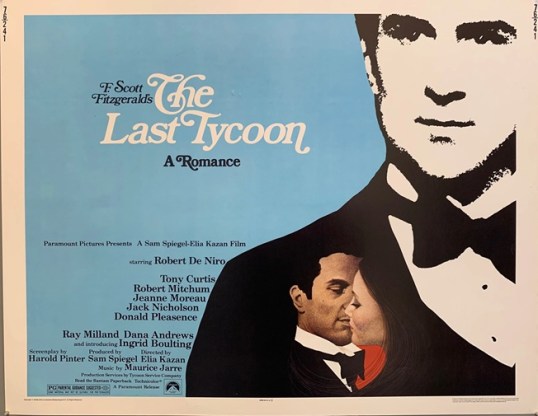
Icarus File No. 23: The Last Tycoon (dir by Elia Kazan)


Based on the final (and unfinished) novel by F. Scott Fitzgerald, 1976’s The Last Tycoon tells the story of Monroe Stahr (Robert De Niro).

Monroe Stahr is the head of production at a film studio during the early days of Hollywood.  Stahr is an unemotional and seemingly repressed man who only shows enthusiasm when he’s talking about movies.  He may not be able to deal with real people but he instinctively knows what they want to see on the big screen.  Stahr is a genius but he’s working himself to death, ignoring his health concerns while trying to create the perfect world through film.  He’s haunted by a lost love and when he meets Kathleen Moore (Ingrid Boulting, giving a remarkably dull performance), he tries to find love with her but, naturally, he doesn’t succeed.  Meanwhile, he has to deal with his boss (Robert Mitchum), his boss’s daughter (Theresa Russell), a neurotic screenwriter (Donald Pleasence), an impotent actor (Tony Curtis), and a lowdown dirty communist labor organizer (Jack Nicholson)!  Sadly, for Stahr, McCarthyism is still a few decades away.

There’s a lot of talented people in The Last Tycoon and it’s undeniably interesting to see old school stars — like Mitchum, Curtis, Dana Andrews, Ray Milland — acting opposite a Method-driven, 30-something Robert De Niro.  This is one of those films where even the minor roles are filled with name actors.  John Carradine plays a tour guide.  Jeff Corey plays a doctor.  This is a film about Golden Age Hollywood that is full of Golden Age survivors.  It’s a shame that most of them don’t get much to do.  The Last Tycoon is a very episodic film as Stahr goes from one crisis to another.  Characters show up and then just kind of disappear and we’re never quite sure how Stahr feels about any of them or how their existence really shapes Stahr’s worldview.  Robert De Niro may be a great actor but, as portrayed in this film, Monroe Stahr is a boring character and De Niro’s trademark tight-lipped intensity just makes Stahr seem like someone who doesn’t have much to offer beyond employment.  This is one of De Niro’s least interesting performances, mostly because he’s playing a not-particularly interesting person.  Mitchum, Pleasence, and the old guard all make an impression because they’re willing to coast by on their bigger-than-life personalities.  De Niro is trapped by the Method and a total lack of chemistry with co-star Ingrid Boulting.
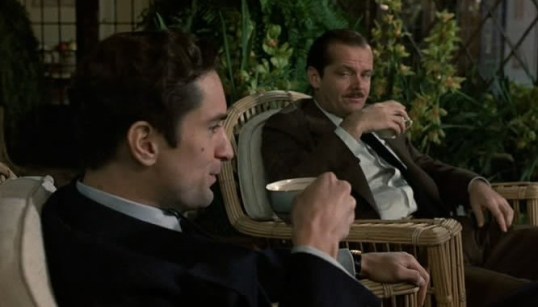
Still, this is the only film to feature both De Niro and Jack Nicholson.  (The Departed was originally conceived as a chance to bring De Niro and Nicholson together, with De Niro being the original choice for the role eventually played by Martin Sheen.)  Nicholson’s role is small and he doesn’t show up until the film is nearly over.  He and De Niro have an intense table tennis match.  Nicholson doesn’t really dig deep into Brimmer’s character.  Instead, he flashes his grin and let’s the natural sarcasm of his voice carry the scene.  It’s nowhere close to being as emotionally satisfying as the De Niro/Pacino meeting in Heat.  That said, Jack Nicholson at least appears to be enjoying himself.  His natural charisma makes his role seem bigger than it actually is.

Why was The Last Tycoon such a disappointment?  Though unfinished, the book still featured some of Fitzgerald’s best work and there’s a huge amount of talent involved in this film.  The blame mostly falls on Elia Kazan, who came out of retirement to direct the film after original director Mike Nichols left the project.  (Nichols reportedly objected to casting De Niro as Stahr.  While it’s tempting to think that Nichols realized that De Niro’s intense style wouldn’t be right for the role, it actually appears that Nichols and De Niro sincerely disliked each other as Nichols also abandoned the next film he was hired to direct when he was told that De Niro wanted the lead role.  Nichols choice for Monroe Stahr was Dustin Hoffman, which actually would have worked.  If nothing else, it would have provided a Graduate reunion.)  Kazan later said that he did the film solely for the money and it’s obvious that he didn’t really care much about the film’s story.  The film has some good scenes but, overall, it feels disjointed and uneven.  Kazan doesn’t really seem to care about Monroe Stahr and, as a result, the entire film falls flat.

Previous Icarus Files:

  1. Cloud Atlas
  2. Maximum Overdrive
  3. Glass
  4. Captive State
  5. Mother!
  6. The Man Who Killed Don Quixote
  7. Last Days
  8. Plan 9 From Outer Space
  9. The Last Movie
  10. 88
  11. The Bonfire of the Vanities
  12. Birdemic
  13. Birdemic 2: The Resurrection 
  14. Last Exit To Brooklyn
  15. Glen or Glenda
  16. The Assassination of Trotsky
  17. Che!
  18. Brewster McCloud
  19. American Traitor: The Trial of Axis Sally
  20. Tough Guys Don’t Dance
  21. Reach Me
  22. Revolution

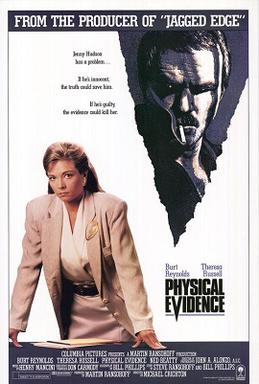
Physical Evidence (1989, directed by Michael Crichton)


Ex-cop Joe Paris (Burt Reynolds) is arrested for the murder of a small-time criminal.  Joe swears that he’s being framed but his public defender, Jenny Hudson (Theresa Russell), isn’t sure that she believes him.  While Jenny’s boyfriend (Ted McGinley) makes a fortune trading stocks and Joe’s former mistress (Kay Lenz) tries to keep her mobster boyfriend from finding out about the affair, Jenny tries to outsmart prosecutor James Nicks (Ned Beatty) and Joe tries to find the real killer.

Tubi sent me to this film after I finished up Raw Justice.  When I saw that it was a Burt Reynolds films, I figured that I would take a chance with it but this one turned out to be one of Burt’s lesser films.  Joe Paris feels like he might be distantly related to the cop that Burt played in Sharky’s Machine but Physical Evidence doesn’t have any of that movie’s style or grit.  Burt doesn’t come across like he wants to be in the movie and he and a very miscast Theresa Russell have next to zero chemistry onscreen.  This was Michael Crichton’s last film as a director and he directs in a stolid, made-for-television manner.

Supposedly, this was originally meant to be a sequel to the thriller Jagged Edge, with Glenn Close and Robert Loggia reprising their roles from the earlier film.  When that fell through, the movie was refurbished into Physical Evidence, with Theresa Russell and Burt Reynolds replacing Close and Loggia.  I think the film would have worked with Close and Loggia because, based on Jagged Edge, they were believable as people who had a close relationship and would do anything to help each other.  Burt Reynolds and Theresa Russell come across like they can’t even stand to be in the same room together.  Better get a new lawyer, Burt!  This one seems like she might be planning on framing you herself.

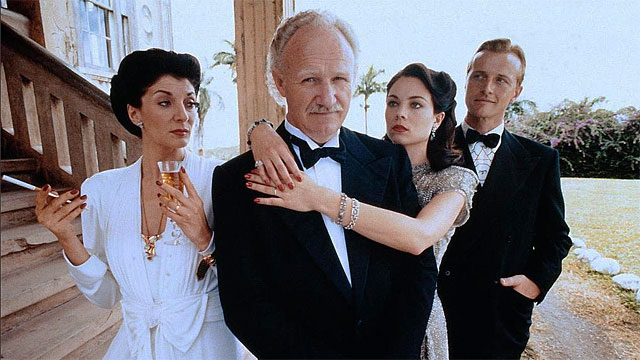
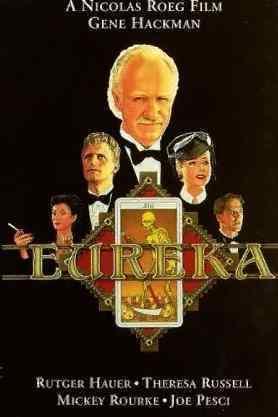
EUREKA (1983) – Gene Hackman strikes gold and tries to strike Rutger Hauer with a meat cleaver in the same move!


I’ve been thinking a lot about Gene Hackman as he recently celebrated his 95th birthday. He’s an incredible actor who has been a part of my life since I first really discovered my love of movies beginning in the mid-80’s. I’ve also been writing about Rutger Hauer every Sunday here on the Shattered Lens. Hackman and Hauer made a movie together back in 1983 called EUREKA, and to be honest, I almost forgot about it. It’s a movie I watched a long time ago and hadn’t watched again until today. It seemed like the perfect time for a revisit.

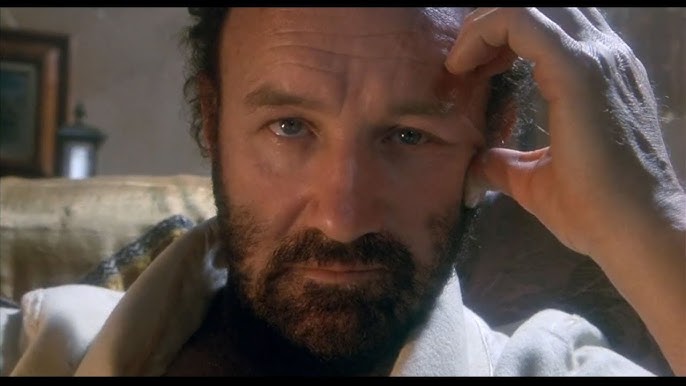
EUREKA opens with a stunning aerial shot that descends upon obsessed gold prospector Jack McCann (Gene Hackman) who’s fighting with a man on a snow-covered mountain in the Yukon territory. The man has asked Jack to partner with him in their search for gold, and Jack makes it clear that he will never “make a nickel on another man’s sweat.” Next, we see Jack as he’s walking through a nearly deserted town. In another unforgettable shot, Jack watches a man, who’s clearly gone mad, commit suicide just outside of the local “Claims office.” Before watching again today, that was the only scene that I could remember from my initial viewings of the film so many years ago. Next, we see Jack lying down below a tree at night, in windy, frigid temperatures, just about to freeze to death. Three hungry wolves have even approached ready for dinner. And this is where things get strange. Out of the blue, this clairvoyant madam (Helena Kallianiotes) from a local brothel sees him in her crystal ball, as a mysterious stone falls right next to him, starting a fire that warms him and drives away the wolves. He goes to see the madam at the brothel where she tells him that he will strike gold, but he “will be alone now.” Jack leaves the next morning and finds gold, rivers of gold. It’s another stunning sequence showing the obsessed man, who’s been searching for gold for 15 long and hard years, finally finding the object of his obsession. 

Cut to 20 years in the future, where Jack is now the richest man on earth, living on his own Caribbean island. It also appears he may also be the unhappiest man on earth. He has all the money in the world, but there is no peace in his heart or soul. His wife Helen (Jane Lapotaire), who he was once deeply in love with, is now detached and addicted to alcohol. His daughter Tracy (Theresa Russell) has fallen in love and married Claude Maillot Van Horn (Rutger Hauer). Jack cannot stand Claude as he suspects that he seduced and married Tracy so he could get to his money. His best friend Charles (Ed Lauter) has somehow gotten mixed in with Miami mobsters, led by a guy named Mayakofsky (Joe Pesci) and his lawyer Aurelio D’Amato (Mickey Rourke), who want to force Jack to sell them land on his island so they can build a casino. Jack feels like everybody just wants a piece of him and his money. He has lost the joy in his life. The rest of the film plays out against this backdrop as Jack tries to separate Tracy from Claude, and as the mobsters try to force Jack to sell to them by any means necessary.

EUREKA is not a film that everyone will love, but I enjoyed watching it again after so many years. Director Nicolas Roeg, who also directed PERFORMANCE (1970), DON’T LOOK NOW (1973) and FULL BODY MASSAGE (1995), creates some truly amazing and brutal images that once seen are not easily forgotten. The scene where Jack McCann finds his huge vein of gold is so beautiful, but there are alternatively horrific scenes of brutal violence that play out almost to the point of overkill. The movie also takes some surprising twists and turns in the third act that you may not see coming. I always like it when a movie surprises me. It’s a melodramatic film that doesn’t have a lot of likable characters, but with a cast this good, I’m willing to go along with the filmmakers. In addition to the excellent work of Gene Hackman and Rutger Hauer, Theresa Russell has the important role as the daughter stuck between the man she loves and the dad who adores her. Her acting style exemplifies the melodrama of Roeg’s vision, so it works well in the context of this film. Jane Lapotaire has a couple of strong moments as Hackman’s alcoholic wife who yearns for days long gone when they were so in love. We were quite spoiled in the early 80’s when a movie could round out its already impressive cast with actors like Joe Pesci, Mickey Rourke, Ed Lauter, Corin Redgrave and Joe Spinell.

Nicolas Roeg appears to be trying to make deep statements about the meaning of life in EUREKA. I’m not a person who generally consumes films for deep meaning, but I thought it might be fun to at least take a surface-level view of some of the items I noticed while watching the movie. Jack spouts a lot of profound things throughout the movie, things that he feels describe him as a person. I mentioned one earlier when Jack tells the competing prospector prior to finding gold that, “I’ll never make a nickel off of another man’s sweat.” He will continue to use this saying throughout the film, even after he’s a rich, jaded, older man. The truth is that he would not have found the gold without the help of the clairvoyant madam, with her even passing away right after he hits the jackpot. In another scene at an extremely awkward dinner party, Jack tells his guests that the only rule that matters is the Golden Rule, “Do unto others as you would have them do unto you.” While I agree with the importance of this rule, Jack does not seem to follow the Golden Rule in any way that helps others or gives him any sense of peace or connection. Jack does not seem to understand the contradictions in his use of these phrases as played out in his own life, but I also think that his lack of understanding helps to illustrate a truth that plays out at times in many of our own lives. So often we’ll claim certain beliefs and values, but our lives as lived will be much more complex and often hypocritical. We can see them in Jack, but can we always see them in ourselves?

EUREKA also seems to be a movie that’s open to different interpretations based on who’s viewing the movie and where they are in life at that specific time. In a moment of clarity with his wife, Jack seems to recognize the hypocrisy in his life when he tells her “I once had it all… now I just have everything.” Jack is finally reflecting on the important things in his life, rather than dwelling on his current distrust of everyone around him. This final quote got me to thinking about my own life and just how different I am as a man in my early 50’s compared that naïve 20-year-old who first watched this film. I didn’t know what it was like to chase my dreams, catch them, and then try to figure out how to keep striving with a purpose. I didn’t know what it was like to be married with the responsibility of loving my wife and genuinely caring about her needs, through both the good times and the bad times. I didn’t know what it was like to be a dad who wanted nothing but true happiness for his children. Jack has lived through these specific opportunities in life, and we can see how he’s dealt with them. Each of these things have now played out in my own life. There have been times that I’ve failed, and there have been times that I’ve succeeded. I just keep reminding myself to try to focus on the things that matter and not get distracted by the things that don’t. Even now, it’s not always easy to do.    

I’ve included the trailer for EUREKA below:

Spring Breakdown: Eureka (dir by Nicolas Roeg)


In this 1983 film, Gene Hackman plays Jack McCann, a prospector who is determined to either get rich or freeze to death as he wanders around Alaska in the 1920s.  When he’s not having sex and philosophical discussions with the local witch, Freida (Helena Kallianiotes), Jack desperately searches for gold.  Jack is convinced that gold is all that he needs to be happy, though Freida counsels him that it’s also important to pursue more Earthly delights.  Everywhere Jack looks, he sees people dying in the snow.  In fact, Jack nearly dies himself until he stumbles across a mountain full of gold.  As gold dust pours down on him, he celebrates while having flashbacks to Freida writhing in ecstasy.  It’s just that type of film.  When Jack tells Freida about his claim, he asks what’s going to happen next.  Freida tells him that it’s both the end and the beginning.  Once again, it’s just that type of film.

At this point, Eureka jumps ahead 20 years.  The year is 1945.  World War II is coming to an end.  Jack is no longer freezing and starving to death in Alaska.  Now, he is one of the world’s richest men.  He even owns his own island in the Caribbean.  Jack has a huge house, a beautiful view of the ocean, and all the money in the world.  One could even say that his life has become an exclusive beach vacation, an eternal Spring Break, if you will.  And yet, even with all of his money, Jack has fallen victim to ennui.  He was happier when he was poor and starving and seeking warmth from Freida.  Now, he’s got an alcoholic wife (Jane LaPotaire) and his daughter, Tracy (Theresa Russell), is in love with a dissolute aristocrat named Claude (Rutger Hauer), to whom Jack takes an instant dislike.  Claude claims that Jack has stolen his wealth from the Earth.  Claude is the type who eats gold and then promises to return it to Jack as soon as he can.  That’s something that actually happens.  It’s kind of silly but Rutger Hauer is such a charmer that he nearly pulls it off.

Claude and Tracy aren’t the only thing that Jack has to worry about.  An American gangster named Mayakofsky (Joe Pesci) wants to take over Jack’s island so that he can build a casino on it.  However, despite the best efforts of Mayakofsky’s attorney (Mickey Rourke), Jack is still not willing to sell.  When hitman Joe Spinell shows up outside the estate, are Jack’s days of ennui numbered?

Of course, they are!  That’s not really a spoiler.  Eureka is (loosely) based on the real-life murder of Sir Harry Oakes, an American-born prospector who was thought to be one of the world’s richest men when he was brutally murdered in the 40s.  Jack is, of course, a stand-in for Oakes while Mayakofsky is based on Meyer Lansky, the mobster who many people suspect ordered Oakes’s murder.  Lansky was never charged with the crime.  Instead, Oakes’s son-in-law, Count Alfred de Marigny, was arrested and charged with the crime.  After a trial that made international news and was described as being “the trial of the century,” de Marigny was acquitted and the murder of Harry Oakes remains officially unsolved.

It’s an interesting story and it seems like one that should perfectly translate to film.  Surprisingly though, Eureka doesn’t really do it justice.  The film was directed by one of the masters of cinematic surrealism, Nicolas Roeg.  Roeg, of course, is probably best remembered for films like Performance, Don’t Look Now, Walkabout, and The Man Who Fell To Earth.  As one might expect from a Roeg film, Eureka is visually stunning but, as a director, Roeg can’t seem to decide whether he’s more interested in Jack’s ennui or in all the soapy melodrama surrounding Jack’s murder.  As such, neither element of the film gets explored with any particular depth and the resulting film, while always watchable, still feels rather shallow and disjointed.  (After taking forever to reach the end of Jack’s story, Eureka then turns into a rather conventional courtroom drama.  Theresa Russell does get to utter the immortal line, “Did you cut off my father’s head?” but otherwise, it’s kind of dry.)  The film is at its strongest when Jack is just a prospector in Alaska.  The harsh landscape and the crazed dialogue is perfect for Roeg’s dream-like style.  Once the film moves to the Caribbean, it suffers the same fate that befell Jack when he become rich.  It loses its spark.

That said, Eureka has its moments.  Any film that features Gene Hackman, Mickey Rourke, Joe Pesci, Rutger Hauer, and Joe Spinell all acting opposite of each other is going to have at least a few scenes worth watching.  I particularly liked Pesci’s surprisingly subdued performance as Mayakofsky.  With everyone else in the film chewing every piece of scenery on the island, Pesci wisely underplays and is all the more menacing for it.  While Eureka ultimately doesn’t add up too much, it’s worth watching at least once for the cast.

Finally, my personal theory is that Harry Oakes’s murder had more to do with the Duke and Duchess of Windsor (formerly King Edward VIII and Wallis Simpson) than it did with Meyer Lansky.  (The Duke was the governor of the Bahamas at the time of Oakes’s murder.)  But that’s just my opinion.

Film Review: Insignificance (dir by Nicolas Roeg)


The 1985 film, Insignificance, opens in New York City in the 1950s.

On the streets of New York, a crowd has gathered to watch as the Actress (Theresa Russell), a famous sex symbol, is filmed standing on a grate while wearing a white dress.  Beneath the street and the Actress, a fan has been set up and the crowd of onlookers cheers as the Actress’s skirt is blown up around her hips, again and again.  Standing in the crowd, the Actress’s husband, the Ballplayer (Gary Busey), watches and shakes his head in disgust.  After the scene has been shot, the Actress hops in a taxi while the Ballplayer chases after her.  A very famous man is in town and the Actress is on her way to pay him a visit.

In a nearby bar, the Senator (Tony Curtis), drinks and talks and sweats.  Though it may not be obvious from looking at him, the Senator is a very powerful man.  He’s leading an investigations into subversives who may be trying to bring down the United States government.  He may look like a small-time mobster but the Senator can make and destroy people on a whim.  He’s come to New York on a very specific mission.  He and his goons are planning on pressuring another famous man into testifying before the Senator’s committee.

Though they don’t know it, both the Actress and the Senator are planning on dropping in on the same man.  The Professor (Michael Emil) is a world-renowned genius.  When we first see him, he is sitting alone in a hotel room and looking at a watch that has stopped at 8:15.  The public may know the Professor for his eccentricities but, in private, he is a haunted man.  The Professor’s work was instrumental in the creation of the first atomic bomb.  And now, with both the U.S. and Russia stockpiling their atomic arsenals and the world seemingly on the verge of war, the Professor fears that his work will be the end of humanity.

Though none of the characters are actually named over the course of the film, it should be obvious to anyone with even a slight knowledge of American history that the four main characters are meant to be versions of Marilyn Monroe, Joe DiMaggio, Joe McCarthy, and Albert Einstein.  Insignificance imagines a meeting between these four cultural icons and really, it’s not difficult to imagine a scenario in which they all could have met.  Joe DiMaggio actually was present during the filming of the subway grate scene from The Seven Year Itch and most accounts record his reaction as being not that different from what’s portrayed in Insignificance.  Albert Einstein was suspected of having communist sympathies and several scientific figures (including many who worked on the Manhattan Project) were investigated during the McCarthy era.  Finally, Marilyn Monroe was often frustrated by her “dumb blonde” image and said that she found Albert Einstein to be a very attractive man.  When she died, a biography of Einstein was reportedly found on her nightstand.

In the film, the Senator pressures The Professor to appear before his committee.  It’s not long after the Senator leaves that the Actress arrives.  The Actress announces that she’s fascinating by the theory of relativity and, using balloons, toys, and a flashlight, she proceeds to demonstrate the theory for the Professor.  The befuddled Professor is impressed.  The Actress informs the Professor that he’s at the top of her list.  Meanwhile, downstairs in another hotel room, the Senator is met by a prostitute who bears a resemblance to the Actress. The Ballplayer sits in the hotel bar, tearing up a picture of the Actress and wondering why their marriage is failing.

Because this film was directed by Nicolas Roeg, the film is full of seemingly random flashbacks.  We see the Senator as an altar boy, trying to impress a smiling priest.  We see the Ballplayer getting yelled at by his domineering father.  We see the Actress, growing up poor and being ogled, at first by the young boys at an orphanage and later by Hollywood execs.  Meanwhile, The Professor continually sees the destruction of Hiroshima.  His visions are apocalyptic and, towards the end of the film, he even gets a glimpse into a possible future of atomic hellfire.  It’s a film about fame and cultural transition, a film where people look to celebrities for hope while doomsday comes closer and closer.

Or something like that.  To be honest, I wanted to like Insignificance more than I actually did.  As is typical with so many of Nicolas Roeg’s films, Insignificance has an intriguing premise but the execution is a bit uneven.  There are moments of absolute brilliance.  Theresa Russell and Gary Busey both give perfect performances and the film’s final apocalyptic vision will haunt you.  And then there are moments when the film becomes a bit of a slog and the dialogue starts to get a bit too pretentious and on-the-nose.  Michael Emil has some good moments as the Professor but there are other moments when he seems to be lost.  Meanwhile, Tony Curtis gives such a terrible performance as The Senator that he throws the entire film off-balance.  Curtis bulges his eyes like a madman and delivers his lines like a comedian doing a bad 1930s gangster impersonation.

That said, Insignificance is still an interesting film.  It’s uneven but intriguing.  Though the film may take place in the 50s and may deal with a quartet of historical figures, it’s themes are still relevant in 2020.  People still tend to idealize celebrities.  Politicians still hold onto power by exploiting fear.  The possibility that everything could just end one day is still a very real one.  Insignificance is a film worth watching, even if it doesn’t completely work.

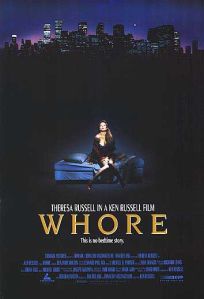
A Movie A Day #93: Whore (1991, directed by Ken Russell)


Liz (Theresa Russell) is a prostitute trying to survive on the mean streets of Los Angeles.  With the help of a homeless performance named Rasta (Antonio Fargas), Liz tries to escape from her abusive pimp, Blake (Benjamin Mouton).
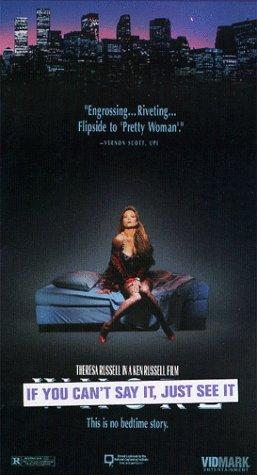
To its credit, Whore was made as a response to the glamorous and irresponsible way that prostitution was portrayed in Pretty Woman but Whore had too much going against it to succeed.  It was based on a theatrical monologue, which was almost always a bad sign.  The majority of the movie was Liz talking straight to the camera, which was another red flag.  Most ominously, it was a Theresa Russell movie that was not directed by Nicolas Roeg and those never seemed to turn out well.  The director of Whore was Ken Russell but it featured none of the excess that Russell was known for.  Stuck with a low-budget and a reportedly unenthusiastic studio, Russell’s direction was uncharacteristically restrained.  (That’s a polite way of saying boring.)

The one good thing about Whore, and the reason why I’m writing about it during this site’s look back at Twin Peaks, was the presence of Jack Nance, playing one of the few men who actually tries to help Liz.  Nance, of course, not only played fishing-obsessed Pete Martell in Twin Peaks but also starred in Eraserhead and appeared in all of Lynch’s films (with the exception of The Elephant Man) up until Nance’s mysterious death in 1996.  Literally credited as playing “Helpful passerby.” Nance only had a few minutes of screen time but made a definite impression as one of the few kind people to be found in Liz’s dark world.

As a reflection of how much times have changed, Whore‘s title was so controversial that, in 1991, it was released in some areas under an alternative title: If You Can’t Say It, Just See It.


Embracing the Melodrama #46: Wild Things (dir by John McNaughton)


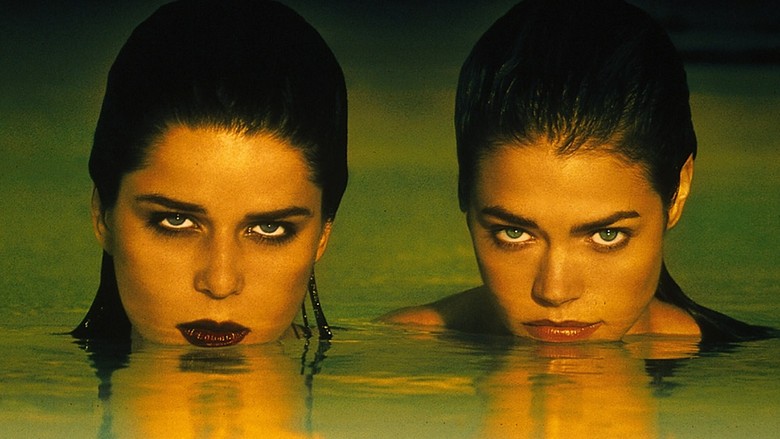
The 1998 film Wild Things starts out like a standard B-movie.  It take place in Florida so, of course, we get a lot of shots of the sun setting on the bayous and crocodiles staring at the camera as if to ask, “What are you looking for?”  Boats skim the water.  High school guidance counselor Sam Lombardo (Matt Dillon) walks across campus while all of the toned and tanned students stop to admire him.  Local rich girl Kelly Von Ryan (Denise Richards) smirks and says something snarky.  Detective Ray Duquette (Kevin Bacon) shows up in the background and stares at the world from behind dark glasses and a serious expression.  Meanwhile, local poor girl Suzie (Neve Campbell) goes back to her home, which happens to be located right behind an alligator farm.

Judging from the first few minutes, Wild Things could just as easily be an episode of CSI Miami.

But then Bill Murray shows up as Kenneth Bowden, a hilariously sleazy attorney who spends most of the movie wearing a neck brace, just in case the insurance company is watching him.

And then Theresa Russell shows up Kelly’s mother, standing on a balcony in a gold bikini and hitting on every passing man like the world’s most hyperactive cougar.

And then Carrie Snodgress shows up as Suzie’s mother, complete with an over-the-top white trash accent.

By the time that Robert Wagner shows up and literally growls at Matt Dillon: “You’re finished, Lombardo!  Finished!,” you realize that Wild Things is probably the most self-aware B-movie ever made and it’s all the better for it.

As for the plot — well, let’s see if I can keep track.  Suzie and Kelly both accuse Sam of rape.  Sam claims to be innocent but nobody in town believes him.  Sam is forced to hire the disreputable Kenneth Bowden to defend him.  During the trial, Kenneth is able to prove that Kelly blamed Sam for the suicide of her father while Suzie is angry that Sam once refused to bail her out of jail on a drug charge.  To get revenge, Kelly and Suzie decided to frame Sam.  Sam is acquitted and, again with Bowden’s help, is able to negotiate an 8 million dollar settlement for defamation.  True, Sam does lose his job but at least he’s a rich man now…

But wait a minute.

The movie still has a little over an hour to go.

Could it be that there’s more to this story?

Well, of course, there is.  It turns out that Sam, Kelly, and Suzie have been working together all the time.  The accusations, the trial, the defamation suit — it was all a part of a grand scheme to get the money.  Sam, Kelly, and Suzie celebrate their success with champagne and a threesome.

While everyone else in town seems to be ready to move on from the entire scandal, Detective Ray Duquette is telling anyone who will listen that he thinks that Sam, Kelly, and Suzie were all in on it together.  Even when Ray is ordered by his superiors to back off, Ray continues to investigate the case.

And why?

Because Ray Duquette is a cop who gets results!

Well, maybe.

Actually, it doesn’t take long to realize that there’s something off about Ray.  For one thing, his obsession with Sam really does seem to be a personal thing.  On top of that, Ray has a past connection with Suzie…

Wild Things has everything that you could hope for from a good exploitation film: a script that is full of double and triple crosses, unapologetically pulpy dialogue, over-the-top performances, and lots of sex.  Yesterday, I reviewed Normal Life and praised John McNaughton’s decision to play up the banality of the film’s characters and locations.  With Wild Things, McNaughton takes the exact opposite approach, playing up every sordid and tawdry detail to such an extent that the film itself eventually transcends such mundane concepts as good and bad.

Wild Things is a lot of fun and it’s also one of the best films of the 1990s.

Wild Things