So, last night, at the TSL offices, Jeff, Leonard, Case, and I watched Insidious! It was an enjoyable experience. I think we were all surprised to discover just how well Insidious holds up. When the film reached the seance scene, in which the ghosts were asked questions and a possessed Lin Shaye would write out their answers, I said, “This scene reminds me of the seance scene from The Changeling!”
And then I thought to myself, “That should be our next horror scene that I love!”
So, I went to YouTube and I searched for the classic (and really scary) seance scene from Peter Medak’s great 1980 ghost story, The Changeling. And guess what? I couldn’t find it! I found a lot of scenes from The Changeling and I found a lot of people talking about how much they love the seance scene but I couldn’t find the scene itself!
So, here’s the best I could do. This scene that I love takes place immediately after the seance and features George C. Scott listening and re-listening to a tape of the seance until he can finally hear the voice of the child who, years before, was murdered in his house.
Even if it’s not the seance scene, it’s still pretty good. I personally consider this to be one of George C. Scott’s best performances. And the sound of the little boy’s voice on the tape is chilling.
The Changeling is really good, by the way. You should watch it, if you haven’t already!
Since it’s Thanksgiving in Canada, it seems appropriate that today’s horror scene that I love should come from one of the best Canadian horror films of all time and….
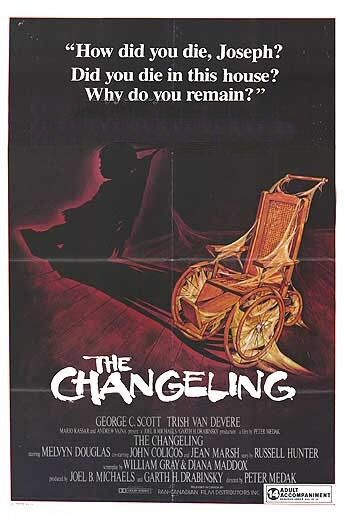
No, this scene is from the 1980 film, The Changeling. Directed by Peter Medak, the film is about a house that’s haunted by the spirit of a boy who was murdered there decades ago. When George C. Scott moves into the house, he discovers the truth about not just the murder but the political conspiracy that led to it. It’s a really good movie. You should watch it.
Anyway, in this atmospheric scene, Trish Van Devere explores the house. It’s always a bit strange to watch a horror scene devoid of context but let me just say that The Changeling is such an atmopsheric and intense ghost film that you’ll never want to wander around a potentially haunted house again once you’ve seen it!
4 Shots From 4 Films is just what it says it is, 4 shots from 4 of our favorite films. As opposed to the reviews and recaps that we usually post, 4 Shots From 4 Films lets the visuals do the talking.
Happy Thanksgiving, Canada! Today’s edition for 4 Shots From 4 Films is dedicate to you!
If you love horror movies, you have to track down and see The Changeling.
First released in 1980, The Changeling stars George C. Scott as John Russell, a composer. At the start of the film, he watches helplessly as both his wife and his daughter are killed in a horrific auto accident. The grieving John leaves his New York home and relocates to Seattle, Washington. With the help of a sympathetic realtor, Claire Norman (Trish Van Devere), John finds and rents a previously abandoned Victorian mansion.
At first, it seems that John is alone with his grief. But, as you can probably guess, it quickly becomes apparent that John isn’t alone in his house. Windows shatter. Doors slam. And, most dramatically, every night a mysterious banging sound echoes through the house. Slowly, John comes to suspect that his house might be haunted…
And, of course, it is! It’s no spoiler to tell you that because the film is admirably straight forward about being a ghost story. And what a clever ghost story it is. I don’t want to give too much away so I’ll just say that the story behind the ghost involves a powerful family, an age-old scandal, and a powerful U.S. Senator (played, with a mixture of poignant sadness and menace, by Melvyn Douglas).
The Changeling is a very well-done and effective ghost story. For the most part, director Peter Medak emphasizes atmosphere over easy shocks, the end result being a film that maintains a steady feeling of dread and sticks with you long after the final credit rolls up the screen. George C. Scott is well-cast as John Russell, capturing both the character’s grief and his curiosity. (There’s actually a very interesting subtext to the film, in that investigating death actually gives John a reason to live.) At the time the film was made, he was married to Trish Van Devere and the two of them have a very likable chemistry. And, as previously stated, Melvyn Douglas makes for a great quasi-villain.
(It’s interesting to compare Douglas’s intimidating work here with the far more sympathetic performances that he gave, around the same time, in Being There and The Seduction of Joe Tynan.)
My favorite scene in The Changeling comes when John and Claire hold a séance in order to try to discover what the ghost wants. The séance team is made up one woman who asks questions, one woman who channels the spirit and writes down his answers, and one man who reads the answers after they’re written. It’s a wonderfully effective scene, dominated by the eerie sounds of questions being asked, answers being scribbled, and then being shakily read aloud. It’s probably one of the best cinematic séances that I’ve ever seen.
The Changeling is a wonderful mix of political intrigue and paranormal horror. It was also the first film ever to win a Genie award for Best Canadian Film, which just goes to prove the 90% of all good things come from Canada.
I wasn’t expecting much from Insidious, the new horror film that’s recieved a surprising amount of critical acclaim over the past month. After all, the film is the product of a collaboration between the makers of Saw and Parnormal Activity, two of the most overrated horror films ever. Add to that, the movie is rated PG-13 and the lesson I took away from seeing The Roommate earlier this year was that PG-13 dooms horror. Insidious might be the proverbial exception that proves the rule.
As with all good horror films, Insidious starts with a deceptively simple premise. Patrick Wilson and Rose Byrne play a married couple whose marriage is thrown into choas when their oldest son slips into what appears to be a coma. After three months of being in the hosptial, their son is moved back into their house where he spends his days lying in bed, hooked up to ominous medical equipment.
(Speaking for myself, there is no more disturbing sound than the sound of heart monitor, because for every beep, there’s that moment of deafening silence between beeps. The film’s director James Wan knows this too because he makes brilliant use of sound in this film.)
While Wilson deals with things by finding excuses to stay late at work, Byrne is soon seeing shadowy figures running through the house and hearing voices coming from empty rooms. Even as Wilson continues to insist that its just her imagination (that’s something all men seem to have in common — they never ask for direction and they always refuse to accept that the house is haunted), Byrne becomes more and more convinced that its not. Eventually, with a help of an eccentric psychic (well-played by Lin Shaye), Wilson and Byrne are forced to confront the evil forces that have taken control of their lives.
Let’s get the most important thing out of the way first.
Insidious is one scary movie. It’s scarier than any movie rated PG-13 has any right to be. It scared me when I was sitting in the theater watching it and, even more importantly, it’s still scary a day later.
Let me set the scene for you. As I sit here writing this, it is nearly 3 in the morning. I live in a two-story house that is full of random cold spot and which, for some reason, never seems to be totally lit even with all the lights on. My friends are with their families for Easter. My sister Erin is currently in Arlington, visiting with our other sister, Melissa. I’m in this house alone with only my overactive imagination keeping me company. Oh, did I mention that, because of some foundation issues, this house tends to randomly creak?
About two hours ago, I had just taken a shower and I was sitting, wrapped in a towel and a blow dryer, on the edge of my bed. I have this antique floor mirror that sits a few feet in front of my bed and I was about to start drying my hair when it suddenly occured to me — what if I looked at the mirror and I suddenly saw a dark shadow — like the ones in Insidious — sitting on the bed directly behind me?
And yes, I knew that was a silly thought just like I know, despite what the Insidious might tell us, there’s no such thing as ghosts and demons. I knew that if I rasied my head, I would not see anything but isolated, vulnerable little me reflected in the mirror.
But, God help me, I could not bring myself to look. Because, even though I knew that there was 99.9% chance that nothing would be sitting behind me, I knew that there was 0.1.% chance that something would be. I sat there, almost paralyzed with my heart pounding so hard I could almost hear it. I realized I was starting to breathe faster, knowing that if there was something there, it was there with me at that exact moment, siting behind me, waiting to strike…
Finally, realizing that I was on the verge of giving myself a very real panic attack over a very unreal possibility, I forced myself to look up at the reflection in the mirror.
A dark shadow was sitting directly behind me.
And I screamed and jumped off that bed so quickly that I’m amazed I actually managed to stay on my feet. I swung around, cluthing that blow dryer like a weapon, prepared to do whatever…
Nobody was sitting on the bed.
Slowly, I creeped across the room. Cautiously, I stuck a foot underneath my bed to feel if anything was hiding underneath it. I opened the closests and pushed my clothes to the side to confirm that nobody was hiding behind them.
Finally, after I somehow found the courage to sit back down on the bed, I realized that there had indeed been a shadow behind me and that shadow, because of the angle of the lights in my room, had been mine.
That’s the type of film Insidious is. It’s the type of film that uses the simple things that scare us — the unexplainable noises, the things that you sometimes think you see out of the corner of your eye — to creates a truly macabre experience that sicks with you. At its best, its a truly creepy film that works its way into your imagination through a perfect combination of atmosphere and paranoia. One reason why the haunted house genre has remained such a dependable horror set up is because it perfectly reflects one of our most basic fears — the fear of having no control, of knowing that there is no place to hide, that the forces of chaos and evil can even get to us in the sanctuary of our own homes. Especially during its first half, Insidious exploits this fear perfectly. James Wan’s camera prowls through the otherwise unremarkable suburban home like a creature possessed and you find yourself spotting shadowy figures and sudden movements in every frame that flickers before your eyes. Wan makes remarkably good use of sound here. I realize that sound of silence may be an oxymoron but if silence can make a sound, then director Wan manages to capture it in Insidious.
A lot of critics and filmgoers have been rather critical of the film’s second half and it is true that the second half if remarkably different from the first. If the first half finds Wan concentrating on atmopshere then the second half concentrates on shock and, as a result, it feels a lot more conventional. During the 2nd half of them, we learn just what exactly is happening and why and unfortunately, no possible solution could hope to compete with the sense of dread that the first part of the movie generated. That doesn’t mean that the second half of the movie isn’t well-executed. It is. It’s just not as surprising as the first half.
(However, there is one scene in that 2nd half — a red-skinned demon cheerfully sharpening his finger nails — that is just so bizarre and disturbing that it borders on genius.)
Now, I will admit (POSSIBLE SPOILER COMING UP DEPENDING ON HOW ANAL YOU ARE) that I was not a huge fan of the film’s ending. It’s not that the ending didn’t work or that it wasn’t well-exectued. It’s just that it’s the same type of ending that we’ve come to expect from all horror films, the type of thing that used to be considered a twist but now is just a cliche.
Still, ending aside, Insidious is an effective, little horror film. While it is true that the film rather liberally borrows from a lot of previous horror films (most blatantly from Poltergiest, Mario Bava’s Shock, an Australian film called Patrick, and an excellent Canadian shocker called The Changeling), Wan still takes all of those familiar elements and molds them into a genuinely scary experience.


 Through the Shattered Lens