Eli (Charlie Shotwell) is a young boy who is allergic to everything outside. As a result, he can’t venture out of the house unless he’s covered, head-to-toe, in protective gear. Eli wasn’t always allergic, of course. It’s just something that suddenly started. Eli’s mother, Rose (Kelly Reilly) and her husband, Paul (Max Martini), are taking him to a special clinic run by Dr. Isabella Horn (Lili Taylor). Because the clinic is sealed off from the outside, Eli can leave his plastic bubble. Because the clinic is in a dark old building, we know that it’s either going to be haunted or run by some sort of cult. In fact, it doesn’t take long before Eli is doubting not only Dr. Horn but his parents as well! He keeps hearing voices that hiss, “Lie.” And the only other patient at the clinic, a young girl named Haley (Sadie Sink), repeatedly tells him to be careful….
Eli is 98 minutes long and I lost interest after the first ten. Basically, I was willing to give the film a chance but then a bunch of rednecks started to taunt Eli while he was walking around outside in his protective gear and I was like, “Yeah, okay.” Then they started throwing stuff at him and I was like, “Getting a little bit heavy-handed now.” Then the suit got torn and Eli started screaming like he was about to die and the rednecks just stood there laughing and that’s when I said, “Okay, this is going to suck.” There’s heavy-handed and then there’s just attacking your audience with a sledgehammer. Sledgehammers give you a migraine.
Once Eli reaches the clinic, the film slows down to a glacial pace. In theory, the slow pace should have helped to maintain an ominous atmosphere but …. eh. To be honest, I’ve seen a lot of creepy clinics in a lot of creepy movies and there was nothing that special about this one. It all leads to a big twist but, again, it wasn’t a particularly original twist and even the film’s attempt to blow my mind with a subversive ending just left me shrugging. “Really?” I thought, “That’s what’s going to happen, huh? Well, what can you do?”
Like a lot of bad movies, the script for Eli was included on the infamous Hollywood Black List. The Black List is an annual list of the “best” unproduced screenplays in Hollywood. A few good films have been made out of scripts on the Black List but, for whatever, the majority of Black List films always seem to turn out to be somewhat disappointing. Broken City, for instance, was a Black List film. So was The Beaver. You can add Eli to the pile of mediocre Black List films.
Every year, we get another Black List. Despite the name, the Black List is not the annual list of actors and directors who need to be run out of America because of their political beliefs. Instead, the Black List is a survey of the “most liked” unproduced scripts that are currently floating around Hollywood.
Now, of course, to a large extent, the Black List is basically just another marketing gimmick. A lot of the scripts that have appeared on the Black List were already in development at the time that they appeared and, undoubtedly, there are clever studio execs who think to themselves, “Junomight be a difficult sell so let’s make sure it gets on the Black List!”
However, every year, there are a few films that are put into production directly as a result of the script appearing on the Black List. What’s interesting is just how many of these films turn out to be, if not quite terrible, at least rather forgettable. Transcendence, for instance, was on the Black List. Cedar Rapids was on the Black List. Broken City was on the freaking Black List. Consider this: The Beaver would never have been made except for the fact that it was on The Black List!
What’s particularly interesting is that the script was often the worst thing about these films. These were films with overly complicated scripts that often tried too hard to be both crowd pleasing and quirky. If nothing else, the Black List proves that being the “most liked” doesn’t mean that a script is good, interesting, or intelligent. It just means that it covered all the bases.
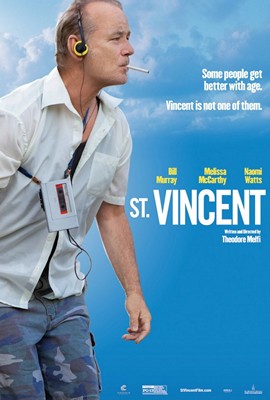
Case in point: the new film St. Vincent. St. Vincent sat on top of the Black List and was apparently so “well-liked” that screenwriter Theodore Melfi not only saw his script produced but he also got to direct it. And wouldn’t you know it — the two biggest failings of St. Vincent are the script and the direction.
It’s easy to point out why the direction is bad so I’ll start there. St. Vincent essentially looks like the pilot for one of those sitcoms that would be described as being edgy just because it was about a cranky old man. There is no visual flair to the film. The images just sit there flat on the screen.
As for the script, it would be likable if it didn’t try so hard. St. Vincent is about a guy named Vincent, a war hero who is now a cantankerous old alcoholic and a pathological gambler. His best friend is a pregnant Russian stripper. He owes money to a violent bookie. Every weekend, he visits his wife in a nursing home and he pretends to be a doctor. His wife no longer recognizes him. When the recently divorced Maggie and her awkward son Oliver move in next door, Vincent agrees to babysit after school. At first, Vincent just does it for the money but, as the movie progresses, he teaches Oliver how to stand up for himself and Oliver makes Vincent a little less grumpy. Eventually, Oliver has to do a report for a school about someone in his life that he considers to be a real-life saint and guess who he picks?
St. Vincent tells the type of story that would usually bring me to tears and I’ll admit that there were a few times when I did get teary-eyed. But, ultimately, the script was too heavy-handed for me to maintain those tears. I love crying at movies but, at the same time, I resent it when a movie demands that I cry just because it happens to be mashing down on all of the right buttons. This is one of those movies that doesn’t trust the audience. Instead of letting us react to the characters, it just keeps piling on development after development. It’s not enough that Maggie is a single mother who feels guilty about not being able to pick her son up from school. Instead, Maggie’s ex-husband has to suddenly sue for custody. It’s not enough that Vincent is struggling to pay the bills. Instead, he has to have a bookie who shows up at random and threatens to kill him. There’s more to an effective dramedy than just having half of your cast act as if they’re in a sitcom while the other half acts as if they’re appearing in an old episode of Law & Order.
And yet, despite the script and despite Melfi’s direction, St. Vincent does work and it really works only for one reason. Melfi has managed to assemble a truly outstanding cast. In the role Maggie, Melissa McCarthy proves that she deserves better than having to spend her career making movies like Identity Thief. Jaeden Lieberhrer is likable and sympathetic as Oliver. Playing the pregnant Russian stripper, Naomi Watts does the best that anyone probably could do with that poorly written character.
But, ultimately, the film is totally about Bill Murray. Bill Murray plays Vincent and he saves the entire film. Whether he’s being funny or being serious, Bill Murray gives the type of great performance that justifies his reputation for being a national treasure. When those tears did come to my eyes, it was all due to Murray’s performance.
St. Vincent is a deeply flawed film but it’s worth seeing for Bill Murray.
So, in my review of The Beaver, I talked about the annual Hollywood Black List and how the movies that are always listed at the top of the black list usually turn out to be vaguely disappointing. Well, in that review, I failed to mention that The Beaver was not the only Black List film that I’ve seen (so far) in 2011. A few months ago, I saw the film that topped last year’s list, Cedar Rapids. (The Cedar Rapids screenplay, by the way, was written by Phil Johnston.)
Now, Cedar Rapids (which is scheduled to be released on DVD in June) actually had a pretty good run down in here in Dallas. Unlike Austin, Dallas is not a film-crazed city and — with only four theaters currently specializing in indie and art films — it’s usually a case of “you snooze, you lose” when it comes to seeing anything out of the mainstream. We’ll have a few hundred theaters all showing something like Avatar for half a year but a film like James Gunn’s Super will usually sneak in, play in one theater for two weeks, and then just as quickly vanish.
Cedar Rapids, however, stuck around for about a month and a half, playing exclusively at the Dallas Angelika. It took me a while to actually find the time to go see it (and, perhaps because of the whole Black List thing, I just didn’t feel much enthusiasm for seeing it) and, in fact, I ended up seeing it the last day it played at the Angelika.
As for why I wanted to see it — well, it had gotten some very positive reviews from critics who traditionally don’t give comedies good reviews so that piqued my interest. I knew that the film featured three of my favorite character actors — John C. Reilly, Stephen Root, and Thomas Lennon. The film was also being touted as a comeback for Anne Heche whose autobiography Call Me Crazy was a favorite book of a former roommate of mine. Finally, I wanted to see the film because it starred Ed Helms, who, at the time, I thought seriously might end up as the new boss on The Office.
Helms, in case you don’t know for some reason, plays Cornell graduate Andy Bernard on The Office. When he first appeared during the show’s third season, he was portrayed as an incredibly obnoxious preppy with an anger management problem and I loved how Helms so thoroughly threw himself into making Andy just the most annoying human being ever. Andy was eventually sent to anger management classes and, upon returning, the character has become less obnoxious and just more buffoonish and, in my opinion, a lot less entertaining. As well, with Jim and Pam now safely married, Andy ended up as the focus of some of the Office’s weakest episodes. In fact, Andy was the center of so many episodes earlier this season that I found myself wondering if the show’s producers weren’t perhaps trying to see how the audience would react to Ed Helms becoming the new star of the show. Since I had mixed feelings about that prospect, I felt that maybe Cedar Rapids would provide me with an answer.
In Cedar Rapids, Ed Helms plays Tim Lippe, an almost impossibly innocent insurance agent who is sent by his boss (Stephen Root, who appears to be the go-to guy when you need someone to play a friendly but vaguely threatening manager) to a regional conference in Cedar Rapids, Iowa. Tim is ordered to conduct himself well, to go out of his way to impress the conference president (Kurtwood Smith), and to win the prestigious “Two Diamonds” Award. (The award has been won for the company in the past by Helms’ rival at the company who, at the beginning of the film, accidentally kills himself while practicing autoerotic asphyxiation. The rival is played by Thomas Lennon and I’m kinda sorry that Lennon didn’t have more scenes because seriously, he always makes me smile.)
After saying goodbye to his much older girlfriend (Sigourney Weaver, who is wasted in her cameo), Helms heads off for Cedar Rapids. This is a big deal for him because he’s the type of movie innocent who has never even been on a plane before. Helms arrives at Cedar Rapids determined to do the right thing but he soon discovers that he is rooming with Dean Ziegler (John C. Reilly), a loud, crude, and cynical agent who indulges in every vice that Helms has been ordered to avoid. Needless to say, Helms initially tries to resist being drawn into Reilly’s orbit but soon, he finds himself being corrupted and enjoying it. Through Reilly, he meets yet another insurance agent (played by Anne Heche) that he soon finds himself falling in lust with. All this happens, of course, under the disapproving eye of Kurtwood Smith and Helms soon learns just how far he is expected to go to win that Two Diamonds Award…
As it might be obvious from the above description, Cedar Rapids is one of those films that attempts to be both a wild comedy and a poignant coming-of-age drama. And it succeeds very well at being a comedy and it does pretty good job of being a drama but it never manages to do both at the same time. The end result is an entertaining but wildly uneven film that never feels like it’s quite as good as it should be.
The film is at it’s best when it’s just Helms, Reilly, Heche, and Isiah Whitlock, Jr. (playing another insurance agent) hanging out and BSing. Those scenes ring well and all four of these actors have a real ensemble chemistry together. You really do end up believing that Reilly, Heche, and Whitlock truly do care about their new friend and you just as strongly believe that Helms really is falling in love with Heche. These are the best scenes in the movie.
The film is less effective when it tries to be something more than just an ensemble comedy. It’s in these scenes — with Kurtwood Smith quoting bible verses and the Two Diamonds Award becoming a metaphor for all sorts of things — that the film gets heavy-handed and a bit boring. I also have a feeling that these scenes are probably the reason why so many Hollywood readers went nuts of the Cedar Rapids screenplay because these scenes are the least challenging in the film. These are the scenes that pat you on the back for watching the movie. Anyone who has ever seen a movie knows that Kurtwood Smith’s character is going to turn out to be a hypocrite because when was the last time that you see a movie in which the guy who talked about Jesus didn’t turn out to be a hypocrite? Therefore, it’s kinda hard to buy into Helms’s shock when he discovers that Smith isn’t all that he’s cracked up to be. I mean, I can force myself to buy that the Helms character has never been on a plane before but my God, has he never seen a movie or an episode of Law and Order before either? Seriously, the character isn’t a Mennonite. He’s just from the midwest.
In the lead role, Ed Helms is a lot like the movie. He’s great when he’s just a member of the ensemble but sometimes seems to struggle a bit in the more dramatic scenes. To a large extent, the problem is that the film goes so out of it’s way to present Helms as being some sort of man-child that it’s hard to take him seriously once he suddenly starts to think for himself. As I previously stated, the supporting cast is uniformly strong. Reilly is a drunken, foul-mouthed force of nature while Heche steals every scene that she’s in and, in the end, proves herself to really be the heart and soul of the film.
So, in the end, I guess I would say that Cedar Rapids, as uneven and as frustrating as it occasionally turned out to be, is worth seeing once it comes out on DVD in June.
So, there’s this thing in Hollywood that they call the Black List. The Black List comes out at the end of each year and basically, it’s a list of the “best” unproduced screenplays of the year. The reason I put best in quotation marks is because the list is 1) determined by studio people and studio asskissers and we all know that those people are toadsuckers, 2) film is not a writer’s medium so the best screenplay in the world can still be ruined if the wrong director gets involved with it, and 3) the films made from the scripts on the blacklist always seem to end up sucking like I did during my sophomore year of high school. Seriously, that was a lot of sucking.
The Beaver (written by Kyle Killen) was at the top of the Black List in 2008 and now, 3 years later, it’s finally been made by Jodie Foster and released to mixed reviews and indifferent box office. I saw The Beaver on Saturday. So does, the Beaver continue the tradition of disappointing movies being produced from Hollywood’s “best” screenplays? Well, yes and no. The final 20 minutes of the Beaver are incredibly effective and almost moving. Unfortunately, they’re not effective enough to make up for the wildly uneven 90 minutes that come before.
One thing that films that top the Black List tend to have in common is that they almost always try to tell a very traditional, rather obvious story by using some quirky gimmick that becomes less and less clever the more you think about it. The Beaver continues that tradition. Mel Gibson plays a guy named Jerry who runs a toy company and who has become clinically depressed. After a unsuccessful attempt to commit suicide, he comes up with a novel solution to deal with his inability to communicate his feelings. He starts to walk around with a beaver hand puppet and whenever he has to talk to his estranged wife (Jodie Foster) or his angry son (Anton Yelchin), he does so through the puppet. And, as long as he has that beaver puppet, he has the strength to be a good husband and a good father. At first, Foster is happy — if confused — but soon she finds herself growing frustrated with always having to talk to the Beaver as opposed to speaking to her husband. However, Gibson has now grown so dependent on the Beaver that he can’t give it up, even though the Beaver has now started to insult Gibson whenever there’s no one else around.
Eventually, this leads Gibson to doing something very shocking and quite disturbing and it’s once that happens that The Beaver actually starts to work as a film. Unfortunately, by that point, there’s only 20 minutes left in the film and we’ve had to sit through a whole lot of subplots, none of which seem to belong in the same movie.
On the one hand, we have Gibson reviving his company by launching a toy line based on the Beaver. These scenes are probably the weakest in the film. Gibson shows up at work and tells everyone that the Beaver hand puppet is in charge and nobody quits. Apparently, nobody calls up the tabloids to tell them that CEO of a major toy company has apparently had a nervous breakdown. Instead, work goes on as normal. Every time I saw Gibson’s character sitting in his office with that hand puppet, I wondered, “Does this company not have shareholders?”
Meanwhile, Yelchin is dealing with the beginning stages of the same clinical depression that has crippled Gibson and (its implied) led to his grandfather killing himself years earlier. A high school senior, Yelchin has a lucrative career writing other students papers for them. He’s hired by Jennifer Lawrence who asks him to write her graduation speech. It also turns out that Lawrence is not only a popular cheerleader who is graduating at the top of her class but she’s also a graffiti artist as well who has a convenient family tragedy that she needs help getting through. Now, that’s not as impossible as it may sound because my sister Erin’s a truly talented artist who was also a cheerleader in high school but that doesn’t change the fact that Lawrence’s character still basically came across as just being a typical male fantasy, the nurturing madonna figure who only exists to justify and/or excuse the behavior of an obviously autobiographical male figure. Still, Lawrence and Yelchin’s subplot is probably the most compelling part of the movie.
As you can probably guess, the main problem with the movie is that it’s essentially about a guy walking around with a Beaver puppet. Neither Kellen’s screenplay nor Foster’s direction seems to be sure just how seriously we should take that beaver and as a result, it just comes across as being a really cutesy idea that never really works as well as the movie seems to think that it does. As well, it’s hard to take anything seriously once the word Beaver is introduced into the conversation. For instance, as we watched Gibson bonding with his employees, my friend Jeff suggested that all Gibson needed to do in order to feel better about his life was to “stick his hand up a beaver and move his fingers.” However, I have to admit that the worst beaver joke was made by me and it happened about halfway through the film when we see Gibson and Foster having sex, with Gibson keeping that beaver on his hand. After they finish, Foster turns her back to him and Gibson caresses her face with — yes, you guess it — the beaver. “I bet that’s not the first time she’s had a beaver in her face,” I said. All of this could have been avoided if the film just hadn’t been made in the first place.
Still, The Beaver is not a complete failure and when the film does work, it works so well that it makes it even more frustrating that the movie, as a whole, doesn’t. Even before the final 20 minutes, the film has the occasional intelligent line or knowing detail that indicates that, if not for the whole beaver thing, this could have been a very touching film about the pain of mental illness. Perhaps the film’s greatest strength is that it features a quartet of excellent performances. Yelchin and Lawrence have a real chemistry and watching them, you kinda wish that the movie would have just focused on them. Foster also does a good job as Gibson’s confused wife and, it must be admitted, that Mel Gibson is perfectly cast in the lead role. He looks like hell here and there’s next to no vanity to be found in his performance here. He actually probably gives the best performance of his career here but, I do have to admit, it was difficult to watch him onscreen without imagining some alcohol-soaked voice ranting and raving and spewing out a lot of anti-Semitic hate.
We saw the Beaver at the Plano Angelika and I have to admit that, even if the film didn’t really work, at least we had a good time seeing the film. On the Saturday afternoon that we went to see it, the Shops at Legacy (where the Plano Angelika is located) were having a street fair with live music and booths and everything. So, at the very least, I got to literally dance in the street both before and after seeing The Beaver.




 Through the Shattered Lens