October True Crime: Killer’s Delight (dir by Jeremy Hoenack)


The 1978 film, Killer’s Delight, opens with the usual beautiful shots of San Francisco in the 70s.  It’s a lovely city, full of attractive people with their entire lives ahead of them.  The camera lingers on the Golden Gate Bridge.  If your movie doesn’t feature the Golden Gate Bridge, is it really set in San Francisco?

A van drives through the city and into the countryside.  My first instinct was to think, “Oh, that’s definitely a rape van,” and yes, it is.  (Seriously, don’t ever accept a ride from someone with a van.  Actually, you shouldn’t be hitchhiking to begin with!  Shame on you!)  The owner of the van, Danny (John Karlen), pulls over to the side of the road and tosses a naked woman’s body over the side of a cliff.

AGCK!

Now, I have to admit that Killer’s Delight (which is known by about a dozen other titles, including The Dark Ride) is a film that I’ve tried to watch several times but I’ve always struggled to make it all the way through.  That’s not because of the subject matter, though as a woman who once thought of herself as being invincible, I could certainly relate to many of the women who appeared in this film and made the fatal mistake of getting in that van.  No, the reason why I’ve always struggled with Killer’s Delight is because it’s a slow movie.  It’s not necessarily a bad film but it’s not one to watch if your eyelids are already starting to feel heavy.

This is an early serial killer film, made before it was decided that every killer should be portrayed as being an erudite and witty anti-hero.  Instead, the film’s killer is a loser named Danny (John Karlen) who has never gotten over his childhood and who, when he’s not killing, is busy sobbing.  It’s certainly a more realistic portrayal of a serial killer than anything that one might find in any of the films or books about Hannibal Lecter.  Danny has two skills.  He’s good at disguising himself and he’s fairly good at getting rid of bodies whenever there’s no one else around to see him.  Otherwise, he’s a total loser.  This realistic portrayal actually makes Danny into a very scary character.  You’re never going to meet Hannibal Lecter in real life.  That’s one reason why it’s so easy for some people to accept his crimes.  However, there are hundreds of people just like Danny out there.  There’s probably at least a few in your city right now.

The majority of the film is taken up with Sgt. Vince De Carlo (James Luisi) and his attempts to prove that Danny is the killer.  Vince is married and very protective of his daughters.  He’s also having an affair with a psychiatrist (Susan Sullivan) who runs the potential of becoming one of Danny’s victims.  Vince becomes obsessed with Danny but, much like Charles Bronson in Ten To Midnight, he knows that the justice system does not know what to do with a monster like Danny.

As I said, it’s a slow film but it is well-acted and, if you stick with it, it does cast an ever-growing atmosphere of doom.  It’s the type of film that will make you double-check the locks before you go to bed.

As for why this is a true crime film, it’s loosely based on the crimes of Edmund Kemper and Ted Bundy.  At the time the film was made, Bundy was still at large.  Killer’s Delight was the first film to be based on Bundy’s crimes, though Danny ultimately has more in common with Kemper than with Bundy.

Retro Television Review: Fantasy Island 5.7 “The Perfect Husband/Volcano”


Welcome to Retro Television Reviews, a feature where we review some of our favorite and least favorite shows of the past!  On Tuesdays, I will be reviewing the original Fantasy Island, which ran on ABC from 1977 to 1984.  Unfortunately, the show has been removed from most streaming sites.  Fortunately, I’ve got nearly every episode on my DVR.

Yay!  It’s finally time to return to the Island.

Episode 5.7 “The Perfect Husband/Volcano”

(Dir by Philip Leacock, originally aired on November 21st, 1981)

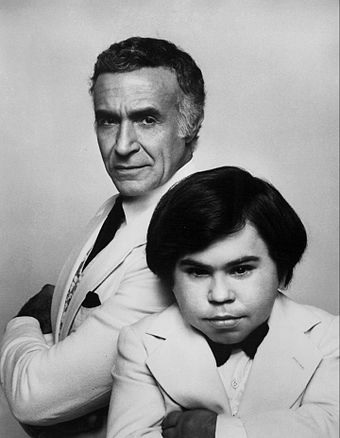
This week, it’s Tattoo’s turn to serve as Roarke’s sidekick while Julie is sent off to deal with two weddings and a tour for “the seniors.”

On the one hand, it’s incredibly awkward for Roarke to have two sidekicks and it’s pretty obvious that Julie was only hired to serve as insurance in case Herve Villechaize walked off the set.

On the other hand, it is kind of nice to be reminded of the fact that there’s a lot happening on Fantasy Island.  Fantasy Island is not just a mystical nation that is ruled over by the enigmatic Mr. Roarke.  It’s also a resort that hosts vacations and retirement homes.  Apparently, you don’t have to have a fantasy in order to spend some time on Fantasy Island.  Instead, you can just come to Fantasy Island for a nice tropical vacation.  That’s kind of nice.

But, that said, the fantasies are why we’re here.  We’ve got two good ones this week.

Dorothy Nicholson (Susan Sullivan) is a newspaper publisher who has been feeling unfulfilled ever since her husband was killed by a drunk driver.  She want to find the perfect husband, a man without any flaws whatsoever.  After giving her his customary “You may not like what you find,” warning, Roarke sends her to Paradise Cove.  Operated by the sinister Anton Jagger (Rossano Brazzi), Paradise Cover is a resort where wealthy women are assigned the perfect companion.  Dorothy’s perfect man is Gilbert (Lyle Waggoner).  Gilbert is handsome, suave, charming, and attentive.  Unfortunately, like all of the perfect men at Paradise Cove, he’s also a robot and a part of Jagger’s scheme to cheat women out of their money!  Dorothy figures out the truth after Gilbert doesn’t even flinch after his hand catches on fire.  Can she defeat Jagger’s plans and rescue the real Gilbert?

(Of course, she can.  It’s Fantasy Island!)

Dr. Hal Workman (George Maharis) thinks that he’s figured out a way to detect when a volcano is going to erupt.  He wants to go to Fantasy Island’s own active volcano to test out his methods.  Roarke agrees, even though he worries that Dr. Workman only cares about science and not about people.  (Honestly, who cares?  A volcano detection system sounds like it would be a good thing, regardless of the motives of the man who created it.)  Workman is led to the volcano by a disillusioned former priest named Lauria (Richard Romanus).  However, Workman and Lauria are not the only people at the volcano.  There’s also a shady tycoon, Joseph Butler (Norman Alden), and his girlfriend, Terri (Misty Rowe).  You can probably guess what happens.  Workman falls in love with Terri.  Lauria finds his faith.  And Butler presumably dies when the volcano erupts and a deluge of what appears to be very thin tomato sauce comes pouring down the mountain.

Both of these fantasies were cheerfully ridiculous, which made them a lot of fun.  You may wonder why Roarke would send one of his guests to a resort that’s being run by a madman and that’s a legitimate question.  But the important thing is that the viewer gets a montage of all of the robots malfunctioning at once.  And you may wonder at the wisdom of allowing someone to go to an active volcano but the important thing is that we get a scene of George Maharis and Richard Romanus running away from the least realistic lava flow ever caught on film.  Fantasy Island is a lot of fun when it goes over the top and embraces its beautiful absurdity and that’s exactly what this episode did.

What a wonderful trip to the Island!

Retro Television Reviews: The Love Boat 3.4 “Going My Way/Dance with Me/Doc, Be Patient”


Welcome to Retro Television Reviews, a feature where we review some of our favorite and least favorite shows of the past!  On Wednesdays, I will be reviewing the original Love Boat, which aired on ABC from 1977 to 1986!  The series can be streamed on Paramount Plus!
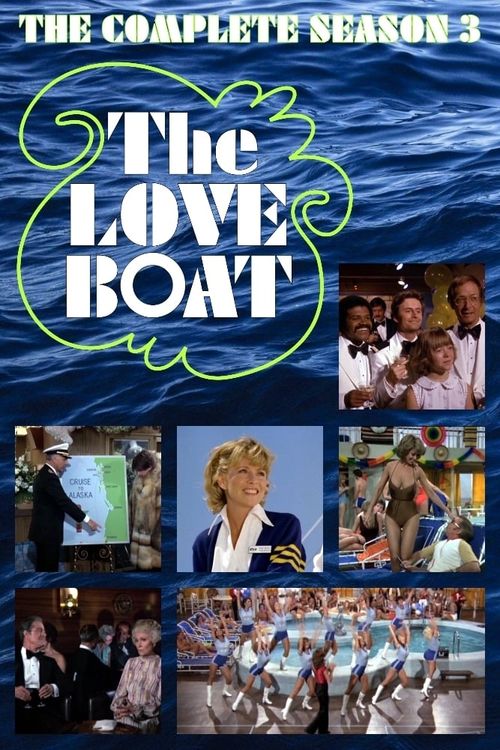
This week’s cruise is all about love and dancing!

Episode 3.4 “Going My Way/Dance with Me/Doc, Be Patient”

(Dir by Adam Rafkin and James Sheldon, originally aired on September 29th, 1979)

Oh no!  The ship has just left port and Doc Bricker has come down with the flu!  He’s so sick that he can barely walk without getting dizzy.  Fortunately, there’s another doctor on the boat.  Dr. Emily Bradford (Susan Sullivan) takes time away from her own vacation to not only look after Doc but also check in on his other patients.  I have to admit that I found myself wondering if the cruise line agreed to pay her for filling in for Doc or if she just did it for free.  It seems like, if she misdiagnosed anyone on the boat, it would lead to an even bigger lawsuit than usual.

It turns out that Doc is not a particularly good patient.  He hates having his temperature taken.  He hates getting shots.  He even resists allowing Emily to take a look at his throat.  But when he ends up sick and delirious, he’s thankful that Emily’s there.  In fact, he’s so thankful that he decides that he’s in love with Emily and he wants her to spend all of her time with him!  Emily reveals to Doc that he’s doing what so many past patients have done to him, falling in love with the person who takes care of them.  A chagrined Doc says that he’s going to have to write a lot of apologies to his former patients.

Probably one of the stranger aspects of The Love Boat has always been the portrayal of Doc Bricker as some sort of decadent swinger.  Bernie Kopell was very likable in the role of Adam Bricker but there was also absolutely nothing about him that would make one think that he was some sort of fun-loving satyr.  While the show insisted that Doc was a legendary womanizer, he actually came across as being a mild-mannered, slightly out-of-touch but well-meaning suburbanite who just happened to work on a cruise ship.  In this episode, Doc actually got to show some vulnerability and it was nice to see.  Certainly, Bernie Kopell seemed to be more comfortable playing Doc as someone who hated needles as opposed to as a doctor who casually kept adult magazines in his waiting room.

While Doc came down with the flu, Suzy Butterfield (Arlene Golonka) is determined to still take her cruise despite having been stood up by her boyfriend.  Because she has an extra ticket and because she enjoyed the jokes that he told while driving her to the docks, Suzy impulsively invites her cab driver, Mickey Greenbaum (Buddy Hackett) to join her on the cruise.  Mickey, an aspiring writer, agrees and I assume he also loses his job as a taxi driver as a result.

On the boat, Suzy recommends women that Mickey could date and Mickey recommend men that Suzy could date but, of course, they’re destined to end up together.  And, of course, they do.  Mickey even proposes marriage.  Yay!  This was a sweet story, even if Buddy Hackett wasn’t the most convincing romantic lead.  He was ten years older than Arlene Golonka and they had an older brother/little sister chemistry that didn’t exactly translate to romance.  But no matter.  I was still glad that things worked out for their characters.

Finally, world famous ballet dancer William Delaney (John Meehan) boards that boat with his much younger partner, Joanna (Starr Danias).  Also on the cruise is William’s former partner, Marcy McGuire (Carol Lawrence).  Marcy now runs a dance academy in Germany and she wants William to teach at the school.  William realizes that he’s getting older and that he’s actually holding Joanna back by not retiring.  William accepts Marcy’s offer, which Joanna’s misinterprets are William and Marcy having an affair.  Fortunately, Captain Stubing is there to help gently explain the whole situation.  Both John Meehan and Starr Danias were real-life dancers (To be honest, they were far better at dancing than delivering dialogue.) and the story is really just an excuse for the two of them to perform, together and separately.  Starr Danias’s solo performance of Swan Lake was absolutely wonderful and, for me, the highlight of the cruise.

I enjoyed this episode.  The passengers were likable, Doc Bricker finally stopped acting like a walking HR nightmare, and best of all …. there was dancing!  This was a very enjoyable cruise.
Retro Television Reviews: The City (dir by Harvey Hart)


Welcome to Retro Television Reviews, a feature where we review some of our favorite and least favorite shows of the past!  On Sundays, I will be reviewing the made-for-television movies that used to be a primetime mainstay.  Today’s film is 1977’s The City.  It  can be viewed on YouTube!

“Civilization began when man realized that he could not survive alone. He left the wilderness and built his citadels, security against intruders and erosion from within. The cities of the world have since become the crossroads of trade and ideas. Ideas that have made the human race more powerful than primitive man could ever have dreamed. Among these was an invention, a machine that conquered to contemporary enemies of man: time and distance….”

So goes the opening narration of 1977’s The City.  The narrator is the veteran character actor (and television producer) William Conrad and, as he speaks, we sees images of the California desert eventually being conquered by the growing city of Los Angeles.  It’s a bit of a portentous opening for a film that turns out to be fairly standard police procedural but it makes sense when you consider that The City was apparently meant to be a pilot for an anthology series about the people of Los Angeles.

The City features Mark Hamill, shortly before Star Wars would turn him into a cultural icon.  Hamill plays Eugene Banks, a sweaty, wild-eyed petty criminal who has made his way to Los Angeles from Texas.  Banks manages to get a nice apartment and a job working at a gas station.  One day, after a lawyer demands that Banks fill the tank of his Porsche, Banks snaps.  He grabs a wrench and attacks the car.  Then, he attacks the lawyer, beating the man until he dies.  Banks proceed to go on a crime and killing spree across Los Angeles, flashing a particularly scary-looking knife whenever he gets the chance.

Searching for Banks are two mismatched cops.  Matt Lewis (Robert Forster) is the tough-as-nails, emotionally reserved veteran with a bad knee and a determination to catch the bad guys.  The case becomes personal for Lewis after Banks kills his partner.  Brain Scott (Don Johnson) is a shaggy-haired country boy, much like Banks.  Brian comes from a wealthy family and is a bit more idealistic in his approach than Lewis.

Banks, it turns out, is obsessed with a country singer named Wes Collins (Jimmy Dean).  Banks not only resents the fact that Collins has everything that Banks has ever wanted but he’s also convinced that Collins is actually the father who abandoned him when he was a baby.  Banks wants to get revenge and he’s not going to let anyone, whether they be a bystander, a cop, or a dog, stand in his way.

Yes, Eugene Banks kills a dog in this film.  Fortunately, it happens off-screen but it’s still an indication of just how different this role is from Hamill’s best-known live action role.  As the two cops, Forster and Johnson work well together and bring their somewhat stereotypical characters to life but the main reason most people will watch this film will be for the chance to see Mark Hamill play an absolute lunatic.  With the exception of his somewhat dodgy Texas accent, Hamill does a good job with the role.  He’s got the crazy eyes down and he’s actually frightening when he attacks the lawyer at the start of the film.  The film itself is a bit predictable (i.e., the mismatched partners learn to work together, the bad guy gives a speech at an inopportune time) but The City is worth watching for the cast.

Cave-In! (1983, directed by Georg Fenady)


Sen. Kate Lassiter (Susan Sullivan) is visiting a cave in order to determine whether it’s safe to leave it open to the public.  Giving the senator and her group the grand tour is Gene Pearson (Dennis Cole), who is not only a park ranger but who is also Kate’s ex-boyfriend.  The question as to whether or not the cave is safe for the general public is answered by a sudden cave-in, which leaves Kate, Gene, and the others trapped.  Now, Gene has to lead the group across often dangerous terrain to safety.

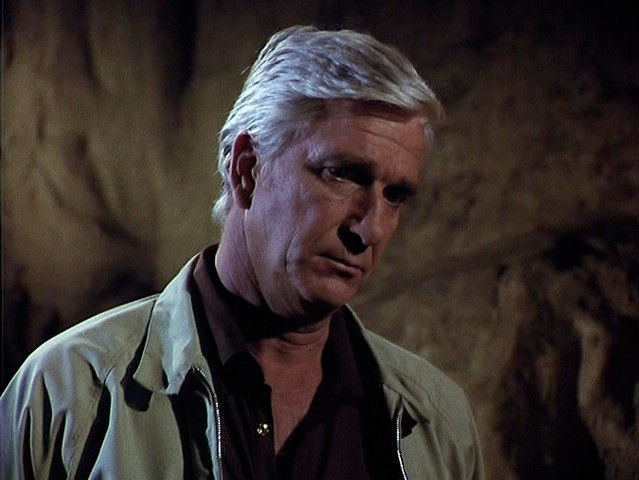
Along with Kate, the group includes a bitter cop named Joe Johnson (Leslie Nielsen!), his wife Liz (Julie Sommars), arrogant Prof. Harrison Soames (Ray Milland), and the professor’s shy daughter, Ann (Sheila Larkin).  Joe and Liz are struggling to keep their marriage together.  Prof. Soames refuses to allow his daughter to have a life of her own.  The six of them are going to have to somehow work together if they’re going to survive this cave-in!  Of course, they’re not alone.  There’s a seventh person in the cave.  Tom Arlen (James Olson) is a dangerous convict who was in the cave hiding out from the police.  Now, he’s trapped along with everyone else.

Cave-In is a pretty standard disaster movie.  Produced by Irwin Allen, it was originally filmed in 1979 but it didn’t air on NBC until 1983.  By that time, Airplane! had pretty much reduced the disaster genre to a joke.  Ironically, Leslie Nielsen himself has a starring role in Cave-In, playing exactly the type of character that he parodied in both Airplane! and Police Squad.  At the time he filmed Cave-In, Neilsen was still a dramatic actor but by the time the movie aired, his deadpan style was firmly associated with comedy.  Even when his dialogue is serious, the natural instinct is to laugh.

Cave-In gets bogged down by flashbacks.  Even though everyone should be concentrating on making their way to safety, it instead seems that they’re too busy obsessing on their backstory.  Since no one’s backstory is that interesting, the flashbacks don’t do much to liven up the film and, unfortunately, a cave-in just isn’t as compelling as a fire in skyscraper or an upside down boat.

On the plus side, every disaster movie needs an arrogant bastard who makes escape unnecessarily difficult and, in the 70s, no one played a better arrogant bastard Ray Milland.  Otherwise, Cave-In is a forgettable entry from the final days of the disaster genre.

A Movie A Day #144: The Incredible Hulk (1977, directed by Kenneth Johnson)


It may seem hard to believe now but there was a time when comic book adaptations were considered to be a risky bet at best.  In 1977, Marvel Comics sold the television rights for four of their characters to Universal Productions. This led to three unsuccessful pilots (one for Dr. Strange and two for Captain America), a Spider-Man series that lasted for two seasons, and The Incredible Hulk.  As opposed to the other Marvel adaptations, The Incredible Hulk series was popular with fans and (some) critics and ultimately lasted for four seasons.

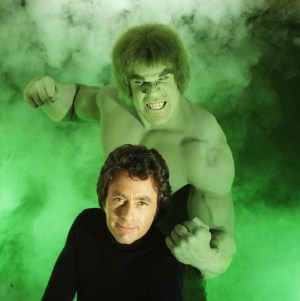
It all started with a 90 minute pilot that aired in 1977.  Haunted by the car accident that caused the death of his wife and his inability to rescue her, Dr. David Banner (Bill Bixby) is researching why, in times of extreme stress, ordinary people can suddenly experience moments of super human strength.  What he theorizes is that it is a combination of body chemistry and gamma radiation caused by sun spots.  Eager to test his theory, David straps himself into a chair and zaps himself with gamma radiation.  At first, it seems as if nothing has changed.  But when David’s driving home, he gets a flat tire.  When he struggles to change the tire, in the middle of a hurricane nonetheless, David gets mad.  Suddenly, his eyes turn green and soon so does the rest of him as David Banner is transformed into the Incredible Hulk (Lou Ferrigno, except for one shot where the Hulk is played by Richard Kiel).  The Hulk runs through the woods, accidentally scaring a girl and getting shot by a hunter.  When the Hulk falls asleep, he transforms back into David, who has no memories of what he did while he was the Hulk.  While David and his colleague, Elaina Marks (Susan Sullivan), investigate what happened to him, tabloid reporter Jack McGee (Jack Colvin) tries to uncover the results of David and Elaina’s research.

Other than introducing the Hulk and giving Banner a backstory, the pilot didn’t have much in common with the series that followed.  Along with being a comic book adaptation, the series was also a remake of The Fugitive.  With everyone convinced that the Hulk had murdered both him and Elaina, David was always on the run and trying to find a way to cure his condition.  Every episode would begin with David working a new odd job and getting involved in a new situation and almost every episode ended with David hitchhiking while the show’s famous piano theme played over the final credits.  Because David was always either getting beaten up or tangled in barbed wire, the Hulk would show up twice an episode.  David Banner just couldn’t catch a break.

The pilot seems to take forever to get going, devoting a lot of time to David and Elaina doing research.  In those days before the success of The Dark Knight and the MCU legitimized comic books as a cultural force, The Incredible Hulk was determined to show that it was not just a show for kids.  Today, the pilot is too slow-paced and self-consciously serious but still contains the elements that made the show itself became a success.  Bill Bixby takes his role seriously and Lou Ferrigno is the perfect choice for the Hulk.  Decades after they first aired, the Hulk-transformation scenes are still undeniably cool.  It was also during the pilot that Dr. Banner uttered those famous and oft-parodied words: “Mr. McGee, don’t make me angry.  You wouldn’t like me when I’m angry.”

As of this week, reruns of The Incredible Hulk are now being shown, daily, on both H&I and the El Rey network.  I will be watching.