Happy 74th Birthday, Kurt Russell! In GUNS OF DIABLO (1964), a young Kurt graces the screen with cinema icon Charles Bronson.


As a person who sees his love of movies through a lens of “Bronson connections,” I have a special fondness for Kurt Russell. In 1963 and 1964, Charles Bronson worked on a television series with Kurt Russell called THE TRAVELS OF JAIMIE MCPHEETERS. The series itself is the story of twelve year old Jaimie McPheeters (Kurt Russell) who, along with his ne’er-do-well doctor dad (Dan O’Herlihy) and a ragtag group of pioneers, travel westward from Paducah, Kentucky to the California gold fields in 1849. Charles Bronson first appeared on episode 10 of the series, and would stay with the series until it ended after 26 episodes. Russell was the star, with Charles Bronson riding along in the important role of Linc Murdock, the guide who gets them through all sorts of dangerous situations. 1964’s GUNS OF DIABLO is an interesting concoction, using the final episode of the series, “The Day of Reckoning” and adding some new scenes shot specifically for a movie release.

GUNS OF DIABLO opens with Linc Murdock (Charles Bronson) leading the wagon train across a raging river. The group constructs a wooden barge, and most of the group makes it across safely. Unfortunately for one of the groups, a tree floating down the river smashes into the barge, causing it to sink along with the wagon and the man on top of it. Murdock jumps into the river and is able to save the man who unfortunately suffers a broken leg. Needing to rest for a few days, Murdock decides to go into the local town, Devil’s Gap, to get supplies. Jaimie (Kurt Russell), a boy with the wagon train, asks his dad if he can go with him. Dad says yes under one condition, Jaimie gets a real bath while he’s in town. So Linc and Jaimie head off together. When they get to town, Linc immediately goes to the saloon to get a beer, where he sees the beautiful Maria (Susan Oliver), a woman with whom he has a dangerous past. Via flashback, we learn the story of Linc and Maria falling in love while he was working as a hand on the Macklin ranch five years earlier. But it was a doomed love affair as Maria had been promised to the eldest son of the family, Rance Macklin (Jan Merlin). When Linc and Maria plan to elope and get married, Rance and his brothers get the drop on them. A big gunfight ensues, with Rance taking a shot in the arm, and Maria being shot in the crossfire. Believing her to be dead, Linc barely escapes with his own life.

Back in the present time we meet a Maria who is stuck in a loveless marriage to a one-armed Rance. Rance and his brothers have lost the ranch and are always trying to stay one step ahead of the law. That’s why Maria’s been reduced to working as a waitress at the saloon. She also believes that Linc ran out on her five years ago, so she’s mad at him. But soon those old feelings start stirring up deep within her when Linc talks sweet to her. When the duplicitous bartender Ives (John Fiedler) sees Linc go into Maria’s room, he sends word to Rance. Soon the Macklin Brothers are on their way back to town to settle their old score with Linc. What they didn’t count on was the 12 year old Jaimie McPheeters, with all of his youthful exuberance and ingenuity, being there to swing the odds in Linc’s favor! I made up that last line, but Jaimie does help Linc a couple of times. 

I mentioned earlier that GUNS OF DIABLO was assembled together using the final episode of THE TRAVELS OF JAIMIE MCPHEETERS, along with some new footage added specifically for the movie. I’ve never seen the final episode of the series that this movie was based on, but I have seen some of the earlier episodes and I did notice one key difference. The TV series revolves mostly around the trials and tribulations of Jaimie and his dad, Dr. Sardis McPheeters. Dan O’Herlihy played Dr. McPheeters in the series, but actor Russ Conway plays him in this movie. He’s not a big part of the movie, just appearing at the beginning and the end, but it was odd seeing a different actor portraying Jaimie’s dad. It sure would be great if the series were to become more widely available at some point in time. I’d love to compare the TV version to this movie version.

Charles Bronson was not a big movie star when GUNS OF DIABLO was released, but he was a well respected character actor. He had already headlined his own TV series, MAN WITH A CAMERA (1958-1960), and he had prominent roles in the massive box office hits THE MAGNIFICENT SEVEN (1960) and THE GREAT ESCAPE (1963). This movie heavily focuses on his character, and Jaimie McPheeters takes a back seat. Bronson, already 43 years old, was more than up to the challenge. He comes across as a decent, hardworking man, who’s capable of taking care of himself. In other words, he shows the strength and charisma that would make him the most popular actor in the world just a few years later. Susan Oliver is quite beautiful as Maria. Although primarily known as a blonde, blue eyed beauty, her hair is dark here. She’s so beautiful that I can understand why a man with such limited options would be willing to fight to the death for her. And what can you really say about Kurt Russell?! He’s such a good child actor. While Jaimie McPheeters may not be the focus of the movie, he’s still so good in the role, showing kindness, loyalty and bravery in equal measure. In a world where so many child actors can’t adjust to life as an adult, Russell has made it look easy for the last six decades. In my opinion, he’s one of the all time greats. 

Overall, GUNS OF DIABLO will never be confused with HIGH NOON (1952) or RIO BRAVO (1959), but for a movie assembled from a 60’s TV western and a few newly shot scenes, it’s actually quite enjoyable. And the storyline may not be the most original, but the time tested tale of true love and honor winning out over greed and evil will always make for compelling viewing. I got my first VHS of this film in the 80’s and I still own it to this day. I even watched it multiple times while I was writing up this review. As far as I’m concerned, GUNS OF DIABLO is well worth watching for fans of westerns or fans of the stars. 

Rather than sharing a trailer for the film I thought I’d share this heartwarming story of the time Kurt Russell bought Charles Bronson a birthday gift while they were working together on this series. It’s a classic. Enjoy, my friends!
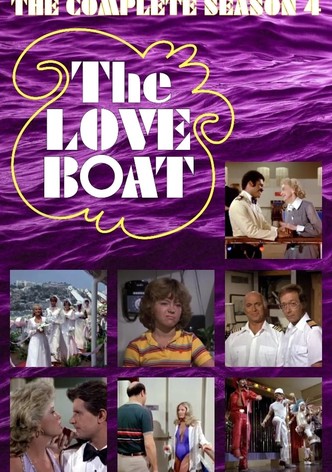

Retro Television Review: The Love Boat 4.16 “Gopher’s Bride/Love with a Married Man/Not Tonight, Jack!”


Welcome to Retro Television Reviews, a feature where we review some of our favorite and least favorite shows of the past!  On Wednesdays, I will be reviewing the original Love Boat, which aired on ABC from 1977 to 1986!  The series can be streamed on Paramount Plus!

This week’s cruise did not make me want to set course for adventure.

Episode 4.16 “Gopher’s Bride/Love with a Married Man/Not Tonight, Jack!”

(Dir by Richard Kinon, originally aired on January 24th, 1981)

This week’s episode is all about cabins.

For instance, Jack Clayton (Patrick Wayne) invited his girlfriend of four weeks, Helen Mann (Trish Stewart), to join him on the cruise without telling her that they would be sharing a cabin.  Sorry, Jack — Helen doesn’t go for that sort of thing!  Jack is kicked out and spends most of the cruise trying to find some place else to sleep.  (He also ends up awkwardly lugging his suitcase around with him.)  Eventually, Helen gets some romantic advice from Julie (always a mistake) and decides that it’s not fair to kick Jack out of the cabin that he paid for.  She tells him that he can stay in the cabin.  Jack’s like, “Finally, let’s get it on!”  No, Jack, Helen doesn’t go for that.  Instead, she plans on sleeping outdoors for the rest of the cruise!

The two of them work it out eventually.  When Jack objects to Helen sleeping outside, even if it means Jack would again have to find someplace else to go, Helen realizes that he actually does care about her and he’s not just interested in sex.  They leave the boat together, with Helen promising that she and Jack will always sleep in the same bed from now on.  I give their relationship another two weeks or so.

Meanwhile, Kay Tindal (Susan Oliver) wants Ned Beacham (Paul Burke) to come visit her cabin and Ned is sorely tempted because his wife, Margo (Dana Wynter), is such a workaholic.  Fortunately, Ned and Margo’s 24th anniversary falls right in the middle of the cruise and it causes Ned to realize that he still loves Margo and it causes Margo to realize that she spends too much time worrying about her career.  Ned and Margo leave the ship together while Kay can only watch from the staircase.  Ha!  Take that, homewrecker!

Finally, Gopher risks his job so that Nicole (Marie Laurin) can stay in his cabin.  Nicole is Gopher’s pen pal from Quebec.  (Actually, she was writing to Doc and Isaac who, for reasons that are never made clear, signed Gopher’s name to all of the letters.)  When Nicole shows up on the boat, Gopher takes one look at her and says that she can stay with him.  Of course, it’s against ship regulations for passengers to stay with crewmembers so, in order to keep Captain Stubing from finding out, Gopher tells him that Nicole is a new maid.  Gopher ends up doing all of Nicole’s work and Nicole ends up meeting and getting engaged to a passenger named Frank (Paul Gale).  Sorry, Gopher!

This was a pretty forgettable episode and it was a bit hard to sympathize with any of the passengers.  Jack was a cad.  Helen was a prude.  Kay was a homewrecker.  Ned was a wimp.  Margo was cold.  Nicole was so self-centered that she didn’t even notice that Gopher was killing himself with extra work to keep her from getting kicked off the boat.  I wouldn’t want to be on a cruise with any of these people.

On a slightly positive note, Captain Stubing did ask Vicki if she had done her homework so I now definitely know that Vicki has a tutor and is getting an education while living on the boat.  At least I don’t have to worry about that anymore!

Retro Television Reviews: International Airport (dir by Don Chaffey and Charles S. Dubin)


Welcome to Retro Television Reviews, a feature where we review some of our favorite and least favorite shows of the past!  On Sundays, I will be reviewing the made-for-television movies that used to be a primetime mainstay.  Today’s film is 1985’s International Airport!  It  can be viewed on YouTube!

It’s not easy working at an international airport!

At least, that’s the message of this made-for-television film.  Produced by Aaron Spelling and obviously designed to be a pilot for a weekly television series, International Airport details one day in the life of airport manager David Montgomery (Gil Gerard).  Everyone respects and admires David, from the recently graduated flight attendants who can’t wait for their first day on the job to the hard-working members of the airport security team.  The only person who really has a problem with David is Harvey Jameson (Bill Bixby), the old school flight controller who throws a fit when he learns that a woman, Dana Fredricks (Connie Sellecca), has been assigned to work in the tower.  Harvey claims that women can’t handle the pressure of working the tower and not having a personal life.  He demands to know what Dana’s going to do during that “one week of the month when you’re not feeling well!”  Harvey’s a jerk but, fortunately, he has a nervous breakdown early on in the film and Dana gets to take over the tower.

Meanwhile, David is trying to figure out why an old friend of his, Carl Roberts (played by Retro Television mainstay Robert Reed, with his bad perm and his retired porn star mustache), is at the airport without his wife (Susan Blakely).  David takes it upon himself to save Carl’s troubled marriage because it’s all in a day’s work for the world’s greatest airport manager!

While Carl is dealing with his mid-life crisis, someone else is sending threatening letters to the airport.  One of the letters declares that there’s a bomb on a flight that’s heading for Honolulu.  David and Dana must decide whether to allow Captain Powell (Robert Vaughn) to fly to Hawaii or to order him to return to California.  And Captain Powell must figure out which one of his passengers is the bomber.  Is it Martin Harris (George Grizzard), the sweaty alcoholic who want shut up about losing all of his friends in the war?  Or is it the woman sitting next to Martin Harris, the cool and aloof Elaine Corey (Vera Miles)?

Of course, there are other passengers on the plane.  Rudy (George Kennedy) is a veteran airline mechanic.  Rudy is hoping that he can talk his wife (Susan Oliver) into adopting Pepe (Danny Ponce), an orphan who secretly lives at the airport.  Unfortunately, when Pepe hears that Rudy’s plane might have a bomb on it, he spends so much time praying that he doesn’t realize he’s been spotted by airport security.  Pepe manages to outrun the security forces but he ends up hiding out in a meat freezer and, when the door is slammed shut, it appears that Pepe may no longer be available for adoption.  Will someone hear Pepe praying in time to let him out?  Or, like Frankie Carbone, will he end up frozen stiff?

International Airport was an attempt to reboot the Airport films for television, with the opening credits even mentioning that the film was inspired by the Arthur Hailey novel that started it all.  As well, Gil Gerard, Susan Blakely, and George Kennedy were all veterans of the original Airport franchise.  George Kennedy may be called Rudy in International Airport but it’s easy to see that he’s still supposed to be dependable old Joe Patroni.  Unfortunately, despite the familiar faces in the cast, International Airport itself is a bit bland.  It’s a disaster film on a budget.  While the viewers gets all of the expected melodrama, they don’t get anything as entertaining or amusing as Karen Black flying the plane in Airport 1975 or the scene in Concorde: Airport ’79 where George Kennedy leaned out the cockpit window (while in flight) and fired a gun at an enemy aircraft.  Probably the only thing that was really amusing (either intentionally or unintentionally) about International Airport was the character of Pepe and that was just because young Danny Ponce gave perhaps the worst performance in the history of television.

International Airport did not lead to a television series.  Watching it today, it’s a bit on the dull side but, at the same time, it is kind of nice to see what an airport was like in the days before the TSA.  If nothing else, it’s a time capsule that serves as a record of the days when the world was a bit more innocent.

Horror on TV: Circle of Fear 1.20 “Spare Parts” (dir by Charles S. Dubin)


On tonight’s episode of Circle of Fear, Susan Oliver plays the widow of a doctor who allows his hands, eyes, and vocal chords to be used in transplants.  Unfortunately for her, the spirit of her dead husband is still inside of his donated body parts.  Because he’s convinced that she murdered him, the dead doctor seeks an elaborate revenge on his wife.

This episode originally aired on February 23rd, 1973.  It was written by Jimmy Sangster, who is best known for his work with Hammer Films.

Enjoy!

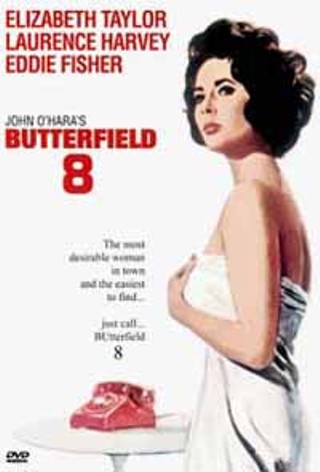
Cleaning Out The DVR: BUtterfield 8 (dir by Daniel Mann)


“Mama, face it,” Gloria Wandrous (Elizabeth Taylor) announces in the 1960 film, BUtterfield 8, “I was the slut of all time!”

Personally, I think Gloria is being a little bit too hard on herself. Certainly the film suggests, in its 1960 way, that she’s promiscuous and that she only sleeps with men for money but that doesn’t necessarily make her the slut of all time. For one thing, I would think that the slut of all time would have more options than just a wimpy pianist played by Eddie Fisher or a depressing, self-absorbed businessman played by Laurence Harvey.

“I still say it stinks,” Elizabeth Taylor said, almost immediately after winning her first Oscar for her performance in BUtterfield 8 and she’s kind of right. BUtterfield 8 is not a particularly good film, though not quite as bad as Taylor seemed to believe it to be.

Taylor won the Oscar after suffering a near fatal bout of pneumonia and having to undergo a tracheotomy. Along with saying that the film stunk, Taylor also often said that she only won her first Oscar because she nearly died. That may or may not be true but the thing is, Taylor’s the best thing in this overwritten and overheated mess of a movie. She certainly gives a better and more sympathetic performance than Laurence Harvey, who is cast as her married lover, Wilson Liggett. We’re meant to sympathize with Ligget but Harvey plays him as if he’s in a permanently sour mood and, after just a few minutes of listening to him bitch about every little thing, the viewer will get sick of him. It’s hard to really see what Gloria Wandrous sees in this whiny alcoholic.

Then again, the only other option that the film gives Gloria is Steve Carpenter, the pianist played by Eddie Fisher. Steve can’t decide if he’s in love with his boring girlfriend, Norma (Susan Oliver) or if he’s in love with Gloria. However, Steve has no problem letting Gloria borrow one of Norma’s dresses so that she can wear it when she goes home to visit her mother and I have to say that if I was Norma, Steve would be finding a new bed to sleep in after that. Gloria tells Steve that he needs to decide who he’s in love with but Steve jut can’t do it. Of course, in real life, Eddie Fisher left Debbie Reynolds so that he could marry Elizabeth Taylor. (A year or so later, Taylor left Fisher so that she could marry Richard Burton.)

BUtterfield 8 is one of those films that was undoubtedly considered to be daring when it was first released, seeing as how it acknowledged that people had sex without getting married first. (GASP!) Of course, though the film acknowledges that people have sex, it still makes sure to let us know that no one’s happy afterwards and that promiscuity eventually leads to death. (I mean, BUtterfield 8 may have taken risks but it still knew better than to defy the production code.) Seen today, the entire film is rather tame, talky, and slow but the star power of Elizabeth Taylor still comes through. The film opens with a lengthy sequence of Gloria getting ready for her day and, as you watch it and, more importantly, as you watch Elizabeth Taylor, you find yourself thinking that this is what a movie star is supposed to be. She dominates the film and she manages to credibly deliver even the most overheated pieces of dialogue. (Just try to imagine Jennifer Lawrence delivering the “slut of all time” line and you’ll immediately understand the difference between the movie stars of the past and the movie stars of the present. Of course, you could also say the same thing about trying to imagine a young Elizabeth Taylor in Silver Linings Playbook or The Hunger Games.) In fact, one could argue that Taylor’s performance is almost too good for the material. The film, in its 1960 way, suggests that Gloria would be better off if she just settled down but it’s impossible to imagine Taylor’s Gloria Wandrous settling for the stiffs played by Laurence Harvey and Eddie Fisher.

Though Elizabeth Taylor was correct about BUtterfield 8‘s overall quality, it’s still a good example of what star power can do for an otherwise mediocre film.

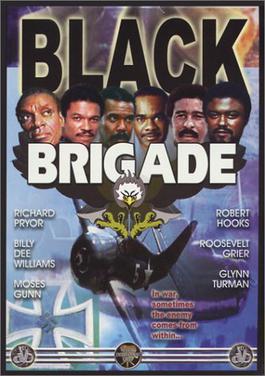
Black Brigade (1970, directed by George McCowan)


During the closing days of World War II, General Clark (Paul Stewart) wants to capture a Nazi-controlled dam and he thinks he’s found just the man for the job.  Captain Beau Carter (Stephen Boyd) is a tough and good with a knife and a gun.  Carter is sent to take command of a ragtag group of soldiers who have spent the last three years waiting for combat.  The only catch is that the soldiers are all black and Captain Carter is a racist redneck.

This was an Aaron Spelling-produced television movie that was originally broadcast under the name Carter’s Army.  When it was released on video, the name was changed to Black Brigade, probably in an effort to fool viewers into thinking that it was a cool blaxploitation film instead of a simplistic TV movie.  The film has gotten some attention because of the cast, which is full of notable names.  Roosevelt Grier plays Big Jim.  Robert Hooks is Lt. Wallace while Glynn Turman is Pvt. Brightman (who keeps a journal full of the details of the imaginary battles in which he’s fought) and Moses Gunn brings his natural gravitas to the role of Pvt. Hayes.  Probably the two biggest names in the cast are Richard Pryor as the cowardly Crunk and Billy Dee Williams as Pvt. Lewis, who says that he’s from “Harlem, baby.”

Don’t let any of those big names fool you.  Most of them are lucky if they get one or two lines to establish their character before getting killed by the Germans.  The movie is mostly about Stephen Boyd blustering and complaining before eventually learning the error of his ways.  The problem is that Carter spends most of the film as such an unrepentant racist that it’s hard not to hope that one of the soldiers will shoot him in the back when he least expects it.  The other problem is that, for an action movie, there’s not much action.  Even the climatic battle at the dam is over in just a few minutes.

There is one daring-for-its-time scene where Lt. Wallace comes close to kissing a (white) member of the German Resistance, Anna Renvic (Susan Oliver).  When Carter sees him, he angrily orders Wallace to never touch a white woman.  Anna slaps Carter hard and tells him to mind his own goddamn business.  It’s the best scene in the movie.  Otherwise, Black Brigade is forgettable despite its high-powered cast.

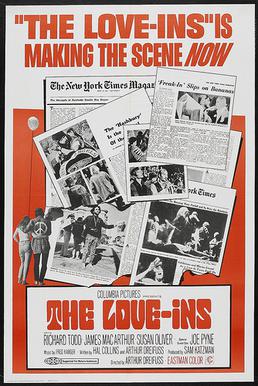
Cleaning Out The DVR: The Love-Ins (dir by Arthur Dreifuss)


(Hi there!  So, as you may know because I’ve been talking about it on this site all year, I have got way too much stuff on my DVR.  Seriously, I currently have 179 things recorded!  I’ve decided that, on February 1st, I am going to erase everything on the DVR, regardless of whether I’ve watched it or not.  So, that means that I’ve now have only have a month to clean out the DVR!  Will I make it?  Keep checking this site to find out!  I recorded the 1967 film, The Love-Ins, off of TCM on September 28th, 2017!)

“We now enter Haight Ashbury.  The promised land of the love movement.  The utopia of LSD…and now we take you to Golden Gate Park for a hippie love-in!”

— A San Francisco Tour Guide in The Love-Ins (1967)

I doubt I could ever be a hippie.  I don’t mind the drugs, the free love, or the music but the whole lack of showers and underwear would be too much for me.  Add to that, from what I’ve seen, it appears that whenever there was a hippie gathering, it would inevitably lead to the arrival of mimes and who wants to deal with that?  That said, I certainly do enjoy watching movies about hippies.

Take The Love-Ins for instance!

This 1967 film is all about hippies, or at the very least the popular perception of hippies.  There’s even a lengthy sequence that takes place at a hippie gathering in San Francisco.  While the hippies plays bongo drums, blow bubbles, dance, and stare at multi-colored umbrellas with stoned eyes, they’re watched by Jonathan Barnett (Richard Todd).  Barnett used to be a respected philosophy professor but then he resigned his teaching position in protest after two students were expelled for publishing an underground newspaper.  This led to Barnett appearing on a right-wing talk show where the antagonistic host told him that, if he loved the hippies so much, maybe he should got to Haight Ashbury and see how they really live.  Barnett does just that and it blows his mind!

Soon, Barnett has re-invented himself.  He’s now a psychedelic prophet, living in a commune with the expelled students and encouraging everyone to “Be more.  Sense more.  Love more.”  That doesn’t quite have the same ring to it as “Tune in.  Turn On.  Drop out,” but it’s the same basic idea.  Soon, hippies from all over the country are flocking to Prof. Barnett, dropping LSD, and doing interpretive dances.  Not even the local outlaw bikers can stop Barnett from spreading his message.

Unfortunately, it doesn’t take long for his newfound fame to go to Barnett’s head.  He soon stops listening to Larry (James MacArthur), the student whose expulsion started the whole movement, and instead surrounds himself with sycophants like Elliott (Mark Goddard).  Barnett goes from being an idealist to a messianic cult leader.  Soon, hippies are fighting in the streets, setting fired to newspaper they don’t like, and jumping out of windows.  (“LSD told him he could fly.  Gravity had different plans.”  No one actually said that in the movie but I wish they had.)  After discovering that his girlfriend (Susan Oliver) has been impregnated by Barnett, Larry realizes that he has to stop his former professor, one way or the other.

The Love-Ins was made by the same people responsible for Riot on Sunset Strip but, whereas Sunset Strip at least pretended to take an even-handed, documentary-like approach, The Love-Ins is a psychedelic freakout.  Whereas Sunset Strip features Mimsy Farmer taking LSD and then staring at her hand, The Love-Ins features Susan Oliver taking LSD, transforming into Alice in Wonderland, and then dancing with Tweedle Dee and Tweedle Dum.  And whereas Sunset Strip tried to be on the side of both the young and the old, The Love-Ins leaves little doubt that those hippies are no good!  (While Larry may be a the film’s hero, he looks like he would be more comfortable in the ROTC than at Woodstock.)  Barnett’s love-ins are revealed to be as choreographed as any political rally and, if there’s any doubt that he’s become a really bad guy, he even starts to perform impromptu wedding ceremonies.  “How dare you make a mockery of marriage!?”  an outraged observer shouts.

Seen today, the main value of The Love-Ins is a chance to see how many adults viewed the counter-culture and its leaders in 1967.  (Director Arthur Dreifuss was 60 when he directed this film and the film often views its young characters with the detachment of someone not sure of how close he can really get before being attacked.)  Of course, the main reason I liked The Love-Ins was because of the psychedelic dance scenes.  (Though no one’s going to mistake this film for another Face in the Crowd, I also enjoyed some of the film’s satiric jabs at the cult of celebrity, which was apparently just as big in 1967 as it is in 2018.)  It’s definitely a film of its time, though whether or not the people involved with the movie actually understood their time is another issue all together.

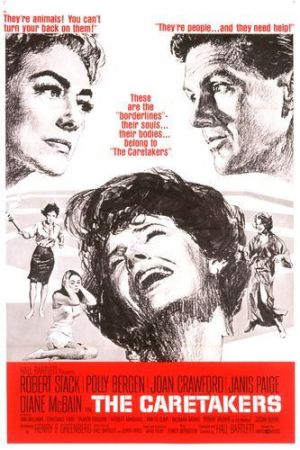
Embracing the Melodrama Part II #27: The Caretakers (dir by Hall Bartlett)


The_Caretakers_(1963_movie_poster)Whenever I go to Half-Price Books, I always seem to end up spending most of my time browsing the “nostalgia” section.  This is where they keep all of the old paperbacks that were published long before I was born.  This is where you can find old romance novels, “for adults only” novels, detective novels, and occasionally you’ll even find mainstream novels that were apparently considered to be quite daring when they were originally released.  These novels usually carry cover blurbs that brag about how controversial they are and how they deal with the “real issues of today.”

Usually, these novels are pretty silly and over-the-top which is why I always seem to end up buying a lot of them.  About a year ago, I bought a novel from 1959.  It was by Dariel Telfer and it was called The Caretakers.  The cover features a naked woman standing in front of several nurses and doctors.  The cover blurb announces that The Caretakers is “A shattering novel about nurses, doctors, and patients in a state hospital where emotions readily explode!”  The back cover features a pull quote from Time: “Will shock as well as arouse compassion.”

Now, I have to admit that I have yet to get around to actually reading The Caretakers.  However, thanks to TCM, I recently saw the 1963 film version and it’s a film that definitely embraces the melodrama.

How melodramatic is The Caretakers?  It’s melodramatic enough that it opens with Lorna Medford (Polly Bergen) stumbling into a movie theater and having a nervous breakdown.  Since this film was made in 1963, her mental breakdown is represented by spinning the camera around and getting hyperactive with the zoom lens, all while Bergen shrieks and tears at her hair.

Lorna is sent to a mental hospital, where she meets several other patients and is treated by Dr. MacLeod (Robert Stack), who is a rebel.  We know that he’s a rebel because everyone else at the hospital keeps telling him that he’s a rebel and complaining about his use of radical use of group therapy.  Under Dr. MacLeod’s guidance, Lorna reveals that she hasn’t gotten over the tragic death of her child.

As the film progresses, Lorna gets to know the rest of the patients.  They’re a mixed bunch, all played by actresses who clearly saw this as their chance to pick up an Oscar for Best Supporting Actress and were determined to make as big an impression as possible.  For instance, Barbara Barrie plays Edna, who never speaks but who does enjoy setting fires and who, whenever she’s feeling persecuted, poses as if she’s hanging from a cross.  And then there’s grandmotherly Irene (Ellen Corby), who is supposed to be the nice one but always looks like she’s on the verge of very sweetly shoving a pair of knitting needles into someone’s eyes.

However, my favorite patient was the cynical Marion (Janis Paige), precisely because she was so cynical and, as a result, she got all the best lines.  Marion is a former prostitute who now hates all men and Paige has a lot of fun playing the role.  Whenever Paige is giving one of her long, angry monologues, she practically grabs the film and refuses to let it go.

And then, of course, there’s Joan Crawford.  Crawford doesn’t play a patient.  Instead, she’s the head nurse and she doesn’t approve of Dr. MacLeod’s methods.  Crawford announces early on that she’s been attacked by a patient in the past and her main concern is protecting her staff.  She teaches a self-defense class.  If you’ve ever wanted to see a middle-aged Joan Crawford flip someone over, The Caretakers is a film to watch.

And that’s The Caretakers for you.  It’s one of those films that takes itself so seriously that it becomes humorous despite itself.  As a result, the film is a lot of unintentional fun.

And who knows?

Maybe someday, I’ll get around to reading the book!