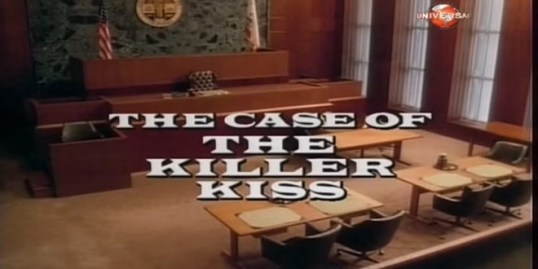
On the set of a popular soap opera, actor Mark Stanton (Sean Kanan) dies after he films a kiss with co-star Kris Buckner (Genie Francis). Kris is accused of intentionally poisoning Mark to get back at him for trying to force her off the show but Kris says she’s innocent. Fortunately, Kris is the goddaughter of Perry Mason (Raymond Burr).
This movie was the last time that Raymond Burr played Perry Mason and it actually aired a few weeks after his death. There are scenes that are hard to watch because it is clear that Burr was not doing well during filming. He rarely stands and when he does, he still leans against the table for support. He’s still great when he’s asking questions and making objections but physically, it’s obvious that he was struggling. He still lights whenever he’s talking to Della, though. The best scenes in the movie are just Raymond Burr and Barbara Hale being Perry and Della. Their affection for each other shines through in every scene. The mystery is routine but the guest cast is full of daytime drama royalty like Stuart Damon, Linda Dano, and Genie Francis.
As I said when I started reviewing these movies at the start of the month, my Aunt Kate loved watching these movies. I know she watched them when they first aired and later, when they started re-airing them on Hallmark or MeTV, she loved rewatching them even though she already knew who the murderer was going to be. I would watch with her sometimes. We agreed that Perry and Della were in love and that Paul Drake, Jr. was Della’s son, even if he didn’t know it.
Rewatching all of the movies this month, what struck me is that most of them are still a lot of fun. Sure, there’s a few clunkers. But the majority of the 27 Perry Mason films are still entertaining to watch. Raymond Burr as Perry Mason and Barbara Hale as Della Street? Nobody did it better.
Welcome to Retro Television Reviews, a feature where we review some of our favorite and least favorite shows of the past! On Tuesdays, I will be reviewing the original Fantasy Island, which ran on ABC from 1977 to 1984. Unfortunately, the show has been removed from most streaming sites. Fortunately, I’ve got nearly every episode on my DVR.
This week, the Island is kind of dull. Tattoo is missed.
Episode 7.6 “Second Time Around/Three’s A Crowd”
(Dir by Philip Leacock, originally aired on November 19th, 1983)
Love is in the air again at Fantasy Island! Remember when this show used to feature mermaids and Greek Gods and ghosts and gothic mansions and stuff like that? Those were good times!
Kate Tucker (Cristina Ferrare) comes to the Island to confront her husband, Gary Tucker (Geoffrey Scott, the quarterback from 1st and Ten), about his infidelity. Roarke decides to bring Gary’s mistress, Helen (Michelle Phillips, who once played the mermaid on this very show), to the Island as well! It’s all a part of Roarke’s plan to show both women that Gary’s not worth all the trouble. Kate realizes she doesn’t want Gary and Helen doesn’t want him either. Kate leaves the Island a single woman. Good for her!
Meanwhile, widowed Joan (Dorothy McGuire) comes to the Island and falls for handsome Alan Reynolds (Craig Stevens). Joan’s son (Stuart Damon) is upset at the idea of Joan marrying someone else. Eventually, he comes to see the error of his ways and smiles as Joan and Alan find happiness.
This may have been an episode of Fantasy Island but it felt more like The Love Boat. Roarke helped everyone find true love and Lawrence …. Lawrence was just kind of there. At this point, I kind of feel that, if they were determined to get rid of Tattoo, they should have just had Roarke running the Island by himself. Lawrence’s presence doesn’t accomplish anything beyond making the viewer miss Tattoo.
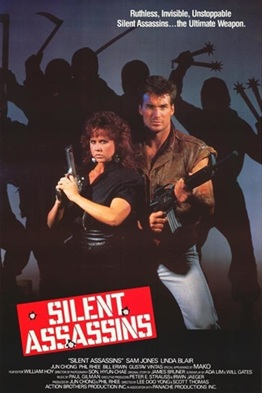
Elite cop Sam Kettle (Sam J. Jones) just wants to get out of Los Angeles and live a peaceful life with his girlfriend, Sara (Linda Blair), but the streets have other plans. The evil Kendrick (Gustav Vintas) has kidnapped Dr. London (Bill Erwin) and is determined to get the code for a deadly bioweapon. For reasons that are never made clear, Kendrick has also kidnapped young Joanna (Joanna Chong). Backing Kendrick up is the evil Miss Amy (Rebecca Ferrati). Backing up Kettle is Joanna’s uncle, Jun Kim (Jun Chong) and Bernard (Phillip Rhee), the son of Oyama (Mako), the owner of the local dojo. Can Sam save the world, saved the doctor and the girl, and also save his relationship with Sara?
Silent Assassins is a terrifically fun martial arts movie. The action is well-choreographed. The film’s plot doesn’t make a bit of sense. The movie is full of weird throw-away dialogue, like an offended Ms. Amy announcing that she’s “a biochemist too.” Chong shows off his moves, Rhee plays his character as a playboy having the time of life, and Jones glowers at the camera as only Sam J. Jones can. There’s an army of loud ninjas (so much for the silent part) and Vintas is so villainous that he even carries around a red rose as some sort of strange trademark. The movie is full of weird details and no one seems to be taking any of it too seriously. Movies like this are why people like me always went straight for the direct-to-video releases when we went to Blockbuster back in the day.
Linda Blair is second-billed. When Lisa and I watched this movie, she kept track of Linda’s screentime. Linda’s onscreen for a total of ten minutes and she spends most of that time doing the worried girlfriend thing. It’s a sad waste of Linda Blair, the one misstep of an otherwise great experience.
Welcome to Retro Television Reviews, a feature where we review some of our favorite and least favorite shows of the past! On Tuesdays, I will be reviewing the original Fantasy Island, which ran on ABC from 1977 to 1984. Unfortunately, the show has been removed from most streaming sites. Fortunately, I’ve got nearly every episode on my DVR.
This week, Mr. Roarke might be a father!
Episode 5.15 “The Case Against Mr. Roarke/Save Sherlock Holmes”
(Dir by Don Weis, originally aired on February 6th, 1982)
After last week’s episode with Julie, Tattoo returns this week and Julie is nowhere to be seen. When Mr. Roarke asks where Julie is, Tattoo mentions that Julie is helping with the Custer’s Last Stand fantasy. At this point, I can only assume that a life insurance policy has been taking out on Julie and Roarke or Tattoo, or maybe both are trying to get her killed so they can collect.
Julie not being present means that she misses out on one of the biggest scandals in Fantasy Island history. A former guest, Fran Warner (Laraine Stephens), returns to the Island after seven years. Accompanying her is her six year-old daughter, Nancy (Nicole Eggert). Fran loudly declares that Mr. Roarke is Nancy’s father and that he now has an obligation to take care of her. Fran even has a birth certificate where, under the father’s name, someone has written — and I kid you not — “Mr. Roarke.”
Is Mr. Roarke the kid’s father? As is his habit, he refuses to answer the question directly when Tattoo asks it. But it soon turns out that no, Mr. Roarke is not Nancy’s father. Instead, Fran is sick and may be dying and she wants to make sure that Nancy is cared for. When Nancy learns the truth, she runs away and Tattoo leads a search party across the Island. Fear not, of course. Nancy is found and a very forgiving Mr. Roarke allows Nancy and Fran to stay on the Island. And Fran’s terminal disease suddenly becomes less terminal!
While this is going on, security guard Kevin Lansing (Ron Ely) gets to live his fantasy of helping a great detective. Kevin doesn’t care which detective he gets to help so Roarke sends him back to Victorian-era London so that Kevin can work with Dr. Watson (a charming Donald O’Connor) to save Sherlock Holmes (Peter Lawford, not looking well in one of his final performances) from the clutches of Moriarty (Mel Ferrer, being as sinister here as he was in countless giallo films). Kevin also falls for Nurse Heavenly (RIta Jenrette, the wife of a corrupt Democrat member of Congress) and is pleased to discover that she’s not really Moriarty’s assistant. Instead, she was just another guest on the Island having a fantasy.
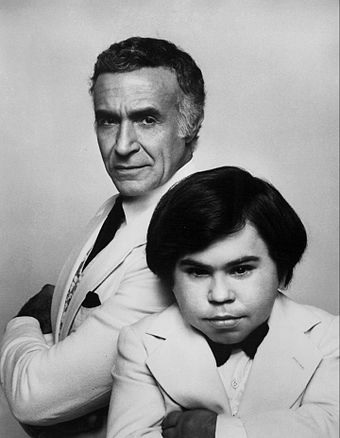
The Sherlock Holmes story was silly but fun, in the way that Fantasy Island often is. It’s always interesting when this show goes into the past and we get to see how the show’s crew dressed up the show’s sets to try to make them look historically accurate. The same street appears in every episode but sometimes, that street is in 1890s London and sometimes, it’s in 1690s Salem and sometimes, it’s just in modern day Fantasy Island! As for the Mr. Roarke’s a father storyline, it was predictable but still, it was a good showcase for Ricardo Montalban’s enigmatic interpretation of Mr. Roarke.
Though the Academy of Motion Picture Arts and Sciences claim that the Oscars honor the best of the year, we all know that there are always worthy films and performances that end up getting overlooked. Sometimes, it’s because the competition too fierce. Sometimes, it’s because the film itself was too controversial. Often, it’s just a case of a film’s quality not being fully recognized until years after its initial released. This series of reviews takes a look at the films and performances that should have been nominated but were,for whatever reason, overlooked. These are the Unnominated.
First released in 1983, Star 80 is an examination of fame, obsession, misogyny, and finally madness. All four of those qualities are exemplified in the character of Paul Snider (Eric Roberts), a man with a charming smile, a ludicrous wardrobe, and the personality of a pimp. When we first see Paul Snider, he’s naked and he’s covered in blood and he’s ranting about how the world is trying to destroy him. Even if he wasn’t holding a rifle, he would be terrifying. Suddenly, we flash back to a few years earlier. Snider is being dangled out a window by two men. Snider pathetically begs to be pulled back into the room. The men laugh at him before pulling him up. Snider, looking fairly ridiculous in a cheap suit that he probably thinks makes him look like a celebrity, fights off tears as he says he deserves to be treated with dignity.
Star 80 is based on a true story. Mariel Hemingway plays Dorothy Stratten, the actress and Playboy playmate who was murdered by Paul Snider. Snider, who often claimed credit for having “made” Dorothy, was married to her at the time, though Dorothy had filed for divorce and was dating director Peter Bogdanovich. Unwilling to let her go and return to being a small-time hustler, Snider shot Dorothy and then himself. Director Bob Fosse, who was best known for directing musicals like Cabaretand All That Jazz, was attracted to the story because he understood that type of world that produces sleazes like Paul Snider. According to Eric Robets, Fosse even said that he probably would have ended up like Paul Snider if not for his talent.
Snider, the film quickly establishes, really doesn’t have any talent beyond the ability to manipulate people who are too naïve to see through his bullshit. Snider wants to be a star. He wants to be rich. He wants people to kiss his ass. When he meets Dorothy, he sees her as his ticket. Dorothy’s mother (a poignant performance from Carroll Baker) sees straight through him from the start. Tragically, Dorothy doesn’t realize the truth abut who he is until they’re already in Hollywood. As Dorothy tries to break away from him, Paul desperately tries to find some sort of success, all the while complaining that the world is conspiring to keep him from being a man.
Eric Roberts dominates the film and it’s one of the scariest performances that I’ve ever seen. Roberts is convincing when he’s ranting and raving against the world that he feels is against him but what’s even more disturbing is that he’s convincing when he’s turning on the charm. Paul Snider may not be smart. Paul Snider may not be talented. But he know how to gaslight. He knows how to destroy someone’s fragile confidence, largely because his own confidence has been shattered so many times that he’s become an expert in exploiting insecurity. Snider is a tacky dresser and nowhere near as smooth as he thinks but, intentionally or not, he uses that to his advantage. He tries so hard to impress that it’s easy to see how someone could feel sorry for him and want to help him. However, because Fosse lets us know from the start what Snider is really going on inside of Sinder’s head, we never make the mistake of trusting him. We know who Paul Snider is because we’ve all known a Paul Snider.
Eric Roberts’s performance is so intense that it’s unfortunate but not surprising that it was overlooked at the 1983 Oscars. He was playing a truly repellent character and he did it so convincingly that I imagine many viewers had a hard time realizing that Eric Roberts was not Paul Snider but was instead an actor playing a terrible character. Some probably said, “Why should we honor such a loathsome character?” and again, the answer is because there are many Paul Sniders out there. Roberts captured much more than just one man’s breakdown. He captured a sickness at the heart of a fame-driven culture.
Of course, Paul Snider was not the only symptom of that sickness to be depicted in Star 80. Every man that Dorothy either uses her in some way or just views her as being a commodity. Hugh Hefner (Cliff Robertson) presents himself as being a fatherly mentor but Robertson plays him as being just as manipulative and ultimately narcissistic as Paul Snider. Director Aram Nicholas (Roger Rees, playing a character based on Peter Bogdanovich) seems to love Dorothy but their relationship still feels out-of-balance. Aram, afterall, is the director while Dorothy is the actress. The private detective (Josh Mosel) that Paul hires to spy on Dorothy seems to have no lingering guilty over the role he played. Even Snider’s roommate (David Clennon) is more interested in talking about his dog and his car then about the murder/suicide of two people with whom he lived.
It’s a dark film and not one to be watched when depressed. At the same time, it’s a portrait of obsessiveness, misogyny, and an overwhelming need to be “someone” that still feels relevant today. Along with Sweet Charity, it was the only Bob Fosse film not to be nominated for Best Picture. (This was back when there were only five best picture nominees. Three of the nominated films — Terms of Endearment, Tender Mercies, and The Right Stuff — hold up well. Two of the nominees — The Dresser and The Big Chill — are a bit more iffy.) Eric Roberts was not nominated for the best performance of his career. Again, it’s a shame but not a surprise. This was a dark and disturbing film, a true Hollywood horror story. One imagines that most members of the Academy wanted to escape it far more than they wanted to honor and be reminded of it.

 Through the Shattered Lens