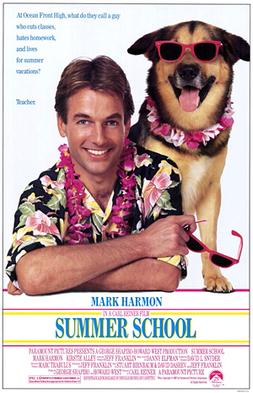
Summer School (1987, directed by Carl Reiner)


Summer School was the movie that made flunking out look like fun.

Freddy Shoop (Mark Harmon) is a relaxed, fun-loving gym teacher who is looking forward to spend his summer in Hawaii until he’s assigned to spend the summer teaching remedial English in summer school.  (His girlfriend goes to Hawaii without him.)  Freddy’s not happy about giving up his summer and he’s prepared to just spend his days taking his students to the beach, the amusement park, and the zoo.  But when he finds out that he’s going to lose his job unless his students pass the big test at the end of the summer, he gets serious and discovers what teaching is supposed to be all about.

When I was growing up, Summer School seemed to be on television all the time.  If it wasn’t on HBO, it was on one of the local stations, usually right before summer began.  The summer school kids seemed to be having too much fun for kids stuck in school.  I don’t think my classmates in Baltimore would have been as happy about losing their summer as the students in this film.  Everyone who has seen this film remembers Dave and Chainsaw (Gary Riley and Dean Cameron) making jokes and showing everyone The Texas Chainsaw Massacre.  They also remember Anna-Maria (Fabiana Udenio), the Italian exchange student who took summer school to work on her English.  They remember Freddy letting one of his students move in with him, which doesn’t seem like a good idea even if she was played by Courtney Thorne-Smith.  Myself, I remember Robin Bishop, the teacher next door, who was played by an extremely sexy Kirstie Alley.  (This was one of the many 80s films in which Kirstie Alley made being uptight seem sexy.)  Of course, Robin was dating the snobbish principal who was trying to get Freddy Shoop fired.

I’m not going to sit here and say that Summer School is a great film.  It’s a dumb comedy with an uplifting message about what a good teacher can accomplish.  However, Summer School is a very likable film, an enjoyable 80s teen romp that suggests summer school was the place to be in the late 80s.  Mark Harmon, Kirstie Alley, and all the students give good performances.  How many future horror nerds were inspired by Dave and Chainsaw?  Legendary nice guy Carl Reiner directed and the movie itself is amiable and amusing enough to be watchable.

October True Crime: Easy Prey (dir by Sandor Stern)


The 1986 film, Easy Prey, tells the story of Tina Marie Riscio (Shawnee Smith), a 16 year-old who was approached in a mall by man (Gerald McRaney) who claimed to be a photographer looking for models.  The man told the insecure Tina that he wanted to take her picture but that he needed her to come out to his car and sign a release.  At first, Tina was reluctant to follow the man out to his car but when he acted embarassed and apologized for making her feel uncomfortable, Tina decided to sign the release.  Later, she would say that the man reminded her of her father.

The man, however, was Christopher Wilder.  At the time that he approached Tina, Wilder was already a suspect in several murders and had been placed on the FBI’s Most Wanted List.  In many ways, Wilder did not seem to fit the typical profile of a serial killer.  Born in Australia, he was a naturalized American citizen who had started his own business and lived what seemed to be a glamorous lifestyle.  He was a millionaire.  He owned a Porsche.  He was a race car driver who competed in races across the country.  Even with his receding hairline, he was considered to be charming and handsome.  It was only under a close examination that cracks started to appear on his perfect surface.  He had a criminal record in Australia.  His girlfriends described him as being paranoid, insecure, and abusive.  His business partners said that, despite his apparent wealth, Wilder was always one step away from financial ruin.

Because Wilder was killed by the police while resisting arrest, it’s not known how many women he murdered over the course of his six-week crime spree in 1984.  It is believed that he definitely murdered eight but the actual number is thought to be much higher.  (He’s a suspect in the disappearance of actress Tammy Lynn Lepert, who appeared in Scarface as the woman who distracted Steven Bauer while the latter should have been keeping track on what was happening with Tony’s meeting with the Colombians.)  However, he did not kill Tina Marie Riscio.  Instead, after kidnapping and assaulting her, he drove across the country with her.  After using her to lure victims in both Indiana and New York, Wilder eventually drove Tina to Boston and bought her an airplane ticket home.  While Tina was flying back to Los Angeles, Wilder was heading for Canada.  (He would be shot and killed by police near the border, in New Hampshire.)

Easy Prey follows Wilder and Tina as they drive from location-to-location.  Along the way, Tina is shown to develop a case of Stockholm Syndrome.  As much as she hates Wilder, she still fails to take advantage of many chances to escape from him.  Unfortunately, the film’s script itself doesn’t provide much insight into how this happened, beyond the fact that Wilder reminded Tina of the father who earlier abandoned her.  The film does feature two strong performances, from Shawnee Smith and Gerald McRaney.  Smith gets a a powerful monologue, in which she talks about how easy it was for Wilder to take advantage of her insecurity.  Meanwhile, McRaney plays Wilder as being a pathetic man who is desperate to convince the world that he is actually a dynamic businessman and adventurer.  If he were alive today, there’s little doubt Christopher Wilder would be on twitter, siding into people’s DMs and posting a bunch of “alpha male” nonsense.  Wilder was a monster who still feels very familiar.

May Positivity: Grace Unplugged (dir by Brad J. Silverman)


The 2013 film, Grace Unplugged, is about Grace Trey (AJ Michalka) and her father, Johnny Trey (James Denton).  Back in the 80s, Johnny was a rock star who had one hit song and then basically wasted away with his career with drugs and alcohol.  Eventually, he got clean and turned his back on rock stardom.  Instead, he started writing and performing faith-based music.  Like her father, Grace is musically talented but, at the age of 18, she is chafing at the idea of living under his strict rules.  Though she plays in his band, she resents the fact that he won’t left her play the songs the way that she wants to.

One day, Johnny is visited by his former manager, Mossy Mostin (Kevin Pollack).  (Never trust anyone named Mossy.)  Mossy explains that, because it was performed by the winner of an Australian singing competition, Johnny’s one hit is suddenly popular again.  Mossy wants Johnny to start recording again.  “None of the religious stuff, obviously,” Mossy says.  Johnny turns Mossy down but Grace, looking for an escape, records her own version of her father’s song and sends it to Mossy.

After she ditches youth group so that she can go to a movie and subsequently gets yelled at about it by her father, Grace decides to leave home and go to Mossy.  Mossy offers to manage Grace.  He also tells Grace that he will be totally taking over her image.  Soon, Grace finds herself in a phony relationship with a vapid television star (Zane Holtz) and she’s told that she has to be willing to sex up her image if she’s going to be a star.  Johnny continually asks her to come back home.  Mossy continually pressures her to stop thinking and just listen to her management.

On the positive side, Grace Unplugged avoids the many of the cliches that one might normally expect to come along with a film like this.  Grace, for instance, doesn’t get hooked on pills or any other drugs.  At worse, she has too much to drink one night and then wakes up with a bad hangover.  Grace may often feel confused about what she wants to do with her career and she doesn’t appreciate her father’s strict ways but she never becomes self-destructive or strung out or any of the other things that usually happen in movies like this.  As well, Mossy is portrayed as being a bit insensitive but he’s not some sort of a mustache-twirling villain.  In fact, the film is smart enough to understand that Grace does have a point about her father.  Johnny is too over-protective and over-controlling, especially when it comes to her music.  He fears that she’ll make the same mistakes that he did but the viewers never have any doubt that she’s not going to.  Grace is often naïve and unsure of what she should do but she’s never portrayed as being weak and I appreciated that.

That said, the film ends on a bit of a heavy-handed note as it reveals itself to be yet another adaptation of the parable of the Prodigal Son.  The film’s script conspires to only leave Grace with two options, which is either abandon her family or abandon stardom.  In the end, the film’s conclusion feels just a little bit too simplistic.

A Movie A Day #210: Who’s Harry Crumb? (1989, directed by Pat Flaherty)


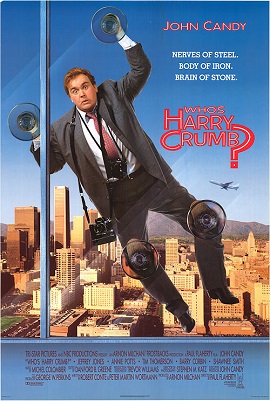
Who’s Harry Crumb?

He is a private detective, the latest in a long line of gumshoes.  While Harry’s father and his grandfather may have been great detectives, Harry is about as incompetent as can be.  He is a self-styled master of disguise but not much else.  He is employed at Crumb & Crumb Detective Agency, solely because of his family background.  When the head of the agency, Eliot Draisen (Jeffrey Jones), engineers the kidnapping of a millionaire’s daughter, he gives the case to Harry because he knows Harry will never be able to solve it.

Who’s Harry Crumb?

He is John Candy, the much beloved and much missed comedic actor from Canada.  As anyone who has ever seen an old episode of SCTV knows, John Candy could be one of the funniest men alive but Hollywood rarely knew what to do with him.  Other than the movies that he made with John Hughes, Candy was always stuck in either supporting roles or in bad comedies.  In Art Linson’s A Pound of Flesh, veteran film producer Linson writes that, because of Candy’s size, some Paramount executives wanted to cast him as Al Capone in The Untouchables.  That is something that I would have enjoyed seeing.  Instead, some actor named Robert De Niro got that role and Candy ended up making movies like Who’s Harry Crumb?

Who’s Harry Crumb? tries to be a mix of comedy and mystery but, due to a weak script and uncertain direction, it does not really succeed as either.  John Candy delivers a few laughs because he was a naturally funny actor but, as a character, Harry Crumb is not that interesting.  Instead, the film is stolen by Annie Potts, playing a duplicitous femme fatale.  Potts and Candy previously came close to working together in the original Ghostbusters.  (Candy pulled out of the role of Louis Tully so that he could play Tom Hanks’s brother in Splash.  He was replaced by his SCTV co-star, Rick Moranis.)  The rest of the cast seems bored and uninterested in what they are doing.  Even Jeffrey Jones, usually so reliable in smarmy bad guy roles, seems bored.
John Candy died just 5 years after the release of Who’s Harry Crumb?, leaving behind two intriguing dream projects, one a biopic of Fatty Arbuckle and another an adaptation of A Confederacy of Dunces.  Sadly, Hollywood never really figured out what to do with this talented comedian.


Back to School Part II #18: Not My Kid (dir by Michael Tuchner)


Not_my_kid

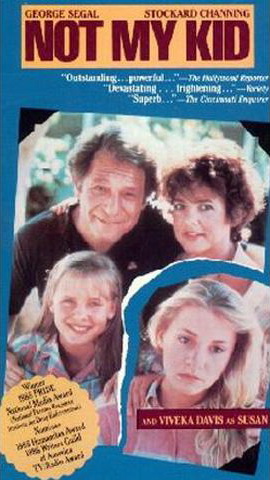
Not My Kid, a made-for-television from 1985, opens with 15 year-old Susan Bower (Viveka Davis) in a car with her friends.  They’re drunk.  They’re stoned.  They’re laughing.  And soon, they’re screaming as the driver loses control and the car ends up getting overturned!  (I’ve had that happen before.  It wasn’t fun but I survived with only a few cuts and bruises.)  Susan isn’t seriously hurt but, at the hospital, it’s discovered that she has alcohol and drugs in her bloodstream.

“NOT MY KID!” her father, surgeon Frank Bower (George Segal), declares.

“NOT MY KID!” her mother, Helen Bower (Stockard Channing, totally wasted in a thinly written role), agrees.

“Totally your kid!” her younger sister, Kelly (Christa Denton), says before then revealing where Susan hides her drugs.  This leads to Kelly getting beaten up by Susan and her drug addict boyfriend, Ricky (Tate Fuckin’ Donavon, decades before playing a hostage in Argo.).

Anyway, neither Frank nor Helen want to admit that Susan has a drug problem so instead, they go to see a smug family counselor who tells them that they are both being too hard on their daughter and that they need to just let Susan be Susan.  That sounds like a good (and easy) plan but then Susan runs away and disappears for two days.  After she’s finally found, stoned and hiding out in the family’s boat, her parents finally decide to send her to rehab.

The rehab is run by Dr. Royce.  Dr. Royce is played by Andrew Robinson and it took me a while to recognize him as being the same actor who played the Scorpio Killer in Dirty Harry.  Perhaps that explains why Dr. Royce came across as being such a creepy character.  As I watched this movie, I kept waiting for the big reveal where Dr. Royce would turn out to be a murderer or something.  That never happened, of course.  In the world of Not My Kid, the harsh and confrontational Dr. Royce is the only thing keeping the entire teenage population for shooting up heroin.

The majority of the film takes place at the rehab and it gets annoying pretty quickly.  This is one of those places where everything is done as a group activity.  Whenever someone says something, everyone in the group replies with, “We love you, so-and-so.”  When Susan doesn’t act properly ashamed of herself, the group gangs up on her.  “You’re a phony!” someone says.  “You’re full of crap!” another person adds.  “We love you, Susan,” the group chants.

AGCK!  Seriously, the rehab scenes totally freaked me out because it came across less like therapy and more like brainwashing.  I spent the entire movie waiting for Susan to escape and when she did, I was happy for her.  She may have been a self-destructive drug addict but at least wasn’t a mindless zombie like everyone else in the movie!  But then she ended up getting caught by her father and taken back to the rehab.

Meanwhile, her parents are going through therapy as well.  Again, it’s all group therapy.  When Frank tries to talk about how Susan’s behavior makes him feel, someone says, “You’re a phony!’  Another person adds, “You’re full of crap!”  And the group chants, “We love you, Frank.”  Okay, to be honest, I’m taking some dramatic license with the dialogue here but hopefully, you get the general idea.

I mean, seriously — I understand that I was supposed to be like, “Yay rehab!” while watching the movie but the rehab came across more like some sort of creepy cult.  It reminded me of both a Canadian film called, Ticket To Heaven and a Texas film called Split Image.  As I watched Not My Kid, I kept waiting for James Woods to show up as a cult deprogrammer.

Anyway, don’t worry.  Everything turns out well in the end.  This was a made-for-TV movie, after all.  Not My Kid is way too heavy-handed for its own good and it lacks a certain self-awareness.  On a more positive note, George Segal does a good job in the role of Frank.

You can watch Not My Kid below!

Quick Horror Film Review: The Blob (1988 Version – Dir. by Chuck Russell)


The Year was 1988.

My father was working in a precinct in Manhattan, and on occasion, my family would have to drive into the city to either get his check or help him file / retrieve something there. Whenever we went to Manhattan, we always saw something grand, like the “Ghost Building” which was shimmered in white light (this was actually Rockefeller Center, but my little sister, brother and I never knew). We once even saw the ’89 Batmobile tear through the city on it’s way to deliver the video release of Tim Burton’s Batman to the Tower Records uptown.

At a stop light, right by the Flatiron Building, I happened to glance around at some of the construction scaffolds. They always put movie posters on there, and I’d squint to see what was coming out soon. That’s when it caught my eye, a pink poster that looked like someone was swimming underwater. We got a little closer as my dad had to make a turn and I was then able to make it out.

“Oh no.”, I muttered, scrunching down in my seat. “They redid it.” All my childhood fears came flooding up in a wave of memories.

I once saw Larry Hagman’s Beware! The Blob (alternately known as Son of Blob) when I was really little. The idea that a gooey mass could squeeze under doors and through window cracks and anywhere there was a space freaked me out. This wasn’t Michael Meyers looking for his sister, or Jason Vorhees guarding Crystal Lake. There was no reasoning my little mind could use to feel better about it. Add to the fact it was only bothered by the cold, it made every summer a secret “look over the shoulder” one. When I attended my first bowling match for fun in college, I’ll admit I hesitated to step out into the bowling alley, if only for a second.

I never saw the movie in the theatre. I got so caught up in Who Framed Roger Rabbit, and everyone talked about Die Hard so much that The Blob became something of a blip to the school kids (from what I remember), but it remembered. I read the poster, and kept tabs on the writer’s names – Frank Darabont and Chuck Russell, who both went on to interesting projects over the years.

Okay, enough about my history with The Blob, let’s dig into the film, which is quite possibly one of the best remakes I’ve ever seen. It hits all of the notes of the original while setting down the groundwork for new directions when some fresh ideas. It’s not perfect, but it’s damn good.

The Blob is a re-telling of the classic 1958 film with Steve McQueen, only this time, Chuck Russell (The Mask) and Frank Darabont (The Shawshank Redemption, The Green Mile, The Mist) brought Kevin Dillon and Shawnee Smith aboard. It’s the story of a small town that receives a strange visitor from outer space in the form of a gelatenous mass inside of a meteor. When an old man gets a little too curious with a yard stick, it jumps out on and onto his hand. Needless to say, if you ever see anything fall from the sky, please, don’t go running to check it out. It never really ends well. At least, I’ve never heard of it doing so.

Anyway, like the original, the old man is found by the Gallant Hero (Donovan Leitch) and Heroine (Smith), who put him in their car and head to the local hospital. This results in the death of the old man, but also a twist in that the Gallant Hero is also killed / absorbed by the Blob. Shawnee’s character tries to save him, but to no avail. She’s should consider herself lucky that she made it through okay. While I didn’t see this in the theatre, I always wondered what effect that might have had on the audience. I mean, here you had the would be hero of the story and he’s taken out of the picture in the first act. That had to be amazing, I think.

As with the original, the Blob makes its way to the main part of town by way of the sewer, heading into the local movie theatre. Before getting there, there’s a interesting scene where Meg and Flagg (Dillon) – the bad boy turned reluctant hero – run into the Blob in a diner and hide in a nearby refrigerator. Rather than go with the classic “solidify it all in one piece”, Darabont and Russell decided to make the Blob’s freezing effect more like pieces of quartz. I thought this made things all the more scary – how could one really tell that all of it was ever collected while it was frozen?

One has to feel just a little sorry for Candy Clarke’s character. You run into a phone booth to make a phone call, only to have slime run down the sides. To top it off, you try to make a phone call for the local sheriff (played by Darabont favorite Jeffrey DeMunn from all of his films and The Walking Dead), and as if it answered for her, the Blob puts his decaying face right on the phone booth window. Another twist thrown in the remake is the death of a child. Usually in horror movies, kids are usually spared. Usually. Not so here, and it just adds to the horror of things. No one’s safe unless you’re walking around with some liquid nitrogen, and it’s not like that’s in great supply.

Eventually, we come to find – thanks to a lot of men in white suits and Crossroads Joe Seneca – that the Blob was actually man made, and it’s the scientists fault it came back the way it did. What I found interesting about that was the idea that they felt they had to burn it. Didn’t anyone think of bringing something cold? I mean, they’re scientists. Someone in the group had to have that idea at some point. Anyway, this all ends with a huge battle in the middle of a busy street and the townsfolk hiding in the municipal hall. Meg and Flagg do find a way to get everything fixed, but (as with many horror movies), we’re left with the promise of another sequel.

Overall, I loved The Blob. There’s very little I can find wrong with it, given that the source material was never really Oscar worthy to begin with. This was just a sit down for the adult in me, grab your popcorn and enjoy the film.

The kid in me prefers to watch this in a very cold room, just in case.