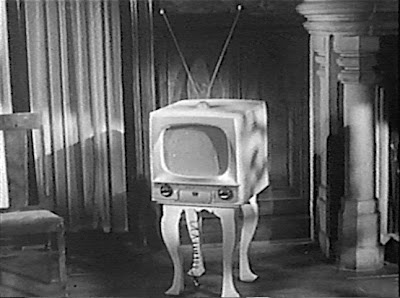
For tonight’s horror on television, we have 1973’s The Night Strangler.
This is the sequel to The Night Stalker and it features journalist Carl Kolchak (Darren McGavin) in Seattle. (After all the stuff that happened during the previous movie, Kolchak was kicked out of Las Vegas.) When Kolchak investigates yet another series of murders, he discovers that paranormal murders don’t just occur in Las Vegas and aren’t just committed by vampires.
I actually prefer this movie to The Night Stalker. The Night Strangler features a truly creepy villain, as well as a trip down to an “underground city.” It’s full of ominous atmosphere and, as always, Darren McGavin is a lot of fun to watch in the role in Kolchak.
Immediately following the Civil War, a group of U.S. soldiers and a group of former Confederates have to work together to survive an Apache ambush. The leader of the soldiers is Sgt. Matt Blake (Scott Brady) and he’s escorting a gunrunner (Baynes Barron) to a nearby fort. Leading the former Confederates is Sam Prescott (Frank Gerstle). The two groups are, at first, suspicious of each other. Confederate Judge Stanfield (Irving Bacon) thinks that Blake should just give the gunrunner and his guns to the Apaches, since that’s what they want. When Blake disagrees, Prescott tries to encourage a young and angry former Confederate named Keith (Clint Eastwood) to challenge Blake’s command. In the end, the former enemies have to learn how to set aside their differences to survive and to make it to the fort.
This was one of Eastwood’s earliest performances and only the fourth time that his name actually appeared in the opening credits. (Eastwood had appeared, uncredited, in several films before this one.) Eastwood later called Ambush at Cimarron Pass “the lousiest western ever made” and claimed that he hated the film so much that he almost gave up on acting after seeing it. I think he’s being too hard on the movie. It’s a low-budget B-movie that pretty much takes place in one location and it has an tending that feels tacked-on but, when it concentrates on the action and the hostility between the two groups, it’s not that bad. It feels more like an episode of Death Valley Days than an actual movie but Scott Brady is a convincing hero and his brawl with Eastwood is one of the movie’s highlights. As for Eastwood’s performance, he’s stiff but convincing when he’s angry. It’s obvious that, in 1958, Clint Eastwood still had a long way to go an actor but his physical presence makes him stand out whenever he’s in a scene. Ambush at Cimarron Pass is nothing special but it’s good enough to work for fans of the genre who might be looking for a brief diversion that features a handful of familiar faces.
After appearing in this film, Eastwood would land the role of Rowdy Yates on Rawhide and spend the next six years on television. His next film would be A Fistful of Dollars, a western that made a much deeper impression on audiences than Ambush At Cimarron Pass.
For today’s horror on the lens, we have 1973’s The Night Strangler.
This is the sequel to The Night Stalker and it features journalist Carl Kolchak (Darren McGavin) in Seattle. (After all the stuff that happened during the previous movie, Kolchak was kicked out of Las Vegas.) When Kolchak investigates yet another series of murders, he discovers that paranormal murders don’t just occur in Las Vegas and aren’t just committed by vampires.
I actually prefer this movie to The Night Stalker. The Night Strangler features a truly creepy villain, as well as a trip down to an “underground city.” It’s full of ominous atmosphere and, as always, Darren McGavin is a lot of fun to watch in the role in Kolchak.
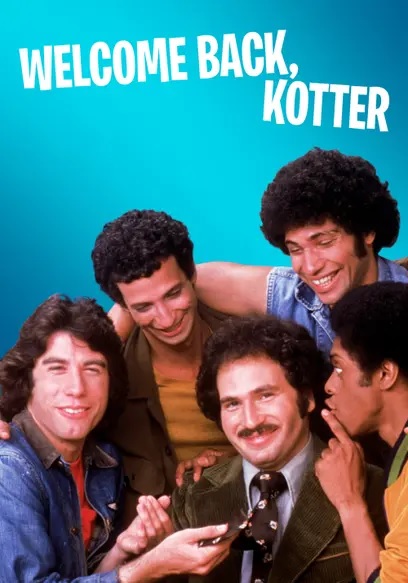
Welcome to Retro Television Reviews, a feature where we review some of our favorite and least favorite shows of the past! On Saturdays, I will be reviewing Welcome Back Kotter, which ran on ABC from 1975 to 1979. The entire show is currently streaming on Tubi!
This week is all about love and punishment!
Episode 2.13 “A Love Story”
(Dir by James Komack & Gary Shimokawa, originally aired on December 30th, 1976)
Gabe tells Julie about his Uncle Pete and Aunt Priscilla and how they won “a lot of money in the sweepstakes.”
In class, Gabe is teaching about the Spanish-American War when Freddie comes in doing the “She Loves Me/She Loves Me Not” routine with a daisy. Freddie is followed by a new student named Carmen (Lisa Mordente), who hands Gabe a note.
“Dear Mr. Kotter,” it reads, “please excuse my daughter’s violent temper. Don’t get her mad and she won’t have to deck you. Signed, Epstein’s Sister’s Mother.”
That’s right, Carmen is Epstein’s sister! When Epstein says, “What’s my baby sister doing in this class!?,” Carmen attacks him and throws him on top of Gabe’s desk.
After Gabe seperates the siblings, he introduces her to the class. Epstein can only watch in horror as Barbarino says, “You really filled out,” and Horshack says, “I want you have your children.”
Fortunately, the bell rings and school ends. Horshack stays after class to tell Kotter that he’s now in love with Carmen Epstein. Gabe encorages him to have confidence and ask out anyone that he wants to ask out.
Meanwhile, Epstein goes to the principal’s office with Carmen so that he can ask his best friend, Principal Lazarus, to transfer Carmen out of the Sweathogs. While Epstein talks to Lazarus, Horshack enters the office and approaches Carmen. When Horshack sees that Carmen is carrying a trumpet, Horshack says that he love the trumpet. Carmen plays a terrible version of Three Blind Mice for him. Horshack asks Carmen to go out with him but Barbarino walks into the office and asks Carmen to come with him. As anyone would, Carmen abandons Horshack for Barbarino. “I might even let you ask me out on Saturday,” Barbarino tells Carmen. Awwwwwww! Barbrino!
Gabe steps into the office and, as Horshack tells Gabe about what happened, Freddie steps into the room and reads a poem that he’s written for his new love. Epstein comes out of Lazarus’s office at the same time that Woodman is coming out of his office. Epstein warns Woodman that Lazarus doesn’t like him. This leads to a vintage Woodman meltdown as he points out that not only is his office smaller than Lazarus’s but his American flag only has 13 stars. “I’m plotting a mutiny,” Woodman says, “You can join, Kotter!” As Woodman plots to take over the school, Freddie mentions that he saw Barbarino heading down to the boardwalk with Carmen. Epstein announces that he’s going to kill Barbarino.
In the very next scene, Epstein has been chained to a locker and Horshack is still talking about how he just wants to devote his life to Carmen. Freddie suggests that maybe Epstein should give Horshack his blessings to date Carmen to keep Carmen away from Barbarino. Epstein agrees because he figures that Horshack won’t “try anything” with his sister. However, as soon as Horshack starts to rehearse what he’s going to say to Carmen, Epstein starts to shout, “STAY AWAY FROM MY SISTER! STAY AWAY FROM MY SISTER!”
The next day, in class, Gabe announces that they’re going to use the last few minutes of class to talk about love. He asks Vinny to explain what love means to him.
“Love,” Barbarino says, “mean never having to hear I’m pregnant.”
Epstein flies into a rage telling Barbarino to stop hitting on Carmen. Barbarino replies, “I’ve got a disease!” No, not that type of disease. It’s a disaease that Barbarino calls “Girlitis” and it requires him to hit on every girl he sees. Horshack then starts yelling at Barbarino, saying that Barbarino that he has no idea what it’s like to be alone. Carmen announces that Horshack has guts and “I like a man with guts!” Carmen then shows that she can take care of herself by beating up her brother.
Horshack literally picks up Carmen in his arms and announces that he wants to show her his shell collection under the boardwalk.
“YOU’RE GOING TO DIE, ARNOLD!” Epstein yells.
Back at the apartment, Gabe tells Julie that Carmen Epstein has transferred out of his class. Oh, okay. I guess that takes care of that plotline. Gabe tells Julie a joke about the time his sister Eileen lost a tooth and figured out that Gabe was the tooth fairy.
This is another one of those episodes that worked because it largely focused on how the four main Sweathogs related to each other. Robert Hegyes, Lawrence Hilton-Jacobs, and John Travolta all had a tremendous amount of chemistry and it’s always fun to watch them play off of each other. Ron Palillo occasionally went bit overboard but, with a character like Horshack, I imagine it was probably impossible not to. That said, Palillo more than held his own in this episode and his awkward flirting with Carmen was actually rather sweet. I still would have gone for Barbarino.
Episode 2.14 “Caruso’s Way”
(Dir by Bob LaHendro, originally aired on January 6th, 1977)
Gabe tells Julie about his uncle who was an inventor and who invented a deodorant called Invisible because, when it was worn, no one would want to acknowledge you. This leads to usual pity laughs from Julie.
At school, Gabe tries to teach about the War of 1812. (“When did it start?” Horshack asks.) Gabe notices that Barbarino is not in class and asks if anyone has seen him. Epstein says that Barbarino was fooling around in gym class and doing his “Ba-Baa-Baaa-Barbarino” dance and Coach Caruso ordered him to stay after class.
When Barbarino finally arrives at Gabe’s class, everyone wants to know what happened but a visibly shaken Barbarino insists that nothing happened and asks Gabe to resume teaching about the War of 1812. (Even Gabe is shocked.) When Epstein says he’d rather here about the “war between Vinny and Caruso,” Gabe announces that it’s Barbarino’s business and they’re not going to discuss what happened between Barbarino and Caruso.
On cue, Woodman enters the classroom and he says that he needs to discuss what happened between Barbarino and Caruso. Woodman says that he’s hearing rumors that Caruso hit Barbarino in front of the Girls Gym Class. “There are rules againt hitting students, even Sweathogs,” Woodman says, “I don’t know why.” Barbarino denies that Caruso hit him and Woodman leaves.
However, after the bell rings, Barbarino tells Gabe, Freddie, Epstein, and Horshack that Caruso did hit him but that he’s got a plan to get revenge but he can’t reveal it. Gabe suggests that Barbarino “cool down about it” before doing anything foolish.
Later, Barbarino drops in on Gabe and Julie at their apartment and you can literally see Julie (or maybe just Marcia Strassman) light up at the idea of sharing a scene with John Travolta as opposed to just with Gabe Kaplan.
Barbarino asks them if they watched the news and if they saw any reports on what happened between him and Caruso. Gabe jokes that they broke into “Bowling for Dentures” to report on it. “Really?” Barbarino asks. Awwwwwwww! Poor Barbarino!
Gabe and Julie try to dissuade Barbarino from hitting Caruso back. Barbarino says that he’s thinking of borrowing his uncle’s cement truck and using it to drive over Caruso. Gabe tells Barbarino a story about what happened when Gabe’s friend Bonzo Moretti was slapped by Caruso. Bonzo went to his parents but Barbarino says that telling his parents would just lead to his mother praying for something bad to happen to Caruso. After suggesting that Julie stock the kitchen with Danish and root beer for anyone who might drop by, Barbarino leaves.
The next day, Gabe talks to Woodman and asks Woodman would he would do if “two of your teachers had a confrontation.”
“Fire you,” Woodman replies.
Coach Caruso (played by veteran tough guy actor, Scott Brady) steps into Gabe’s classroom and, after Woodman leaves, they discuss the Barbarino situation. In a very well-acted scene (seriously, this episode features Gabe Kaplan at his most sincere), Gabe tells Caruso that, when he was a student, it bothered him when he heard about Caruso hitting kids. “Now that I’m a teacher, it bothers me even more.” Gabe explains that Caruso took away Barbarino’s pride and asks Caruso to apologize to him. Caruso refuses, saying that he his own pride to think of. Gabe convinces Caruso to come back to the classroom in the afternoon, so that Barbarino can apologize to him and Caruso can apologize back and they can both retain their pride.
However, when Caruso shows up in class and Barbarino apologizes, Caruso refuses to return the apology. (What a jerk!) Instead, Caruso challenges Barbarino to an arm wrestling contest.
“How macho!” Horshack exclaims.
Barbarino wins the arm wrestling contest! Yay! Caruso warmly congratulates Barbarino and leaves. In the hallways, Caruso confesses to letting Barbarino beat him. “When you went to school here,” Caruso says, “I taught you. Today, you taught me.” Awwwwwwww!
Back at the apartment, Gabe tells Julie about the time his Uncle Moe went to Miami Beach and jumped into a pool that he had been told was lukewarm, just to discover it was freezing. “How could you say that water was lukewarm!?” Moe demanded of another vacatinor. “I don’t know, look warm to me .”
This was a great episode, featuring the young John Travolta at his sensitive best and also giving Gabe Kaplan a chance to show off that he actually could act. Barbarino regained his pride, Coach Caruso learned how to be a better teacher, and Woodman continued to be Woodman.
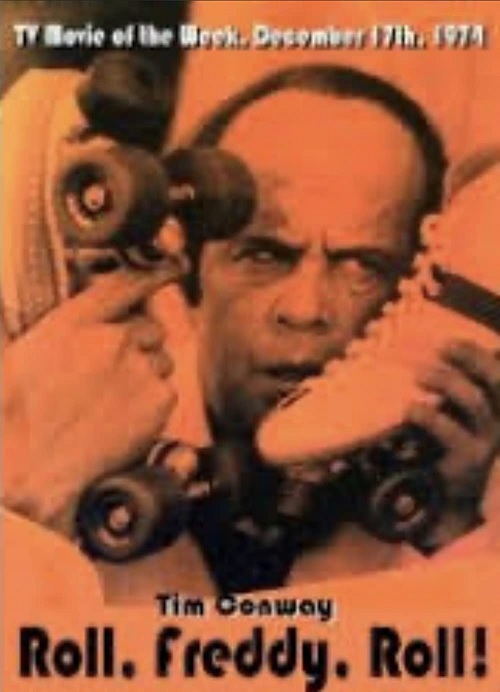
Welcome to Retro Television Reviews, a feature where we review some of our favorite and least favorite shows of the past! On Sundays, I will be reviewing the made-for-television movies that used to be a primetime mainstay. Today’s film is 1974’s Roll, Freddy, Roll! It can be viewed on YouTube!
Poor Freddy Menlo!
Played by Tim Conway, Freddy is a well-meaning guy who gets absolutely zero respect from the rest of the world. He works as a computer programmer but his boss (Henry Jones) doesn’t think much of him and an attempt to score a contract with the U.S. Navy falls through when Admiral Norton (Scott Brady) announces that he doesn’t think much of computers. Meanwhile, his ex-wife (Ruta Lee) has fallen in love with and married “Big Sid” Kane (Jan Murray). Big Sid is a millionaire who made his fortune selling used cars. Big Sid is seen every day on television. And, due to catching the biggest bluefish tuna on record while on his honeymoon, Big Sid Kane is now in the Guinness Book of the World Records.
A lesser engineer would crack under the pressure and go on a rampage through Los Angeles, Falling Down-style. But Freddy just wants to be a good father. He just wants his son, Tommy (Moosie Drier), to look up to him the way that he now looks up to Big Sid. Freddy takes Tommy to a roller skating rink and awkwardly skates around while Tommy talks about how much he enjoys going to Big Sid’s car lot. When it’s time to leave the rink, Freddy is informed that his shoes have been lost. An angry Freddy refuses to return the rink’s skates until he gets back his shoes. Freddy then takes Tommy down to Big Sid’s used car lot, where Big Sid has invited other people to come and try to set world records of their own. A local news reporter sees that Freddy is on roller skates and announces that Freddy is seeking to set the world record for the most time spent rolling around! Finally, Freddy has found a way to impress his son!
Excuse me while I catch my breath. That was a lot of plot to cram into just two paragraphs.
Roll, Freddy, Roll is not a particularly complicated movie. For the most part, it exists solely so that Tim Conway can do some mild physical comedy while trying to balance himself on roller skates. It only has a 73-minute run time and it basically feels like an extended episode of an old sitcom. With all that in mind, it still seems like it takes forever to actually get Freddy into those roller skates and once he does put them on, the movie keeps up coming with implausible excuses to keep him from taking them off until he finally decides to go for the world record. The story would have been stronger if Freddy has been the one to look at his feet and say, “I’m going to set a world record,” as opposed to him just being bullied into it by a news reporter. Tim Conway’s likable but there’s only so many times you can watch someone fall on roller skates before the joke starts to wear thin.
It would not surprise me if Roll, Freddy, Roll was meant to be a pilot for a sitcom. It’s easy to imagine Tim Conway trying to impress his son and win back his wife by doing something stupid on a weekly basis. As far as I know, Roll, Freddy, Roll did not lead to a television series and that’s probably a good thing. Freddy had a hard enough time just rolling around Los Angeles for two days! Who knows what would have happened if he had tried to do it on a weekly basis!?
For today’s horror on the lens, we have 1973’s The Night Strangler.
This is the sequel to The Night Stalker and it features journalist Carl Kolchak (Darren McGavin) in Seattle. (After all the stuff that happened during the previous movie, Kolchak was kicked out of Las Vegas.) When Kolchak investigates yet another series of murders, he discovers that paranormal murders don’t just occur in Las Vegas and aren’t just committed by vampires.
I actually prefer this movie to The Night Stalker. The Night Strangler features a truly creepy villain, as well as a trip down to an “underground city.” It’s full of ominous atmosphere and, as always, Darren McGavin is a lot of fun to watch in the role in Kolchak.
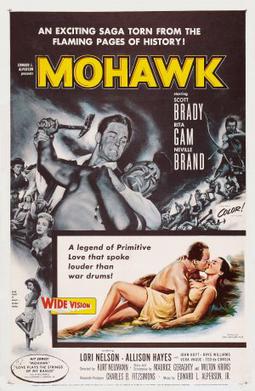
In the late 18th century, Boston socialite Cynthia Stanhope (Lori Nelson) travels to Fort Alden in upstate New York to visit her fiancé, a painter named Jonathan Adams (Scott Brady), who has been commissioned to paint the local scenery. As soon as Cynthia and her mother arrive, they are shocked to discover that not only Jonathan has been painting pictures of the members of the Native local tribes but that he is also now flirting with a barmaid named Greta. Greta is played by Allison Hayes so who can blame him? Cynthia wants to return to their normal upper class life in Boston but Adams has fallen for the untamed wilderness of the frontier.
When Onida (Rita Gam), the daughter of Iroquois chief Kowanen (Ted de Corsia) is captured during a raid on the fort, Adams is assigned to escort her back to her tribe. Leaving behind Cynthia and Greta, Adams falls in love with Onida over the course of the journey. When he meets the Iroquois, he earns the respect of her father and the entire tribe when he agrees to paint the chief’s portrait.
Meanwhile, a haughty settler named Butler (John Hoyt) is trying to play the army and the Iroquois against each other, feeding both of them false information in an attempt to spark a war. Butler is hoping that a war will lead to both sides wiping each other out so that he can once again have the valley to himself. When it turns out that his words might not be enough to spark a war, Butler resorts to murder. When Kowanen’s son is killed, the Iroquois prepare for war while Adams is framed for the crime and finds himself tied to a stake.
Mohawk is a standard B-western, with a plot that is largely lifted from John Ford’s Drums Along The Mohawk. Unfortunately, Adams is about as sympathetic hero as you would expect someone manipulating three different women to be and, when it comes to depicting the Iroquois, Mohawk resorts to too many clichés. This is one of those westerns where the Native characters speak broken English, even when they are just talking to each other.
Mohawk does have three things to recommend it. Number one, John Hoyt was a master at playing haughty villains and Butler is easy to root against. You will look forward to seeing him get his comeuppance. Number two, Allison Hayes was a force of nature and that’s true even in this film, where she’s not given nearly enough to do. Number three, one of Iroquois braves is played by Neville Brand. A highly decorated World War II veteran, Brand built a long career playing tough guys. In Mohawk, it only takes one look at Neville Brand to know that this isn’t someone you want to mess with. Anyone watching would want to stay on Neville Brand’s good side.
Otherwise, Mohawk is forgettable. Two years after it was released, Mohawk’s director Kurt Neumann, would be responsible for the much more memorable The Fly.
The 1948 film noir, He Walked By Night, opens with a policeman named Rawlins on his way home from work. As he drives down the street, he sees a man walking alone at night. Because there’s been a number of recent burglaries in the area and the man’s a stranger, Rawlins decides to pull over and ask the man for his ID.
What Rawlins doesn’t realize is that the man is Roy Morgan (Richard Basehart) and yes, Roy is indeed the burglar. Roy is something of a mystery man. (Needless to say, Morgan is not his real last name.) In the pre-Internet age, he has very carefully and very meticulously avoided leaving any sort of paper trail. He lives, by himself, in a small apartment, his only companion being an adorable dog and the police scanner that Roy uses to always stay a few steps ahead of the cops. When Rawlins pulls him over, it’s the closest that Roy has ever come to being caught. Roy get out of the situation by shooting the cop and then running into the night.
The rest of the film deals with the efforts of two police detectives (played by Scott Brady and James Cardwell) and their captain (Roy Roberts) to discover who shot Rawlins and bring him to justice. It’s not easy because not only has Roy done a good job of obscuring his very existence but his police scanner always gives him advanced warning whenever they cops start to close in on him. The only lead that the cops have is a salesman named Paul Reeves (Whit Bissell). Reeves has been buying and reselling the electronic equipment that Roy’s been stealing from houses all over Hollywood. When Reeves tells the cops that he had no idea the stuff was stolen, the cops all share a weary roll of the eye. No matter whether Reeves is telling the truth or not, he’s now the key to tracking down a cop killer….
He Walked By Night is a police procedural and, while the plot may sound familiar, the film is elevated by the atmospheric direction of Alfred Werker and an uncredited Anthony Mann. As visualized by Werker and Mann, the streets of Los Angeles have never been darker and more menacing. Roy emerges from the fog to commit his crimes and then disappears back into the mist, like some sort of paranormal spirit. The film reaches its high point when the police chase their quarry through the sewers of Los Angeles, a scene that will remind many of the famous finale of The Third Man.
Though the film offers up clues to Roy Morgan’s motivation, he remains an enigma for much of the film. Richard Basehart plays him as a paranoid man who only seems to be confident and happy when he’s stealing or when he’s outsmarting the police. In many ways, regardless of whether he escapes the police or not, Roy’s destined to spend his life trapped in a prison of his own design. Even hiding out on the fringes of society, Roy knows that his time is limited. There’s only so many times one person can escape their fate. Until he’s either captured or killed, Roy is destined to always walk the night, alone.
In the 1949 film, Undertow, Scott Brady plays Tony Reagan. Tony used to be a member of the Chicago mob but that’s all in the past now. He served his country in World War II and now, as he tells his old racket friend, Danny (John Russell), all Tony wants to do is settle down and run a hunting lodge in Reno.
However, before Tony can forever abandon Chicago for Nevada, he has to make peace with his future in-laws. He’s engaged to marry Sally Lee (Dorothy Hart). In fact, he’s so in love with her that not even meeting a single teacher named Ann McKnight (Peggy Dow) can distract Tony from his plans. The only problem is that Sally is the niece of a Chicago gangster named Big Jim Lee and, in the past, Big Jim and Tony haven’t always been the best of friends. In fact, the Chicago police are constantly harassing Tony because they’re convinced that he wants to start a gang war with Big Jim. Instead, Tony just wants to make peace with Big Jim before the wedding.
Tony goes to visit Big Jim and …. well, you can guess what’s going to happen, can’t you? If you’ve seen enough film noirs, you know that no one is every totally out of the rackets. No one believes an ex-mobster when they say that they’re no longer interested in making trouble. Even worse, any murder committed with automatically be blamed on anyone who says that they’re no longer a member of the rackets. That’s what happens to Tony. Not only does he discover that Big Jim has been shot dead but everyone thinks that he’s the one who did it. Fleeing through the shadowy streets of Chicago, Tony finds himself not only being pursued by the police but also by the murderers. Everyone wants to either capture or kill Tony.
In fact, the only person who seems to be on Tony’s side is Ann McKnight. Ann lets Tony hide out at her apartment while he tries to figure out what’s going on. Of course, Ann does have a nosy landlady who has no hesitation about letting herself into the apartment whenever she feels like it….
The plot of Undertow isn’t going to win any points for originality. It’s not going to take you long to figure out who is setting Tony up, if just because there really aren’t enough characters in the film for there to be much suspense about who is betraying who. But no matter! The film is still an atmospherically shot and briskly-paced thriller. Undertow was directed by William Castle, who is probably best known for directing campy B-movies like The Tingler and Strait-Jacket. There’s nothing campy about Castle’s direction of Undertow. The majority of the film was shot on location and Castle makes great use of Chicago. When Tony tries to lose the cops that are tailing him, it helps that he’s not running across a soundstage but instead down real city streets, ones that feels alive with tension and danger. There’s also a great chase that takes place in a long and dark corridor in an underground garage.
Scott Brady (who was the brother of tough-guy actor Lawrence Tierney) gives a sympathetic performance as Tony and he and Peggy Dow have a really likable chemistry in their scenes together. Dorothy Hart is also well-cast as the film’s femme fatale, while Bruce Bennett has a few good scenes as a detective who is an old friend of Tony’s. Fans of “classic” matinée idols will want to keep an eye out for Rock Hudson, making a brief appearance in his second film and credited as “Roc” Hudson.
For today’s horror on the lens, we have 1973’s The Night Strangler.
This is the sequel to The Night Stalker and it features journalist Carl Kolchak (Darren McGavin) in Seattle. (After all the stuff that happened during the previous movie, Kolchak was kicked out of Las Vegas.) When Kolchak investigates yet another series of murders, he discovers that paranormal murders don’t just occur in Las Vegas and aren’t just committed by vampires.
I actually prefer this movie to The Night Stalker. The Night Strangler features a truly creepy villain, as well as a trip down to an “underground city.” It’s full of ominous atmosphere and, as always, Darren McGavin is a lot of fun to watch in the role in Kolchak.



 Through the Shattered Lens