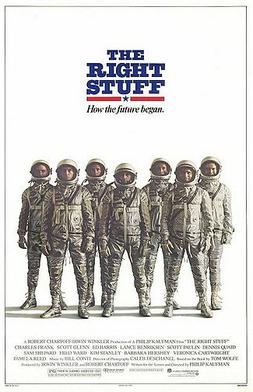
Lisa Marie Reviews An Oscar Nominee: The Right Stuff (dir by Philip Kaufman)


There’s a brilliant scene that occurs towards the end of 1983’s The Right Stuff.

It takes place in 1963.  The original Mercury astronauts, who have become a symbol of American ingenuity and optimism, are being cheered at a rally in Houston.  Vice President Lyndon Johnson (Donald Moffat) stands on a stage and brags about having brought the astronauts to his supporters.  One-by-one, the astronauts and their wives wave to the cheering crowd.  They’re all there: John Glenn (Ed Harris), Gus Grissom (Fred Ward), Alan Shephard (Scott Glenn), Wally Schirra (Lance Henrisken), Deke Slayton (Scott Paulin), Scott Carpenter (Charles Frank), and the always-smiling Gordon Cooper (Dennis Quaid).  The astronauts all look good and they know how to play to the crowd.  They were chosen to be and sold as heroes and all of them have delivered.

While the astronauts are celebrated, Chuck Yeager (Sam Shepard) is at Edwards Air Force Base.  Yeager is the pilot who broke the sound barrier and proved that the mythical “demon in the sky,” which was whispered about by pilots as a warning about taking unnecessary risks, was not waiting to destroy every pilot who tried to go too fast or too high.  Yeager is considered by many, including Gordon Cooper, to be the best pilot in America.  But, because Yeager didn’t have the right image and he had an independent streak, he was not ever considered to become a part of America’s young space program.  Yeager, who usually holds his emotions in check, gets in a jet and flies it straight up into the sky, taking the jet to the edge of space.  For a few briefs seconds, the blue sky becomes transparent and we can see the stars and the darkness behind the Earth’s atmosphere.  At that very moment, Yeager is at the barrier between reality and imagination, the past and the future, the planet and the universe.  And watching the film, the viewer is tempted to think that Yeager might actually make it into space finally.  It doesn’t happen, of course.  Yeager pushes the jet too far.  He manages to eject before his plane crashes.  He walks away from the cash with the stubborn strut of a western hero.  His expression remains stoic but we know he’s proven something to himself.  At that moment, the Mercury Astronauts might be the face of America but Yeager is the soul.  Both the astronauts and Yeager play an important role in taking America into space.  While the astronauts have learned how to take care of each other, even the face of government bureaucracy and a media that, initially, was eager to mock them and the idea of a man ever escaping the Earth’s atmosphere,  Chuck Yeager reminds us that America’s greatest strength has always been its independence.

Philip Kaufman’s film about the early days of the space program is full of moments like that.  The Right Stuff is a big film.  It’s a long film.  It’s a chaotic film, one that frequently switches tone from being a modern western to a media satire to reverent recreation of history.  Moments of high drama are mixed with often broad humor.  Much like Tom Wolfe’s book, on which Kaufman’s film is based, the sprawling story is often critical of the government and the press but it celebrates the people who set speed records and who first went into space.  The film opens with Yeager, proving that a man can break the sound barrier.  It goes on to the early days of NASA, ending with the final member of the Mercury Seven going into space.  In between, the film offers a portrait of America on the verge of the space age.  We watch as John Glenn goes from being a clean-cut and eager to please to standing up to both the press and LBJ.  Even later, Glenn sees fireflies in space while an aborigines in Australia performs a ceremony for his safety.  We watch as Gus Grissom barely survives a serious accident and is only rescued from drowning after this capsule has been secured.  The astronauts go from being ridiculed to celebrated and eventually respected, even by Chuck Yeager.

It’s a big film with a huge cast.  Along with Sam Shepherd and the actors who play the Mercury Seven, Barbara Hershey, Pamela Reed, Jeff Goldblum, Harry Shearer, Royal Dano, Kim Stanley, Scott Wilson, and William Russ show up in roles both small and large.  It can sometimes be a bit of an overwhelming film but it’s one that leaves you feeling proud of the pioneering pilots and the brave astronauts and it leaves you thinking about the wonder of the universe that surrounds our Earth.  It’s a strong tribute to the American spirit, the so-called right stuff of the title.

The Right Stuff was nominated for Best Picture but, in the end, it lost to a far more lowkey film, 1983’s Terms of Endearment.  Sam Shepard was nominated for Best Supporting Actor but lost to Jack Nicholson.  Nicolson played an astronaut.
Film Review: Tucker: The Man and His Dream (by Francis Ford Coppola)


First released in 1988, Tucker: The Man and His Dream is a biopic about Preston Tucker.

Tucker was an engineer in Detroit who went from designing vehicles for the Army during World War II to trying to launch his own car company.  His ideas for an automobile don’t sound particularly radical today.  He wanted every car to have seat belts.  He wanted a windshield that popped out as a safety precaution.  He want brake pads and he also wanted a car that looked sleek and aerodynamic, as opposed to the old boxy cars that were being pushed out be Detroit.  He wanted a car that got good mileage and he wanted one that could be taken just about anywhere.  Unfortunately, Tucker’s dreams were cut short when he was indicted for stock fraud, a prosecution that most people agree was a frame-up on behalf of the Big Three auto makers.  Tucker was eventually acquitted but his car company went out of business.  Of the 50 cars that Tucker did produce, 48 of them were still on the road and being driven forty years later.

The film stars Jeff Bridges as Preston Tucker, Joan Allen as his wife, Christian Slater and Corin Nemec as two of his sons, Lloyd Bridges as the senator who tried to take Tucker down, Martin Landau as Tucker’s business partner, and Dean Stockwell as Howard Hughes, who shows up for a few minutes to encourage Tucker to follow his dreams regardless of how much the government tries to stop him.  One gets the feeling that the film was a personal one for director Francis Ford Coppola, a filmmaker who has pretty much spent his entire career fighting with studios while trying to bring his vision to the screen.  Tucker fought for seat belts.  Coppola fought for a mix of color and black-and-white in Rumble Fish.  Tucker stood up for his business partner.  Francis Ford Coppola stood up for Al Pacino when no one else could envision him as Michael Corleone.  As is the case with many of Coppola’s films, Tucker: The Man And His Dream is a film that Coppola spent years trying to get made.  It was the film that Coppola originally intended to be the follow-up to The Godfather, with Marlon Brando projected for the lead role of Tucker.  After watching the Tucker, it’s hard not to feel that it worked out for the best that Coppola was not able to make the film in 1973.  It’s impossible to imagine anyone other than Jeff Bridges in the role of Preston Tucker.

“Chase that tiger….chase that tiger….chase that tiger….” It’s a song that Tucker sings constantly throughout the film as the camera spins around him and how you react to Tucker: The Man And His Dream will largely depend on how tolerant you are of Coppola’s stylistic flourishes.  Coppola directs the film as a combination of Disney fairy tale and film noir.  The opening of the film, with Tucker running around in almost a manic state and excitedly telling everyone about his plans, is presented with vibrant colors and frequent smiles and an almost overwhelming air of cheerful optimism.  As the film progresses and Tucker finds himself being targeted by both the government and the other auto companies, the film gets darker and the viewer starts to notice more and more shadows in the background.  The moments of humor become less and less and there’s a heart-breaking moment where Martin Landau, in one of his best performances, reveals just how far the government will go to take down Tucker’s company.  But, in the end, Tucker refuses to surrender and Jeff Bridges’s charming smile continues to fill the viewer with hope.  The film becomes about more than just cars.  It’s a film that celebrates all of the innovators who are willing to defy the establishment.

There’s a tendency to dismiss the majority of Coppola’s post-Apocalypse Now films.  However, Tucker: The Man And His Dream is a later Coppola film that deserves to be remembered.

Embracing the Melodrama Part II #40: One Is A Lonely Number (dir by Mel Stuart)


one_is_a_lonely_number_ver2

You’ve probably never heard of the 1972 film One Is A Lonely Number.  I certainly hadn’t until, a few weeks ago, I happened to come across it on TCM.  Like a lot of films that have apparently been forgotten by history, One Is A Lonely Number is one that deserves to be remembered.

One Is A Lonely Number opens with the end of a marriage.  James Brower (Paul Jenkins), an arrogant college professor, coldly packs his collection of vinyl records into a box and tells his wife, Amy (Trish Van Devere), that he’s filing for divorce and that he’s leaving her.  She asks him why.  He coolly mentions something about her throwing out a prized copy of Paradise Lost and then leaves the apartment.

Shocked, Amy goes to the college and asks her husband’s students if they’ve seen him.  They tell her that James canceled his final exam and has since disappeared.  At first, Amy insists that James is going to come back and denies that they’re getting a divorce.  When she finally does accept that her marriage is over, Amy is forced to be independent for the first time.

What she quickly discovers is that the world is full of people who are looking to take advantage of both her vulnerability and her naiveté.  When she goes to an employment agency, she explains that she has a degree in Art History and that she minored in Philosophy.  Frighteningly (especially in the eyes of this particular holder of a degree in Art History), all this gets Amy is a job as a lifeguard at the local pool.  When she finally find herself attracted to another man, she doesn’t discover that he’s married until the morning after.  And when she finally discovers why her husband actually left her, she discovers that he was even more of a stranger to her than she realized.

Fortunately, there are a few good spots in Amy’s life.  Her best friends Madge (Jane Elliott) and Gert (Janet Leigh) provide support.  (“Men are shit,” Gert explains at one point.)  And she strikes up a poignant friendship with a widowed grocer (Melvyn Douglas).

There are so many scenes in One Is A Lonely Number that ring true, even when viewed today.  Amy finally realizes that her marriage is over while trying on clothes and ends up sobbing by herself.  Amy, Gert, and Madge get drunk and talk about their exes, laughing away their shared pain.  Amy discovers that the man from the employment agency (played, as a disturbingly plausible creep, by Jonathan Goldsmith who is best known for being the Most Interesting Man In The World for Dos Equis) expects her to “repay” him for his help in getting her a demeaning job as a lifeguard.  Amy panics when she can’t find what’s happened to that kindly grocer.

One Is A Lonely Number moves at its own deliberate pace but it’s still one that you should watch and stick with until the end.  It’s an intelligent and well-acted movie and the film’s poignant final scene will fill you with hope.  Watch it the next time that it shows up on TCM.

Back to School #13: American Graffiti (dir by George Lucas)


Well, this is certainly intimidating.  I know I’ve said this many time before but it deserves to be repeated: it’s often a hundred times more difficult to review a great film than it is to review a merely mediocre one.  When a film fails, it’s usually easy to say why.  The acting was bad.  The directing was uninspired.  The plot didn’t make any sense.  Or maybe the film has been so overpraised that you, as a reviewer, are almost obligated to be tougher on it than you would be with any other film.  However, it’s never as easy to put into words just what exactlyit is that makes a movie great.

Take the 1973 Best Picture nominee American Graffiti for instance.  I could tell you that this is a very well-acted film and that it features an ensemble of very likable performers, many of whom subsequently went on to become stars and celebrated character actors.  Then again, you can say the same thing about countless other films.

american-graffiti-1973-03-g

I could say that director George Lucas does such a good job putting this film together that it’s hard to believe that he’s the same man who would later be responsible for all three of the Star Wars prequels.  Then again, I could also say the same thing about how odd it is that the same man who directed the entertaining Final Destination 5 was also responsible for the far less enthralling Into The Storm.

i007737

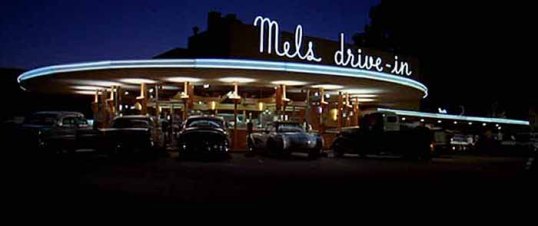
I could tell you that the film serves as a valuable time capsule in that not only does it feature a loving recreation of small town America in the early 60s but that it’s also a chance to see what Richard Dreyfuss, Ron Howard, and Charles Martin Smith all looked like when they still had hair.  But then again, I also praised The Young Graduates for being a time capsule as well.

MelsGraffiti

Let’s face it — it’s difficult to define the intangible qualities that make a film great.  Often times, it’s a case of simply knowing it when you see it.  I’ve seen American Graffiti a few times.  The last time I saw it was at a special Sunday showing at the Alamo Drafthouse.  And, on that early Sunday afternoon, the theater was packed with people who had paid for the chance to see the 40 year-old film on the big screen.  I’m 28 years old and it’s significant that, while the majority of the audience was older than me, there were quite a few people who were younger.  American Graffiti is one of those films that obviously spoke to audiences when it was first released and continues to speak to audiences today.

As I mentioned in my review of Rebel Without A Cause, films about teens tend to age quickly and, often times, one generation’s masterpiece will turn out to be a later generation’s joke.  When a film like Rebel or American Graffiti survives the test of time, it’s because the film has managed to capture a universal truth about what it means to be young and to have your entire life ahead of you.

American Graffiti takes place over the course of one long night in Modesto, California in 1962.  The film follows several different characters, the majority of whom have just graduated from high school.  What these characters all have in common is that one phase of their life has ended and a new one is about to begin.  Over the course of that one night, all of them are forced to say goodbye to their past identities and, in some instances, are forced to face their future.

Curt and the Pharoahs

For instance, there’s Curt (an amazingly young Richard Dreyfuss), a neurotic intellectual who spends the night trying to decide whether or not he actually wants to leave for college in the morning.  Complicating Curt’s decision is a mysterious blonde who mouths “I love you” at him before driving away.  While searching for her, Curt finds himself unwillingly recruited into the Pharoahs, a somewhat ludicrous small town gang that’s led by Joe (played, in hilariously clueless fashion, by Bo Hopkins.)  Curt, incidentally, is my favorite character in the film.  He’s just adorable, which admittedly is not a reaction that one often has to Richard Dreyfuss.

(Curt is also featured in one of my favorite scenes, in which he smokes a cigarette with a lecherous teacher named Mr. Wolf.)

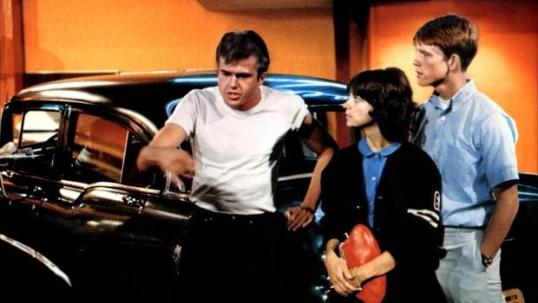
Cindy Williams, Ron Howard, and Charles Martin Smith

Curt’s sister (Cindy Williams) is dating Steve Bolander (Ron Howard).  Steve is the former class president and, unlike Curt, he’s very excited about leaving home.  Ron Howard gives such a likable performance that it actually takes a few viewing to realize just how big of a jerk Steve really is.

Terry and Debbie


And then there Terry (Charles Martin Smith) who wears big glasses and has bad skin.  Terry gets to spend the night driving around in Steve’s car and manages to pick up a girl named Debbie (Candy Clark).  For Terry, this is his night to actually be somebody and what makes it all the more poignant is just how obvious it is that Terry will probably never get another chance.  Though he may not realize it, those of us watching understand that this is literally going to the be the best night of Terry’s life.

(Incidentally, much like Ron Howard, Charles Martin Smith would go on to become a film director and gave the world the amazingly sweet Dolphin Tale.)

John Milner

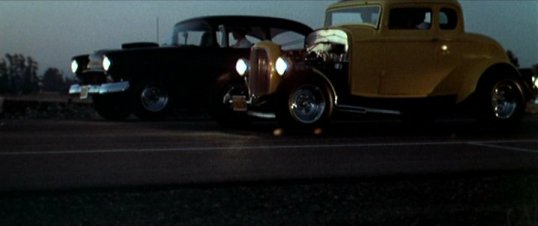
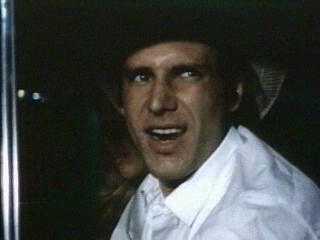
And finally, there’s John Milner (Paul Le Mat).  John is a little older than the other main characters.  He spends most of his time in his car, driving around and getting challenged to race.  He’s the epitome of late 50s/early 60s cool, with an attitude and a look that he obviously borrowed from James Dean and Marlon Brando.  Over the course of the night, he is forced to deal with a bratty 13 year-old stowaway (MacKenzie Phillips) and a mysterious challenger named Bob Falfa (played by a youngish Harrison Ford, who wears a cowboy hat and speaks with a country twang).

Harrison Ford in American Graffiti

The film follows these characters through the night and then, at the end of it, we get the famous epilogue where we discover that all of the male characters have pretty much ended up exactly how we thought they would.  In some cases, that’s a good thing.  And in other cases, it’s not.  It’s a good ending that’s kept from being great by the fact that none of the film’s female characters rate so much as even a mention.

So, what else can be said about American Graffiti?

It’s a great film.

Isn’t that enough?

American Graffiti