The film is 1968’s Danger Diabolik! The music is courtesy of Morricone. The direction is courtesy of Mario Bava. Does the scene make any sense? Does it have to? This film is all about pure style and it’s hard to think of any place as stylish (by 1968 standards) as Valmont’s Nightclub.
Today, as we continue to honor the memory of Ennio Morricone and celebrate the birthday of Mario Bava, this just seems like the perfect scene to share.
Stanley Kubrick would have been 92 years old today!
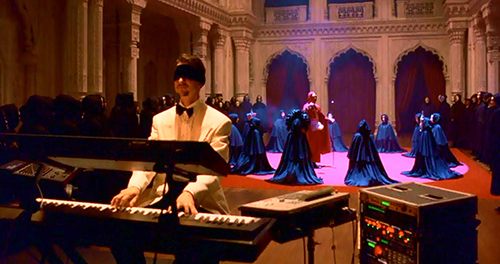
In honor of this visionary and his career, here is a wonderfully creepy scene from his final film, 1999’s Eyes Wide Shut. Like so many of Kubrick’s films, it took a while for people to really appreciate Eyes Wide Shut. It’s an odd and, at times, frustrating film but still a film touched by genius.
In this scene, Tom Cruise discovers that it’s not quite as easy to crash a super secret party as he thought it would be.
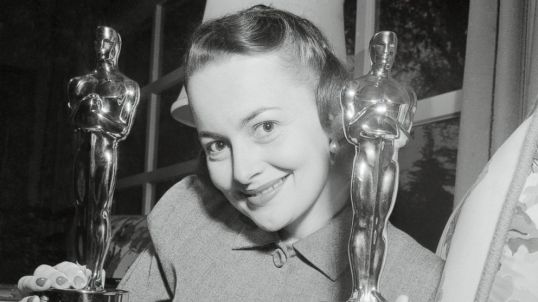
I woke up today to the news that Olivia De Havilland, the last of the great Golden Age stars, had died. She was 104 years old and she spent all of those years as the epitome of a type of grace and class that we really don’t see much nowadays. Her famous feud with her sister Joan Fontaine aside, it’s impossible to imagine an actress like Olivia de Havilland getting caught up in a silly twitter fight.
Here she is with one of her most frequent co-stars, Errol Flynn. This short but sweet scene is from The Adventures of Robin Hood.
Mel Brooks. What can you say Mel Brooks? Not only did he help to redefine American comedy but he was also responsible for bringing David Lynch to Hollywood. Brooks was the one who hired Lynch to direct The Elephant Man. It can probably be argued that, if not for Brooks, Lynch’s feature film career would have begun and ended with Eraserhead. Brooks not only hired Lynch but also protected him for studio interference. When the execs tried to make Lynch remove two surrealistic sequences from The Elephant Man, Brooks stood up to them. When they requested a more conventional biopic, Brooks defended Lynch’s vision and the result was one of the best films ever made.
Of course, Brooks isn’t listed in the credits of The Elephant Man. Though he produced the film, he went uncredited because he didn’t want people to assume that the movie was a comedy. By doing so, Brooks missed out on an Oscar nomination but he also ensured that the film was taken seriously. It’s hard not to respect someone who was willing to go uncredited to help make the film a success.
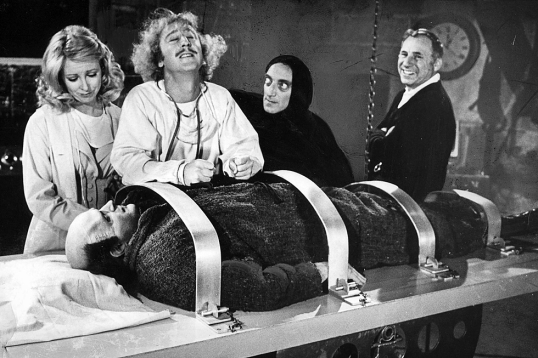
Though Brooks, as a producers, was responsible for a number of serious films, there’s a reason why Brooks is associated with comedy. He’s a very funny man and he directed some very funny films. In honor of Mel Brooks, here’s a scene that I love from 1974’s Young Frankenstein.
Today is Daria Nicolodi’s birthday so what better time than now to share a scene that I love from Dario Argento’s 1975 masterpiece, Deep Red?
Now, this might seem like a strange scene to love but you have to understand it in context of the overall film. (And yes, the scene is in Italian but surely you can figure out that it’s a scene of two people flirting.) Deep Red is often thought as being merely a superior giallo film but it’s also, in its way, a rather sweet love story. David Hemmings and Daria Nicolodi may investigate a murder but they also fall in love and the two of them have a very sweet chemistry, which is fully displayed in this scene and which elevates the entire film. Deep Red is a giallo where you care about the characters as much as you care about the murders.
While making this film, Daria Nicolodi and Dario Argento also fell in love and they went on to have a rather tumultuous relationship. Personally, I think that Argento’s most recent films are underrated but it’s still hard to deny that the ones that he made with Nicolodi have a heart to them that is missing from some of his later work.
So, in honor of Daria Nicolodi and her important role in the history of Italian horror, here she is with David Hemmings in Deep Red!
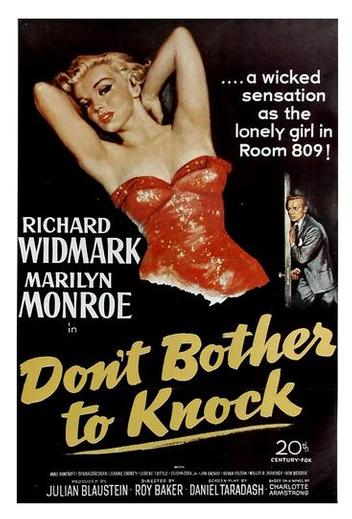
Marilyn Monroe would have been 94 years old today.
Unfortunately, Marilyn died when she was just 36 years old and also when she was only starting to get a chance to reveal what she was truly capable of as an actress. It’s a shame, because I would have liked to have seen what type of roles she would have played in her 40s and her 50s. Would she have eventually become a respected, award-winning character actor or would she have ended up like Bette Davis, doing cameos in films that weren’t particularly worthy of her talents? Who knows but it’s a shame that the world will never get to find out.
For her birthday, I’m going to share a scene from one of her earlier films, 1952’s Don’t Bother To Knock. In this film, Marilyn plays an unstable woman who is staying at a hotel. Her cousin (played by Elisha Cook, Jr.) gets her job as a babysitter but is shocked to find out that Marilyn has been trying on her employer’s clothes. After getting admonished by her cousin and pretending to be sorry, she proceeds to then summon another gust (played by Richard Widmark) over to her room.
It’s a simple scene but it’s wonderfully played by Monroe. This was one of her first truly dramatic roles and she does a good job with it.
From Don’t Bother To Knock, here is a scene that I love:
Since today is the 113th anniversary of the birth of John Wayne, I decided to watch the 1962 classic, The Man Who Shot Liberty Valance! And then I decided to share a scene that I love from the film.
The famous steak scene features three of the greatest screen icons of Hollywood’s golden age: James Stewart, John Wayne, and Lee Marvin. Lee Marvin is the bully who is terrorizing the entire town. James Stewart is the idealist who thinks that the law, and not violence, is the answer. And John Wayne is …. well, he’s John Wayne. He’s the only man in town who can stand up to Lee Marvin but, at the same time, he’s also aware that his time is coming to a close. In the scene below, all three of the characters display their different approaches to life and a disagreement with steak nearly leads to violence.
This scene — and really, the entire film — features these three actors at their best. John Wayne is an actor who is often described as having “just played himself” but that’s really not quite fair. While Wayne’s outsized persona definitely does influence how the audience reacts to any character that he plays, he was a better actor than he’s often given credit for being. That’s especially evident in The Man Who Shot Liberty Valance, in which Wayne plays a confident man’s man who knows that fate is closing in on him. The coming of civilization (represented by James Stewart) will be great for the town of Shinbone but it will also leave men like Wayne’s Ton Doniphon with nowhere to go. The coming of civilization means that the heroes of the past are destined to become obsolete.
Enjoy this scene from The Man Who Shot Liberty Valance:
Harvey Keitel is one of those actors who has given so many great performances that it’s difficult to pick which one is his best. He’s almost always great, even when the film sometimes isn’t. That said, I’ll always have a lot of affection for the character of Winston Wolfe, the cleaner that Keitel played in Quentin Tarantino’s Pulp Fiction.
Keitel doesn’t show up until the final third of Pulp Fiction but once he does, he pretty much takes over the entire film. For me, though, my favorite Winston Wolfe moment comes at the end of his story, when he says goodbye to John Travolta and Samuel L. Jackson and essentially reveals himself to be kind of an old-fashioned, almost dorky (if impeccably dressed) guy.
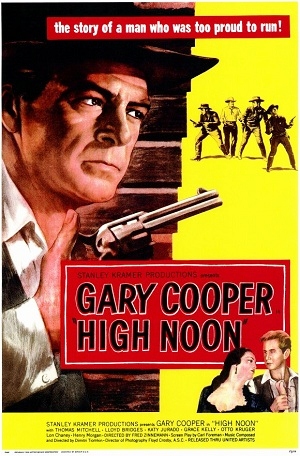
119 years ago today, Gary Cooper was born in Helena, Montana.
Cooper was an actor who, for many viewers, represented the American ideal. He played characters who were strong and modest and who refused to compromise their principles. Though Gary Cooper appeared in many films over the course of his career, he is probably destined to be forever associated with High Noon. In this classic western, Cooper plays Will Kane, the marshal who finds himself abandoned by almost everyone when a group of killers come to town looking to kill him. The film is often seen as being a commentary on the 1950s Red Scare. Cooper, who was a committed anti-Communist and about as conservative as anyone in Hollywood, stood up for the film’s screenwriter, the blacklisted Carl Foreman and threatened to walk off the picture when it appeared that Foreman’s writing credit might be removed. That was what a huge part of Cooper’s appeal. He did the right thing, even if it meant standing up for someone with whom he didn’t agree. There aren’t many Gary Coopers left today, are there?
Below, we have the final scene of High Noon, in which the cowardly townspeople finally come to support Marshal Kane. Kane, disgusted by their actions, can only throw away his star and leave town. Even without dialogue, Cooper lets you know exactly what is going through Kane’s mind. It’s a great scene from a great film featuring a great actor.
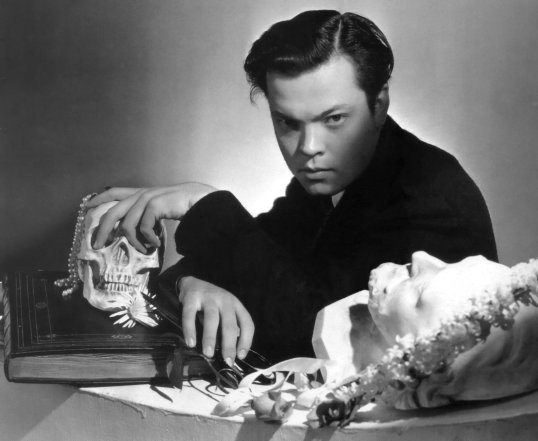
Today is the 105th anniversary of the birth of the great Orson Welles. As those of you who have been reading us for a while know, Orson Welles is a bit of patron saint around here. With this year being the 10th anniversary of the creation of Through the Shattered Lens (and wow, what a year to celebrate that moment, right?), there was no way that we couldn’t pay tribute to Orson Welles on his birthday.
The scene below comes form the 1965 film, Chimes at Midnight. Based on several of Shakespeare’s history plays (Henry IV, Part 1 and Henry IV, Part 2, and also Richard II, Henry V, and The Merry Wives of Windsor), Chimes at Midnight was one of Welles’s dream projects. Though it was initially dismissed by critics, it has since been rediscovered and is now regularly cited as one of the greatest Shakespearean films of all time.
Welles not only directed this film but he also played the key role of Falstaff, the knight who loves good food, good drink, and low company. Falstaff acts as a mentor to Price Hal and, when Hal is finally ready to make his move and assume the throne of England as Henry V, Falstaff supports him. Falstaff believes that Hal will remember his friends once he is king. Sadly, Falstaff turns out to have been far too trusting.
In the poignant scene below, Falstaff greets the newly crowned King Henry V (played by Keith Baxter), just to be coldly rebuffed by his former friend. Now that Henry is king, he no longer has time for the loyal Falstaff. In Shakespeare’s time, this scene was probably meant to reflect that, now that he was king, Henry V was prepared to set aside childish games and devote himself to ruling England. Seen, today, it just comes across as being a betrayal of a good man who deserved better.
It’s a heart-breaking scene. Critic Danny Peary has speculated that, in this scene, Prince Hal/Henry V is a stand-in for every director who Welles mentored in Hollywood who later refused to help Welles when the latter was struggling to get his projects off the ground. Peary may be right because Welles was betrayed by quite a few people during his lifetime. As Welles himself put it, “They’ll love me when I’m dead,” and indeed, it wasn’t until after Welles was dead that his post-Citizen Kane work was truly appreciated.


 Through the Shattered Lens