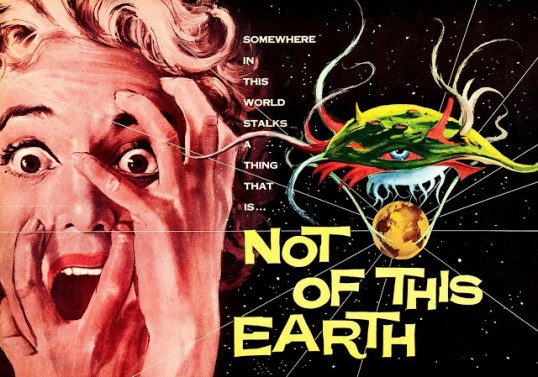
Today’s horror on the lens is the 1957 Roger Corman-directed, sci-fi “epic,” Not of this Earth.
Paul Johnson (Paul Birch) may seems like a strange character, with his stilted way of speaking and his sunglasses and his overdramatic reaction to any and all loud noises. Paul could us be an eccentric. Or, he could be …. NOT OF THIS EARTH! Actually, his habit of draining people of their blood and sending weird, umbrella-like creatures out to attack his enemies would seem to suggest that the latter is probably true.
Listen, it’s not easy being a blood-sucking alien. I mean, sure, there’s always seems to be people stupid enough to show up at your mansion so that you can drain their bodies. Paul is lucky that he doesn’t exactly seem to be surrounded by brain surgeons. But sometimes, things happen. For instance, someone might show up from your home planet and demand an immediate transfusion! What is an alien to do?
Watch this low-budget but undeniably entertaining film to find out! And be sure to especially keep an eye out for the great Dick Miller, who reportedly improvised his role as a vacuum cleaner salesman. (Before going into acting, Miller actually did sell vacuum cleaners door-to-door.)
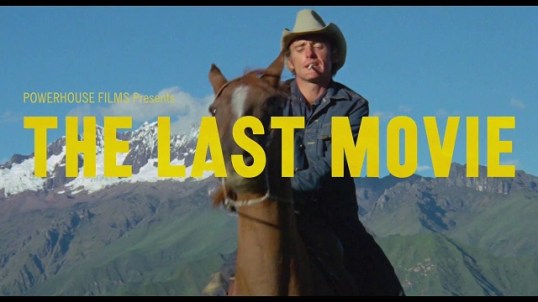
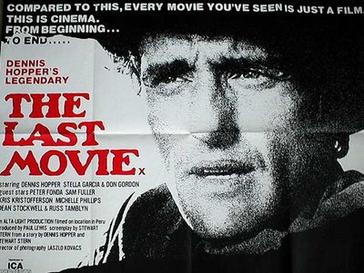
The story behind the making of 1971’s The Last Movie is legendary. It’s also a bit of a cautionary tale.
In 1969, Hollywood was stunned by the box office success of an independent, low-budget counter-culture film called Easy Rider. Easy Rider not only made a star out of Jack Nicholson but it was also the film that finally convinced the studios that the way to be relevant was not to continue to crank out big budget musical extravaganzas like Doctor Doolittle and Hello, Dolly! Instead, it was decided that the smart thing to do would be to hire young (or, at the very least, youngish) directors and basically just let them shoot whatever they wanted. The resulting films might not make much sense to the executives but, presumably, the kids would dig them and as long as the kids were paying money to see them, everyone would continue to get rich. Because Dennis Hopper had directed Easy Rider, he suddenly found himself very much in demand as a director.
Of course, almost everyone in Hollywood knew Dennis Hopper. Long before he became an icon of the counter-culture, Dennis Hopper had been a part of the studio system. John Wayne even referred to Hopper as being his “favorite communist.” Everyone knew that Dennis could be a bit arrogant. Everyone knew that Dennis was very much into drugs and that, as a result, he had a reputation for being a bit unstable. Everyone knew that Dennis Hopper deliberately cultivated an image of being a bit of a wild man and a revolutionary artist. But Dennis Hopper had just directed Easy Rider and Universal was willing to give Hopper some money to go down to Peru and direct his follow-up.
The Last Movie was a film that Hopper had been planning on making for a while. The film’s original script told the story of an aging and broken-down stuntman named Kansas who retires to Mexico and searches for a gold mine with a friend of his. Hopper first tried to get the film going in 1965, with Montgomery Clift in the lead role. After Clift died, Hopper tried to interest John Wayne in the starring role but, though Wayne enjoyed having Hopper in his films so that he could threaten to shoot him whenever Abbie Hoffman said something shocking, he had no interest in being directed by him. When Universal finally agreed to put up the money for the film, Hopper offered the lead role to Jack Nicholson. Nicholson turned it down and told Hopper that it was obvious that Dennis wanted to play the role himself. Dennis decided that he agreed with Nicholson and he cast himself as Kansas. Dennis also made the fateful decision to not only change the story’s setting to Peru but to also film on location.
Dennis and a group of friends flew down to Peru, which, at that time, was the cocaine capitol of the world. Drug use was rampant on the set, with Dennis reportedly being one of the main offenders. The cast and crew filmed during the day and partied at night and no one was particularly sure what the film was supposed to be about. Amazingly, Hopper finished filming on schedule and within budget but, much as he did with Easy Rider, he also overfilmed and ended up with 40 hours of footage. Not wanting to be bothered by the studios, Hopper edited the footage in his compound in Taos, New Mexico. Working slowly and continuing to consume a large amount of drugs and alcohol, Hopper still managed to put together a film that had a straightforward storyline. When Hopper showed his initial cut to filmmaker Alejandro Jodorowsky, the director of El Topo accused Hopper of being too conventional in his approach, which led to Hopper chopping up the film and reassembling it. Finally, after spending over a year working with the footage, Hopper turned in his final edit.
Universal had no idea what to make of the film that Hopper delivered to them. Still, they released it with the hope that the same crowd that loved Easy Rider would embrace The Last Movie. While the film did win an award at the Venice Film Festival, critics hated it and, even worse, audiences stayed away. The film’s reception was so overwhelmingly negative that Hopper found himself largely exiled from Hollywood, with only a few directors (like Francis Ford Coppola) willing to take the chance of working with him. It wasn’t until the 80s, when he finally got clean and sober, that Dennis Hopper was able to reestablish himself as a character actor and, ultimately, a beloved cultural institution.
But what about The Last Movie? Was is it really as bad as the critics claimed? Or was it, as some more recent reviewers have suggested, an unacknowledged masterpiece that was ahead of its time? I recently watched The Last Movie to find out for myself.
Despite its reputation, The Last Movie gets off to a pretty strong start. Samuel Fuller (playing himself) is directing a hilariously over-the-top and violent western in the mountains of Peru. Kansas (Dennis Hopper) is working as a stuntman. He’s fallen in love with a local sex worker named Maria (Stella Garcia). Kansas is meant to be an aging Hollywood veteran, someone who has broken a lot of bones and who carries a lot of aches as a result of his line of work. (One can see why Hopper initially imagined an actor like John Wayne in the role.) He knows that this is going to be his last job and, as we see over the first 25 minutes of the film, he feels alienated from the rest of the cast and crew. Admittedly, Hopper does appear to be a bit too young for the role. The ideal Kansas would have been someone like Ben Johnson, L.Q. Jones, or perhaps Warren Oates. But, still, Hopper does a good job of capturing Kansas’s mixed feelings about the western that’s being filmed around him.
A lot of familiar faces pop up in the film’s fictional western. Dean Stockwell plays an outlaw. Jim Mitchum, Russ Tamblyn and Kris Kristofferson plays his associates. Peter Fonda is the youthful sheriff. Michelle Phillips is the daughter of the town’s banker and apparently, she’s also the girlfriend of one of the outlaws. We watch as the actors pretend to shoot guns and kill each other while the cameras are rolling, just to get up off the ground once “Cut” is yelled. When a local Indian who has been cast as an extra grows upset at the violence, an assistant director explains to him that no one really dies while the cameras are rolling. When shooting wraps, the film company goes home but Kansas stays behind with Maria. One day, the local priest (Tomas Milian) warns Kansas that the local indigenous people have moved into the abandoned film set and are trying to shoot their own movie. Kansas discovers that they have built wooden cameras and wooden boom mics and that their chief is giving orders in the style of Sam Fuller. They’re also firing the guns that the Americans left behind.
The first part of the film works quite well. Hopper’s camera captures the beautiful and isolated Peruvian landscape. The violent western is a pitch perfect and affectionate parody of a generic studio film. Though Hopper is a bit too young for the role, he still does a good job of capturing Kansas’s alienation from his fellow Americans. Even more importantly, the first part of the film seems to have an identifiable theme. The American film crew invaded an isolated part of Peru and changed the culture of the natives without even realizing it. Now, they’ve left but the natives are still dealing with the after effects of the American “invasion.” It’s easy to see, within that part of the story, a critique of both American culture and American foreign policy.
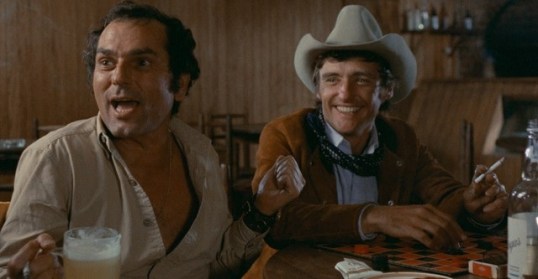
The second part of the film is where things start to fall apart. Kansas meets an old friend named Neville (Don Gordon). Neville has discovered a gold mine in the Peruvian mountains. With Kansas as his partner, he tries to get a businessman named Harry Anderson (Roy Engel) to invest in it. Kansas and Neville try to impress Harry and his wife (Julie Adams, best-known for being stalked by The Creature From The Black Lagoon). Kansas and Neville take the Andersons to a brothel and, in the process, Kansas offends Maria. Kansas then paws Mrs. Anderson’s fur coat and mentions that human beings are covered in hair. For all of their efforts, Harry will not invest, no matter how desperately Neville begs him to reconsider.
The second part of the film drags, with many of the scenes being obviously improvised between Hopper, Gordon, Garcia, Engel, and Adams. Unfortunately, the improved conversations aren’t particularly interesting and they tend to go on forever. Usually a reliable character actor, Don Gordon ferociously chews the scenery as Neville and it doesn’t take long before one grows tired of listening to him yell. (Gordon was far more impressive in Hopper’s Out of the Blue.) With the use of improvisation and overlapping dialogue, the second half of the film tries to feel naturalistic but instead, it’s a migraine-inducing method exercise gone wrong. It’s also during the second part of the film that a “scene missing” title card flashes on the screen, an indication that the discipline that Hopper showed as a director during the beginning of the film is about to be abandoned.
Finally, the third part of the film — well, who knows? The final 25 minutes of the film is collection of random scenes, some of which may be connected and some of which may not. The natives have decided that the only way to properly end their “film” is to kill Kansas. Kansas is shot several times and rides away on his horse. Suddenly, Kansas is back at his home and Maria is taunting him for getting shot. Then, Kansas is riding his horse again. Then suddenly, Dennis Hopper and Tomas Milian are laughing at the camera. A script supervisor tries to get Dennis to look at the shooting schedule while Dennis drinks. This happens:
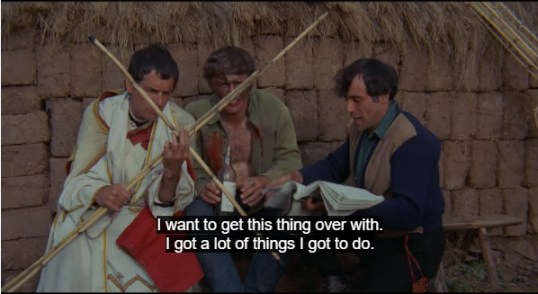
Milian points out that the blood on Hopper’s shirt is dry. Hopper looks at his shoulder, where Kansas was previously shot, and says that someone needs to add his scar before he can shoot the scene. Ah! So, now we’re acknowledging that it’s all just a movie. Thanks, Dennis! Suddenly, Dennis is Kansas again and he’s collapsing over and over again in the dust. He appears to be dead but no, now he’s Dennis again and he’s standing up and smiling at the camera. And now, he’s singing Hooray for Hollywood. And now, suddenly, Kansas and Neville are talking about The Treasure of the Sierra Madre and then….
Well, let’s just say that it goes on and on before finally ending with a scrawled title card.
It’s a disjointed mess and it’s all the more frustrating because the first 30 minutes of the film is actually pretty good. But then, Dennis apparently remembered that he was supposed to be the voice of the counter-culture and he gave into his most pretentious impulses. Of course, just because a film is a mess, that doesn’t mean that it can’t be entertaining. And again, the first part of the film is entertaining and third part of the film is weird enough that it’ll hold most people’s attention for at least a few minutes. But the middle section of the film is so slow and pointless that it pretty much brings down the entire film.
In the end, what is The Last Movie about? In The American Dreamer(a documentary that was filmed while Hopper was editing The Last Movie in New Mexico), Hopper spends a lot of time talking about revolution and taking over Hollywood but The Last Movie is hardly a revolutionary film. The film is at its most alive when it is focused on the shooting of its fictional western. For all the satirical pokes that The Last Movie takes at the studio system, it’s obvious that Hopper had a lot of affection for Old Hollywood and for directors like Sam Fuller. Kansas may say “Far out,” but he’s hardly a hippie. Even the film’s jumbled finale seems to be saying, “It’s all Hollywood magic!” In the end, the film’s call for a new style of cinema is defeated by its love for the old style of cinema.
Instead, I think The Last Movie works best when viewed as a portrait of paranoia. Hopper himself admitted that he was naturally paranoid and the heavy amount of drugs that he was doing in the 70s didn’t help. One reason why Hopper filmed in Peru and edited in New Mexico was so the studios couldn’t keep track of him and, while directing, he worried about being arrested by the Peruvian secret police. As an actor, Hopper plays Kansas as being someone who views the world with caution and untrusting eyes. He doesn’t trust the other members of the film crew. He loves Maria but he’s still convinced that she’s going to betray him. Even the natives ultimately try to destroy him and the script supervisor tries to get him to stick to the shooting schedule. The film works best as a disjoined portrait of one man’s paranoid and fatalistic world view.
The Last Movie pretty much ended the studio’s attempts to harness the counter-culture by giving money to self-described revolutionaries. The new wave of directors — like Spielberg and Lucas — may have shared Hopper’s then-politics but they weren’t looking to burn down the system. (Hopper himself later became a Republican.) The Last Movie may not have been the literal last movie but it was, for a while at least, the last of its kind.
I have to admit that I always find films about amphetamines to be fascinating because I take them for my ADD. I’ve been taking Dexedrine since I was in middle school and it has always amused me how people who don’t have ADD seem to think that the meds will give you super powers. For instance, every season of Big Brother, there’s people online who get outraged over certain houseguests taking Adderall. “She had an unfair advantage!” someone will say, “Because she’s taking Adderall!” What can I say? People who don’t have ADD just don’t get it. Yes, if you have ADD, the meds can help you focus but it’s not like they’re going to give you any sort of special power that’s not available to any other person.
(I will admit that there is a slight difference between me on my meds and me off my meds. Actually, my family says that there’s a huge difference but I think they’re exaggerating. It is true that I’m a lot more focused when I take my Dexedrine. My mind wanders a bit less than usual and I’m also usually in better control of my frustrations. When I take my meds, I can finish any project. When I don’t take them, I can talk about finishing any project.)
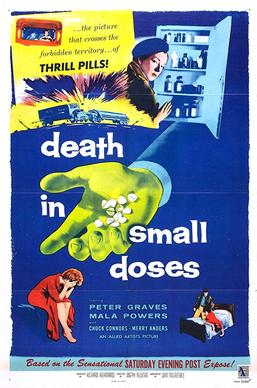
Dexedrine focuses me but apparently, it does the opposite for those who don’t have ADD. The 1957 film, Death in Small Doses, features a truck driver named Mink Reynolds who, despite not having ADD, pops too many capsules and ends up playing really loud music and trying to force a waitress to dance with him. He also hallucinates seeing a car and then grabs a knife and tries to kill another truck driver. To be honest, that seems a bit extreme to me. In fact, I’d almost argue that Mink’s behavior would indicate that the filmmakers really didn’t know much about amphetamines. Making things even stranger is that Mink is played by Chuck Connors, who was a remarkably inexpressive actor. Watching Connors, with his stone face, trying to dance and jump around is an interesting experience. Mink is supposed to be a jazz-crazed, speed-abusing hepcat but instead, he comes across like an animatronic mannequin. You can almost hear the gears shifting whenever he has to move across the screen.
Mink’s fellow truck driver is Tom Kaylor (Peter Graves), a seemingly upright man who is usually seen wearing a tie and who looks like he would be more comfortable working behind a desk than driving a truck. Of course, that’s because Tom is actually an FBI agent! He’s working undercover, pretending to be a truck driver so that he can smash a ring of drug dealers! Of course, the problem here is that everything about Peter Graves’s screen presence shouts out, “Narc!” With his square jaw and his perfect haircut and his stiff but authoritative delivery of his dialogue, he seems like he was created in a lab that specifically set out to develop the most stereotypical FBI agent imaginable. There’s not a single rough edge to him and it’s hard to buy that the other truck drivers wouldn’t see straight through him.
While Tom tries to bust the ring, he also finds time to possibly fall in love with two different women, both of whom seem as if they might know more than they’re letting on. Amy (Merry Anders) is the waitress who has developed a drug habit of her own. Val (Mala Powers) owns the boarding house when Tom and Mink live. Can Tom trust either one of them? And will Tom not only undercover the identity of the head of the drug ring but also survive long enough to bring the dealers to justice?
So, here’s the thing. During its worst moments — i.e., whenever Chuck Connors is jumping all over the place and talking about how much he loves his friend “benny” — this is a campy and rather silly film that makes Reefer Madness look subtle by comparison. However, during its best moments, this is a tough and entertaining noir that features good performances from Merry Anders and Mala Powers. Both Anders and Powers manage to transcend the film’s sillier moments and they actually bring a charge of reality to the story. And while director Joseph M. Newman may not have known much about drugs, he did know how to shoot a fight scene. Making good use of its desolate locations (the truck drivers spend a lot of time driving through the desert) and setting many of the film’s best moments at night, Newman overcomes some of the script’s weaker moments. In the end, it makes for a rather uneven but entertaining viewing experience. Despite the film’s cluelessness about drugs and the miscasting of both Graves and Connors, this lesser-known noir is worth tracking down.
Way back in the early days of the site, I did a series of reviews called 31 Days of Paranoia, in which I reviewed films about mysteries, cover-ups, and conspiracies. Unfortunately, because I wasn’t all that disciplined about posting during the early days of the Shattered Lens, my 31 Days of Paranoia ended up being something like 24 days. Still, it was a lot of fun and, historically, it was important because it was the very first “themed” series of reviews that I had ever done. Shattered Politics, Embracing the Melodrama, Back to School, Sprin Breakdown, and all the rest started with 31 Days of Paranoia.
So, with this being the 10-year anniversary of the Shattered Lens’s founding and Spring Breakdown wrapping itself up tomorrow, I figured why not return to where it all started. From now til April, please enjoy …. 18 Days of Paranoia!
We begin with:
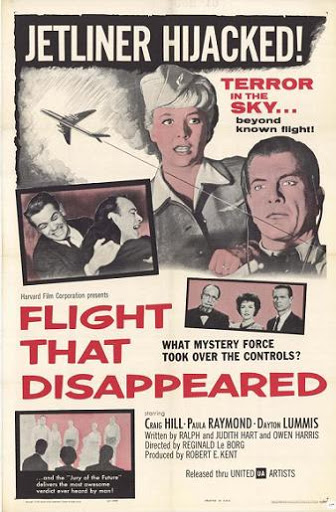
The 1961 film, The Flight That Disappeared, deals with an airplane that …. wait for it …. disappears!
What’s happened to Trans-Coast Airways Flight 60? When it first took off from Los Angeles, everything seemed fine. It was carrying a small but well-behaved group of middle-aged people to Washington D.C. The pilots all seemed like good professionals. The two flight attendants were busy serving people coffee and having conversations about whether or not one of them would ever get married. She had every right to be concerned, of course, seeing as how she was in her 20s and still unmarried and childless, despite the fact that this film was made in 1961.
It doesn’t take too long for something strange to happen. The plane suddenly starts to climb upward, eventually going up over 10 miles high in the sky. The pilots can’t do anything to get the plane to come back down. Due to the lack of oxygen, some of the passengers start to pass out. One passenger panics and opens a door, out of which he promptly falls. Oddly, this doesn’t create the whole vacuum effects that we always see in other movies where a window or a door is opened while a plane is in the air. Stranger still, no one thinks to close the door afterwards. Was this intentional or was it just crappy filmmaking? It’s hard to say.
Why is the plane being lifted up into the air? Could it have something to do with the three atomic scientists who are all on the plane? One of them, Dr. Morris (Dayton Lummis), is wearing glasses and has a van dyke beard so you know he’s smart! It turns out that Dr. Morris has been working on the Beta Bomb, which is apparently the most powerful atomic bomb ever built. I kept waiting for someone to ask Dr. Morris why it was called the Beta Bomb and not the Alpha Bomb or the Omega Bomb or the Big Scary Bomb or the …. well, seriously, anything would be better than Beta Bomb! Everyone in the movie says, “Beta Bomb,” in a tone that’s meant to communicate reverence but it just sounds too much like “Beta Male” for me to really take it seriously.
But, again, who is responsible for the flight climbing? Is it the Russians? Is it aliens? Is it some enemy of the American way? While everyone else on the plane is passed out, the three scientists find themselves awake. Their watches are no longer running and, despite the fact that they appear to be alive, their hearts are no longer beating. Are they dead? Or have they been transported to the future where they will now be put on trial for the crime of developing the Beta Bomb?
Of course, the thing with being put on trial in the future is that it provides the perfect defense for making weapons in the present. “Hey,” a smart defense attorney would say, “you’re still alive in the future and you’ve got time travel technology so what are you bitching about?” But the jurors explain that they’re actually the ghosts of the people who would have been born in the future if not for the Beta Bomb which …. what? So, is the plane in the future or is it in the afterlife? The film itself doesn’t seem to be sure.
I’m probably making it sound like this is a more intriguing film than it actually is. This movie is about 72 minutes long and all the stuff with the people in the future takes place during the final 10 minutes. That means that the film is essentially just 60 minutes of people saying, “We’re still climbing.” From a historical point of view, it’s an interesting example of people being paranoid about the arms race. (If the film were made today, the future the ghostly jurors would be the souls of people who were not born in the future due to climate change.) From an entertainment point of view, it’s a forgettable dud.
Today’s horror on the lens is the 1957 Roger Corman-directed, sci-fi “epic,” Not of this Earth.
Paul Johnson (Paul Birch) may seems like a strange character, with his stilted way of speaking and his sunglasses and his overdramatic reaction to any and all loud noises. Paul could us be an eccentric. Or, he could be …. NOT OF THIS EARTH! Actually, his habit of draining people of their blood and sending weird, umbrella-like creatures out to attack his enemies would seem to suggest that the latter is probably true.
Listen, it’s not easy being a blood-sucking alien. I mean, sure, there’s always seems to be people stupid enough to show up at your mansion so that you can drain their bodies. Paul is lucky that he doesn’t exactly seem to be surrounded by brain surgeons. But sometimes, things happen. For instance, someone might show up from your home planet and demand an immediate transfusion! What is an alien to do?
Watch this low-budget but undeniably entertaining film to find out! And be sure to especially keep an eye out for the great Dick Miller, who reportedly improvised his role as a vacuum cleaner salesman. (Before going into acting, Miller actually did sell vacuum cleaners door-to-door.)
Peter Wade, Jr. (Ron Hagerthy) is a rather timid man who would rather design planes than fly them. However, his father, Peter Wade, Sr. (Boris Karloff, who also hosted the episode), is a World War I veteran who has gone from being an aviation hero to owning his own aviation company. Peter, Sr. demands that his son become a pilot. And yet, every time that Peter, Jr. is flying, he’s haunted by ghostly face that 1) puts him in a trance and 2) tries to get him to crash his plane! Could it have something to do with a secret from his father’s past?
This episode is effectively creepy, as any show featuring a possessed pilot and a potential aviation disaster should be. As with some of the past episodes of The Veil, the main attraction here is really the chance to see Boris Karloff doing what he did best. Karloff was one of the great actors and it’s always fun to see him get a good character role.




 Through the Shattered Lens