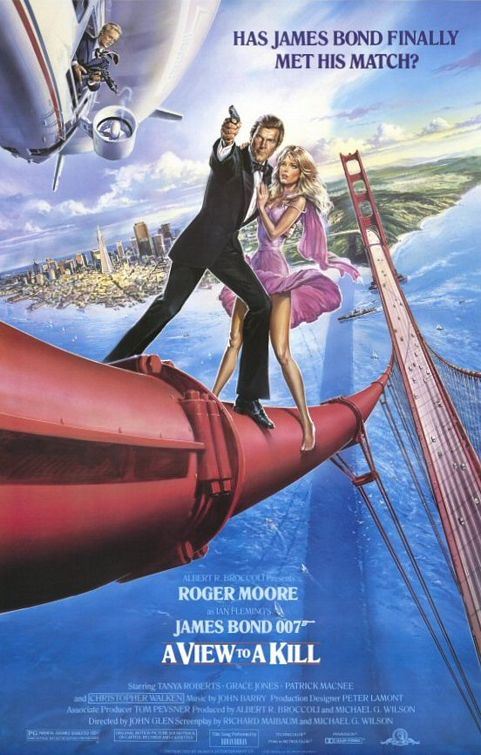
James Bond Film Review: A View to a Kill (dir by John Glen)


In the days leading up to the American premiere of Skyfall, the Shattered Lens has been revisiting the previous films in the James Bond franchise.  Today we take a look at 1985’s A View To A Kill.

Along with bring the 14th “official” Bond film, it was also the last to star Roger Moore in the role of 007.  On a personal note, it was also released the same year that I was born.  I have to say that I hope I’ve aged better than this film has.

Much like The Spy Who Loved Me, A View To A Kill opens with a ski chase between Bond and a bunch of Russians.  And while the chase itself isn’t all that exciting, it does lead to one of the better opening credits sequences of the Bond franchise.


Say what you will about A View To A Kill, it features the perfect theme song.  I first heard Duran Duran’s title song long before I saw the actual film.  After I graduated high school, I spent the summer in Italy and I can still remember hearing this song blaring from a loud speaker in Venice.  With it combination of exuberant music and incoherent lyrics, the song is the perfect soundtrack for both an American girl abroad and a mid-80s spy flick.

A View To A Kill finds James Bond investigating the mysterious industrialist Max Zorin (Christopher Walken).  Though Zorin is one of the world’s richest men, MI6 is suspicious of him.  Microchips manufactured by Zorin Industries are turning up in Russian submarines.  Perhaps even worse, it’s become apparent that, much like Auric Goldfinger, Zorin is a cheater.  He owns a champion racehorse but it’s rumored that the horse is somehow being given steroids.  MI6 sends Bond and racehorse trainer Sir Godfrey Tibbets (played, quite wonderfully, by Patrick Macnee) to investigate.

These scenes, in which an undercover Bond sneaks around Zorin’s estate in France, are my favorites of the film.  Moore and Macnee make for a likable team and it’s fun to watch the two veteran actors play off each other.  As well, since these scenes are more about detection than action, it’s easier to ignore the fact that Moore was 58 years old when he made A View To A Kill.
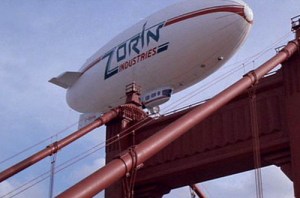
Unfortunately, the rest of the film doesn’t work as well and that’s unfortunate because A View To A Kill starts to get seriously weird as things progress.  It turns out that Zorin isn’t just a shady businessman.  No, he’s actually the product of Nazi genetic experimentation and, as a result, he’s both a genius and a complete sociopath.  What this means is that, opposed to previous Bond antagonists, Zorin spends a lot more time giggling and smiling as if even he can’t believe how evil he is.

Bond ends up following Zorin and his aide, May Day (Grace Jones), to San Francisco.  It’s there that Bond discovers that Zorin is planning on setting off a massive underground explosion, in hopes of causing an Earthquake that will totally destroy California.  This will allow Zorin to corner the world microchip market and make a lot of money but, for the most part, Zorin just seems to want to do it so that he’ll have something to talk about the next time he gets together with his fellow megalomaniacs.

Once everyone arrives in San Francisco, James Bond ends up teaming up with geologist Stacy Sutton (played by Tanya Roberts, better known as Donna’s mother on That 70s Show).  As for Zorin, he divides his time between holding business meetings on his blimp and laughing like a maniac while gunning down random people.

Seriously, it’s an odd film.
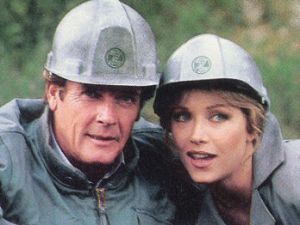
Whenever film critics are looking over the Bond films, A View to  A Kill seems to be the Bond film that’s destined to get the least amount of respect and admittedly, this is an uneven entry in the Bond franchise.  In Sinclair McKay’s excellent look at the oo7 films, The Man With The Golden Touch, Roger Moore is quoted as having been uncomfortable with just how violent A View To A Kill eventually turned out to be and, watching the film, he definitely had a point.  It’s odd to see Moore’s light-hearted approach coupled with scenes in which Zorin gleefully kills a thousand people in a thousand seconds.  It also didn’t help that, in this film, Roger Moore looked every bit of his 58 years.  Never have I been as aware of stuntmen then when I watched A View To A Kill.  Finally, Moore and Tanya Roberts have next to no chemistry together.

With all that in mind, A View To A Kill is something of a guilty pleasure and that’s largely because of the bad guys.

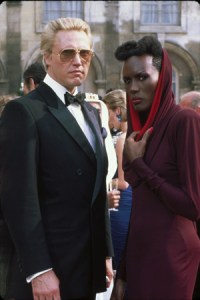
If anyone was born to play a Bond villain, it’s Christopher Walken and Max Zorin is an enjoyably over-the-top villain.  Whereas previous Bond villains were motivated primarily by greed, Zorin is the first Bond sociopath and Walken seems to be having a blast playing bad.  As opposed to the grim bad guys of the past, Zorin laughs and grins through the whole movie and Walken is a lot of fun to watch.  Regardless of whatever other flaws that the film may have, Max Zorin is rightly regarded as one of the best of the cinematic Bond villains.

As played by Grace Jones, May Day is one of the franchise’s most memorable and flamboyant villainous lackeys.   Much like Richard Kiel in The Spy Who Loved Me, Jones is such a physical presence that she dominates every scene that she’s in.  In their scenes together, Walken and Jones have the type of chemistry that’s so noticeably lacking between Moore and Roberts.
As I previously stated, A View To A Kill was Roger Moore’s final appearance as James Bond.  Before we started our look at the Bond films, I spent some time researching the history of both the franchise and the men who have played 007.  One thing that quickly became apparent was that nearly everyone agreed that Roger Moore is a nice, likable guy but that he didn’t bring much more than likability to the role of James Bond.  Having now rewatched the Bond films, I can say that Roger Moore’s performance as James Bond was and is seriously underrated.  Yes, Moore may have brought a light touch to the role but his interpretation of Bond was perfect for the films that he was starring in.  Much as it’s difficult to imagine Roger Moore in From Russia With Love, it’s just as difficult to visualize Sean Connery in The Spy Who Loved Me.  Moore’s greatest talent may have been likability but that likability kept the Bond franchise alive and Moore’s interpretation of the role deserves better than to be continually dismissed.  
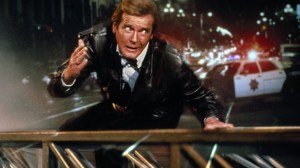
With Roger Moore leaving the franchise, the role of James Bond would next be played by an actor named Timothy Dalton.  If Moore was the likable, fun Bond, Dalton was, in many ways, the complete opposite.  We’ll be taking a look at The Living Daylights tomorrow.
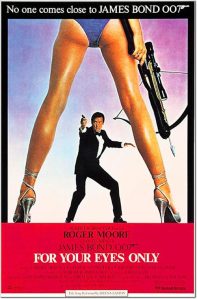
James Bond Review: For Your Eyes Only (dir. by John Glen)


For Your Eyes Only marks a few changes in the way EON Productions wanted to go with James Bond.  With Moonraker being so over the top, the producers decided to go a little more low key and practical. After working on the 2nd unit for Moonraker and a few other Bond Films, John Glen would step up to the plate as the director for this and every 007 film leading up to Goldeneye. Instead of John Barry working on the music, Bill Conti would take over here, which ended up being a very different kind of sound for the film, one fitting of the early 80s.

For Your Eyes Only opens with an interesting start, having Bond visit the grave of his wife, Tracy, who was killed during the events in Her Majesty’s Secret Service. Bond is informed that his helicopter is ready, but when he climbs inside, he finds that it’s under the control of someone with a serious grudge, and though we can’t see his face, we’re to assume he could be Ernst Starvo Blofeld. Supposedly, the scene, which ends with Bond reclaiming control of the helicopter and dropping the would be Blofeld into a chimney pipe, was a jab at writer Kevin McClory. Over the years, the Thunderball lawsuit caused some rifts between McClory and EON Productions. The statement made with For Your Eyes Only was that EON could come up with plenty of great stories without having to use a signature villain like Blofeld. They’d been successful with two movies back to back using Richard Kiel as the henchman Jaws, and probably felt they were doing pretty well. In reponse, McClory would give the Thunderball another try in the bond film Never Say Never Again (which isn’t part of the EON produced Bond films, and won’t be found in any of their Bond Blu-Ray / DVD compilations.

Similar to Tomorrow Never Dies, the story starts with a boat being attacked and sunk. Bond is asked to retrieve a targeting system from the ship and return it to Britain before the Russians do the same. One of the great things about the time period is that since it was pretty much the Cold War, everything was a black ops -sneak in, sneak out – scenario to avoid World War III and nukes being fired by both sides.

The Bond Girl for this film is Melina Havelock (Carole Bouquet), who I really liked here. After her parents are gunned down on their boat, she picks up a bow and arrow to take revenge. As a result, she manages to run into Bond on a number of occasions and had a real sense of calm to her (or as calm as one could be when facing a giant fellow in a scuba suit). The villain of the story, Kristatos was played by Julian Glover, who I enjoyed in Indiana Jones and the Last Crusade and currently on Game of Thrones. I didn’t care much for him in Harry Potter and the Chamber of Secrets as Hagrid’s pet spider, Aragog. One thing to note about Glover is that at one point, he was approached to actually play Bond after Connery left. An interesting casting choice if you notice him is Charles Dance as one of the henchmen and Fiddler On the Roof’s Topol, who played a former business partner of Kristatos’. I found that kind of fun, that you could see these actors here in 1981 that people are familiar with to some degree. The year this came out, Liam Neeson was in Excalibur, for example.

The story features a number of good moments, particularly a great snow skiing chase, a mountain climb as well as a fight between Bond and some hockey players. There’s even a well filmed underwater sequence. Of the Roger Moore Bond films, I always thought of this one and The Spy Who Loved Me as two of his best. With the mission being as small as it is, there wasn’t a lot of room for anything as wild as Moonraker. It’s a pretty tight, practical film that doesn’t rely too much on the gadgetry of the other films. It should also be pointed out that like The Spy Who Loved Me, the signature car for Moore’s Bond is still a Lotus, as I don’t believe the Aston Martins made an appearance until The Living Daylights. That was a little of a letdown for me, but otherwise, the film is beautiful.

Tomorrow, The Shattered Lens takes on Octopussy, a film that showcases just how deadly the circus can be when James Bond is involved. We’ll leave you with the theme song to For Your Eyes Only, sung by Sheena Easton.

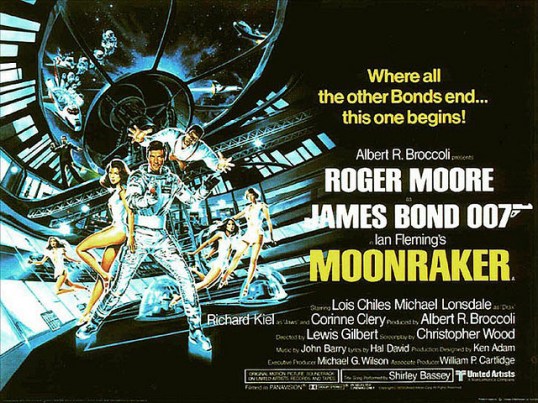
James Bond Film Review: Moonraker (dir. by Lewis Gilbert)


For the past two weeks, here at the Shattered Lens, we’ve been reviewing the James Bond film franchise.  We’ve reviewed the good, the bad, and the ugly of James Bond and today, we’re going to take a look at James Bond at his silliest.  Today, we’re going to review the 11th official James Bond film, 1979’s Moonraker.

Moonraker starts out with a genuinely exciting pre-credits sequence.  James Bond (Roger Moore) is on an airplane when he’s suddenly attacked by the stewardess, the co-pilot, and Jaws (Richard Kiel), the henchman with the steel teeth.  All four of them end up falling out of the plane.  In mid-air, Bond wrestles the pilot’s parachute away from him and uses it to safely land on the ground.  The pilot and the stewardess presumably plunge to a very grisly death.  Jaws, meanwhile, crashes into a circus tent and walks away without a scratch.  This scene pretty much establishes the tone of Moonraker — increasingly implausible action sequences that usually end with some sort of crowd-pleasing joke.  In short, Moonraker is Bond as pure spectacle.  Those looking for another From Russia With Love should look elsewhere.

As for the rest of the film, someone’s stolen a space shuttle and James Bond and CIA agent Holly Goodhead (Lois Chiles) team up to find it.  It turns out that the shuttle was stolen by Hugo Drax (Michael Lonsdale), who plans to wipe out life on the Earth and start a new society in space.

That’s right, in space!

Moonraker was made in 1979, at the height of the cinematic science fiction boom.  In the late 70s, everyone was going into space and James Bond wasn’t going to get left behind.  Not surprisingly, it turns out that Drax has a secret HQ in a space station that’s orbiting the Earth and Bond is not only the world’s greatest secret agent but the universe’s as well!

It also turns out that Jaws is now working for Drax and his girlfriend Dolly (Blanche Ravelec) works in the space station.  I know that a lot of Bond fans hate Moonraker because of this very subplot but seriously, just take a look at the happy couple!  They’re so cute together!

I have to admit that I have mixed feelings on Moonraker.  On the one hand, it’s the most over-the-top of Roger Moore’s Bond films and it’s certainly the silliest.  Your reaction to it will depend on just how seriously you take or want to take your Bond films.  Myself, I appreciate Moonraker as a celebration of excess but, at the same time, I can also understand why so many fans of the Bond franchise consider Moonraker to be a low point for the series.

At its weakest, Moonraker feels almost like a generic Bond rip-off as opposed to an official Bond film.  It’s obvious that most of the preproduction attention was devoted to the film’s special effects.  The rest of the film feels almost like an afterthought and several of the sequences feel as if they’ve been lifted from other Bond films.  Bond’s initial meeting with Hugo Drax is reminiscent of the golf game in Goldfinger and both Drax’s evil scheme and motivation appear to have been borrowed from The Spy Who Loved Me‘s Karl Stromberg.

Especially when compared to his witty performance in The Spy Who Loved Me, Roger Moore appears to be simply going through the motions here and he has next to no chemistry with Lois Chiles.  One gets the feeling that Bond is merely with her so that he can brag to his mates back in London that he actually hooked up with someone named Holly Goodhead.  If her name was Holly Smith, he wouldn’t have any interest in her.

On the plus side, Michael Lonsdale makes for a good villain, the film’s special effects still look good over 30 years later, and I like the way that Jaws’ storyline is resolved.  I know that a lot of people hate the fact that Jaws softens up by the end of this film but I wouldn’t have it any other way.  Richard Kiel and Blanche Ravalec are so cute together that you simply can’t help but smile at their unlikely romance.

Finally, how can you not enjoy the curiosity value of having James Bond in space?  I’m not a huge sci-fi fan.  Whenever I hear people mention Dr. Who, Star Wars, or Star Trek, my eyes roll up into the back of my head and I end up zoning out for a few hours.  But there’s just something so odd and vaguely inappropriate about the idea of James Bond floating around in a space station with a laser gun.  If nothing else, Moonraker serves as a time capsule of the late 70s, a time when even James Bond could turn up in outer space.

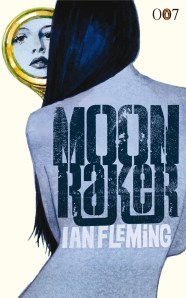
Much like The Spy Who Loved Me, Moonraker has little in common with the book that inspired it.  The literary Moonraker featured a villain named Hugo Drax but the Moonraker of the title was a nuclear missile.  Nobody went into outer space and there was certainly no one named Holly Goodhead.  Instead, Bond worked (and fell for) a fellow agent named Gala Brand.  It’s a shame that no one has ever filmed a faithful adaptation of Moonraker because it’s actually one of the best of the Bond novels.  Bond and Gala have a genuinely interesting relationship and the book has a melancholy, rather introspective feel to it.  Surprisingly, the end of the book deals with why none of Bond’s relationships last that long and makes an attempt to deal realistically with the psychological consequences of being the world’s greatest secret agent.

Surprisingly enough, the spectacular, effects-heavy Moonraker would be followed by the much more realistic and low-key For Your Eyes Only.  We’ll take a look at that film tomorrow.

Until then, here’s the Moonraker theme song:

James Bond Film Review: The Spy Who Loved Me (dir. by Lewis Gilbert)


For the past few days, the Shattered Lens has been taking a journey through the history of the James Bond film franchise.  Today, we continue that journey by taking a look at 1977’s The Spy Who Loved Me.  This was the 10th film in the “official” James Bond series and the 3rd to star Roger Moore as 007.  It was also the first of Moore’s films to be embraced by contemporary critics and it’s still considered to be one of the best films in the entire series.  It’s also one of my personal favorites.

The Spy Who Loved Me opens with one of the most of brilliant pre-credit sequences in the history of the franchise.  British and Russian submarines are mysteriously vanishing.  M (a returning Bernard Lee) summons James Bond (Roger Moore) to investigate.  Not surprisingly, Bond is with a woman at a ski resort when the summons comes.  As Bond starts to leave, the woman says, “But James, I need you.”

“So does England,” Bond replies.

Now, this was long before my time so I can’t say for sure but I always like to imagine  that line got some applause when it was first heard in theaters.  It is with that line (and, even more importantly, with his self-assured but humorous delivery of that line) that Roger Moore truly claims the role of James Bond as his own.  No, this scene seemed to be telling us, Moore would never be Sean Connery.  But he would be James Bond.

After leaving the chalet, Bond finds himself being pursued by several Russian agents.  This downhill ski chase, filmed by real people who were truly putting their lives in danger in the days before CGI, is one of the most exciting of all the chases to be found in Bond films and it builds up to a perfect climax.  After Bond manages to kill one of his pursuers, he skis right over the edge of a cliff.  Luckily, he has a parachute in his backpack and, of course, it’s a union jack parachute.  Again, I like to imagine that audiences applauded at this moment.

Bond’s escape leads to the opening credits and, even more importantly, Carly Simon singing the film’s theme song, “Nobody Does It Better.”  Seriously, I love this song.

Both MI6 and the KGB discover that the plans for a submarine tracking system are being sold on the Egyptian black market.  Suspecting that this is connected to the missing submarines, both James Bond and the Russian agent Anya Asamova (Barbara Bach) are sent to Egypt.  Bond and Anya team up to find the plans.  Along the way, they are attacked multiple times by Jaws (Richard Kiel), a hulking man with steel teeth.

Eventually, Bond and Anya discover that the man responsible for the missing submarines is Karl Stromberg (Curt Jurgens), a shipping magnate who is planning on destroying the surface world so that he can start a new society underwater.  The two secret agents work together to defeat Stromberg even though Anya assures Bond that she’s going to kill him as soon as their mission is completed.  Remember the man who Bond killed during that opening ski chase?  It turns out that man was Anya’s lover and she’s only putting off getting her revenge so that she and Bond can save the world first.

With its confident mix of humor, intrigue, and spectacular action, The Spy Who Loved Me remains one of the most popular of the Bond films.  It’s certainly one of my favorites.

Along with From Russia With Love and On Her Majesty’s Secret Service, this is the most romantic of the Bond films.  Roger Moore and Barbara Bach have a very real chemistry and, as a result, you actually care about whether or not Bond and Anya will still be together after the end credits.  As played by Barbara Bach, Anya is one of the strongest of the Bond girls.  For once, Bond and his lover are truly equals.  For anyone who doubts the importance of having a strong Bond girl, I invite them to compare this movie to The Man With The Golden Gun.

For those who are more into action than romance, The Spy Who Loved Me will not leave them disappointed.  This film features some of the best set pieces in the history of the Bond franchise.  Along with the ski chase at the start of the film, there’s also a genuinely exciting car chase that features Bond and Anya being pursued by a helicopter piloted by Caroline Munro.

(Speaking of cars, this film also features one of my favorite Bond gadgets — a car that doubles as a submarine.)

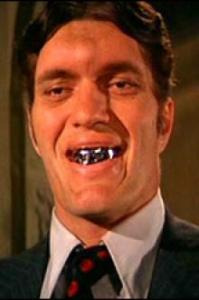
Karl Stromberg makes for an interesting villain.  His plan makes absolutely no sense but he may be the first Bond bad guy to motivated by perverted idealism as opposed to pure greed.  As you would expect from a Bond film, his secret underwater HQ is quite an impressive set.  However, the best thing about Stromberg is that he employs Jaws.  With his stainless steel teeth, Jaws was the best henchman since Goldfinger‘s Oddjob and he proved to be such a popular character that he actually returned in the next Bond film.

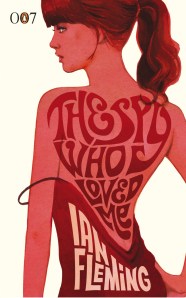
One final note: As has often been noted, The Spy Who Loved Me was the first Bond film to have absolutely nothing in common (beyond a title) with the book that it was based on.  This is largely because the literary Spy Who Loved Me wasn’t really about James Bond.  Instead, it told the life story of Vivienne Michel, a Canadian woman who just happens to meet Bond towards the end of the book.  Fleming reportedly considered this book to be a failed experiment on his part and reportedly he only sold the film rights when he was assured that only the book’s title would be used.

That said, I recently read The Spy Who Loved Me and it’s not that bad.  Vivienne Michel is a compelling character and it’s interesting to, for once, see James Bond through the eyes of a lover as opposed to the other way around.  If it is a failed experiment, it’s still an experiment that’s worth reading.

As for the cinematic James Bond, he conquered the sea in The Spy Who Loved Me so it only made sense that, in his next film, he would attempt to conquer space.  We’ll take a look at Moonraker tomorrow.

James Bond Film Review: The Man With The Golden Gun (dir. by Guy Hamilton)


Hi there!  The name’s Bowman.  Lisa Marie Bowman.  Yes, I’ve made that joke a few times over the past two weeks but so what?  Let me have my fun!  And speaking of fun, we’ve been reviewing the entire James Bond franchise here at the Shattered Lens.  Today, we’re going to take a look at 1974’s The Man With The Golden Gun, the 9th “official” James Bond film and the second Bond film to feature Roger Moore in the lead role.

The Man With The Golden Gun is Francisco Scaramanga (Christopher Lee), the world’s most feared assassin.  Living on his own private island, Scaramanga is waited on hand-and-foot by a murderous dwarf named Nick Nack (Herve Villechaize) and his mistress Andrea Anders (played by Maud Adams, who, like me, is a member of the red-headed 2%).  Every few days or so, Nick Nack arranges for a different gangster or spy to come to the island and fight a duel with Scaramanga.  Much to Nick Nack’s disappointment, Scaramanga always manages to win each duel.  However, Scaramanga remains a frustrated assassin because he’s never had the chance to take on (and kill) his hero, James Bond.

Just how obsessed is Scaramanga with Bond?  Scaramanga has his own private funhouse set up on the island and the star exhibit at that funhouse is a wax figure of Bond that Scaramanga enjoys firing golden bullets at.

Meanwhile, in London, MI6 receives one of those golden bullets with “007” etched into the surface.  M (Bernard Lee), not wishing to see his best agent killed, immediately relieves Bond from his current mission.  Bond, along with a painfully dizzy British agent named Mary Goodnight (played by Britt Ekland), responds by setting off to track down Scaramanga on his own.

Bond eventually tracks Scaramanga down to Bangkok where Scaramanga is busy scheming to steal something called a Solex agitator which, depending on who is using it, can either be the key to solving the energy crisis or it can be a deadly, solar-powered weapon.  Bond also discovers that the bullet wasn’t sent by Scaramanga but was instead sent by Andrea who wants Scaramanga dead.

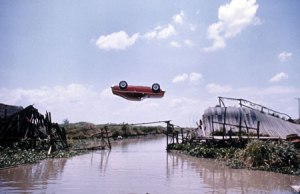
Not surprisingly, this all leads to what you would expect — an elaborate car chase, a Bond girl in a bikini, and a final duel between Bond and Scaramanga.

When The Man With The Golden Gun was first released way back in 1974, the film received some of the worst reviews in the Bond franchise’s history.  A typical review came from Time Magazine’s Jay Cocks who complained that Moore “lacks all Connery’s strengths and has several deep deficiencies”, whilst Lee was “an unusually unimpressive villain.”  In a complaint that would be made about the majority of the post-Connery, pre-Craig Bond films, Cocks also criticized the film’s plot for being too dependent on both Bond and Scaramanga using implausible gadgets.

While most of the Bond films were treated dismissively by critics when they were first released, the majority of them have also come to be seen in a more positive light  as the years have passed.  The Man With The Golden Gun, however, is an exception to that rule.  Nearly four decades after first being released, The Man With The Golden Gun still has a reputation for being a disappointment.  While Christopher Lee has rightly come to be recognized as one of the best Bond villains, the film itself is still regularly dismissed as one of the worst of the Bond films.

The Man With The Golden Gun‘s flaws are pretty obvious.

As played by Britt Ekland, Mary Goodnight is perhaps one of the most useless Bond girls ever and pretty much confirms every accusation of sexism that’s ever been made against the Bond films.  It’s hard not to wish that the role of Goodnight had been played by Maud Adams who, as Andrea Anders, proves to be one of the best of the Bond femme fatales.

Redneck Sheriff J. W. Pepper (Clifton James) was an acquired taste when he first showed up in Live and Let Die and those who were annoyed by his character the first time will probably not be happy when he implausibly pops up in this film, vacationing in Bangkok and somehow getting involved in yet another car chase.

Finally, while Roger Moore’s performance as James Bond has always been rather underrated, it’s hard to deny that he looks a bit ill-at-ease in this film.  As opposed to Live and Let Die (which was clearly written to match Moore’s interpretation of the role), The Man With The Golden Gun feels like it was written for Sean Connery’s more ruthless interpretation of the role.  There’s a rather ugly scene where Bond roughly slaps Andrea to get her to tell him about Scaramanga.  It’s the type of thing that you could imagine Connery doing without a second thought but Moore seems uncomfortable with it.  His Bond simply doesn’t have the sadistic streak that hid underneath the surface of Connery’s interpretation.

That said, The Man With The Golden Gun is something of a guilty pleasure of mine.  The Man With The Golden Gun is one of the Bond films that I always make a point to catch whenever it shows up on television and I certainly had a better time rewatching it than I did when I rewatched You Only Live Twice.  The film moves along quickly enough, the car chases are a lot of fun, and Scaramanga’s funhouse is one of the best of the Bond sets.  

For all of its flaws, The Man With The Golden Gun is saved by its trio of villains. Maud Adams, Herve Villechaize, and especially Christopher Lee give three of the most memorably eccentric performances in the history of the Bond franchise.  They’re so much fun to watch that, if spending time with them also means spending time with Mary Goodnight and Sheriff Pepper, it’s a sacrifice that I’m willing to make.

The strength of Christopher Lee’s performance as Scaramanga cannot be understated.  There’s something oddly touching in the contrast between Scaramanga the steely assassin with the golden gun and Scaramanga, the insecure killer who is apparently always comparing his accomplishments to the accomplishments of James Bond.  Lee’s Scaramanga is such a compelling character that you almost regret that he can’t, in some way, be allowed to achieve some sort of victory at the end of the film.

But, of course, if that happened then it would no longer be a James Bond film.

As always, regardless of what the critics may have wished, James Bond would return.  Ironically, Moore would follow-up a what many considered to be the worst James Bond adventure with a film that many consider to be one of the best.  We’ll be taking a look at The Spy Who Loved Me tomorrow.

Until then, let’s enjoy one of the most underrated theme songs in the history of the Bond franchise.

Song of the Day: Live and Let Die (by Paul McCartney and Wings)


Lisa Marie recently wrote up her very unique review of the James Bond film Live and Let Die and I’ve decided to use that review as the springboard for the latest “Song of the Day” entry. It’s easy enough to figure out that the latest choice is the similarly titled song from the film by Paul McCartney: “Live and Let Die”.

This song remains one of the most recognizable songs made specifically for a film. Most songs that become part of a film’s appeal tend to be pre-existing licensed songs and music. Live and Let Die would be the first James Bond film that would introduce Roger Moore as the British superspy and 007 agent. The song itself, written by Paul McCartney and his wife Linda, would become even more popular than the film through the years.

While the song has been covered by many bands and groups through the years it would be the cover by Guns N’ Roses in 1991 as part of their Use Your Illusion I album that many consider the best cover. I consider both favorite songs of mine, but I must pick McCartney’s original over the GnR cover by the smallest of margins.

Live and Let Die

When you were young
and your heart was an open book
You used to say live and let live
you know you did
you know you did
you know you did
But if this ever changin’ world
in which we live in
Makes you give in and cry
Say live and let die
Live and let die

What does it matter to ya
When ya got a job to do
Ya got to do it well
You got to give the other fella hell

You used to say live and let live
you know you did
you know you did
you know you did
But if this ever changin’ world
in which we live in
Makes you give in and cry
Say live and let die
Live and let die

Horror Film Review: Live and Let Die (dir. by Guy Hamilton)


I know what you’re going to say before you say it.

“Okay, Lisa,” you sigh, “I hate to tell you this but Live and Let Die is not a horror film.  Live and Let Die is a James Bond film.  In fact, it’s the first one to feature Roger Moore in the role of Bond.  It’s the one where Yaphet Kotto is the guy who’s both a Harlem drug dealer and a world leader and he’s planning on importing all this heroin from Haiti or somewhere and Bond runs off with his Tarot card reader who is played by Jane Seymour, who has mismatched eyes, just like you!”

“Thank you,” I say in my shy little way as my cheeks flush red and my mismatched eyes glance downward.

“However,” you continue, “it’s hardly a horror film.  Live and Let Die is just the James Bond film where they go to Louisiana and end up chasing each other in boats and then Clifton James shows up as this redneck sheriff and its just kinda embarrassing.”

“May I speak now?” I ask as I narrow my multi-colored eyes at you, “Now, to be honest, I’ve only recently started to really watch all of the old school James Bond films from the 60s and the 70s but Live and Let Die is actually one of my favorites, even with Clifton James as Sheriff J.W. Pepper.  I mean, the film’s actually a lot of fun, Yaphet Kotto made a great villain, and even if Roger Moore wasn’t quite as sexy and dangerous as Sean Connery was, at least he wasn’t all stiff and humorless like Daniel Craig.  In fact, I think it could be argued that Live and Let Die was the first — and maybe only — truly Grindhouse James Bond film.  I just find it interesting how the whole film is basically a hybrid of all of the big exploitation genres of 1973.   The scenes in Harlem and really the film’s entire plot is pretty much ripped off from blaxploitation while the voodoo scenes all have this kind of campy, Hammer feel to them.  Even the scenes in Louisiana are an homage to the southern car chase movies that were apparently big at the drive-ins back then.”

“That’s all good and well, Lisa, but how does that make Live and Let Die a horror film?  And don’t say it’s because Felix Leiter is played by David Hedison, the star of the original Fly because–”

“Hold on,” I say, “this is the point where we show the trailer.”

“Okay, Lisa Marie,” you say, “now that you’ve indulged in your bizarre trailer fetish, explain just how exactly this is a horror film and don’t try doing that thing you always do where you link it to some weird-ass thing that happened to you like ten years ago.”

My nostrils flare as I begin, “Ten years ago, me and my family were taking a vacation in voodoo country…”

“Lisa Marie, did you not read the previous paragraph?”

“Oh, sorry.”  I pause in order to get my thoughts straight in my head.  “Well, first off, let’s start with the opening credits.  Now, I’ll be honest here and admit that I’ve always kinda wanted to be one of those girls that are always dancing around naked during the opening credits of all the old school James Bond films–” 

“That’s a shock.”

“–so I always end up paying attention to those opening credits.  I mean, that’s my time to fantasize about being in a James Bond film.  And I have to say, the opening credits of Live and Let Die — Agck!  Seriously, everyone always spends so much time talking about how great the theme song is that they kinda miss just how freaky and nightmarish those opening credits are.  I mean, seriously, when you’re at home alone and you’re watching this in a dark room, these opening credits are genuinely unsettling.  Here, check them out.”

“Okay,” you say, “I can see how the credits might freak you out but that’s just like 2 minutes of a two hour film–”

“Oh my God, I’m so not even done yet!” I snap, “This film isn’t about James Bond fighting drug dealers.  All of that stuff with Yaphet Kotto and the heroin and all that — it’s all just an excuse to get to what the film is truly about: James Bond vs. Baron Samedi, the man who can not die!  As played by Geoffrey Holder, Baron Samedi’s only in a few scenes but he dominates the entire film.  I mean, it’s actually kinda funny because every time Baron Samedi shows up, someone dies but the film comes to life.”

“In fact,” I continue, now pretty much talking to myself, “when Baron Samedi first appears in the film, he’s killing this poor, terrified man by holding a poisonous snake up to the man’s face and oh my God, that scene freaked me out when I first saw it!  In fact, it’s the only scene from a James Bond film that’s ever given me a nightmare.  Even Eva Green drowning in Casino Royale didn’t freak me out as much as that snake scene did and you know I’m a lot more scared of drowning than I am of snakes.  Which is odd since I live in Texas and there’s a lot more snakes around here than large bodies of water…”

“Slow down and breathe, Lisa Marie,” you say, “you’re getting off topic.”

“Right, sorry.  Anyway, it’s a scary scene precisely because Baron Samedi seems to be enjoying killing the man so much.  Then again, it could also be the fact that Baron Samedi had the most evil laugh ever.  Seriously, listen to it in the scene below.”

As you watch the scene, I continue to speak, my words tumbling one after another out of my mouth, “But the scariest Baron Samedi scene isn’t even on YouTube.  Seriously, YouTube sucks.  I hate YouTube.  I mean, you can find a thousand videos of silly people doing that Wii workout game in their underwear but you can’t find the freakiest Baron Samedi scene ever.  Seriously, forget about Occupying Wall Street.  Let’s occupy freaking YouTube and demand–”

“Focus, Lisa.”

“Sorry.  Anyway, the freakiest scene in Live and Let Die and I would dare say the freakiest scene of the entire James Bond series, comes towards the end of the film.  Baron Samedi pops up out of this grave and James Bond like shoots him and blows off half his forehead, right?  And Baron Samedi just stand there perfectly still and emotionless.  Then, his eyes slowly roll upward and stare up at where his forehead used to be.  So, Bond shoots him like three more times and Baron Samedi just collapses like a rag doll.  And then, suddenly, Baron Samedi — forehead intact — pops out of another grave and does that evil laugh of his!  Oh.  My.  God!  It is so freaky!  I was watching it and I was just like…AGCK!

“And that,” I conclude, “is why Live and Let Die is a horror film.”

However, now that I’m finished, you don’t reply.  I look up and I see that you’re gone.

And in your place…

Review: The Wild Geese (dir. by Andrew V. McLaglen)


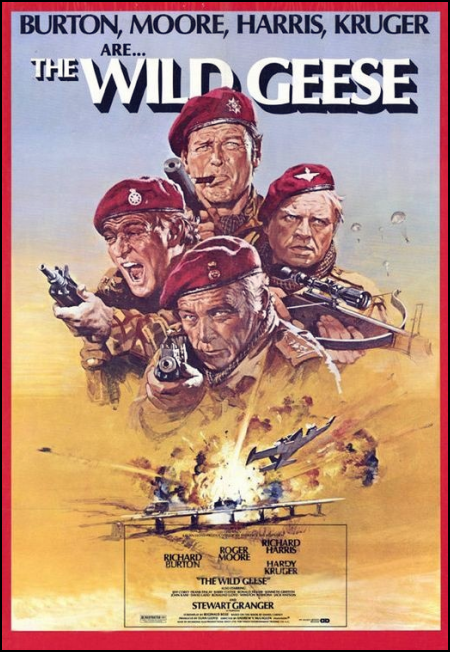
1978’s action war film The Wild Geese is an adaptation of Daniel Carney’s unpublished novel about a group of mercenaries on a mission during the turbulent revolutionary times that beset Central Africa during the 1960s and early 70s. The film features an all-star cast of British actors, a true who’s who of the era. Under the direction of Andrew V. McLaglen, The Wild Geese manages to be an action-packed and well-told film with memorable performances.

The character Colonel Allen Faulkner, played by Sir Richard Burton, is loosely based on the real-life mercenary legend Michael “Mad Mike” Hoare. Hoare not only inspired this central character but also served as the film’s military and technical advisor. Adding to the film’s authenticity, one of the actors portraying a mercenary, Ian Yule, had served with Hoare in his mercenary company. This infusion of real-life experience gives the film a vivid sense of art imitating life and lends credibility to its portrayal of mercenary warfare.

The story begins with a meeting between Faulkner and British banker Sir Edward Matheson about a rescue mission in the fictional Central African nation of Zembala. The first third follows Faulkner’s recruitment of a 50-man mercenary team, including his reluctant old friend Rafer Janders (Sir Richard Harris). The film portrays the mercenary company training and preparing for the mission before being inserted behind enemy lines. The second half details the rescue of their target: a deposed African leader about to be executed by the man who overthrew him.

During the second third of the film, the action intensifies. Though tame by today’s standards, the sequences were energetic and well-shot for their time. The mercenaries are shown not as idealized heroes but as pragmatic soldiers who use ruthless tactics—such as cyanide gas and poisoned crossbow bolts—that may shock modern audiences. This realism reflects Hoare’s influence and presents mercenaries as professionals doing a dangerous job for pay, blurring the moral lines of warfare. Betrayal during the mission tests their survival in enemy territory.

Burton and Harris deliver excellent performances as hardened war veterans, while a younger Sir Roger Moore adds roguish charm as the Irish pilot Shaun Fynn. Strong supporting roles include Hardy Kruger as Pieter Coetzee, an initially racist Afrikaner who gains new perspective on the continent’s upheaval, and Stewart Granger as the principled banker Matheson.

Though relatively small budgeted compared to other war epics of the era, The Wild Geese carries an epic feel and should have appealed more to American audiences. Unfortunately, financial difficulties with the production company affected its U.S. release. Over time, video and DVD releases built it a cult following among war and mercenary film fans, a subgenre often dominated by lesser films. McLaglen’s straightforward direction keeps the film’s pacing steady, and the story balances action with political and philosophical themes in its final act.

The Wild Geese stands as a rare gem in war cinema that delves into a little-known subgenre. With strong performances by knighted British actors, a former Hitler Youth, and real-life mercenaries as extras, the film distinguishes itself from the many flawed war movies flooding late-70s and early-80s cinema. Its roots in actual mercenary experiences, highlighted by Hoare’s real-life involvement and character inspiration, make it a compelling and underappreciated classic for aficionados of the genre.