6 Roger Corman Trailers For Halloween


Happy Halloween!  Today, in order to celebrate, we have a special Roger Corman-themed edition of Lisa Marie’s Favorite Grindhouse and Exploitation film trailers!  Here are 6 Roger Corman trailers for Halloween!

1. The Day The World Ended (1955)

2. Bucket of Blood (1959)

3. Little Shop of Horrors (1960)

4. The Terror (1963)

5. The Masque of the Red Death (1964)

6. Frankenstein Unbound (1990)

Horror On The Lens: Little Shop of Horrors (dir by Roger Corman)


Whenever it’s time to share this film for Horrorthon, I have a little story that I like to tell:

Enter singing.

Little Shop.…Little Shop of Horrors.…Little Shop.…Little Shop of Terrors….

When I was 19 years old, I was in a community theater production of the musical Little Shop of Horrors.  Though I think I would have made the perfect Audrey, everybody always snickered whenever I sang so I ended up as a part of “the ensemble.”  Being in the ensemble basically meant that I spent a lot of time dancing and showing off lots of cleavage.  And you know what?  The girl who did play Audrey was screechy, off-key, and annoying and after every show, all the old people in the audience always came back stage and ignored her and went straight over to me.  So there.

Anyway, during rehearsals, our director thought it would be so funny if we all watched the original film.  Now, I’m sorry to say, much like just about everyone else in the cast, this was my first exposure to the original and I even had to be told that the masochistic dentist patient was being played by Jack Nicholson.  However, I’m also very proud to say that — out of that entire cast — I’m the only one who understood that the zero-budget film I was watching was actually better than the big spectacle we were attempting to perform on stage.  Certainly, I understood the film better than that screechy little thing that was playing Audrey.

The first Little Shop of Horrors certainly isn’t scary and there’s nobody singing about somewhere that’s green (I always tear up when I hear that song, by the way).  However, it is a very, very funny film with the just the right amount of a dark streak to make it perfect Halloween viewing.

So, if you have 72 minutes to kill, check out the original and the best Little Shop of Horrors….


Horror On The Lens: Not Of This Earth (dir by Roger Corman)


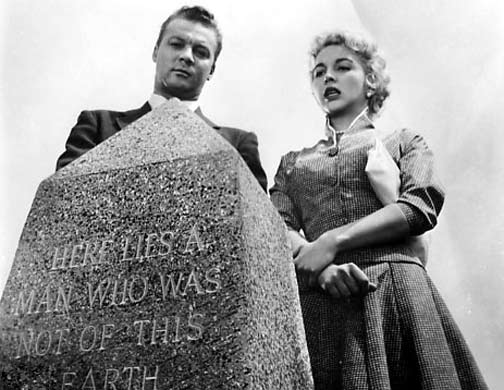
Today’s horror on the lens is the 1957 Roger Corman-directed, sci-fi “epic,” Not of this Earth.

Paul Johnson (Paul Birch) may seems like a strange character, with his stilted way of speaking and his sunglasses and his overdramatic reaction to any and all loud noises.  Paul could us be an eccentric.  Or, he could be …. NOT OF THIS EARTH!  Actually, his habit of draining people of their blood and sending weird, umbrella-like creatures out to attack his enemies would seem to suggest that the latter is probably true.

Listen, it’s not easy being a blood-sucking alien.  I mean, sure, there’s always seems to be people stupid enough to show up at your mansion so that you can drain their bodies.  Paul is lucky that he doesn’t exactly seem to be surrounded by brain surgeons.  But sometimes, things happen.  For instance, someone might show up from your home planet and demand an immediate transfusion!  What is an alien to do?

Watch this low-budget but undeniably entertaining film to find out!  And be sure to especially keep an eye out for the great Dick Miller, who reportedly improvised his role as a vacuum cleaner salesman.  (Before going into acting, Miller actually did sell vacuum cleaners door-to-door.)


The Magic Voyage of Sinbad (1953/1962, directed by Aleksandr Ptushko)


When is a Sinbad film not a Sinbad film?

When it’s The Magic Voyage of Sinbad!

Sinbad (Sergei Stolyarov) returns to his land after going on a great quest.  He sees that half of the citizens are rich and happy and always dancing.  He sees that the other half are poor and never happy.  Those of us watching see that the film’s version of Persia looks a lot like Russia.  Sinbad announces that he is going to capture the Bird of Happiness and bring it back to his people.  He sets sail and is given help by the daughter of Neptune.  Sinbad visits many lands and spend some time underwater, where Neptune offers him the hand of his daughters and there’s also an octopus hanging around and watching in the background.  Sinbad never finds the Bird of Happiness but it doesn’t matter because he realizes that his people have all the happiness that they need in Persia.

The Magic Voyage 0f Sinbad may seem like a strange Sinbad film and that’s because it was never a Sinbad film in the first place.  It was actually a Russian film called Sadko, about a young Russian man who tries to prove himself by finding the Bird of Happiness.  In America, Sadko was even released under its original name and plot in 1953.  No one paid much attention to it.

Then, in 1962, Roger Corman got his hands on the American distribution rights for the film and he decided to rerelease it.  He changed the title to The Magic Voyage of Sinbad and he hired a young film student to write narration for the film and to also “translate” the film’s dialogue so that it could be dubbed into English.  The very Russian Sadko instead became a film about Sinbad, the legendary Persian sailor.

The Corman version went on to become the better-known version, largely because it was featured on Mystery Science Theater 3000.  Personally, I prefer the Corman version because the badness of the dialogue and the overly solemn narration go a long way toward making up for the fact that this is a 79-minute movie about someone searching for something and failing to find it.  After making so many grand promises, Sinbad returns to his home and tells everyone that he actually lied and they don’t need the Bird of Happiness to be happy.  The film ends abruptly, probably because the people rose up and tossed Sinbad in the ocean at that point.

As for that film student who wrote the script, Francis Ford Coppola later did alright for himself.

Horror On The Lens: It Conquered The World (dir by Roger Corman)


“Man is a feeling creature, and because of it, the greatest in the universe….”

Hell yeah!  You tell ’em, Peter Graves!

Today’s Horror on the Lens is 1956’s It Conquered The World.  Graves plays a scientist who watches in horror as his small town and all of the people who he loves and works with are taken over by an alien.  Rival scientist Lee Van Cleef thinks that the alien is going to make the world a better place but Graves understands that a world without individual freedom isn’t one that’s worth living in.

This is one of Corman’s most entertaining films, featuring not only Graves and Van Cleef but also the great Beverly Garland.  Like many horror and science fiction films of the 50s, it’s subtext is one of anti-collectivism.  Depending on your politics, you could view the film as either a criticism of communism or McCarthyism.  Watching the film today, with its scenes of the police and the other towns people hunting anyone who fails to conform or follow orders, it’s hard not to see the excesses of the COVID era.

Of course, there’s also a very persuasive argument to be made that maybe we shouldn’t worry too much about subtext and we should just enjoy the film as a 50s B-movie that was directed with the Corman touch.

Regardless of how interpret the film, I defy anyone not to smile at the sight of ultra-serious Peter Graves riding his bicycle from one location to another.

Here, for your viewing pleasure, is It Conquered The World!


The TSL Horror Grindhouse: The Dunwich Horror (dir by Daniel Haller)


Look at me/I’m Sandra Dee….

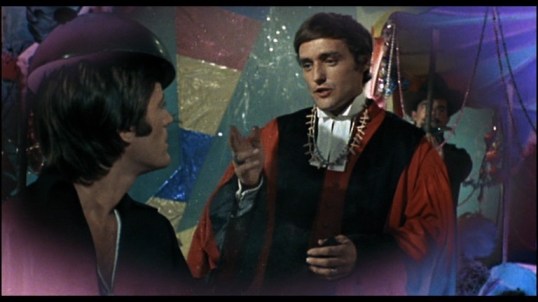
First released in the groovy and psychedelic year of 1970, The Dunwich Horror stars Sandra Dee as Nancy, an somewhat innocent grad student at Massachusetts’s Miskatonic University.  When the mysterious Wilbur Wheatley (Dean Stockwell) comes to the university and asks to take a look at a very rare book called The Necronomicon, Nancy agrees.  She does so even though there’s only one edition of The Necronomicon in existence and it’s supposed to be protected at all costs.  Maybe it’s Wilbur’s hypnotic eyes that convince Nancy to allow him to see and manhandle the book.  Prof. Henry Armitage (Ed Begley) is not happy to see Wilbur reading the book and he warns Nancy that the Wheatleys are no good.

Nancy still agrees to give Wilbur a ride back to his hometown of Dunwich.  She finds herself enchanted by the mysterious Wilbur and she’s intrigued as to why so many people in the town seem to hate Wilbur and his father (Sam Jaffe).  Soon, she is staying at Wilbur’s mansion and has apparently forgotten about actually returning to Miskatonic.  She has fallen under Wilbur’s spell and it soon becomes clear that Wilbur has sinister plans of his own.  It’s time to start chanting about the Old Ones and the eldritch powers while naked cultists run along the beach and Nancy writhes on an altar.  We are in Lovecraft county!

Actually, it’s tempting to wonder just how exactly H.P. Lovecraft would have felt about this adaptation of his short story.  On the one hand, it captures the chilly New England atmosphere of Lovecraft’s work and it features references to such Lovecraft mainstays as Miskatonic University, the Necronomicon, and the Old Ones.  As was often the case with Lovecraft’s stories, the main characters are students and academics.  At the same time, this is very much a film of the late 60s/early 70s.  That means that there are random naked hippies, odd camera angles, and frequent use of the zoom lens.  The film makes frequent use of solarization and other psychedelic effects that were all the rage in 1970.  Lovecraft may have been an unconventional thinker but I’m still not sure he would have appreciated seeing his fearsome cult transformed into a bunch of body-painting hippies.

Really, the true pleasure of The Dunwich Horror is watching a very earnest Sandra Dee act opposite a very stoned Dean Stockwell.  Stockwell was a charter member of the Hollywood counterculture, a friend of Dennis Hopper’s who had gone from being a top Hollywood child actor to playing hippie gurus in numerous AIP films.  As for Sandra Dee, one gets the feeling that this film was an attempt to change her square image.  When Wilbur tells Nancy that her nightmares sound like they’re sexual in origin and then explores her feelings about sex, Nancy replies, “I like sex,” and it’s obviously meant to be a moment that will make the audience say, “Hey, she’s one of us!”  But Sandra Dee delivers the line so hesitantly that it actually has the opposite effect.  Stockwell rather smoothely slips into the role of the eccentric Wilbur.  Wilbur is meant to be an outsider and one gets the feeling that’s how Stockwell viewed himself in 1970.  Sandra Dee, meanwhile, seems to be trying really hard to convince the viewer that she’s not the same actress who played Gidget and starred in A Summer Place, even though she clearly is.  It creates an oddly fascinating chemistry between the two of them.  Evil Wilbur actually comes across as being more honest than virtuous Nancy.

Executive produced by Roger Corman, The Dunwich Horror is an undeniably campy film but, if you’re a fan of the early 70s grindhouse and drive-in scene, it’s just silly enough to be entertaining.  Even when the film itself descends into nonsense, Stockwell’s bizarre charisma keeps things watchable and there are a few memorable supporting performances.  (Talia Shire has a small but memorable roll as a nurse.)  It’s a film that stays true to the spirit of Lovecraft, despite all of the hippies.

4 Shots From 4 Horror Films: The 1960s Part One


This October, I’m going to be doing something a little bit different with my contribution to 4 Shots From 4 Films.  I’m going to be taking a little chronological tour of the history of horror cinema, moving from decade to decade.

Today, we start the 1960s!

4 Shots From 4 Horror Films

Psycho (1960, dir by Alfred Hitchcock)

Psycho (1960, dir by Alfred Hitchcock)

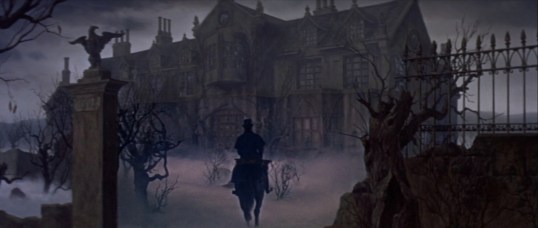
THe Pit and the Pendulum (1961, dir by Roger Corman)

The Pit and the Pendulum (1961, dir by Roger Corman)

The Awful Dr. Orlof (1962, dir by Jesus Franco)

The Awful Dr. Orlof (1962, dir by Jesus Franco)

Black Sabbath (1963, dir by Mario Bava)

Black Sabbath (1963, dir by Mario Bava)

Wizards of the Lost Kingdom (1985, directed by Hector Olivera)


The kingdom has been conquered by an evil sorcerer named Shurka (Thom Christopher).  Young Simon (Vidal Peterson), the son of the king’s wizard, barely escapes with his best friend and pet, the white fur-covered Gufax (Eugenio Martin).  In the wilderness, they meet warrior Kor (Bo Svenson), who teams up with them to free the kingdom.

This is another Roger Corman-produced sword and sorcery film from Argentina.  Corman did a lot of these in the 80s.  Wizards of the Lost Kingdom stands out by being considerably more kid-friendly than the rest of them.  There’s no nudity.  The violence is not excessive and is largely directed at fake looking giant insects.  There’s no nudity and no scenes of the bad guys forcing themselves on women.  The hero even has a toy-friendly companion!

Wizards of the Lost Kingdom also has a lot of stock footage.  The entire pre-title sequence is stock footage lifted from movies like Death Stalker to explain how “King Tyler” came to control the kingdom.  (King Tyler sounds like someone who would be the kegger king of the local college.)  Wizards of the Lost Kingdom is a short movie with a barely 72-minute run-time.  Fourteen of those minutes is footage from other movies.

Wizards of the Lost Kingdom takes a lighter approach to the sword-and-sorcery genre and it pays off with a simple and easy-to-watch movie featuring swords, magic, and monstrous insects.  It’s not a film that demands much of the audience and Bo Svenson looks convincing grunting and carrying a sword.  It wasn’t a box office hit but found a second life on video.  Of course, it got a sequel.  None of the original cast returned.

Horror Scenes That I Love: Dick Miller In The Howling


A true scene stealer, the character actor Dick Miller was a Navy veteran who earned a Phd in psychology, even while he was already appearing on stage.  His 1952 move from New York to California was originally so that he could pursue a career as a writer.  Instead, he ended up becoming one of the most beloved members of Roger Corman’s stock company.  (Famously, in 1952’s Apache Woman, he played both a Native American and the townsperson who shot him.)  Many of the directors who started their careers under Roger Corman continued to cast Dick Miller in their own films, keeping Miller busy as a character actor.  Miller worked with everyone from Martin Scorsese to Joe Dante to James Cameron to Steven Spielberg to Jim Wynorski.  Miller often played characters named Walter Paisley, a reference to his first starring role in Corman’s A Bucket of Blood.

In this scene from 1981’s The Howling, Dick Miller lets two reporters know what’s truly going on with the werewolves.