Late Night Retro Television Review: Highway to Heaven 3.21 “Parents’ Day”


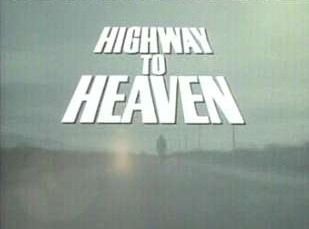
Welcome to Late Night Retro Television Reviews, a feature where we review some of our favorite and least favorite shows of the past!  On Thursdays, I will be reviewing Highway to Heaven, which aired on NBC from 1984 to 1989.  The entire show is currently streaming on Tubi and several other services!
This week, Mark and Jonathan become narcs!

Episode 3.21 “Parents’ Day”

(Dir by Michael Landon, originally aired on February 25th, 1987)

Robert Culp plays one of the worst characters ever in this week’s episode of Highway to Heaven.

Culp plays Ronald James, a news anchor who is known for his fiery anti-drug editorials.  His teenage son, David (Lance Wilson-White), is a student at an exclusive boarding school.  When a joint is found in David’s dorm room, Ronald comes down hard on his son.  Ronald says David should be ashamed of himself.  Ronald says that David has brought dishonor to the family.  Ronald grounds David for four weeks.

After attending an anti-drug lecture delivered by newly hired narcotics detective Mark Gordon, David decides to call the police and tell them about the cocaine that is hidden in his family’s garage.  The cocaine belongs to Ronald but, when Ronald is confronted by the police, he announces that it must belong to David.  When it becomes obvious that Ronald’s job is at risk, he tells David to take the blame.  David says he’ll do it if Ronald promises to stop using.  Ronald agrees.

David takes the blame….

….and Ronald keeps on using!

Seriously, what a scumbag!

While Ronald is disappointing everyone, Jonathan — who is also working as a narcotics detective — pressures the local boarding school drug dealer, Brad Dietrich (Bill Calvert), to stop dealing.  Brad laughs off Jonathan’s threat.  Come back with a warrant, Brad says.  Then Brad’s girlfriend overdoses on the cocaine that Brad gave her.

Finally, after David nearly drinks himself to death, Ronald goes on the news and admits that he’s a drug addict.  He then says that parents have to step up and do a better job.  That’s fine, Ronald, but you know what?  YOU’RE A DRUG ADDICT WHO FRAMED YOUR OWN SON!  You don’t get to be a moral authority!

As you can probably guess, there was not a subtle moment to be found in this episode.  On the one hand, the message was obviously heartfelt.  That’s kind of a given when it comes to Highway to Heaven.  With every episode, it’s obvious that Michael Landon was sincerely trying to make the world a better place.  On the other hand, this episode was so heavy-handed that it sometimes verged on camp.  Culp was very believable as someone who was totally coked up.  The kid playing his son, on the other hand, was considerably less convincing.  It also doesn’t help that there’s a massive hole in the middle of the plot.  If the police were really unsure about who had brought the cocaine into Ronald’s house, they could have just drug-tested both Ronald and David to see who was snorting.  As well, seen from a modern perspective, it’s hard to really buy into the show’s argument that parents and children should be constantly calling the police on each other.  Today we know that the attempt at a zero tolerance war on drugs made the situation even worse.  This episode’s suggestion that snitching on loved ones is the answer reminded me of the worst excesses of the COVID era.

As I mentioned earlier, the episode ends with Ronald making an impassioned plea to parents to get serious about teenage drug use.  Hopefully, he was arrested as soon as the cameras were turned off.


Retro Television Review: Broken Angel (dir by Richard T. Heffron)


Welcome to Retro Television Reviews, a feature where we review some of our favorite and least favorite shows of the past!  On Sundays, I will be reviewing the made-for-television movies that used to be a primetime mainstay.  Today’s film is 1988’s Broken Angel!  It  can be viewed on YouTube.

Chuck Coburn (William Shatner) has a nice house in the suburbs, a nice job, a nice car, and a nice Bruins jacket.  He’s hoping that he can once against have a nice marriage with his wife (Susan Blakely), despite the fact that she cheated on him and she still thinks that he spends too much time at work.

Chuck is proud of his teenage daughter, Jaime (Erika Eleniak).  Jaime seems like the perfect suburban and angelic teenager.  But then Jaime goes to prom and her best friend, Jenny (Amy Lynne), is gunned down in front of her.  Jaime runs from the scene and vanishes.  As Chuck searches for his daughter, he is stunned discover that Jaime, Jenny, and their boyfriends were all a part of a gang!  His perfect daughter was smoking weed, doing cocaine, selling crack, and taking part in rumbles with a rival Asian gang.  Even worse, Jaime’s gang was called …. LFN!

LFN?  That stands for Live For Now.  The Live For Now Gang.  Whenever we see the members of the gang preparing to get into a fight with another gang, they all chant, “LFN!  LFN!”  LFN is a gang of white suburban teenagers and they look just as dorky as they sound.  I mean, I think it would be bad enough to discover that your child is in a gang but discovering they were in a dorky gang would probably make it even worse.

The majority of Broken Angel is made up of scenes of Chuck searching the mean streets of Los Angeles.  He partners with a social worker (Roxann Dawson) who is herself a former gang member.  Chuck discovers that his daughter’s street name was — *snicker* — Shadow.  He also befriend a member of the LFN’s rival Asian gang and tries to encourage her to go straight.  This leads to scene in which he is attacked by Al Leong.  Somehow, middle-aged William Shatner manages to beat up Al Leong.  That, in itself, is worth the cost of admission.

Broken Angel deals with a serious issue but it does so in such an overwrought and melodramatic fashion that most viewers will be moved not to tears but to laughter.  In Broken Angel, William Shatner gave the type of overly dramatic and self-serious performance that he routinely pokes fun at today.  If you’re one of those people who enjoys listening as Shatner emphasize random syllables and takes meaningly pauses, this movie will give you a lot to enjoy.  In every scene, Shatner seems to be saying, “Notice me, Emmy voters!  Notice me!”  Of course, it wouldn’t be until Shatner learned how to laugh at himself that the Emmy voters would finally notice him.

The film ends on an abrupt note but with the promise of better days ahead.  Just remember — keep an eye out for the LFN!

The TSL’s Horror Grindhouse: Chopping Mall (dir by Jim Wynorski)


This 1986 film tells the story of what happens when one local mall decides that it’s had enough of thievery and vandalism.

First off, automatic locks and shutters are installed.  What that means is that, at a certain hour, anyone who is inside the mall is going to be trapped there until the morning.  Secondly, three robots are used as a security force.  They’re called Protectors and they roll around, looking for thieves and keeping people safe.  Don’t worry about getting mistaken for a thief, of course.  As long as you’ve got a badge, the protector will just say, “Thank you and have a good day.”

It all seems perfect but …. what if the robots malfunction?  What if they ignore the badges and just start killing anyone unlucky enough to be trapped in the mall for the night?  Surely, that could never happen, right?

Of course, it does happen.  Thanks to a freak electrical storm, the Protectors come to life and set out to keep the mall safe from intruders.  First, they kill the technicians that are supposed to keeping a watch over them.  Then, they kill a janitor named Walter Paisley (played, of course, by Dick Miller).  Then, they set off after the six attractive people who were having a sleep-over in one of the stores.

So, what did I learn from Chopping Mall?

Well, I was tempted to say that I learned not to shoplift but actually, no one in the movie gets in trouble for shoplifting.  I guess the main thing I learned is not to walk around the mall in my underwear because that definitely seems to be something that will cause the Protectors to blow up your head.

I also learned that, if you’re tapped in the mall with a bunch of killer robots, the best place to go is the sporting goods store because that store not only has a lot of automatic rifles but also an unlimited supply of ammunition.  Of course, I already learned that from Dawn of the Dead but it’s always good to be reminded….

Anyway, Chopping Mall is a lot of fun.  It’s undeniably dated.  Just the fact that everyone’s life revolves around a mall tells you just how dated it is.  I guess if they made the film now, it would have to take place at an Ikea store or maybe an Amazon warehouse.  But the fact that the film is dated is a part of what makes it so much fun to watch.  Seriously, it’s amazing all of the stuff that apparently used to go on at the local mall in the 80s.

Despite the fact that they have a bad habit of killing people, the Protectors are actually kind of cute.  If nothing else, they’re unfailingly polite.  You have to love the fact that they’ll wish you a nice day even after they’ve killed you.  Surprisingly enough, the humans are just as likable as the Protectors.  For a film about killer robots, Chopping Mall is surprisingly well-acted by a likable cast.  Russell Todd, who was the best-looking man to ever be killed by Jason Voorhees, is in this film and he’s as broodingly handsome here as he was in Friday the 13th Part II.

Chopping Mall is a good mix of humor and thrills and robots and exploding heads and Dick Miller.  This is 80s mall horror at its best!

A Movie A Day #103: Mobsters (1991, directed by Michael Karbelnikoff)


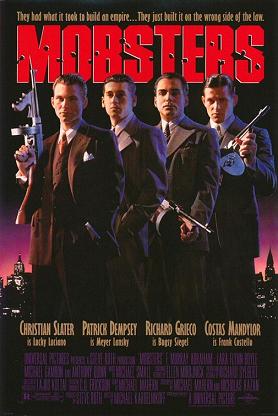
The place is New York City.  The time is the prohibition era.  The rackets are controlled by powerful but out of touch gangsters like Arnold Rothstein (F. Murray Abraham), Joe Masseria (Anthony Quinn), and Salvatore Faranzano (Michael Gambon).  However, four young gangsters — Lucky Luciano (Christian Slater), Meyer Lansky (Patrick Dempsey), Frank Costello (Costas Mandylor), and Bugsy Siegel (Richard Greico) — have an ambitious plan.  They want to form a commission that will bring together all of the Mafia families as a national force.  To do it, they will have to push aside and eliminate the old-fashioned mob bosses and take over the rackets themselves.  When Masseria and Faranzano go to war over who will be the new Boss of all Bosses, Luciano and Lansky seen their opportunity to strike.
I love a good gangster movie, which is one reason that I have never cared much for Mobsters. Mobsters was made in the wake of the success of Young Guns and, like that film, it attempted to breathe new life into an old genre by casting teen heartthrobs in the lead roles.  There was nothing inherently wrong with that because Luciano, Lansky, and Seigel were all still young men, in their 20s and early 30s, when they took over the Mafia.  (Costello was 39 but Mobsters presents him as being the same age as they other three.)  The problem was that none of the four main actors were in the least bit convincing as 1920s mobsters.  Christian Slater was the least convincing Sicilian since Alex Cord in The Brotherhood.  As for the supporting cast, actors like Chris Penn and F. Murray Abraham did the best that they could with the material but Anthony Quinn’s performance in Mobsters was the worst of his long and distinguished career.

Fans of Twin Peaks will note that Lara Flynn Boyle had a small role in Mobsters.  She played Luciano’s girlfriend.  Unfortunately, other than looking pretty and dying tragically, she was not given much to do in this disappointing gangster film.

Back to School Part II #33: No One Would Tell (dir by Noel Nosseck)


no_one_would_tell

Do you remember when Chris Brown performed The Man In The Mirror at the 2010 BET Awards?  It was during a tribute to Michael Jackson and Brown broke down crying while singing the song.  Afterwards, he accepted an award and he said, “I let you all down before, but I won’t do it again.  I promise you.”

This, of course, was about a year after Brown had pled guilty to physically abusing Rihanna.  I remember being on twitter during Brown’s performance and seeing literally thousands of tweets from people talking about how brave Chris Brown was and how amazing his performance had been.  Chris Brown was looking at the man in the mirror and asking him to change his ways.  Chris Brown was promising not to let anyone else down by nearly killing any future girlfriends.  A lot of people on twitter claimed this was amazing.  I thought it was disgusting and I tweeted out my opinion.  I really didn’t give a fuck if Chris Brown was asking the man in the mirror to change his ways.  The man in the mirror was (and is) an abusive asshole.  The man in the mirror beats women.  The man in the mirror is not capable of changing his ways.  “FUCK THE MAN IN THE MIRROR!” I tweeted.

And, oh my God, the reaction my little twitter rant inspired.  What was especially disturbing was that the majority of people who tweeted me in Brown’s defense were other women.  Yes, they all agreed, Chris Brown had beat Rihanna but he admitted what he had done, he was asking the man in the mirror to change his ways, and hey, Rihanna probably deserved it.

My favorite excuse — and this was used by quite a few of Brown’s defenders — was this: “Only God can judge Chris Brown.”  Well, you know what?  I asked God and he says Chris Brown’s an abusive asshole.

I’m tempted to say that it amazes me that Chris Brown still has fans but actually, it doesn’t.  Sadly, when it comes to a celebrity, people are willing to make excuses for almost anything.  If you ask most people, they’ll say that they’re against domestic abuse and they think abusers should suffer the worst punishment imaginable.  But when the abuser is someone who they know (or, in the case of a celebrity like Chris Brown, someone who they feel they know), the excuses start.  The equivocations are heard.  The blame is assigned to everyone but the abuser.  We start hearing bullshit about how people make mistakes and only God can judge.

In short, people are willing to talk but when it matters, they rarely act.

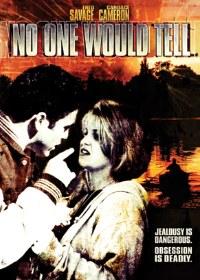
That’s also the theme of a powerful and sad movie called No One Would Tell.  No One Would Tell was originally made for television in 1996 and it still shows up fairly regularly on Lifetime.  Though the names and certain details have been changed, it’s based on a true story.  In fact, the film feels like it’s based on several true stories.  The plot of No One Would Tell is one that has occurred and continues to occur on far too regular of a basis.

Stacy Collins (played by Candace Cameron, before she added the Bure to her name) is a 16 year-old high school student.  She’s quiet, shy, and insecure.  When she first starts to date a popular jock named Bobby Tennison (Fred Savage), it seems like a dream come true.  But soon, Bobby starts to show another side.  He’s controlling and possessive.  He grabs her wrist hard enough to leave bruises.  He shoves her into a wall when they have an argument.  When she wears a skirt that he thinks is too short, he grabs her in the school hallway and demands that she change immediately.  When she isn’t home to answer his calls, he assumes that she most be cheating on him.  And, when she finally breaks up with him, he kills her.

What’s infuriating is that, throughout the film, Bobby’s abuse is witnessed by all of his and Stacy’s friends.  Everyone sees him push her.  Everyone sees the bruises.  Everyone knows that Bobby is unstable and that Stacy is afraid of him.  And yet, nobody says a word.  Nobody does a thing.  Instead, they just make excuses for Bobby’s behavior.  Some of them even blame Stacy.  No one is willing to get involved and it eventually costs Stacy her life.

For a TV movie from the mid-90s, No One Would Tell holds up surprisingly well.  Admittedly, Fred Savage overacts in the role of Bobby (and maybe it would have been better if the role had been played by Eric Balfour, who appears as Bobby’s best friend) but Candace Cameron does a perfect job as the tragic Stacy, capturing both her insecurity and her vulnerability.  Some of the film’s best moments are the ones shares by Cameron and Michelle Phillips.  In those scenes, we see how Stacy learned how to make excuses for Bobby’s behavior from watching the way that her mother made excuses for the men who similarly abused her.  No One Would Tell is a powerful film, one that offers an unflinching look at abuse and one that dares to demand that its audience take a stand.

No One Would Tell is a film that should be watched by anyone who thinks that the man in the mirror can change his ways.