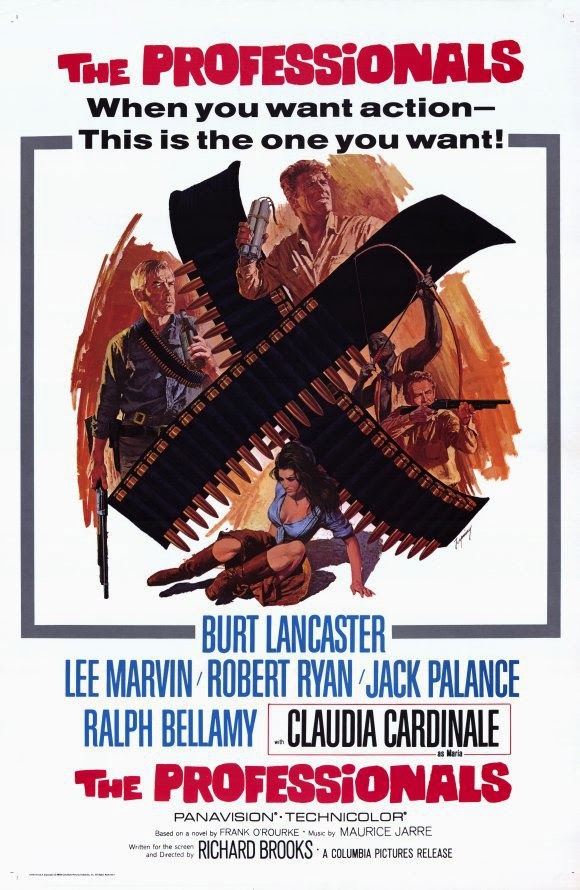
Experience Matters: THE PROFESSIONALS (Columbia 1966)


gary loggins's avatarcracked rear viewer

pro1

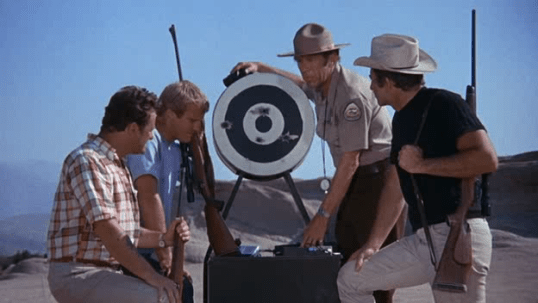
A quartet of macho mercenaries – Lee Marvin Burt Lancaster Robert Ryan , and Woody Strode  – cross the dangerous Mexican desert and attempt to rescue a rich man’s wife kidnapped by a violent revolutionary in writer/director Richard Brooks’ THE PROFESSIONALS, an action-packed Western set in 1917.  The film’s tone is closer to Sergio Leone’s Spaghetti Westerns than the usual Hollywood oater, though Leone’s trilogy wouldn’t hit American shores until a year later.

pro2

Rich rancher J.W.Grant (screen vet Ralph Bellamy ) hires the quartet to retrieve wife Maria (Claudia Cardinale) from Jesus Raza (Jack Palance ), formerly a captain in Pancho Villa’s army, now a wanted bandito. Marvin is the stoic leader, a weapons expert who once rode with Raza for Villa, as did Lancaster’s explosives whiz. Ryan plays a sympathetic part (for a change) as the horse wrangling expert, while Strode is a former scout and bounty hunter adept…

View original post 373 more words

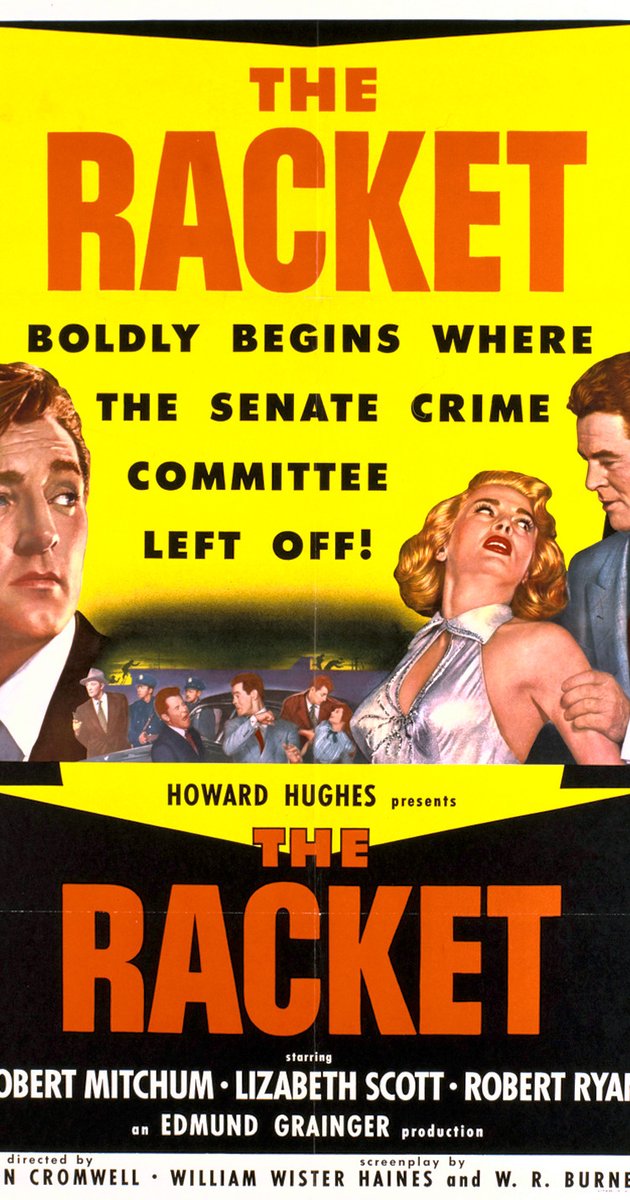
Diluted Noir: Robert Mitchum in THE RACKET (RKO 1951)


gary loggins's avatarcracked rear viewer

racket1

A solid film noir cast headed by Robert Mitchum Robert Ryan , and Lizabeth Scott ; and a lineage that dates back to both a Broadway smash and an Oscar-nominated original can’t save THE RACKET from rising above minor status. Once again, tinkering behind the scenes by RKO honcho Howard Hughes, this time under pressure from Hollywood censorship czar Joseph I. Breen, scuttles a promising premise that coulda been a contender into an average movie.

racket2

City crime boss Nick Scanlon is an old-school hood whose violent ways don’t jibe with the modern-day syndicate. Capt. Thomas McQuigg, “an honest cop” who’s a no-nonsense guy, is determined to take him down. But the city’s rife with tainted politicians, making McQuigg’s job that much harder. Scanlon’s got a headstrong kid brother named Joe dating a “cheap canary” named Irene, and McQuigg plans on using him to get to Nick. Add a crooked DA, a…

View original post 531 more words

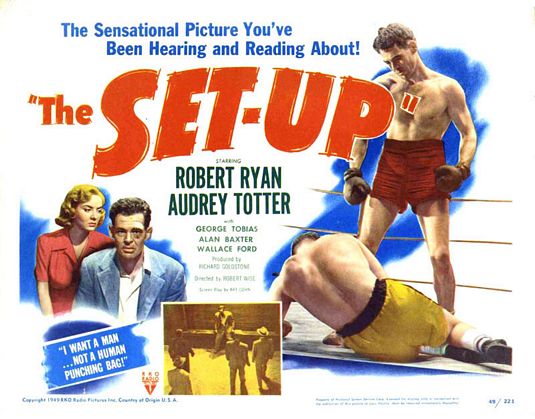
Bloody Pulp Fiction: THE SET-UP (RKO 1949)


gary loggins's avatarcracked rear viewer

setup1

The seedy worlds of professional boxing and film noir were made for each other. Both are filled with corruption, crime, and desperate characters trapped in situations beyond their control.  Movies like CHAMPION, BODY AND SOUL, and THE HARDER THEY FALL expose the dark underbelly of pugilism. One of the best of this sub-genre is THE SET-UP, Robert Wise’s last film for RKO studios. He doesn’t fail to deliver the goods, directing a noir that packs a wallop!

THE SET-UP follows one night in the life of aging, washed up fighter Stoker Thompson ( Robert Ryan ). Stoker’s 35 now, ancient in boxing terms, but still has delusions of making the big time. Wife Julie (Audrey Totter ) is tired of going from one tank town to the next, and fears for Stoker’s safety. She refuses to go to tonight’s fight, a matchup with up and coming young contender Tiger…

View original post 817 more words

Cleaning Out the DVR Pt 7: Film Noir Festival


Now that Lisa’s finished cleaning out her DVR, it’s time once again for me to clean mine, featuring five fabulous films noir:

gary loggins's avatarcracked rear viewer

prev

I first got my DVR service from DirecTV just in time for last year’s TCM Summer of Darkness series, and there’s still a ton of films I haven’t gotten around to viewing… until now! So without further ado, let’s dive right into the fog-shrouded world of film noir:

dvr7.1

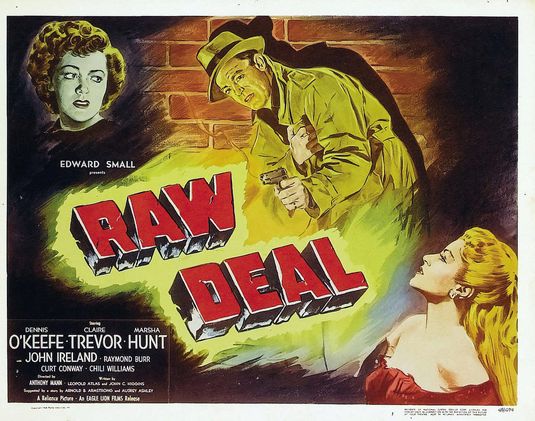
RAW DEAL (Eagle-Lion 1948, D: Anthony Mann)

This tough-talking film seems to cram every film noir trope in the book into its 79 minutes. Gangster Dennis O’Keefe busts out of prison with the help of his moll ( Claire Trevor ), kidnaps social worker Marsha Hunt, and goes after the sadistic crime boss (Raymond Burr) who owes him fifty grand. Director Mann and DP John Alton make this flawed but effective ultra-low budget film work, with help from a great cast. Burr’s nasty, fire-obsessed kingpin is scary, and John Ireland as his torpedo has a great fight scene with O’Keefe. The flaming finale is well staged…

View original post 614 more words

44 Days of Paranoia #2: Executive Action (dir by David Miller)


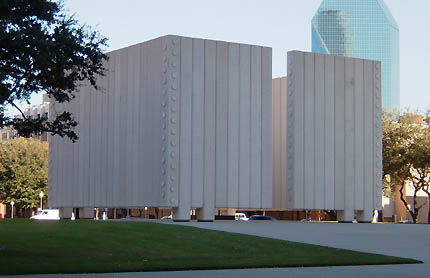
The Kennedy Memorial in Downtown Dallas

The Kennedy Memorial in Downtown Dallas

Even though it happened 22 years before I was born, I sometimes feel as if it was only yesterday that President John F. Kennedy was assassinated.

A lot of that is because I’m from Dallas.  When I was born, my family lived in Oak Cliff, a few blocks away from where the accused assassin Lee Harvey Oswald once lived.  I drive by the Kennedy Memorial several times a week.  I’ve gone to the Sixth Floor Museum.  I’ve made out on the Grassy Knoll.  On a daily basis, I see tourists who have come down here from up north with their preconceived prejudices, their unwieldy copies of Stephen King’s 11/22/63, and their overactive sweat glands.  (“How do you handle the heat!?” they ask when the temperature is barely above 90.)  With the 50th anniversary of the assassination approaching, the Dallas Morning News has been running daily stories examining every detail of that terrible event.

The rest of the nation, of course, will never let us forget that JFK was assassinated in Dallas.  Just last week, there was an idiotic and bitter opinion piece in The New York Times, written by James McAuley, in which he claimed that Dallas was a “city of hate” that should feel more guilt over the JFK assassination.  As McAuley (who is studying history at Oxford and is not a resident of that city that he apparently feels qualified to judge) put it, “For 50 years, Dallas has done its best to avoid coming to terms with the one event that made it famous: the assassination of John F. Kennedy on Nov. 22, 1963.”

This, of course, is bullshit.

There are two competing schools of thought about the assassination of John F. Kennedy.  One says that Lee Harvey Oswald was solely responsible.  The other is that Kennedy was killed as the result of a complex conspiracy.

JFK Assassination Bullets

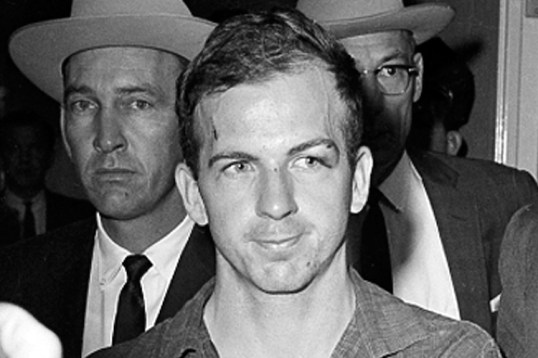
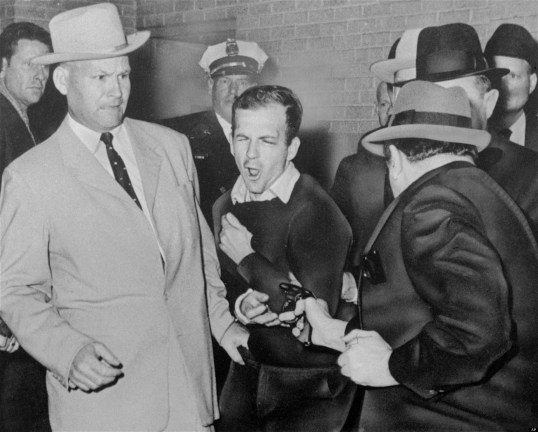
Let’s say, for the sake of argument, that Lee Harvey Oswald acted alone.  Well, Oswald was born in New Orleans but he was raised up north in New York City.  He was also a communist with a history of mental instability.  Hence, if you accept that Oswald was the lone assassin than you also have to be willing to accept that Oswald would have tried to kill Kennedy regardless of what city he was living in.

IMF Head-Perp Walk

Things get a bit more complicated if you believe that Kennedy was killed as the result of a conspiracy.  But let’s consider the usual suspects that come up whenever people start talking about the possibility of conspiracy.  The Mafia was based in the north.  The CIA was based in Washington, D.C.  The anti-Castroites were based in Miami.  Again, all of these conspirators would have killed Kennedy regardless of what city he went to in November.

It’s easy for the rest of the country, in a fit of jealousy, anger, and delusion, to blame Dallas and Texas for the assassination of John F. Kennedy but, regardless of whether you believe in the lone assassin or a larger conspiracy, the truth is far more complex.

Over the next few days, as part of the 44 Days of Paranoia, I’ll be taking a look at some of the many films that were inspired by this assassination.  Let’s start things off with one of the lesser known entries in the JFK genre, 1973’s Executive Action.

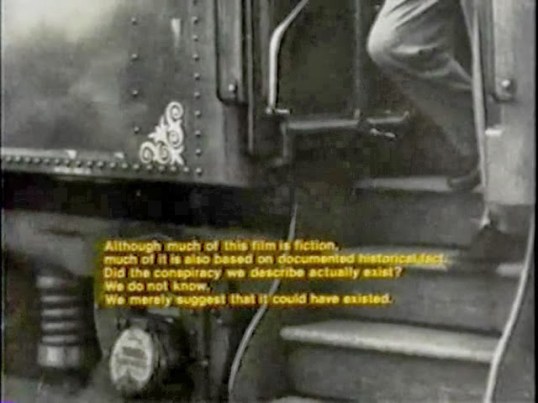
Executive Action opens with a series of grainy, black-and-white photographs of both America in the 1960s and the men who, over the course of the film, will be portrayed as having plotted and carried out the assassination of President Kennedy while a mournful piano plays in the background.  It’s a low-key but eerily effective opening and it also lets the viewers know exactly what type of film they are about to see.  As opposed to Oliver Stone’s far better known JFK, Executive Action is a low-key, almost deliberately undramatic film.   Despite the fact that there are some familiar faces in the cast (or, at the very least, familiar faces to those of us who watch TCM), Executive Action almost feels as if it could have been a documentary.

blogger-image--1805315534

As the film opens in 1963, we see a group of very rich men talking about the future of America.  Ferguson (Will Geer) and Foster (Robert Ryan) are concerned that President Kennedy’s policies are going to destroy America.  Foster is worried that Kennedy is planning on cutting back on military spending.  Ferguson is upset by Kennedy’s support of the Civil Rights movement.  (In one memorable scene, we see Martin Luther King delivering his Dream speech on TV before the camera pulls back to reveal Ferguson watching in disgust.)  Their associate, the shadowy Farrington (Burt Lancaster), argues that the only way to stop Kennedy is to assassinate him and put the blame on a lone gunman.

With the support of Ferguson and Foster, Farrington recruits a group of gunmen (led by Ed Lauter and including Roger Corman regular Dick Miller) and works to set up the perfect patsy.  A man (James MacColl) goes around Dallas, acting obnoxious and telling anyone who will listen that his name is Lee Oswald.  At Ferguson’s insistence, a picture is doctored to make it appear as if Lee Harvey Oswald is posing in his backyard with a rifle.  As all of this goes on, the date of November 22nd steadily approaches…

ex3

As I stated before, Executive Action is an almost obsessively low-key film.  That, however, works to the film’s advantage.  Ferguson, Foster, Farrington, and the other conspirators are chillingly believable because they are presented almost as being anonymous.  Instead of being portrayed as being super villains, they are instead men who approach assassination as just another part of doing business.  The impression one gets is that Kennedy isn’t the first leader they’ve had killed and he probably wasn’t the last.  Director David Miller seamlessly mixes historical footage with film reenactments and the end result is a disturbingly plausible film.

Unfortunately, Executive Action is less well-known than some of the other films that have argued that a conspiracy was responsible for the assassination for John F. Kennedy.  However, it may very well be the best.

executive-action-movie-poster-1020681901

A Quickie With Lisa Marie: Crossfire (dir. by Edward Dmytryk)


I recently decided that I wanted to watch and review every single movie ever nominated for the Academy Award for best picture.  As part of that mission, I recently rewatched one of my favorite also-rans, 1947’s Crossfire.

Crossfire is a message movie disguised as a B detective flick.  A group of soldiers who have just returned from World War II decide to get together for a drink.  At the bar, they run into a civilian named Joseph Samuels (Sam Levine).  The soldiers end up going back to Samuels’s apartment and the next morning, Samuels is found dead.  Obviously, he was killed by one of the soldiers but which one.  Suspicion falls on the meek (and missing) Floyd Bowers (Steve Brodie) but police detective Finlay (Robert Young) and Sgt. Peter Keeley (Robert Mitchum) both (correctly) suspect that Samuels was actually murdered by the far more outspoken and imposing Montgomery (Robert Ryan).  It quickly becomes obvious that Montgomery is an anti-Semite who killed Samuels solely because he was Jewish.  However, neither Finlay or Keeley can prove it.  The film quickly becomes a darkly intense duel between these three men as Finlay and Keeley attempt to trick Montgomery into implicating himself while Montgomery attempts to further frame Bowers for the murder.

Before Crossfire, director Edward Dmytryk specialized in making low-budget “B” movies and he brings that noir, near-grindhouse sensibility to Crossfire.  As a result, Crossfire is a one of those rare “message” films that is actually entertaining.  Only a few times does the film start to feel preachy and luckily, Robert Mitchum is there being his usual cynical self.  If anyone could deflate the pompous nature of the mid-40s message movie, it was Robert Mitchum.  The film says, “Love one another.”  Mitchum replies, “Baby, I just don’t give a damn,” and he keeps things from getting too heavy-handed.  Mitchum is one of three Roberts to star in this film.  Robert Young plays the police inspector with just the right amount of world-weary indignation while Robert Ryan is a force of nature as the film’s brutal murderer.  Don’t get me wrong.  You can pretty much peg Ryan as a killer from the first minute he shows up on-screen.  If Mitchum and Young smartly underplay their roles, Ryan goes the exact opposite direction.  He’s an obvious brute but he’s also totally believable.  You look at his character and it’s not difficult to imagine him passing the collection plate at Westboro Baptist Church.  As well, Crossfire also features an excellent supporting term by one of my favorite noir actresses, the great and wonderful Gloria Grahame.  She plays Bowers’ married girlfriend and gives a compellingly, real performance that suggests that maybe Hollywood in the 40s wasn’t quite as clueless as we all like to assume.

Crossfire was nominated for Best Picture of 1947 but it lost to another film about anti-Semitism, Elia Kazan’s Gentleman’s Agreement.  (Oddly enough, both Kazan and Dmytryk would end up naming names during the McCarthy Era.)  Like Gentleman’s Agreement, Crossfire was based on a novel.  However, in the original novel, the victim was not Jewish but instead was gay.  However, back in the 1940s, the Hollywood Production Code specifically forbade any open depiction of homosexuality and so, the crime went from being motivated by homophobia to anti-Semitism.