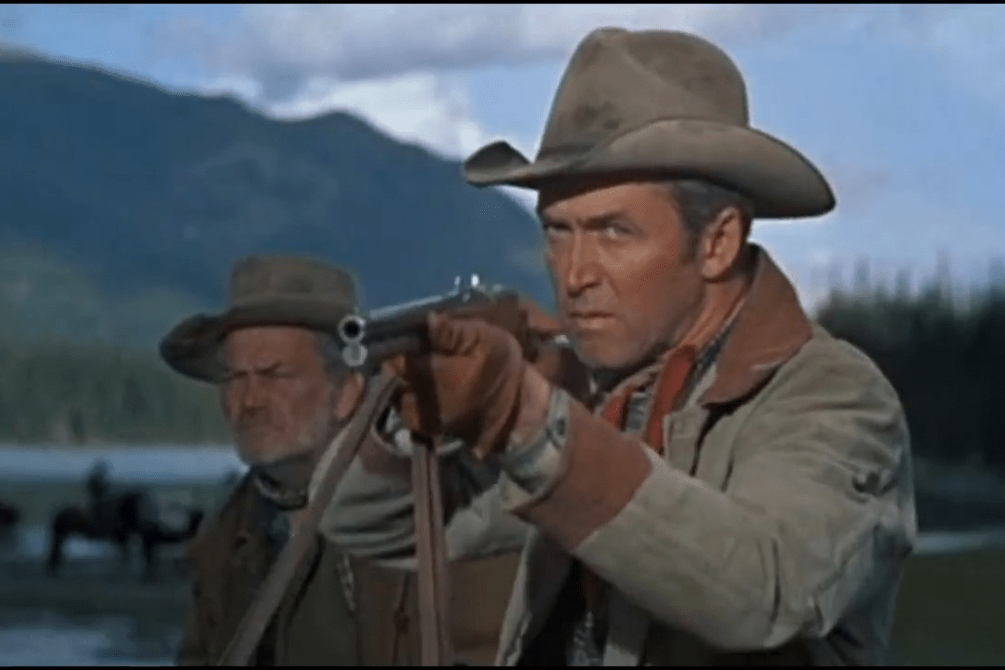
THE FAR COUNTRY (1954) – James Stewart and Walter Brennan head North to make their fortune!


James Stewart is one of the great movie stars of all-time. His work with Frank Capra (MR. SMITH GOES TO WASHINGTON, IT’S A WONDERFUL LIFE) and Alfred Hitchcock (REAR WINDOW, VERTIGO) is legendary. In my household, Stewart’s work with director Anthony Mann is celebrated just as much as those other classics. Mann and Stewart made five classic westerns, beginning with WINCHESTER ‘73 in 1950 and ending in 1955 with THE MAN FROM LARAMIE. I own them all on DVD and watch them quite often. It’s very cold in Arkansas today, so I decided to write about the Yukon-set THE FAR COUNTRY, from 1954. 

Jeff Webster (James Stewart) and his crusty ol’ coot of a partner Ben Tatem (Walter Brennan) head North towards Dawson City, in the Yukon Territory, with a herd of cattle. The two men encounter a variety of problems along the way, with the biggest being the corrupt Judge Gannon (John McIntire) of Skagway, Alaska. When Jeff finds himself in front of the judge for killing two cowhands who tried to steal his herd, Gannon acquits him on the charges but decides to keep his herd as payment for the court fees. With their cattle taken away from them, Jeff and Ben sign up to help business lady Ronda Castle (Ruth Roman) take supplies to Dawson City, where she plans to set up shop. After their first day on the trip, Jeff and Ben double back to Skagway and re-take their herd and take off towards Dawson as fast as they can go, with Gannon and his men in hot pursuit. They’re able to make it into Canada, so Gannon and his goons turn back, determined to hang the men if they ever come back through Skagway.

So Jeff and Ben make it to Dawson City with their cattle where they sell them off for $2 per pound to Ronda. Suddenly flush with cash, the two partners buy a gold claim and proceed to find some nice golden nuggets! When they head back into town, they find that Judge Gannon has now come to Dawson City and is in partnership with Ronda. Of course, that bastard immediately starts cheating the miners out of their claims, this time with gunman Madden (Robert J. Wilke) by his side, enforcing his corrupt actions with lead. Jeff and Ben decide they’re going to sneak out of town with their loot, but Gannon finds out about it and sends his men to stop them. Ben is killed in the process and Jeff is seriously injured. Jeff has tried his best up to this point to not get involved with the mess in Dawson City, but with his best friend now dead, he decides it’s time for Judge Gannon and his thugs to be stopped. 

James Stewart is just so good as Jeff Webster. The best thing about his work with Mann is how each of the movies would give him a meaty role that capitalized on his basic decency, while simultaneously making him a more complex, layered man, miles away from the likes of Mr. Smith or George Bailey. In THE FAR COUNTRY, he’s as tough as nails, but he really doesn’t want to get involved with the people around him. It takes the death of his best friend for him to finally commit to helping them stand up against the bad guys. Stewart’s work here, and in the other Mann westerns, ranks with his very best. 

The remainder of the cast is uniformly excellent. Three time Oscar winner Walter Brennan is always a welcome presence in a movie I’m watching. While he’d pretty much settled into the “old coot” role that would come to personify the later part of his career, his character is a valuable conscience for Stewart a couple of times in the story. I thought that John McIntire and Ruth Roman really stood out in their respective roles as the corrupt Judge Gannon and the stubbornly, independent businesswoman Ronda Castle. Both give excellent performances. The cast is rounded out with a who’s who of character actors like Jay C. Flippen, Harry Morgan, Robert J. Wilke, Royal Dano, and Jack Elam. It’s always nice seeing these familiar faces pop up in these old westerns.

I love it when movies are filmed on location in beautiful places. THE FAR COUNTRY was filmed at the Jasper National Park in Alberta, Canada, which added another interesting element to the film. The final thing I want to say about the film is that the screenplay for THE FAR COUNTRY was written by Borden Chase, who had penned RED RIVER a few years earlier. Not only would Chase write this movie, he would also write the screenplays for WINCHESTER ‘73 and BEND OF THE RIVER, both westerns that paired Anthony Mann and Jimmy Stewart. Chase was an excellent writer of western material, and his strong work in this group of films is crucial to their enduring success. 

Overall, I confidently recommend THE FAR COUNTRY to any person who enjoys westerns or Jimmy Stewart. I might rank THE NAKED SPUR and THE MAN FROM LARAMIE slightly above this one in the Mann / Stewart westerns, but the truth is that you can’t go wrong with any of them. 

I’m sharing the trailer for THE FAR COUNTRY below:

Stripes (1981, directed by Ivan Reitman)


Bill Murray and Harold Ramis join the army.

Wait, that can’t be right, can it?  Bill Murray and Harold Ramis were cinematic anarchists.  Early in his career, Bill Murray was the ultimate smart aleck slacker who did not have any respect for authority.  Harold Ramis was hardly a slacker but he came across as someone more likely to be marching on the Pentagon than guarding it.  Stripes is one of the ultimate examples of a comedy where the laughs come from things  that don’t seem to go together suddenly going together.

John Winger (Murray) at least has a reason to join the army.  He has a dead end job.  He has just broken up with his girlfriend.  The country appears to be at peace so why not spend four years in the Army?  It’s harder to understand why John’s friend, Russell (Ramis), also decides to enlist, other than to hang out with John.  Along with Ox (John Candy), Cruiser (John Diehl), Psycho (Conrad Dunn), and Elm0 (Judge Reinhold), they enlist and go through basic training under the watchful eye of Sgt. Hulka (Warren Oates).  John and Russell go from treating everything like a joke to invading East Germany in a tank that’s disguised as an RV.  They also meet the two sexiest and friendliest MPs in the service, Stella (P.J. Soles) and Louise (Sean Young).  Russell goes from being an proto-hippie who teaches ESL to asking John if he thinks he would make a good officer.  John goes from not taking anything seriously to picking up a machine gun and rescuing his fellow soldiers.

It’s a comedy that shouldn’t work but it does.  It’s actually one of my favorite comedies, full of memorable lines (“Lighten up, Frances.”), and stupidly funny situations.  The cast is full of future comedy legends and P.J. Soles shows that she deserved to be a bigger star.  This was early in Bill Murray’s film career and he was still largely getting by on his SNL persona but, in his confrontations with Hulka, Murray got a chance to show that he could handle drama.  With all the comedic talent in the film, it’s Warren Oates who gets the biggest laughs because he largely plays his role straight.  Sgt. Hulka is a drill sergeant who cares about his men and who knows how to inspire and teach  but that doesn’t mean he’s happy about having to deal with a collection of misfits.  (Watch his face when Cruiser says he enlisted so he wouldn’t get drafted.)

The movie does get strange when the action goes from the U.S. to Germany.  What starts out as Animal-House-In-The-Army instead becomes an almost straight action movie and the movie itself sometimes feels like a recruiting video.  Join the Army and maybe you’ll get to steal an RV with PJ Soles.  That would have been enough to get me to enlist back in the day.  But the combination of Murray, Ramis, and Oates makes Stripes a comedy that can be watched over and over again.

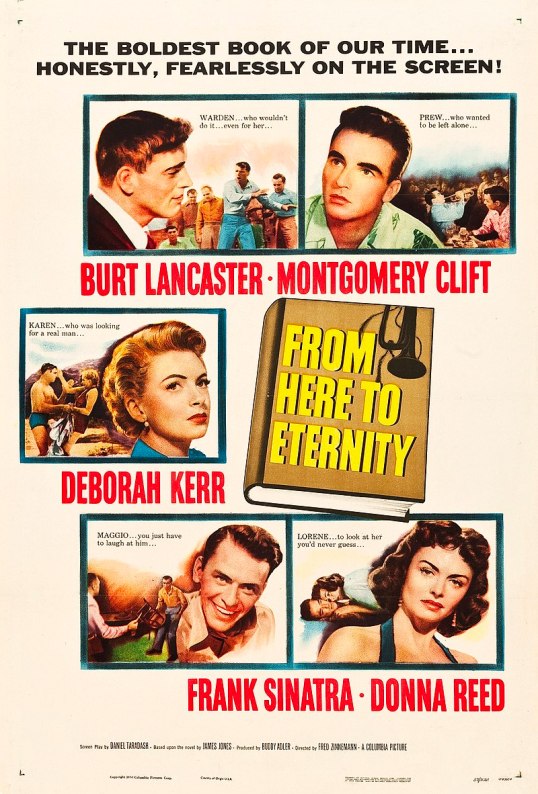
Lisa Marie Reviews An Oscar Winner: From Here To Eternity (dir by Fred Zinnemann)


“The boldest book of our time,” shouts the poster art for 1953’s From Here To Eternity, “honestly, fearlessly brought to the screen!”

And indeed, James Jones’s novel was brought to the screen about as boldly as a studio film could be brought in 1953.  The book told the story of several soldiers in the days immediately before the attack on Pearl Harbor.  The Production Code was still in effect and, as a result, a few changes were made to the film’s plot.  Donna Reed played Lorene, a character who is described as being a “hostess” at social club but who, in the book, worked at a brothel that was popular with the soldiers from a nearby army base.  In the book, an unfaithful husband gives his wife a venereal disease that leads to her getting a hysterectomy.  In the movie, Karen’s (Deborah Kerr) hysterectomy was the result of a miscarriage that occurred after she discovered her husband was being unfaithful.  The book was critical of the Army and featured officers who faced no consequences for their actions.  The movie definitely presents the enlisted men as being at the mercy of officers but the worst of the officers is ultimately disciplined.  The movie was made with the cooperation of the U.S. Army and, as a result, the film’s villains — like Captain Holmes (Philip Ober) and the monstrous Fatso Judson (Ernest Borgnine) — were portrayed as being aberrations who did not represent the Army as a whole.  That said, the film version of From Here To Eternity is still a powerful, moving, and daring film.  What couldn’t be shown on screen is still suggested.  One might not see the specifics of what Fatso Judson does to Maggio (Frank Sinatra) in the stockade but it’s not difficult to figure out.

The film follows one company of soldiers as they laugh, fight, and fall in love while stationed in Hawaii.  They spend time training for a war that most of them think will never come.  Captain Holmes is more concerned with his regimental boxing team than the prospect of going to war and is confused when Private Prewitt (Montgomery Clift) refuses to stop back into the ring.  Prewitt, who takes pride in his ability as a bugler, quit boxing after he blinded an opponent in the ring but Holmes doesn’t care.  Holmes wants another trophy for his office.  He orders Sgt. Warden (Burt Lancaster) to make life Hell for Prewitt until Prewitt agrees to box.  Warden, who has seen a lot of officers come and go and who has been tempted to become an non-commissioned officer himself, is having an affair with Holmes’s wife, Karen.  Meanwhile, Prewitt and his friend Maggio spend their time looking forward to the weekends they’re allowed to spend off the base.  Prewitt has fallen in love with Lenore but, as with all the men in From Here To Eternity, Prewitt’s true love is for the army.  Even with Holmes pressuring him to box, Prewitt’s loyalty is to the men with whom he serves.  There’s a lot of drama, a lot of death, and a lot of romance.  This is the film in which Burt Lancaster and Deborah Kerr make out on the beach while the tide rolls in.  But, when Pearl Harbor is attacked, all of the drama and all of the romance is forgotten as America goes to war.

From Here To Eternity is one of the best films of the 1950s and certainly one of the more worthy winners for Best Picture.  Intelligently directed, wonderfully acted, deliriously romantic, and finally rather sad, it’s a film that embraces the melodrama without ever hitting a false note.  Burt Lancaster’s rugged weariness, Montgomery Clift’s method sensitivity, Frank Sinatra’s naturalism, Ernest Borgnine’s crudeness, Deborah Kerr’s classiness, and Donna Reed’s earnestness all come together to create a film in which the characters feel real and alive.  Warden, Prewitt, Lenore, Karen, and Maggio are all interesting, multi-faceted people, trying to find some sort of happiness in the shadow of an inevitable war.  The viewer may sometimes have mixed feelings about their actions (and Borgnine’s Judson is one of the most loathsome roles that the normally likable Borgnine ever played) but you never cease to care about them and their stories.  With all of the characters and the affairs and the secrets, From Here To Eternity can feel like a soap opera but it’s also a portrait of a world that is on the verge of changing forever.

A few years ago, I attended a screening of From Here To Eternity at the Dallas Angelika.  This is a film that definitely deserves to be seen on the big screen.  From the famous scene on the beach to the attack on Pearl Harbor to the tragic final moments, this is a big movie that deals with big emotions and big moments.  It’s one of the best.

Roaring Rangers (1946, directed by Ray Nazarro)


Another frontier town is in trouble.

Sherriff Jeff Conner (Jack Rockwell) is having trouble ridding his town of outlaws so his son, Larry, (Mickey Kuhn) writes a letter to his hero to ask for help.  He addresses the letter to “Durango Kid, Texas.”  That’s all it takes for Steve Randall (Charles Starrett) and his sidekick, Smiley Burnette, to show up in town.

Steve and Smiley apply to be deputies but Sheriff Conner explains that someone is circulating a petition to get him fired.  Steve dresses up as the Durango Kid and pressures the citizens to give the Sheriff another chance.  Realizing that the Durango Kid is making them look bad, the outlaws decide to dress up one of their own as Durango and make the Kid look bad.  With the town turning on Durango, will Durango and Smiley be able to save Sheriff Conner from an assassination attempt?

This Durango Kid film is different from the rest of the series in that, for once, Steve is hired to be a deputy instead of a sheriff.  This really is Sheriff Conner’s story, as he tries to win the respect of the town and keep its citizens safe, even while his own brother (Ed Cassidy) is working with the outlaws.  There are all the usual horse chase and shootouts but this time, Durango and Smiley are mostly around to provide support to a man who is trying to do the right thing.  B-western fans will enjoy it.

Smiley sings a few songs, as always.  This time, musical accompaniment is provided by Merle Travis and his Bronco Busters.

Six-Gun Law (1948, directed by Ray Nazarro)


Steve Norris (Charles Starrett) has moved to a new frontier town and is making a good living as a cattle rancher.  The sheriff (Ethan Laidlaw) takes a dislike to Steve and even accuses him of being a cattle rustler.  Steve is so angered that he plays right into the hands of Decker (Hugh Prosser), a corrupt businessman who secretly puts blanks into Steve’s gun and then tricks Steve into thinking that he has shot and killed the sheriff.

Decker appoints Steve as the new sheriff but demands that Steve do exactly what Decker orders him to do.  If Steve actually enforced the law, Decker will turn him in as the first sheriff’s murderer.  Steve may not be able to do anything about Decker’s crimes but his alter ego, The Durango Kid, can!  As always, working with Steve is his loyal sidekick, Smiley Burnette.

The stand-out set piece of this Durango Kid film is an exciting stagecoach chase, which features the Durango Kid (in the form of legendary stuntman Jock Mahoney) making some thrilling moves.  The scene was so exciting and popular that it was used in a dozen other Durango Kid films.  These movies were never shy about reusing good scenes, effective stunts, and plot twists.  (It’s easy to lose track of how many times Steve has been appointed as sheriff of a town.)  This was also neither the first nor the last time that Hugh Prosser and Robert Wilke would play bad guys in a Durango Kid movie.  However, this is the only Durango Kid film to feature the Rodeo Rangers providing musical accompaniment  to Smiley Burnette’s songs.

Six-Gun Law will be best appreciated by fans of the western genre.  Charles Starrett is as tough and authentic a cowboy as always and the storyline has some nice twists and turns.  For once, with Steve being blackmailed by Decker, it makes sense that Steve would put on his disguise and solve his problems as the Durango Kid.

Trail to Laredo (1948, directed by Ray Nazarro)


On the frontier, everyone has gold fever.  People are trying to find gold and steal gold and it falls to brave Treasury agents like Steve Ellison (Charles Starrett) and Smiley Burnette (played by Smiley Burnette) to keep things safe.  When Steve needs to find out who is trying steal gold, he puts on his mask and assumes the identity of The Durango Kid.

Near Laredo, a shipment of government gold has been stolen.  Dan Parks (Jim Bannon) is arrested after the gold is found in his wagon but Steve knows that the Durango Kid earlier warned Dan about traveling with gold.  Durango and Smiley set out to prove that Dan was set up by his business partner, Fenton (Hugh Prosser).

This yet another Durango Kid movie where Steve gets a job working for the bad guy while Durango works to thwart his plans.  (Remarkably, no one ever puts two and two together and notices that Steve, Smiley, and Durango always seem to show up in town at the same time.)  Fenton is just one of a long line of corrupt businessmen and land barons that Durango has had to deal with.  Fenton is not above threatening Dan’s young son (Tommy Ivo) to get Dan to do what he wants.  Given that Dan is just trying to make a good life for his family in a rough world, it’s satisfying when Fenton gets his comeuppance.

Almost every Durango Kid film featured at least one good fight scene.  In Trail to Laredo, the big fight takes place in a saloon and it’s pretty exciting.  Not only does the saloon get trashed but there’s a moment where one of the bad guys actually seem to fly through the air.  Even Virginia Maxey, playing Classy the saloon singer, gets in on it.

Both Virginia Maxey and Smiley Burnette get to sing a few songs.  As always, there enough gunfights and horse chases to keep fans of the genre happy.  Charles Starrett was a great cowboy.

Cyclone Fury (1951, directed by Ray Nazarro)


Brock Masters (Mark Roberts) has been awarded a contract to supply the army with horses.  Corrupt businessman Grat Hanlon (Clayton Moore) wants that contract for himself so he sends his henchmen to kill Brock.  Because Brock has no known relatives, Grat believes that both the horses and the contract will soon be his.

However, Brock does have an heir!  He adopted an Indian child named Johnny (Louis Lettieri).  Johnny inherits the contract and both the Durango Kid (Charles Starrett) and Smiley Burnett are going to make sure that Johnny is able to deliver the horses.  Smiley is also going to find some time to sing some songs that have even less to do with the story than usual.

Cyclone Fury was one of the later entries in the Durango Kid series.  By the time it was made, Colombia was no longer willing to spend much money on the series so that majority of the film’s action scenes are lifted from other Durango Kid movies.  If you’ve never seen another Durango Kid movie, the action scenes are exciting and feature some impressive stunts.  If you have seen another Durango Kid movie, this one is going to seem really familiar.

For western fans, the main appeal here will be seeing Clayton Moore playing a bad guy.  Moore had already played The Lone Ranger when he appeared in this movie.  At the time Cyclone Fury was made, Moore had been unceremoniously fired from his most famous role and The Lone Ranger was being played by John Hart.  Hart would only last a season and Moore would subsequently be invited back to play the role that defined his career.  As for Cyclone Fury, Moore is convincing as Grat, though the character himself is just a typical Durango Kid bad guy.  The Durango Kid was always going up against seemingly respectable businessmen who were actually outlaws.

One final note: Moore’s Lone Ranger co-star, Jay Silverheels, appears in this film but only in archival footage from an early adventure of The Durango Kid.

Law of the Canyon (1947, directed by Ray Nazarro)


When a gang of outlaws starts hijacking freight wagons and then ransoming them back to their owners, government agent Steve Langtry (Charles Starrett) is sent to investigate.  He both goes undercover as an inexperienced traveler and as the masked Durango Kid.  As always, he is accompanied by Smiley Burnette.  In this installment, Smiley tries to invent a machine that can find silver and he also sings a few songs.  His backing band, The Lone Star Cowboys, follow him everywhere that he goes but they don’t actually get involved in the action.

This is another Durango Kid movie, with all of the usual horse chases and shootouts.  The same action montage that started Phantom Valley also starts this movie.  As always, Charles Starrett is convincing when riding a horse or shooting a gun.

What sets this Durango Kid movie apart from the others is the main villain.  Dr. Middleton (played by a regular member of the Durango Kid stock company, Fred F. Sears) appears to be a kindly man who serves as a middleman between the citizens and the outlaws.  Actually, he is working with the outlaws and receives a commission of every ransom that he negotiates.  The reason he can get away with it is because he’s drugged the Sheriff (George Cheseboro)!  He attempts to drug Durango too but luckily, Smiley drinks the water instead.

While it won’t convert anyone who isn’t already a fan of the genre or the character, this is another entertaining outing for the Durango Kid.

Bonanza Town (1951, directed by Fred F. Sears)


The frontier community of Bonanza Town has been taken over by the corrupt businessman, Krag Boseman (Myron Healey).  No one can stand up to Krag because the local judge (Luther Crockett) is under Boseman’s control.  The judge’s son (Ted Jordan) writes to the Durango Kid and asks him to come to Bonanza Town and lead a group of vigilantes to overthrow Boseman.

The Durango Kid, whose real name is Steve Ramsay (Charles Starrett) somehow receives the letter and heads into town.  As Steve, he gets a job working for Boseman and looks for evidence that Boseman is actually being bankrolled by a notorious outlaw named Henry Hardison (played by the film’s director, Fred Sears).  As the masked Durango Kid, he defuses the vigilante’s violent plan and, with the help of Smiley Burnette, he investigates what Boseman has on the judge.

Charles Starrett played the Durango Kid in 131 films.  In fact, he appeared in so many movies that the majority of Bonanza Town is made up of flashbacks from 1947’s West of Dodge City.  Despite all of the flashbacks, Bonanza Town is one of Starrett’s better films, featuring an interesting story and good performances from both Fred Sears and Luther Crockett.  Sears shows some imagination with his staging of the many gunfights and, as always, Starrett is convincing riding a horse and carrying a gun.

Bonanza Town is a fairly serious film and Smiley Burnette’s trademark comedic relief feels out of place but the kids in 1951 probably enjoyed it.  While everyone else is shooting guns and committing murder, Smiley is running his barber shop and turning a potato into a musical instrument.  While the Durango Kid dispenses frontier justice, Smiley sings a song and leaves his customers bald.  They were a good team.

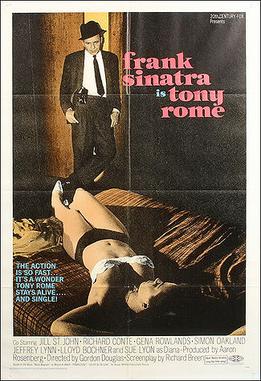
Cleaning Out The DVR: Tony Rome (dir by Gordon Douglas)


The 1967 film, Tony Rome, is about a detective named …. can you guess it?

That’s right! Tony Rome!

Tony works out of Miami and, because he’s played by Frank Sinatra, you can be sure that he’s a tough guy who knows how to throw a punch but who, at the same time, also knows how to have a good time. He’s got a bottle of liquor in the glove compartment. He’s got his own boat. He’s got a snappy quip for every occasion and a properly cynical sense of humor but at the same time, he also cares about doing the right thing. He says what’s on his mind and if that hurts your feelings, tough. Again, none of this should be a surprise, considering that he’s played by Frank Sinatra and Sinatra could play these type of sentimental tough guys in his sleep.

That’s not to say that Sinatra sleepwalks through the role, of course. Far from it. As played by Sinatra, Tony comes across as an authentic tough guy, as someone who has seen it all and who, as a result, understands that importance of stopping to have a drink and appreciate the world around him. Tony Rome might be a Rat Pack-style private investigator but that doesn’t mean he can’t solve the case and, even while Tony’s having a good time, Sinatra never lets you forget that he takes his job very seriously.

As for the film, it’s a story that beings when Tony is hired to drive a passed out rich girl back to her home. This leads to him investigating a jewelry theft and eventually discovering an extortion plot. Sue Lyon plays the rich girl. Gena Rowlands plays her stepmother while Simon Oakland (the psychologist at the end of Psycho) plays her father. Richard Conte, who played bad gangster Barzini in The Godfather, plays Tony Rome’s best friend on the police force. (Every good private eye has a best friend on the police force.) Jill St. John plays Ann Archer, who helps Tony out with his investigation. Ann is recently divorced. Will Tony claim her heart or will she go back to her husband? It wouldn’t be a Sinatra film without a little heartbreak. (To a large extent, St. John’s performance here feels like a slightly more serious version of the performance she would later give as Tiffany Case in Diamonds are Forever, which is perhaps as close as we’ll ever get to a Rat Pack-style James Bond film.)

The story itself is surprisingly easy to follow. This is not one of those detective stories that will leave you shocked over who turns out to be the bad guy. For a film that often takes something of a light-hearted approach to Tony’s efforts to solve the mystery, it’s also a rather violent film. More than a few people get killed. Tony gets kicked in the ribs at one point and the sound of the 50-something Sinatra groaning in pain is disconcerting. Of course, Tony recovers quickly and immediately gets his revenge. When you watch the scene, you think to yourself that anyone who would try to beat up Frank Sinatra has to be a fool. That’s largely because Tony is Sinatra and Sinatra is Tony.

It’s an entertaining film, one that works well as a time capsule of what it was like to cool and swinging and middle-aged in 1967. Tony Rome is smart enough to focus more on Sinatra’s charisma than on trying to impress the viewers with its own cleverness. If I ever have to hire a private detective, I hope he’s like Tony Rome. I hope he gets the job done. I hope he has a good time while doing it. And I hope he comes with his own Nancy Sinatra-sung theme song. That’s not too much to ask, is it?