The Oklahoma City Dolls (1981, directed by E.W. Swackhamer)


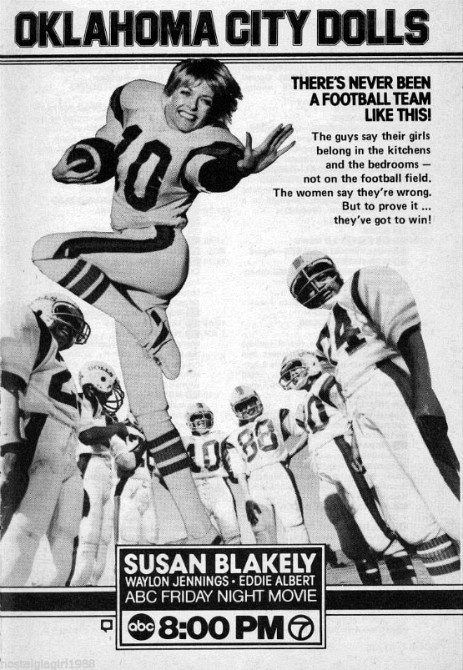
At an Oklahoma manufacturing plant, the women are always expected to put in extra hours while their male co-workers practice as a part of the company’s football team.  Shop steward Sally Jo (Susan Blakely) files a complaint with the EEOC.  John Miller (Robert Hooks) pays a visit to the plant and says that the women have to be given the same opportunities and benefits as the man, including recreation time.  The plant’s foreman, J.D. Hines (David Huddleston), agrees.  The woman can have recreation time as long as they’re doing what the men are doing and that’s playing football.  Determined to show up Hines and all of her sexist co-workers (and her boyfriend, played by Waylon Jennings), Sally Jo puts together a football team and even gets a broken-down former NFL coach (Eddie Albert) to serve as their trainer.

There actually was a woman’s football team called The Oklahoma City Dolls.  They played in the National Women’s Football League and they won the league’s championship three times.  However, they don’t appear to have anything to do with this movie, which is as much about Sally Jo trying to get a fair treatment for the workers as it is about hitting the field and running it in for a touchdown.  There are some parts of the movie that work.  I liked Eddie Albert’s performance as the alcoholic coach and the scene where he discovered that his community service would include coaching a group of women who had never played football before.  Folk singer Ronee Blakley was good as the team’s emotionally fragile wide receiver.  I even liked that the women didn’t all automatically become the world’s best football players.  The movie’s main weakness was that Susan Blakely just wasn’t believable as someone who lived in a trailer park, used “ain’t” in every sentence, and spent her time organizing a union.  She was too glamorous for the role and her scenes with Waylon Jennings all felt overwritten and overacted.  The story couldn’t decide if it wanted to be a drama about working in a factory or a football comedy and it was pretty uneven as a result.  The good thing is that the movie’s heart was in the right place, even if it didn’t always score a touchdown.

As for the real life Oklahoma City Dolls, they were active from 1976 to 1979.  An attempt to revive the team in 1982 failed when their financial backers pulled out at the last seconds.  The National Women’s Football League folded in 1988.

FAST-WALKING – James Woods and Kay Lenz light up the screen!


One of the first movies I ever watched starring James Woods is COP. It’s a 1988 action thriller about a police detective on the trail of a serial killer. I really enjoyed the movie, which was directed by James B. Harris. Harris is a producer and director whose various credits include THE KILLING (1956), PATHS OF GLORY (1957), LOLITA (1962) and TELEFON (1977, with Charles Bronson). Harris also directed James Woods in a movie from 1981 called FAST-WALKING. 

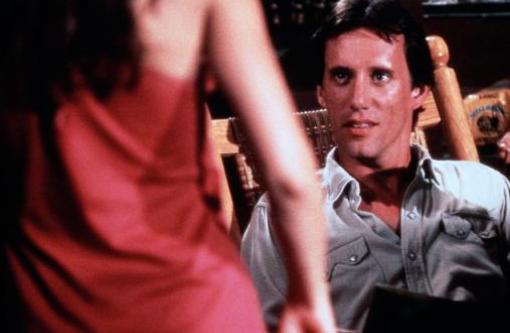
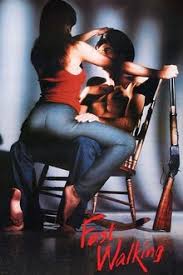
FAST-WALKING is about a prison guard named Frank “Fast-Walking” Minniver. He loves to smoke pot and dream about a future life in a beautiful part of Oregon. In order to make that move, though, he needs to make some money. When a black revolutionary named William Galliot is transferred to his prison, he finds himself with some options, as he receives offers of money from two different sides. On one side is his cousin Wasco, a prison trustee who offers Fast-Walking $25,000 to kill the revolutionary as part of a staged prison race riot. On the other side is Galliot’s own people who offer him a bag of money containing $50,000 if he’ll help Galliot escape. The biggest obstacle to taking the bigger payday is that Wasco threatens to kill Fast-Walking’s lady love Moke, if he doesn’t make the right choice.

The cast is phenomenal in FAST-WALKING beginning with James Woods as the title character. In his best roles, Woods is somewhat morally ambiguous, and we hope he makes the right decisions at the end. This definitely fits that mold. Kay Lenz was sexy as hell as Moke. We’re not supposed to be sure if she’s just using Fast-Walking or if she truly loves him. She plays that balance well. In a surprising turn of events, M. Emmet Walsh gives the most memorable performance of his career, and it doesn’t have a thing to do with his acting. Rather, he does a full frontal nude scene. I’d like to forget this performance, but it’s burned into my psyche at this point. Tim McIntire was the revelation to me, though, as Fast-Walking’s inmate cousin Wasco. This is the only role I really know him from, and he absolutely nails it. The fate of his character is one of the most satisfying parts of the entire film. Unfortunately, McIntire would suffer from drug and alcohol addiction and would pass away a few years after completing his role in FAST-WALKING. I can’t help but think there could have been more great performances if his career would have been longer. 

I recommend FAST-WALKING. It’s not a perfect film, but James Woods, Kay Lenz, and Tim McIntire all make it worth watching. 

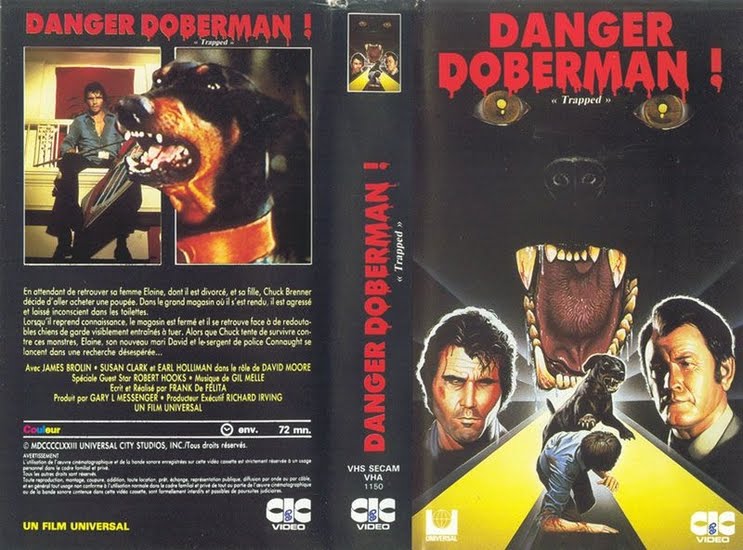
Trapped (1973, directed by Frank De Felitta)


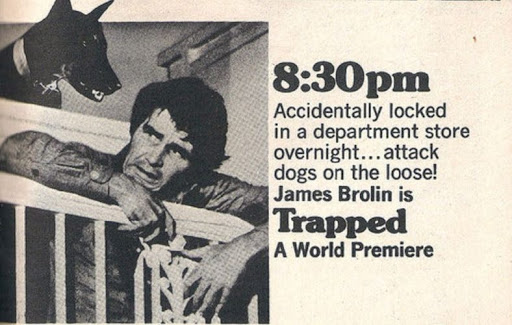
Chuck Brenner (James Brolin) is out shopping when he’s mugged and left unconscious in a men’s room stall.  By the time Chuck wakes up, the store is closed for the weekend and the place is deserted except for him and six doberman guard dogs.  The dogs are trained to hunt down and attack anyone who shouldn’t be in the store and, as far as they’re concerned, that includes Chuck.  Chuck now has to survive the night and try to figure out a way to get out of the store.  Not helping is that Chuck still hasn’t recovered from taking a blow to the head and he’s been bitten by one of the dogs, leaving a blood trail for them to follow.

This made-for-TV movie is a simple but effective thriller about an ordinary man trapped in an extremely dangerous situation.  Frank De Felitta (who would later direct one of my favorite made-for-tv horror film, The Dark Night of the Scarecrow) does a good job of creating suspense as Chuck tries to make it from one area of the department store to the next without getting attacked.  (One of the best scenes involves Chuck, dizzy because he has a concussion, jumping from one cabinet to another while the dogs wait below him.)  Even dog lovers will become nervous as the dobermans prowl the aisles, looking for their prey.  James Brolin gives a good everyman performance and he’s ably supported by Susan Clark as his ex-wife and Earl Holliman as Clark’s new husband.  The film is so well-executed that it was only after it ended that I started to wonder why any store would leave six dog unsupervised in their store overnight.  Just the effort that would have to be made to clean up after them would cancel out whatever money was being saved by not using a human security guard.

Trapped has been released under several titles, the best known of which is The Dobermn Patrol.  My personal favorite, though, is Danger Doberman!

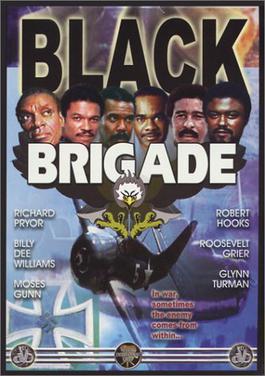
Black Brigade (1970, directed by George McCowan)


During the closing days of World War II, General Clark (Paul Stewart) wants to capture a Nazi-controlled dam and he thinks he’s found just the man for the job.  Captain Beau Carter (Stephen Boyd) is a tough and good with a knife and a gun.  Carter is sent to take command of a ragtag group of soldiers who have spent the last three years waiting for combat.  The only catch is that the soldiers are all black and Captain Carter is a racist redneck.

This was an Aaron Spelling-produced television movie that was originally broadcast under the name Carter’s Army.  When it was released on video, the name was changed to Black Brigade, probably in an effort to fool viewers into thinking that it was a cool blaxploitation film instead of a simplistic TV movie.  The film has gotten some attention because of the cast, which is full of notable names.  Roosevelt Grier plays Big Jim.  Robert Hooks is Lt. Wallace while Glynn Turman is Pvt. Brightman (who keeps a journal full of the details of the imaginary battles in which he’s fought) and Moses Gunn brings his natural gravitas to the role of Pvt. Hayes.  Probably the two biggest names in the cast are Richard Pryor as the cowardly Crunk and Billy Dee Williams as Pvt. Lewis, who says that he’s from “Harlem, baby.”

Don’t let any of those big names fool you.  Most of them are lucky if they get one or two lines to establish their character before getting killed by the Germans.  The movie is mostly about Stephen Boyd blustering and complaining before eventually learning the error of his ways.  The problem is that Carter spends most of the film as such an unrepentant racist that it’s hard not to hope that one of the soldiers will shoot him in the back when he least expects it.  The other problem is that, for an action movie, there’s not much action.  Even the climatic battle at the dam is over in just a few minutes.

There is one daring-for-its-time scene where Lt. Wallace comes close to kissing a (white) member of the German Resistance, Anna Renvic (Susan Oliver).  When Carter sees him, he angrily orders Wallace to never touch a white woman.  Anna slaps Carter hard and tells him to mind his own goddamn business.  It’s the best scene in the movie.  Otherwise, Black Brigade is forgettable despite its high-powered cast.

Fast-Walking (1982, directed by James B. Harris)


Frank Miniver (James Woods) is the prison guard that everyone calls Fast-Walking.  He’s involved in almost every vice that a man living in a small town in Oregon can be involved in.  He takes bribes.  He usually shows up for work stoned and what he doesn’t smoke, he sells to the prisoners and the other guards.  He’s got a second job, running a trailer park brothel behind his cousin’s general store.

Frank’s cousin, Wasco (Tim McIntire), has been incarcerated and he expects Frank to help him take over the prison.  At first, Frank has no problem working with Wasco and letting his cousin have free reign of the cell block.  Wasco has soon established himself as the most powerful man behind bars.  When a black power activist named Galliot (Robert Hooks) arrives at the prison, Wasco wants to arrange for him to be assassinated.  Meanwhile, Galliot has offered Frank even more money to help him escape from the prison.

While Frank tries to keep both sides happy and make off with some money for himself, he’s also sleeping with Wasco’s accomplice on the outside, Moke (Kay Lenz).  Originally, Wasco ordered Moke to seduce Frank in order to keep Frank in line but, as Moke and Frank’s relationship continues, Wasco starts to get jealous and starts plotting to put Frank back in his place.

Fast-Walking is a gritty film that features a good deal of dark humor.  Unfortunately, the film’s many different parts never really come together and the film never strikes the right balance between comedy and drama.   James Woods is perfectly cast as Frank and the underrated Kay Lenz does wonders with an underwritten role but Tim McIntire is a less than ideal Wasco.  McIntire was a good actor but, physically, he’s all wrong for a character who is supposed to be so intimidating that he can walk into a prison and automatically take it over.  Wasco is written and played as being such a cartoonish character that it’s difficult to take him or his plots seriously.  The movie works best when it’s just focuses of James Woods’s nervy performance and Frank’s attempts to keep the other prison guards (including M. Emmett Walsh) from discovering his own racket.

That’s Blaxploitation! 7: TROUBLE MAN (20th Century-Fox 1972)


gary loggins's avatarcracked rear viewer

trouble1

One of the earliest Blaxploitaion films is TROUBLE MAN, a 1972 entry about Mr T…

trouble2

…no, not THAT Mr. T! THIS Mr. T…

trouble3

Thank you! This Mr. T is played by Robert Hooks, a tough talking private eye who drives a big-ass Lincoln Continental and “fixes troubles” on the mean streets of L.A. T gets hired by gangsters Chalky Price and Pete Cockrell to protect their crap games, which are getting ripped off by masked gunmen. Things go awry when Chalky shoots one of the heisters, a dude named Abby who works for rival gangster “Big”. Abby’s body is dumped and word is on the streets T did the killing. Police Capt. Joe Marx puts the heat on T, as does “Big”, so T arranges a late night summit between “Big”, Chalky, and Pete at Jimmy’s Pool Hall .  “Big” arrives, but before Chalky and Pete do, some cops raid the joint. These…

View original post 373 more words

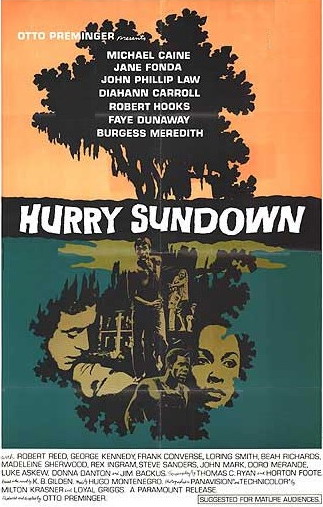
Were the critics right? A Review of Otto Preminger’s Hurry Sundown


It seems like whenever film bloggers and reviewers are making out a list of the worst films of all time, somebody always mentions Hurry Sundown.

Now, don’t get me wrong.  It doesn’t get mentioned as often as Battlefield Earth or Adam Sandler’s latest comedy.  And, when it does get mentioned, it’s done with little of the warmth that’s given to Troll 2, The Room, or Birdemic.  Instead, one gets the impression that Hurry Sundown is a film so bad that even those of us who appreciate bad films would find little to love about it.

But y’all know me.  I’m the type that prefers to judge for herself and I’m also someone who rather enjoys being a contrarian.  There’s a reason why one of my most read posts on this site is entitled 10 Reasons Why I Hated Avatar.  Add to that, Hurry Sundown was directed by Otto Preminger who also directed one of my favorite films of all time, Anatomy of a Murder.  How, I asked myself, could the man who made Anatomy of a Murder possibly also direct one of the worst films of all time?  As a result, every time that I saw someone claiming that Hurry Sundown was one of the worst films of all time, I grew more and more determined to someday see the film and judge for myself.

Well, I finally got my chance this weekend.  Hurry Sundown was on one of my newest favorite channels, The MOVIES! TV Network.  And I proceeded to watch it.  I sat through all four hours of this film (that’s including commercials and, oh my God, was I thankful for the distraction that those commercials provided).  I watched Hurry Sundown and …. wow.  Was it ever bad.

Hurry SundownReleased in 1967, Hurry Sundown was Otto Preminger’s attempt to take a look at race relations in the deep south.  It’s a film full of good, liberal intentions and an apparent lack of knowledge about — well, about everything.  As I watched this slow, almost formless blob of a film, I found myself wondering how the director who gave us Laura and Anatomy of a Murder could have possibly directed a film with a gigantic cast but absolutely no interesting characters.  I wondered how the director who had been willing to challenge the racist assumptions of 1950s Hollywood by directing Carmen Jones could have been responsible for the corny and subtly condescending look at race relations that was Hurry Sundown.

Hurry Sundown takes place in 1946 and is set in rural Georgia.  The war is over, the soldiers are coming home, and nobody in the film can maintain a convincing Southern accent for more than a line or two.  (Seriously — I’ve heard a lot of really bad Southern accents in a lot of really bad films but none of those accents were as bad as what I heard in Hurry Sundown.)  It’s a brand new world but the South is clinging to the old ways of racism and classism.

Preminger slowly (and clumsily) introduces us to the huge cast of characters who populate the slice of Hollywood Georgia.

There’s the sheriff (George Kennedy) who is so stupid that he can be distracted by an offer of fried chicken.  Kennedy actually gives a good comedic performance but his character seems like he belongs in another movie and you have to wonder how civil rights activists in 1967 — many of whom had undoubtedly been arrested and harassed by Southern sheriffs much like this one — reacted to Kenendy’s character being presented as harmless comic relief.

There’s the racist judge (Burgess Meredith) who, much like the sheriff, is presented as being a comedic buffoon as opposed to an actual threat.  The judge uses the n-word in every other sentence, which should be shocking and infuriating but, as a result of Meredith’s over-the-top delivery, instead simply comes across as being gratuitous and tasteless.

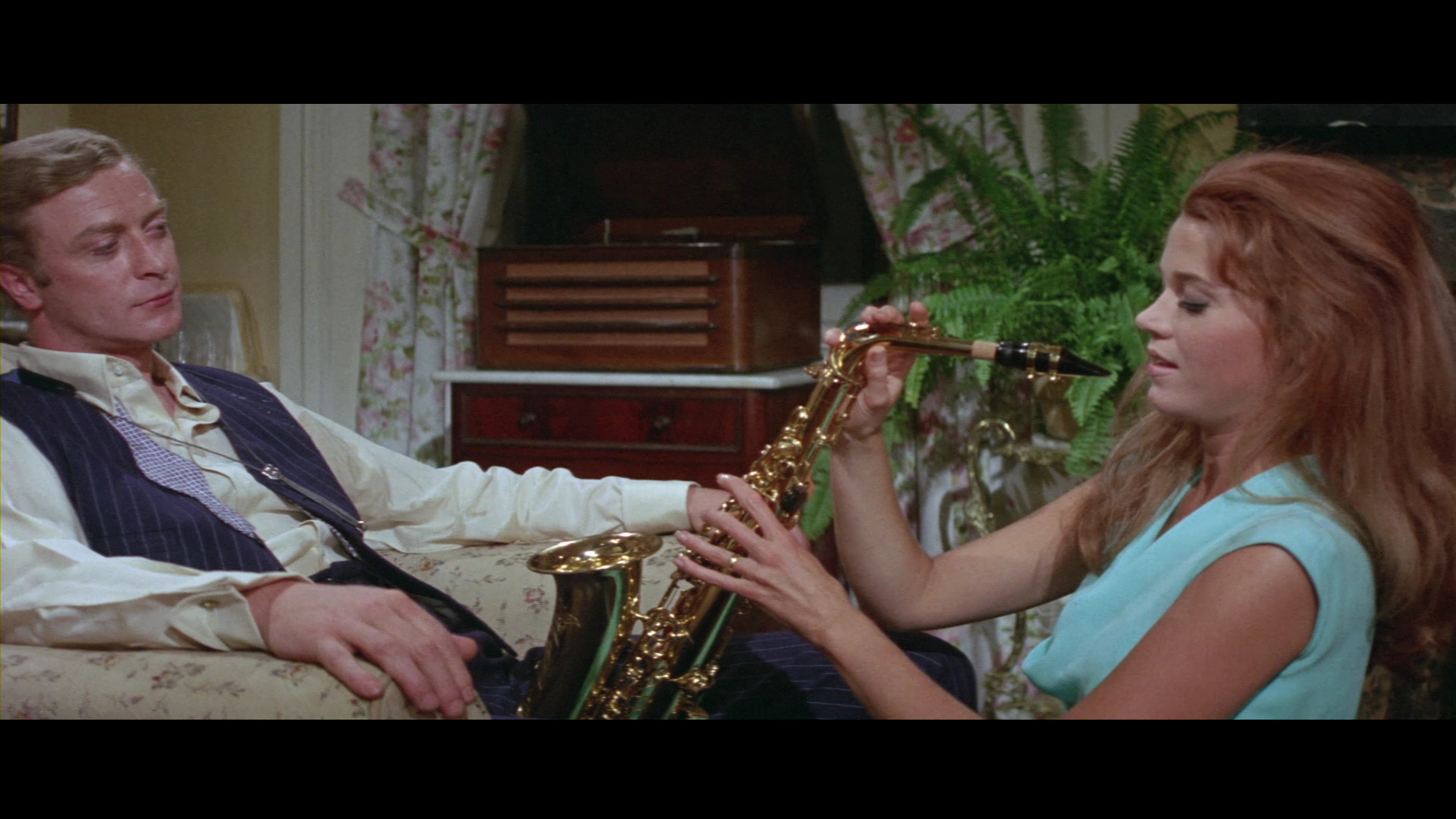
Then there’s Henry.  Henry is a businessman who dodged the draft, cheats on his wife, and who has a son who literally spends the entire movie screaming at the top of his lungs.  (Whenever that kid was on-screen, I imagined Preminger standing behind the camera and going, “More!  More!  Scream more!”)  Henry is also a racist, though for some reason he loves jazz and often plays the saxophone.  I kept waiting for someone in the movie to point out to him that jazz was created by black musicians but nobody did.  (If Henry had appeared in Anatomy of a Murder, someone would have.)

Did I mention that Henry is played by Michael Caine?  And did I also mention that Caine is the most cockney-sounding Southerner that I’ve ever heard?  Because he totally is.

Henry’s wife is named Julie and is played by Jane Fonda.  At one point, she suggestively blows on Henry’s saxophone.  One can only imagine how audiences in the 60s reacted to that.  (Actually, they probably didn’t.  They probably just said, “Good thing she’s pretty because she ain’t no musician…”)

Michael Caine and Jane FondaAnyway, Harry wants to buy up some farmland but half of that land is owned by Henry’s poor cousin Rad (John Phillip Law) and Rad doesn’t want to move.  Rad has just returned from fighting in the war and he views Harry as being a cowardly draft dodger.  Rad is married to Lou (Faye Dunaway) and wow, are they ever a boring couple!  Dunaway was under a five-picture contract to Preminger when she made this film and apparently, she had such a terrible time on the set of Hurry Sundown that she sued to get out of ever having to make another movie with Otto.  Dunaway’s misery comes through in every scene.

The other half of the farmland is owned by Reeve (Robert Hooks), a black farmer whose mother (played by Beah Richards) is Julie’s former mammy.  Julie goes down to the farmhouse to convince Reeve to sell and Reeve’s mother responds by having the most (over)dramatic heart attack in the history of cinema.  Saddened by death of his mother, Reeve is definitely not going to sell.  When he’s not chastely romancing the local teacher (played by Diahann Carroll, who appears to have wandered over from a different, far more glamorous movie), Reeve is singing sprituals and working out in the fields.

One of the things that Reeve does not do — no matter how many times he gets called the n-word or is treated unfairly — is get mad.  Rad gets mad.  Julie gets mad.  A liberal white preacher (Frank Converse) gets mad.  But Reeve and the other black characters in the film are never really allowed to get mad or do anything that might make the film’s white audience feel nervous.  Watching a film like Hurry Sundown, you can understand why — in just a few more years — Blaxploitation films would suddenly become so popular.  It was probably the first time that black film characters were actually allowed to not only get angry over the way they were being treated but to fight back, as opposed to reacting in the Hurry Sundown-way of passive acceptance.

Anyway, Rad and Reeve come together to protect their land and Henry and the evil judge conspire to cheat them out of their land and — well, let’s just say that Hurry Sundown is one of those films that has a lot of plot and very little action.  Preminger directs with a stunning lack of pace or grace, the actors deal with a poorly written script by either engaging in histrionics or going catatonic, and Michael Caine’s attempt at a Southern accent will amuse anyone who has ever been south of the Mason-Dixon.

https://www.youtube.com/watch?v=GBkWLkQvoXA

I have to admit that I was really hoping that Hurry Sundown would turn out to be a sordid and tawdry little masterpiece, the type of overheated misfire that you love despite your better instincts.  But, no.  Hurry Sundown is just boring.  The film is such a misfire that it doesn’t even work as a piece of history.  The critics were right.  Hurry Sundown sucks.

Hurry_sundown_moviep


6 Trailers For Your Oscar Hangover


Now that the Oscars are over with, it’s time for another installment of Lisa Marie’s Favorite Grindhouse and Exploitation Trailers.

1) The Sicilian Connections (1972)

Since we’re coming down off the Oscars, I’ll start this latest edition off with the trailer for The Sicilian Connection, an Italian rip-off of 1971 best picture winner, The French Connection.  I haven’t seen the actual movie but I love the music that plays in the background of this trailer.

2) Dirty Gang (1977)

This is another Italian crime flick.  This trailer is worth it to just see that wonderful credit “Tomas Milian as Trash.”

3) Trouble Man (1972)

Tomas Milian may have been Trash but Robert Hooks was Trouble.

4) Q: The Winged Serpent (1982)

I’m so happy to include this trailer because I think Arleigh will love it.  David Carradine and Richard Roundtree fight a prehistoric something-or-an0ther.  Michael Moriarty’s in this which can only mean that this is a Larry Cohen film.

5) Dawn of the Mummy (1980)

“Egypt…a nice place to visit but would you want to die there?”  Not surprisingly, this is an Italian film that was released in the wake of Dawn of the Dead and Zombi 2.

6) The Crippled Masters (1979)

I kinda feel that this trailer runs a little bit long but then again, I’m not big into Kung Fu films that don’t star Uma Thurman.  Still, this is one of those pure grindhouse trailers that has to be seen to be believed.