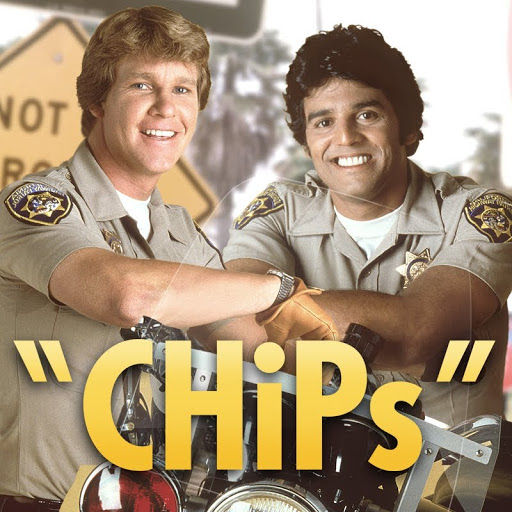
Welcome to Late Night Retro Television Reviews, a feature where we review some of our favorite and least favorite shows of the past! On Mondays, I will be reviewing CHiPs, which ran on NBC from 1977 to 1983. The entire show is currently streaming on Prime!
This week, two sets of thieves cause trouble!
Episode 4.10 “Forty Tons Of Trouble”
(Dir by Gordon Hessler, originally aired on January 11th, 1981)
A group of criminals is stealing equipment from construction sites and selling it on the black market. An attempt to steal a loader leads to it rolling down a Los Angeles street until Baker is able to jump onto it and crash it into a (hopefully) abandoned building. Getraer points out that Baker just destroyed a building. Baker shrugs and says he’s always wanted to do that.
A different group of criminals is stealing parts for their drag racer. The CHiPs have their own car entered into the drag races. Of course, it’s driven by Ponch.
After two accidents on the highway and several chases, Baker and Ponch (but mostly Ponch) capture the bad guys. Paula Kohl (Mary Louise Weller), the owner of Kohl Construction, appreciates the efforts of Baker and Ponch (but mostly Ponch).
In other words, this was a typical episode of CHiPs. Still, it’s memorable because of the supporting cast. Amongst the construction site thieves is Robert Englund. Englund thinks that Sarge (Taylor Lacher) is taking to many risks when it comes to trying to steal loaders and bulldozers but Sarge is like, “I got it under control.” Meanwhile, amongst the drag race thieves, is Chris Mulkey. Mulkey doesn’t get to do much but he does get two scenes where he smirks at Ponch. Sadly, both characters end up getting arrested during this episode but have no fear. Robert Englund went on to play Freddy Krueger. Chris Mulkey went on to play the sleazy but strangely likable Hank Jennings on Twin Peaks.
As for the rest of the episode — hey, I don’t ask for much from CHiPs. As long as there’s a good crash scene and a lot of cool cars, I’m happy. This episode delivered. One could ask why Ponch is always the one who gets to do the cool things, like driving in the race and taking Paula out on a fancy date. Earlier seasons usually tried to portray Ponch and Baker as being equals. This season, though, has clearly been The Ponch Show. It’s a legitimate criticism but …. eh. Sometimes, you just want to watch a chase or two.
Today’s scene that I love comes from 1984’s A Nightmare on Elm Street. Directed by the great Wes Craven, A Nightmare on Elm Street remains a frightening and creepy masterpiece. It’s ability to scare its audience has not been diminished by countless sequels and rip-offs.
In this scene, Nancy (Heather Langenkamp) discovers that she’s not even safe from Freddy (Robert Englund) at school.
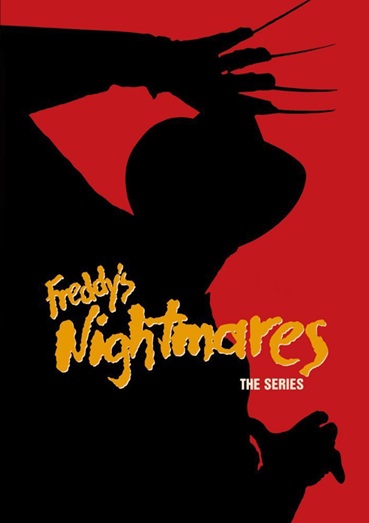
Welcome to Late Night Retro Television Reviews, a feature where we review some of our favorite and least favorite shows of the past! On Fridays, I will be reviewing Freddy’s Nightmares, a horror anthology show which ran in syndication from 1988 to 1990. The entire series can be found on Plex!
Let’s see what’s happening in Springwood!
Episode 1.2 “It’s A Miserable Life”
(Dir by Tom McLoughlin, originally aired on October 16th, 1988)
Bryan Ross (a young John Cameron Mitchell, giving a performance that really can’t be described as being anything less than lousy) is the son of the owner of the Beefy Boy hamburger joint in Springwood, Ohio. Bryan wants to go to college. His dad (Peter Iacangelo) and his mom (Annie O’Donnell) want him to take over the family business and join them in singing “Chew me, eat me, you can’t beat me.”
Bryan is working the overnight shift alone when a scruffy man (Michael Melvin) pulls up to the drive-through on his motorcycle and threatens to kill him. Bryan passes out but, when he wakes up, he’s got a throbbing headache and he keeps seeing blood dripping on the floor. Bryan’s girlfriend, Karyn (Lar Park Lincoln, giving a good performance), takes Bryan home. At his house, Bryan discovers his mom and dad are acting weird. Bryan tries to convince his parents to let him leave home. Dad tries to stick his head in the oven. Mom tries to seduce her son and then climbs into the refrigerator. On the radio, there’s a news story about “another” drive-by shooting. What could it all mean!?
Oh, you know what it all means. Even if you haven’t watched the episode, you know that the motorcycle man obviously shot Bryan in the head and everything that happens after Bryan leaves Beefy Boy is just his dying vision. It’s not a bad idea but it’s ineffectively executed. We don’t really know enough about Bryan or his parents for Bryan’s hallucination to carry any impact and, from what we do see, they all appear to be broadly-drawn caricatures. This episode also commits the sin of introducing a memorable character — the man on the motorcycle — and then not exploring just who or what he was meant to be.
Bryan’s story was wrapped up in 20 minutes. The second half of the episode dealt with Karyn. Shot in the same drive-by attack that killed Bryan, Karyn ended up at the hospital and …. well, I guess her story was another collection of hallucinations that really didn’t add up to much. The story was effective because hospitals are scary and Lar Park Lincoln gave a better performance than John Cameron Mitchell did in his story. That said, the entire story was basically Karyn getting upset because everyone kept saying that her parents were on their way. Finally, Karyn finally revealed that — you guessed it! — her parents were dead and that they died at the same hospital where she was taken after getting shot. As the episode ended, Karyn saw her parents standing in the doorway and screamed and thrashed around in bed while the doctor and nurse tried to calm her. And …. that was it. I mean, is Karyn dead? Is that why her parents showed up? Is Karyn hallucinating again? Much like a drunk frat boy, this story didn’t reach a climax as much as it just stopped.
As for Freddy, he showed up to introduce each story. There was a cool moment where he emerged from the restaurant’s fry cooker. For the hospital scene, he put on scrubs. He didn’t actually interact with either Bryan or Karyn but he still took credit for their suffering. I think Freddy was just bragging on himself.
This episode was pretty uneven. For the most part, I’m just glad I don’t live in Springwood.
In the 1976 film StayHungry, Jeff Bridges plays Craig Blake.
When we first meet Craig, he doesn’t have much of a personality, though we still like him because he’s played by Jeff Bridges. Living in Alabama, he’s a young rich kid who, after the death of his parents, divides his time between his nearly empty mansion and his country club. Craig suffers from a good deal of ennui and seems to spend a lot of time writing letters to his uncle in which he promises that he’s going to eventually get his life together. Craig eventually gets a job at a real estate firm that is managed by Jabo (Joe Spinell). We know that the real estate firm is shady because Joe Spinell works there.
Craig is assigned to handle the purchase of a small gym so that he can eventually close the place and allow it to be torn down to make room for an office building. However, Craig soon falls for the gang of colorful eccentrics whose lives revolve around the gym and bodybuilder Joe Santo (Arnold Schwarzenegger, who gets an “introducing” credit, even though this was his fourth film). The friendly Franklin (Robert Englund) is Santo’s “grease” man. Anita (Helena Kallianiotes) is tough and can kick anyone’s ass. The receptionist, Mary Tate (Sally Field), is a free spirit with whom Craig soon falls in love. In fact, the only less than likable person at the gym is the former owner, Thor Erickson (R.G. Armstrong), a heavy-drinking perv who has a hole in the floor of his office that he uses to peek down at the women’s locker room.
There’s not much of a plot here. Instead, the film plays out in a rather laid back manner, with Santo befriending Craig and showing him the joy of embracing life. Arnold Schwarzenegger actually won an award (well, a Golden Globe) for his performance here and it must be said that he’s very good as the gentle and easy-going Santo. Because he’s huge and he’s Schwarzenegger, we expect him to be intimidating. Instead, he’s a soft-spoken guy who is quick to smile and who doesn’t even get upset when he finds out that Mary Tate and Craig are now involved. There’s even a surprising scene where Joe Santo picks up a fiddle and starts playing with a bluegrass band. Schwarzenegger is so likable here that it’s easy to wonder where his career might have gone if he hadn’t become an action star. Even early in his career (and when he was still speaking with a very thick accent), Schwarzenegger shows off a natural comic timing. He’s fun to watch.
In fact, he’s so much fun that the rest of the film suffers whenever he’s not onscreen. The cast is full of talented people but the film’s loose, plotless structure keeps us from truly getting too invested in any of them. (Santo is training for Mr. Universe so at least he gets an actual storyline.) Sally Field and Jeff Bridges are cute together but their romance is never quite as enchanting as it seems like it should be. The main problem with the film is that, when it ends, one still feels like Craig will eventually get bored with the gym and return back to his mansion and his country club. One doesn’t get the feeling that Craig has been changed so much as Craig just seems to be slumming for the heck of it.
There are charming moments in StayHungry. I’m a Southern girl so I can attest that the film captured the feel of the South better than most films. If you’re a Schwarzenegger fan, you have to see this film because it really does feature Arnie at his most charming and natural. Unfortunately, despite all that, the film itself never really comes together.
Welcome to Late Night Retro Television Reviews, a feature where we review some of our favorite and least favorite shows of the past! On Fridays, I will be reviewing Freddy’s Nightmares, a horror anthology show which ran in syndication from 1988 to 1990. The entire series can be found on Plex!
Having finished up Friday the 13th, I’m not going to take a look at another syndicated horror show that aired around the same time. Freddy’sNightmares was an anthology show hosted by Robert Englund, in character as Freddy Krueger. Each story would take place in Freddy’s hometown of Springwood, Ohio. Would the show be a dream or a nightmare? Let’s find out!
Episode 1.1 “No More Mr. Nice Guy”
(Dir by Tobe Hooper, originally aired on October 9th, 1988)
Freddy Krueger has become such a familiar and popular figure that I think it’s sometimes forgotten that, when he first appeared, he was truly a horrifying character. He was a child molester and a serial killer, one who escaped legal justice only because someone forgot to read him his rights when he was arrested. He was killed by the citizens of Springwood, Ohio, set on fire in the same boiler room where he killed his victims. Yes, he was brutally murdered and yes, the respectable people who murdered him covered up their crime. At the same time, what would you do if a monster like Freddy was loose in your town and stalking your children? “I’m burning in Hell,” Freddy says and that’s exactly what he deserved.
How did Freddy Krueger then become an oddly beloved pop cultural icon? Some of that was undoubtedly due to his one-liners, which tended to be a slightly better than the typical slasher film banter. If Freddy was pure evil in the first three NightmareonElmStreet films, he became more a homicidal prankster as the series continued. I think another reason why Freddy became popular is because the actor who first played him, Robert Englund, himself always comes across as being such a nice guy. Unlike the personable but physically intimidating Kane Hodder, who looked like he could kill you even when he wasn’t playing Jason Voorhees, Englund always comes across as being slightly nerdy and very friendly. He’s the neighbor who you would trust to get your mail while you’re on vacation. If Englund hadn’t been cast as Freddy Krueger in 1984, he probably would have spent the 90s playing quirky programmers and hackers in tech thrillers. The thing with Robert Englund is that seems to have a good sense of humor, he’s at peace with his place in pop culture, and he always seem to be having fun. (In his autobiography, he even jokes about something that fans had been laughing about for years, the fact that the female lead in A Nightmare In Elm Street 2 looked almost exactly like Meryl Street.) Those are qualities that bled over into Freddy.
As a result, Freddy became popular enough to host his own horror anthology. The premiere episode of Freddy’sNightmares open with Englund, in full Freddy makeup, telling us that we’re not about to see one of our nightmares. Instead, we’re going to see his nightmare. The episode gives us Freddy’s origin story, starting with Freddy getting off on a murder charge on a technicality and ending with Freddy getting bloody revenge of the police chief (played by Ian Patrick Williams) who set him on fire.
By almost any standard, it’s a disturbing story. We open with Freddy on trial and we hear details about an 8 year-old boy that he left in a dumpster. After the charges against Freddy are dismissed (damn those Carter judges!), Freddy happily gets into an ice cream truck and later, the police chief has a vision of the same truck coming straight at him. After getting set on fire, Freddy doesn’t waste any time coming back and using his razor-blade gloves to slash his way to vengeance. I think what’s particularly disturbing about this episode is that the police chief is not a bad guy. He arrested Freddy as Freddy was trying to attack his twin daughters. Throughout the episode, Freddy — in both life and death — makes it clear that he’s coming for the man’s daughters. And in the end, Freddy will probably get them because their father fell asleep in a dentist’s chair and got his mouth drilled by Dr. Krueger.
Agck! That’s disturbing stuff. Of course, it would be even more disturbing if the show’s special effects and gore were anywhere close to being a realistic as what was present in the movies. The show itself looks remarkably cheap. I would say it almost looks like a community theater production of A Nightmare on Elm Street. Director Tobe Hooper (of TexasChainsawMassacre fame) manages to wring a few jump scares out of the material and a scene where we see one of Freddy’s courtroom fantasies is genuinely horrifying but, for the most part, the budget is low enough that the viewer can safely say, “It’s only a TV show, it’s only a TV show….” In the end, it’s very much an 80s TV show, right down to the oddly gratuitous scene where the police chief suddenly imagines the dental hygienist in her underwear.
Where will Freddy’sNightmares lead us? We’ll find out. I’m sure it will be bloody, wherever it is!
Today, the Shattered Lens wishes a happy 78th birthday to actor Robert Englund.
Englund will forever be identified with the horror genre and Freddy Krueger. That said, before he first played Krueger in the first Nightmare on Elm Street, he was a busy character actor who appeared in roles both big and small. He was considered for Star Wars. He even played some sympathetic characters!
Of course, he’s not particularly sympathetic in today’s scene that I love. Here he is in 1975’s Hustle, bringing his intense style to the small role of a thief who pulls a gun on Burt Reynolds. This scene stands out for both Englund’s menace and Reynolds’s trademark cool. Of course, if you’ve seen the film, you know what this scene is going to lead to. The 70s were a dark time!
First released in 1977, The Great Smokey Roadblock tells the story of Elegant John Howard (Henry Fonda).
Elegant is not really his first name. It’s a nickname, one to let us know that, in the world of independent truckers, John Howard was one of the good guys. He never crashed his rig. He never overcharged for a job. He always arrived on time and in good shape. John Howard was a good man but then he turned 60 and he got sick. He spent months in the hospital, unable to work. His truck was repossessed. The movie starts with John sneaking out of his hospital room, stealing back his truck, and hitting the road in search of one final job. Though John says he just wants to make enough money to get his truck back, the truth is that John is terminally ill. If he’s going to die, he wants to die doing what he loves. Of course, dying while driving could lead to some trouble for anyone else who happens to be on the road at the time but still, you have to respect John’s determination. He’s a true American, independent to his core.
(My Dad occasionally made a living driving a truck so perhaps that’s why I’m partial to films like this one.)
John picks up a hitchhiker, a religious young man named Beebo Crozier (Robert Englund). John picks Beebo up because Beebo was walking through the desert in a suit. Beebo claims that he’s walking to Florida but John tells him that he can’t do that. John will drive Beebo to Florida. Of course, John also expects Beebo to pay for the gas that his truck uses because it’s not like John has any money. At first, Beebo accuses John of cheating him. (Henry Fonda cheating someone!? Perish the thought!) Soon, however, John has become Beebo’s mentor.
Everyone respects John but no one wants to hire him. The only offer that John gets is from sleazy Charlie Le Pere (Gary Sandy), who has an agenda of his own. Finally, John visits his old friend, Penelope (Eileen Brennan). Penelope is a madam whose brothel has just been closed down. John agrees to transport Penelope and her girls (including Susan Sarandon) to a new location on the East Coast. Penelope offers to help John pay the bills. Elegant John’s a pimp now! (I was about to say that this seemed like an odd turn-of-events for Henry Fonda but then I remembered that he starred in The Cheyenne Social Club with Jimmy Stewart.)
There’s not really much of a plot to The Great Smokey Roadblock. John, Beebo, Penelope, and the girls travel from one location to another. They get thrown in jail by a notoriously corrupt deputy named Harley Davidson (Dub Taylor). After they escape, they become minor celebrities. Two counterculture journalists (played by Austin Pendleton and John Byner) show up and help them broadcast their story and the film comes to a halt while Pendleton and Byner exchange what sounds like improvised dialogue. The police attempt to set up a roadblock to stop Elegant John and his Six Mystery Women. I guess that’s the Great Smokey Roadblock of the title.
It’s a weird movie, in that the humor is extremely broad and often crude but Henry Fonda is playing a man who is not only terminally ill but who actually looks like he’s terminally ill. (Henry Fonda himself was reportedly very ill during the filming of The Great Smokey Roadblock.) As such, it’s a rather melancholy comedy, one in which every joke seems like it might be the last one that Elegant John will ever hear. In the 70s, not even a trucker comedy could have a happy ending and, as such, The Great Smokey Roadblock feels like a drive-in film for the existential set. The film’s plot doesn’t really add up to much and is full of plot holes that serve as evidence of a troubled production. That said, there’s something rather charming about seeing a pre-Nightmare On Elm Street Robert Englund playing a gentle guy who ends up as Henry Fonda’s protegee. Fonda and Englund play off each other well and their scenes together are the best thing about The Great Smokey Roadblock.
Today’s horror scene that I love comes from 1984’s A Nightmare on Elm Street. Directed by the great Wes Craven, A Nightmare on Elm Street remains a frightening and creepy masterpiece. It’s ability to scare its audience has not been diminished by countless sequels and rip-offs.
In today’s scene, Nancy (Heather Langenkamp) discovers that she’s not even safe from Freddy (Robert Englund) at school.
Can you imagine how things might have played out if Robert Englund had played Han Solo?
It’s not as far-fetched as it might sound. In his autobiography, Hollywood Monster: A Walk Down Elm Street with the Man of Your Dreams, Englund mentions that he was one of the many actor who, in 1975, auditioned for a role in the first Star Wars film. It’s often forgotten that, before he became famous as Freddy Krueger in A Nightmare In Elm Street,Englund was a busy character actor who had roles in several big studio productions in the 70s. He was definitely a part of the “new Hollywood” that included people like George Lucas, Steven Spielberg, and Jon Milius.
Though Englund doesn’t go into much detail, he does say that he read for the roles of both Han Solo and Luke Skywalker. At the time, Englund didn’t feel that he was right for either role and he went back to his apartment under the correct impression that he would not be cast. However, he did feel that his friend and then-roommate Mark Hamill would be a good pick for Luke Skywalker and Englund writes that he encouraged Hamill to try out for the role.
Would Mark Hamill have been cast if Robert Englund hadn’t told him about the audition? Probably. Given that Star Wars was Lucas’s follow-up to the very popular American Graffiti, it’s probable that every struggling young actor in Hollywood was hoping to audition. As well, Hamill was not totally unknown to George Lucas, having early read for a role in American Graffiti. Still, it’s nice to think that, long before he was cast as Freddy Krueger, Robert Englund may have played a role in casting one of the most successful films of all time.
What would Robert Englund have been like as Han Solo? He definitely would not have been as grouchy as Harrison Ford’s Han. Indeed, one of the striking things out about Englund’s pre-Nightmare career was how he was usually cast as friendly characters who were almost shy. Englund would have been friendlier and rather eccentric Han Solo but I think he would have been entertaining in his way.
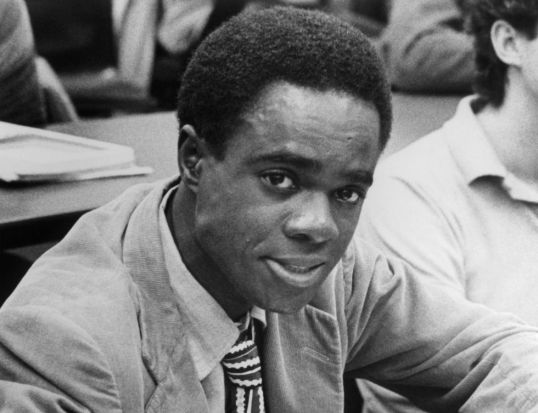
Because of the film’s success, it can be a bit difficult to know who was actually considered for a role in Star Wars. Lucas has said that he originally wanted to cast Black actor Glynn Turman as Han Solo but he feared audiences would not accept the possibility of an interracial romance between him and Leia, even in a galaxy far away. (Lucas’s regret over that decision is one of the things that led to the casting of Billy Dee Williams as Lando Calrissian.) The film’s IMDb trivia page insists that everyone from Al Pacino to Bill Murray to Marlon Brando to Chevy Chase was considered for the role of Han Solo and I have to say that this is a case where I doubt the accuracy of the IMDb. Harrison Ford, who had originally been hired only to read with people at the auditions, eventually got the role despite telling Lucas, about the script, “You can type this shit but you can’t say it.”
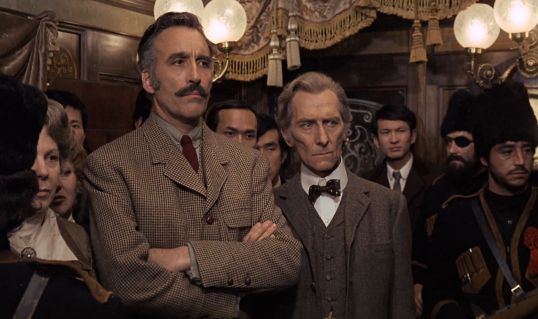
In several interviews, Christopher Lee expressed regret at having turned down the role of Grand Moff Tarkin, which was instead played by Lee’s best friend Peter Cushing. Interestingly enough, Cushing was also one of Lucas’s choices for Obi-Wan Kenobi so it’s easy to imagine a universe in which Star Wars reunited two Hammer films legends, along with setting box office records.
Famously, Lucas held joint-auditions with his friend Brian De Palma. De Palma was casting Carrieand just about everyone who read for one of the films also read for the other. Reportedly, William Katt came close to getting the role of Luke before instead being cast as Carrie’s doomed prom date. Amy Irving was also a strong contender for Leia, before instead ending up as Sue Snell in De Palma’s film. Some source that that Sissy Spacek also read for Leia, though I’ve also read that Spacek was not a part of the joint-auditions. That’s one thing about collecting trivia about classic films. It’s often hard to know what’s true and what’s just wishful thinking.
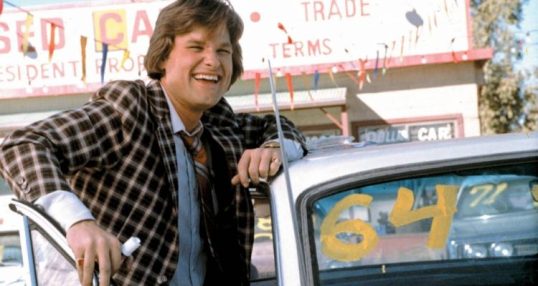
I should mention that another strong contender for Han Solo (and reportedly Luke as well) was Kurt Russell. It’s actually easy to imagine Kurt Russell as Han and, just as with Englund, it leads to an intriguing game of what if. Would Kurt Russell have gone on to have Harrison Ford’s career if he had been cast in Star Wars? Would Russell have gone to play Indiana Jones and Jack Ryan if he had been cast as Han Solo and would Harrison Ford have ended up helping the President to Escape from New York? Or is it just as possible that Star Wars have not worked without the chemistry of Harrison Ford, Carrie Fisher, and Mark Hamill? Would a Kurt Russell, Amy Irving, and William Katt version of Star Wars captured the imagination of audiences?



 Through the Shattered Lens