Welcome to Retro Television Reviews, a feature where we review some of our favorite and least favorite shows of the past! On Saturdays, I will be reviewing The American Short Story, which ran semi-regularly on PBS in 1974 to 1981. The entire show can be purchased on Prime and found on YouTube and Tubi.
This week, we have an adaptation of a Richard Wright short story.
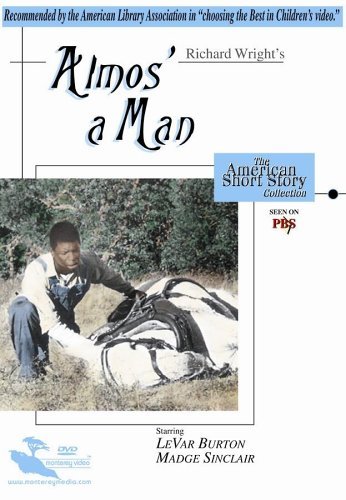
Episode #4 “Almos’ A Man”
(Dir by Stan Lathan, originally aired in 1976)
David (LeVar Burton) is a black fifteen year-old living in the Deep South in the 1930s. He works on his family’s farm and takes care of a mule named Jenny. He considers himself to be almost a man. His mother (Madge Sinclair) and his father (Robert DoQui) disagree.
David knows the one thing that he need to make himself a man. He needs a gun and, this being the 1930s, he finds one that he can order from a Sears & Roebuck catalogue. His mother says that there’s no way she’s letting him get a gun. His father is a bit more open to it. David secretly sends away for the gun and, as you can probably guess, tragedy ensues.
This was a downbeat adaptation of a similarly downbeat Richard Wright short story. David obsession with being a man makes sense when you consider that he lives in a world where everyone — from his parents to the menacing white people who show up towards end — calls him a “boy.” The white people even call his father “boy” and it’s a reminder of how that term was used to dehumanize and degrade black men, even someone like David’s father who has raised a family, takes care of his farm, and who is, in every way imaginable, a man.
Nicely done, this one, with good performance from Burton, Sinclair, and Doqui. As for Richard Wright, he had been dead for 16 years by the time this premiered. He died in Paris, having left the United States in 1946. He’s remembered for his novel NativeSon and his memoir, BlackBoy. Personally, I would add that he should also be remembered for his essay that appeared in the anti-Communist collection, TheGodThatFailed. This adaptation of Almos‘ AMan does a good job paying tribute to Wright’s voice and legacy.
1976’s Buffalo Bill and the Indians, or Sitting Bull’s History Lesson takes place in the waning years of the Old West. Civilization is coming to America and the “wild” west’s days are numbered. And yet, even as the days of outlaws and gunslingers come to an end, America is already in the process of building up its own mythology.
Buffalo Bill (Paul Newman) owns a popular wild west show, one where his stars put on a show that claims to recreate the great moments of western history. The show is made up of a motely collection of performers, some of whom are more talented than others. This is a Robert Altman film and, as usual, the emphasis is more on watching how his large ensemble of actors interact as opposed to highlighting any one actor. Indeed, it can be hard to keep everyone in the film straight and one gets the feeling that this was intentional on Altman’s part. Buffalo Bill and the Indians may be a revisionist western and a satire of American history but it’s also a showbiz film. The emphasis is on people continually coming and going, sticking around long enough to either prove their worth as a performer or moving on to a hopefully more receptive audience.
Geraldine Chaplin plays Annie Oakley, the sharp shooter who takes joy in firing her gun and who barely seems to notice that her husband (John Considine) is terrified of getting shot. Joel Grey serves as the unflappable manager of the show while Harvey Keitel is miscast as Buffalo Bill’s somewhat nerdy assistant. (Keitel, with his natural intensity, seems like he’s desperately waiting for a chance to explode, a chance that never really comes.) Burt Lancaster plays Ned Buntline, the writer who made Buffalo Bill into a celebrity and who provides a somewhat sardonic commentary as Bill’s current activities. Shelley Duvall shows up as the wife of President Grover Cleveland (played by Pat McCormick), who comes to the show and is amused until an Indian points a gun towards the president.
Throughout it all, Buffalo Bill enjoys his fame and pushes his vision of the Old West on those who come to see his show. Newman plays Bill as being a blowhard, an eccentric who is obsessed with opera and whose entire persona is a fake. He can’t shoot straight. He can barely ride a horse. His trademark long hair is actually a wig. The only people who take Bill seriously as those who come to see his show. Those who know him view him as being a buffoon but they also understand that he’s a very successful and very famous buffoon and that ultimately matters more than any sort of historical truth.
What conflict there is in the film occurs when Sitting Bull (Frank Kaquitts) and his translator (Will Sampson) arrive on the scene. Sitting Bull has agreed to appear in the show but only under his own terms. Buffalo Bill grows frustrated with Sitting Bull and his refusal to pretend to be a savage but he also knows that this audience wants to see the last remaining great Indian chief.
It’s a big and sprawling film and it’s really not entirely successful. Altman was an intelligent director who was willing to take risks and no one deserves more credit for popularizing the idea of the ensemble film. That said, he could also be a bit heavy-handed and that’s certainly the case here. It takes a certain amount of courage to cast a star like Paul Newman as a thoroughly unlikable character and it also took a bit of courage on Newman’s part to give the performance that he did. At the same time, neither the shallow Buffalo Bill nor the dignified Sitting Bull are really compelling enough characters to carry a film that runs for more than two hours. The film’s message is an obvious one and it’s also one that Altman handled in a much more memorable way with Nashville.
That said, the film is a memorable misfire. It’s at its best when it abandons the politics and just concentrates on the community of performers that popular Buffalo Bill’s show. The film’s best moments are not the ones with Paul Newman growling but instead the ones with John Considine hoping that Geraldine Chaplin won’t accidentally shoot him. As with many of Altman’s film, Buffalo Bill and the Indians works best when it focuses on the misfit community at the center of its story.
In the late 1970s, the Rev. Jim Jones was a very powerful man.
The leader of the California-based People’s Temple, Rev. Jones had made a name for himself as a civil right activist. As a minister, he made it a point to reach out to the poor and to communities of color. (It was said, largely by Jones, that he had been forced to leave his home state of Indiana by the Ku Klux Klan.) Local politicians eagerly sought not only Jones’s endorsement but also the donations that he could easily raise from the members of the People’s Temple. Though there were rumors that he was more of a cult leader than a traditional preacher, Jones was appointed chairman of the San Francisco Housing Authority. Everyone from Governor Jerry Brown to San Francisco Mayor George Moscone appeared with Jim Jones at campaign events. Among the national figures who regularly corresponded with Jim Jones were First Lady Rosalyn Carter and Vice President Walter Mondale.
Of course, what actually went on behind the closed doors of the People’s Temple was a bit of secret. Jones was a self-proclaimed communist who claimed to have had visions of an upcoming nuclear war between the U.S. and Russia. In his sermons, he often claimed that it would be necessary for both him and the rest of the People’s Temple to eventually leave the United States. Jones spoke of enemies that were trying to destroy him, like the reporters who investigated Jones’s claim of being a faith healer and who followed up on reports that Jones was sexually exploiting both the women and the men who followed him. Jones secretly started to make plans to leave the United States in 1973 but it would be another four years before he and a thousand of his followers arrived in Guyana. The People’s Temple Agricultural Project sat in the jungle, isolated from oversight. It was informally known as Jonestown.
Over the next year, Jonestown did not exactly thrive. Rev. Jones demanded that his people work hard and he also demanded that they spend several hours a day studying socialism and listening to him preach. Jones ran his commune like a dictator, refusing to allow anyone to leave (for their own safety, of course). Anyone who questioned him was accused of being an agent of the CIA. In the U.S, the families of Jonestown’s citizens became concerned and started to petition the government to do something about what was happening in Guyana. A few people who did manage to escape from Jonestown told stories of forced labor, suicide drills, rape, and torture. The People’s Temple claimed that those people were all lying and, because Jones still had his government connections, he was largely left alone.
Finally, in 1978, Congressman Leo Ryan, a Democrat who had a history of opposing the political establishment, flew down to Guyana so that he could see Jonestown for himself and also bring back anyone who wanted to leave. Despite the efforts of Jones to disguise the truth about life in Jonestown, several people did ask to leave the colony with Rep. Ryan. Jones sent his most loyal men to meet and open fire on Rep. Ryan’s entourage at a nearby airstrip. Rep. Ryan and four others were shot and killed, making Ryan the first Congressman to be assassinated since 1868. Nine others, including future Rep. Jackie Speier, were wounded in the attack.
Back at Jonestown, Jim Jones announced that his prophecy was coming true and that the imperialists would soon descend on Jonestown. Though 85 of Jones’s followers managed to escape into the jungle, the other 909 residents of Jonestown subsequently died. Though some showed signs of having been murdered by Jones’s followers, the majority committed suicide by drinking poisoned Flavor-Aid. Jim Jones shot himself in the head.
The world was horrified and the term “drinking the Kool-Aid” entered the discourse. And, of course, many filmmakers were inspired by the horrific events that happened in Jonestown. Ivan Rassimov, for instance, played a Jim Jones-style cult leader in Umberto Lenzi’s Eaten Alive. Meanwhile, Powers Boothe would win an Emmy for playing Jim Jones in a 1980 television miniseries called Guyana Tragedy.
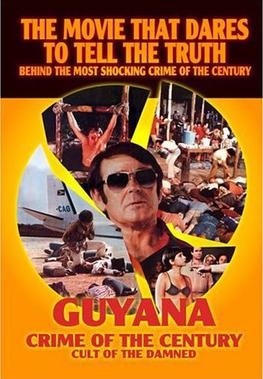
Guyana Tragedy is often described as being the definitive film about Jim Jones. However, a full year before Guyana Tragedy aired, the Mexican director, Rene Cardona Jr., was in theaters with his own version of the Jim Jones story. To anyone who is familiar with Cardona’s style of filmmaking, it’s perhaps not surprising that 1979’s Guyana: Crime of the Century did not win any awards.
Cardona’s film opens with a rather odd title card, explaining that, though the film is based on Jonestown, the names of certain characters “have been changed to protect the innocent.” But if you’re going to start the film by announcing that it’s about the biggest news story of the past year, what’s the point of changing anyone’s name? And for that matter, why is Jim Jones renamed James Johnson and his colony rechristened Johnsontown? Jones was hardly one of the innocents, not to mention that he was dead and in no position to sue when the film came was released. Why is Leo Ryan renamed Lee O’Brien, especially when the film portrays Ryan as being the type of hard-working and honest congressman that anyone would be happy to vote for?
The film opens with Rev. James “Johnson” (played by Stuart Whitman) giving a lengthy sermon about how it’s time for the congregation to move to Guyana, which he describes as being a Socialist paradise. Oddly, in the film, the People’s Temple is portrayed being largely white and upper middle class whereas, in reality, the opposite was true. Indeed, Jones specialized in exploiting communities that were largely marginalized by American society. One reason why Jones’s claim of government persecution was accepted by the members of his church is because the People’s Temple was made up of people who had very legitimate reasons for distrusting the American government.
A few scenes later, Johnson is ruling over “Johnsonville.” Since this is a Cardona film, the viewers are shown several scenes of people being tortured for displeasing Johnson. A child is covered in snakes. Another is shocked with electricity. A teenage boy and girl are forced to kneel naked in front of Johnson as he announce that their punishment for trying to run away is that they will be forced to have sex with someone of Johnson’s choosing. Once the torture and the nudity is out of the way, the film gets around to Congressman O’Brien (Gene Barry) traveling to the Johnsontown. Since the audience already knows what’s going to happen, the film becomes a rather icky game of waiting for O’Brien to announce that he’s ready to go back to the landing strip.
Because the film has been released under several different titles and with several different running times, Guyana: Crime of theCentury has gotten a reputation for being one of those films that was supposedly cut up by the censors. I’ve seen the original, uncut 108-minute version of Guyana and I can tell you that there’s nothing particularly shocking about it. Instead, it’s a painfully slow film that doesn’t really offer much insight into how Jim Jones led over 900 people to their deaths. While Gene Barry make for a convincing congressman, Stuart Whitman gives a stiff performance as the Reverend Johnson. There’s very little of the charisma that one would expect from a successful cult leader. One gets the feeling that Whitman largely made the film for the paycheck.
Of course, Whitman was hardly alone in that regard The film features a host of otherwise respectable actors, including Yvonne DeCarlo, Joseph Cotten, John Ireland, Robert DoQui, and Bradford Dillman. As well, Cardona regular Hugo Stiglitz appears as a photographer. (Stiglitz is perhaps best known for starring in Nightmare Cityand for lending his name to a character in Tarantino’s Inglourious Basterds.) Of the large cast, I appreciated the performances of Cotten and Ireland, who play Johnson’s amoral but well-connected attorneys. (The characters are based on the Temple’s real-life attornes, Charles Garry and Mark Lane. Lane also wrote the first JFK conspiracy book, Rush to Judgment.) I also liked Yvonne DeCarlo’s performance as the most devoted of Johnson’s followers. Even Bradford Dillman’s natural blandness was used to good effect as his character comes to represent the banality of evil when it comes time for him to start administering the Flavor-Aid. But those good performances still can not overcome the film’s slow pace and the fact that the film didn’t bring any new insight to the tragedy.
The film sticks fairly close to what is believed to have actually happened at Jonestown but, in the end, it barely even works as an example of shameless grindhouse filmmaking. It’s not even offensive enough to be enjoyable on a subversive level. Instead, it was just a quick attempt to make some money off of the crime of the century.
Robocop 2, the 1990 sequel to Robocop, finds Detroit on the verge of getting nuked.
No, not nuked like that! Instead, there’s a new designer drug called Nuke and it’s tearing the city apart. Of course, Detroit has problems that go beyond just the new drug. The city is almost bankrupt. OCP, under the leadership of The Old Man (Dan O’Herlihy), is still running things behind the scenes. There’s still all sorts of petty crime to deal with. To be honest, it seems like the city has gotten even more out-of-control now that Clarence Boddiker is no longer around to oversee things.
Fortunately, Robocop (Peter Weller) is still patrolling the streets! But, for how long? There are lawyers who claim that Robocop is a huge potential liability and when you consider some of the stuff that went on during the first film, it’s hard not to see their point. His ex-wife is also suing the police department, claiming that Robocop has been harassing her. Despite being a robocop, our hero is still Murphy and he’s still haunted by memories of the family he once had. Or, at least, he is for the first few minutes of the film. That storyline kind of gets abandoned, along with a lot of other storylines.
While OCP is trying to develop a second robocop, one that can be mass produced and used to replace the human police force (the majority of whom have gone out on strike), a cult leader named Cain (Tom Noonan) is attempting to take over the city’s Nuke trade. Working with Cain is the usual gang of flamboyant malcontents. His second-in-command is a sociopathic child named Hob (Gabriel Damon). Hob may be a kid but he’ll kill anyone and he’ll enjoy himself while he’s doing it.
Robocop 2 is a bit of a mess. It apparently was rushed into production after the surprise success of the first film and filming started before there was even a completed script. As a result, there are a lot of storylines and themes that are brought up and then seem to mysteriously disappear. The film duplicates Paul Verhoeven’s satirical approach to the first film’s ultra-violence but, unfortunately, it does so in the most superficial way possible. Once again, we get the cheerful and vapid news reports about impending doom and once again, the violence is completely and totally over-the-top. But none of it carries any of the bite that was present in the first film. The first film worked because director Verhoeven actually was trying to make a larger point with all of the violence and the hints of growing fascism. He was attempting to challenge the audience and to get them wonder why they found all of the terrible thing happening in Robocop to be so entertaining. The sequel was directed by Hollywood veteran Irvin Kershner who was a good, workmanlike director but who also didn’t possess Verhoeven’s subversive sensibility. Far too often, Robocop 2 just feels like it’s going through the motions.
That’s not say that Robocop 2 isn’t occasionally an effective film. Dan O’Herlihy is wonderfully amoral as the Old Man and Tom Noonan is a worthwhile villain. Though Peter Weller has said that he wasn’t happy with how the overall film turned out, he still make for a sympathetic hero and he still manages to capture Robocop’s anguish without letting us forget that the character is still essentially a machine. I’m not really a big fan of films that use evil children for cheap shocks but Gabriel Damon is frequently chilling as Hob. Detroit is such a terrible place in the Robocop films that it’s not really a surprise when an evil child pops up and start shooting people. When compared to the first film, Robocop 2 may be a disappointment but it’s hardly a disaster.
Last week, I watched the original Robocop (along with Robocop 2 and Robocop 3) and I have to say that the first film holds up far better than I was expecting. Made and released way back in 1987, Robocop may be one of the most prophetic films ever made.
Consider the plot:
America is torn apart by crime and a growing gap between the rich and the poor. That was probably true in 1987 and it’s certainly true in 2021.
Throughout the film, we see news reports about what’s happening in the world. The news is always grim but the reporters are always cheerful and the main message is that, no matter what’s happening, the government is not to blame and anyone who questions the wisdom of the establishment is a fool. If that’s not a perfect description of cable news and our current state-run media, I don’t know what is.
The populace is often too busy watching stupid game shows to really pay attention to what’s happening all around them. I’m writing these words on a Wednesday, which means that Game of Talents will be on Fox tonight, immediately after The Masked Singer.
Detroit, a once proud center of industry, has now turned into a dystopian Hellhole where no one feels that they’re safe. Now, I don’t live in Detroit so I don’t know how true that is but I do know that most of the recent news that I’ve heard about the city has not exactly been positive. Also, this seems like a good time to point out that, even though the film is set in Detroit, it was shot in Dallas. Though the Dallas skyline has undoubtedly changed a bit since 1987, I still recognized several buildings while watching Robocop. Seeing Reunion Tower in the background of a movie that’s supposed to be set in Detroit was interesting, though perhaps not as interesting as seeing our City Hall transformed into the headquarters of Detroit’s beleaguered police force.
OCP, a multi-national conglomerate that’s run by the amoral but occasionally charming Old Man (played by the brilliant Dan O’Herlihy), has a contract with city of Detroit to run their police department. This certainly doesn’t seem far-fetched in 2021. Considering that we now have prisons that are run by private companies and that the government has shown a willingness to work with private mercenaries overseas, it’s not a stretch to imagine a city — especially one on the verge of bankruptcy — handing over the police department to a private company.
Two OCP executives — Dick Jones (Ronny Cox) and Bob Morton (Miguel Ferrer) — are competing to see who can be the first to create and develop a peace-keeping robot, a machine that will replace the need to employ (and pay) human police officers. Dick Jones goes with an actual robot, which malfunctions during a boardroom demonstration and guns down another executive. (The scene where the poor exec is targeted is both terrifying and darkly humorous at the same time. Particularly disturbing is how everyone in the boardroom keeps shoving him back towards the robot in order to ensure that they won’t accidentally be in the line of fire.) Bob Morton, however, takes a mortally wounded cop named Murphy (Peter Weller) and turns him into Robocop!
Robocop turns out to be a huge success and is very popular with the media. (Anyone who doubts this would really happen has obviously never watched news coverage of a drone attack.) As you can guess, Dick is not particularly happy about getting shown up by Morton and his robocop. Dick also happens to be secretly in league with Clarence Boddicker (Kurtwood Smith), the crimelord who blew Murphy apart in the first place.
(A gangster and a businessman working together!? I doubt that was shocking even in 1987.)
Robocop claims that he’s just a machine, without a past or emotions, but he’s still haunted by random flashes of his life as Murphy. Working with Lewis (Nancy Allen), Murphy’s former partner, Robocop tracks down Boddicker and his gang. A lot of people die in outrageously violent ways. (The scene where Boddicker and his gang use a shotgun to torture Murphy is still shocking, even after all these years.) The violence is so over-the-top that it soon becomes obvious that director Paul Verhoeven is deliberately trying to get those of us watching to ask ourselves why we find films like this to be so entertaining. On the one hand, Robocop is an exciting action film with a sense of humor. On the other hand, it’s the type of subversive satire of pop and trash culture to which Verhoeven would return with Basic Instinct, Starship Troopers, and Showgirls. This is the type of film that asks the audience, “What are you doing here?”
34 years after it was first made, Robocop remains a triumph. Peter Weller’s performance holds up well, as he does a great job of capturing Robocop’s anguish while, at the same time, never forgetting that the character is ultimately a machine, one that’s trapped in a sort of permanent limbo. I also really liked the performance of Miguel Ferrer, who takes a character who should be unlikable and instead makes him into a surprisingly sympathetic figure.
Of course, a film like this lives and dies on the strength of its villains and both Ronny Cox and Kurtwood Smith are ideally cast as Dick Jones and Clarence Boddicker. Kurtwood Smith especially took me by surprise by how believably evil and frightening he was. As a I watched the film, I realized that it was his glasses that made him so intimidating. Wearing his glasses, he looked like some sort of rogue poet, a sociopathic intellectual who had chosen to use his talents to specifically make the world into a terrible place. Boddicker’s crew was full of familiar actors like Paul McCrane, Ray Wise, and, as the always laughing Joe Cox, Jesse Goins. Interestingly enough, all of the bad guys seemed to genuinely be friends. Even though they were all willing to betray each other (“Can you fly Bobby?”), they also seemed to really enjoy each other’s company. That somehow made them even more disturbing than a group of bad guys who were only in it for the money. The villains in Robocop really do seem to savor the chance to show off just how evil they can be.
(Incidentally, for all of the Twin Peaks fans out there, this film features three members of the show’s ensemble: Miguel Ferrer, Ray Wise, and Dan O’Herlihy.)
Robocop holds up well as entertainment, prophecy, and satire. Though not much was expected from it when it was first released, it became a surprise hit at the box office. Needless to say, this led to a sequel. I’ll deal with that film in about an hour.
Last night, as I was watching the 1988 film, Miracle Mile, I found myself thinking about the fact that this film literally could not be made today.
No, it’s not because the film itself is about the treat of nuclear war. Though nuclear war may no longer be as much of a cultural obsession as it apparently was back in the 80s, the fact of the matter is that the U.S., Russia, the UK, France, and China all still have nuclear weapons. Pakistan, India, and North Korea all claim to have nuclear weapons. It’s believed that Israel also has a few. Iran is apparently working on developing an arsenal. It’s estimated that there are currently 13,865 nuclear weapons in existence, 90% of which are divided between the U.S. and Russia. That’s not even counting the threat of a terrorist group setting off a nuclear device. In short, the threat of nuclear war is still very much a real one.
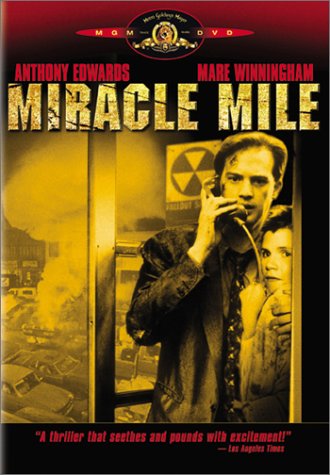
Instead, what truly makes Miracle Mile stand out as a film of its time, is the fact that almost the entire plot revolves around the character of Harry (played by Anthony Edwards) answering a Los Angeles pay phone at four in the morning.
Why is Harry answering a pay phone at 4 in the morning? It’s because, earlier, he met Julie (Mare Winningham) at the La Brea Tar Pits and they fell instantly in love. After spending most of the afternoon together, they made a date to meet at the local diner where Julie worked as a waitress. Julie’s shift ended at midnight. Harry went home to get a quick nap before picking her up. Unfortunately, a power failure — one that was largely caused by Harry carelessly tossing away a cigarette — resulted in Harry’s alarm not going off. At midnight, while Julie was standing outside the diner, Harry was asleep.
Harry doesn’t wake up until well-past 3 a.m. After hastily getting dressed, Harry drives down to the diner. When he arrives, he bumps into a tree and three rats fall off the branches and land on his car, which is a bit of an ominous omen. (After watching the movie, I did a Google search and discovered that it’s actually not uncommon for rats to hang out in palm trees after dark. I had no idea. I’m glad I don’t live near any palm trees.)
By the time Harry arrives, Julie’s already gone. From the payphone outside the diner, Harry calls Julie and leaves an apologetic message on her answering machine. (Julie sleeps through it.) Within minutes of Harry hanging up, the pay phone rings again. Harry answers it, expecting to speak to Julie. Instead, he finds himself talking to a panicked soldier who was trying to call his father but who dialed the wrong area code. The soldier says that a war is about to break out and that everyone is going to die. Suddenly, Harry hears what sounds like a gunshot. Another voice gets on the phone and tells Harry to go back to sleep and forget about the call.
Of course, the reason why this story couldn’t take place in 2020 is pretty obvious to see. No one uses pay phones anymore. If the movie were made today. Harry would have just Julie on his own phone and then waited for her to call him back. The soldier would never have misdialed his father’s area code. Harry never would have gotten the message that the world was about to end and most of the subsequent events in Miracle Mile never would have happened. Harry would have just sat in the diner and had a cup of coffee and waited for Julie to call until the inevitable happened. In 2020, that would have been the movie.
So, let’s be happy that this film was made in 1988. during the time when pay phones were everywhere, because Miracle Mile is an excellent film. Miracle Mile starts out as a romantic comedy, with Anthony Edwards and Mare Winningham making for an incredibly adorable couple. Then, after Harry answers that pay phone, the movie grows increasingly grim as Harry desperately tries to make his way to Julie and arrange for the two of them to board a plane that a mysterious woman (Denise Crosby) has charted for Antarctica. The problem, of course, is that in order to reach Julie, Harry is going to need the help of the type of people who are typically up and wandering around at 4 in the morning in Los Angeles. Several people die as Harry tries to make it to Julie and, smartly, the film doesn’t just shrug off their deaths. For the majority of the film, Harry isn’t even sure if there’s actually going to be an attack and it’s possible that he’s not only panicking over nothing but that he’s causing others to panic as well. People are dying because of that phone call and Harry doesn’t even know whether it was real or not. Even when full scale rioting breaks out, Harry doesn’t know if it’s because the world’s ending or because of a bad joke that he took seriously. Transitioning from romantic comedy to dark comedy, Miracle Mile eventually becomes a nightmare as it becomes obvious that, even if Harry does reach Julie, escaping the city is not going to be easy. The sun is rising and the truth is about that phone call is about to revealed….
Miracle Mile is a film that will get your heart racing. On the one hand, Anthony Edwards and Mare Winningham have such a wonderful chemistry and they’re both just so damn likable that you want them to find each other and stay together. Even if it means running the risk of being incinerated in a nuclear explosion, you want Harry and Julie to be with each other. At the same time, you watch the movie with the knowledge that, even if they do manage to reunite, it might not matter because the world’s going to end. Remarkably, almost everyone who Harry talks to about the phone call believes him when he says that a war is about break out. Almost all of them have a plan to escape and, as a viewer, you get so wrapped up in the film that it’s only later that you realize that none of their plans made any sense. Hiding out in Antarctica? How exactly is that going to work? Antarctica’s not exactly a place to which you impulsively move. If there is truly no way to escape the inevitable, perhaps we should just be happy that Julie and Harry found love, even if it was right before the apocalypse.
It may seem odd to describe Coffy as being a love story.
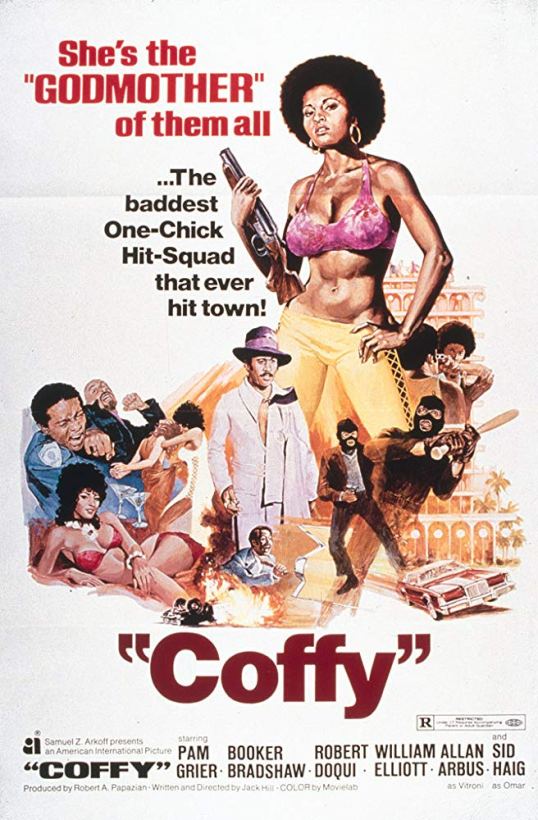
After all, this is a film that is perhaps best known for a scene in which Pam Grier (as Nurse Coffin, a.k.a. Coffy) shoots her lying boyfriend in the balls. Coffy is often described as being the epitome of 70s grindhouse, a film in which Pam Grier takes on drug dealers, the Mafia, and a corrupt political establishment with a combination of shotguns and shanks. Coffy is perhaps Grier’s best-known films and it features one of her best performances. There’s nothing more empowering than watching Pam Grier take down some of the most corrupt, arrogant, and disgusting men to ever appear in a movie. It’s a violent and gritty film, one that opens with a drug dealer’s head literally exploding and never letting up afterwards. There are many different ways to describe Coffy but it’s rarely called a love story.
But here’s the thing. A film about love doesn’t necessarily have to center around romantic love. Coffy is about love but it’s not about any love that Coffy may have for her boyfriend, the duplicitous politician Howard Brunswick (Booker Bradshaw). Instead, the love at the center of this film is the love that Coffy has for her sister, who died from a heroin overdose. It’s her sister’s death that leads to Coffy first seeking revenge but that’s not the only love that motivates Coffy. There’s also the love that Coffy feels for her community. Throughout the film, we hear about how the black community is being destroyed by the drugs that are being pushed into their neighborhoods by white mafia dons like Arturo Vitronia (Allan Arbus, who was once married to the iconic photographer, Diane Arbus). It’s not a random thing that, for all of Coffy’s anger, she saves her most savage revenge for the members of her community who are working with the white mobsters, men like the pimp, King George (Robert DoQui), and her own boyfriend, Howard.
Throughout the film, Coffy says that she feels like she’s “in a dream” and Pam Grier gives an intelligent performance that suggests that, even after her mission is complete, Coffy will never be the same. She’s not a natural killer. She’s a nurse and it’s her job to save lives. But when she sets out to get revenge on those who killed her sister and who are destroying her community, Coffy shows no mercy. When she violently interrogates another victim of the drug trade, Coffy shows the junkie no sympathy because sympathy isn’t going to solve the problem. Coffy is determined and the reason why she succeeds is because none of her victims realize just how serious she is. Coffy uses her beauty to distract them and then, when they aren’t looking, she strikes. By the end of the film, she’s walking alone on the beach and the viewer is left to wonder what’s going on inside of her head. After all the people that Coffy has killed, can she ever go back to simply working the night shift at the ER? After you’ve seen life and death at its most extreme, can things ever go back to the way that they once were?
And listen, I’m generally a pacifist and I’m not a huge fan of real-life vigilante justice and I’ve signed many petitions against the death penalty but it’s impossible not to cheer for Coffy. Pam Grier gives such a committed performance that it’s impossible not to get sucked into her mission. (It helps, of course, that most of the people who she targets are legitimately terrible human beings.) The brilliance of Grier’s performance comes in the quiet moments. Yes, she’s convincing when she has to shoot a gun and she delivers vengeful one-liners with the best of them. But the film’s best moments are the ones were Grier thinks about how her life has become a dream of violent retribution and where she allows us to see the love for her sister and her community, the same love that is motivating all of the bloodshed.
Coffy is a rightfully celebrated film. For once, a cult film actually deserves its cult. It’s one of the best of the old grindhouse films and, in fact, to call it merely an exploitation film actually does a disservice to how effective a film Coffy actually is. It’s just a great film period.
Tonight’s episode of Kolchak: The Night Stalker is a fun one!
In this episode, Kolchak investigates a series of mysterious deaths that seem to involve one very ambitious politician (played by Tom Skerritt). Kolchak’s investigation leads him to believe that not only has the politician made a deal with the devil but that the politician also has the ability to transform himself into a killer dog!
Agck!
That’s Chicago-style politics for you, I guess.
This episode originally aired on November 15th, 1974.
Everyone’s favorite hippie action hero, Peter Fonda, plays Virelli, a long-haired Vietnam vet turned mercenary who is hired by a corrupt African general (Robert Doqui) to protect the construction of a dam that will result in the flooding of a native village. Got all that? Though Fonda is top-billed, he is not the star of the film. The star is Reb Brown, who plays T.J. Christian. T.J. starts out as a member of Fonda’s team but then he falls in love with a nurse (Joanna Weinberg) and he switches sides. The villagers need someone to lead their revolution and all it takes is hearing Reb Brown do one of his trademarks power yells to know that he’s the man for the job. Reb Brown was famous for yelling whenever he did anything and he yells a lot in Mercenary Fighters, even more than he yelled in Space Mutiny.
Mercenary Fighters is a typical Cannon film from the late 80s. Like many of Cannon’s mercenary movies, it was covertly filmed in South Africa, at a time when apartheid was still being enforced and Nelson Mandela was still sitting in a prison cell. (Cannon was not the only film company to secretly make movies in South Africa during the Apartheid Era. They were just the most blatant about it.) Richard Kiel apparently turned down Peter Fonda’s role. It’s hard to imagine Kiel in the role but perhaps that’s because Virelli is a quintessential Peter Fonda-in-the-80s role. Fonda glides through the film, delivering his lines like a California surfer who just smoked the kine bud. The presence of Ron “Superfly” O’Neal and James “son of Robert” Mitchum serves to elevate the film’s cool factor while Robert Doqui brings some “I’ve worked with both Robert Altman and Paul Verhoeven” credibility to his one-note role. Mercenary Fighters is good for anyone who is into either mindless Cannon action movies or Reb Brown yelling while shit blows up behind him.
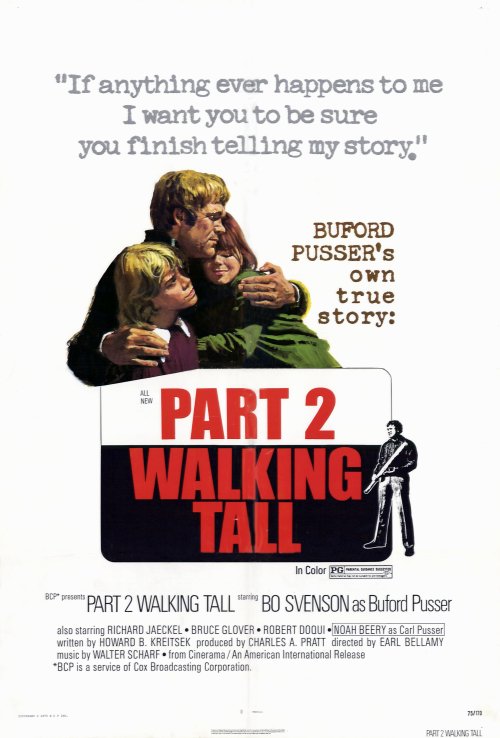
The 1975 southern melodrama Walking Tall Part 2 opens with a voice over telling us that we’re about to see more of the true of story Sheriff Buford Pusser, the Tennessee lawman who carried a big stick, battled the Dixie Mafia, and whose wife was killed in an ambush. Pusser, we learn, died under suspicious circumstances shortly after the release of the film Walking Tall.
Mere hours before he died, Pusser had signed a contract to play himself in Walking Tall Part 2. As a result of Pusser’s car “accident,” the film’s producers were forced to cast an actor as the lawman. Now, it would have made sense to, once again, give the role to Joe Don Baker. After all, he played the role in Walking Tall and I imagine that to most audiences at that time, he was Buford Pusser. However, for whatever reason, Baker was not given the role for a second time. Instead, the role was given to Bo Svenson and, while Svenson does not necessarily do a bad job in the role, he’s still no Joe Don Baker. The difference between Baker and Svenson is the difference between someone being a redneck and someone just pretending.
The film opens almost immediately where Walking Tall ended. Terribly wounded in the ambush that took his wife’s life, Buford is in the hospital and his face is covered in bandages. Townspeople gather outside both his room and his farm and they wonder whether he’ll run for reelection as sheriff. Someone else mentions that Buford has had massive facial reconstructive surgery.
Finally, the bandages are removed and we discover that Buford has turned into Bo Svenson. Now, Svenson and Baker do have enough facial similarities that you can force yourself to believe that surgery could lead to Baker having Svenson’s features. I mean, this isn’t like Mark Ruffalo taking over the role of Bruce Banner from Edward Norton. At the same time, it’s hard not to wonder how reconstructive surgery could have led to Buford Pusser becoming a blonde or, for that matter, apparently growing by 5 inches between Walking Tall and Walking Tall Part 2.
Anyway, Buford’s out of the hospital and, of course, he’s reelected as sheriff. One thing that quickly becomes apparent is that everyone in the world totally loves Buford Pusser. I lost track of how many characters specifically walked up to Buford to tell him that he was a great man and a great sheriff. Nobody complains about Buford’s habit of ignoring civil liberties while enforcing the law. Instead, everyone cheers for him.
(And, just in case the viewer is uncomfortable with the sight of the very white Buford taunting the mostly black moonshiners that he spends the film arresting, Buford’s black deputy constantly says stuff like, “Buford, you’re my kind of sheriff!”)
The only people who don’t like Buford are the local crime lords. They still want Buford dead so they hire a race car driver (Richard Jaeckel) to kill him. The race car driver’s girlfriend (Angel Tompkins) attempts to hit on Buford but Buford has no interest in her. Buford’s about enforcing the law and avenging his wife…
Walking Tall Part 2 is a pretty standard film. Whereas the original Walking Tall had a raw and unpredictable vibe to it, the sequel is predictable and boring. On the plus side, the film was made on location in rural Tennesee and some of the countryside is nice to look at.
As for Buford Pusser, he died before Part Two was released but the character would return in Walking Tall — The Final Chapter.



 Everyone’s favorite hippie action hero, Peter Fonda, plays Virelli, a long-haired Vietnam vet turned mercenary who is hired by a corrupt African general (Robert Doqui) to protect the construction of a dam that will result in the flooding of a native village. Got all that? Though Fonda is top-billed, he is not the star of the film. The star is Reb Brown, who plays T.J. Christian. T.J. starts out as a member of Fonda’s team but then he falls in love with a nurse (Joanna Weinberg) and he switches sides. The villagers need someone to lead their revolution and all it takes is hearing Reb Brown do one of his trademarks power yells to know that he’s the man for the job. Reb Brown was famous for yelling whenever he did anything and he yells a lot in Mercenary Fighters, even more than he yelled in Space Mutiny.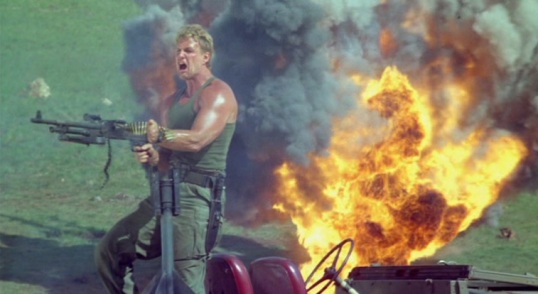
 Through the Shattered Lens